To import kids’ clothing into Canada, you need a suitable supplier, the right business setup, products and labels that meet Canadian requirements, and a plan for customs and delivery. Start organizing these details before committing to bulk production so you can resolve questions while the order can still be changed.
This guide takes you through nine steps, from finding wholesale kidswear suppliers to checking the boxes at your warehouse. Along the way, you’ll find an inquiry template, a budget worksheet, and practical checks to help you decide when you’re ready to move forward.
Step 1: Plan Your First Kidswear Order
Start with a collection you can describe clearly. Buying ready-made clothing for resale is different from asking a manufacturer to develop garments with your own fit, fabrics, and labels. That choice affects who you contact, what samples you need, and how much development work you should budget for.
Before searching for suppliers, write down:
- The products you want, such as everyday hoodies, dresses, or winter jackets, and whether they are ready-made or custom.
- The intended age group and size range, with reference images or measurements where available.
- Your proposed quantity by style and color, plus an initial size breakdown.
- Your spending limit, including money for samples, shipping, and import costs.
- Where you will sell in Canada and when the goods need to arrive.
For an illustrative first order, imagine a small range of everyday hoodies in two colors. Our bulk kids’ hoodie buying guide shows how to plan that order across colors and sizes. Adding another color creates another set of size quantities to manage, so check whether demand and budget support each option before expanding the range. This is a planning example, not a recommended order size.
A smaller, clearly defined collection is easier to compare and approve than a long list of loosely specified products. Your initial quantity is a proposal; the supplier still needs to confirm whether it fits its production or wholesale terms.
Step 2: Find Kidswear Suppliers for the Canadian Market
You can source children’s clothing through manufacturers, B2B platforms, wholesale brands, or trade shows. These routes overlap: a factory might have its own website, sell through a platform, and exhibit at a trade fair. Choose the purchasing model first, then use the channel to find suitable suppliers. If you’re also considering local production, our guide to children’s clothing manufacturers in Canada provides starting points for your shortlist. Confirm where each supplier will make your order before comparing it with overseas options.
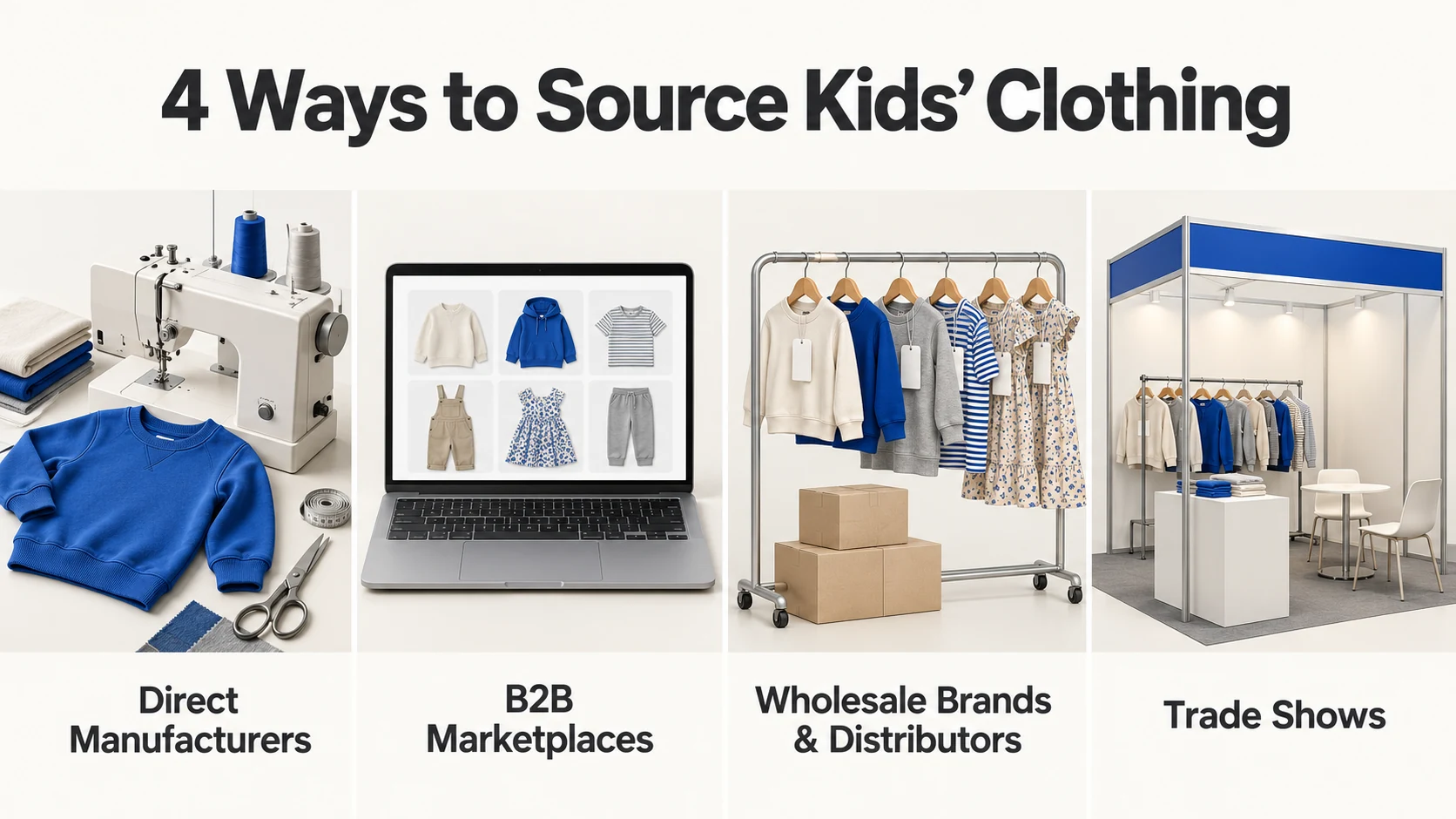
Buy Directly From Manufacturers
Contacting a manufacturer makes sense when you want your own designs, measurements, materials, or branding. Send your product brief and ask which parts require custom development. At HAPA, our kidswear manufacturing services cover fabric selection, sampling, and bulk production, with sketches, reference images, or existing samples as possible starting points.
Discuss your Canadian target market at the beginning. A manufacturer needs to understand the intended product and customer before you agree on materials or construction. Ask about sampling, minimum quantities, and the documents available for your particular order. Don’t assume a general export service includes Canadian customs brokerage or product-specific testing.
Search B2B Sourcing Platforms
Alibaba.com and Made-in-China.com both have children’s clothing supplier directories. Search for the actual product, such as cotton kids’ hoodies or girls’ woven dresses, rather than relying on a broad “clothing supplier” search. Then send the same brief to your shortlisted companies.
Check whether each business is a manufacturer, trading company, or wholesaler. If you’re comparing Chinese suppliers, our guide to buying bulk kids’ clothing from China explains the sourcing routes and supplier checks in more detail. A platform badge is useful context, but it doesn’t establish that the garment you order meets Canadian requirements. You still need to review the company, samples, specifications, and relevant documents.
Contact Wholesale Brands and Distributors
For an existing retail store, buying finished collections may suit your needs better than developing new styles. Brand wholesale websites, distributors, and the Faire Canada kids’ apparel marketplace provide starting points. Confirm available sizes, reorder options, sales restrictions, and the actual shipping location before comparing offers.
Buying stock already imported and held in Canada is different from importing directly from an overseas seller. Clarify which situation applies. Also, purchasing another brand’s products for resale doesn’t automatically give you permission to remove its labels and replace them with your own.
Meet Suppliers at Trade Shows
Trade shows let you examine fabrics and construction while discussing your brief. For example, the Canton Fair lists Kids’ Wear among its Phase 3 categories. Check the current exhibitor list and schedule before arranging a visit, then prepare questions around your own collection.
Keep notes and photographs of the specific samples discussed, with the supplier’s permission. After the show, request written terms and an order-specific sample. A good display garment helps you decide whom to investigate; it doesn’t prove that a future production batch will match it.
Step 3: Compare Children’s Clothing Suppliers and Quotes
Check Who You Are Buying From
Confirm the legal company name, business address, contact details, and role in the order. Ask who develops the sample, who produces the goods, and which business will appear on the invoice. Request examples of similar products rather than assuming that experience with adult T-shirts transfers to babywear or children’s outerwear.
Keep a short record for each candidate: what it can supply, what you have checked, and what remains unanswered. Use the comparison criteria in our guide to choosing a kids’ clothing manufacturer to assess the same details for every candidate. A supplier that cannot explain its product specifications or keeps changing the proposed materials needs further investigation before payment. Prior exports to Canada are worth discussing, but they aren’t proof that your new style is suitable for sale there.
Send a Clear First Inquiry
MOQ means minimum order quantity. Ask whether it applies to the entire order, each style, each color, or a particular fabric. Then check how sizes can be divided within that quantity. This matters when buying wholesale children’s clothing because an attractive total order size may leave you with an unsuitable size mix.
You can adapt this first-contact message:
Hello, we are a Canadian kidswear brand sourcing [product] for [age group]. We are interested in [ready-made products/custom development] and expect to order approximately [quantity], across [colors and sizes]. Reference images are attached.
Please confirm your minimum quantities, sample options and fees, proposed fabric, and production timing. Please quote in [currency] and explain what the price includes, including labels, packaging, and any delivery charges.
We plan to sell in [Canadian provinces] and need delivery to [city/postal code] by [date]. What product information and relevant test documents can you provide? Please identify any development or testing that would need a separate quote.
Compare the Same Product Details
Place the replies side by side before choosing a sample supplier. Compare fabric composition, garment measurements, quantity, branding, packaging, sample charges, and the delivery point covered by the quote. A lower price for a different fabric or an unbranded garment isn’t a cheaper offer for the same product.
Ask when the quoted production period starts. It might depend on sample approval, materials being available, or an agreed payment. If something is unclear, resolve it in writing and update the quote. Keep that version for the budget calculation rather than working from scattered messages.
Step 4: Understand Canada’s Kidswear Import Requirements
Begin these checks while you compare suppliers. Don’t approve bulk production before resolving the requirements that could change the garment or its labels. Account registration can run alongside sampling, but it needs to be ready for your import arrangements.
Set Up Your Import Account
The Canada Border Services Agency, or CBSA, administers customs. Its CARM portal is the system used to manage commercial import accounts and related duties and taxes. If your Canadian business will import commercial goods, follow the CBSA’s current registration instructions to obtain or confirm your business number and import-export program account, called an RM account. Most new resident commercial importers can obtain a business number through CARM; other cases follow different instructions.
If you plan to use a customs broker, contact one early and confirm the authorization needed. A broker can assist with customs work, but you should understand who is responsible for the declarations and payments. You don’t need to master every portal function before contacting a supplier; you do need to avoid discovering an account problem when goods are ready to leave.
Check the Rules for Your Products
Canada’s rules depend on the actual garment. Share its intended use, age range, materials, trims, and design with a testing laboratory or qualified product-compliance adviser. Ask which Canadian requirements apply, what evidence is needed, and whether the proposed sample is suitable for testing. An unrelated report or a certificate bearing a familiar logo isn’t enough to answer those questions.
Pay particular attention to these categories:
- Everyday clothing needs a review of applicable textile flammability and general product safety requirements. Health Canada’s textile flammability guide is a starting point.
- Children’s sleepwear has specific requirements, including distinctions between tight-fitting and loose-fitting designs. Check the children’s sleepwear guidelines before selecting fabrics and finalizing the fit.
- Upper outerwear, including relevant hoodies and jackets, needs particular attention to drawstrings. Review Health Canada’s drawstring safety assessment against the actual design and size range.
Approve the Labels Before Production
Canadian textile labeling requirements cover fiber content and dealer identification. For nationwide sales, prepare the required fiber information in English and French; the federal rules include limited language exceptions. Dealer identification can use the business name and postal address, or an eligible Canadian dealer’s CA identification number. A CA number is a labeling option, not an import license. Review the Competition Bureau’s textile labeling guide for the details, including label attachment and durability.
Check country-of-origin marking separately with your customs adviser. Care instructions also need separate consideration; they aren’t universally mandatory under the federal textile labeling rules. If you sell in Quebec, review the additional French-language product requirements. Ask your supplier for the actual label artwork and placement, then approve the version that will go into production. A note saying “Canadian labels included” leaves too much undefined.
Step 5: Budget for Importing Children’s Clothing into Canada
Add Up More Than the Product Price
Build your budget around the amount needed to get the goods to your chosen Canadian address. This is often called the landed cost, although quotes may include different items under that label. Ask what is included each time, and keep one-time development expenses visible. Fill in the following worksheet with actual quotations rather than comparing garment prices alone.
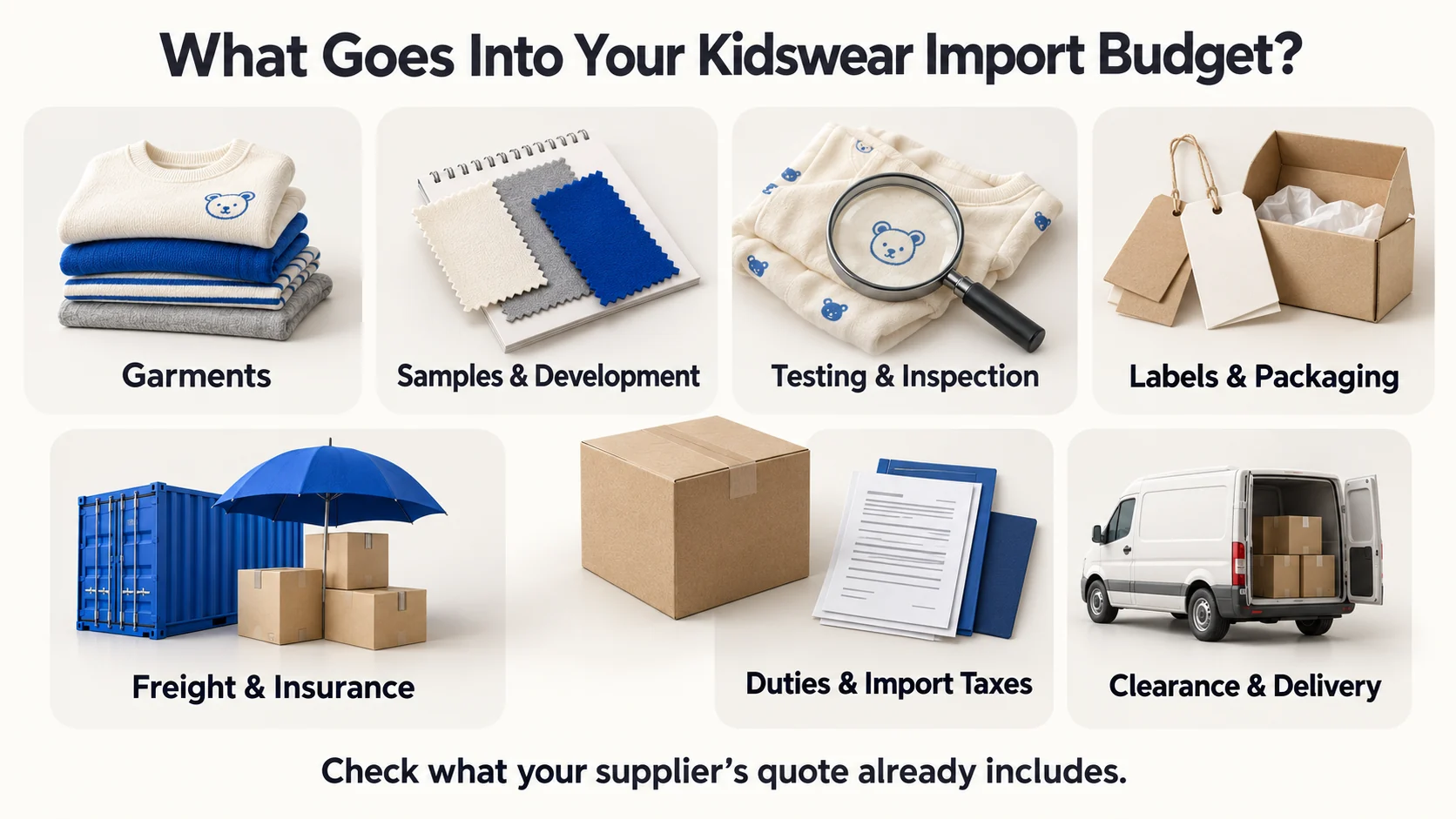
| Budget Item | What to Confirm | Where to Get the Estimate |
|---|---|---|
| Garments | Quantity, unit price, currency, and included customization | Supplier |
| Development and samples | Sample fees, revisions, sample shipping, and any agreed credits | Supplier |
| Testing and inspection | Product-specific scope and who pays | Laboratory or inspection provider |
| Labels and packaging | Included items and separately charged options | Supplier |
| Freight and insurance | Pickup point, destination, shipment dimensions, and coverage | Carrier or freight forwarder |
| Customs duty and import tax | Classification, origin, customs value, and applicable treatment | Customs broker or CBSA tools |
| Clearance and delivery | Brokerage, handling, storage risks, and final delivery | Broker and logistics provider |
Mark each item as included, separately quoted, or still unknown. For a first order, a blank cost line should trigger a question, not become zero in your spreadsheet. Check how the supplier’s minimum order quantity applies before multiplying the unit price by your planned quantity; minimums by style or color can change how much stock you need to buy. Also record when each payment is due: you may need to fund production well before you can earn revenue from the collection.
Ask for a Duty and Tax Estimate
An HS code is a customs classification code used to identify goods. Give your broker the garment description, fiber content, construction, intended wearer, and origin so it can assess the correct Canadian classification. There is no single duty rate for all kidswear. Origin and eligibility for preferential treatment matter too; shipping a garment from a country doesn’t automatically make it a product of that country. Use the CBSA duty and tax guidance rather than applying a percentage found on a general sourcing blog.
Imported goods are generally subject to GST or the federal part of HST unless a non-taxable importation rule applies. Eligible GST/HST registrants may claim an input tax credit when the conditions are met. Keep the cash needed at import separate from the eventual net business cost, and check your position against the CRA’s import tax guidance. Don’t assume a retail tax concession for children’s clothing removes all import charges.
Step 6: Approve Kidswear Samples Before Buying in Bulk
Check the Actual Product
Compare the sample with your written brief and measurements. Check fabric feel, stitching, closures, pocket placement, labels, and ease of dressing. For the illustrative hoodie order, measure both the body and the neck opening; an appealing silhouette doesn’t tell you whether the garment matches the intended fit. Record observations rather than approving it with a message that simply says “looks good.”
Discuss any wash check using the proposed care instructions and record before-and-after measurements. This can help you identify practical concerns, but a home wash check doesn’t replace required safety testing. For ready-made wholesale stock, ask whether the sample matches the actual style, material, and available batch you will receive. Don’t assume the seller offers custom changes.
Put Sample Approval in Writing
List the changes you need with photographs and measurements, then request confirmation or a revised sample. Once you approve it, identify the sample version and the matching specification sheet. Keep the fabric and color approvals for bulk production with that record so the supplier can see which material and shade you accepted. If the supplier later changes a fabric, trim, or label, review that change before production continues; earlier approvals and test evidence may no longer cover the revised product.
For brands developing their own collection, HAPA’s custom cut-and-sew service covers garment development and branding options. Your approval should identify the exact materials, fit, and finishing details agreed for the order. Keep the approved sample available for production checks, along with the written specifications. You’ll still need to check the finished order against both.
Step 7: Place Your First Wholesale Kidswear Order
Write Down the Order Details
A purchase order is your written record of what you intend to buy. Use it alongside the supplier’s confirmed quotation and any agreed contract terms. Include style references, materials, size and color quantities, approved sample details, labels, packaging, prices, currency, and the delivery arrangement. Keep these documents together so neither side has to reconstruct the agreement from a chat history.
Set out how shortages, defects, delays, and proposed substitutions will be handled. If a term matters to your launch, make it explicit before paying. For example, specify whether the promised date means production completion, dispatch, or arrival at your Canadian warehouse. Those dates serve different purposes and shouldn’t be used interchangeably. If this is your first order with the factory, consider a paid kidswear pilot order to assess how it handles production and delivery before committing to a larger run.
Confirm Payment and Production Checks
Agree on payment timing and the checks required before each relevant payment or shipment approval. There is no universal deposit percentage that makes every clothing order safe. Confirm the beneficiary details through a trusted contact, and independently verify any later request to change bank accounts. If you use a platform payment service, read its conditions and keep the agreed order details within the required process.
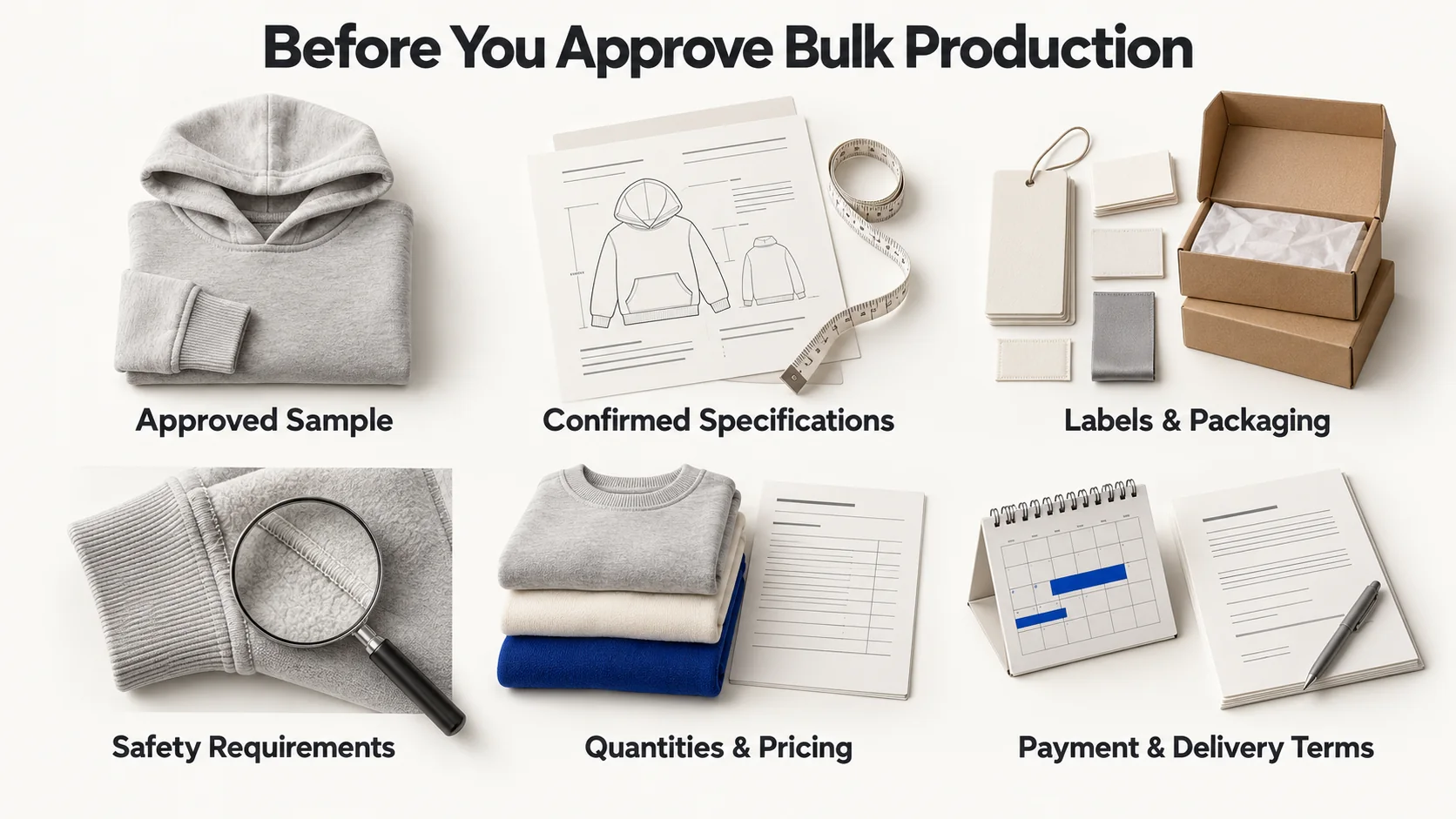
Before approving bulk production, check that:
- The final sample and specifications match the agreed product.
- The label artwork, packaging, and size breakdown are confirmed.
- Applicable safety questions and required testing arrangements are resolved.
- The price, payment milestones, delivery terms, and problem-resolution process are recorded.
- Both sides understand the production updates and pre-shipment checks you expect.
Step 8: Ship Kids’ Clothing to Canada and Clear Customs
Confirm the Shipping Plan
Discuss transport during budgeting, then confirm the booking once the order is ready. Courier service can suit samples and smaller consignments; air or sea freight may be worth comparing for larger orders. Ask for a shipment-specific quotation based on the packed dimensions, weight, origin, and delivery address. A low freight figure alone doesn’t tell you what the full journey will cost.
A freight forwarder arranges transport, while a customs broker handles agreed customs services; one business may offer both. Confirm pickup, insurance, customs work, destination handling, and final delivery in writing. If your clothing quote uses terms such as FOB or DDP, ask the provider to explain the named location and each party’s obligations. “Door-to-door” on its own is not a complete description of who pays or imports.
Prepare the Shipment Documents
Ask your broker or carrier to confirm the documents needed for your shipment, then review the supplier’s drafts before departure. Useful preparation includes:
| Document or Information | What It Helps Establish | Who Usually Provides It |
|---|---|---|
| Commercial invoice | Seller, buyer, detailed goods description, quantities, value, and transaction details | Supplier |
| Packing list | What is in each carton, with quantities and shipment weights | Supplier |
| Transport document | Shipment movement and identification, such as an air waybill or bill of lading | Carrier or forwarder |
| Origin information and applicable proof | Origin and support for any claimed preferential treatment | Supplier or other party permitted under the applicable rules |
| Product support file | Specifications, approved labels, and relevant safety evidence | Buyer, supplier, and laboratory as applicable |
The product support file is separate from the routine customs document set; not every report is automatically submitted with every shipment. Keep it accessible if authorities request information. Ensure the product descriptions and quantities agree across documents, and resolve errors before dispatch. Never ask a supplier to understate the value or describe commercial stock as a gift.
Follow the Shipment Through Customs
Your carrier reports the goods, and you or your authorized broker arrange the required customs release and accounting. Follow the CBSA’s shipping and reporting guidance with the parties handling your consignment. Respond promptly if they need a clearer description, corrected invoice, or supporting information. Build room into your launch plan for an examination or other delay instead of assuming arrival equals immediate delivery.
Confirm the duty and tax payment arrangement before shipment. The CBSA’s release guidance distinguishes payment before release from Release Prior to Payment, which has enrollment and security conditions. After release, confirm the final delivery appointment and obtain your customs and payment records. Hiring an agent doesn’t mean you can ignore the information submitted for your goods.
Step 9: Check Imported Kidswear Before Selling It
When the shipment arrives, keep the packing list and approved sample nearby. Check the delivered stock before mixing it with other inventory or dispatching customer orders. Customs release is not a product safety certification, and delivery doesn’t establish that the supplier met every agreed specification.
Work through the delivery in a consistent order:
- Count cartons and record visible damage before unpacking.
- Reconcile received styles, colors, sizes, and quantities with the packing list.
- Check garments and labels against the approved version, documenting discrepancies with photographs.
- Separate damaged, incorrect, or potentially unsafe stock while you investigate.
- Notify the supplier under the agreed claims process and keep the correspondence with the order file.
Store purchase, customs, supplier, and product records so you can trace goods back to their source. Health Canada requires relevant supply-chain records and reporting of qualifying safety incidents; its commercial consumer-product import guide links to the specific recordkeeping and incident-reporting instructions. Follow those timelines rather than treating a safety concern as an ordinary return. Confirm customs record-retention requirements with your broker as well.
Start Your First Canadian Kidswear Order With a Clear Plan
Importing children’s clothing into Canada becomes easier to manage when each decision has a written basis: a clear brief, comparable quotes, approved samples, confirmed labels, and an agreed delivery plan. Start with a collection you can fund and check properly, then use what you learn to plan future orders.
If you’re developing your own range, send HAPA your reference images, intended age group, proposed quantities, and launch schedule to discuss your kidswear project. Our team can discuss product development and sampling while you confirm the Canadian import arrangements for your business.
Frequently Asked Questions About Importing Kids’ Clothing
Can I Start Without a Tech Pack?
Yes, you can begin supplier discussions with reference images, a product description, size requirements, and a proposed quantity. Our guide to developing patterns from sketches without a tech pack explains what to prepare for that first conversation. A tech pack is the detailed product specification used to guide development and production. Before bulk manufacturing, agree who will prepare the necessary specifications and confirm whether that work has a separate charge. An initial reference image is useful, but it leaves too many details open for production approval.
How Many Pieces Should I Buy for My First Order?
Choose a quantity that fits your expected sales, size mix, available cash, and supplier’s minimums. There is no universal best number for a first kidswear import. If the minimum requires more stock than you can reasonably support, consider fewer styles or colors, another suitable supplier, or an existing wholesale collection rather than increasing the order only to meet a quoted threshold.
Can I Use a Supplier’s Existing Test Report?
Possibly, but first confirm that it addresses the applicable Canadian requirements and matches the product you will buy. Compare the tested materials, construction, trims, and other relevant details with your approved specification. Ask a qualified laboratory or adviser whether changes require further assessment. A recent report on a different garment isn’t necessarily more useful than an older report that accurately covers the product.
Does a Small Order Avoid Import Requirements?
A small order intended for resale is still a commercial purchase. Don’t assume that a low quantity removes product safety, labeling, or customs obligations. Procedures and charges can depend on the shipment and circumstances, so confirm the treatment with the carrier or broker before paying. Keep personal-use shopping advice separate from guidance for your brand’s inventory.
What If My Supplier Offers Door-to-Door Delivery?
Ask who will be named in the import arrangements, who pays duties and taxes, what documents you receive, and which destination fees are included. Also confirm how product questions or customs holds will be handled. A convenient delivery service can reduce coordination work, but its marketing description doesn’t establish your legal responsibilities or prove the garments are suitable for sale in Canada.
References & Sources
- CBSA: Guide to Importing Commercial Goods into Canada
- CBSA: Register for an Import-Export Program Account
- Competition Bureau: Guide to the Textile Labelling and Advertising Regulations
- Health Canada: Importing Consumer Products for Commercial Purposes
This guide provides general purchasing information, not legal or tax advice. Check current requirements for your products and business before placing an order. Use the official sources above as a starting point, then confirm the requirements for your specific garment and shipment.