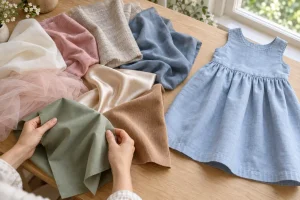
Yes. You should approve the fabric and the color before bulk production reaches any step that is expensive or impossible to reverse. For most custom clothing orders, that means approving a documented material specification, a physical color standard, and a representative garment sample before the factory buys the full material quantity or starts cutting. You should also require the factory to compare the actual bulk fabric with those approved standards before cutting begins.
A useful fabric and color approval is more than a message saying “looks good.” It identifies exactly what you reviewed, what it must match, which test results are required, what variation you will accept, and which later changes need your permission. This protects both sides. Your brand gets a clear basis for rejecting an unauthorized substitution, while the manufacturer gets a stable target instead of conflicting comments from several people.
The important distinction is that material development and bulk release are separate decisions. A small swatch can show direction. A lab dip can show a proposed shade. A pre-production sample can show how the material behaves in a garment. The bulk fabric inspection can show whether the delivered rolls are consistent enough to cut. One approval cannot automatically stand in for all the others.
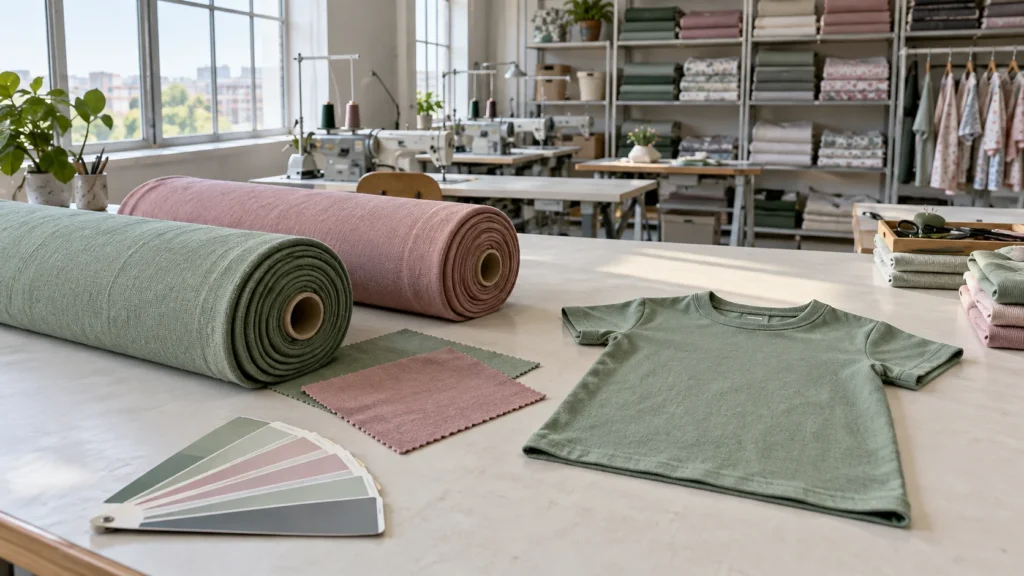
Physical fabric, color, and garment references prepared for approval.
Approve before the decision becomes expensive
Fabric is usually committed well before a finished order exists. The mill may have to knit or weave greige goods, dye a custom shade, apply a finish, print artwork, or reserve stock. Once that work starts, changing your mind may mean paying for unusable fabric, missing a launch window, or accepting a compromise you would have rejected earlier.
Your approval schedule should therefore follow the commercial risk. Approve the material direction before the factory places a noncancelable fabric order. Approve the final physical shade before custom dyeing moves forward. Approve the garment made in the intended material before the cutting room processes the full order. Then require a bulk-lot check before cutting, especially when color consistency or fabric performance is critical.
This staged fabric and color approval keeps each decision close to the evidence it needs.
This sequence is also why a rushed email should not function as a blanket authorization. “Proceed with production” can mean different things to a merchandiser, fabric buyer, mill, and sewing team. State the specific action you are releasing: book yarn, order stock fabric, dye bulk fabric, make the pre-production sample, or cut the approved rolls.
Decide who has authority to approve
Your own team needs one named approval owner. A founder may choose color while a technical designer approves construction and a compliance specialist reviews test evidence, but the factory should receive one consolidated decision. If several people issue separate instructions in chat, the latest comment may correct one detail while unintentionally reopening another.
Create a simple responsibility list for each style:
- Product owner: commercial direction, assortment, and final release
- Technical reviewer: material specification, fit, construction, and tolerances
- Brand reviewer: physical shade, print, embroidery, and visual finish
- Compliance reviewer: applicable test plan, labeling, and documentation
- Factory contact: version control and distribution of the approved standard
Small brands can assign several roles to one person. The point is not bureaucracy. It is to prevent a casual comment from being mistaken for final approval.
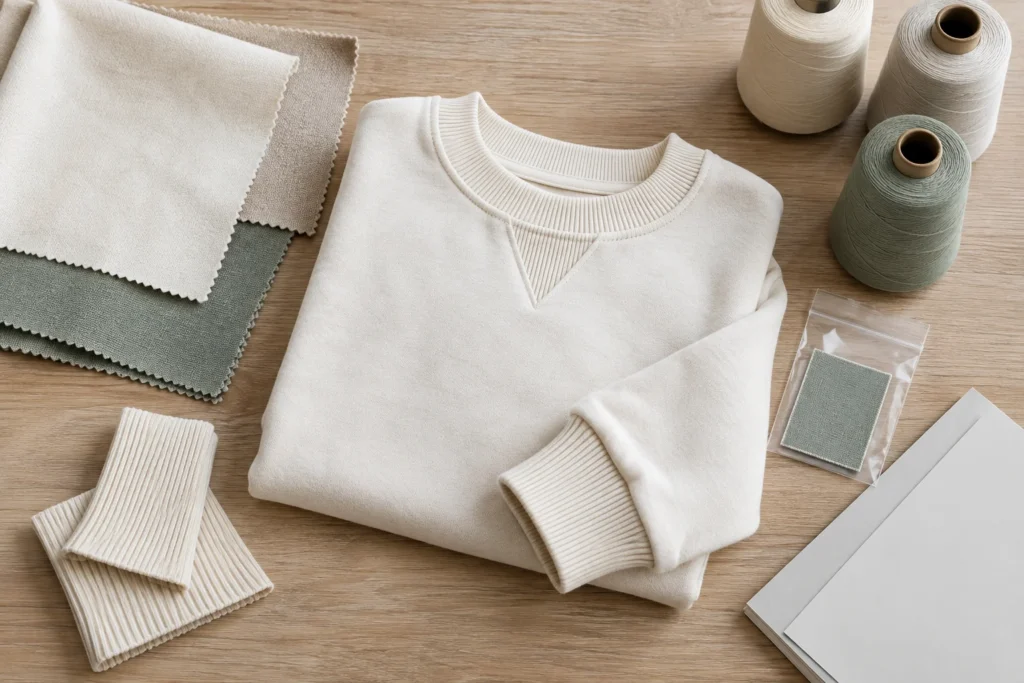
A garment, swatches, trims, and thread create separate approval references.
Separate four different approval decisions
Strong fabric and color approval treats four objects separately: the written fabric specification, the physical color standard, the garment sample, and the actual bulk material. They answer different questions.
Approve the fabric specification
The specification records what the material is meant to be. It should identify the supplier or mill when known, fabric code, fiber composition, knit or weave, yarn information where relevant, weight, usable width, finish, stretch direction, recovery, surface, and intended care method. It should also record tolerances rather than presenting every number as exact.
This written record supports costing, purchasing, testing, and quality control. It also makes substitutions visible. “Cotton jersey” is not a controlled specification: two cotton jerseys can have different weight, density, yarn quality, shrinkage, spirality, opacity, hand feel, recovery, and print performance.
Approve a physical color standard
Color needs a physical reference. A color-system code is useful for communication, but the code alone does not prove that dyed fabric looks right in the selected fiber, construction, and finish. A digital image is even less reliable because screens, cameras, compression, white balance, and ambient light alter appearance.
For a custom solid shade, the physical standard is often an approved lab dip attached to a dated approval card. For a print, it may be an approved strike-off that controls ground color, artwork colors, scale, registration, and print hand. For a stock material, it may be a cut swatch from the actual available lot.
Approve the garment made in the intended material
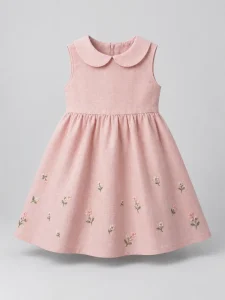
A flat swatch cannot show the complete product. The same fabric may drape differently after it is cut, stretch at a neckline, distort near a zipper, show seam impressions after pressing, or change how embroidery sits. Contrast colors may transfer or look different when placed next to each other.
The pre-production sample should use the intended fabric, shade, pattern, trims, artwork, labels, construction, and finish as closely as practical. If any component is a substitute, the sample report must identify it. Approving fit in substitute fabric does not automatically approve the final fabric’s drape, stretch, shrinkage, or appearance.
HAPA’s guide to using physical samples and tech packs in custom garment production explains how several references should be converted into one controlled production standard. For this decision, the key is to record which reference controls each attribute.
Release the actual bulk fabric
Even after a lab dip and sample are approved, the delivered bulk fabric can vary. Different rolls may come from different dye lots. Width, weight, shade, surface, or finish can drift. Defects may appear during knitting, weaving, dyeing, printing, transport, or storage.
Before cutting, the factory should identify rolls and lots, inspect material, compare bulk shade with the approved standard, check the required measurements or test results, and quarantine anything outside the agreed range. A brand does not need to examine every roll personally, but it should agree on the release process and receive evidence appropriate to the order risk.
Build a complete fabric approval package
A practical fabric and color approval package combines identity, physical references, performance evidence, and a decision record. The exact contents depend on the product, destination market, order size, and claim, but the following groups create a strong starting point.
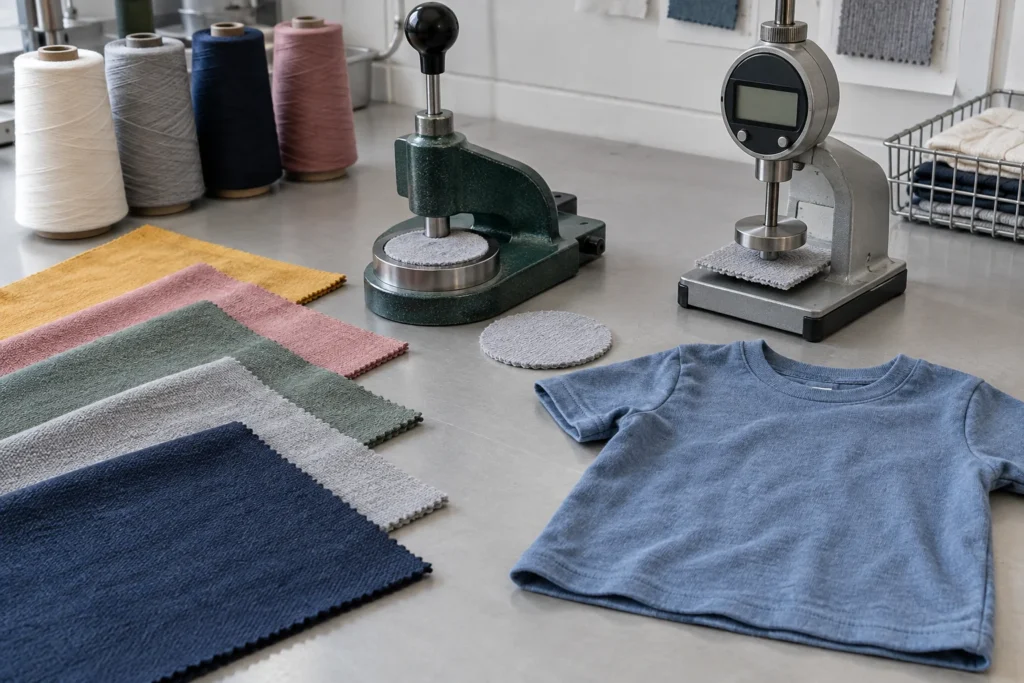
Material identity, physical checks, and performance evidence support approval.
Confirm identity and construction
Record enough information for the purchasing and quality teams to identify the same material later:
- Supplier or mill and country of origin when relevant
- Fabric article number or code
- Fiber composition and any branded-fiber evidence required for a claim
- Knit or weave construction
- Nominal weight and allowed range
- Usable width and allowed range
- Finish, wash, brushing, coating, or other treatment
- Stretch direction, elongation, and recovery when important
- Approved color name and physical standard reference
- Approved lot, if the order uses stock fabric
- Substitution rule: no change without written review
These facts should match the bill of materials, quotation, care-label development, test request, and purchase order. If the factory quotes one fabric but the sample uses another, the approval chain is already broken.
Review touch, appearance, and end use
Some important properties are evaluated physically rather than through one number. Feel the material and garment. Check drape, surface uniformity, opacity, luster, brushing, noise, static, cling, and whether the reverse side is comfortable against skin. For children’s products, consider how the material behaves during movement and frequent care, not only how it looks when freshly pressed.
Use descriptive comparisons instead of vague adjectives. “Softer” can mean less crisp, more brushed, smoother, or more flexible. A useful comment might say that the approved swatch is the hand standard and that the bulk fabric must not feel rougher, thinner, or more heavily brushed. Where subjective differences matter commercially, keep sealed reference swatches for comparison.
Select performance checks for the real product
Do not copy a generic laboratory list into every purchase order. Choose methods and acceptance criteria according to the fiber, construction, color, garment type, care method, end use, destination market, retailer rules, and claims. Common areas include dimensional change, spirality, pilling, abrasion, seam performance, stretch and recovery, bursting or tensile strength, and colorfastness to laundering, rubbing, perspiration, light, or water.
The AATCC Manual announcement shows that its current method set includes areas such as dimensional change after home laundering and several forms of colorfastness. That does not create one universal pass score. Ask a qualified laboratory and your product team to select current methods, specimen preparation, care cycles, conditioning, and acceptance levels for the actual item.
If the fabric will be printed, embroidered, washed, bonded, pleated, coated, or combined with contrast panels, test the finished configuration when that process can change performance. A report for plain greige fabric cannot prove how a dark finished garment will behave after dyeing, printing, and laundering.
Connect the material to labeling and safety review
For U.S. sales, the FTC’s clothing and textiles guidance is a useful official starting point for fiber content, country-of-origin, responsible-company, and care-label requirements. The approved material identity should agree with the fiber statement and with any material claims in product listings.
The CPSC clothing-textiles fact sheet summarizes the general clothing-textile flammability scope and notes that children’s sleepwear can face more specific requirements. Product category matters: everyday apparel, sleepwear, coated fabric, trims, prints, and age-related details can change the compliance plan.
Do not treat a general supplier certificate as proof for every style or shipment. Confirm what product, material, color, component, production lot, method, laboratory, and date the evidence covers. If a regulated or tested component changes after approval, review whether the previous evidence still applies.
Approve color under controlled viewing conditions
Color is where confident comments often hide weak evidence. A shade can look acceptable beside a window and wrong under store lighting. A pale neutral may shift because of optical brighteners. A navy shell can appear mismatched against rib even when both suppliers used the same color code.
For that reason, fabric and color approval should define both the physical reference and the conditions used to judge it.
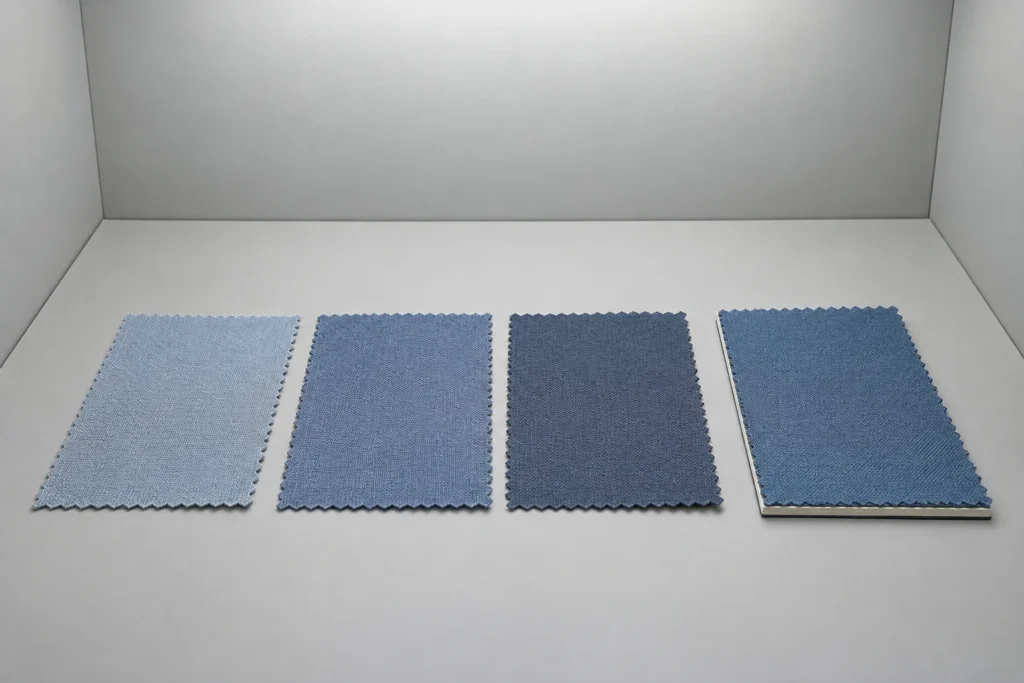
Physical lab dips are compared with an approved shade under controlled light.
Review lab dips as physical samples
A mill may submit several lab-dip options, usually marked with option codes. Compare them with the target standard under agreed light sources and on a neutral background. Let your eyes adapt, avoid judging next to bright colors, and keep the viewing arrangement consistent. Review face and back when relevant, because penetration and surface treatment can differ.
Your fabric and color approval note should identify the selected option and the retained standard. Do not reply only with “B is best.” Write the style, fabric code, color name, lab-dip option, submission date, decision date, and any condition. If no option is acceptable, reject them and describe the direction of correction without implying that a screen sample is the final standard.
Treat prints and decorations as separate approvals
A printed fabric needs more than a ground-color decision. Review each artwork color, print scale, repeat, placement where relevant, outline sharpness, registration, penetration, hand feel, cracking risk, and appearance after the agreed care test. Embroidery, appliqué, transfer, sequin, and beadwork need their own material and color references.
Check how components look together. Main fabric, rib, lining, thread, zipper tape, elastic, labels, and decoration may use different fibers and dye processes. Exact instrumental equality may not be possible, but the intended relationship should be approved: match, coordinated contrast, or intentionally different shade.
Compare bulk shade before cutting
The factory should not assume that approval of a lab dip guarantees the bulk lot. Ask how it creates a shade band, identifies dye lots, separates rolls, and compares production fabric with the retained standard. If several lots must be used, agree whether they may appear in one garment or one shipment and how shade continuity will be controlled.
For highly shade-sensitive products, require the factory to pause before cutting if bulk fabric falls outside the agreed visual or measured tolerance. For more forgiving products, a controlled commercial range may be acceptable. The decision should reflect the brand position and the risk of garments appearing together online, in store, or within a set.
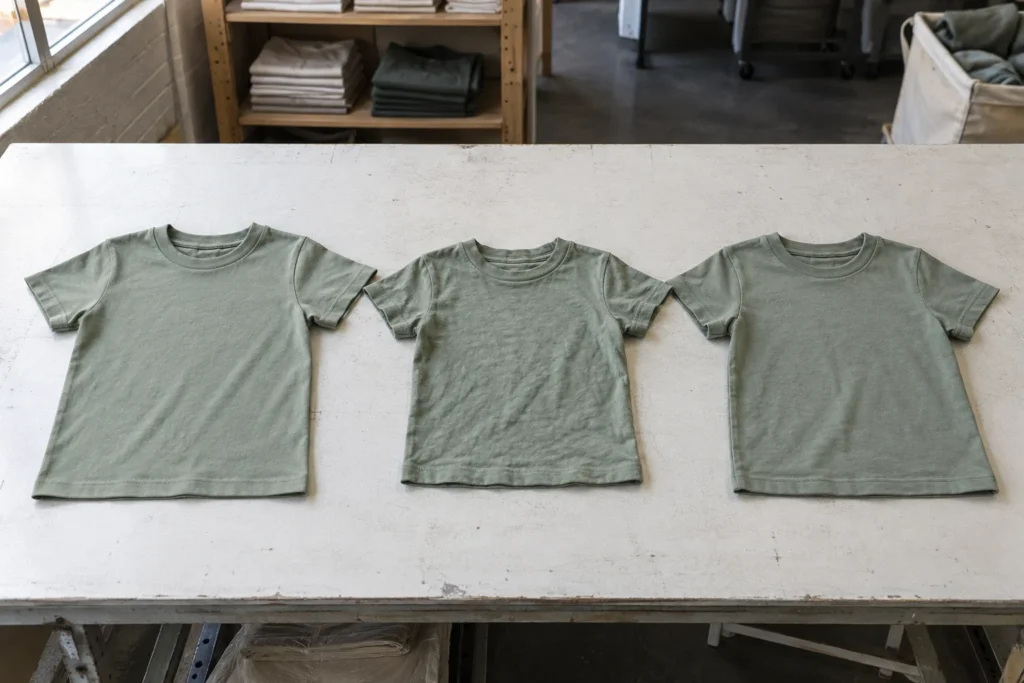
The same T-shirt style is checked before washing, after washing, and at final sample approval.
Approve the fabric as a finished garment
A thorough fabric and color approval does not end at the roll. The customer buys a garment, so the material must work with the pattern, sewing, decoration, finishing, and care instructions.
Evaluate fit and construction after realistic care
Measure the sample before and after the agreed wash and dry procedure. Then reassess fit, length, width, neck opening, seam shape, side-seam twist, surface, pilling, shade, and hand feel. A swatch may pass a dimensional test while a garment still loses balance because different panels were cut off-grain or because rib and body recover differently.
For cotton T-shirts, HAPA’s guide to avoiding shrinkage and fading in custom kids cotton T-shirts provides deeper coverage of wash performance and bulk-fabric control. Use those checks as inputs to the release decision rather than waiting for customer complaints to define your tolerance.
Check decoration and trim interaction
Printing can change hand and stretch. Embroidery can cause puckering or create a rough interior. A heat transfer can respond differently to laundering than the base fabric. Contrast trim can bleed or crock onto a light body. Pressing can create shine or flatten pile.
Review the complete sample with final or representative processes. If the factory needs to use a substitute decoration during development, keep that approval open until the correct process is reviewed. Do not allow approval of the garment silhouette to be interpreted as approval of an unreviewed print, trim, or finish.
Keep children’s wear comfortable and appropriate
Material decisions influence seam comfort, breathability, warmth, recovery, laundering, and attachment performance. Check the intended age group and use. A fabric suitable for a loose daytime top may not suit close-fitting sleepwear, swimwear, outerwear, or a product with heavy decoration.
Your fabric and color approval should refer to the actual category and market. Avoid unsupported promises such as “hypoallergenic,” “non-toxic,” or “safe for all children.” Confirm the evidence behind any claim and make sure the approved material, labeling, online description, and delivered garment remain consistent.
Put every approval in writing
An effective approval record is short enough to use and detailed enough to prevent guessing. It should be stored with the controlled product file, not buried in an informal chat history.
The record also makes fabric and color approval traceable when staff, suppliers, or production dates change.
Use approve, approve with conditions, or reject
Use three clear decision states:
- Approve. The submitted item is accepted as the production standard for the named attribute and action.
- Approve with conditions. Production may move only after specific measurable conditions are incorporated and acknowledged. Use this sparingly; unresolved visual or performance risks usually need a revised submission.
- Reject and resubmit. The item is not authorized for the next committed step. State the issue and the evidence needed for a new decision.
For example, “Approved” is weaker than: “Approved: Style K214, main jersey FJ-882, sage lab dip option C dated 22 September 2026, for PP sample and bulk dyeing. Bulk shade and required test results remain subject to release before cutting. No supplier, construction, finish, or color substitution without written approval.”
That wording defines the object, the permitted next step, and what remains open.
Maintain one approved production master
Store the final fabric specification, physical swatch reference, color standard, test reports, bill of materials, care method, pre-production sample comments, artwork, and approval history together. Give each controlled file a version and date. Mark obsolete versions so they cannot return to the cutting or purchasing team.
The production master should also say where physical standards are held. Ideally, the brand and factory each retain an identical signed or sealed swatch. When that is impractical, record exactly which party holds the master and how disputed bulk material will be compared.
HAPA’s product sample development process gives context for moving from brief and material sourcing to a physical sample. The approval record is what turns that development work into an instruction the factory can repeat.
Do not rely on photographs for final shade approval
Photographs are useful for tracking submissions, showing defects, and discussing broad direction. They are not reliable final shade standards. Camera processing, white balance, exposure, lighting, compression, and screens can all change the apparent result. If timing makes physical review impossible, document the increased risk and agree on an alternative inspection method rather than pretending the risk disappeared.
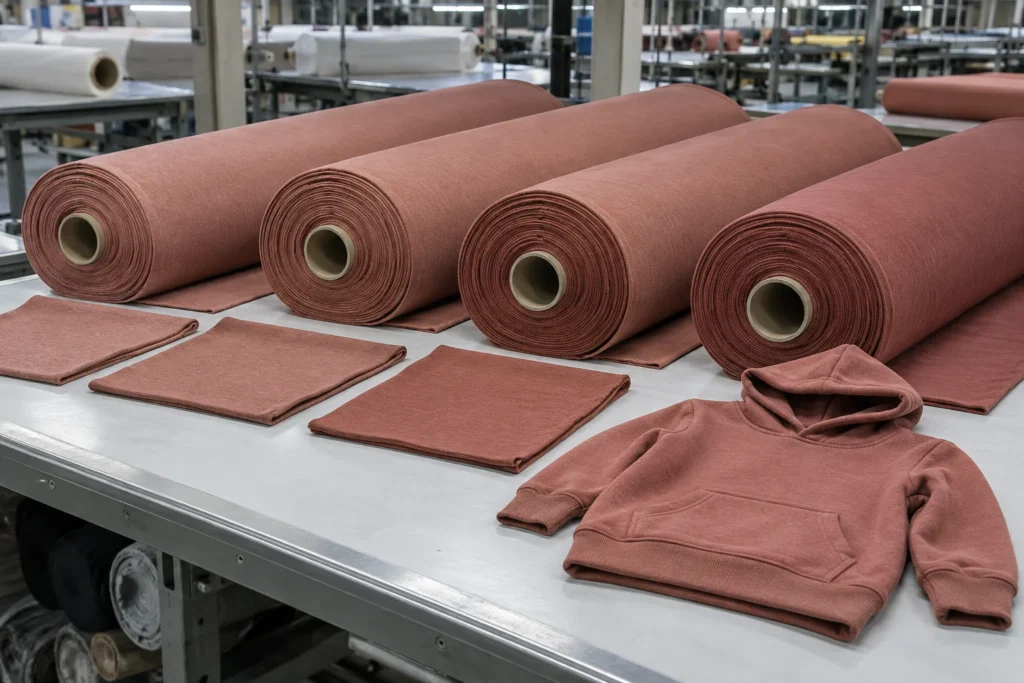
Bulk rolls and cuttings are compared with the finished garment reference before release.
Require reapproval when a meaningful variable changes
Approval applies to a defined product and process. It should not be treated as permanent permission to make any similar garment.
Repeat fabric and color approval when a change could alter identity, appearance, performance, compliance evidence, or consistency. Common triggers include:
- New mill, fabric supplier, or fabric code
- Different fiber blend, yarn, construction, weight, width, or finish
- New dye lot where shade consistency matters
- Different print, embroidery, coating, wash, or finishing supplier
- New artwork color, scale, placement, or technique
- Material substitution caused by MOQ, cost, or availability
- Long production gap or movement to a different factory
- Test failure, unexplained defect, or bulk result outside tolerance
- Care-label or product-claim change
- New destination market or retailer requirement
A repeat order can sometimes use an established approval package when nothing meaningful changes. But the factory should still verify the incoming lot and document current production. If a variable changes, decide whether you need a new swatch, lab dip, strike-off, test, PP sample, bulk shade review, or a combination.
Know when to stop bulk production
Pause the next irreversible step when:
- The factory cannot identify which fabric or color standard applies
- The bulk lot differs from the approved specification or shade
- Required test evidence is missing, expired for the decision, or tied to another product
- A supplier or process changed without review
- Different dye lots cannot be separated or controlled
- The PP sample used substitute material and the final material has not been evaluated
- The buyer’s comments conflict or the latest approved version is unclear
- A defect trend appears during spreading, cutting, sewing, finishing, or inspection
Stopping before cutting may cost days. Continuing with an uncontrolled material can cost the entire order. A good supplier should explain the issue, isolate affected material, provide evidence, and propose a measurable correction rather than asking for a vague exception.
The garment factory process shows where material inspection, sampling, cutting, sewing, and quality control sit in the wider sequence. Your hold points should appear before the steps where correction becomes disproportionately expensive.
Send a clear approval request to your manufacturer
You can use the following structure when the factory submits material or asks to proceed:
Style and order: style number, product name, colorway, quantity, size range, destination market, and purchase-order reference.
Submission: supplier, fabric code, composition, construction, weight, width, finish, color reference, option or lot number, and submission date.
Evidence attached: physical swatch or lab dip, print strike-off, test reports, washed sample results, PP sample reference, photographs for tracking, and any deviation list.
Decision: approve, approve with conditions, or reject and resubmit.
Scope of release: identify whether the factory may order fabric, dye bulk, make a sample, print, cut, or begin full production.
Open items: list bulk shade approval, test results, trim matching, garment wash review, labeling, or any other item that remains unresolved.
Change control: state that no supplier, material, construction, finish, color, print, or process substitution is permitted without written review.
Owner and date: name the authorized approver and record the approval date and version.
This structure makes fabric and color approval an operational instruction rather than a subjective preference.
Frequently asked questions
Can I approve color from a photo or video call?
Use photos and video for discussion, defect review, and broad direction, but not as the only final physical shade standard when color matters. Screens and cameras change color. Review a physical lab dip, strike-off, swatch, or bulk cutting under agreed viewing conditions whenever practical.
Is approving a pre-production sample enough?
Only if you know exactly which attributes the sample represents and you still verify the bulk material. A PP sample made in final fabric can control garment appearance and behavior, but it does not prove that every bulk roll matches the approved shade, weight, width, finish, and quality range.
Do I need laboratory testing for every fabric?
You need a risk-based test plan, not a copied list. The plan depends on product category, material, color, construction, care, destination market, order risk, claims, and retailer requirements. Some checks may be performed in development, some by a qualified third-party laboratory, and some on the actual production lot. Agree on methods and acceptance criteria before testing.
What if the factory says the shade difference is commercially acceptable?
Ask the factory to compare the material with the approved standard under the agreed conditions and show the affected lots. Decide against your documented tolerance, how the colors will appear together, and the product’s price position. If you accept a deviation, record exactly what is accepted for that order; do not silently change the master standard.
Does a repeat order need a new approval?
An unchanged repeat may not require full redevelopment, but it still needs verification of the new production lot. Request new approval when the mill, fabric code, construction, finish, dye lot, artwork, process, factory, test scope, or other meaningful variable changes. The principle is to repeat the approval when the risk has changed.
Approve the standard, then verify the bulk
The answer to the title question is yes, but the quality of the decision matters more than the word “approved.” A strong fabric and color approval identifies the material, uses a physical color reference, checks relevant performance, proves the garment works after realistic care, states what the factory may do next, and remains valid only while the important variables stay controlled.
Keep the process proportionate. A simple stock-fabric T-shirt may need fewer development steps than custom-dyed sleepwear with contrast trims and a print. Both still need a clear standard and a release point before the factory commits the whole order.
When you separate specification approval, shade approval, garment approval, and bulk-lot release, you replace a vague “looks fine” with evidence the purchasing, production, and quality teams can use. That is the practical goal: approve what you can define, verify what arrives, and stop when the evidence no longer matches the decision.