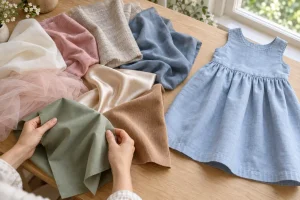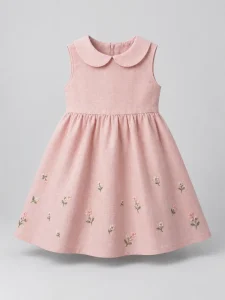
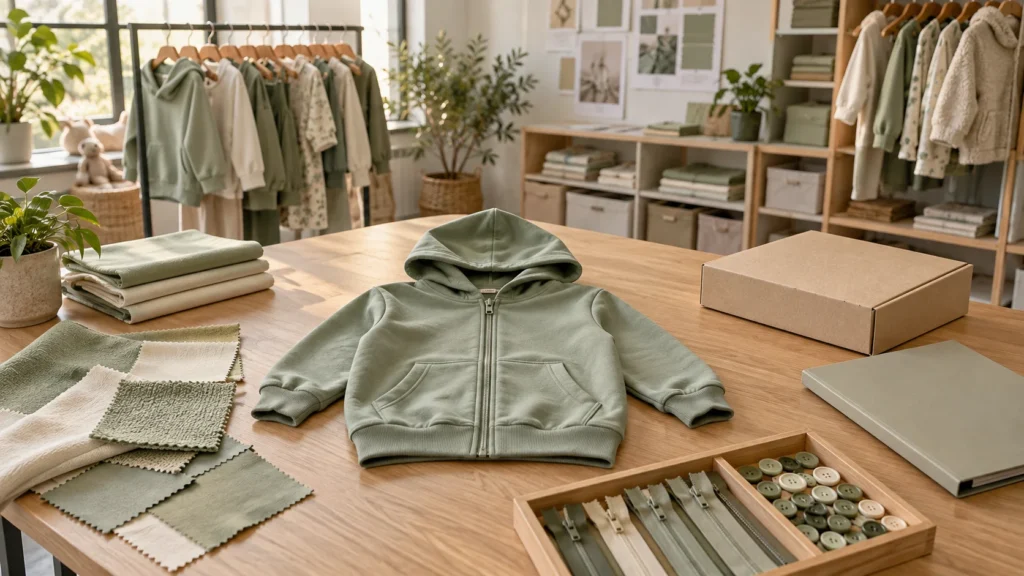
One representative garment brings product, material, packing, and file controls into the same paid pilot.
You can test a full-service factory by treating one small commercial order as a controlled operating trial. Choose a style that represents the work you expect to place later, document every requirement, agree on evidence at each handoff, and score what actually happens from design interpretation through delivery. A kidswear factory pilot order should answer a business question: can this supplier run your product through its complete system with acceptable quality, control and communication when real money and a real shipment are involved?
That purpose changes how you plan the order. You are not buying a few units simply to see whether the garments look attractive. You are testing whether the factory can keep the approved design, material, measurements, workmanship, labels, packing and delivery instructions aligned across several teams. You are also testing how it responds when something is unclear or goes wrong.
A paid pilot cannot remove all sourcing risk. It can, however, replace a large part of the guesswork with direct evidence. This guide explains how to design that test, what records to request, how to inspect the result, and how to decide whether the factory deserves a larger commitment. Planned this way, a kidswear factory pilot order becomes a controlled decision tool rather than a hopeful first purchase.
Start with the right definition of a paid pilot
A pilot order sits between product development and a normal repeat order. It is commercial: you pay for development, materials, production and agreed services. It is also deliberately limited: the financial exposure and operational complexity are kept low enough that you can learn without placing a major season at risk.
That makes it different from a sample. A sample can show whether a pattern, fabric and construction can produce one acceptable garment. It usually does not prove that the approved information will survive size grading, material issuing, line setup, in-line inspection, finishing, packing and shipment. HAPA’s overview of product samples is useful background for understanding what the development stages can establish before bulk begins.
A pilot is also different from a token order designed only to reach the lowest possible quantity. If the test is so simplified that it bypasses the factory’s normal people and processes, it tells you little about future production. The order needs enough reality to exercise the workflow you actually intend to use.
Decide what the pilot must prove
Write a short hypothesis before discussing quantity or price. For example:
This factory can take one approved children’s style from controlled production files through bulk manufacturing, final inspection, retail packing and export handover while maintaining the approved product and providing usable records at every stage.
Break that hypothesis into observable questions:
- Does the product team identify missing or conflicting design information?
- Can the sample room turn comments into a controlled approval sample?
- Are fabric, trims and colors linked to approved references?
- Does the production team use the latest approved specification?
- Are defects found and corrected before they spread?
- Do packed quantities reconcile by style, color and size?
- Are shipping milestones and documents communicated accurately?
These questions become the backbone of the kidswear factory pilot order. Without them, you may finish with merchandise but no clear conclusion.
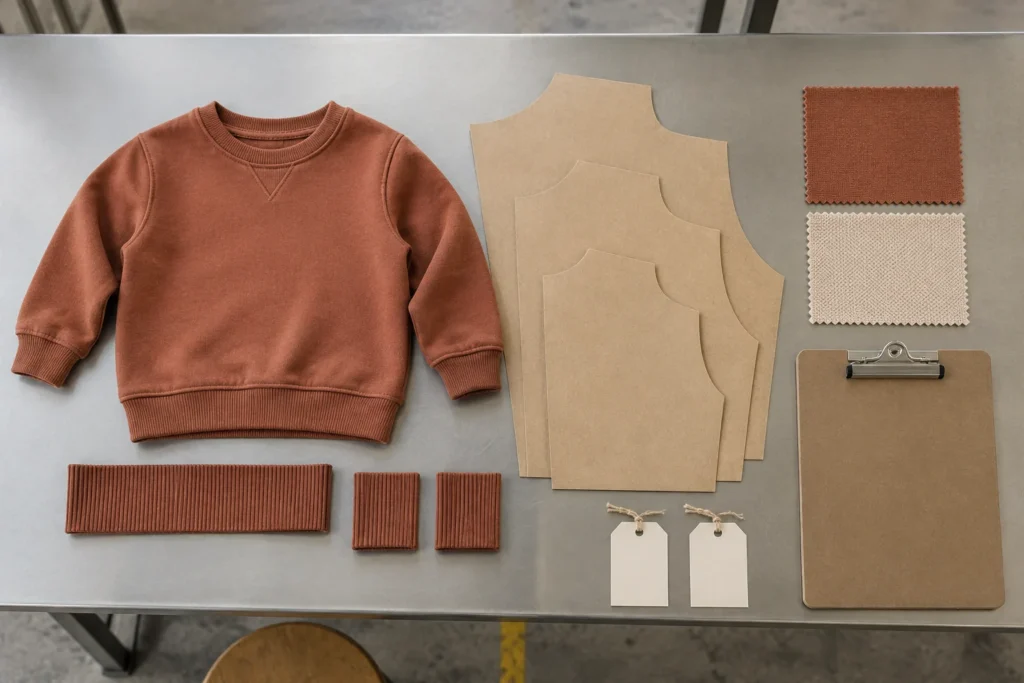
A representative style and controlled components make the pilot commercially useful.
Choose one style that reveals useful risk
The best pilot style is representative, manageable and commercially relevant. A plain item with no meaningful variation may be easy to produce but may not test the capabilities you need. An unusually complex fashion piece may create so many variables that you cannot tell whether a failure came from the factory’s system or from an unrealistic first project.
Choose a style with several normal control points. A children’s sweatshirt might include graded sizes, a rib specification, a color standard, a print or embroidery, a neck label, a care label, a hangtag and a defined fold-and-pack method. That is enough to expose design, sourcing, production and packing handoffs without turning the pilot into an entire collection.
Use a modest size and color range that resembles your future orders. If your business will always sell several sizes, testing only one size avoids the grading and assortment work you need to evaluate. If color accuracy is important, include a controlled colorway rather than accepting whatever stock fabric is convenient. The goal is not maximum variation. It is enough relevant variation to produce evidence.
Avoid changing the test halfway through
Late design changes make the result hard to interpret. Freeze the pilot specification at an agreed point. If a necessary change occurs after that point, record the reason, the affected files, the cost or timing effect, and the new approval. This gives you two useful signals: whether the factory controls changes, and whether it explains their consequences before acting.
You should also separate factory-caused rework from buyer-requested changes. A scorecard is only fair when responsibility is visible. That discipline will matter even more on larger orders.
Build a written pilot brief before requesting the final quote
Your pilot brief should make the order testable. It can build on a tech pack, an approved sample and a purchase order, but it should also state the operating rules for this particular trial. If you are still learning the normal sequence, review how kidswear OEM manufacturing works before defining your gates.
At minimum, the brief should identify:
- the style, revision number and approved reference sample;
- the size range, colorways and quantity breakdown;
- approved fabric, trims, color references and substitution rules;
- measurement points, tolerances and construction requirements;
- artwork files, placement dimensions and appearance standards;
- label content, placement and attachment method;
- folding, individual packing, assortment and carton requirements;
- required samples, inspection stages and approval owners;
- required tests or compliance documents for the target market;
- delivery term, destination, milestone dates and document responsibilities;
- the evidence the factory must provide at each gate;
- what requires written approval before the factory proceeds.
Do not assume that “full service” gives the factory permission to make every decision. Full service should mean the supplier can coordinate the work. You still need to define which choices it may make, which choices it may recommend, and which choices only you may approve.
Make the commercial boundary explicit
Ask for a costed quotation that separates development, product, special tooling or artwork, testing, packing and delivery-related charges where relevant. The point is not to force every factory into one pricing format. It is to understand what the quoted scope includes and what could become an extra charge.
Record the payment stages, the conditions for each payment, and how approved changes are priced. Confirm who owns paid patterns, graded specifications, artwork files, molds or other development assets if those items are part of the project. Clarify what happens to excess custom materials. A pilot should reveal commercial discipline as well as sewing ability.
Test design interpretation and file control
The first valuable result may be the factory’s questions. A capable product team should not silently guess when a sketch, measurement or construction instruction is incomplete. It should consolidate questions, explain the production consequence and propose a practical option where appropriate.
Pay attention to the quality of clarification. Does the team refer to specific measurement points and file revisions? Does it notice that artwork placement will shift across sizes? Does it flag a trim that may create a safety or durability concern for the intended age group? Good questions show that the supplier is reading the product as a system.
Weak file control often looks harmless during sampling and becomes expensive in bulk. Set one approved location for current files. Put a revision identifier and date on the specification. When comments are issued, require the factory to return a consolidated action list showing what will change, what remains open and which sample will verify it. Retire obsolete files instead of leaving several “final” versions in circulation.
For the kidswear factory pilot order, ask the factory to show the production team the same controlled package you approved. A screenshot of an old chat message is not a production specification. The evidence might be a signed pre-production sample record, an approved bill of materials and a revision-controlled measurement sheet.
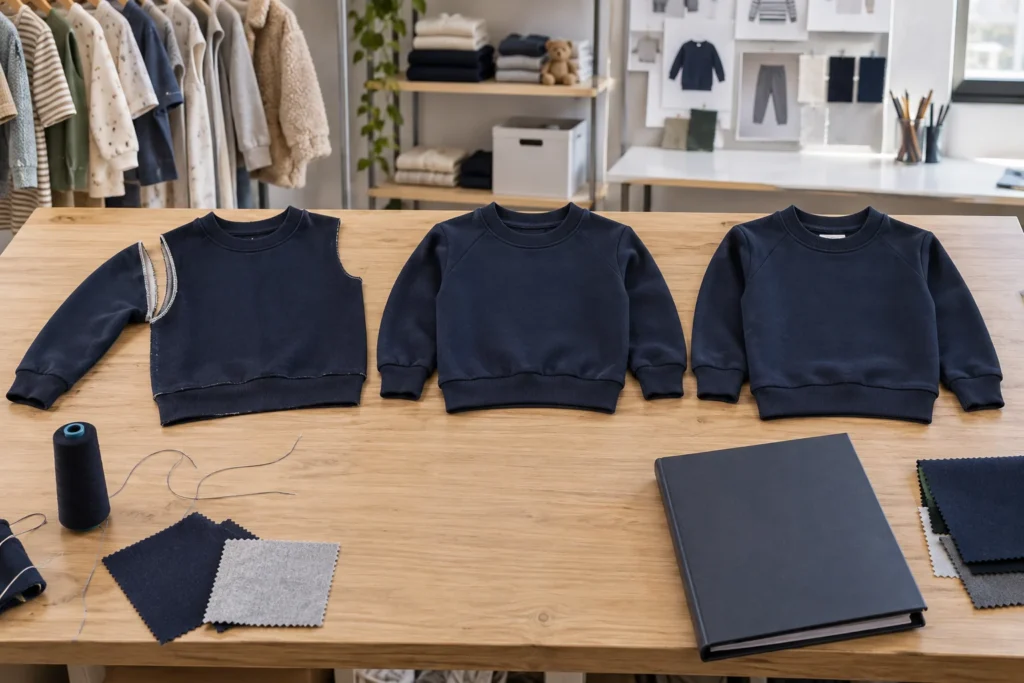
Successive physical samples close construction and fit questions before bulk production.
Make sampling produce decisions, not just parcels
Sampling should close defined questions in a sensible order. The exact sample names vary by factory and product, but the logic is consistent: first prove shape and construction, then prove materials and appearance, and finally prove that the approved combination is ready to transfer to production.
For each submitted sample, require a short record:
- sample type and revision;
- materials and trims actually used;
- measurements taken by the factory;
- known deviations from the intended specification;
- open questions needing buyer approval;
- date sent and requested decision date.
When you review it, respond in the same structure. Mark each point approved, rejected or pending. Use photographs to identify a location, but keep the written requirement in the controlled comment sheet. Photographs alone can be ambiguous about scale, tolerance or the exact change requested.
Approve a complete reference before bulk
The pre-production reference should combine the elements that matter to the saleable product: correct fabric, color, trims, construction, measurements, artwork, labels and finishing. If one component is a substitute, record it and state exactly how the bulk component will be approved.
Do not approve a sample with a casual promise that several visible problems will be “fixed in bulk.” If a point cannot be verified on the sample, define another gate and do not let the issue disappear. Your pilot is testing whether approvals are real controls.
Test sourcing and material control
A full-service supplier often coordinates mills, dye houses, printers, embroiderers and trim vendors. That convenience is valuable only if the factory can keep material decisions traceable.
Ask for a bill of materials that links each component to an approved description or physical standard. For color-sensitive materials, agree on the approval method and lighting conditions. For performance requirements, state the test method or buyer standard rather than using vague words such as “high quality” or “colorfast.” If third-party laboratory testing is required, agree on the sample source, laboratory, report recipient and action if the result fails.
Substitution is an important pilot test. The contract should say that unavailable materials cannot be replaced without written approval. If the nominated item becomes unavailable, a good supplier should identify the change, explain the effect on appearance, performance, price and timing, then submit the alternative for approval.
The kidswear factory pilot order should also test material segregation. Ask how approved bulk materials are identified and protected from similar stock. When practical, request photographs of received rolls or trim lots, the factory’s incoming check, and the link between the material lot and your production order. The purpose is a traceable chain, not a large collection of unverified photographs.
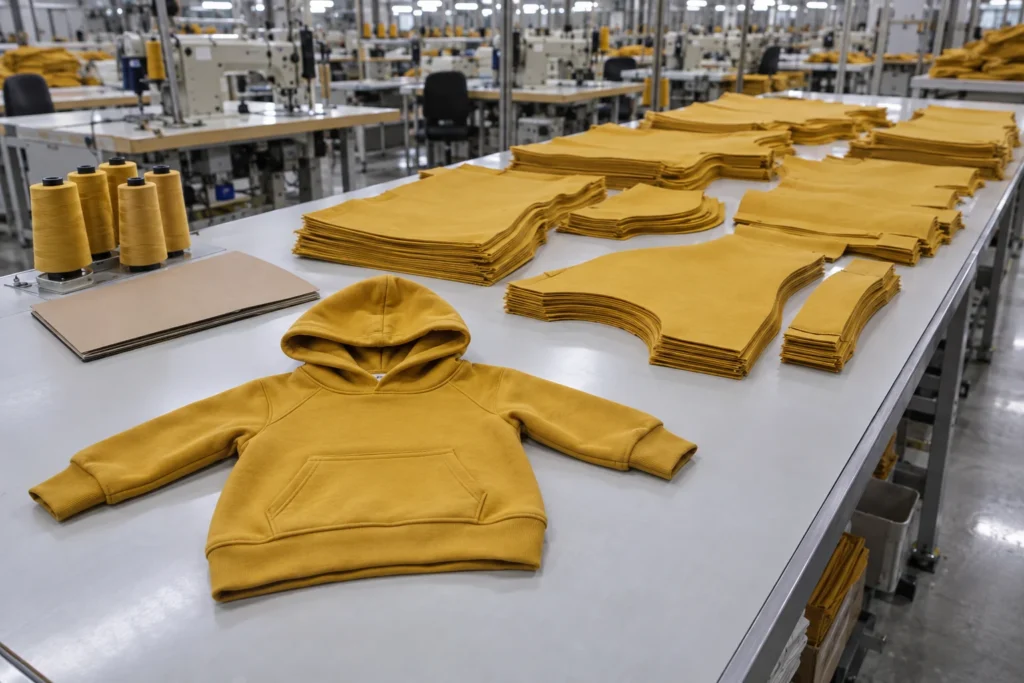
The approved garment reference must reach bulk cutting and sewing without losing specification control.
Watch the handoff from approval to bulk production
Many sourcing problems appear after an excellent sample has been approved. The sample room may understand the product, while the production line receives incomplete instructions or uses a different technique. Your pilot should make this handoff visible.
Before cutting, request a pre-production meeting record or equivalent checklist. It should confirm the current specification, approved sample, material status, size ratio, critical construction points, artwork placement, label rules, inspection plan and packing method. Ask who attended and who owns each unresolved item.
If possible, include a first-output or pilot-run gate. A small number of units from the intended production method can expose line interpretation problems before the full quantity is made. Define what you need to see and who can release continued production. This is more useful than asking for general “production updates.”
HAPA’s guide to verifying a kidswear OEM manufacturer before bulk provides additional checks for supplier identity, capability and documentation. Those checks belong before and alongside a pilot; the order itself should validate how the chosen team performs.
Ask for evidence at risk points
Do not request constant photographs of routine activity. Select evidence that resolves a risk. Examples include:
- first-cut components checked against the approved pattern;
- first production units measured before the line continues;
- artwork placement checked with a defined reference;
- an in-line defect summary and corrective action;
- label and packing setup approved before all units are packed.
The factory’s willingness to report a contained problem is a positive signal when the record also shows cause, affected quantity, correction and prevention. A suspiciously perfect story can be less informative than transparent control.
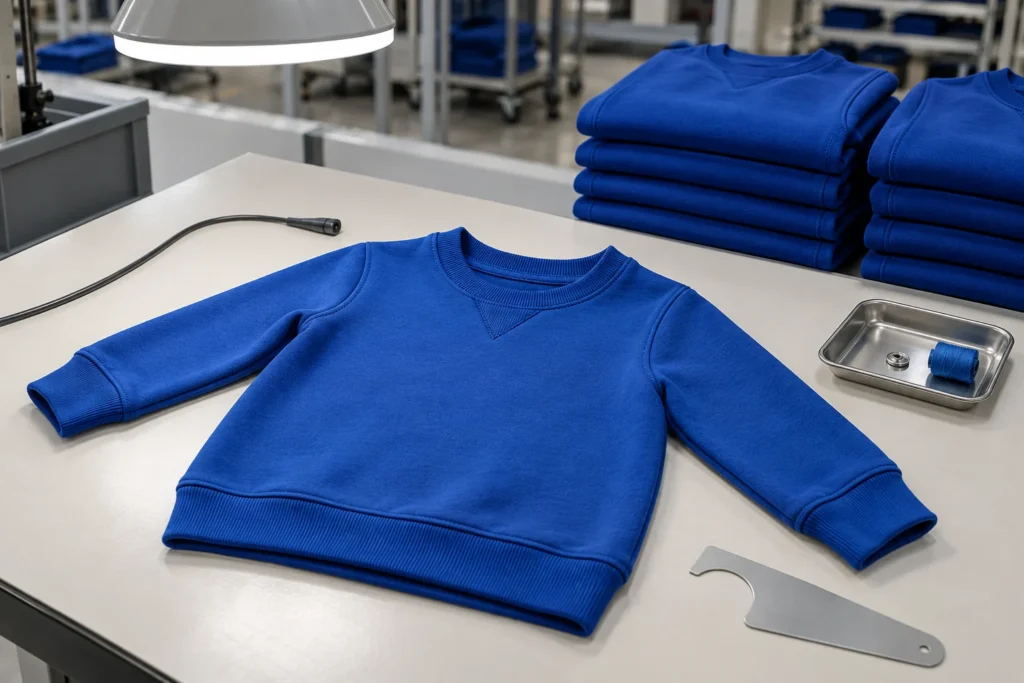
Defined garment checks and consistent references make pilot-order QC evidence useful.
Define quality control before defects exist
Quality language must be specific enough for two people to reach the same conclusion. Create a short defect reference for the style. Identify critical safety or legal failures, major defects that make the product unsaleable or materially wrong, and minor workmanship issues that do not prevent use but fall below the agreed standard.
Set measurable tolerances for dimensions. Define how appearance will be judged against the approved sample or color standard. State whether inspection occurs in-line, before packing and/or before shipment. Agree on what happens after a failed inspection: sorting, rework, reinspection, replacement, concession or another written resolution.
For final inspection, you may use an acceptance-sampling plan. The current ISO 2859-1:2026 standard describes sampling procedures for inspection by attributes indexed by acceptance quality limit. Your inspection instruction still needs to define the lot, sample basis, inspection level, defect classes and acceptance numbers. An AQL plan is a decision rule for a sample from a lot; it does not prove that every uninspected garment is defect-free.
Use the kidswear factory pilot order to compare three things: what the specification required, what the factory’s own QC recorded, and what your final inspection found. Large gaps can reveal weak standards, poor reporting or ineffective corrective action. The children’s clothing supplier quality-control guide offers more detail on building useful quality checks into sourcing.
Include product safety and labeling in the pilot
Children’s apparel requirements depend on the product, age group and destination market. Identify the applicable rules with qualified compliance support before ordering. Do not accept a generic statement that the product is “compliant” without defining the rule, product, test evidence and responsible party.
For the United States, the Consumer Product Safety Commission explains Children’s Product Certificates and the information they must contain. The domestic manufacturer or importer is responsible for certifying covered children’s products based on applicable testing. A factory can support the evidence chain, but outsourcing production does not automatically transfer the importer’s legal obligations.
Test the document trail during the pilot. Confirm the product identifier, production location and date, applicable rule, testing basis and report references where required. Make sure samples sent for testing are linked to the materials and construction used in production. If the product changes after testing, assess whether the existing evidence still applies.
Labels also belong in the controlled product specification. The U.S. Federal Trade Commission’s apparel-labeling guidance explains that covered textile and wool products generally need fiber-content, country-of-origin and responsible-business information, and that care-labeling rules apply. Your target market may require different or additional information. Check label content, language, placement, durability and attachment on the actual pilot goods.
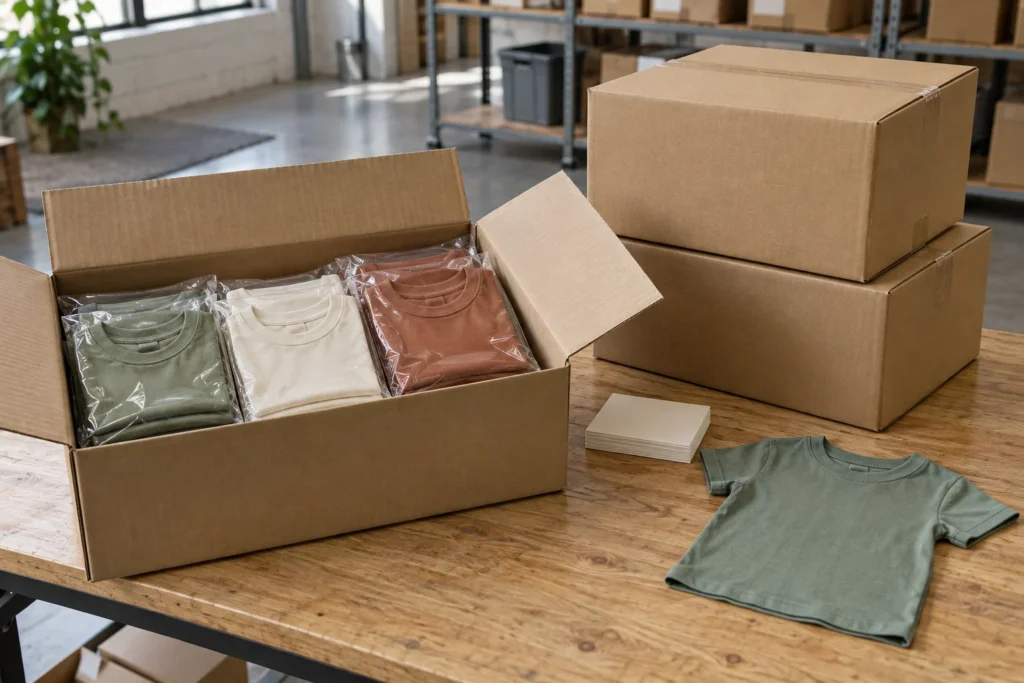
Packed colors, units, and cartons are reconciled before the pilot shipment is released.
Test packing, quantity control and delivery handover
Packing is where an otherwise good product can become a bad shipment. Approve a pack sample before the whole order is closed. Check the fold, individual bag if used, size indication, barcode or sticker placement, assortment, carton protection and any limits on carton dimensions or weight.
Require a packing list that reconciles to the purchase order by style, color and size. Select cartons and count their contents rather than relying only on the total printed in a document. Check that carton identification matches the list and that mixed assortments follow the agreed rule.
For the kidswear factory pilot order, define delivery as a chain of responsibility rather than one date. Record the agreed trade term, named place, booking responsibility, document list, cargo-ready date and handover evidence. A factory may not control a carrier’s entire journey, but it should communicate accurately about the milestones within its scope and provide correct documents on time.
After receipt, inspect the delivered condition. Reconcile cartons and units, review transit damage, check a sample of packed goods, and compare your findings with the pre-shipment record. The receiving check closes the pilot. Without it, you have tested only the factory gate, not the delivered result.
Score behavior and evidence, not presentation
Create the scorecard before the order starts and share the operating criteria with the factory. You do not need to reveal every weighting, but there should be no surprise about what acceptable performance means. A practical scorecard can use a five-point scale for each area, supported by notes and file references.
| Area | What to evaluate | Example evidence |
| Design interpretation | Questions, feasibility feedback, accurate translation of intent | Consolidated query list, controlled specification |
| Sampling | Accuracy, closure of comments, disclosure of deviations | Sample record, measurement report, approval log |
| Materials | Approval discipline, traceability, substitution control | Bill of materials, lot record, test linkage |
| Bulk handoff | Use of approved files and reference sample | Pre-production record, first-output check |
| Quality control | Defect detection, measurement control, corrective action | In-line and final inspection records |
| Packing | SKU accuracy, pack conformity, carton reconciliation | Pack approval, packing list, carton check |
| Delivery | Milestone honesty and document accuracy | Booking updates, handover and shipping documents |
| Communication | Clear ownership, response quality and escalation | Decision log, issue reports, agreed actions |
Weight the areas according to your risk. Product safety and critical quality failures should not be averaged away by friendly communication. You can set mandatory gates for critical requirements and use the weighted score for the remaining commercial decision.
Separate outcomes into three decisions
At the end of the kidswear factory pilot order, choose one of three outcomes.
Go: The factory met mandatory requirements, the product and shipment were acceptable, and the records support confidence in a controlled increase. The next order may still scale gradually.
Conditional go: The result is commercially usable, but specific weaknesses need corrective action. Record the issue, root cause, action owner, due date and evidence required before or during the next order. Keep the next exposure appropriate to the unresolved risk.
No-go: A critical requirement failed, evidence is unreliable, unauthorized changes occurred, corrective action was ineffective, or the residual risk exceeds your tolerance. Close financial and material matters clearly, preserve the records and do not let sunk development cost force a larger commitment.
Avoid reducing the decision to a single percentage. A high average score cannot compensate for a serious safety, integrity or repeatability concern.
What one pilot can and cannot prove
A well-designed pilot can show how a factory handles your real product, whether its teams share information, whether its records correspond to the goods, and how it responds to contained problems. It can also expose hidden work on your side: unclear specifications, slow approvals or conflicting instructions.
One pilot does not prove unlimited capacity, peak-season performance, long-term consistency, financial stability or competence in every product category. It may not test the effect of a new mill, a different production line or a much larger quantity. Supplier monitoring therefore continues after admission.
Treat the kidswear factory pilot order as the first evidence-rich production cycle. On the next order, compare the same measures. Watch whether corrective actions remain in place and whether the factory can maintain control as volume, variety or speed increases.
A practical sequence for your paid pilot
The following sequence keeps the kidswear factory pilot order focused while producing enough evidence for a decision:
- Define the future order type and the biggest operational risks.
- Select one representative style and a meaningful size/color mix.
- Complete due diligence on the supplier’s identity and relevant capability.
- Issue a controlled brief, specification and responsibility map.
- Agree on the quote, payment stages, change process and ownership of development assets.
- Approve materials, trims, labels, artwork and the production reference.
- Hold a documented pre-production handoff and close open points.
- Review first output and risk-based in-line evidence.
- Conduct the agreed final inspection and resolve any failure.
- Approve packing setup and reconcile finished quantities.
- Track delivery handover, receive the goods and inspect delivered condition.
- Complete the scorecard and issue a go, conditional-go or no-go decision.
Put every gate on one timeline with the decision owner and the evidence needed to release the next stage. This gives both sides a workable process and prevents an informal message from becoming an accidental approval.
Questions buyers often ask
Should the pilot be the factory’s minimum order quantity?
Not necessarily. The right quantity depends on the factory’s workable production method, material minimums and the evidence you need. An artificially tiny run may be expensive or may be handled outside the normal bulk process, which weakens the test. Ask how the pilot will be produced and whether the same teams and controls would handle a larger order.
Should I tell the factory it is being scored?
Tell the factory that the order is a controlled pilot and share the requirements, gates and evidence expectations. Transparent criteria help a capable supplier plan correctly. You can keep internal weightings and your broader sourcing comparison confidential.
What if the pilot has a defect but the factory fixes it?
Record the defect, affected quantity, containment, root cause, correction and prevention. A contained problem with effective, documented action may demonstrate stronger control than a supplier that hides issues. The decision depends on severity, transparency, recurrence and residual risk.
Can I skip an independent final inspection?
That depends on your risk, contract and internal capability, but a new relationship usually benefits from verification independent of the production line. The inspector can be your own qualified representative or an agreed third party. Define the inspection plan before production rather than choosing standards after seeing the goods.
When is the pilot complete?
It is complete after the goods arrive, quantities and condition are checked, documents are reconciled, open claims are resolved, and the scorecard is signed off. Shipment from the factory is a milestone, not the final learning point.
Use the pilot to earn the next level of trust
A full-service claim is meaningful only when the handoffs work. Design interpretation must survive sampling. Approved materials must reach the production line. Production information must guide QC. Finished quantities must reach packing and delivery without losing accuracy. A kidswear factory pilot order makes those handoffs observable before you expose a larger collection to them.
The most useful kidswear factory pilot order is therefore a small version of the relationship you actually want. It uses a real product, real approvals, real payment and a real delivery, but limits the exposure while you collect evidence. When the requirements are written, the gates are visible and the final decision is tied to records, you can increase the next commitment for a reason—not because a sample looked good or a salesperson sounded confident.