Choosing an OEM manufacturer for children’s clothing can feel like handing your idea into a black box and hoping the right product comes out the other side. It doesn’t have to work that way. The kidswear OEM process is a defined sequence of stages, and at nearly every one, the brand — you — has a decision to make or a sample to approve.
This guide walks through how kidswear OEM manufacturing actually works, from the tech pack you send at the start to the finished goods that arrive at your warehouse. The focus is on your role: what you own, what you hand over, where your checkpoints sit, and how children’s safety requirements shape each stage along the way. If you’re preparing your first production run, or moving from ready-made wholesale into a custom line, knowing the workflow in advance is the difference between a smooth first order and an expensive lesson.
What OEM Manufacturing Means for a Kidswear Brand
OEM stands for original equipment manufacturer. In apparel, it describes a model where you supply the design and specifications and the factory produces the garments to match. You keep creative and commercial control; the factory contributes production capability, material sourcing, and manufacturing know-how. The term comes from other industries, but in clothing it means something simple: your design, their production line.
The OEM operating model
Under OEM, the intellectual property is yours. You decide the styles, choose the fabrics and trims (often with the factory’s input), and own the finished designs. The manufacturer turns your specifications into patterns, samples, and bulk garments. This differs from buying blank or ready-made stock, where you select from what already exists. With OEM, you’re building something specific to your brand.
OEM vs ODM, in one look
The main alternative is ODM — original design manufacturer — where the factory offers existing designs that you adapt and put your label on. ODM is faster and needs less design work; OEM gives you a more distinctive product and clearer ownership. There’s also CMT (cut, make, trim), where you supply the materials and the factory only sews. Most brands starting a custom kidswear line use OEM or ODM, and this article assumes the OEM route. For a deeper comparison and a checklist for evaluating factories, see our guide on how to vet an OEM kidswear manufacturer.
What you handle vs. what the factory handles
The clearest way to understand OEM is to see how responsibilities split between the two sides:
| You (the brand) | Your OEM factory |
|---|---|
| Design concept, tech pack, and brand IP | Pattern making and grading |
| Fabric and trim direction and final choices | Material sourcing and procurement |
| Approving samples at each stage | Sampling and prototype development |
| Purchase order, quantities, size and color split | Bulk production and in-line QC |
| Target-market compliance requirements | Manufacturing to spec, packing, and shipping prep |
Knowing which column an item sits in tells you where your attention needs to be. The rest of this guide follows that left-hand column, stage by stage.
Stage 1: The Tech Pack, Your Production Blueprint
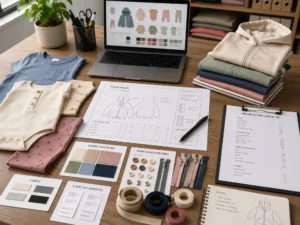
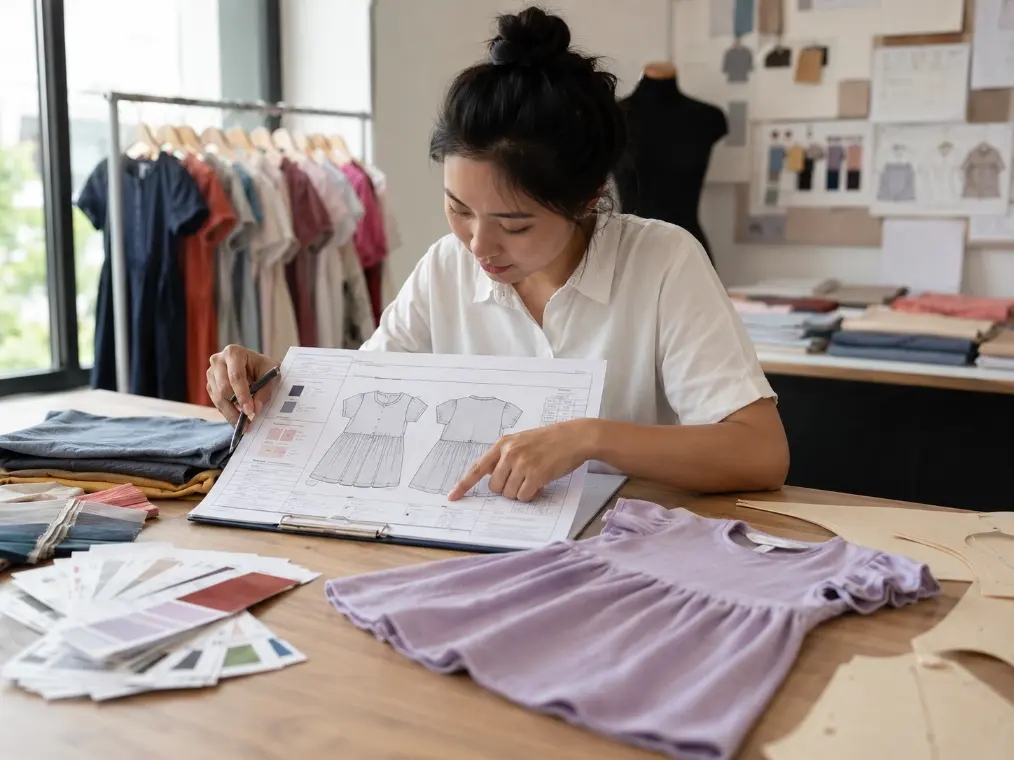
Every OEM order begins with a tech pack. It’s the technical document that tells the factory exactly what to make. A strong tech pack removes guesswork; a vague one invites errors, delays, and cost surprises. If there is one place to invest effort before production, it’s here.
What belongs in a kidswear tech pack
A complete kidswear tech pack usually includes:
- Flat technical sketches showing the garment front, back, and any construction details
- A full measurement spec (points of measure) for each size you plan to produce
- A bill of materials listing every fabric, trim, and component
- Color references, ideally by Pantone number, for each colorway
- Trim and hardware details: snaps, zippers, elastic, appliqué, and labels
- Labeling and packaging instructions, including care and content labels
- Construction and stitching notes wherever the finish matters
The more precise these are, the more accurately a factory can quote and produce.
Why completeness decides your quote and lead time
Factories price and schedule from the tech pack. When information is missing, they either ask (which takes time) or assume (which risks the wrong result). A detailed pack lets the manufacturer calculate material needs, estimate labor, and give you a realistic price and timeline up front. It also reduces the number of sample rounds you’ll need, because the first sample starts closer to what you actually want. Incomplete specs are one of the most common reasons first orders run late.
Protect your design before you send it
You’re about to share your designs with a factory, so protect them first. Many brands ask a manufacturer to sign an NNN agreement (non-disclosure, non-use, non-circumvention) before sending files — for overseas manufacturing, it’s generally considered stronger than a standard NDA. Registering your trademark in your target market is another sensible step. Our guide on how to find and vet a manufacturer covers this and other due-diligence steps in more detail. Working with an established, specialized partner remains your best protection against both quality and IP problems.
Stage 2: Sampling and Your Approval Gates
Sampling is where your design becomes a physical garment you can hold, test, and correct — before you commit to hundreds or thousands of units. For a business reader, this stage is best understood as a series of approval gates. Nothing should move to bulk production until you’ve signed off.
The kidswear sampling ladder
Kidswear samples typically progress through a few stages:
- Proto sample — the first attempt, made to test the design and construction. Expect to request changes.
- Fit sample — focused on measurements and fit, checked against your size spec.
- Pre-production (PP) sample — made with the actual production fabric and trims, representing what bulk will look like.
- Size set — samples across your size range to confirm the grading works across the different age bands.
Overseas sampling rounds often take a few weeks each, so build this into your schedule from the start.
How to review a kids’ sample
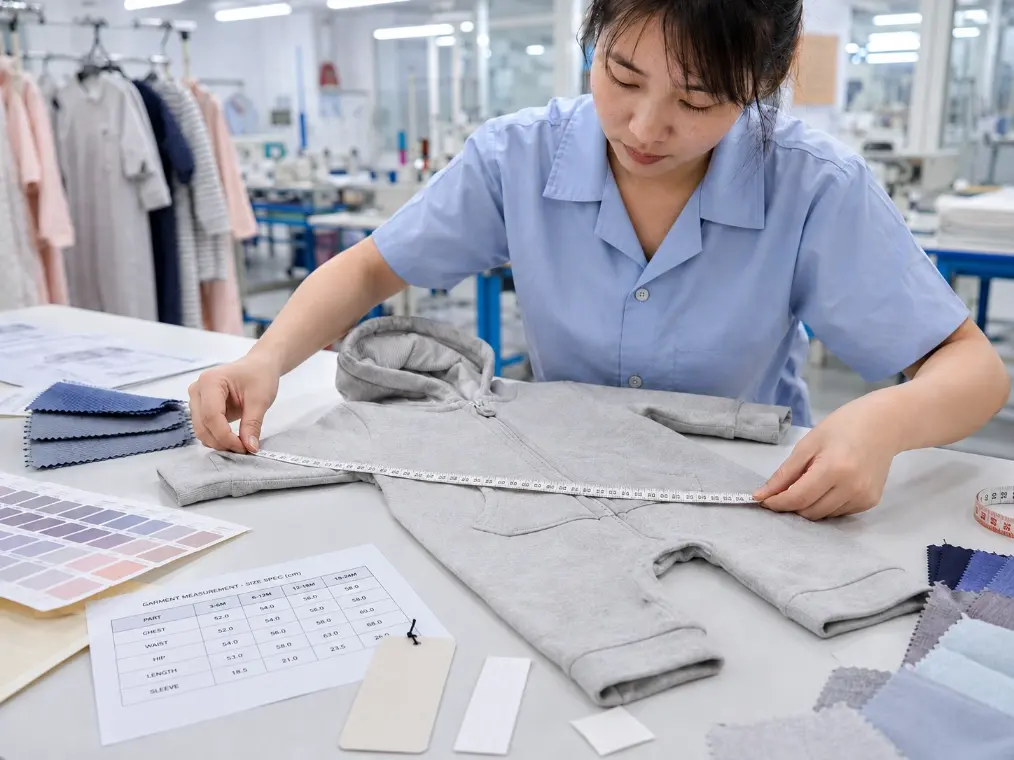
Reviewing a children’s sample means going beyond how it looks. Check the things that matter for young wearers:
- Inside-seam construction, so seams won’t irritate sensitive skin
- Hardware security — pull-test snaps, buttons, and any appliqué to see how firmly they’re attached
- A wash-and-dry test to check for shrinkage and color bleeding
- Measurements against your spec, not just overall appearance
These checks catch the issues that become expensive once they’re multiplied across a full order.
The PP-sample sign-off
The pre-production sample is your last real checkpoint. A reliable manufacturer will ask for your written approval of the PP sample before cutting bulk fabric. Treat that approval seriously: it’s your final chance to confirm that fit, fabric, construction, and finish match what you expect. Once bulk begins, changes are limited and costly. Many factories will iterate through dedicated custom sampling until the sample is right — use that stage fully rather than rushing it.
Grading across kids’ size bands
Children’s sizing works differently from adult S/M/L. A kids’ range might span newborn through age 12 or beyond, with many more size points and proportions that change as children grow. Grading — scaling the base pattern across sizes — carries more fit risk here, which is exactly why the size set matters. Confirm the fit holds at both the smallest and largest sizes, not just the sample size.
Stage 3: Bulk Production With Kidswear Safety Built Into the Line
Once you approve the PP sample, the order moves into bulk production. On the factory floor, that means cutting, sewing, and finishing at scale. What sets children’s clothing apart is that safety isn’t a final step bolted on at the end — it’s built into how the garment is designed and made.
What “bulk” looks like at a kids’ factory
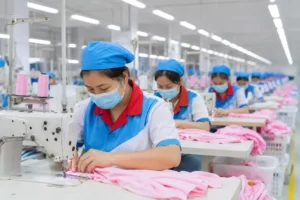
Bulk production runs through cutting (often with automated cutters and marker planning to reduce fabric waste), sewing along specialized lines, and finishing such as trimming, pressing, and attaching labels. For a full walkthrough of the factory-floor steps, see our step-by-step kids clothing manufacturing process. For OEM buyers, the more useful thing to understand is what’s happening for safety reasons alongside the standard construction.
Safety that shapes the garment on the line
Several children’s requirements affect the garment itself, not just the paperwork:
- Drawstrings and cords. In the United States, the U.S. Consumer Product Safety Commission (CPSC) has long-standing guidance restricting drawstrings in the hood and neck area of children’s upper outerwear — commonly cited for sizes 2T–12 — to reduce strangulation risk. Rules like this influence design decisions before production even starts.
- Small parts and hardware. Buttons, snaps, and decorative pieces must be attached securely, since a detached small part is a choking hazard for young children.
- Sharp objects and needles. Children’s garments typically get extra checks for broken needles or metal fragments.
Requirements vary by market, so confirm what applies to where you sell before you finalize the design.
In-line QC and needle/metal detection
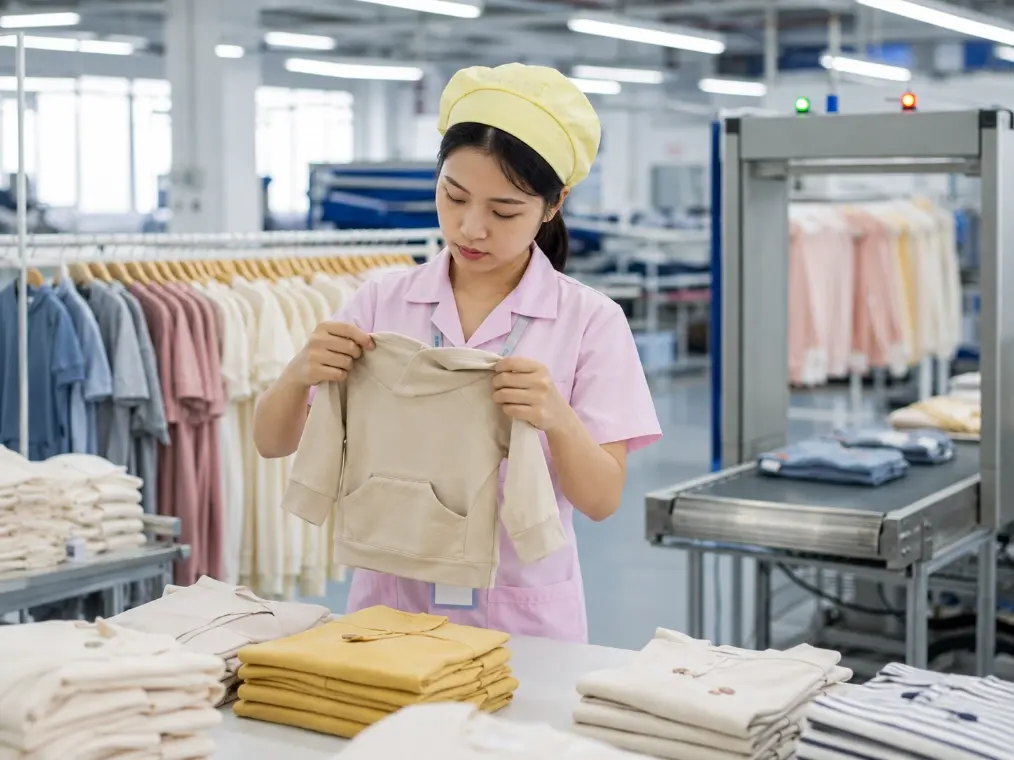
Good factories inspect during production, not only at the end. In-line quality control catches problems while there’s still time to correct them. For children’s clothing, this often includes running finished garments through needle- or metal-detection equipment to screen for contamination — a step that is far more standard in kidswear than in general apparel.
Tracking labels and care/content labeling
Many markets require specific labeling on children’s garments. In the U.S., for example, permanent tracking labels are commonly required so a product can be traced back to its production batch, alongside fiber content and care instructions. Exact requirements differ by destination market, so confirm the labeling rules for where your products will be sold before production locks in.
Stage 4: Final Inspection, Packing, and Delivery
With bulk garments made, the order goes through final checks, gets packed, and ships. This is where you confirm the goods match what you approved and collect the documents you’ll need afterward.
Final inspection and the AQL check
Before shipment, finished goods are inspected. Many factories and third-party inspectors use an AQL (acceptable quality limit) system, which checks a statistically chosen sample of the order against agreed standards and reports defects by severity. An inspection report tells you the defect rate and whether the order passes your tolerance — it doesn’t guarantee that every single piece is flawless, so agree on the standard in advance.
The documents you should receive
For children’s clothing, ask what documentation comes with the order. Depending on your market, this can include third-party test reports for safety and chemical compliance and, for the U.S., a Children’s Product Certificate (CPC) where required. Verified fabric certifications such as OEKO-TEX Standard 100 also strengthen your compliance position. It pays to ask a manufacturer up front which certifications they hold and which test reports they can provide, rather than discovering a gap after the goods arrive.
Shipping, Incoterms, and arrival checks
Finished goods ship by air (faster, costlier) or sea (cheaper, slower); your choice depends on volume, budget, and how quickly you need stock. Shipping terms are defined by Incoterms — FOB (free on board), for example, sets where the seller’s responsibility ends and yours begins. When the goods arrive, verify quantities against your purchase order, check packaging, and confirm the safety certificates and documents are included before you release final payment or put stock on sale.
Timelines, Costs, and Where OEM Orders Go Wrong
Two questions come up on every first order: how long will it take, and what am I actually paying for? Timelines and costs vary by product and factory, so treat any figures as starting ranges to confirm with your manufacturer — but the shape of both is predictable.
A realistic OEM timeline, stage by stage
An OEM order isn’t a single lead time; it’s a chain of stages. As a rough guide:
| Stage | Typical range (confirm with your factory) |
|---|---|
| Sampling (per round) | ~1–3 weeks, often across several rounds |
| Fabric and trim sourcing | Varies widely; specialty materials take longer |
| Bulk production | ~2–5 weeks depending on complexity and quantity |
| Final inspection and packing | A few days |
| Shipping | Days by air; several weeks by sea |
Fabric sourcing is often the least predictable stage, and it can hold up everything after it. Add a buffer rather than assuming best-case timing at every step.
What actually drives your per-unit cost
Your price per garment reflects several factors:
- Fabric choice and quantity — higher-grade or specialty fabrics cost more
- Construction complexity — more panels, linings, or finishing techniques add labor
- Order size — larger runs usually lower the per-unit cost
- Number of sampling rounds and any custom development
- Trims, prints, and decorative techniques such as embroidery or sequins
Minimum order quantities (MOQs) also shape cost. They vary by factory and fabric; many manufacturers that support smaller and growing brands work in the low hundreds per style, and sometimes lower with in-stock fabrics. Confirm the MOQ before you design around it.
The failure points that derail kidswear OEM orders
Most first-order problems trace back to a handful of avoidable mistakes:
- An incomplete tech pack, which leads to wrong assumptions and rework
- Skipping or rushing the PP sample, so problems only surface in bulk
- Underestimating fabric lead time, which delays the whole order
- Discovering compliance requirements late, after the garment is already made
- Setting deadlines with no buffer for the back-and-forth that sampling always involves
Each of these is preventable with planning at the front of the process.
Conclusion
Kidswear OEM manufacturing isn’t a black box. It’s a sequence of stages — tech pack, sampling, bulk production, inspection, and delivery — with clear points where your input and approval shape the outcome. Get the tech pack right, hold each approval gate (especially the PP sample), plan for realistic timelines, and confirm the safety requirements for your market early. Do those things, and your first production run is far more likely to arrive the way you pictured it.
The right manufacturing partner makes each stage easier, particularly the parts unique to children’s clothing. As a specialist children’s apparel manufacturer offering OEM and ODM production, HAPA works with brands through every stage from tech pack to finished goods. If you’re planning a kidswear line and want to talk through your design or sourcing questions, reach out for a quote.
Frequently Asked Questions
What’s the difference between OEM and ODM in kidswear?
With OEM, you supply the design and tech pack and the factory produces to your specification. With ODM, the factory offers ready-made designs that you customize and put your label on. OEM gives more creative control and clearer ownership of the design; ODM is faster to launch and needs less design work.
Do I need a tech pack to start OEM production?
Yes. OEM production is built from your tech pack, so it’s essential. A complete pack — sketches, measurements, bill of materials, colors, trims, and labeling — lets the factory quote accurately and reduces sampling errors and delays. The more detail you provide, the closer the first sample will be.
How long does OEM kidswear production take from tech pack to delivery?
It depends on style complexity, order size, and shipping method. As a rough guide, sampling can take a few weeks (often across several rounds), bulk production a few more, plus inspection and shipping. Fabric sourcing can extend the timeline further. Confirm exact lead times with your factory and build in a buffer.
What safety requirements apply to children’s clothing?
Requirements vary by market — CPSIA rules in the U.S. and REACH in the EU, for example — and can cover drawcords, small parts, flammability, chemical content, and labeling. Confirm the rules for your target market before production, and ask your manufacturer for test reports and a Children’s Product Certificate where required.
What is a PP sample and why does it matter?
A pre-production (PP) sample is the factory’s final sample, made with your actual production fabric and trims before bulk begins. Approving it in writing is your last checkpoint to catch fit, construction, and safety issues — after bulk production starts, changes are limited and expensive.
What’s a typical MOQ for OEM kids clothing?
Minimum order quantities vary by factory and fabric. Many manufacturers that support smaller or growing brands work in the low hundreds of pieces per style, and sometimes lower when you use in-stock fabrics. Always confirm the MOQ with your manufacturer before finalizing your designs and budget.