The best fabrics for kids’ dresses include cotton poplin for defined shapes, lawn or voile for light styles, jersey for stretchy everyday dresses, and linen blends or viscose challis for relaxed drape. Satin, tulle, and fine-wale corduroy suit more specific looks.
I’d choose between them by picturing the finished dress: how it moves, what touches the skin, and how you’ll wash it. This guide uses published textile and pattern-making guidance, with practical selection advice rather than claims from a wear test.
Which Fabrics Work Best for Kids’ Dresses?
For an everyday woven dress, cotton poplin is a useful starting point. For a pull-on style, look at jersey. If you’re choosing fabric for a party dress, decide whether you want shine, soft folds, or a fuller skirt before comparing materials. “Best” means best for the job you need the fabric to do.
| What you’re making | Candidates to compare | The effect you’re looking for | What to check first |
|---|---|---|---|
| Everyday woven dress | Cotton poplin | A clear outline and defined gathers | Stiffness and coverage in the chosen color |
| Light summer dress | Cotton lawn, voile, lightweight linen blend | A lighter feel and relaxed shape | Whether lining changes that feel |
| Pull-on play dress | Cotton jersey | Stretch that works with the design | Stretch direction, recovery, and fit |
| Soft, flowing dress | Viscose challis | Folds that fall closer to the body | Drape and care instructions |
| Special-occasion dress | Satin or tulle over a suitable inner layer | Shine or layered volume | Surface feel and the complete layer combination |
| Dress worn over a top | Fine-wale corduroy | Texture and a more substantial appearance | Seam bulk and room for the layer underneath |
Many fabrics used in children’s clothing can work in dresses. Compare them for a particular garment: a cloth that suits a simple pinafore might be awkward in a densely gathered waist.
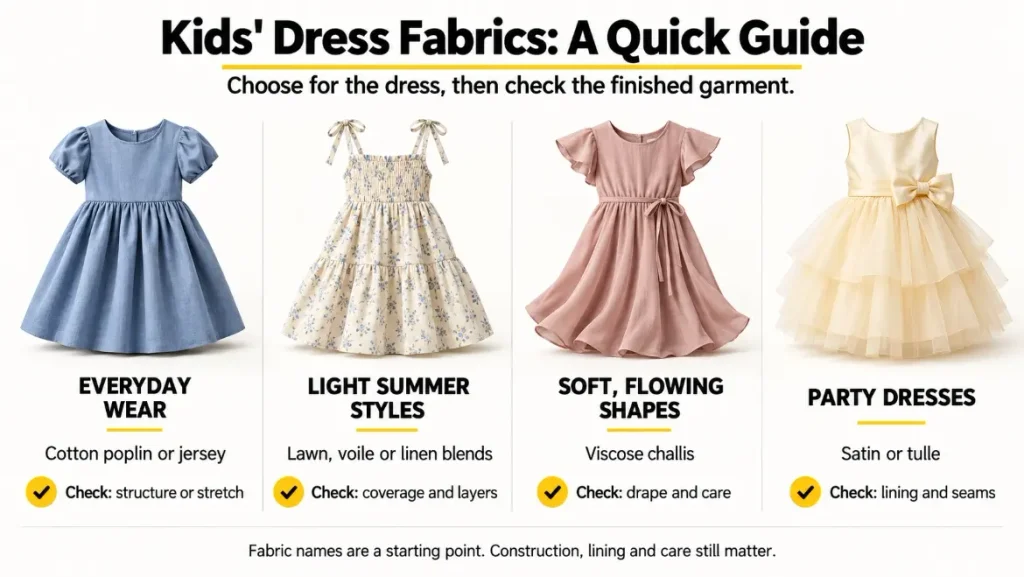
Best Fabrics for Kids’ Dresses by Use
These names describe different things. Cotton is a fiber; jersey is a knitted construction; satin is a weave. Suppliers often combine those terms in fabric descriptions. Read the full specification so you know both what the cloth contains and how it’s made.
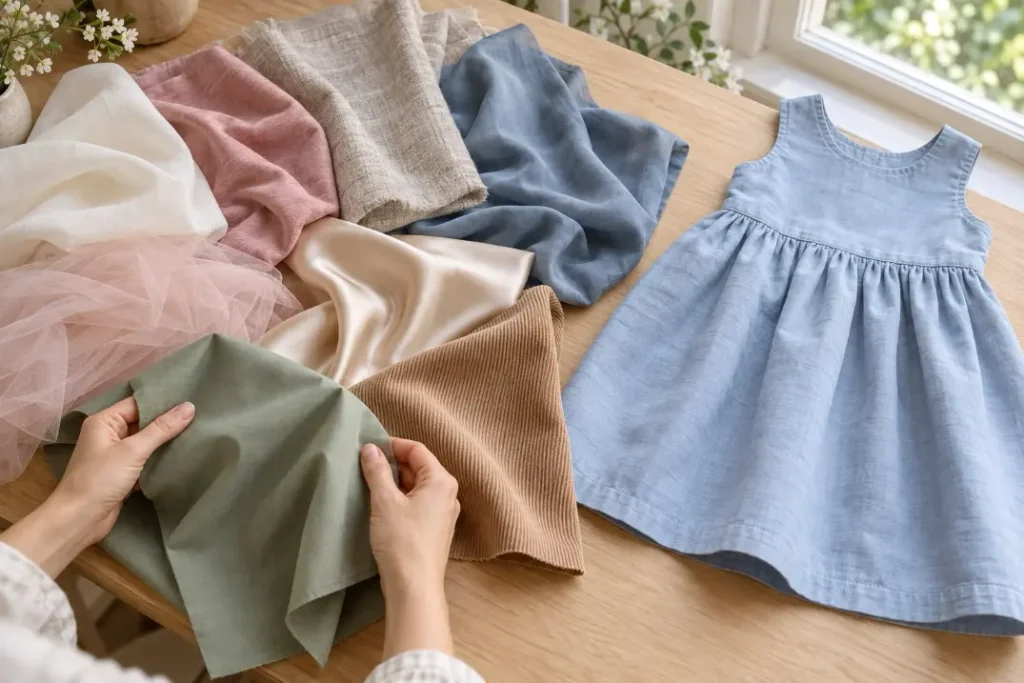
Cotton Poplin for Defined Everyday Shapes
I’d shortlist cotton poplin for a shirt dress or gathered everyday dress when you want the outline to stay visible. A crisp sample can give collars, seams, and folds more definition than a fluid cloth. Spoonflower’s own cotton poplin, for example, is described as having a structured drape; that describes its particular fabric, not every poplin on sale.
Gather a section in your hand and feel the thickness where the folds meet. Would you be happy with that bulk at the waist? Check composition and coverage in the actual color too, rather than assuming the poplin will be soft or opaque enough to use without lining.
Cotton Lawn and Voile for Light Dresses
Lawn and voile are useful cotton fabric options when a heavier cloth would overwhelm small gathers or a light summer shape. They aren’t interchangeable labels. Liberty’s Tana Lawn and Art Gallery Fabrics’ cotton voile are examples of specific lightweight fabrics, each with its own finish and care information.
Compare swatches in your intended colors. Look at drape and coverage. If a pale fabric needs another layer, assess both layers together before deciding it’s the lighter option. A tiny swatch won’t show you the whole skirt’s behavior.
Cotton Jersey for Stretchy Everyday Dresses
Cotton jersey belongs on your shortlist for T-shirt dresses and other designs that use a knit’s stretch. Check how far the fabric stretches, in which direction, and whether it returns toward its original shape. You need a sample or specification for those details; the cotton percentage alone won’t tell you.
The pattern matters too. Simplicity’s fabric-selection guidance explains that some designs depend on a fabric’s stretch for their fit. For a child’s pull-on dress, I’d check the neck opening as well as the body. A roomy skirt doesn’t help if getting the dress over the head is a struggle.
Linen Blends for Relaxed Summer Styles
A lightweight linen blend is worth considering when you like a textured, relaxed-looking dress and can accept some creasing. The other fiber in the blend matters, but you still need to handle the cloth. “Linen blend” covers too many different combinations to promise one feel, drape, or level of wrinkle resistance.
I wouldn’t choose it for a look that depends on staying perfectly pressed unless the sample supports that expectation. Ask what happens after washing and whether ironing is part of the intended routine. For an everyday children’s dress, that’s a buying decision you should make before falling for the print.
Viscose Challis for Soft Drape
Viscose challis is a candidate for a dress with loose folds and a flowing skirt. Viscose describes the fiber; challis describes the fabric type. Truro Fabrics’ Stars challis, for example, is listed as a lightweight woven fabric with fluid drape. Request a swatch to see whether a particular version suits your design.
If your design needs a firm collar, a pronounced bow, or a skirt that stands away from the body, check those details in a sample. Read the care instructions too. I’d pass on a beautiful fabric if its care requirements didn’t fit the way the dress would be used.
Satin for Special-Occasion Dresses
Satin is worth comparing when you want a smooth, lustrous surface. Satin doesn’t mean silk: the weave and fiber content are separate information. There are fluid satins and versions with more body, so a photograph of the shine tells you little about the skirt’s shape.
For children’s party dresses, look at how the surface handles gathers and how it feels against the proposed lining. Simplicity’s S3209 children’s occasion-dress pattern includes satin among its fabric suggestions and specifies lining separately. That distinction is useful: choosing the outside doesn’t finish the material selection. Check the complete combination before approving the look.
Tulle for Layered Party Skirts
Tulle creates a visible net layer, but its feel varies. Mood’s fabric guidance distinguishes soft, flowing tulle from stiffer versions used for volume. Decide which effect you want before choosing the material or the number of layers. “More tulle” isn’t a clear enough instruction for someone making your sample.
Place the proposed tulle over its inner layer and gather them together. Check the waist seam, the underside of the hem, and any edge that could brush an arm or leg. I’d simplify a layered skirt if its appearance depended on a combination that felt awkward to wear. The prettiest swatch isn’t necessarily the right finished skirt.
Fine-Wale Corduroy for Layering Dresses
Fine-wale corduroy has narrow raised ribs and works as a candidate for textured dresses worn over a top. The Oliver + S Library Dress lists fine-wale corduroy alongside lighter woven options, illustrating how one design can accommodate different fabric choices. It doesn’t make all those choices identical in feel or use.
Check the bulk at straps, pockets, and intersecting seams. Then try the sample over the intended underlayer. The narrow ribs don’t tell you the fabric’s weight or guarantee warmth. For production, confirm the direction of the pile when planning the cut so adjoining pieces have the intended appearance.
What Are the Best Fabrics for Kids’ Summer Dresses?
I’d start by comparing cotton lawn, voile, and lightweight linen blends, adding jersey if the design needs stretch. Then I’d consider where the dress will be worn. An outdoor play dress and an indoor celebration outfit can have different priorities even when both are sold as summer clothing.
Use the setting to narrow your choice:
- For everyday outdoor wear, decide how much coverage the dress needs without automatically adding a full lining to a sheer fabric. A different outer fabric may be the simpler solution.
- For a party dress, assess every layer together. The lightness of the top layer doesn’t describe the complete outfit.
- Check the actual color in ordinary daylight and while the garment moves. Looking through a swatch helps you judge coverage; it doesn’t measure airflow or sun protection.
Ask to see the proposed fabric with the intended lining and cut before settling on a “summer cotton.”
What Makes a Kids’ Dress Comfortable?
A comfortable dress needs an agreeable contact surface and enough room for the child to move. You can start with soft fabric and still create an uncomfortable neckline, waist, or armhole. Turn the garment inside out before judging it by its outer surface.
Check the Parts That Touch the Skin
Run your fingers along the neckline, underarm seams, and gathered waist. You’re looking for particular places that deserve a closer check: a rough seam allowance, stiff trim backing, or a bulky join. This is an initial inspection, not proof that every child will find the dress comfortable.
When choosing a sequin dress, look behind the decoration and along its edges. If an area feels uncomfortable, decide how to finish or enclose it before approving the sample. Simply requesting a softer main fabric may leave that contact point unchanged.
Judge the Whole Dress in Motion
Have the child sit, raise their arms, and reach forward in an appropriately supervised fitting. Ask where the dress pulls or feels bothersome. Check whether the waist stays comfortable when seated and whether the opening is practical for dressing. For a layering dress, use the top it will actually be worn over.
If movement is restricted, investigate the armhole, sleeve, closure, and lining before requesting more stretch. Record where the problem occurs so the next sample addresses something specific. The fitting identifies a problem to investigate; it doesn’t establish the cause by itself.
How Do You Choose Lining for Kids’ Dresses?
Choose lining by its purpose: adding coverage, enclosing internal construction, or supporting the intended finish. A dress doesn’t automatically need a full lining. For example, Butterick’s B6201 children’s dress specifies a lined bodice, showing that lining can be planned for a particular part of the garment.
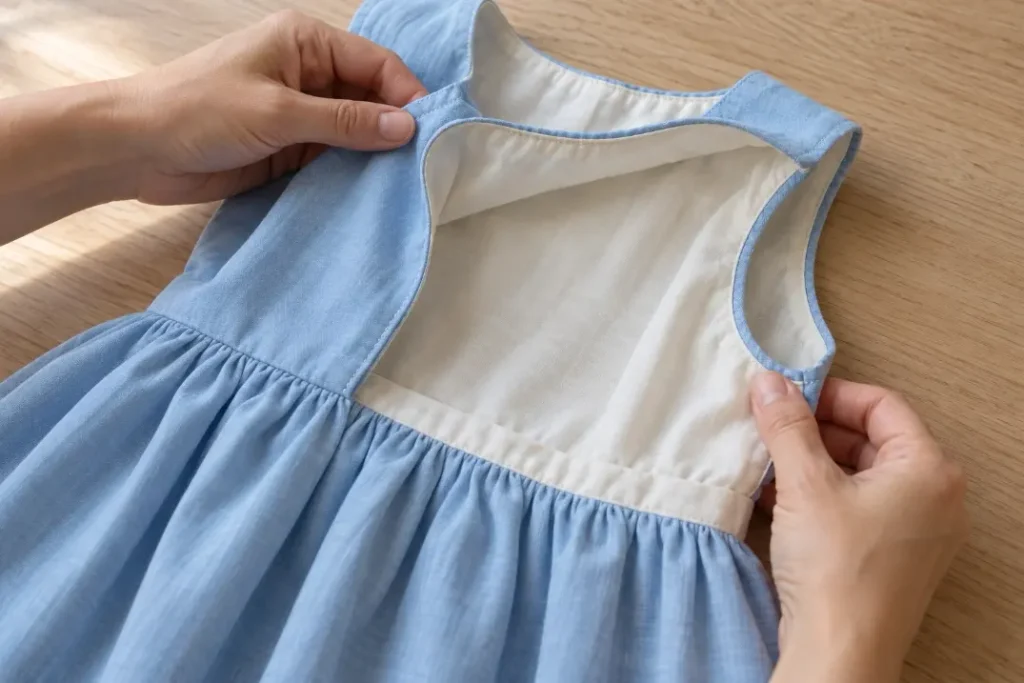
Before choosing lining fabric for kids’ dresses, check the combination:
- Decide which areas need lining. Don’t add a complete extra skirt simply because the bodice needs an enclosed finish.
- Compare the inner and outer layers in motion. For a stretch-dependent design, the lining must allow the movement the garment requires; for a flowing skirt, check whether the combination still falls as intended.
- Confirm compatible care requirements. Check a sample made from both materials, since inspecting them separately won’t show how the assembled dress behaves after washing.
I’d ask for the proposed lining swatch alongside the outer fabric. “Standard lining” leaves too much unspecified, particularly when the chosen outer fabric is light or stretchy.
How Does Fabric Change a Dress’s Shape?
Fabric affects whether folds stand out or fall inward, and whether the garment stretches with the wearer. Drape means how the cloth hangs. You can begin comparing it by suspending similar-sized swatches, but gathers, seams, and lining still need checking in the finished design.
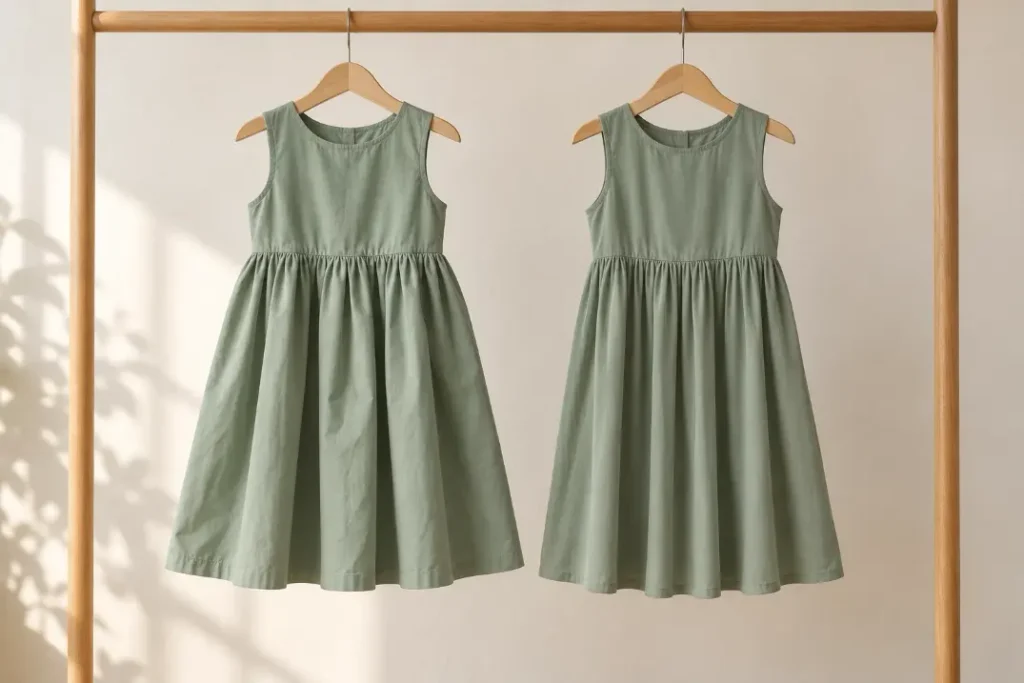
Consider this illustrative selection example, not a test result: you’re developing a gathered-waist day dress and have two candidates, a crisp cotton poplin and a fluid viscose challis. These descriptions refer to the proposed samples, not every fabric carrying those names.
| Decision | Crisp poplin sample | Fluid challis sample |
|---|---|---|
| Intended appearance | Choose if you want more visible shape around the skirt | Choose if you want softer folds closer to the body |
| Waist detail to examine | How thick the gathered seam becomes | How the gathers distribute and fall |
| Bodice question | Does the cloth feel too firm for the intended fit? | Does the bodice need different support or finishing? |
| Next sample decision | Adjust fullness or construction if the waist feels bulky | Recheck the design if you wanted a more pronounced outline |
Both could be reasonable choices. I’d show the sample maker which effect matters more before asking for a replacement fabric. “Something softer” is vague; “keep the bodice shape but reduce bulk at this waist seam” gives them a problem they can work on. If the change also introduces stretch, revisit the pattern rather than assuming the same cut will work.
Which Dress Fabrics Fit Your Laundry Routine?
The right easy-care dress fabric is one whose care requirements suit the finished garment and the household using it. Start with the specific instructions. A washable outer cloth doesn’t settle how a dress with lining, trim, and decorations should be cleaned.
CottonWorks identifies dimensions, surface appearance, colorfastness, and twisting among the issues covered by textile quality testing. For an early sample review, translate those categories into observations you can record:
- Measure the same points before and after the agreed care procedure, including dress length and a relevant width. Keep the measuring method consistent.
- Check whether the outer skirt and lining still hang together without pulling, puckering, or an unexpected length difference.
- Look at side seams, pleats, and the neckline. Note visible changes rather than writing only “washed well.”
- Compare the color and surface with an unwashed reference, looking for staining, fuzzing, or other changes that need investigation.
Use these observations to guide further checks, alongside appropriate production testing. If you’re developing a range, agree on the care procedure and acceptance criteria before approval. “Machine washable” still needs specific washing and drying instructions.
What Should You Check Before Choosing Dress Fabric?
Before choosing, ask for the actual material information and a sample of the dress you intend to produce. Resolve any mismatch between the cloth and the design before approval, while you can still change either one.
Use this sequence to keep the decision manageable:
- Write down the use. Include who will wear the dress, where, and whether it’s an everyday outfit or an occasional purchase.
- Record the fabric details. Ask for composition, construction, weight, relevant finish, and proposed care. Keep the sample reference so everyone is discussing the same cloth.
- Compare the shortlist physically. Look at the intended color, gathered thickness, coverage, and how each fabric hangs. Request a larger sample if the swatch is too small to judge.
- Confirm the actual combination during sample development. Use the planned outer fabric, lining, and important trims; record any substitutes still awaiting approval.
- Review the sample after movement and care checks. Write down the change you need, who will address it, and whether another sample is required.
Pause approval if a substitute material remains unresolved. For instance, a dress made with a temporary lining hasn’t answered whether the intended lining works. That missing decision should stay visible until you can assess the correct combination.
Conclusion
The best fabrics for kids’ dresses are the ones that support the dress you want to make and the way it will be worn. Start with a small shortlist, decide which trade-offs you can accept, and check the complete garment before choosing.
If you’re planning a collection, bring your reference style, intended use, and care expectations to a girls’ dress manufacturing discussion. Those details give the conversation a more useful starting point than asking for “the best cotton.”
Frequently Asked Questions
Can I use quilting cotton for kids’ dresses?
Yes, when its weight and behavior suit the design. Oliver + S lists quilting cotton among the suggested fabrics for its Playdate Dress. That supports its use in that design, not in every dress. If you want a very fluid skirt, compare the actual cloth with a softer-draping candidate before choosing.
Can I replace woven fabric with jersey?
Sometimes, but don’t assume you can keep the pattern unchanged. Stretch affects fit, openings, and how parts of the garment behave. Check whether the design allows both constructions or needs adapting. A sample is especially useful around the neckline, waist, and any closure that was designed for a woven fabric.
Is a higher GSM better for a kids’ dress?
No. GSM means grams per square meter, a measure of fabric mass per area. It doesn’t grade quality or tell you how soft, opaque, or fluid the cloth will be. Use it to compare specifications alongside construction and finish. There isn’t one ideal GSM for both a light summer dress and a structured layering dress.
Is cotton always better than polyester for kids’ dresses?
No. Compare the actual fabrics for the job: their feel, shape, layer combination, and care. Cotton poplin and polyester satin are different in more ways than fiber content, so that comparison can’t isolate a “cotton versus polyester” effect. I’d choose the combination that meets the garment’s requirements rather than make a fiber-wide rule.
Is expensive fabric worth it for a special-occasion dress?
It can be if the extra cost buys a finish or appearance you specifically want and you’re comfortable with the care requirements. Price alone doesn’t show that a child will prefer wearing it. Before paying more, decide what improvement you expect and whether you can see or feel it in the sample.
More Articles About kids clothing Fabrics
Modal vs Cotton: Which Fabric Is Better for Clothing?