Ordering bulk kids’ hoodies can look straightforward until you divide the total across colors and sizes. Suddenly, the price you liked applies to a different quantity, your preferred color needs a separate fabric order, or the smallest size hasn’t been sampled.
I’d start with the collection you can reasonably sell, then work out how to buy it. This guide helps you choose between blanks and custom production, build a usable order breakdown, compare quotes, and settle the details that matter before you commit to a production run.
Choose Your Bulk Kids’ Hoodie Buying Route
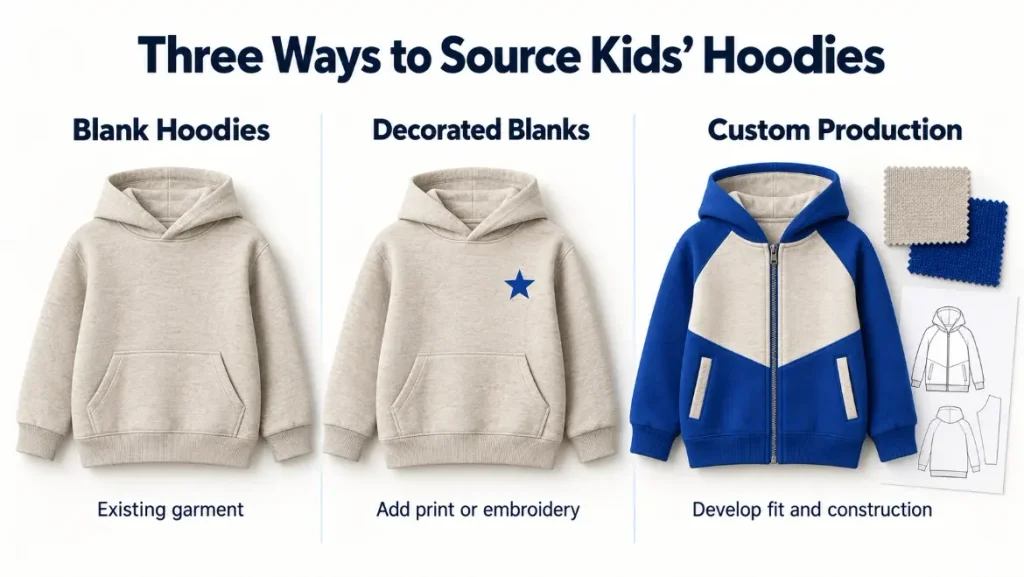
You can buy existing blank hoodies, order those garments with decoration, or develop a hoodie to your own specifications. Choose the route according to what you need to change. A different logo is a different request from a different fit, and the supplier’s quotation should reflect that distinction.
Blank Hoodies for Existing Fits
Buying blank kids’ hoodies in bulk makes sense when an available garment already suits your collection. You choose from the supplier’s styles, colors, and size range, then sell the blanks or arrange suitable branding separately. Wholesale distributors and blank-apparel brands are useful places to compare these options.
When comparing wholesale youth hoodies, check stock across your entire size breakdown before choosing a color. Seeing navy on the product page doesn’t mean every navy size is available in the quantity you need. If you expect to reorder, find out whether the supplier plans to keep the style in its range.
Decorated Blanks for Branded Collections
Decorated blanks give you custom kids’ hoodies with your print, embroidery, or other agreed branding on an existing garment. This is worth considering when your artwork carries the collection and you don’t need to develop a new garment shape. The approved item should show both the actual hoodie and the intended decoration.
Find out who supplies the garments and who handles decoration. If you buy blanks yourself, ask the decorator about accepted materials, rejected pieces, and responsibility for damage during application. Those arrangements belong in the quote before you send garments away.
Custom Production for Your Own Specifications
Custom production is the route to discuss when you need your own measurements, fabric, pocket shape, or construction details. You’ll need time to review development samples and resolve changes before bulk production. The phrase “private label” alone doesn’t tell you how much development is included.
When sourcing private label kids’ hoodies, ask whether the proposal uses an existing pattern or includes developing a new one. That distinction should be clear before you compare the work and cost involved.
| Buying route | What you select or develop | Main limitation to check |
|---|---|---|
| Blank hoodies | Existing style, available sizes and colors | Stock availability and whether the fit suits your customers |
| Decorated blanks | Existing garment plus agreed artwork or branding | Decoration compatibility and the garment’s fixed construction |
| Custom production | Agreed garment specifications and branding | Development work, material requirements, and approval schedule |
4 Ways to Buy Kids’ Hoodies in Bulk
You can source through manufacturers, clothing wholesalers, B2B marketplaces, or blank-apparel suppliers and decorators. These channels can overlap: a manufacturer might also list on a marketplace. I’d use them to build a shortlist, then check who supplies the garments, what you can customize, and which order conditions apply.
1. Buy Directly From Kids’ Hoodie Manufacturers
Contact kids’ hoodie manufacturers when your collection needs garment development. Start with their official product pages and request examples relevant to your age range and hoodie design. Ask who will handle sampling, production, and any outsourced work, rather than relying on the word “factory” in a listing. For a starting shortlist, compare the suppliers in this hoodie manufacturer guide and confirm each candidate’s experience with children’s sizes before requesting samples.
HAPA offers custom boys’ hoodie manufacturing. Share your references and proposed quantities to discuss the development scope. Buying direct doesn’t automatically mean the lowest total cost; compare the work included and whether the order fits your budget.
2. Source From Wholesale Clothing Suppliers
Look for wholesale kids’ hoodies in clothing catalogs when you want existing styles for resale. Ask for current stock by size and color, whether you can choose individual quantities, and whether products are sold in fixed packs. A pack can meet a supplier’s rules while leaving you with sizes you don’t need.
Before paying, confirm the product branding, resale conditions, and process for shortages or damaged goods. If the range is seasonal, ask whether a later order will contain the same style or only similar alternatives.
3. Find Suppliers Through B2B Marketplaces
B2B marketplaces can help you find suppliers, but they don’t all serve the same buying need. For kids’ hoodies, these are useful places to start:
- Alibaba.com: Search for wholesale kids’ hoodies or custom kids’ hoodies, depending on your buying route. Send your brief to shortlisted suppliers and confirm whether their offer covers existing garments, decoration, or custom production.
- Made-in-China.com: Search children’s hoodie products and supplier profiles when comparing China-based sourcing options. Check the seller’s business type and ask which specifications the displayed price covers.
- Global Sources: Use its kidswear supplier listings to find businesses to contact. Ask for a current children’s hoodie catalog and relevant samples; a general kidswear listing doesn’t establish experience with your particular design.
- Faire: Browse wholesale kids’ sweatshirts and hoodies from brands supplying retailers. I’d use it primarily to compare existing products for resale, then ask individual sellers about any customization rather than assume they offer factory development.
Treat a listing as a lead, not an approved supplier. Use the same brief to compare replies, check the business identity, and request a relevant sample. Confirm that prices and minimums apply to your order, and review any platform payment or dispute terms before relying on them.
4. Order Through Blank Apparel Suppliers and Decorators
To buy blank kids’ hoodies in bulk for decoration, search blank-apparel catalogs and contact printing or embroidery businesses. Ask whether the decorator supplies the garments or expects you to purchase and deliver them separately.
If two businesses are involved, confirm stock before booking decoration. Agree who checks incoming garments and handles rejected pieces or application damage. Compare the combined garment, decoration, and delivery cost with an all-inclusive proposal.
Define the Hoodie Before Requesting Prices
A useful inquiry gives suppliers enough information to quote the same product. Start with the intended customer and how the hoodie will be worn. A roomy layer for school-age children and a close-fitting toddler style need different specifications, even if both reference the same photograph.
Use hoodie styles and fits to narrow the shape, then explain the details a style name leaves open. “Oversized” doesn’t specify sleeve length, body width, or where the hem should sit. A reference garment can help, provided you identify what you want to keep and what you want changed.
Your first brief should cover:
- Target market, age or height range, and intended use.
- Front and back references, opening type, pockets, and fit direction.
- Size range, measurement units, and any existing garment measurements.
- Fabric composition, construction, weight, and desired inside finish, where already decided.
- Artwork dimensions, placement, labels, packaging, and required delivery location.
- Estimated quantities by style, color, and size, with unresolved choices clearly marked.
If you haven’t selected materials, explain how the hoodie will be used and what you can spend, then ask for fabric suggestions. The guide to fabrics for kids’ hoodies can help you describe that request. Have each alternative priced separately so you can see what changes with the fabric or finish. Give the brief a version number, too; otherwise, two suppliers may be pricing different revisions without either realizing it.
What Is the MOQ for Kids’ Hoodies?
There isn’t one minimum order quantity for bulk kids’ hoodies across all suppliers. The minimum depends on the buying route and the conditions attached to the garment, material, color, or decoration. Ask what the MOQ applies to before treating it as your total order requirement.
Confirm What the Minimum Applies To
Suppose a supplier quotes a hypothetical minimum of 100 pieces per style per color. One style in two colors would require 200 pieces under those terms. That doesn’t tell you whether sizes can be mixed freely, whether an individual size has a minimum, or whether custom fabric has another requirement.
Send the supplier your proposed breakdown and ask them to confirm it line by line. The answer should identify any combination that doesn’t meet their conditions. A general “yes, we accept mixed sizes” is less useful than confirmation of the quantities you actually intend to order.
Reduce Complexity Before Increasing Quantity
If the minimum is above your budget, I’d first ask which specification creates it. An available fabric color, a simpler trim, or fewer colorways might allow a different proposal. The supplier needs to confirm whether those changes help; reducing the order’s complexity doesn’t automatically reduce every minimum.
Be careful about accepting extra units simply to make the original design possible. Compare that option with a smaller, more focused collection. You might prefer one well-supported style over several lightly stocked variations, especially when you have little sales history. Keep the features that give the garment its purpose, and negotiate the choices that don’t materially affect your customer.
Plan Your Size and Color Breakdown
Your order breakdown should show what you expect to sell, rather than divide the total equally for convenience. Existing sales, customer measurements, retailer commitments, or preorders can inform it. Without that evidence, write down why you’ve chosen each quantity and revisit those assumptions once sales begin.
Use Measurements Alongside Age Labels
When comparing wholesale youth hoodies, treat age labels and youth S, M, or L as starting points, not a shared measurement system across suppliers. Ask whether a chart describes the child’s body or the finished garment. A chest circumference and a flat garment chest width cannot be compared directly without understanding how each was measured.
Record measurement points, units, and agreed tolerances for your chosen fit. Include the intended layering room rather than assuming that a larger age label will solve it. You can gain width by moving up a size while also adding sleeve and body length that you didn’t want.
For a new range, I’d check the ends of the size run early. A hoodie that looks balanced in the middle size can have a different hood-to-body proportion or awkward pocket placement in the smallest size. That gives you a specific issue to review before ordering every size.
Check the Quantities Behind Each SKU
A SKU identifies a particular sellable variant. One hoodie style in two colors and five sizes creates ten variants to plan and track. The table below is an illustrative 300-piece order, not a recommended sales ratio or an actual customer order. Its purpose is to show how a total becomes individual purchasing decisions.
| Size label | Navy | Oatmeal | Total |
|---|---|---|---|
| XS | 20 | 15 | 35 |
| S | 35 | 20 | 55 |
| M | 45 | 30 | 75 |
| L | 35 | 25 | 60 |
| XL | 25 | 50 | 75 |
| Total | 160 | 140 | 300 |
The 50 oatmeal XL units deserve a reason just as much as the 15 oatmeal XS units do. If you can’t explain that difference through demand evidence, revisit it. Then check the breakdown against the supplier’s conditions. Under the earlier hypothetical 100-piece minimum per style per color, both color totals qualify; any size-level or material minimum would still need checking.
Adding another color without increasing the total means redistributing those 300 pieces. You may end up with fewer units in your useful sizes or fall below a color minimum. Keep the order sheet tied to your budget, and record which assumptions you intend to test through sales.
Compare Bulk Hoodie Quotes on Equal Terms
When pricing bulk kids’ hoodies, two unit prices are comparable only when they cover the same product and delivery scope. Send each supplier the same specification version and size breakdown, then ask them to identify substitutions or exclusions. A different fabric, smaller print, or simpler packaging can explain a price difference without saying anything about manufacturing quality.
Ask What the Unit Price Includes
Request a written breakdown of charges and responsibilities. You don’t need the supplier’s private cost accounting, but you do need to know what you’ll pay for. Check these items against each quote:
- Pattern development, samples, revisions, and whether any charge is credited against production.
- The hoodie itself, including larger-size surcharges or different prices by color.
- Decoration setup and application, with artwork size and placement specified.
- Labels, hangtags, individual packaging, carton packing, and barcode application.
- Agreed testing, inspection, shipping, and any destination charges included or excluded.
For decorated collections, refer back to embroidery vs. printing for kids’ hoodies before accepting “logo included” as a specification. A small chest emblem and a large back graphic are different requests. Ask suppliers to quote the actual design, not a generic decoration allowance.
Keep a separate total for costs needed to receive the order at your destination. Add only charges that aren’t already included, and have the relevant logistics provider confirm freight and import costs. Record the currency, quotation validity, delivery terms, and named destination. An attractive factory price leaves several questions unanswered if you don’t know where the supplier’s delivery responsibility ends.
Weigh Price Breaks Against Inventory Risk
A larger order can have a lower unit price while requiring more cash overall. Compare both totals before accepting the discount. Then consider where the extra units will sit in your size and color breakdown and whether your sales assumptions support them.
I’d ask for prices at two quantities you can genuinely consider, using the same specifications. That shows the cost of flexibility without turning the conversation into an unrealistic request for the lowest possible price. Include the cash you still need for shipping, launch expenses, and a possible reorder when deciding what you can afford.
The quantity that earns the best discount isn’t necessarily the quantity your brand should buy. If you need to reduce the order, identify the product features customers value before removing them. Cutting a feature that defines the collection can leave you with a cheaper hoodie that no longer meets the brief.
Approve Samples Before Bulk Production
Before ordering custom kids’ hoodies in bulk, use samples to resolve uncertainties that could affect the whole order. Ask what stage each sample represents and which materials or details differ from the proposed production version. A fit sample in substitute fabric can answer some questions, but it cannot approve the final fabric’s feel or appearance.
Check Fit Across the Size Range
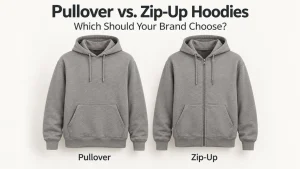
Measure the sample using the agreed points, then assess it in the intended wearing situation. Check the head opening, sleeve length, cuff stretch, pocket access, and room over the expected underlayer. For a zip-up, open and close the zipper and look at how the front hangs.
A size set is a group of samples covering agreed sizes. Discuss which sizes you need to review based on the development risk, rather than assuming one middle size approves everything. Smaller sizes also need a decoration check: a graphic that fits one body width may crowd the pocket or seams on another.
When arranging product sample development, specify which questions each sample needs to answer. You can then distinguish a fit approval from a color approval or a complete pre-production approval. That keeps “sample approved” from becoming an instruction broader than you intended.
Record Wash Checks and Final Changes
Wash a suitable sample using the proposed care instructions and record the conditions, measurements, and visible changes. Compare body and sleeve dimensions, seam appearance, surface condition, and decoration. Agree in advance what results require a revision. A home wash check is a useful observation, but it doesn’t replace applicable laboratory testing.
Put comments into one dated revision record with photographs and measurements. “Make the cuff looser” is open to interpretation; the desired measurement and acceptable range give the supplier something to work with. Check whether a change affects connected parts, such as the sleeve opening or rib attachment.
Keep an identified approved sample and matching specification version. If any production material changes afterward, ask what needs reapproval. You want the factory and your inspector to use the same reference, including any written exceptions you agreed to accept.
Check Children’s Product Requirements Early
Tell the supplier where the hoodies will be sold, the intended age range, and their use before approving the design. Requirements depend on those details. Ordinary daywear, sleepwear, and products making protective claims shouldn’t be treated as interchangeable categories. This guide uses US examples; other markets need their own review.
For the US, CPSC’s guidance on drawstrings identifies hood and neck drawstrings in children’s upper outerwear sizes 2T to 12, or equivalent, as a substantial product hazard. Separate requirements cover waist and bottom drawstrings in sizes 2T to 16. Review the design against the applicable rules before sampling, rather than copying every detail from an adult hoodie.
Agree who will prepare and check the product’s evidence:
- Identify applicable requirements with a qualified laboratory or compliance adviser for the destination market.
- Specify which materials and components any reports cover, and whether they match the proposed product.
- Assign responsibility for labels, production identification, and any required certification documents.
- Keep approved specifications and relevant records connected to the production batch.
US children’s products also need permanent tracking information on the product and packaging to the extent practicable, as explained in CPSC’s tracking-label guidance. Where a Children’s Product Certificate is required, the US domestic manufacturer or importer is responsible for issuing it; it is not a factory accreditation. Have that party confirm applicable testing, exemptions, and certification requirements. A good-looking sample, fabric certificate, or final quality inspection alone doesn’t establish that the finished hoodie meets every applicable requirement.
Plan Delivery and Reorders Together
Set the date you need usable stock at your destination, then ask suppliers to work backward from it. At the same time, discuss what happens if one color or size sells faster than expected. The first order and the replenishment order may face different availability or minimums.
Work Back From Your Delivery Date
Ask for a schedule that separates sampling, revisions, material approval, production, inspection, dispatch, and transport. Find out which approvals or payments start each stage. A production estimate beginning after final approval won’t help if your launch calendar starts counting from the first inquiry.
Allow room for decisions you still need to make, and agree how delays will be communicated. For a fixed launch, identify the latest date at which a change would force you to revise the launch or delivery plan. Base your buffer on the transport route and unfinished development work. Check who on your team can approve samples while the usual decision-maker is unavailable; an unanswered approval request can leave the next stage waiting.

Confirm Repeat-Order Conditions
Ask whether you can reorder selected sizes, what minimum applies, and whether the same material and color will still be available. For blanks, check the style’s supply continuity. For private label kids’ hoodies made to your specifications, ask about fabric availability, retained patterns, and the reference used to match future batches.
If you plan a repeat girls’ hoodie collection, make continuity part of the original development discussion. Keep approved color and garment references, but don’t assume a new production lot will be visually identical without review. Record whether substitutions require your written approval and who will notify you before a material is changed.
Review the Order Before Paying a Deposit
Before committing to bulk kids’ hoodies, read the purchase order alongside the final quote and approval record. They should describe the same product and quantities. Check the supplier’s legal business details and payment instructions, and verify any unexpected payment-account change through an established contact channel.
I’d pause the order if an unresolved point could change the product, total spend, or delivery commitment. Use this final review to close those gaps:
- Match each style to the approved specification version and sample reference.
- Reconcile every color and size quantity with the quoted total and minimums.
- Confirm all included charges, exclusions, payment milestones, and any quantity variation allowed.
- Record delivery milestones, destination, shipping responsibilities, and packaging instructions.
- Agree on inspection criteria and how nonconforming goods will be reported and handled.
- Confirm that material, construction, or artwork changes need approval before implementation.
Agree how problems will be handled before they happen. Who reviews a failed inspection? What evidence is needed? How are rework, replacement, or other remedies agreed? Those answers depend on your contract; neither a deposit nor a payment method guarantees a particular outcome. Keep a copy of the accepted documents outside the supplier’s messaging thread so you can find the final agreement without searching through weeks of messages.
Conclusion
Buying bulk kids’ hoodies becomes easier when the product and order breakdown are clear enough for everyone to work from. Choose the buying route, check the quantities behind each color and size, and compare complete quotes before approving production. Preserve the final sample and written changes so you have a reference when the goods arrive.
If you’re preparing a collection with HAPA, send your target market, size range, reference design or tech pack, proposed quantities, and required delivery date. Use those details to discuss development and sampling, then confirm the commercial conditions for your specific order.
Frequently Asked Questions
Can I add my own label to blank kids’ hoodies?
Ask the supplier about rebranding options and inspect which information appears on the original labels. In the US, FTC guidance on replacing textile labels explains that required information must be retained in a compliant replacement, with identification and recordkeeping obligations. A tear-away brand label isn’t permission to remove all product information.
Can toddler and youth hoodies share one order?
A supplier may accept them under one purchase order, but ask whether they count as separate styles or size ranges for production and MOQ purposes. Don’t assume a toddler hoodie is simply the smallest youth size. Confirm each range’s measurements, design details, and approved samples before combining their quantities in your planning.
Can one bulk order include individual packaging and barcodes?
Include those requirements in the inquiry and ask the supplier to confirm the service and cost. Provide the SKU-to-barcode mapping, label placement, and packing instructions rather than asking for “retail-ready packaging.” Approve an example and check that the code, garment size, color, and outer packaging all identify the same item.
What if I need to change the order after approval?
Contact the supplier promptly and request a pause on the affected work where possible. Ask what has already been purchased or produced before agreeing to the change. Update the specification, quantity sheet, price, and schedule in writing. Some changes may no longer be practical, and costs depend on the work already committed.