When comparing pullover vs. zip-up hoodies, start with what your customer needs the garment to do. Choose a pullover as your starting point for an uninterrupted front design; consider a zip-up when easy removal and adjustable coverage matter more. Neither choice settles the fabric, fit, or quality.
For your brand, that opening also changes artwork placement, sampling priorities, and the quote you need. This guide compares those decisions so you can select a style, spot avoidable development problems, and give your manufacturer a clearer brief.
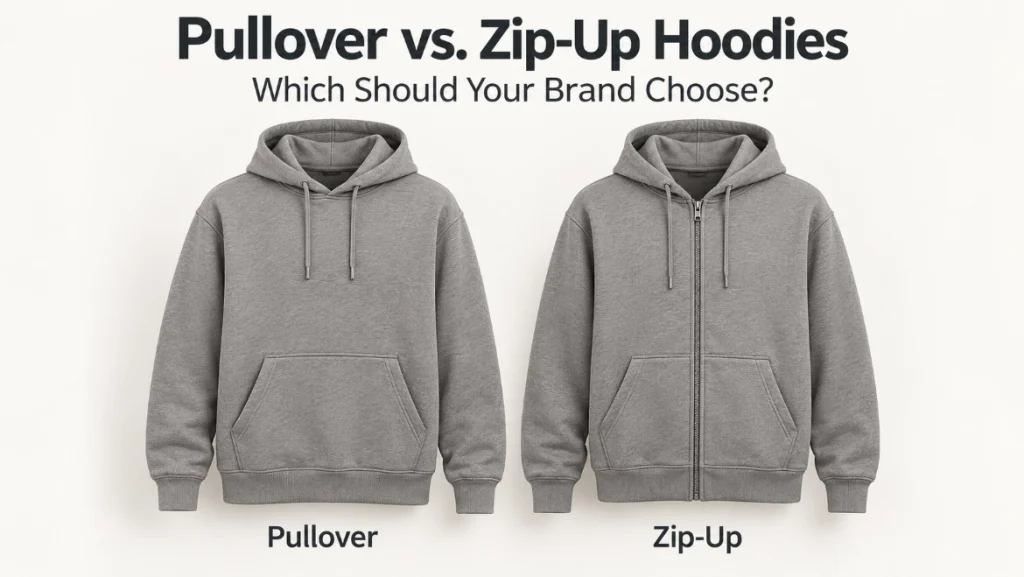
What Is the Difference Between Pullover and Zip-Up Hoodies?
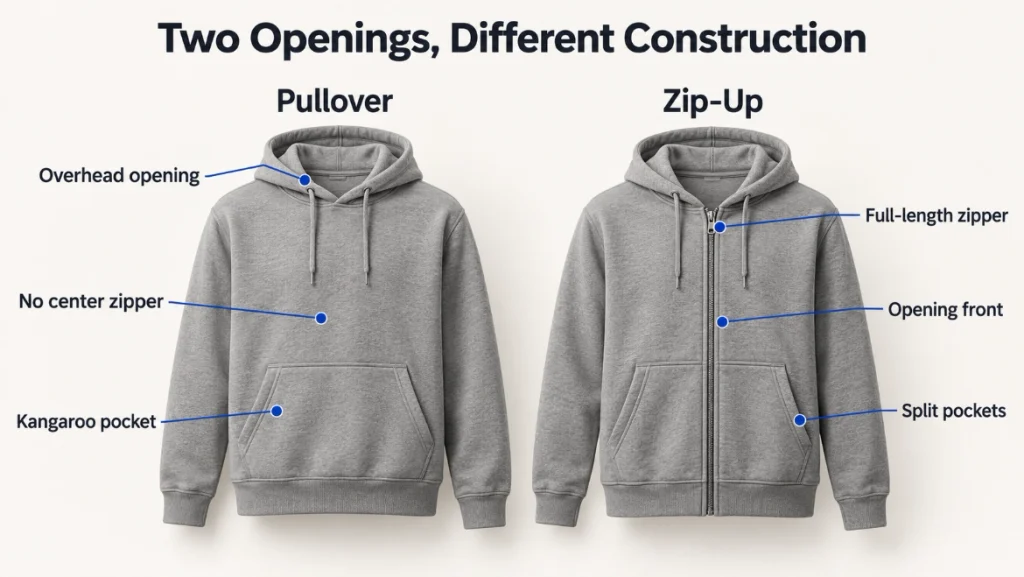
A pullover hoodie goes over the head and has no full-length front opening. A zip-up hoodie opens down the front with a zipper. That difference affects how you put it on, where you place a graphic, and which construction details need attention. Both can be fitted, oversized, lightweight, or substantial.
Treat the closure and silhouette as separate choices. A boxy pullover and a slim zip-up differ in more than their openings, so comparing them won’t tell you which closure works better for your intended fit. If you’re still defining the silhouette, the wider guide to types of hoodies can help you separate those decisions.
| Decision | Pullover hoodie | Zip-up hoodie |
|---|---|---|
| Putting it on | Head and arms pass through the garment | Front opens before the arms enter the sleeves |
| Front artwork | No central zipper, but pockets and seams still restrict placement | Zipper divides the front; separate chest placements are an option |
| Adjusting coverage | Usually requires removing the garment to uncover the torso | Can be worn fully closed, partly open, or open |
| Components | No front zipper to specify | Zipper, slider, tape, and installation details need approval |
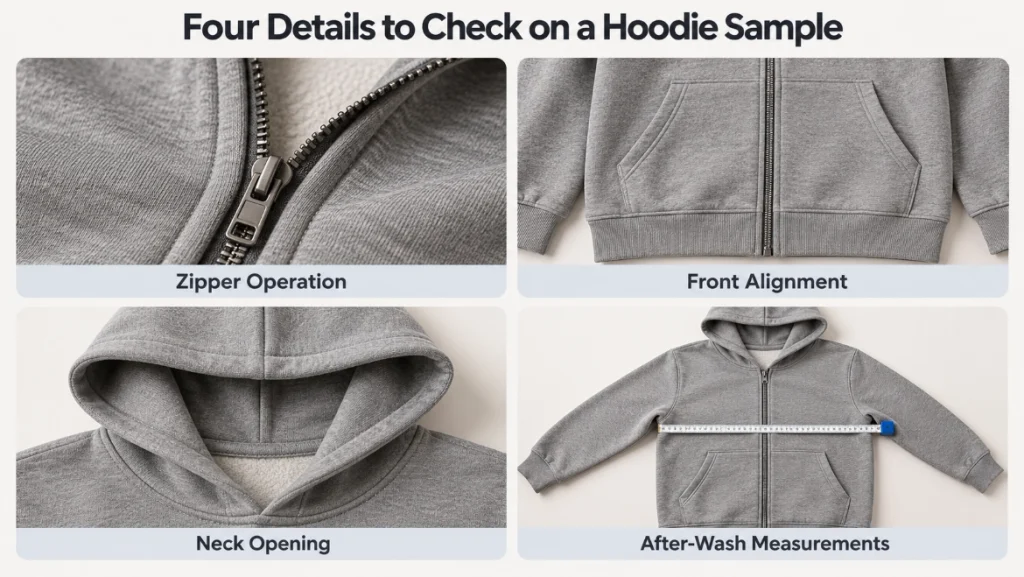
| Sample priorities | Neck opening, hood attachment, pocket position, and shape | Zipper operation, front alignment, pocket matching, and shape |
| Useful starting brief | A graphic-led top or an everyday sweatshirt | A removable layer or a style designed to show the garment underneath |
This guide compares everyday sweatshirt-style hoodies using published technical guidance and suggested sample checks, not wear-test results or sales rankings. If the options use different fabrics or fits, you can still choose between them. Just keep those differences visible when explaining why you selected one.
Which Style Works Better for Everyday Wear?
I’d start with a zip-up when your customer expects to take the layer off frequently, and a pullover when it will stay on as a top. Either needs to fit comfortably. The basic features of a hoodie give you a starting checklist; trying the sample in movement tells you more than its appearance on a hanger.
Getting It On and Off
With a pullover, the neck opening has to let the wearer put it on comfortably while returning to the appearance you want afterward. A roomy body doesn’t guarantee an easy opening. Ask the sample wearer to put it on and remove it with the intended shirt underneath. Observe whether they struggle at the head, pull heavily on the hood, or drag the shirt upward.
A full-zip hoodie avoids pulling the garment over the head, but it introduces a different task: joining and operating the zipper. Check whether the wearer can grasp the pull and start the closure without repeatedly correcting it. For a children’s range, use an age-appropriate fitting process with supervision. Don’t assume that a front opening automatically makes every zipper easy for every child to use.
Comparing Open and Closed Fit
Approve a zip-up’s fit while it is closed, even if your campaign photographs show it open. An open front can conceal insufficient room across the chest or stomach. Compare the closed garment against your specified measurements, then check its side profile. A neat standing photograph won’t tell you what happens when the wearer sits, reaches forward, or puts a bag over one shoulder.
For both styles, fit the sample over the layer your customer is likely to wear. A hoodie that works over a thin T-shirt may feel restrictive over a heavier top. If you want an oversized silhouette, define the shoulder position and body proportions rather than simply increasing the labeled size. Use a few ordinary movements to review that choice:
- Sit down and check whether the hem, pocket, or closed front presses uncomfortably against the body.
- Reach forward and overhead, observing sleeve movement and how far the body rises.
- Put the hood up and turn the head; note pulling at the neckline or unwanted obstruction.
- Add the intended outer jacket and check whether the sleeves and hood fit together without awkward bunching.
Are Pullover Hoodies Warmer Than Zip-Ups?
A pullover isn’t automatically warmer than a zip-up. To evaluate the closure itself, start with comparable fabric, coverage, fit, and underlayers. Comparing a thick brushed pullover with a lightweight loopback zip-up tells you about two different garments, not the thermal effect of adding a zipper. Fabric weight alone also isn’t a temperature rating.
A zipper lets the wearer uncover part of the torso without taking the hoodie off. That’s useful when moving between indoors and outdoors, or when activity levels change. It is different from the fabric’s ability to pass air or manage moisture. REI’s layering guidance separates insulation from weather protection and explains why conditions and activity affect clothing choices. A casual hoodie should not acquire a windproof or waterproof claim simply because it feels substantial.
For a winter collection, compare the hoodie as part of the intended outfit. Check coverage at the neck and hem, room for the underlayer, and compatibility with the outer jacket. For an indoor layer, ask whether customers can comfortably keep it on. If you’re developing childrenswear, the guide to fabrics for kids’ hoodies covers material choices separately. Set the fabric and use requirements before choosing a closure as your answer to warmth.
Which Hoodie Is Better for Printing?
A pullover is usually the simpler starting point for a large centered front graphic because there is no zipper through the image. A zip-up can work well with separate chest graphics, sleeve decoration, or a back design. Choose the artwork location before approving the hoodie body, particularly when the image is central to your collection’s identity.
Large Front Graphics
A pullover’s front is not an unlimited print surface. A kangaroo pocket, its stitching, and the neckline can restrict the usable area. Review your artwork at its actual output size on the smallest and largest planned garments. A design that looks balanced in one mockup might sit too close to the pocket on a smaller size. Agree whether the graphic stays the same size throughout the range or changes between size groups.
Also distinguish an existing blank from a garment you are developing from scratch. On a blank, the pocket and seams are already fixed. In custom production, you can ask about changing pocket placement or decorating a cut panel before assembly. Those choices require revised drawings and approval of the assembled sample. They don’t remove the need to check the finished graphic’s position. Put these details in the artwork brief:
- Give the design’s finished width and height, with a clear placement reference on the garment drawing.
- Mark its relationship to pocket edges and seams rather than relying on a centered image in a mockup.
- Show how the artwork should appear across the size range, including any approved size changes.
- State whether the pocket itself is decorated and whether the graphic must continue across a seam.
Logos Around a Zipper
A small chest logo leaves the opening clear, while a back graphic gives you another prominent location. Check the back with the hood resting normally, since the hood can cover upper artwork. For heat-applied decoration, STAHLS’ guidance on hoodie decoration discusses using suitable accessories around pockets, seams, and zippers. That is process-specific advice; it doesn’t mean every printer can reproduce every design across a raised closure.
If artwork must cross the zipper, ask the decorator to demonstrate the proposed process on the intended garment. Approve how the two halves meet when closed and how each looks when open. In an illustrative design brief, a circular front emblem might become a small chest emblem plus a larger back image on the zip-up. That is a design change requiring your approval, not an equivalent reproduction. For children’s collections, compare the finish and placement alongside embroidery versus printing for kids’ hoodies, including how the decorated area feels inside.
Do Zip-Up Hoodies Cost More to Produce?
A zip-up introduces a zipper and the work needed to install and check it, so it adds cost items to an otherwise comparable specification. That doesn’t establish a universal price difference. A simple zip-up and a heavily decorated pullover are different jobs. The fabric, order breakdown, construction, and decoration can change the result more than the closure alone.
Ask for two quotes against the same brief, with any necessary differences identified. If the zipper changes but the factory also substitutes a lighter body fabric, you no longer have a useful closure comparison. Likewise, a stock pullover blank and a newly developed zip-up carry different development costs. To understand the custom hoodie production cost, request the following breakdown:
- Keep the body fabric, color, size breakdown, and quantity consistent wherever possible. Ask the supplier to identify any specification it cannot match.
- Name the proposed zipper and its relevant details, including length, finish, and pull. Ask which options are available before specifying a custom component.
- Separate initial pattern, sample, and artwork preparation charges from the recurring garment price. Confirm which charges apply again to a reorder or revision.
- Compare decoration by actual size, location, and method. A large front print and a small chest logo should not appear as the same undefined “branding included” item.
- Confirm the checking, packaging, delivery basis, and other inclusions. Keep freight and import-related costs visible when comparing factory quotes with delivered prices.
- Ask what must be ordered specially for each version and what can be sourced again for a repeat order. If the proposed zipper length, finish, or color is unavailable later, agree who approves an alternative. For decorated blanks, ask the same question about the garment itself. A workable first quote should also make clear which specifications depend on stock availability.
Consider the money committed across the collection as well as the price of one hoodie. Two closures in several colors and sizes create more stock combinations to manage. Sharing a fabric does not necessarily mean the supplier will combine every minimum. The bulk kids’ hoodie buying guide covers that order-planning discussion for childrenswear brands.
I’d accept a cheaper option more readily if the supplier could show exactly what changed. Removing a feature your customer doesn’t need can be a sensible saving. Changing the fabric or leaving decoration and packaging unpriced needs a different discussion. Request the revised specification beside the price rather than relying on an assurance that both versions are “the same quality.”
What Quality Issues Should Your Brand Check?
For a zip-up, pay particular attention to the closure and the way the two front sections sit together. For a pullover, focus on the neck opening and how the garment behaves during dressing. Both still need acceptable seams, dimensions, and washing performance. Removing a zipper removes one component, but it does not prove a longer garment life.
Zipper Operation and Front Alignment
Inspect the zipper on the finished hoodie, not just as a loose component. Start it, close it, reopen it, and check whether nearby fabric gets caught. Compare the left and right pocket positions and the bottom edges with the garment closed. Review the fabric behind the zipper and the top finish where it approaches the neck. Record an issue precisely: “left pocket sits higher when closed” is more actionable than “the front looks wrong.”
If the front looks wavy, don’t diagnose it from the zipper brand alone. The assembly and material combination need investigation. In its discussion of cotton zipper tapes, the YKK Zipper Usage Instruction Manual identifies shrinkage and insufficient matching between tape and garment fabric as a puckering concern. Ask the factory to assess your actual combination and proposed care or processing conditions. A recognizable component supplier doesn’t approve the way that component has been used in your hoodie.
Neck Opening and Shape Recovery
On a pullover, check whether the intended wearer can pass through the opening comfortably and whether it returns to the agreed shape. Look at the neckline and hood attachment after normal dressing, rather than stretching them aggressively by hand and calling that a test. If the wearer has to pull hard, discuss the opening, construction, and materials with the pattern maker instead of automatically increasing the entire garment size.
Also look at the hoodie with the hood down. Note whether its weight pulls the neckline backward or changes how the shoulder area sits. A satisfactory loose fabric swatch cannot answer that question. Review the body, hood, and neckline as an assembled garment, and make sure any revised opening still gives the coverage and appearance you approved. These are fitting observations to investigate, not a universal pass/fail standard.
Appearance After Washing
Review a representative finished sample after the planned washing and drying procedure. Measure and photograph it beforehand, record the conditions, and compare it afterward. For a zip-up, examine the front, zipper operation, and pocket alignment. On a pullover, revisit the neck opening and overall shape. On both, inspect seams and decorated areas, and check whether the garment still fits the intended measurements and layers.
Agree on the procedure and acceptance criteria before interpreting the result. One informal wash cannot establish a lifetime claim, and a fabric test does not replace review of the assembled garment. If a retailer or specification calls for laboratory testing, agree on the applicable method with the testing provider. Keep the report tied to the actual material and garment version; a change to fabric, trim, or finishing needs its own review.
Which Style Fits Your First Collection?
Choose the style that performs the main role in your collection. If your launch centers on a large front illustration, a pullover deserves the first sample. If the customer needs a layer they can remove or open throughout the day, start with a zip-up. Developing both makes sense when each has a distinct purpose and you can support the extra sampling and stock commitments.
The following are illustrative product briefs, not customer orders, sales forecasts, or test results:
| Example collection brief | Starting choice | Why it fits the brief | What still needs approval |
|---|---|---|---|
| A casual collection built around a centered illustration | Pullover | Keeps a zipper out of the main image | Graphic clearance, pocket position, fit, and decoration across sizes |
| An everyday layer worn over a branded T-shirt | Zip-up | Opens to show the shirt and can be removed without going over the head | Closed fit, zipper operation, and appearance when open |
| A children’s school layer expected to come off between activities | Zip-up candidate | Front access suits the stated use | Age-appropriate operation, comfort, and the product’s market-specific safety requirements |
You can change the starting choice when the brief changes. A children’s graphic sweatshirt intended to remain on indoors could justify a pullover instead. Write down the reason for selecting each style before discussing colors. If the only reason for a second version is that a competitor sells one, you still need to establish what your customer would use it for. Preference research can help here, but it should ask about the intended use, not just which photograph looks better.
For children’s ranges, HAPA offers cut-and-sew development. You can discuss this route when the body, pocket position, or other construction details need development rather than decoration of an existing blank. Bring the product brief and reference images, then ask which details need a new pattern or sample. That gives both sides something specific to review before settling the production approach.
How Should You Compare Samples Before Production?
Compare the samples under matching conditions and record the differences that affect your buying decision. If the available materials cannot be matched, identify those differences before the review. You can still choose between the garments, but you should not describe the result as a controlled test of pullover versus zip-up construction. This checklist is a suggested development process, not a laboratory standard.
- Fix the comparison brief. Record the intended use, fit, fabric, size, artwork, and care procedure. Give each sample a version identifier. Note any substitute material or component, so a convenient early sample is not mistaken for the final production specification.
- Review normal wearing actions. Use the intended underlayer and check dressing, sitting, reaching, and hood movement. For the zip-up, review both open and closed positions. Have the person recording feedback describe the specific discomfort or appearance issue rather than selecting a favorite without explanation.
- Inspect the approved artwork in place. Compare the finished dimensions and location with the brief. Look at pocket and seam relationships, the back with the hood down, and any split graphic when the zipper is open. Review the inside finish where decoration adds material against the body.
- Repeat relevant checks after care. Use the agreed washing and drying conditions, then compare dimensions, closure operation, and appearance with the original record. Discuss unexpected changes with the supplier before accepting a revision. Agree separately on any required laboratory testing.
- Document the version you approve. Keep the sample, drawings, material references, artwork files, and written comments connected. If a change remains outstanding, identify it clearly and agree how it will be confirmed before production. Avoid leaving different people with different versions labeled “final.”
A brief approval note should explain why the selected garment meets the intended use and what is still conditional. That makes a later revision or reorder easier to discuss. Fitting and wash observations also remain separate from any compliance evidence required for the product and sales market.
Conclusion
The useful answer to pullover vs. zip-up hoodies comes from the garment you intend to sell. A pullover gives you a front without a central zipper; a zip-up gives the wearer a full opening. Compare the artwork, wearing actions, complete quote, and finished samples before choosing either for your brand.
For a children’s hoodie collection, contact HAPA with your development brief. Include the age range, sales market, preferred style, fabric direction, size breakdown, artwork, and quantity range. Those details give the team a concrete starting point for discussing construction and sampling, rather than quoting two very different products under the same hoodie name.
Frequently Asked Questions
Is a full-zip hoodie the same as a zip-up hoodie?
In this guide, both terms describe a hoodie with a zipper running down the full front so it can open completely. A half-zip or quarter-zip only opens partway. Include a drawing in your product brief so the supplier doesn’t have to interpret the name alone.
Can a pullover pattern be converted into a zip-up?
It can be a starting reference, but the pattern maker needs to assess the front opening, zipper attachment, pocket layout, and related construction. Don’t treat conversion as simply cutting the front in half. Approve a new sample with the intended zipper and check the fit, appearance, and measurements again.
Can both styles share one minimum order quantity?
Ask your supplier how it applies minimums by style, fabric, color, and component. A shared body fabric does not automatically combine the production minimums for two constructions. Request the quantity breakdown and pricing for each style before treating the two designs as one order commitment.
Is a two-way zipper worth adding to a hoodie?
A two-way separating zipper lets the wearer open the hoodie from the bottom as well as the top. Consider it when that adjustment serves a specific purpose, such as opening the lower front while seated. Ask for a sample and a separate quote before adding it simply as a premium detail.
Are metal zippers better than plastic zippers for hoodies?
Neither material is automatically better. Ask which metal, molded-plastic, or coil option suits your fabric and intended use. Compare the proposed samples for operation, feel, appearance, and care compatibility. Specify the actual zipper, not just its material, and avoid treating a metallic appearance as proof of strength or garment quality.
Can pullover and zip-up hoodies use the same size chart?
You can use the same target body measurements as a starting point, but approve each style’s finished garment measurements separately. The front opening, fit, and intended underlayers still need review. For a customer-facing chart, state whether the numbers describe the wearer’s body or the garment itself so shoppers know how to use them.
How do you match zipper colors to hoodie fabric?
Request a physical zipper sample beside the approved body fabric. Review the tape and visible components separately rather than approving everything from a color name or phone photo. Check the combination under consistent lighting, then decide whether you want a close match or an intentional contrast. Keep that approved combination with the production specification.
Can I launch both styles using ready-made hoodie blanks?
Yes, if available blanks meet your fit, size, and decoration requirements. Compare the two actual products before presenting them as a matching range; a shared color name or supplier doesn’t establish identical fabric and proportions. Approve each decorated sample, check reorder availability, and use custom development if the existing construction cannot accommodate your design.
References & Sources
- YKK: Zipper Usage Instruction Manual, particularly its guidance on cotton zipper tape and processing compatibility.
- STAHLS: Best Blank Apparel & Accessories for Cold Weather, for heat-applied decoration around hoodie construction details.
- REI: Layering Basics, for the separate roles of insulation, weather protection, and adjustable layering.
- Printful: Different Types of Hoodies Explained, for pullover, full-zip, and half-zip terminology.