OEKO-TEX certified means an article or business has met the requirements of a specific OEKO-TEX certification. For clothing, OEKO-TEX STANDARD 100 concerns testing textiles and their components for harmful substances. The exact standard and certificate scope determine what the claim covers.
For your brand, the difficult part starts when a supplier sends a certificate. Does it cover the fabric, the finished garment, or something else? This guide explains how to read that evidence, connect it to your order, and avoid promising customers more than the certification supports.
What Does OEKO-TEX Certified Mean?
Start by asking which OEKO-TEX program the supplier means. A certificate for a production facility answers a different question from a certificate covering a particular textile product. That distinction affects both purchasing and the words you can put on a product page.
OEKO-TEX Is More Than One Label
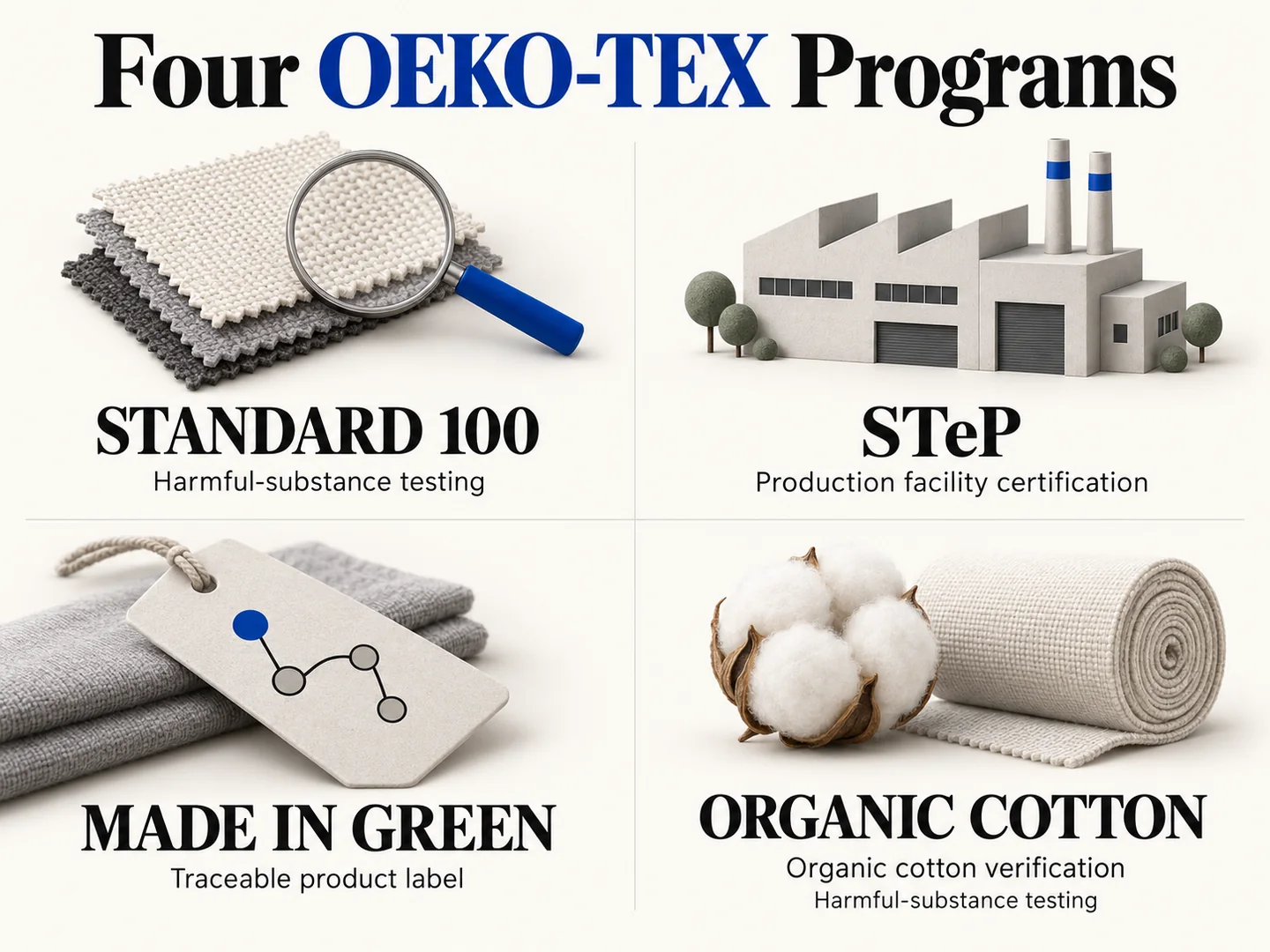
The OEKO-TEX certification and label portfolio covers several different subjects. These four names help explain why a general statement such as “we have OEKO-TEX” needs a follow-up question:
| Program | Main Focus | What to Establish With Your Supplier |
|---|---|---|
| OEKO-TEX STANDARD 100 | Testing textile articles for harmful substances | Which materials or finished products are covered? |
| OEKO-TEX STeP | Environmental and social conditions in textile and leather production facilities | Which facility and production activities are certified? |
| OEKO-TEX MADE IN GREEN | A traceable product label combining harmful-substance testing with production requirements | Which specific product carries the label? |
| OEKO-TEX ORGANIC COTTON | Verification of organic cotton through the supply chain, with harmful-substance testing | Which cotton materials or products fall within its scope? |
For example, evidence about a sewing facility doesn’t automatically establish that a particular printed pajama set is STANDARD 100 certified. Keep the full program name in your supplier notes instead of shortening every document to “OEKO-TEX certificate.”
Why STANDARD 100 Matters for Clothing
STANDARD 100 gives buyers a defined testing framework for harmful substances. That makes it more useful than an unsupported description such as “skin-friendly fabric.” You have criteria and an identifiable certification to investigate, rather than a reassuring adjective that different suppliers can interpret differently.
Its purchasing value depends on whether the evidence matches your project. A relevant certificate helps answer a specific sourcing question; an unrelated certificate does not. If your brief requires certified finished clothing, settle that point before comparing prices with a supplier offering only certified fabric. Otherwise, the quotes are answering different requests.
What Does OEKO-TEX STANDARD 100 Test For?
STANDARD 100 assesses compliance with its harmful-substance requirements. Tested for harmful substances does not mean chemical-free. The current standard and its testing documents set the criteria and limits that apply to OEKO-TEX certified textiles.
What the Testing Covers
The article under certification can include textile and non-textile parts. A garment is more than its main fabric: sewing thread, elastic, fasteners, labels, prints, and decorative components can all matter. The certifying institute determines the testing appropriate to the submitted article and its materials. A photograph of the outer fabric cannot establish what the complete garment contains.
When preparing your product information, make the less visible parts explicit:
- Identify linings, pocket bags, and interlinings alongside the main fabric.
- Include thread, ribbing, elastic, buttons, zippers, and labels in the materials list.
- Describe printing, coatings, washing, and other finishing work planned for the product.
What Passing the Tests Means
Certification uses samples and a defined article scope, with requirements for maintaining conformity. It doesn’t mean a laboratory individually tests every garment in every carton. OEKO-TEX also conducts product controls, while the certificate holder remains responsible for keeping production consistent with the certified articles.
For a buyer, that makes the connection between the sample and production important. Ask which approved materials and processes will be used in your order, and keep the answer with the sample record. If someone substitutes a component later, you need a way to recognize the change. The certificate number alone cannot tell your production team which zipper was approved.
Which OEKO-TEX Product Class Does Your Clothing Need?
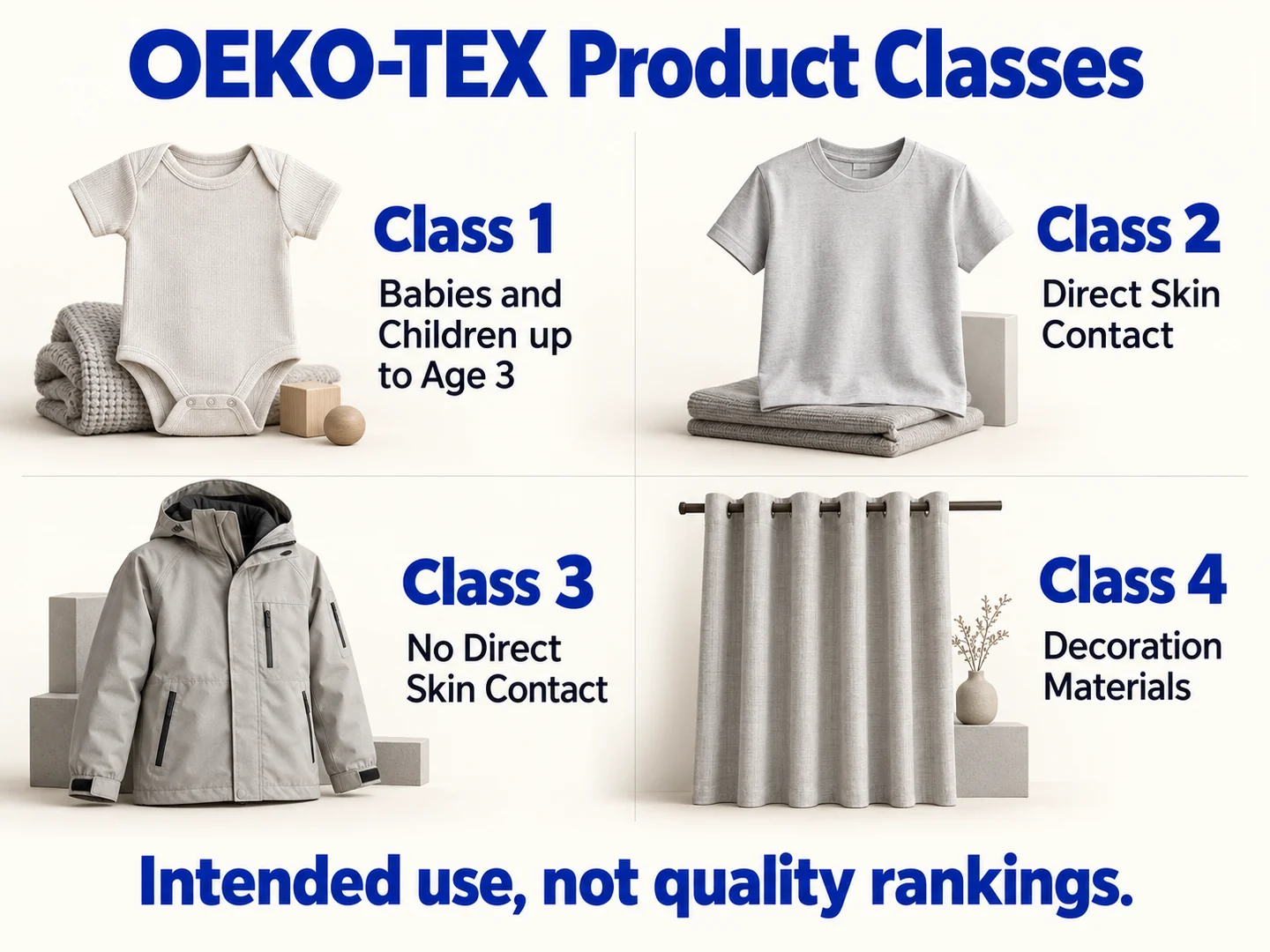
The intended user and type of contact guide the product class. These classes describe use conditions, not grades of garment quality. OEKO-TEX assigns its strictest requirements to Class 1, covering products for babies and children up to three years old.
| Product Class | Intended Use | A Useful Question for Your Project |
|---|---|---|
| Class 1 | Products for babies and children up to three years | Does the evidence cover the intended young age group? |
| Class 2 | Products with direct skin contact | Is the article assessed for the way it will touch the wearer? |
| Class 3 | Products without direct skin contact | Does the proposed use fit this category? |
| Class 4 | Decoration materials, such as curtains | Are you mistakenly accepting evidence intended for furnishings? |
A fabric offered for decorative use should not be accepted for a baby garment merely because its certificate is valid. Likewise, a collection extending from infant sizes to older children needs a clear age and use description. Ask the institute or supplier to confirm the appropriate coverage instead of treating “kidswear” as a single classification.
For your buying brief, record the age range beside the product description. That small addition makes the requirement easier to communicate than leaving the supplier to infer it from a size code or a photograph.
What Does STANDARD 100 Not Tell You?
STANDARD 100 is useful within its scope. Problems arise when a brand uses it to answer unrelated questions about organic content, garment performance, or all the requirements of a sales market.
Does OEKO-TEX Certification Mean Organic?
STANDARD 100 certification does not, by itself, establish that a fabric is organic. OEKO-TEX ORGANIC COTTON addresses a different set of requirements. When comparing OEKO-TEX STANDARD 100 vs. GOTS, distinguish harmful-substance testing from organic textile processing requirements. GOTS, the Global Organic Textile Standard, covers the processing of organic textiles with environmental and social requirements. Specify the standard you need in purchasing documents rather than treating the names as interchangeable.
Separate your goals when discussing sustainable clothing manufacturing. If you want evidence about organic fibers, production conditions, and harmful substances, identify each requirement rather than expecting one unspecified certificate to answer everything. This also makes your marketing brief clearer: describe the documented attribute instead of turning it into a broad “eco-friendly” promise.
Fit and Durability Still Need Checking
A STANDARD 100 certificate doesn’t tell you whether a waistband is comfortable, a sleeve fits, or a garment will maintain the appearance you expect after washing. Fit and wash performance need separate checks. Your sample review and, where appropriate, performance testing should address those questions. Keep the results distinct from chemical testing evidence in your approval notes.
For example, when evaluating bamboo baby clothes, compare the actual blend, openings, seams, and care instructions. Certification doesn’t remove those purchasing decisions. You can reject a certified sample because its fit is wrong without questioning the validity of its certification; the sample has failed a different part of your brief.
Legal Requirements Still Apply
Do not treat a voluntary product certification as blanket permission to sell clothing anywhere. The standard itself limits what its mark says about other quality and legal matters. Have a competent adviser or laboratory identify the requirements relevant to your product and destination, then establish which evidence addresses each one.
Keep that work separate from your certification request. A children’s sleepwear project, for example, needs a product-specific market assessment, not simply an instruction to use certified fabric. This guide explains procurement decisions; it does not determine the legal requirements or testing exemptions for a particular shipment.
Is Certified Fabric the Same as Certified Clothing?
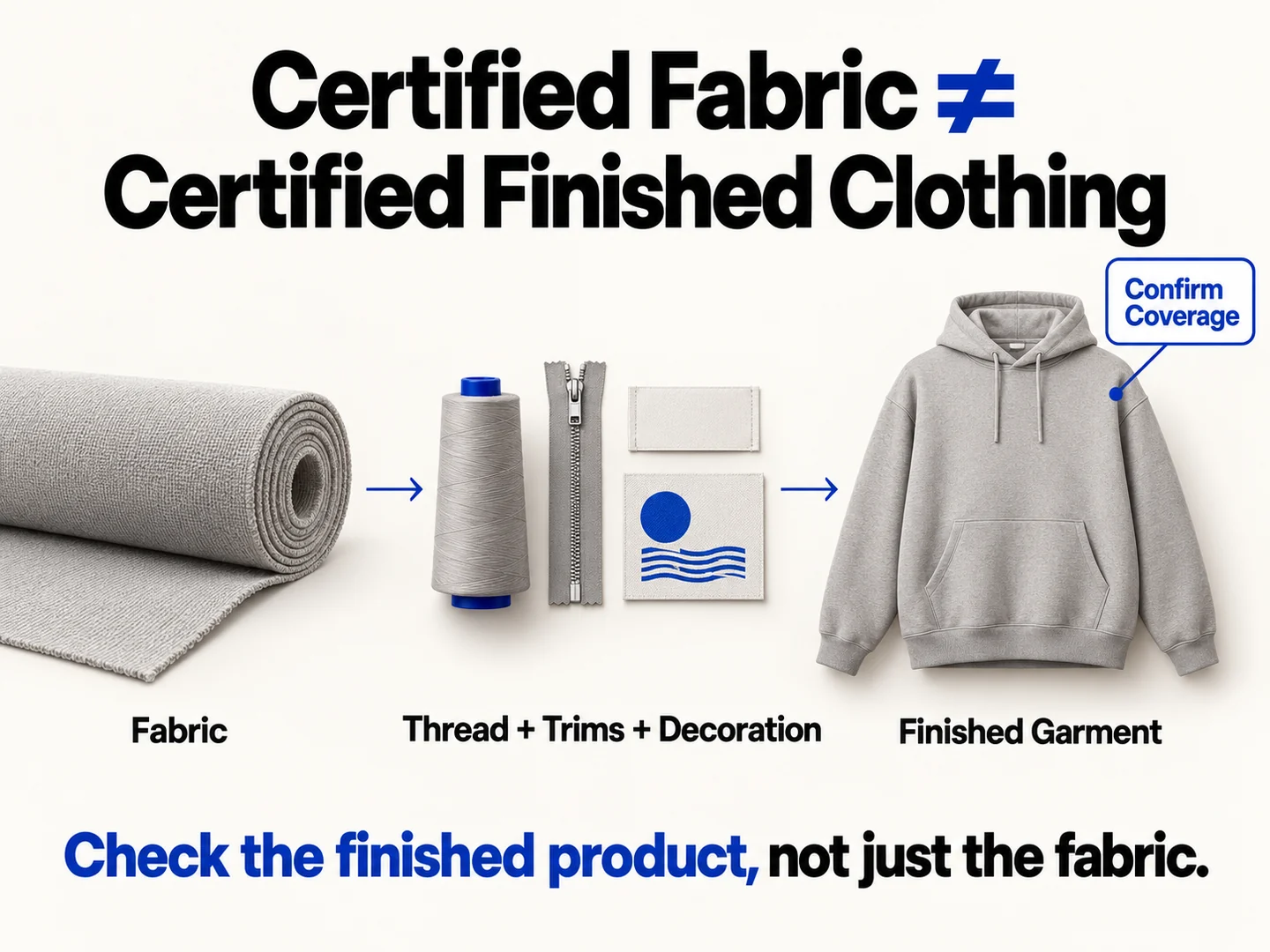
No. OEKO-TEX certified fabric does not automatically make the finished garment certified. Hohenstein, an OEKO-TEX testing institute, explains that finished goods need their own certification even when their individual components have already been certified.
A Fabric Certificate Has a Defined Scope
Read what the certificate describes before using it to approve a finished product. A document covering a particular knitted fabric is evidence about that article. It doesn’t automatically cover a dress assembled with a different lining, sewing thread, zipper, and decoration. Having all those components on a purchase order doesn’t establish finished-product certification either.
Pre-certified components can reduce duplicated testing within the certification process, so they are useful starting materials. But that benefit shouldn’t become an assumption that no further certification work is necessary. Agree whether your supplier is offering certified material, a finished product already within scope, or a product that still needs certification arrangements. Put the distinction in the quotation so it remains visible when you compare offers.
How HAPA Reviews Prints and Labels Before Production
At HAPA, our private-label kidswear development brings fabric sourcing, trims, custom labels, and sample making into one process. We review the brand’s design and branding requirements, develop samples for checking fit, construction, color, and decoration, and move into bulk production after sample approval.
For a project requiring OEKO-TEX certification, the evidence needs to match the final garment specification. Selecting the fabric is one development step; approving the garment with its print, trims, and labels is another. Approval of a sample’s design does not confirm its certification coverage.
Our fabric and color approval guide recommends recording the selected materials, decoration, and any substitutions. If a print, trim, or finish changes, review whether the existing evidence still applies. Ask the certificate holder or issuing institute to resolve any uncertainty before describing the finished product as certified.
Our advice to brands is to settle these questions while the sample and label artwork can still be revised. Keep the final specification and supporting confirmation together, so production instructions and product claims refer to the same version of the garment.
How Can You Verify an OEKO-TEX Certificate?
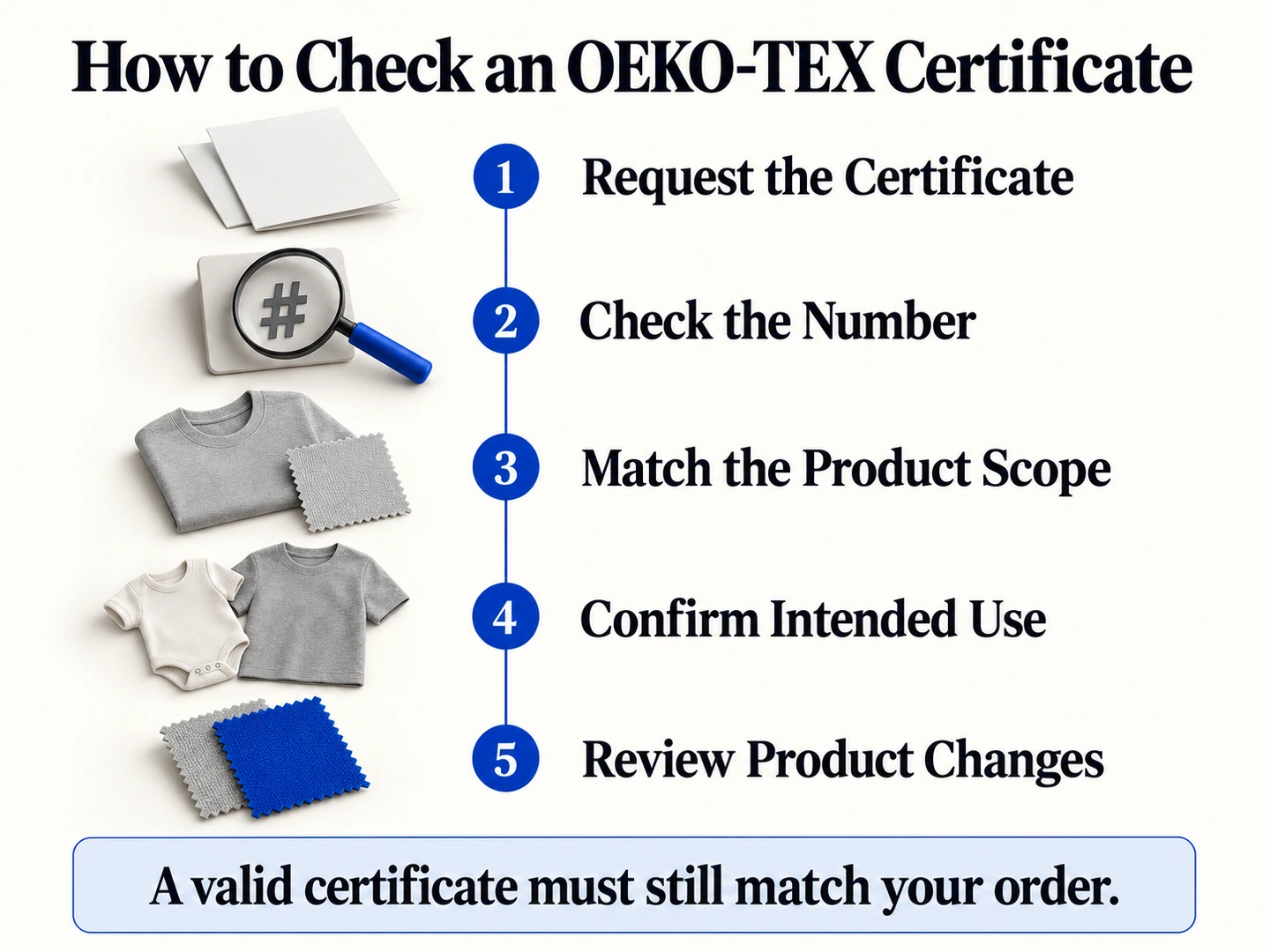
An OEKO-TEX certificate check should connect the official verification result to the goods you are buying. The following checks are a buyer workflow, not an official certification application form.
Ask for the Complete Certificate
Request the complete certificate, not just a logo or screenshot. You need enough information to identify the program, certificate holder, issuing institute, article description, product class, and validity period. A supplier presentation can introduce the claim, but it should not be the only document your purchasing team keeps.
Send the request with your style reference and intended use. For instance, ask which certificate covers the finished printed garment in your proposed material, rather than asking whether the company has any certificates. A precise question gives the supplier a chance to identify a gap before either side commits to the order.
Check the Number and Product Coverage
Enter the certificate or label number in the official OEKO-TEX Label Check, or use the label’s QR code. Read the result alongside the complete certificate. Where the public tool does not show enough detail, ask the supplier or issuing institute for clarification. Don’t assume every field you need will appear in an online result.
Use a simple review sheet to keep unresolved questions visible:
| What to Match | Evidence to Request | Question to Resolve |
|---|---|---|
| Program and number | Complete certificate and official check result | Is this the certification your brief requires? |
| Certificate holder | Named company and explanation of its supply role | How is this company connected to your order? |
| Article scope | Product description and supporting details | Does it cover the material or finished item being supplied? |
| Intended use | Product class and age/use information | Is the coverage appropriate for your garment? |
| Current status | Validity details and renewal information where relevant | Is the evidence current for the planned supply? |
| Final specification | Approved materials, decoration, and processing details | Has anything changed since the covered version? |
Resolve Gaps Before Approving the Order
A valid result is evidence about the recorded certification, not independent proof that the cartons offered to you contain the covered goods. Ask the supplier to connect its product references and documents to your order. If the scope is unclear or the names do not match your understanding of the supply chain, seek a written explanation and contact the institute when necessary.
An unclear result doesn’t prove fraud, and it doesn’t establish that the product is unsafe. It means you haven’t resolved the question. Treat an unresolved certification requirement as an open purchasing issue, rather than marking it approved to keep the schedule moving. Keep the dated evidence and the person responsible for follow-up in the same project folder.
Can Your Brand Use the OEKO-TEX Label?
The right to promote a product as certified depends on the actual product and the applicable label rules. Placing your own brand name on a garment does not automatically settle that question.
Keep Claims Tied to the Product
The OEKO-TEX STANDARD 100 labeling requirements connect use of the label to qualifying products and their corresponding certification. They also prohibit ingredient labeling: you cannot promote an unqualified finished garment by highlighting a STANDARD 100 certified component within it. Writing “made with certified fabric” is not a general workaround.
Keep the claim attached to the right product in your content system. If a website badge appears across every product page, it can suggest broader coverage than you have established. Review collection pages, packaging templates, and marketplace listings as well as the individual product description. Ask the institute about the appropriate arrangements if your brand will relabel or sell goods under its own name.
Check Hangtags and Product Pages Together
The official guidance requires the connection between the certification and the promoted product to remain clear. It also states that a physical product advertised as STANDARD 100 certified must carry the corresponding valid label. Label information includes the number and institute; a decorative logo without the required details is not an adequate substitute.
Before artwork approval, have one person compare the product page, physical label, and supporting certificate together. Ask the supplier for the authorized label artwork instead of recreating it from an image search. If there is uncertainty about the placement or wording, resolve it before printing. Marketing approval and certification review should refer to the same final product version.
Is OEKO-TEX Certification Worth It for Your Brand?
For brands sourcing OEKO-TEX certified clothing, the main benefit is documented harmful-substance testing within the relevant certification scope. A retailer’s certification requirement can also make it a purchasing priority. Whether it belongs in your collection plan depends on the evidence you need and what your customers expect. It does not guarantee a higher selling price, better fit, or repeat orders.
Before investing in a certification route, ask:
- Does a retailer require a particular certification, or have they asked more generally for test evidence? Get their actual requirement rather than guessing.
- Do you want a certified finished product that can carry a label, or are you currently comparing material options? Define the intended outcome before requesting quotations.
- Who will manage coverage when you change suppliers, decorations, or styles? Include that responsibility in development planning.
Budget for the work around the certificate as well as any quoted fee. Someone must gather product information, answer questions, keep records current, and review changes. For a small brand, a well-defined first collection is easier to manage than a broad certification promise covering products you have not yet specified.
Certification should support a product offer your customers already understand. If the garment’s fit, care requirements, and price don’t suit them, the label won’t resolve those weaknesses. Equally, the absence of a certificate alone is not proof that a garment is harmful; it means this particular assurance has not been established.
How Should You Source OEKO-TEX Certified Clothing?
When comparing suppliers of OEKO-TEX certified clothing, specify whether you need certified fabric or certified finished garments. A supplier cannot assess the right route from “OEKO-TEX required” alone if the age range, materials, decoration, and desired finished-product claim are still unknown. Prepare a short sourcing brief:
- Product and wearer: garment type, intended use, age range, and sales market.
- Construction: proposed fabrics, trims, linings, printing, and finishing.
- Certification outcome: exact program required and whether the finished garment must be covered.
- Buyer requirements: any retailer instructions and the evidence expected before approval.
- Responsibilities: who obtains documents, resolves scope questions, and approves label artwork.
- Change control: which substitutions or design changes must be reviewed before production continues.
For a custom kidswear project, HAPA’s cut-and-sew development service provides a relevant place to discuss material selection, prototypes, and decoration. Include your certification requirements in that brief so the proposed development route can be assessed against them. Do not assume every available fabric or customization has the same certification coverage.
Renewals also deserve attention. OEKO-TEX’s 2026 update introduces changes concerning direct-supplier certificates and certification of wet processes at renewal, with transition arrangements until June 2027. If your order or reorder crosses that period, ask the certificate holder how its documentation will be maintained. The transition does not mean every earlier certificate became invalid when the update was announced.
Keep responsibility for certification questions visible when you move from sampling to repeat orders. A reorder may look unchanged in a sales spreadsheet while its fabric source or printing arrangement has changed. Asking the supplier to confirm continuity is a practical purchasing safeguard, not a substitute for the institute’s decision on coverage.
HAPA’s Commitment to OEKO-TEX Certified FabricsAt HAPA, we consistently use OEKO-TEX certified fabrics in our children’s clothing development. We combine careful material selection with sample reviews and production checks, focusing on comfort, fit, durability, and finishing quality.
Through our private-label kidswear development service, we work with brands to define the fabric, trim, labeling, and testing requirements for their target markets. From selecting materials to developing samples and preparing branded packaging, our team helps create quality children’s clothing tailored to each brand’s customers and product standards.
Share your designs, age range, and target market with HAPA to discuss suitable materials and the next steps for your collection.
Conclusion
OEKO-TEX certified clothing is easier to evaluate when you separate the program name, the covered article, and the claim you plan to make. Check each against your actual product instead of treating the logo as a final approval.
Start with the complete certificate, verify its status, and ask how it relates to your finished specification. Keep changes visible and review product claims before printing labels. For a HAPA kidswear inquiry, send your product brief, target market, age range, and certification requirements together. That creates a useful starting point for discussing what your collection needs and which evidence must be confirmed before proceeding.
Frequently Asked Questions
Can Polyester Be OEKO-TEX Certified?
Yes. STANDARD 100 is not limited to natural fibers. A polyester article can qualify if it meets the applicable requirements. Read the composition label to understand the fiber content and the certification documents to understand the testing coverage. These are separate pieces of information.
How Much Does OEKO-TEX STANDARD 100 Certification Cost?
There is no single price suitable for every clothing project. Hohenstein describes licensing, audit, and testing fees, with testing costs depending on the article and available pre-certifications. Send the institute your product details for a quotation, and ask what it includes. Don’t assume another brand’s quoted amount applies to your collection.
Can a Certificate Show a Different Company Name?
Yes, the certificate holder can differ from the retailer or brand selling the goods. The difference needs an explanation: identify that company’s role and establish that the supplied product is within the relevant scope. A different name is neither automatic evidence of fraud nor a reason to skip the connection check.
Does STANDARD 100 Mean 100% Cotton?
No. STANDARD 100 is the program name, not a fiber-content statement. Check the garment’s composition separately. A cotton blend or a synthetic textile can be within the standard’s scope; the number does not tell you the percentage of cotton or any other fiber.
References & Sources
Source review: October 28, 2026. This guide draws on official OEKO-TEX documentation, Hohenstein’s published guidance, and GOTS materials. The HAPA section draws on the company’s published private-label development workflow and fabric-approval guidance. Purchasing checklists are editorial recommendations, not audit or laboratory test results.