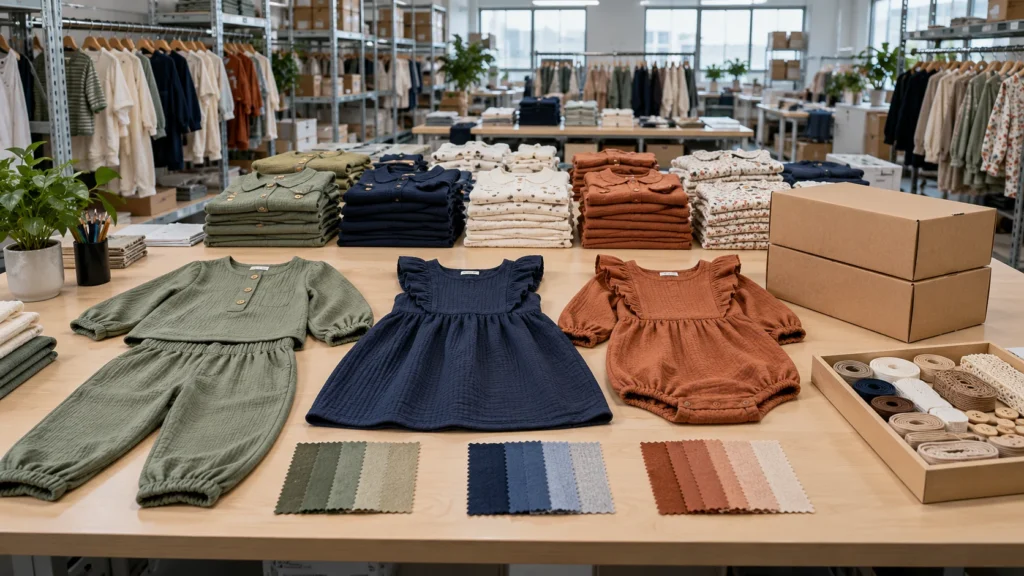
Garments, materials, packing, and stock decisions come together in one controlled sourcing plan.
Wholesalers reduce supply chain risk by controlling exposure before they place an order, then requiring evidence at every point where money, material, or delivery becomes difficult to reverse. That means planning the assortment at SKU level, verifying who will actually make the goods, freezing specifications, approving materials before cutting, building destination-market compliance into the purchase order, inspecting production at defined gates, assigning delivery responsibilities clearly, and measuring what arrives against what was ordered.
The practical goal is not a risk-free supply chain. No factory, inspection, certificate, or shipping term can provide that. The goal is to make each important risk visible early enough to prevent it, contain it, or choose it consciously. For a wholesaler, kidswear supply chain risk is especially sensitive because a single style can multiply into many size-color SKUs, seasonal delivery windows can be narrow, and product requirements vary by age group and destination market.
From a manufacturing and sourcing perspective, the strongest buyers do not manage an order as one long promise. They divide it into decisions. Every decision has an owner, a reference, a deadline, an acceptance rule, and a response if the evidence fails. This guide shows how to build that control system without turning every purchase into unnecessary bureaucracy.
Build a kidswear supply chain risk map before choosing suppliers
A supplier shortlist answers who might make your garments. It does not tell you where your business is most exposed. Before requesting quotations, map the failure modes that could stop you from selling the right stock at the right time.
For most kidswear wholesalers, the risk map includes eight connected areas:
1. Demand and inventory: ordering the wrong product mix, too many slow sizes, too many colors, or too much seasonal stock.
2. Supplier network: relying on an unverified factory, hidden subcontractor, single fabric source, or one person who holds all communication.
3. Product definition: unclear measurements, artwork, construction, labels, packaging, or version control.
4. Materials: unavailable fabric, unapproved substitution, shade variation, shrinkage, weak trim attachment, or a lot that differs from the sample.
5. Compliance: applying the wrong rules, testing the wrong configuration, using inaccurate labels, or losing the traceability between a report and the shipped goods.
6. Production: late approvals, capacity conflicts, workmanship drift, incomplete corrective action, or an inspection performed too late to fix the cause.
7. Commercial and logistics: unclear payment triggers, vague delivery terms, document errors, missed bookings, customs delay, loss, or damage.
8. Continuity: no usable response if a material, production line, route, document, or supplier becomes unavailable.
Score each risk in a simple register. You can use low, medium, and high if that is easier than a numerical scale. Record the cause, possible impact, early warning, preventive control, responsible person, due date, and contingency. The value is not the color of the score. The value is forcing your team to state what it will observe and what it will do.
A useful kidswear supply chain risk register also separates likelihood from exposure. A rare failure can still deserve strict control if it could create a recall, block an import, or leave a major customer without stock. A frequent issue may be tolerable if it is inexpensive and quickly reversible. This keeps attention on business consequences instead of whichever problem is loudest that day.
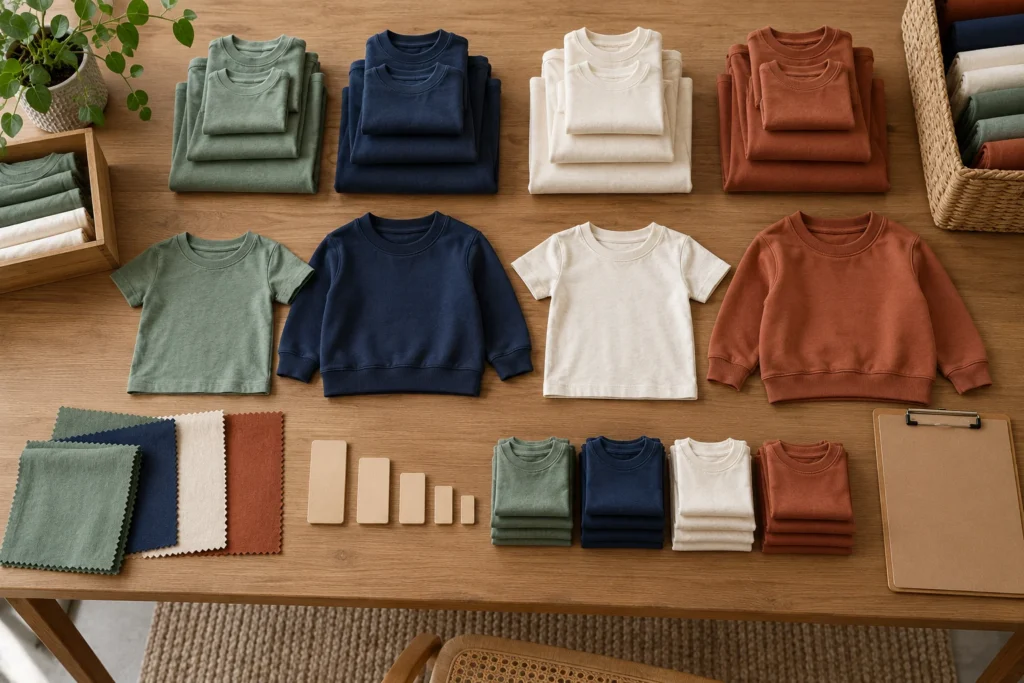
Controlling style, color, and size complexity reduces exposure before an RFQ is issued.
Reduce exposure before you send an RFQ
Many sourcing problems are created before a factory quotes. A range with too many lightly differentiated products can exceed the buyer’s ability to control it, even when every unit price looks attractive.
Count decisions, not only pieces
Calculate the number of styles, colors, sizes, fabric bases, prints, trims, label versions, packing configurations, and delivery dates. Fifty thousand pieces spread across a few stable basics is a different operating problem from the same quantity split into hundreds of small SKU cells.
Every extra combination creates another forecast, material allocation, label count, packing line, carton assortment, document entry, and receiving check. It can also divide the factory’s production into shorter runs, increasing changeovers and the chance that components are mixed.
Classify the range before you buy:
- Core styles have repeat demand and can justify stable specifications, reserved materials, and planned replenishment.
- Seasonal styles need firm cut-off dates and conservative commitments because late goods lose value quickly.
- Test styles should have a controlled financial ceiling and a clear decision about whether they may be repeated.
- Complex styles need more development and production evidence than simple carryover basics.
This classification helps you spend control effort where failure would hurt most. It also prevents a trend item with uncertain demand from receiving the same inventory commitment as a proven core style.
Standardize what the customer does not need to see
Wholesalers can often reduce dependency by sharing approved base fabrics, elastics, threads, labels, carton sizes, or packaging methods across compatible styles. Standardization can simplify testing, spare stock, replenishment, and supplier substitution. It should never be used to hide a material change from the buyer’s own product or compliance review.
Ask whether each new component creates customer value. If two navy jerseys look identical online but require separate mills, dye processes, and care instructions, the operational cost may exceed the merchandising benefit. Simplification is one of the least expensive ways to lower kidswear supply chain risk because it removes failure points rather than monitoring more of them.
Qualify the supplier and the real production network
Once you know what you need, verify who can deliver it. A registration document or polished showroom proves very little about the line, mill, print shop, embroidery unit, washing facility, laboratory, packing team, or export party that will touch your order.
If your team first needs to understand how OEM, ODM, private-label development, sampling, and export support fit together, use HAPA’s China children’s clothing manufacturing overview as background. For this risk review, the important step is to map the actual network behind your own order rather than assume that every process shown by a supplier happens under one roof.
Start with legal identity, business address, payment beneficiary, relevant production locations, product experience, key outsourced processes, and the people responsible for merchandising, technical decisions, quality, and shipping. Reconcile inconsistencies before paying a deposit. If the quotation comes from one entity, payment goes to another, and export documents will name a third, understand and document why.
Read HAPA’s guide to choosing a reliable wholesale supplier for a children’s boutique for the detailed first-round checks. At wholesaler scale, add a network view: which operations are internal, which are subcontracted, which material sources are single points of failure, and which capacity claims can be supported by a realistic production plan for your styles.
Test the handoffs, not just the sample
One attractive sample shows that one garment was made. It does not prove that the supplier can control revisions, reserve the correct material, reproduce measurements, separate lots, inspect bulk, pack assortments accurately, or prepare shipment documents.
For a new relationship, use a commercially meaningful but bounded order to observe those handoffs. The paid kidswear factory pilot order guide explains how to structure that test. Score the evidence rather than rewarding smooth conversation: Were questions raised early? Were versions controlled? Did the bulk match the approved reference? Were inspection findings corrected and documented? Did the carton contents match the packing list?
Avoid indiscriminate dual sourcing. Two factories making the same style can introduce different patterns, sewing methods, shrinkage, shades, and inspection habits. Use a second source where the impact and lead time justify it, then qualify that source deliberately. For other products, a stable primary supplier plus approved material alternatives or reserved capacity may provide better continuity.
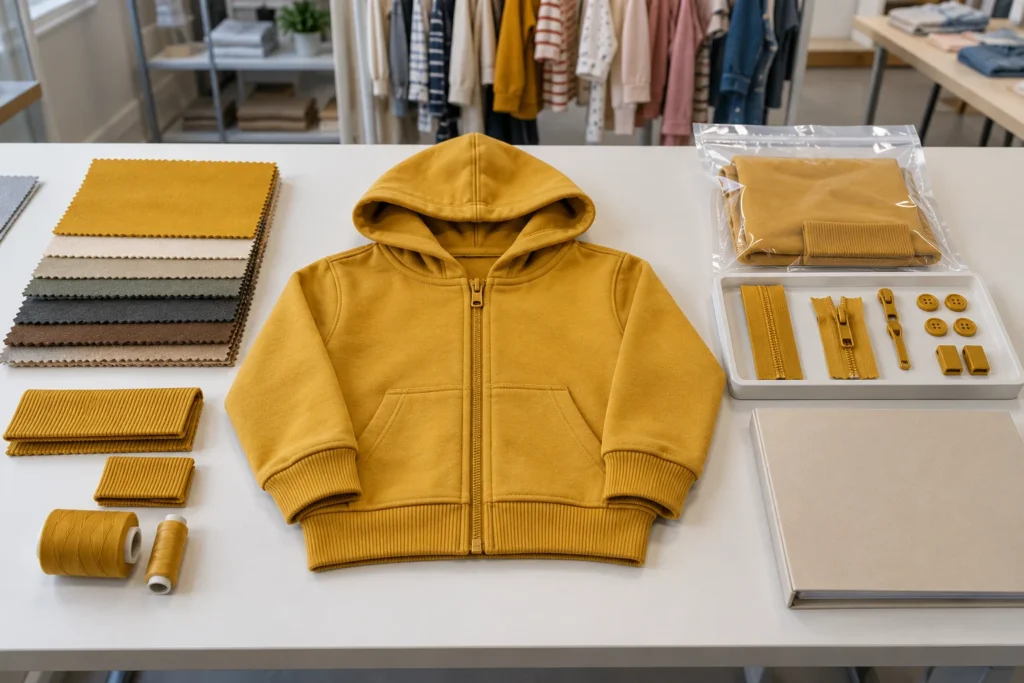
A controlled garment reference connects approved materials and components to bulk production.
Turn specifications and approvals into control points
A purchase order cannot control what the product file leaves ambiguous. Your technical package should identify the current style, size range, measurement method and tolerances, bill of materials, construction, artwork, label content and placement, testing needs, packing method, carton assortment, inspection rules, and approved references.
Give every controlled file a version and date. Keep one change log that states what changed, who requested it, who approved it, and which sample or production lot it affects. Chat messages can support a decision, but they should not become an unsearchable alternative specification.
Separate approval from financial release
Buyers often write “approved” when they mean “the direction is acceptable.” A factory may read the same word as authority to buy all fabric or start cutting. Replace broad approvals with specific releases:
- approve design direction for the next sample;
- approve a lab dip as the color reference;
- approve the pre-production sample for fit and construction;
- release the stated bulk material quantity;
- release identified fabric lots for cutting;
- release inspected goods for shipment.
Each release should name the style, version, color, reference, quantity or lot, exceptions, and date. This makes responsibility visible and prevents one casual email from authorizing several irreversible steps.
Material risk deserves its own sequence because a sample swatch, lab dip, pre-production garment, and bulk fabric lot answer different questions. The guide to fabric and color approval before bulk production provides the detailed approval workflow. In your wider control system, require any substitution to pause at the same evidence gate as the original material.
Control inventory risk at style, color, and size level
The factory’s minimum may be quoted per style, per color, per fabric lot, or per order. Your commercial risk sits lower down, at the size-color SKU that customers actually buy. A workable total quantity can still create excess stock if the size curve or color split is wrong.
Use sales history where it is comparable, but separate real demand from stockouts, promotions, and one-time events. A size with low recorded sales may have been unavailable. A color with strong sell-through may have received better placement. New products need an explicit assumption rather than false precision.
For every proposed buy, calculate:
- the quantity and cash commitment by SKU;
- the weeks or selling windows that stock must cover;
- the point at which a reorder would arrive, not merely be placed;
- the markdown or carryover consequence if demand is lower than expected;
- the lost-sales consequence if demand is higher;
- the components or materials that could be reused if the finished style underperforms.
Staging an order can reduce exposure, but only if the second quantity can be produced and delivered within the selling window. A small first buy followed by an impossible reorder lead time is not flexibility. Ask what must be reserved in advance—greige fabric, custom color, printed fabric, labels, or line time—and distinguish that commitment from finished-goods inventory.
Track kidswear supply chain risk in the open-to-buy discussion, not only in the sourcing department. Procurement may celebrate a lower unit cost at a larger quantity while sales later pays for slow stock, discounts, storage, and cash tied up in the wrong sizes. Compare landed margin under realistic sell-through scenarios rather than comparing quotations alone.
Protect material continuity and batch identity
Fabric and trims often have longer or less predictable lead times than sewing. They can also change after approval because a stock lot sells out, a mill cannot repeat a shade, a zipper supplier changes tape, or the planned quantity does not meet a processing minimum.
Create a material status record by style and color. It should show supplier or mill, article or code, composition, construction, weight range, width, finish, color reference, required quantity, allowed loss, lot identity, approval state, test state, booking date, expected date, and substitution rule. The factory may maintain the operational sheet, but the buyer should receive enough evidence to understand high-impact dependencies.
Reserve critical material only after confirming what the reservation means. Is physical stock segregated? Is it greige goods waiting for dyeing? Is the supplier merely forecasting demand? How long is it held, who owns it, and what happens if the final order changes? Vague “material secured” messages should not support a launch commitment.
At bulk receipt, connect roll or batch identity to the cutting and finished-goods records where practical. If a defect or shade problem appears later, this can help contain the affected quantity instead of treating the entire order as unknown. Traceability is useful only when identifiers continue through the process; a fabric lot number stored in one spreadsheet but absent from production records will not locate affected garments.
This material chain is a core part of kidswear supply chain risk because fabric can be commercially committed weeks before the finished product exists. Your control should therefore follow the money and the lot identity from reservation through cutting, packing, and receipt.
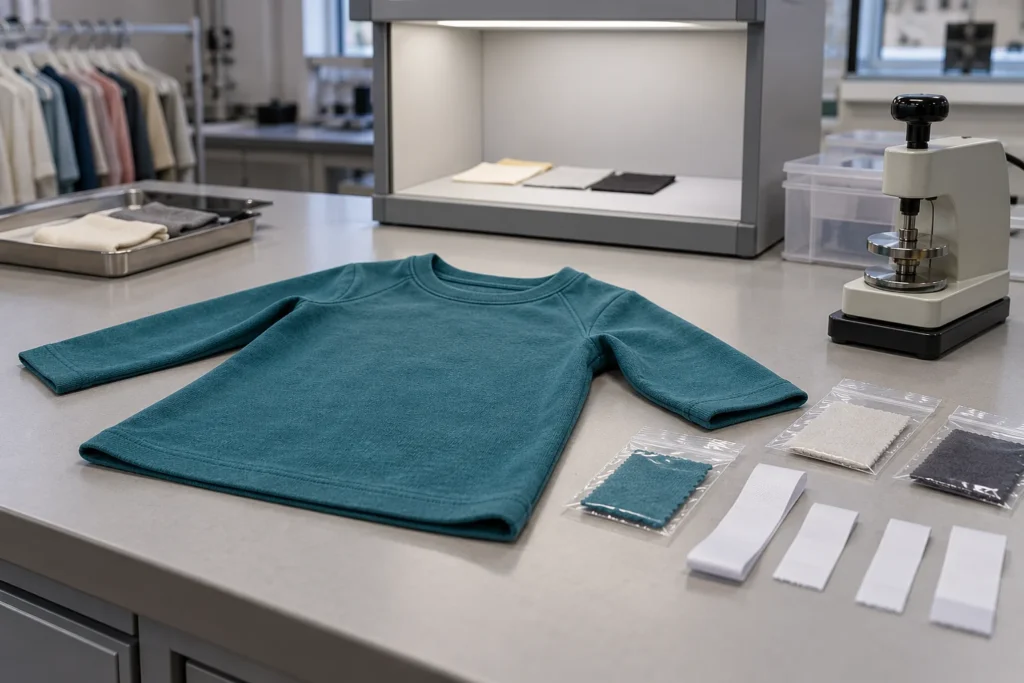
Product-specific material and label evidence should be checked before production and shipment.
Build compliance into the purchase order
Compliance is a product-specific plan, not a certificate folder. Before development is frozen, identify the destination market, product classification, intended age, fabric and trim composition, construction features, performance claims, labeling duties, retailer requirements, and who holds each legal responsibility.
For U.S. sales, the CPSC’s Children’s Product Certificate guidance states that importers issue the certificate for applicable children’s products made overseas, based on qualifying evidence. It also notes that the required rules depend on the product. The FTC’s apparel-labeling guidance is an official starting point for fiber content, country of origin, responsible-business identity, and care instructions.
That means your product file, test request, labels, certificate data, invoice description, and shipped item must describe the same thing. A report for a different fabric, color, component, age grade, or production configuration may not support the current shipment. When a regulated or tested component changes, route the change back through compliance review before production continues.
For current U.S. imports, note that the CPSC page says eFiling of certificate data became required for most regulated consumer products on 8 July 2026. Treat this as a workflow requirement, not a last-minute document request. Confirm the current rule, applicability, data owner, broker process, and timing for your products. Other markets have different rules and responsible parties; obtain qualified advice for the actual destination rather than copying a U.S. checklist.
Good compliance control lowers kidswear supply chain risk because it connects decisions that are often separated. The fabric buyer knows which material identity must be preserved, the label team uses verified information, the laboratory tests the intended configuration, and shipping does not discover missing data after the goods are packed.
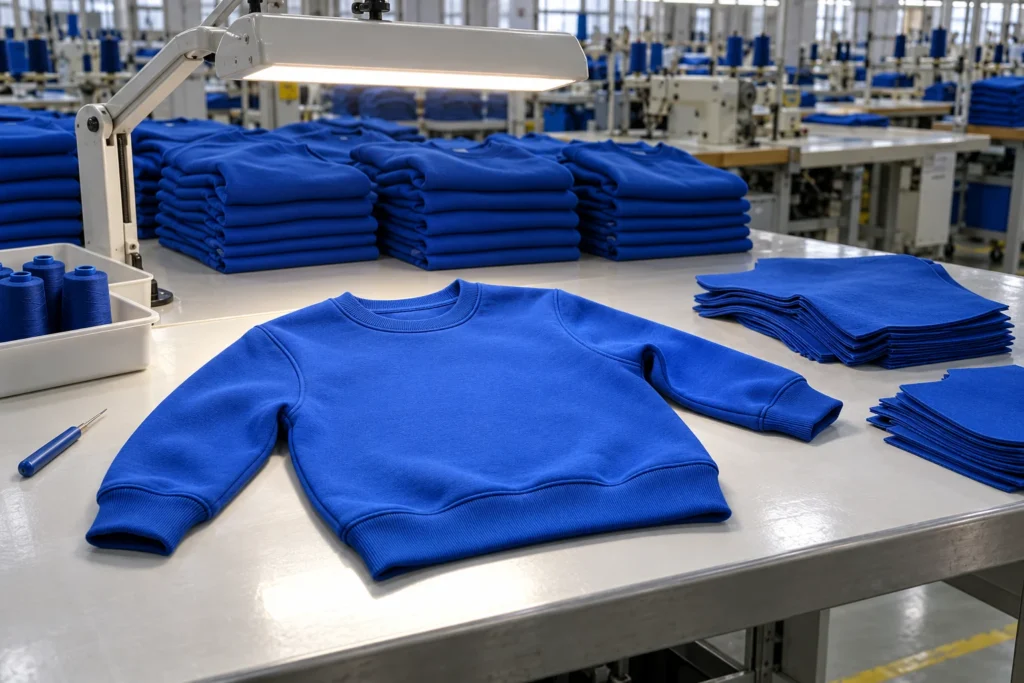
Early production checks reveal repeatable causes while correction is still practical.
Use production gates that reveal causes early
Final inspection is useful, but it is a late sampling decision. It cannot efficiently correct fabric already cut, an incorrect grading rule applied to every size, or a label sewn into the full order.
Use gates that match the order’s main failure modes:
1. Pre-production readiness: current files, approved references, material and trim status, test plan, label data, packing method, line plan, and unresolved exceptions.
2. First output: measurements, construction, workmanship, artwork, labels, and assembly checked on the first representative units before the process runs at volume.
3. In-line control: recurring defects, measurement drift, shade or lot separation, repair handling, and progress against the production plan.
4. Pre-final readiness: complete goods, finished packing method, document draft, and evidence that earlier corrective actions were applied.
5. Final inspection: identity, quantity, assortment, workmanship, measurements, packaging, carton marks, and other agreed checks on a defined finished lot.
State the sampling plan and defect classifications before inspection. ISO 2859-1:2026 is the current edition of the widely used acceptance-sampling standard for lot-by-lot inspection by attributes. AQL-indexed sampling can make sample size and accept/reject decisions reproducible, but it does not mean the order contains that percentage of acceptable defects, guarantee zero defects, or replace safety testing and process control.
Define critical, major, and minor defects for the actual product. A loose decorative thread and an insecure small component do not have the same consequence. Also define what happens after a failed inspection: segregation, rework, root-cause analysis, reinspection, concession by an authorized person, or rejection. “Factory will improve” is not a corrective-action plan.
Measure first-pass performance. A supplier that repeatedly fails, reworks, and passes later may ship acceptable goods, but it consumes time and increases schedule risk. Over several orders, first-pass approval, repeat defects, and closure time are more informative than the final result alone.
These gates convert kidswear supply chain risk from a general concern into dated decisions. They also show whether an exception is isolated or whether the same cause is moving from sample approval into bulk production.
Align contracts, payments, and delivery responsibility
Commercial terms should reward evidence and keep enough leverage to resolve problems. The correct payment structure depends on relationship history, customization, material commitment, order value, and finance conditions, so there is no universal deposit-and-balance formula. What matters is that each payment trigger is observable and that payment does not silently waive unresolved quality, quantity, document, or delivery issues.
The purchase agreement should connect the quotation, product files, approved samples, change process, quantity tolerances, inspection terms, testing and document duties, packing, delivery term, claim process, and remedies. Use qualified legal and customs advice for your transaction; a purchase order template is not a substitute for it.
The ICC’s Incoterms® 2020 guidance explains that the eleven rules allocate defined delivery obligations, costs, and risks. Write the chosen rule with the precise named place and version, such as the relevant named point followed by “Incoterms® 2020.” A three-letter abbreviation without a place can leave the handover point unclear.
Incoterms® rules do not define product quality, transfer of title, payment timing, every document, all insurance needs, or every consequence of delay. Map the chosen delivery rule to your actual workflow: who books carriage, clears export and import, supplies data, pays local charges, arranges insurance, receives notices, and handles a claim. This is where contract language becomes an operational control rather than a line on an invoice.
Plan logistics backward from sale-ready receipt
A factory ship date is not the date inventory is available to customers. Back-plan from the date goods must be received, counted, inspected, entered into stock, allocated, and ready for dispatch. Include time for booking, pickup, export formalities, main carriage, transshipment where relevant, import clearance, local delivery, receiving, discrepancy resolution, and channel preparation.
Separate milestones the supplier controls from external transit estimates. Confirm cargo-ready dates, booking cutoffs, document deadlines, planned and actual departure, arrival, clearance, warehouse appointment, and receipt. One “ETA” field cannot explain where a delay occurred.
Before cargo is released, reconcile the commercial invoice, packing list, carton count, purchase order, product descriptions, quantities, weights and dimensions, consignee data, origin information, compliance data, and transport documents. Document accuracy is a quality characteristic. A perfect garment in a shipment with incorrect data can still be delayed.
Decide when split shipment, air freight, or an alternate route is genuinely justified. The fastest rescue can destroy margin, fragment receiving, and leave the remaining stock commercially incomplete. Predefine who can authorize extra freight, the maximum exposure, and which SKUs protect the most sales value. Do not wait for a missed vessel to begin that discussion.
Cargo insurance, packaging, moisture protection, carton strength, loading method, and claim evidence should reflect the route and product. Photographing sealed cartons, recording counts and weights, and preserving damage evidence at receipt can support investigation. The exact insurance arrangement requires professional review; the general control is to know who bears which risk, what cover exists, and what evidence a claim requires.
Logistics is part of kidswear supply chain risk because a delivery can fail commercially even when garment workmanship passes. Build time, document, handover, and claim controls into the order before cargo becomes urgent.
Create a contingency playbook before the exception
A continuity plan should name triggers and actions. “Find another factory” is rarely a fast response once material is committed and delivery is late.
For each high-impact risk, define an early warning and a decision deadline. Examples include material not booked by the agreed date, lab dip rounds exceeding the plan, approval samples failing twice for the same cause, production not starting by the latest recoverable date, first output failing a critical requirement, booking not confirmed, required certificate data incomplete, or a supplier withholding evidence.
Then define practical options:
- simplify or remove a color before custom material is committed;
- transfer an approved material booking to a compatible style;
- use a prequalified alternate trim or packaging component;
- move selected operations to a disclosed and approved backup facility;
- prioritize high-value or launch-critical SKUs;
- split a shipment only when the commercial benefit exceeds added cost and complexity;
- delay, cancel, or reallocate an order while the loss is still bounded.
Keep controlled backup files available: current tech pack, pattern ownership status, grading rules, artwork files, approved samples or records, BOM, label data, test history, packing requirements, and supplier contacts. A theoretical second supplier is not a contingency if you cannot transfer a usable product definition.
Safety stock can protect service, but it is not a universal answer. Hold it where demand stability, margin, replenishment time, and customer-service consequences justify the cash and obsolescence risk. A proven basic may support a buffer; a dated fashion set may become a liability. The appropriate response to kidswear supply chain risk depends on the product’s economic life, not a fixed percentage copied across the range.
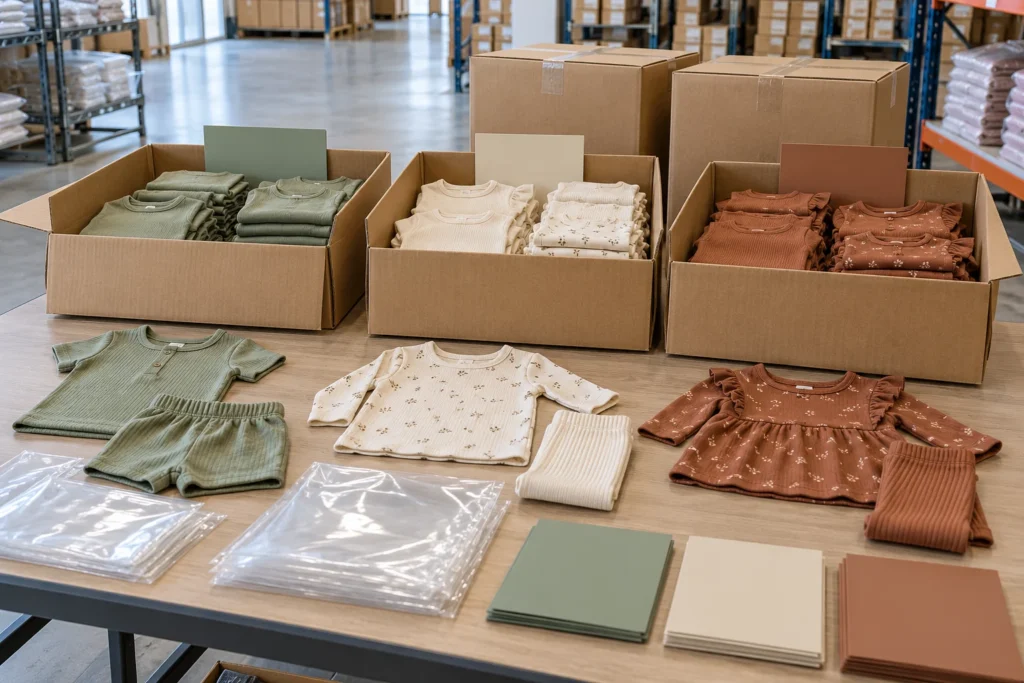
Cartons and SKU quantities are reconciled at receipt so discrepancies remain traceable.
Verify receipt and close the learning loop
Risk control does not end when the balance is paid or the container departs. At receipt, check carton count and condition before breaking traceability. Reconcile received quantities by style, color, and size; record shortages, overages, mixed cartons, labeling errors, damage, moisture, and visible quality issues. Preserve photos, carton identifiers, product labels, and samples where a claim may follow.
Connect warehouse findings to the purchase order and production lot. If customer returns later reveal a recurring defect, you need to know which supplier, material lot, line or period, shipment, and SKUs may be affected. The goal is not to collect data indefinitely. It is to contain the problem, correct the cause, and decide what evidence is required before the next order.
Review each order while facts are still available. Ask:
- Which milestone moved, why, and when did we first know?
- Which approvals required repeated rounds?
- Which defects appeared at first output, in-line, final inspection, receiving, and customer return?
- Did documents and carton assortments match on the first submission?
- Which corrective actions were verified rather than merely promised?
- Did the supplier disclose problems early enough to protect options?
- Did our own late decisions create avoidable delay or cost?
This balanced review matters. Supplier performance cannot improve if the buyer changes artwork after approval, delays comments, or sends conflicting instructions and records every consequence as a factory failure.
Use a supplier scorecard across several orders
A scorecard should support decisions, not produce a decorative total. Keep a small set of measures with defined data sources. Useful examples include milestone adherence, first-pass sample approval, first-pass final inspection, recurring defect rate, document accuracy, receiving discrepancy, corrective-action closure time, and responsiveness to material or schedule risk.
Avoid comparing unrelated orders without context. A complex embroidered dress and a repeat jersey T-shirt do not carry the same development load. Record order type, novelty, quantity, number of SKUs, and approved changes so the result can be interpreted.
Use trends to decide whether to continue, tighten controls, reduce exposure, require a recovery plan, or qualify an alternative. A single late order caused by a documented external event may deserve a different response from repeated undisclosed delays. Equally, repeated rescue work should not be hidden by the fact that goods eventually shipped.
This is where kidswear supply chain risk becomes manageable over time. Your controls generate evidence, and the evidence changes future order size, lead-time buffer, inspection intensity, payment triggers, and sourcing allocation.
A practical 30-, 60-, and 90-day implementation plan
You do not need to rebuild every process at once. Start with the controls that protect the next irreversible commitments.
In the first 30 days
- List active and planned orders by style, color, size count, destination, required receipt date, and financial exposure.
- Identify the top ten risks by impact and latest recoverable decision date.
- Assign one internal owner for product approval, compliance coordination, commercial release, and logistics.
- Freeze a controlled version of the specification, BOM, label, packing, and approval record for each active style.
- Confirm real production sites, outsourced processes, material dependencies, and named operational contacts.
- Reconcile the chosen delivery term, named place, shipment plan, and document owner.
By day 60
- Introduce pre-production and first-output gates for new or changed styles.
- Add material booking, bulk-lot identity, test status, and substitution rules to the order tracker.
- Define defect classes, sampling plan, inspection timing, failure response, and reinspection responsibility.
- Connect required compliance evidence to the exact product and shipment.
- Pilot a receiving reconciliation that records discrepancies by SKU and carton.
- Draft contingency triggers for the highest-impact material, production, and logistics dependencies.
By day 90
- Review at least one completed order from quotation to receipt and trace every material decision, approval, inspection, document, and exception.
- Start a supplier scorecard with clearly defined measures and context.
- Reduce low-value assortment complexity discovered through the first review.
- Qualify selected backup materials, processes, or capacity where the risk justifies it.
- Adjust order size, buffers, payment gates, and inspection intensity using evidence from actual performance.
The result should be a lighter, clearer system, not a larger collection of spreadsheets. If a field never changes a decision, remove it. If a high-impact decision has no evidence, owner, or fallback, add the control.
At that point, the kidswear supply chain risk process becomes a normal purchasing discipline rather than an emergency checklist used only after a delay.
Frequently asked questions
Should a wholesaler use more than one kidswear factory in China?
Sometimes. A second source can reduce concentration risk for high-impact products or capacity, but it can also introduce fit, shade, material, and workmanship variation. First decide which dependency requires protection. Then qualify the alternative with the same specification, evidence, and controlled order process rather than assuming that another supplier is automatically interchangeable.
Is a final inspection enough to control quality risk?
No. Final inspection can support a shipment decision on a defined lot, but it is late. Use specification review, material approval, pre-production readiness, first-output checks, in-line control, and corrective-action verification to prevent or find causes earlier. Keep final inspection as one gate in the system.
How much safety stock should a kidswear wholesaler hold?
There is no universal percentage. Base the decision on demand stability, replenishment time, service commitment, margin, product life, size-color imbalance, storage cost, and obsolescence risk. Stable carryover basics may justify more protection than short-season fashion.
Does an Incoterms® rule cover every sourcing responsibility?
No. It allocates defined delivery obligations, costs, and risks, but it does not replace product specifications, quality terms, title provisions, payment conditions, compliance duties, insurance analysis, or a claim process. Use the precise named place and version, then map the rule to the real shipment workflow.
Who is responsible for children’s clothing compliance?
Responsibility depends on the market and the party’s legal role. For applicable children’s products made overseas and imported into the United States, the CPSC states that the importer issues the Children’s Product Certificate based on qualifying evidence. Other markets and product categories differ. Confirm current requirements for the actual item, age, construction, claims, and destination before production.
Reduce risk by making the next decision reversible
The most effective sourcing controls are rarely dramatic. They make the next decision smaller, clearer, and supported by evidence. A controlled assortment reduces inventory exposure. A verified network reveals hidden dependencies. A versioned product file gives production one standard. A named approval gate prevents premature spending. Product-specific compliance evidence protects import and sale. Early production checks preserve time to correct a cause. Clear delivery responsibilities and receiving records show where an exception began.
For wholesalers, kidswear supply chain risk is reduced order by order. Start with the few failures that would hurt customers, cash, or market access most. Give each one an owner, a trigger, a control, and a fallback. Then use real performance to decide where to simplify, where to hold protection, and where a supplier has earned more responsibility.