India vs China clothing manufacturing is not a contest with one permanent winner. China often offers an efficient route for complex collections that need coordinated fabrics, trims, packaging, and specialist processes. India can be a strong option for cotton-led products, craft details, category specialists, and sourcing diversification. This guide shows how a clothing brand can compare both countries with the same product brief, commercial terms, quality requirements, and launch plan before choosing a factory.
Which Country Is Better for Clothing Manufacturing: India or China?
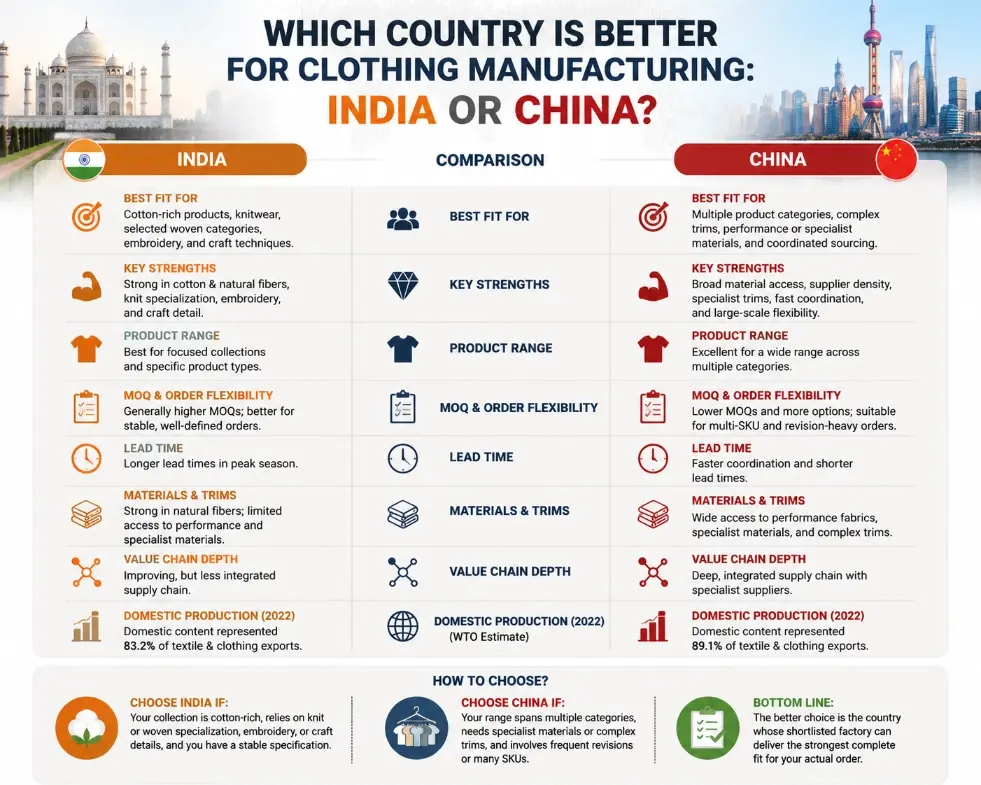
China often fits brands that need broad material access, multiple product categories, complex trims, or rapid coordination between specialist suppliers. India can fit brands whose products align with cotton, knitwear, selected woven categories, embroidery, craft techniques, or a deliberate China+1 sourcing plan. The better choice is the country whose shortlisted factory can prove the strongest complete fit for the actual order.
The comparison is closer than simple export rankings suggest. A WTO textiles and clothing value-chain profile estimated that domestic content represented 89.1 percent of China’s textile and clothing exports and 83.2 percent of India’s in 2022. Both countries therefore have substantial domestic production networks. The difference lies in the depth, specialization, and order-level accessibility of those networks.
India often deserves the first search when a focused collection relies on cotton-rich materials, knit or woven specialization, embroidery, or craft detail. China often deserves the first search when a range spans several product categories, needs performance or specialist materials, or depends on coordinated trims, washes, printing, labels, and packaging. A stable specification may work well with a focused Indian specialist, while a revision-heavy, multi-SKU program may benefit from China’s supplier density.
These country-level patterns are starting hypotheses, not a score. A capable Indian factory can outperform a weak Chinese supplier on a complex product, and the reverse is equally possible. Brands still considering more than these two countries can use HAPA’s guide to the best countries for clothing manufacturing to compare broader sourcing routes.
What Should Brands Compare Before Choosing India or China?
Brands should compare India and China with the same tech pack, bill of materials, fabric specification, quantity breakdown, quality standard, Incoterm, target market, and launch date. If those inputs change between quotations, the result measures two different orders rather than two manufacturing countries.
A comparable request for quotation should give every candidate the same commercial and technical starting point:
- Product specification: Include construction drawings, measurement charts, tolerances, grading, seam details, artwork, and workmanship standards. A reference image without measurable specifications leaves too much room for interpretation.
- Material definition: State fiber content, fabric construction, weight, finish, color standard, shrinkage limits, and performance requirements. Identify which substitutions need written approval.
- Quantity structure: Separate quantity per style, color, and size from the total collection volume. A factory may accept the total order while rejecting an inefficient color split.
- Development scope: Clarify whether the buyer needs pattern making, grading, material sourcing, artwork preparation, or only production from approved files.
- Quality and testing plan: Define the approved sample, inspection stages, test responsibility, acceptable tolerances, and destination-market documentation.
- Branding and packing: Specify labels, hangtags, barcodes, polybags, cartons, folding, ratio packs, and retail-channel requirements.
- Commercial basis: Request the same pricing model and Incoterm from every factory. FOB, CMT, and full-package quotations do not include the same responsibilities.
- Calendar: Give the sample approval deadline, material commitment date, production window, inspection date, and required delivery date.
This preparation also improves supplier selection. A factory that asks precise questions about fabric, tolerances, component safety, packaging, and testing is showing how it thinks. A factory that returns a fast price without resolving obvious gaps is offering an estimate, not a controlled production plan.
Brands that have not yet built a candidate list can first review this guide to finding clothing manufacturers. The country comparison should begin only after each candidate’s legal identity, proposed production site, and product relevance have passed an initial screen.
Why Do Clothing Manufacturing Costs Differ Between India and China?
Clothing manufacturing costs differ because material sourcing, order size, factory setup, specialist processes, sampling, testing, freight, duties, rework exposure, and buyer coordination vary by product and supplier. A country-level wage comparison cannot show which complete order will cost less.
The opening factory quote is only one layer. A lower sewing price can be offset by imported fabric, separate trim suppliers, extra sample rounds, third-party quality control, smaller-shipment surcharges, or more buyer time spent coordinating several vendors. A higher FOB quote may include a more complete material and packaging path. The buyer has to normalize the scope before comparing the numbers.
A useful total sourcing cost calculation includes these layers:
- Development cost: Add pattern work, sample fees, material trials, artwork preparation, courier charges, and every planned revision round. Record whether any amount is credited later, but do not treat a conditional credit as guaranteed savings.
- Factory price: Compare like with like. Confirm whether fabric, trims, labels, packing, testing, and export preparation are included, and identify the quotation currency and validity period.
- Quality and compliance cost: Include laboratory testing, factory audits, inline inspections, final inspection, document review, and any buyer-appointed quality staff.
- Logistics and import cost: Add origin handling, freight, insurance, destination charges, duties, taxes, brokerage, and domestic delivery under the same shipment assumptions.
- Operational overhead: Estimate the internal hours required for supplier coordination, translation, sample review, issue resolution, and approval control.
- Risk allowance: Model the effect of delayed materials, failed tests, rework, rejected units, missed launch windows, and inventory that arrives too early or too late.
| Cost layer | What to request | Why the India vs China result can change |
|---|---|---|
| Fabric and components | Named source, minimum, price basis, availability, and approved substitute | A local material path may reduce cost and time, while a special imported input can remove that advantage |
| Conversion | Cutting, sewing, finishing, decoration, washing, and packing scope | Productivity, equipment, order size, and factory specialization affect the result |
| Development | Number and type of samples, revision policy, and courier basis | Complex products may create more rounds and more coordination than the first quote shows |
| Testing and QC | Test menu, inspection stages, responsibility, and retest terms | The cheapest quotation may exclude controls that another supplier includes |
| Freight and duty | Shipment mode, Incoterm, HS or HTS code, destination, and date | Rates and trade measures differ by product and market and can change quickly |
| Buyer overhead | Communication load, vendor count, travel, and local support | A fragmented execution path can consume more internal resources |
Tariffs deserve special care. There is no useful global statement that Indian or Chinese garments receive the lower duty. The answer depends on the destination country, garment classification, fiber content, origin rules, and any current trade measures. A brand should confirm the exact HS or HTS code with its customs broker and use the destination country’s official tariff database immediately before costing.
The strongest commercial comparison is therefore not “Which country has cheaper labor?” It is: Which qualified factory can deliver the approved product at the lower total sourcing cost, with assumptions the buyer can verify and manage?
How Should Brands Match Products to India or China?
Brands should match the country to the product’s material base, construction, trims, specialist processes, SKU complexity, and development needs. India or China may indicate where to search first, but the assigned factory and its actual supply chain must prove the fit.
India’s Ministry of Textiles reports that the country was the world’s sixth-largest textile and apparel exporter in 2023 and had a 3.9 percent share of global textile and apparel trade. Its 2024 to 2025 annual report also describes a large cotton base that supports yarn, fabric, garments, made-ups, and knitwear. This makes India a credible starting point for relevant cotton-rich and category-specialized programs.
China’s advantage is broader scale across the textile and clothing chain. The WTO profile attributes China’s high domestic value-added share to domestic supply chains that cover production from fibers through spinning, weaving, dyeing, and finished garments. An Indian government Trade Watch report also notes China’s much larger position in global synthetic and technical textile categories. That matters when a garment depends on performance fabrics, coatings, laminations, complex hardware, or several specialist processes.
India’s Product Fit
India deserves early consideration when cotton or cotton-rich materials are central to the range, especially when a candidate factory can identify the proposed mill and finishing route. Knitwear clusters and category specialists can also be relevant for jersey basics, selected babywear, casual apparel, embroidery, print-led products, and garments with craft detail.
However, a national cotton base does not prove that a specific fabric is locally available, competitively priced, or suitable for the target market. The buyer should confirm yarn quality, fabric construction, finishing, shade control, shrinkage, testing, minimums, and whether any process is subcontracted. A workshop that produces beautiful hand detail may not have the systems for consistent high-volume repetition. A large exporter may not prioritize a small, complex order.
China’s Product Fit
China often deserves early consideration when the collection combines several fabrics, trims, printing methods, washes, labels, packaging components, or garment categories. A dense network can shorten the distance between a problem and a replacement option. It can also make consolidated development easier when one sourcing team coordinates multiple specialist facilities.
That ecosystem should not be confused with factory ownership. A garment supplier may source fabric, embroidery, washing, testing, labels, and cartons from separate partners. The buyer still needs to know who performs each process, where it happens, and how approvals move between parties. HAPA’s explanation of why brands use clothing factories in China provides more context on the country’s clustered supply network.
For either country, request evidence that connects the product to the proposed execution path:
- Recent samples with similar fabric, construction, fit, and decoration
- The exact production facility and any approved subcontractors
- Material suppliers, lead times, minimums, and backup options
- Equipment and technical processes needed for the design
- A sample and testing plan tied to the target market
Country capability narrows the search. Product-level evidence decides whether the shortlist is credible.
India vs China Apparel Development Capacity
MOQ, sample speed, and scale are factory and order characteristics, not reliable country averages. Development capacity should be judged through material readiness, sample execution, revision discipline, production allocation, and the factory’s ability to keep an approved specification stable as volume grows.
Sample Iteration
A strong sample is not simply attractive. It should show that the supplier understands measurements, construction, materials, color, artwork, trims, labels, and packing instructions. The factory should document deviations instead of quietly replacing an unavailable input.
Compare how candidates receive comments, issue revised specifications, label sample versions, and close open points. A fast first sample followed by confused revisions is not faster development. HAPA’s product sample process illustrates a China kidswear path that begins with a brief, moves through specification review and material sourcing, and uses buyer feedback before bulk approval. Any Indian candidate should be assessed with the same checkpoints.
Order Growth
A factory that accepts a trial order may not have the right structure for a larger repeat, while a high-volume plant may handle scale well but give a small launch limited attention. Ask how capacity is reserved, whether key materials must be committed earlier at higher volumes, and which production line would handle a reorder.
MOQ also has several layers. The sewing minimum can differ from the fabric, dyeing, printing, trim, or packaging minimum. A low garment MOQ may still force a brand to purchase excess fabric or simplify colors. Compare the complete minimum structure per style, color, and material rather than one headline number.
Collection Complexity
Multi-SKU collections test coordination more than sewing capacity. One factory may quote every style but route different categories through several facilities. Another may specialize in fewer products and provide better control within that range.
Ask each supplier to map the responsible facility, material source, sample owner, production line, quality checkpoint, and packing location for every SKU. China’s broader supplier density can help with cross-category coordination, but it does not guarantee consistent control. India can perform efficiently when the collection matches a focused cluster or manufacturer specialization. The useful measure is not theoretical capacity. It is the capacity allocated to the brand’s exact calendar.
India vs China Clothing Manufacturing Risks
Quality, compliance, labor conditions, and sustainability cannot be inferred from a country label. A brand must verify the legal company, the actual production site, the certificate scope, the testing plan, subcontracting, traceability, and corrective-action process for each supplier.
Factory Evidence
Start by separating four questions: Is the business legally real? Is the proposed factory real? Can that facility make this product? Is the required capacity actually available? A company registration answers only the first question. A factory video answers none of them completely.
The risk file for an Indian or Chinese candidate should contain:
- Legal entity details, operating address, and payment account ownership
- The proposed manufacturing site for each style
- Product-relevant machinery, production samples, and responsible technicians
- Current audit and certification documents with scope and expiry dates
- Named subcontractors for washing, printing, embroidery, testing, or packing
- A quality plan linked to the approved sample and specification
- Material traceability and approved-substitute controls
- Corrective-action ownership when a sample, test, or inspection fails
Compliance Proof
Compliance follows the product and destination market, not the production country. A children’s garment, adult fashion item, nightwear product, or performance jacket can involve different material, labeling, flammability, chemical, and documentation requirements. The brand or importer may retain legal responsibility even when the factory organizes testing.
Certificates can support due diligence, but they must be checked in the issuing body’s database and matched to the legal entity, facility, product scope, and validity period. They do not replace product testing or a review of actual working conditions. Statements such as “India is more sustainable” or “China has better compliance” are too broad to guide a purchase.
For children’s apparel, HAPA’s verified children’s clothing OEM workflow covers tech pack review, pattern and grading, fabric and trim selection, sample approval, bulk quality checks, labels, and packaging. These checkpoints help translate destination-market requirements into development tasks, but testing, certification, timing, and commercial terms still need order-specific confirmation.
Supply Continuity
Country diversification can reduce concentration risk, but it also creates a second onboarding, material approval, audit, testing, logistics, and communication system. A backup factory is not useful if it uses a different fabric, cannot match the approved fit, or has never run a controlled pilot.
A practical continuity plan identifies critical materials, single-source processes, alternative facilities, approval owners, document storage, and the time needed to transfer production. Brands should also consider whether an Indian factory relies on an imported component from China, or whether a Chinese supplier depends on a specialized input from another market. The country name alone does not reveal those dependencies.
Best-Fit India vs China Sourcing Scenarios
China, India, and a dual-source model suit different operating conditions. The brand’s ability to manage specifications, approvals, quality control, and replenishment matters as much as the garment category.
| Brand scenario | India-first case | China-first case | Decision check |
|---|---|---|---|
| First collection | Focused cotton or knit range with a specialist that actively supports the order | Complex product or trim package where consolidated sourcing reduces development gaps | Which factory asks better questions and produces the stronger approved sample? |
| Cotton-led label | Domestic cotton route, relevant knit or woven specialization, and stable material plan | Special finish, mixed material, unusual trim, or cross-category range needs broader coordination | Can the supplier name the mill, finish, minimum, test plan, and substitute route? |
| Complex collection | A capable multi-category exporter maps every facility and process clearly | Dense supplier access supports materials, hardware, printing, washing, labels, and packaging | Is coordination controlled, or merely hidden behind one sales contact? |
| China+1 strategy | India adds a verified category specialist or second production path | China remains the main source for products that depend on its supplier ecosystem | Does the risk reduction justify two sets of onboarding and operating costs? |
First Collection
A startup should not choose a country from a claimed national MOQ. It should choose a factory that treats the first order as a controlled development project. Clear questions, realistic material options, documented samples, and transparent commercial assumptions are stronger signals than a low opening price.
The first range should stay focused enough to expose execution quality without creating unnecessary supplier complexity. When the product is still changing, one well-managed relationship can be safer than splitting a small budget across two countries.
Brands preparing an India-side candidate pool can use this practical guide to finding clothing manufacturers in India before issuing the same RFQ to qualified factories.
Cotton-Led Brand
India can be a logical first search market for cotton-rich products, but the buyer still needs fabric-level proof. The relevant questions cover yarn and fabric source, construction, weight, finishing, shrinkage, color consistency, testing, and replacement availability.
China should remain in the comparison when the cotton garment also uses specialized elastics, coatings, hardware, printing, washes, or complex packaging. The final choice should reflect the whole product, not its headline fiber.
Complex Collection
China often has an advantage when a collection needs many components and fast coordination among specialist processes. For a children’s brand, that may include patterns, grading, secure trims, prints, labels, packaging, and several garment categories.
HAPA can serve as one China-side candidate for a kidswear feasibility and sampling comparison. Its role should be assessed against the same RFQ and scorecard used for Indian suppliers. Brands exploring the India side can review these top 15 garment manufacturers in India as a broader comparison set, then independently verify every candidate against the product brief.
Dual-Source Strategy
A China+1 plan works when the brand has enough volume, documentation discipline, and quality infrastructure to maintain two real production paths. It should not be a collection of untested backup contacts.
The two suppliers need controlled specifications, comparable materials, shared test requirements, approved samples, and a clear SKU allocation. The brand must decide whether both factories produce the same item, whether each country owns different categories, or whether one remains a qualified contingency. If the extra audit, testing, logistics, and management cost exceeds the value of diversification, a stronger single-country backup plan may be more practical.
Run an India vs China Factory Test
The most reliable next step is to send the same RFQ to qualified Indian and Chinese factories, then compare their questions, material path, sample execution, total cost, risk evidence, and project management. This turns a country debate into an order-level decision.
Run the comparison in six controlled steps:
- Shortlist comparable candidates: Select factories with evidence of similar products and an identifiable production site. Do not compare a small specialist in one country with a multinational full-package group in the other unless that difference reflects the actual buying choice.
- Issue one locked RFQ: Send the same files, quantity structure, quality requirements, testing responsibilities, packing instructions, Incoterm, and calendar. Record every clarification issued to one supplier and share it with the others.
- Normalize the proposals: Separate included and excluded costs, material assumptions, minimums, sample rounds, production timing, subcontracting, payment terms, and quotation validity.
- Approve a sample path: Use the same review fields for measurements, fit, construction, materials, color, decoration, labels, and packing. Track how each factory handles corrections.
- Verify the risk file: Confirm the legal entity, proposed factory, relevant documents, testing plan, quality controls, payment account, and escalation owner before a bulk commitment.
- Make a go or no-go decision: Score total sourcing cost, product fit, sample performance, evidence quality, communication, allocated capacity, and supply continuity. Document why the chosen route won.
Score every proposal across seven fields: product understanding, material path, commercial clarity, sample control, quality evidence, production readiness, and supply resilience. A strong response connects each field to the tech pack, identifies the proposed facility and subcontractors, states exclusions and validity, documents sample deviations, defines inspections and corrective action, and names backup materials or escalation routes. Record evidence gaps rather than smoothing them over with a single total score.
The winner may be India, China, or neither candidate. That is a useful result. Rejecting two weak proposals is cheaper than forcing a country choice and discovering the gaps during bulk production.
For a China kidswear comparison, a brand can contact HAPA with its product type, tech pack or reference sample, fabric and trim requirements, size range, quantities, target market, branding, packaging, and launch date. HAPA can then confirm whether the project fits its children’s clothing workflow and identify the points that need clarification before sampling.
Conclusion
India vs China clothing manufacturing should end with an order-level decision, not a country slogan. India can be the stronger first search for cotton-led, knit, woven, craft-detailed, or category-specialized programs when the selected factory proves the material and production route. China can be the stronger first search for complex, multi-category, trim-heavy, or revision-intensive collections that benefit from dense supplier coordination.
The final decision should use the same tech pack, quantities, Incoterm, target market, testing plan, packaging requirements, and delivery window. Compare total sourcing cost, sample performance, factory evidence, allocated capacity, and the effort required to control the order. If neither candidate provides a credible path, continue the search rather than forcing a winner.
For children’s apparel, HAPA can be evaluated as one China-side OEM candidate using the same RFQ and scorecard applied to Indian factories. Choose the factory that provides the strongest complete evidence for the same brief, not the country with the most persuasive slogan or the lowest isolated quotation.
FAQ
Is India or China Better for a Startup Clothing Brand?
Neither country is automatically better for a startup. Choose a factory whose product specialization, development support, MOQ structure, communication, and material access match your first range. Compare complete proposals and samples. A higher unit price can be safer if it reduces revisions, split minimums, delays, or quality risk.
Are Chinese Clothing Manufacturers Always Cheaper Than Indian Manufacturers?
No. Unit price depends on fabric, order size, construction, labor content, trims, finishing, testing, packaging, and factory fit. Compare quotations at the same Incoterm and include development, inspection, freight, duty, rework, and buyer time. A low ex-factory price does not prove a lower landed or total sourcing cost.
Can a Brand Source Clothing From Both India and China?
Yes, if each country has a clear role and the order volume justifies two supplier systems. A brand might place cotton-led categories with an Indian specialist and complex, trim-heavy products with a Chinese supplier. Dual sourcing improves resilience only when specifications, approvals, quality controls, and ownership remain consistent across both routes.
Which Country Has Lower MOQs for Clothing Production?
Neither universally. Compare garment, fabric, color, and trim minimums for the same specification because factory specialization and material sourcing determine the result.
How Can You Verify an Indian or Chinese Clothing Factory?
Confirm its legal entity, factory address, production evidence, subcontractors, quality controls, and payment account, then validate through sampling.