Every sourcing season, I watch the same cycle play out. Brands spend months touring factories in Vietnam, Bangladesh, Turkey, and Portugal — doing the math, running the comparisons, building the pitch decks for why this year they’re finally going to diversify away from China. And then, quietly, the majority of their production routes right back through Chinese clothing manufacturers.
I’ve been on both sides of this equation. I’ve helped brands explore alternatives in good faith, and I’ve watched those same brands come back to China not out of habit, but because the business case kept winning. If you’re finalizing your sourcing strategy for 2026, you deserve an honest look at why that keeps happening — and what it actually means for your brand.
Reason1. Vertical Integration: The Supply Chain Advantage Nobody Talks About Enough
When people ask me what makes clothing factories in China different from factories elsewhere, I don’t start with price. I start with proximity.
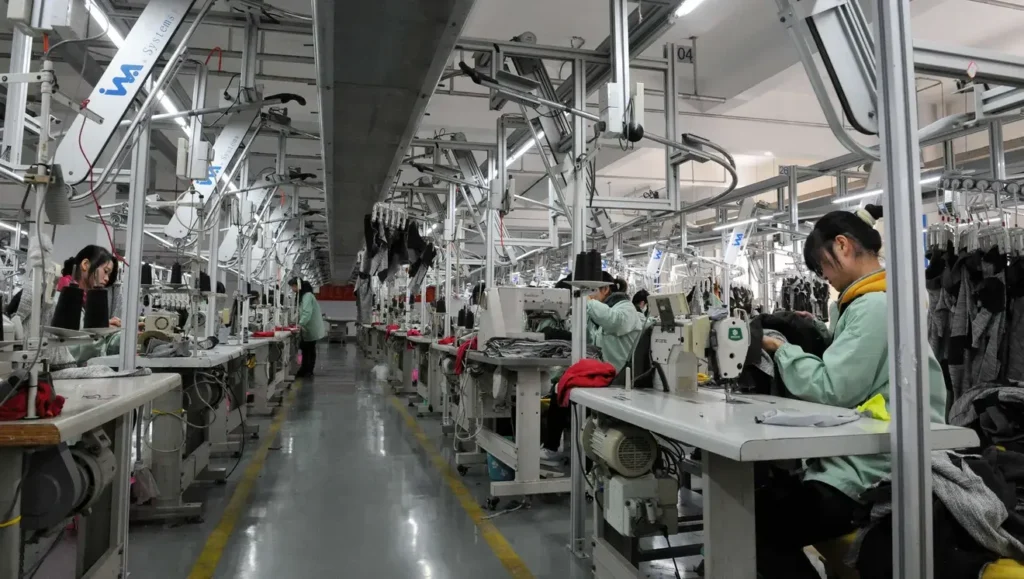
China’s apparel industry is organized into hyper-specialized regional clusters — self-contained production ecosystems where you can source every component of a garment, from thread to finished packaging, without leaving a 50-kilometer radius. In Guangdong’s Pearl River Delta, yarn mills, fabric dyeing facilities, button manufacturers, and garment assembly lines sit practically next door to each other. There are no cross-border shipping delays between suppliers, no import duties stacking up between raw materials and finished goods, and no lost weeks waiting on trims to clear customs.
This is what genuine vertical integration looks like in practice — and it’s something I’ve never seen matched anywhere else in the world.
What Vertical Integration Means for Your Sampling Speed
That integrated supply chain translates directly into sampling timelines that genuinely change how brands operate. Here’s the honest comparison:
- China: 3–7 days for standard samples; 10–14 days for complex technical garments
- Vietnam: 14–21 days for standard samples
- Bangladesh: 21–30 days for standard samples
For a fast-fashion brand or a DTC label testing new drops, that’s not a marginal difference — it’s the difference between reacting to a trend and missing it entirely. When I work with brands on finding the right manufacturing partner, the sampling timeline is often the factor that makes up their minds faster than any unit cost calculation.
Reason2. Cost Efficiency — But Not for the Reasons Most People Assume
Reducing China’s manufacturing advantage to “cheap labor” has always missed the point. The cost savings brands capture here are structural, and they compound in ways that no single competing country has managed to replicate at scale.
Brands regularly report cutting unit production costs by 30 to 50 percent when they shift manufacturing from North America or Western Europe to China. That gap isn’t narrowing — and it isn’t built on a single variable.
Three Cost Drivers That Stack
Skilled labor cost ($3–$6/hr): Garment workers in Guangdong and Zhejiang are skilled and experienced — precision sewing, quality finishing, complex construction — at a fraction of the cost of their US or EU counterparts.
Raw material proximity: Fabric mills, trim suppliers, and dyehouses cluster directly around garment factories. Materials land on the cutting table in days. No cross-border freight, no import duties, no waiting.
Volume-driven pricing: China’s production scale drives down the cost of every input — thread, packaging, machinery depreciation, logistics. Even mid-size brands access pricing infrastructure that was built for the world’s largest buyers.
How China Compares to Other Low-Cost Countries
The headlines about “China alternatives” aren’t wrong exactly — they’re just incomplete. Here’s what the full picture looks like:
| Country | Avg. Unit Cost (Basic Tee) | Typical MOQ | Production Lead Time | Quality Consistency |
|---|---|---|---|---|
| China | $2.50 – $5.00 | 50 – 500 pcs | 15 – 25 days | High — advanced QC, ISO-certified factories widely available |
| Vietnam | $2.80 – $5.50 | 300 – 1,000 pcs | 30 – 45 days | Good — but fabric often sourced from China, adding lead time risk |
| Bangladesh | $2.00 – $4.00 | 1,000 – 3,000 pcs | 45 – 60 days | Variable — strong for basic knitwear; limited range for complex styles |
| India | $3.00 – $6.00 | 200 – 800 pcs | 30 – 50 days | Good for cotton & handcrafted; less consistent on technical fabrics |
Figures reflect mid-market apparel production benchmarks as of 2025–2026. Costs vary by garment complexity, fabric type, and factory tier.
Bangladesh can undercut China on unit cost for high-volume basics — but once you factor in MOQ flexibility, lead time, and quality range, garment factories in China remain the stronger default for most brand profiles. Vietnam’s own fabric supply chain still runs through China, which means you’re adding a leg to the journey without eliminating the dependency.
For a closer look at which country fits your product, order size, and target market, see our clothing manufacturing country comparison.
Reason3. Production Capacity and Scalability From Day One
One of the most persistent myths I encounter is that manufacturing in China only makes sense for large brands placing massive orders. That hasn’t been accurate for years.
A new wave of factories — concentrated in Guangdong and Fujian — specifically serves early-stage brands, with minimum order quantities starting as low as 50 to 100 pieces per style. If you’re a startup validating a design, an influencer brand testing a limited drop, or a DTC label gauging customer response before committing to a full run, the infrastructure is genuinely there. You can grow from a 100-piece test run to a 100,000-unit reorder without switching factories or renegotiating relationships from scratch.
If you’re in the early stages, our guide on clothing manufacturers for startups walks through exactly how to approach that process.
Low MOQ vs. High-Volume: Understanding the Spectrum
Low MOQ factories (50–500 pcs per style) Best for DTC startups, influencer brands, first-time buyers, and limited-edition drops. Shorter sampling timelines (7–10 days), greater flexibility on colorways and customization, higher per-unit cost — but lower total capital commitment. The Canton Fair and platforms like Alibaba are practical starting points for finding vetted partners at this tier.
High-volume factories (5,000–1,000,000+ pcs per style) Best for established retailers, fast fashion labels, and global wholesale brands. Dedicated production lines, automated cutting, AI-assisted quality control, ERP-integrated order tracking, and long-term partnership pricing. Factories at this tier routinely hold BSCI, ISO 9001, and OEKO-TEX certifications.
China’s Key Apparel Manufacturing Hubs
China’s garment industry isn’t evenly distributed — it concentrates in four major provincial hubs, each with distinct specializations. Knowing which region to target based on your product can shave weeks off your sourcing timeline.
| Province | Key Cities | Specialization | Cluster Advantage |
|---|---|---|---|
| Guangdong | Guangzhou, Dongguan, Foshan | Fast fashion, denim, sportswear, woven apparel | Largest garment export hub; dense concentration of trim, fabric, and packaging suppliers |
| Zhejiang | Hangzhou, Ningbo, Shaoxing | Knitwear, silk, premium textiles, outdoor apparel | Home to Keqiao, the world’s largest textile market; strong ODM capabilities |
| Jiangsu | Suzhou, Nanjing, Wuxi | Embroidery, high-end tailoring, technical fabrics | Advanced textile R&D; preferred by luxury and performance wear brands |
| Shandong | Qingdao, Weifang | Denim, workwear, uniform manufacturing | Deep denim heritage; large-scale capacity with competitive pricing on basics |
The cluster model is what separates these hubs from standalone factories elsewhere. When a zipper supplier, a Pantone-matched thread house, a woven label printer, and a freight forwarder all operate within the same 10-kilometer zone, your factory absorbs coordination costs that would otherwise fall entirely on you.
Reason4. Master Craftsmanship and Advanced Automation — Running in Parallel
China’s manufacturing reputation gets framed as an either/or: either skilled handwork or industrial-scale machinery. Having spent time on factory floors in both Jiangsu and Guangdong, I can tell you the more accurate picture is both, running in parallel — and it’s that combination, refined over decades, that gives Chinese factories a versatility most competitors can’t match.
Decades of Specialized Artisan Skill
Long before automation entered the picture, China’s garment industry was built on craft. Generations of workers in provinces like Jiangsu and Zhejiang developed deep expertise in embroidery, tailoring, hand-finishing, and fabric construction — knowledge that gets passed down on the factory floor rather than taught in classrooms.
When a brand needs intricate smocking on a premium dress, hand-stitched detailing on a luxury jacket, or precise Pantone-matched embroidery across a 10,000-unit run, Chinese clothing manufacturers consistently deliver the consistency that automated systems alone can’t replicate. And this expertise isn’t locked inside a handful of elite ateliers — it’s distributed across thousands of mid-tier factories that have been refining the same techniques for 20 to 30 years.
Advanced Manufacturing Technology
Artisan skill only scales so far. What allows garment factories in China to fulfill million-unit orders without a proportional drop in quality is the manufacturing technology now operating across leading facilities:
- Laser-guided fabric cutting — reduces material waste by up to 15% and delivers precision that manual cutting can’t consistently achieve at scale
- AI-powered defect detection — automated vision systems scan finished garments at speed, flagging stitching inconsistencies, color deviations, and fabric flaws before pieces leave the line
- Computer-controlled embroidery and printing — multi-head embroidery machines and digital sublimation printers reproduce complex artwork with near-zero color variance between units
- CAD pattern-making and 3D sample visualization — brands review and approve fit digitally before a single piece of fabric is cut, reducing costly sample revisions and compressing development timelines
The factories investing most heavily in this technology aren’t replacing their skilled workers. They’re deploying them where judgment, touch, and experience still outperform any machine.
Reason5. Quality Control That Meets Global Standards
The “cheap Chinese manufacturing” stereotype is genuinely outdated. Today’s leading private label clothing manufacturers in China operate quality control systems that meet or exceed the strictest global standards — and the brands working with them know it.
Multi-Stage Inspection Processes
Unlike many overseas factories that only perform final product checks, top Chinese manufacturers implement proactive, multi-stage inspections at every step of production:
- Incoming raw material testing for fabric strength, color fastness, and chemical safety
- In-line production spot checks every two hours to catch assembly errors early
- Pre-shipment final inspections covering 10–20% of units per order
- Post-delivery defect tracking and formal corrective action protocols
Global Compliance and Certification
Chinese factories have decades of experience navigating the regulatory landscapes of the EU, US, and other major markets. Most reputable facilities maintain certifications including BSCI, WRAP, OEKO-TEX, and CPSIA, working with third-party auditors such as SGS, Bureau Veritas, and Intertek to ensure full compliance with labor, safety, and environmental requirements. This eliminates guesswork for brands and significantly reduces the risk of customs holds, product recalls, or reputational damage.
Reason6. A Growing Commitment to Sustainable Manufacturing
One of the more significant shifts I’ve observed over the past few years is how seriously leading Chinese clothing manufacturers are taking sustainability — not as a marketing exercise, but as a genuine operational priority driven by both government policy and brand pressure.
Green Manufacturing Technologies
China’s factories are adopting sustainable processes faster than any other manufacturing region:
- Waterless digital dyeing that cuts water usage by 90% and chemical waste by 70%
- Solar-powered production facilities that reduce Scope 2 carbon emissions by 40%
- Closed-loop recycling systems that repurpose 95% of fabric scraps into new textiles
Transparent Ethical Labor Practices
Leading factories now hold independent certifications including GOTS, Fair Trade, and SA8000, with regular unannounced third-party audits. Many also provide above-minimum wages, comprehensive healthcare, and professional development opportunities for their workforce. For brands navigating the advantages of manufacturing clothes in China while managing ESG commitments, this represents a meaningful shift from even five years ago.
Reason7. Speed to Market — The Factor That Decides Seasons
In the TikTok era, the brand that gets to market first usually wins. Missing a trend by three weeks isn’t a minor inconvenience; it’s lost revenue and dead inventory. This is where China export clothing infrastructure creates a structural advantage that’s genuinely hard to replicate.
From Digital Sample to Physical Production
Factories now use 3D rendering software to finalize fits and prints in days, bypassing the weeks-long physical sampling phase entirely. Once a design is digitally approved, localized material sourcing means physical production kicks off immediately — shrinking what used to be a 90-day cycle down to 30–45 days.
Agile Supply Chains for Trend-Responsive Brands
The ability to react to real-time sales data and place smaller initial orders — then reorder proven best-sellers quickly — is one of the most underrated advantages of manufacturing clothes in China. This just-in-time model minimizes dead stock, frees up cash flow, and keeps your inventory aligned with actual consumer demand rather than six-month-old forecasts.
For seasonal drops: produce and stage inventory weeks ahead of launch. For flash trends: turn around viral styles in under 21 days. Very few manufacturing ecosystems can make both of those statements honestly. If you want to understand how to structure your buying process around this kind of agility, our guide on how to buy apparel direct from the factory is a practical place to start.
How to Find High-Quality Clothing Factories in China
Knowing that China has thousands of capable garment factories doesn’t make finding the right one easier. The search process trips up experienced buyers as often as first-timers — not because good factories are scarce, but because the path to them isn’t always obvious, and the wrong choices are expensive to undo.
Where to Start Your Search
Online B2B platforms: Alibaba and Made-in-China.com remain the most accessible starting points for brands without existing industry connections. The volume is enormous, which means the filtering work falls on you. Focus on suppliers with verified business licenses, trade assurance coverage, and meaningful order history rather than sorting by price. Read reviews critically — a detailed review from a buyer in your product category is worth a dozen generic five-star ratings.
Trade shows: The Canton Fair — held twice yearly in Guangzhou — puts you in front of thousands of manufacturers across every apparel category. You can handle samples, meet production teams directly, and gather competitive pricing in real time. For brands in the early stages of building a supply base, it’s hard to match the density of qualified introductions a well-prepared Canton Fair visit can generate.
Sourcing agents: A reputable agent based in China — with category-specific experience in your product type — can compress the search and vetting process significantly. A good agent maintains existing relationships with vetted factories, understands which suppliers are genuinely capable, and negotiates in Mandarin with local market knowledge behind them. The cost is typically a percentage of order value or a fixed retainer, and for brands without an in-country presence, it frequently pays for itself in avoided mistakes. Always ask for references from current clients, and be transparent about how they’re compensated.
Industry referrals: The most reliable factory introductions often come through other brand founders in adjacent, non-competing categories. A women’s swimwear brand and a men’s activewear brand can share factory recommendations freely — and a firsthand endorsement from someone who has actually placed orders carries far more signal than any platform review.
For a deeper look at navigating this process, our full breakdown of how to find clothing manufacturers covers each of these channels in detail.
How to Vet a Factory Before Placing Your First Order
Finding a factory is the beginning of the process, not the end. Moving from initial contact to a committed order without proper vetting is one of the most common and costly mistakes brands make — especially with a new supplier.
Work through these checkpoints before any money changes hands:
Verify the business license. Request a copy and cross-reference the registered company name against the entity you’ll be contracting with. Legitimate factories provide this without hesitation. Resistance or deflection is an immediate red flag.
Request a factory audit or profile. Ask for a third-party audit report (BSCI, WRAP, or SA8000) or commission your own through an independent inspection agency. The cost is modest relative to the order value.
Order a paid sample before committing to bulk. Always evaluate a physical sample before placing a bulk order. Pay for it — factories that produce serious samples for free are usually folding the cost into your production pricing later. Evaluate construction, finishing, fabric handle, measurement accuracy against your tech pack, and how the factory communicates during the sampling process. The sampling stage is the most accurate preview of what bulk production will look like.
Test communication quality deliberately. Send a detailed, multi-part inquiry early in the relationship and evaluate how the factory responds. Do they answer every point or only the easy ones? Do they flag potential issues proactively? Communication quality during sampling almost always predicts communication quality during bulk production.
Start smaller than you think you need to. Even with a fully vetted factory, the first order carries more unknowns than subsequent ones. Build in extra lead time, use that first run to establish your quality benchmarks and approval processes, and scale up from a position of knowledge rather than optimism.
Red Flags Worth Walking Away From
Not every factory that presents well is worth working with. These warning signs consistently appear in sourcing relationships that go wrong:
- Prices significantly lower than every comparable quote you’ve received — this almost always reflects a compromise in materials, labor, or compliance that won’t become visible until your goods arrive
- Reluctance to provide business registration documents, audit reports, or client references
- Vague or non-committal answers about where fabric is being sourced from
- Sample quality that doesn’t match the product images or showroom pieces used for marketing
- Pressure to pay large deposits before any sampling or contractual terms have been agreed
- Claims to produce across every apparel category simultaneously — genuine specialization is a quality signal; unlimited capability claims rarely are
Specific Sourcing Areas Worth Knowing
For brands sourcing specialty categories, it’s worth knowing that the same depth of expertise in adult apparel exists in adjacent sectors. If you’re developing made in China clothing for younger markets, our overview of children’s clothing OEM production in China covers the specific compliance and quality considerations that apply. Similarly, if your brand is built around small-batch, customized production, our cut and sew manufacturer guide walks through how to identify facilities that excel in that format.
Final Thought
The brands with the strongest factory relationships in China almost universally say the same thing in hindsight: they wish they had moved more slowly at the beginning. The temptation to shortcut the vetting process is real — especially when a launch date is bearing down. But the cost of a bad manufacturing relationship, measured in delayed shipments, failed inspections, and unsaleable inventory, is almost always higher than the time proper vetting would have taken.
Clothing factories in China remain the global benchmark for apparel manufacturing — not because of inertia, but because the combination of vertical integration, cost efficiency, scalability, craftsmanship, and speed hasn’t been meaningfully matched anywhere else. Understanding exactly how that works, and how to access it intelligently, is one of the best investments you can make in your brand’s supply chain.
If you’re ready to start building those relationships, Hapa Garments works directly with vetted Chinese manufacturers to help brands source with confidence — from first samples through full-scale production.
Frequently Asked Questions
Where are the clothing factories in China?
Clothing factories are primarily concentrated in eastern coastal provinces. The main hubs are Guangdong (Guangzhou, Dongguan) for casualwear and denim, Zhejiang (Hangzhou, Shaoxing) for knits and silk, Jiangsu (Suzhou, Changshu) for high-end outerwear, and Shandong (Qingdao) for sportswear and heavy knits.
What percent of US clothing is made in China?
As of recent trade data, approximately 20–25% of US apparel imports originate from China. While this percentage has modestly declined as brands diversify into Vietnam and Bangladesh, China remains the single largest supplier of clothing to the United States by overall value and volume.
What city in China is known for manufacturing?
Guangzhou is widely recognized as the manufacturing and sourcing capital of China for apparel. Located in the industrial heartland of the Pearl River Delta, it provides unmatched access to garment factories, the world’s largest fabric markets, and efficient global shipping ports.
What is the clothing capital of China?
Guangzhou holds that title. The city is home to the Zhongda Fabric Market — one of the largest textile markets in the world — and a vast ecosystem of wholesale markets and garment factories. For global fashion brands, it’s the most practical single destination to begin any serious sourcing effort.