Manufacturing Location Guide
Is China Suitable for Sustainable Clothing Manufacturing?
Yes, China can be a strong location for sustainable clothing manufacturing, particularly for brands that need certified fabrics, integrated textile supply chains, custom development and scalable production. However, sustainability depends on the individual factory, material source, dyeing process, labor controls and traceability—not simply the “Made in China” label.
Country signal
China offers a deep apparel ecosystem, not an automatic sustainability result.
Evidence test
Connect every claim to the company, site, process, product and shipment.
Commercial test
Compare the complete project cost, not an isolated factory price.
Decision rule
Approve a pilot only when critical evidence and product performance agree.
What Makes a Manufacturing Location Sustainable?
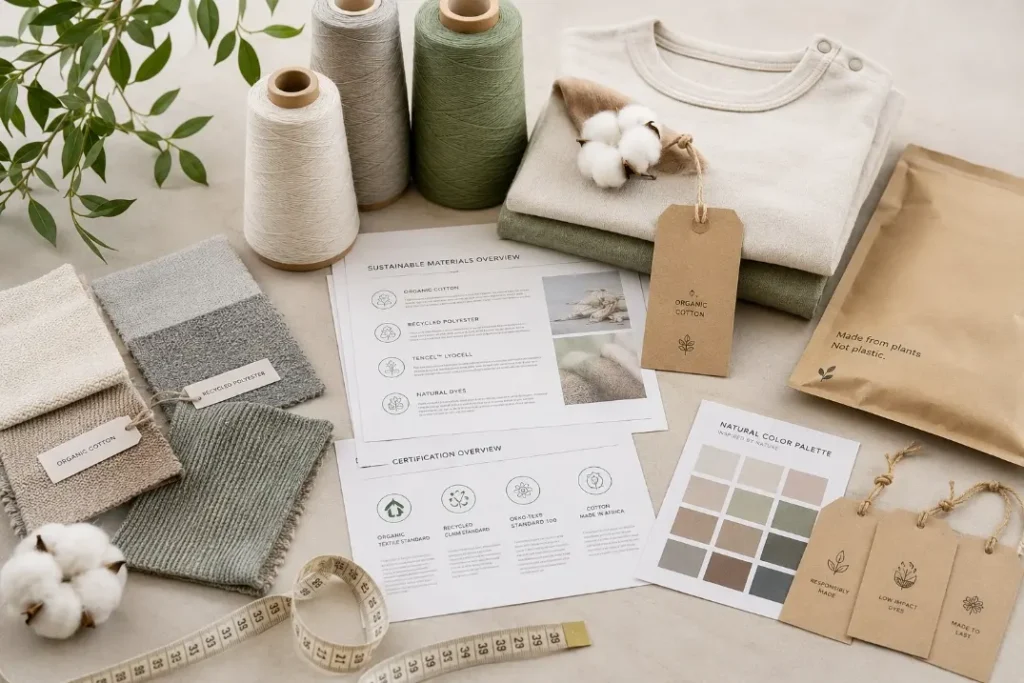
A suitable location is one where your product can meet its performance, environmental, social, traceability and commercial requirements, with evidence that stays connected to the actual order.
Start with the product, not a country’s reputation. A nearby factory may still import fabric, use an unverified dye house or generate costly rework. A distant supply chain may coordinate more processes in one region but still fail if upstream records are missing. The practical question is whether the complete route supports your stated objectives.
Score every candidate location against the same seven dimensions:
- Product fit: required fabric, construction, safety, finish and quality capability.
- Material and process route: origin, spinning, knitting or weaving, dyeing, printing, washing and finishing.
- Environmental controls: energy, water, chemicals, wastewater, waste and improvement records relevant to the order.
- Social due diligence: responsible facilities, working conditions, origin risks, findings and corrective action.
- Traceability: documents that connect each claim to the facility, product, lot and shipment.
- Commercial viability: total cost, minimums, timing, quality risk, inventory and team workload.
- Market fit: importer duties, product rules, claim wording and evidence required in the destination.
| Dimension | What to assess in China | Evidence needed | Decision warning |
|---|---|---|---|
| Product fit | Capability for the exact material, construction, finish and age group | Equipment list, similar sample, test plan and quality checkpoints | Do not substitute a factory’s general category experience for your product. |
| Supply-chain route | Which steps are in-house, coordinated or subcontracted | Named facility map with responsibilities and addresses | An unknown dye house, printer or laundry breaks visibility. |
| Environmental and social controls | Controls at every material production and wet-processing site | Current reports, records, findings and corrective actions | A final sewing audit cannot cover an unrelated upstream processor. |
| Traceability and claims | Whether evidence follows the product and delivery | Material, lot, test and shipment documents | A logo or capability certificate alone is not order proof. |
| Cost and logistics | Complete cost under one scope, date and Incoterm | Comparable quote, freight, duty and inventory assumptions | The lowest unit price may create the highest total sourcing cost. |
Treat the scorecard as a living project record. Sourcing can collect facility and cost inputs, sustainability can review environmental and social evidence, quality can define product gates, and the importer can confirm destination requirements. Record unresolved items beside the decision instead of converting incomplete information into an optimistic overall score.
The OECD garment and footwear due-diligence framework is useful here because it treats certification as one input to risk-based due diligence, not as a replacement for it.
Why Can China Support Sustainable Clothing Manufacturing?

China can support sustainable apparel projects through a deep textile ecosystem, broad development capability and access to certified supply options. Each advantage must still be proven for the assigned facilities, processes, material and order.
Integrated Textile Supply Chain
China can connect yarn, fabric, wet processing, trims, garment assembly, testing and packaging within a broad manufacturing network. The WTO textiles and clothing profile reported 89.1% domestic content in China’s 2022 textile and clothing exports, indicating supply-chain depth rather than proven sustainability.
Product Development Depth
Projects combining custom fabric, printing, embroidery, trims and private-label packaging can benefit from coordinated technical partners. Ask who performs each operation and approves substitutions. See how clothing moves through a garment factory for production context.
Certified Supply Options
The official GOTS certified suppliers database helps buyers check listed Chinese entities, sites, scope and validity. A listing shows potential capability, but the product and order documents must still support the material or goods delivered.
Why certified fabric is simply easier to buy here
The difference that matters is between we can source it and we hold it. A factory that can source a certified fabric is placing an order with a mill that will impose its own minimum, its own dye-lot schedule and its own lead time.
A factory working with mills that already run certified qualities in stock-supported colours can quote you a realistic date. Four questions separate the two:
Ask before you believe a lead time
- Which mill supplies this fabric?
- What is the fabric reference and construction?
- What certification does that mill hold, and in whose name?
- Is the colour I want a stock shade or a lab dip?
Fewer hand-offs, fewer places a claim can break
Every additional company between the fibre and your finished garment is another point where documentation can go missing. Vertically integrated and near-vertical factories are not automatically more ethical — but they do have fewer gaps to explain.
- They can usually name their tier 2 and tier 3 suppliers without a week of internal chasing.
- Fewer intermediaries means fewer parties who can quietly substitute a material.
- Nominated mills work well here: you control the material claim at source, and the factory handles assembly against it.
Where in China Should You Manufacture Sustainable Clothing?
Regions specialise. Match the cluster to what your product actually demands — a brand doing seasonal printed cotton kidswear and a brand doing high-volume basics should not be shortlisting from the same list.
- Pearl River Delta (Guangzhou and surrounds) — fast development cycles, complex construction and export handling. Useful for detailed kidswear, prints, embroidery and frequent style changes.
- Yangtze River Delta (Zhejiang, Jiangsu) — enormous knitting, weaving and dyeing capacity. Matters most when your priority is fabric development and volume.
- Inland regions — competing primarily on labour cost. A legitimate strategy, but rarely the one that supports a certified material programme.
Tier matters more than geography. This is the part most sourcing content skips entirely.
| Supplier type | What you are usually dealing with | What it can realistically evidence | Best suited to |
|---|---|---|---|
| Trading company or agent | A sales office placing your order with factories it does not own | Whatever its suppliers hand over; rarely holds certificates itself | Buyers who need many product types in one shipment and accept less visibility |
| Small CMT workshop | Sewing capacity only; fabric and trims come from you or a broker | Little beyond its own workplace conditions | Established brands with their own material supply chain and QC staff |
| Mid-size specialised factory | Pattern making, sampling and production under one management | Its own certifications, named mills, documented QC procedure | Growing brands that need development support and traceable materials |
| Large vertical group | Fabric and garment operations in one corporate structure | Deep documentation across multiple stages | High-volume programmes with the order size to hold their attention |
Where small brands go wrong
An unusually low advertised minimum is often the signature of an intermediary rather than a factory, because a trader can split a mill’s minimum across several clients. The intermediary may be completely honest — but each additional layer weakens traceability and makes a certified material claim harder to substantiate.
If you want a wider view on how China compares with other Asian sourcing bases, our breakdown of China versus Vietnam for garment production covers the trade-offs beyond sustainability alone.
What the major production clusters are each good at
Think in terms of what the cluster has practised most. Neither profile is better in the abstract; they are better at different products.
- Regions built around knit fabric development give you better fabric options and weaker complex-construction capability.
- Regions built around export-oriented finished goods handle labelling, packaging and documentation more smoothly, but may source fabric from further away.
What Sustainability Risks Should Brands Check in China
The main risks are not created by the country label itself. They arise when upstream processors are invisible, environmental or labour records are incomplete, origin evidence is weak, or commercial pressure causes unauthorized substitution, subcontracting or excess inventory.
Upstream Process Visibility
Tier 1 garment assembly is only one part of the product. Fabric mills, dye houses, printers, laundries, embroidery units and trim suppliers can determine much of the environmental and traceability profile. Request a route showing names, addresses, operations and approval status. If a processor changes, require written approval and refreshed evidence before production continues.
Environmental Control Gaps
Preferred fiber does not answer how fabric was dyed, finished or washed. For wet processing, look for chemical inventories, restricted-substance controls, wastewater testing, water and energy records, sludge handling and corrective action. The ZDHC Wastewater and Sludge Guidelines provide a recognized reference for what suppliers and reviewers can assess.
Labour and Origin Traceability
A social-audit report needs the correct facility, date, scope, findings and corrective-action status. Material origin also matters. US-bound orders should be reviewed against current CBP forced-labour guidance, while EU-bound products require destination-specific review, including the EU regulation prohibiting products made with forced labour. This article is general sourcing information, not legal advice.
Pause or narrow a sustainability claim when you see any of these warning signs:
- The supplier will not name the actual sewing or wet-processing facility.
- The certificate belongs to a different company, address, process or expired period.
- The bill of materials changes without updated material and claim evidence.
- Audit findings exist, but ownership, correction dates or closure evidence are missing.
- The quotation assumes volumes or delivery timing that encourage excess inventory or air freight.
How Can Brands Verify a Sustainable Factory in China?

Verify five connected levels: company, facility, process, product and shipment. A certificate or audit is useful only within the entity, site, scope, period and order it actually covers.
Verify the Company and Facility
Match the registered company, contract party, bank beneficiary, factory address and operating role. A trading company can coordinate a valid supply chain, but the buyer must know who makes the goods and who carries each responsibility. Use a structured process to find and screen clothing manufacturers, then confirm the proposed site through records, video review or a suitable audit.
Trace Processes and Materials
Map spinning, knitting or weaving, dyeing, printing, finishing, assembly and special treatments. For each sustainability claim, record the responsible facility and evidence. GOTS and GRS, an applicable OEKO-TEX certificate or test report, social-audit programs and management-system certifications answer different questions. Do not treat them as interchangeable.
You can review HAPA’s certification and compliance scope as an initial evidence page, but a public logo should always lead to current certificate details and documents applicable to the order.
Connect Evidence to the Shipment
Complete the chain with the approved bill of materials, purchase orders, material invoices, lot references, test reports, inspection records and shipment documents. For GOTS claims, a Scope Certificate shows certified capability within its stated scope; it does not by itself prove that your delivered goods are certified. Ask whether a Transaction Certificate or other order evidence is required and available.
| Verification level | Question to answer | Useful evidence | Common limitation |
|---|---|---|---|
| Company | Who contracts, invoices and receives payment? | Registration, contract and bank details | Company name differs without an explained relationship. |
| Facility | Where will each operation happen? | Address, facility profile, audit and visit record | Audit covers a different location. |
| Process | Which site performs the claim-relevant step? | Process map, controls, reports and corrective action | Sewing evidence is used to represent dyeing. |
| Product | Does the evidence apply to this material and specification? | Certificate scope, product appendix, BOM and test report | Certificate category does not match the product. |
| Shipment | Can the delivered lot be connected to approved inputs? | PO, lot, invoice, inspection and transaction records | Capability evidence is presented as shipment proof. |
What Are the Commercial Trade-Offs of Manufacturing in China?
China is commercially attractive when its coordination advantages offset the cost of verified materials, development, testing, quality control and logistics. Compare identical project scopes before deciding.
Calculate the Full Project Cost
Certified inputs may have their own mill minimums, color minimums and production windows. Sampling, testing, inspection, documentation and traceability also require resources. Compare factories using the same Tech Pack, bill of materials, quantity by style and color, claim scope, destination, Incoterm and quotation date.
Add the cost of buyer time, clarification, sample revisions, likely rework and evidence review. An apparently low unit quote can be poor value if it excludes the material, testing or quality level needed to sell the product responsibly.
Account for Delivery and Inventory
Freight mode, duty, customs handling, warehouse timing and replenishment risk affect the final decision. Longer planning cycles may be acceptable for stable core products but less suitable for uncertain demand or rapid replenishment. Model a realistic base case and a delay case rather than assuming every order will travel at the lowest planned freight cost.
Also price overstock, markdown, cancellation and stockout risk. Sustainability loses commercial meaning when the buying plan depends on unnecessary units or repeated emergency air shipments.
Keep the comparison scope identical: use the same product specification, colors, sizes, certification objective, sample and testing standard, Incoterm, destination and quotation date. Add rework, delay, inventory and buyer-management assumptions separately so they are visible rather than hidden inside the unit price.
China or Another Manufacturing Location?
China may fit a product that needs several coordinated materials and processes. Another country may sit closer to a priority raw material, specialized craft or end market. Nearshoring can help replenishment, but distance alone cannot account for imported inputs, energy, process efficiency, rework, inventory or product life. A China+1 plan may improve continuity, yet it also creates a second qualification, sample, quality and evidence workload.
China-firstUse this route when the product benefits from coordinated textile, garment and trim capabilities. Validate the full production route, evidence, cost and delivery plan.
Regional alternative firstCompare another region when a priority fiber, process, trade route or replenishment need favors it. Require the actual candidate to prove that advantage.
Dual-sourceConsider two qualified routes when demand and continuity justify the extra work. Check specification alignment, duplicated oversight cost and workable volumes.
Stop and redesignPause when no option meets essential evidence, cost or performance requirements. Reconsider the material, construction, claim or launch timing.
For a wider location overview, compare the main clothing manufacturing locations, then return to one product brief for the final decision. Country data should tell you where to investigate, not who automatically wins.
When Is China a Good Fit for a Sustainable Clothing Brand?
China is a good fit when its supply-chain capabilities match your product and your team can verify and manage the complete route. It is a poor fit when essential evidence is unavailable or another location materially reduces a product-specific risk.
Conditions That Support a China-First Choice
Prioritize China when the project needs coordinated materials and processes, candidate facilities disclose their roles, required inputs are available, current evidence can follow the order, and the complete cost and timing work for the brand. Your sourcing, sustainability, quality and compliance teams must also have the capacity to review changes and monitor bulk production.
Once those conditions are clear, a qualified sustainable clothing manufacturing partner can respond to the same product and evidence brief. The location remains a candidate, not a guarantee.
Conditions That Require Another Option
Compare another route when a supplier cannot identify critical processors, documentation does not match the product or site, destination-market risk cannot be resolved, or the order depends on unapproved substitutions. A regional option may also deserve priority when quick replenishment, small repeated batches or a raw-material origin is central to the business model.
Stop and redesign when no location can meet the non-negotiable product, evidence and cost requirements. Changing the material, finish, color range, claim or launch plan is often more responsible than forcing an unsuitable supply chain.
Good fit: product capability, evidence, cost, timing and team oversight align.
Compare first: a material, market, logistics or replenishment factor may favor another route.
Stop or redesign: critical facility, process, origin or order evidence is missing.
How Should Brands Test a China Factory Before Bulk Production?
Use one controlled project to test how the supplier clarifies requirements, maps facilities, presents evidence, develops the product and handles deviations before you approve bulk production.
Run the RFQ and Evidence Check
Send the same complete brief to every shortlisted supplier. Include:
- Product category, age range, Tech Pack or reference sample and construction details.
- Material, color, trim, certification and claim objectives.
- Quantity by style and color, size range, destination and preferred Incoterm.
- Testing, inspection, labeling, packaging, delivery and order-document needs.
- A request for the company, facility, subcontractor and process map.
Score the quality of the response as well as the answer. A supplier that identifies conflicts, asks precise questions and states evidence limits may be more useful than one that accepts every requirement immediately.
Approve the Sample and Bulk Plan
Request a production-representative sample using the intended fabric, construction and finish whenever feasible. Then complete four approvals:
- Check measurements, workmanship, appearance, function and applicable testing.
- Reconcile the sample against the approved bill of materials and process route.
- Close document gaps and approve accurate claim and label wording.
- Set incoming, inline and final checks, change control and written go or no-go conditions.
A good sample does not prove that every bulk unit will match. The bulk plan must preserve approved inputs, facility assignments, batch traceability, inspection and deviation approval.
| Pilot gate | Pass evidence | Review status | Decision |
|---|---|---|---|
| RFQ clarity | Conflicts, assumptions, exclusions and commercial terms are documented. | Pass / Clarify / Stop | Do not compare incomplete scopes. |
| Supply-chain visibility | Responsible company, facilities and processors are connected. | Pass / Clarify / Stop | Stop if a critical site remains undisclosed. |
| Claim evidence | Current certificate, report, product and order documents fit the intended wording. | Pass / Narrow / Stop | Use only the claim the evidence supports. |
| Sample performance | Approved specification, tests and deviations are recorded. | Pass / Revise / Stop | Approve only a controlled version. |
| Bulk control | BOM lock, inspections, lot traceability and change approval are defined. | Pass / Clarify / Stop | No bulk order without named owners. |
Discuss a responsible kidswear project with HAPA.
HAPA can provide GOTS-certified organic cotton options for eligible babywear and children’s clothing projects. The project discussion can also cover fabric selection, Tech Pack review, sampling, quality checks, private labeling and packaging. Confirm the current certificate holder, facility, scope, product appendix, validity, material availability, order documents and finished-product label eligibility for the exact fabric and order.
HAPA can help align project specifications and documentation with target-market expectations, but the brand or importer should obtain the appropriate professional review for its destination and claims.
Conclusion: China Can Work, but the Factory Must Prove It
China can be a good location for sustainable clothing manufacturing when its capabilities fit the product and the buyer can verify the complete production route. The decision should come from actual facilities, processes, material and labour traceability, environmental and quality records, order-level documents, target-market needs and total sourcing cost.
Use one brief and scorecard to choose among four paths: start with China, compare another location first, qualify a second source, or stop until the evidence improves. A country reputation, certification logo, Scope Certificate, sample or single audit should never carry the entire claim. Prepare your product, material, quantity, market, testing, packaging and timing requirements before requesting comparable proposals.
Frequently Asked Questions About Sustainable Clothing Manufacturing in China
Is China a good place to manufacture sustainable clothing?
Yes, for buyers who verify rather than assume. China offers unmatched access to certified materials at workable minimums. The variance between factories is wide, so supplier selection matters far more than country selection.
Is local clothing manufacturing always more sustainable than China?
No. Distance is only one variable. Imported inputs, energy source, production efficiency, freight mode, rework, inventory and durability can change the result. Compare the same product route and use a clearly defined logistics or lifecycle boundary before making a lower-impact claim.
Do sustainable clothing manufacturers in China require high MOQs?
There is no single China MOQ. The garment factory, fabric mill, dye lot, color, trim, process, certified batch and production schedule may each create a different minimum. Send complete quantities by style and color, then ask the supplier to separate every minimum and explain which one controls the quotation.
Can a trading company be part of a traceable sustainable supply chain?
Yes, if its coordinating role is transparent. Connect the contract company, payment beneficiary, actual sewing factory, upstream processors, certificate holders and order records. The trading company should identify who controls each process and how substitutions, quality issues and evidence gaps are approved and corrected.
Should a brand use China only or adopt a China+1 strategy?
It depends on order volume, SKU complexity, continuity needs and management capacity. A second source can reduce some concentration risk but adds qualification, sampling, testing, audit, document and specification-control work. Compare the complete two-source cost and confirm that both routes can maintain the same approved product.