Shahi Exports is the most defensible answer to “Who is the biggest clothing manufacturer in India?” when biggest means export-oriented apparel manufacturing scale. Its official website describes it as India’s largest apparel manufacturer and exporter, while its latest detailed public operating snapshot reports 48 factories, more than 100,000 employees, and annual production above 144 million garments. Still, size depends on the metric. Revenue, export value, workforce, factory count, and output measure different things, and none proves that a manufacturer fits every brand or order.
What Does “Biggest” Mean in Clothing Manufacturing?
The word biggest only becomes useful when it has a defined metric, reporting period, company boundary, and product category. A company can lead in apparel exports but not have the highest consolidated revenue. Another business can have a larger textile operation while producing fewer finished garments. A retail group can sell more clothing without operating the largest export manufacturing network.
For this article, biggest means the strongest public combination of export-oriented apparel manufacturing scale, factory network, workforce, and annual garment output. That definition fits the likely buyer question more closely than stock-market value or domestic retail sales.
| Scale metric | What it can show | What it cannot prove |
|---|---|---|
| Apparel export value | Commercial importance in international garment supply | Product fit, available capacity, or current order acceptance |
| Annual garment output | The size of reported finished-garment production | Output from a specific facility or open capacity for a new buyer |
| Factory count | Geographic and operational breadth | That every site makes the buyer’s category |
| Workforce | Employment scale and labor intensity | Productivity, workmanship, or communication quality |
| Revenue | Overall business size within a stated reporting boundary | Comparable apparel-only output when the group also operates other businesses |
| Vertical integration | Control across more stages of the textile and garment route | That every process is used for the proposed order |
The reporting boundary matters just as much as the number. An India-only factory count is not directly comparable with a multinational group’s global network. Installed production capacity is not the same as actual annual output, and neither figure tells you how much line time is available next season.
This is why a credible answer should say more than “Company X is the largest.” It should identify the metric, attach a date, use an authoritative source, and explain the limit of the evidence. Under that method, Shahi Exports has the clearest case for the title, but the answer remains specific to export-oriented apparel manufacturing.
Why Is Shahi Exports Considered India’s Largest Apparel Manufacturer?
Shahi Exports has the strongest public case because several evidence types point in the same direction. The company makes a current first-party claim, publishes substantial operating indicators, and has industry-body recognition for export performance.
The evidence case has three main layers:
- Current company identification: Shahi’s About Us page describes it as India’s largest apparel manufacturer and says it grew into the country’s largest apparel exporter. A December 2025 company announcement also referred to Shahi as India’s largest apparel and textile manufacturer.
- Dated operating scale: Its FY 2023-24 Sustainability Report reports a large manufacturing footprint, workforce, processing network, and garment output. These figures give the superlative an operational basis instead of leaving it as marketing language.
- Export recognition: An Apparel Export Promotion Council publication records that Shahi received the gold trophy for highest global exports for 2021-22 and 2022-23 in the applicable above-Rs.500-crore category. This is historical evidence, but it supports the export-leadership part of the answer.
The wording across current Shahi pages is not perfectly uniform. Some newer company material says “one of India’s largest” rather than using an absolute claim. That does not make the evidence useless. It means an independent article should avoid relying on a single phrase and should keep the conclusion tied to defined, dated indicators.
There is also a difference between being the largest apparel exporter and being the largest clothing company. The latter phrase can pull retailers, branded fashion businesses, textile mills, and diversified groups into the comparison. Those businesses do not all perform the same function. If your question is about an export factory partner that turns textile inputs into finished apparel for global buyers, Shahi is the clearest answer. If your question is about market capitalization, consumer sales, denim production, yarn capacity, or home textiles, another company and another dataset may be more appropriate.
The defensible conclusion is not that Shahi wins every possible size comparison. It is that Shahi has the strongest public support for being India’s largest export-oriented apparel manufacturer.
How Large Is Shahi Exports?
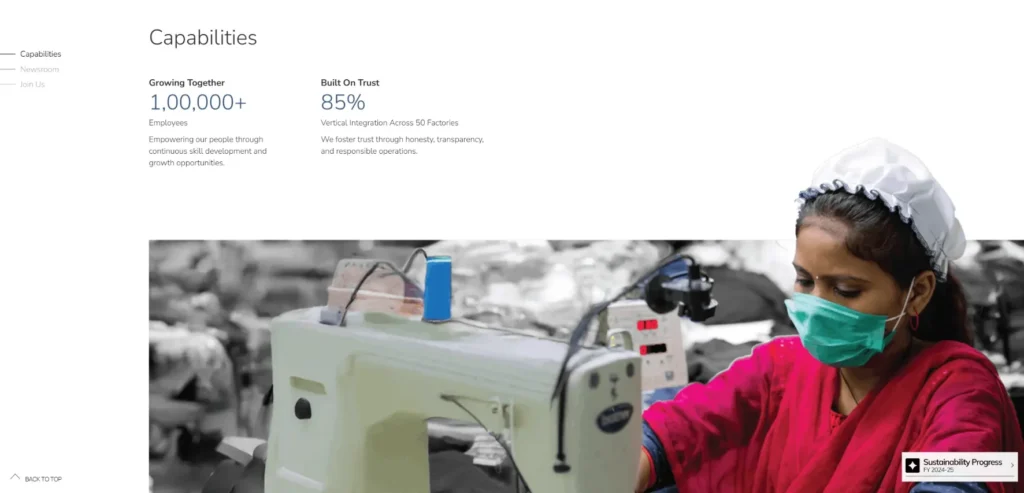
The latest detailed operating snapshot located during this review is Shahi’s FY 2023-24 report. It lists 48 factories, four processing mills, operations across eight Indian states, more than 100,000 full-time employees, and more than 144 million garments produced annually. It also reports that 73 percent of the workforce was female.
Those figures belong together because they come from one reporting package and one period. Other official or industry pages use different numbers, including references to more than 50 production units. The variation can reflect timing, expansion, consolidation, the treatment of mills, or different definitions of an operating unit. Combining the largest number from every page would create a fictional snapshot.
The annual output figure also needs careful interpretation. More than 144 million garments indicates the scale of the overall platform. It does not mean a single factory produces that amount, that every division handles every product, or that 144 million pieces of new capacity are available. A buyer needs to know which facility would receive the order, what that line is already producing, and how capacity has been allocated for the requested delivery window.
Scale can still provide useful signals. A network of this size suggests organizational depth, access to multiple production locations, and experience coordinating large programs. It can also support dedicated functions for materials, development, quality, testing, workforce management, and sustainability. These are corporate-level signals, not order-level approvals.
Treat the FY 2023-24 numbers as a dated scale card. Before publishing an updated version of this article or making a sourcing decision, check whether Shahi has issued a newer operations report with comparable figures. When new figures appear, replace the whole snapshot rather than updating one number in isolation.
What Does Shahi Exports Manufacture?
Shahi’s public materials support a broad, vertically integrated apparel route. Its website describes a process extending from spinning to finished garments, while the FY 2023-24 report discusses woven and knitted fabrics, garmenting units, mills, design, innovation, and laboratory functions. That breadth helps explain why the company can serve large international apparel programs.
Corporate capability is only the first screening layer. The right question is not simply “Can Shahi make clothing?” It is “Which Shahi division and facility can make this product, using this material and construction, for this market and order structure?”
Woven and Knitted Apparel
Shahi’s current About page states that its mills produce woven and knitted fabrics. Its company history also describes expansion from wovens into a specialized knits division. These are meaningful category signals because woven and knit production require different materials, equipment, engineering, finishing routes, and line experience.
A broad woven or knit statement does not confirm every garment type. A buyer developing a tailored woven jacket, a lightweight jersey top, a washed denim item, and a technical performance piece should not assume that one team or site handles all four. Ask for recent product evidence from the proposed division, then confirm material minimums, finishing, decoration, testing, and subcontracting.
Vertical Integration
Vertical integration means that more stages of the value chain sit within the same corporate system. Shahi’s reported route includes several of the following functions:
- Spinning and yarn-related operations
- Woven and knitted fabric production
- Textile processing
- Garment development and manufacturing
- Design, innovation, and laboratory support
This structure can reduce handoffs and improve traceability when the order actually uses the integrated route. It can also help a large buyer coordinate materials and garment production through fewer corporate relationships.
Integration does not remove external dependencies. A specific trim, specialty yarn, finish, print, membrane, closure, or packaging component may still come from an outside supplier. Ask the manufacturer to map what is in-house, what is sourced, which steps are subcontracted, and who remains responsible for approval and corrective action.
Design and Testing Support
Shahi’s FY 2023-24 report refers to in-house design, innovation, and laboratory teams. These resources can support development, material evaluation, and customer-specific testing methods. For a buyer, the value lies in how those functions connect to the actual style.
Request a development plan that names the sample stages, review owners, measurement standard, material approval points, test menu, and closure process for deviations. Laboratory capability should not be presented as proof that every garment automatically complies with every destination market. Product requirements depend on the garment, materials, age group, intended use, and market. The brand or importer still needs a product-specific compliance plan.
The useful takeaway is that Shahi publishes evidence of a wide manufacturing platform. Your task is to narrow that platform to a named division, facility, material route, and sample process.
How Does Shahi Compare With Other Large Indian Apparel Manufacturers?
Shahi is not the only large Indian apparel manufacturer worth investigating. Gokaldas Exports, Pearl Global, KPR Mill, and other businesses offer substantial manufacturing platforms, but their public figures use different years, geographies, and company boundaries. A responsible comparison should show those differences rather than forcing them into a false league table.
| Manufacturer | Public scale signal | Comparison boundary | Buyer interpretation |
|---|---|---|---|
| Shahi Exports | FY 2023-24 report lists 48 factories, 100,000+ employees, and 144+ million garments annually | Primarily India operations in the cited report | Strongest public case for India’s largest export-oriented apparel manufacturer |
| Gokaldas Exports | Corporate website presents a large multi-country apparel group with extensive units, workforce, and annual output | Group scope has expanded through overseas acquisitions | Relevant for complex export apparel, but current group figures are not India-only |
| Pearl Global | FY 2024-25 report reports 25 manufacturing units and 93.2 million pieces of annual capacity | Global network across India and several other countries, including partnership capacity | Large multinational sourcing and manufacturing option, not a direct India-only comparison |
| KPR Mill | Corporate site describes one of India’s largest vertically integrated apparel manufacturing companies | Diversified textile and apparel operations | Important when yarn, fabric, and garment integration matter, but consolidated scale is not apparel-only |
The table is contextual, not a quality ranking. Shahi’s figures describe reported output, while Pearl’s figure is capacity. Gokaldas has expanded its international footprint, and KPR’s vertical integration spans several textile operations. Even when all numbers are accurate, they do not answer the same question.
For a broader candidate pool, use HAPA’s guide to compare leading garment manufacturers in India. That page is better suited to company-by-company discovery. This article should stay focused on the biggest-manufacturer question and the limits of that answer.
When you compare large manufacturers, normalize five fields: reporting period, India-only versus global scope, installed capacity versus actual output, apparel-only versus diversified revenue, and the exact product division. If the fields cannot be normalized, describe the evidence without declaring a winner.
Is India’s Biggest Clothing Manufacturer Right for Your Brand?
Not necessarily. Large scale is valuable when it matches your order, but it can work against you when the project is too small, too uncertain, or outside the manufacturer’s active priorities. The best supplier is the one that can execute the approved product under clear commercial and quality controls.
When Large Scale Helps
A large manufacturing organization can be a strong fit when your program requires structure and repeatability. The advantages become more relevant when:
- Your volumes justify dedicated planning: The order is large or recurring enough to support line allocation, material booking, and formal account management.
- The specification is clear: Your tech pack, bill of materials, measurement chart, artwork, quality standard, testing plan, and packaging instructions are ready for technical review.
- The category matches an active division: The proposed facility already makes similar products, materials, constructions, and finishes for comparable markets.
- You need coordinated functions: Development, fabric, manufacturing, quality, testing, and delivery need to work through a structured organization.
- You can manage formal approvals: Your team can respond to sample comments, material submissions, commercial clarifications, and production decisions on schedule.
These conditions allow scale to support the order instead of simply making the supplier look impressive.
When Scale Creates Friction
A large factory can be difficult for a buyer whose project does not fit its operating model. Warning signs include:
- The order is below the practical material or production minimums: A factory may technically accept the inquiry but struggle to make the economics work.
- The collection changes constantly: Repeated design, material, and quantity changes disrupt costing and capacity planning.
- The product needs specialist attention outside the active line mix: Corporate breadth does not guarantee that the allocated facility has recent experience.
- The buyer expects informal flexibility: Large organizations often need documented approvals, fixed calendars, and defined escalation paths.
- The order has little future potential: A development-heavy first run may receive lower priority if the supplier sees no credible scale path.
None of these points proves that Shahi will reject a project. Shahi does not publish a universal MOQ or new-customer acceptance rule that applies to every product. They show why you need a current, product-specific response.
Build a Shortlist Around Your Product
Before adding a large manufacturer to your shortlist, find out how your product would move through its organization. Ask which division would review the brief, which facility would make the garment, and whether that team is currently producing similar materials and constructions. Then confirm the sample stages, quotation scope, capacity window, subcontractors, quality plan, and day-to-day account owner. A useful reply will connect these details to your product instead of sending a generic corporate presentation.
If you do not yet have comparable candidates, use this practical process for finding clothing manufacturers in India to build a broader pool, then narrow it by category experience, material route, order size, and evidence. Once credible options emerge, ask whether India is the right production base for the collection.
How Should Buyers Verify a Large Clothing Manufacturer?
Verify the company and the order route, not just the scale claim. A recognized corporate name reduces neither the need for due diligence nor the risk of being assigned to an unsuitable division, factory, or subcontractor.
Confirm the Company and Facility
Start with the legal entity that will quote, contract, invoice, and receive payment. Match its name and bank account to official documents. Then identify the physical production facility proposed for the order. A corporate group can operate many sites, and the capabilities shown on the main website may not exist at every location.
Ask whether garment cutting, sewing, washing, printing, embroidery, finishing, inspection, and packing occur at the proposed site. Record any subcontractors and define who approves them. If an audit or visit is required, agree on the scope and timing before the commercial commitment.
Verify Product and Capacity Fit
Request evidence from the proposed division, not a general corporate presentation. Useful evidence includes similar product samples, machine and process capability, material-source options, production-flow information, quality records, and the names of technical owners.
Capacity should be discussed as allocated line time for your order. An annual corporate output number cannot replace a production calendar. Ask when materials need to be booked, when the line is reserved, what dependencies could move the date, and how delays or changes are escalated.
Test the Sample and Control Plan
Sampling converts public capability into product evidence. Use a consistent review form covering measurements, fit, construction, fabric, color, decoration, trims, labels, finishing, and packaging. Record every deviation and require closure before bulk approval.
The bulk control plan should name the approved sample, material approvals, inspection stages, test responsibility, defect handling, corrective action, and release authority. Compliance documents must match the product, facility, scope, and validity period. A certificate logo in a presentation is not enough.
Follow a Seven-Step Verification Sequence
A practical verification sequence has seven steps:
- Confirm the legal counterparty: Match the quotation, contract, invoice, bank account, and company records.
- Name the production site: Record the address, division, production processes, and proposed subcontractors.
- Issue one complete RFQ: Provide the same product files, quantities, target market, Incoterm, quality requirements, packaging, and calendar to each candidate.
- Review product evidence: Check whether the proposed team has recent, relevant experience with similar materials and constructions.
- Approve the sample path: Define sample types, feedback fields, approval owners, and closure rules.
- Lock the control plan: Agree on inspections, testing, defect treatment, corrective action, and shipment release.
- Start with controlled exposure: Use a pilot order or a tightly managed first bulk order when the relationship is new.
This process protects the buyer without assuming that a famous manufacturer is risky or that a smaller one is safer. It simply applies the same evidence standard to every candidate.
Conclusion
Shahi Exports is the most defensible answer to the biggest clothing manufacturer in India when the question refers to export-oriented apparel manufacturing scale. Its official description, FY 2023-24 operating snapshot, and AEPC export recognition support that conclusion. The answer still needs a metric and date, and it should never be translated into “best for every brand.”
Your sourcing decision should move from company scale to order evidence. Confirm the product division, proposed facility, material route, capacity window, sample result, quality controls, commercial scope, and escalation path. If those elements do not fit, compare other Indian manufacturers rather than forcing the largest name into the project.
For a children’s apparel brand considering both countries, HAPA can serve as one China-side OEM candidate under the same brief and evaluation standard. Prepare your product type, tech pack or reference sample, materials, quantity breakdown, target market, packaging, and launch window before you contact HAPA.
Frequently Asked Questions
Is Shahi Exports a Manufacturer or a Sourcing Company?
Shahi presents itself as a vertically integrated apparel manufacturer and exporter. Its public materials describe textile and garment operations from spinning and fabric production to finished garments. A buyer should still confirm which legal entity, division, facility, and external suppliers would handle the proposed order.
Does Shahi Exports Publish a Minimum Order Quantity?
No universal product-level MOQ was found in the public sources reviewed for this article. Minimums can depend on fabric, color, size breakdown, construction, processing, trims, packaging, and factory planning. Ask for garment, material, color, and trim minimums in a current written response.
Does the Largest Manufacturer Always Offer the Lowest Price?
No. Scale can improve purchasing and production efficiency, but price still depends on product specifications, material route, order size, service scope, quality controls, testing, packaging, and commercial terms. Compare the same brief and Incoterm, then calculate landed and total sourcing cost rather than relying on the lowest unit quote.
Can a Buyer Visit or Audit the Factory Producing the Order?
Factory access depends on the manufacturer’s policy, customer requirements, timing, confidentiality, and the proposed site. Ask for the facility address and audit route early. If an on-site visit is not immediately possible, request current facility documents and a live production review, then define what requires independent verification.
What Should a First RFQ to a Large Indian Manufacturer Include?
Include the garment type, tech pack, bill of materials, target fabric and trims, quantities by style, color, and size, target market, testing needs, branding, packaging, Incoterm, sample requirements, and launch window. Clear inputs help the manufacturer route the inquiry to the right division and identify feasibility gaps.