If you want to import kidswear from China, finding a supplier is only the start. The harder part is keeping the approved product consistent from sample to bulk production, while labels, packaging, inspection records, and shipment documents are ready before the goods leave the factory.
That matters because children’s clothing has less room for vague specifications. Fit, fabric handfeel, trim security, washing performance, label accuracy, carton packing, and target-market requirements can all affect whether an import order arrives ready to sell or full of avoidable problems.
This guide is for children’s clothing brands, private label buyers, wholesalers, retailers, ecommerce sellers, and sourcing teams that want a practical quality-control path for importing kidswear from China. It is not legal, customs, or compliance advice. For U.S. import basics, the U.S. Customs and Border Protection guide to basic importing and exporting is a useful starting point, but final obligations should still be checked with the right official sources, customs brokers, testing labs, and compliance advisors for your product and destination market. Brands importing into a Middle East market can use our Middle East kidswear sourcing guide to add destination-specific checks.
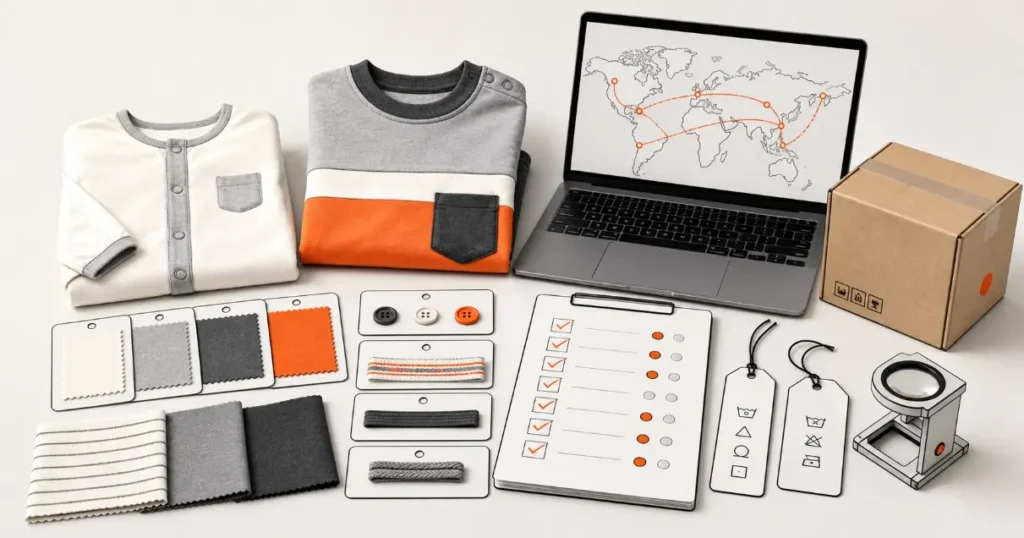
Start With a Quality-Control Mindset Before You Import
Many first-time buyers approach importing as a supplier search. They compare photos, ask for MOQ, request a price, and then move quickly into sampling.
That is understandable, but it is incomplete.
For kidswear, supplier search and quality control need to happen together. The way you describe the product, approve the sample, lock the fabric, confirm trims, prepare labels, and review packing details will shape the final shipment.
Importing is not the same as sourcing
Sourcing is the process of finding and evaluating possible suppliers. Importing is the larger process of moving a product from supplier to destination market with the right specifications, documents, labels, packaging, and shipment readiness.
You can source a supplier and still import poorly if the approved sample is unclear, the bulk order changes materials, the labels are wrong, or the documents do not match the shipment.
For broader sourcing strategy, HAPA’s guide to sourcing apparel from China can support the early supplier discovery stage. This article focuses on what happens after you have a potential supplier and need to control quality before shipment.
Why kidswear quality risk starts before bulk production
Kidswear quality risk starts when product details are still flexible. If a supplier does not know the exact size range, fabric weight, measurement tolerance, trim specification, label artwork, and packaging requirement, they will fill in the gaps with assumptions.
Those assumptions may not match your brand, your sales channel, or your destination market.
Children’s clothing also brings product-specific concerns. A hoodie drawcord, pajama fabric, snap closure, sequin, care label, zipper guard, or elastic waistband can create fit, comfort, durability, or compliance questions. These should be discussed before sampling, not after the shipment is packed.
What this guide will help buyers control
A useful kidswear import plan should make the following areas clear before the order moves too far:
- Supplier route: wholesale, OEM, ODM, private label, factory, trading company, or sourcing agent.
- Product specifications: size, fit, fabric, trims, artwork, labels, packaging, and target market.
- Sample approval: what the sample proves before bulk production.
- Bulk quality control: what must stay consistent during production.
- Label and document readiness: what must be checked before shipment.
- Shipment release: what to ask before goods leave China.
- Reorder consistency: how future orders stay aligned with the approved product.
This does not make importing more complicated. It makes each decision visible before it becomes an expensive problem.
Choose the Right China Kidswear Supplier Model
Different supplier models create different levels of control. Before asking for a quote, decide what kind of partner fits your product and risk level.
If you only need ready-made stock, a wholesale supplier may be enough. If you need original fit, custom fabric, private labels, branded packaging, or repeatable production, you need a more structured manufacturing route. For that route, this list of Chinese kidswear manufacturers offers a starting pool; verify each factory’s actual services before sampling.
Compare common supplier models
Wholesale and stock kidswear
Wholesale or stock kidswear is usually a faster route. You choose from existing products and buy available styles.
This can work for quick market testing, small retail replenishment, or lower-risk stock buying. The limitation is control. You may have limited ability to change fabric, fit, labels, trims, packaging, or size ratios.
Quality control also depends heavily on what is already available. Ask whether the supplier can provide real sample photos, measurement charts, material information, and packing details before you buy.
OEM or custom kidswear factory
OEM or custom kidswear manufacturing is a better route when your brand owns the design and wants the factory to produce according to your specifications.
This route usually requires a tech pack, reference sample, measurement chart, fabric direction, trim details, label files, and packaging instructions. It gives you more control, but it also requires clearer communication.
HAPA’s children’s clothing OEM manufacturer page describes support across tech pack review, pattern and size grading, fabric and trim selection, sample development, bulk manufacturing, quality checks, labels, packaging, and delivery preparation.
ODM and private label supplier
ODM and private label can fit buyers who want product-development help without starting every style from zero. You may modify an existing direction, add brand labels, adjust trims, select fabrics, or build a branded collection around supplier-supported styles.
This route can be practical for ecommerce sellers, boutique brands, and private label kidswear businesses. Before choosing it, ask exactly what can be changed and what must stay fixed. If you are weighing this route, HAPA’s ODM clothing manufacturer for kidswear brands page gives more context on product development support, sample adjustments, and collection building.
HAPA’s private label clothing manufacturer page can help buyers connect branded labels, packaging, and retail-ready presentation with the wider production plan.
Trading company or sourcing agent
A trading company or sourcing agent may help you communicate with multiple suppliers or consolidate products. This can reduce coordination work, especially for buyers managing several categories.
However, you still need to know who controls production quality, who approves samples, who checks labels, who prepares documents, and who takes responsibility if the bulk order differs from the approved sample.
How supplier model affects quality control
| Supplier model | Best for | Quality-control risk | Documents to clarify | When to avoid |
|---|---|---|---|---|
| Wholesale stock | Fast buying from existing styles | Limited control over fit, fabric, and labels | Product specs, carton details, invoice, packing list | When you need custom fit or branding |
| OEM factory | Original designs and repeatable production | Requires clear tech pack and approvals | Tech pack, approved sample, BOM, label files, packing specs | When your product idea is still vague |
| ODM/private label | Faster branded development | Limited customisation if base styles are fixed | Custom labels, artwork, packaging, sample approvals | When you need full design ownership |
| Trading company or sourcing agent | Multi-supplier coordination | Less direct visibility into production | Supplier responsibility, inspection process, document ownership | When quality accountability is unclear |
Questions to ask before choosing the route
Before you choose the supplier route, ask a few practical questions:
- Can the supplier work from a tech pack, a reference sample, or only existing stock?
- Who owns pattern adjustments and size grading?
- Can labels, care labels, hangtags, barcode stickers, polybags, and cartons be customised?
- Who checks fabric, trims, measurements, workmanship, and packing before shipment?
- Can the same fabric, trims, and packaging be repeated for reorders?
- Who prepares commercial invoice and packing list information?
- Who helps confirm target-market label or compliance details?
The answers will tell you whether the supplier model fits your quality-control needs, or whether it only looks convenient at the quotation stage.
Lock Product Specifications Before You Pay for Samples
Sampling should not begin with only a photo and a target price. If you want to control quality when you import kidswear from China, your sample brief must give the supplier enough detail to make a meaningful sample.
A sample does more than show what the garment might look like. It is the first test of your production communication.
If you need a clearer view of how sampling fits into development, HAPA’s product samples page explains how sample requests, revisions, and approvals can be handled before bulk production.
Build a sample brief your supplier can actually use
Product type, age range, and size spec
Start with the product category and intended age range. A toddler pajama set, baby romper, girls’ dress, boys’ hoodie, kidswear set, school jacket, or activewear top all create different production concerns.
Include the planned size range and measurement chart if available. If you do not have a finished size spec, at least provide target age group, fit intention, and reference measurements.
For kidswear, do not leave fit to guesswork. Sleeve length, shoulder width, waist stretch, rise, neck opening, crotch snap placement, dress length, and hood shape can all affect comfort and returns.
Fabric, trims, artwork, and construction details
List the preferred fabric composition, weight, handfeel, stretch, lining, print method, embroidery, applique, snap, zipper, button, drawcord, elastic, and seam finish.
If you are unsure about a fabric, describe the performance you need: soft handfeel, breathable summer weight, warm fleece, durable schoolwear, stretch recovery, wash resistance, or premium gift presentation.
Do not approve decorative trims only by appearance. For children’s clothing, trims need to be reviewed for attachment, durability, comfort, and age suitability.
Labels, packaging, and target market notes
Tell the supplier where the product will be sold. Labels and packaging for a U.S. ecommerce brand may not be the same as labels and packaging for an EU retailer, an Australian boutique, or a wholesale distributor. If the collection will sell in the U.S. or Europe, this guide to screening kidswear exporters for the US and Europe adds export-related checks to the shortlist.
At the sample stage, discuss the main label, size label, care label, country of origin label, hangtag, barcode sticker, polybag, carton marks, retail packaging, marketplace packaging, and any known testing or documentation expectations. These details may feel secondary while you are focused on the garment, but they often decide whether the order arrives ready to receive, label, scan, and sell.
Confirm fit and measurement expectations early
Fit is one of the hardest problems to fix late. A sample may look close in photos but fail once measured against the size chart.
Before approving a sample, compare measurements to the size spec and define acceptable tolerance. If there is no tolerance, the supplier may not know what counts as pass or fail during production.
Also check how size grading will work. A style that fits well in one size can grade poorly across the full range if the base measurements are not planned carefully.
Document what the approved sample must prove
An approved sample should prove more than appearance. It should confirm fit, measurements, fabric handfeel, fabric weight, construction method, print or embroidery result, trim placement, trim attachment, label position, packaging approach, colour, finishing, and any washing or shrinkage expectations that apply to the style.
Keep written notes about what is approved and what still needs change. When the supplier moves into bulk production, this approved sample becomes the benchmark.
What to do if you only have reference images
If you do not have a full tech pack, do not pretend you do. Send a structured product brief and ask the supplier what information is missing.
Your brief should include product type, target customer, age range, reference images, desired fabric, colour direction, trim ideas, label needs, packaging expectations, estimated quantity, and target market.
This is also where a supplier’s professionalism becomes visible. A capable kidswear supplier should ask clarifying questions before quoting production as if every detail is already known.
Control Quality From Approved Sample to Bulk Production
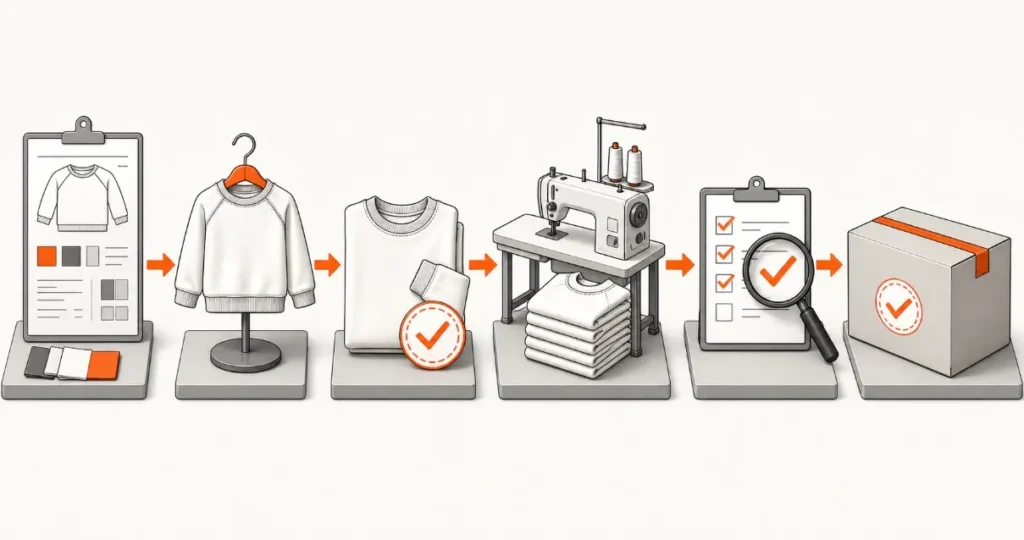
Quality control should not be treated as a single final inspection. It is a chain of decisions that begins with the approved sample and continues through fabric sourcing, cutting, sewing, finishing, packing, and shipment release.
If one link is vague, the final order can drift from the approved product.
Use the approved sample as the production reference
The approved sample should be physical, documented, and clearly linked to the final production file. It should not live only as a set of chat images.
Before bulk production starts, confirm the approved sample version, fabric, colour, trims, label artwork, packaging method, measurements, tolerances, and packing instructions. These details should sit in the same production record, not scattered across chat messages and file attachments.
If you change any detail after sample approval, update the record. A small trim change or label placement change can affect quality, compliance review, or customer experience.
Create a kidswear QC checklist before bulk starts
Measurements and size tolerance
Check key measurements by size and define tolerance before production. Do not wait until final inspection to decide whether a garment is too small or too long.
Important measurements may include chest, length, shoulder, sleeve, waist, hip, inseam, rise, neck opening, leg opening, and garment-specific points.
Fabric, trims, print, and embroidery
Confirm fabric handfeel, colour, weight, stretch, lining, shrinkage expectations, and finishing. For prints and embroidery, check placement, colour, durability, reverse-side comfort, and whether the decoration affects skin-contact areas.
For trims, confirm size, material, placement, attachment, and whether they are suitable for the target age group.
Labels, packaging, and carton details
Labels and packaging are part of quality control. A garment can be well made but still create problems if the size label is wrong, the care label is missing, the barcode does not match the SKU, or carton marks do not match the packing list.
Review label files, packaging artwork, polybag size, size stickers, hangtag string placement, folded dimensions, carton quantity, carton marks, and SKU breakdown.
| QC item | What to check | Why it matters in kidswear | Who confirms |
|---|---|---|---|
| Measurements | Size spec and tolerance | Fit problems create returns and poor reviews | Buyer and supplier |
| Fabric | Handfeel, colour, weight, shrinkage | Comfort and consistency affect customer trust | Supplier, buyer, lab if needed |
| Trims | Attachment, placement, material | Loose or uncomfortable trims create risk | Supplier and buyer |
| Print/embroidery | Placement, durability, inside comfort | Decoration can affect wearability | Supplier and buyer |
| Labels | Care, size, origin, SKU, barcode | Errors can affect sale readiness | Buyer, supplier, compliance advisor |
| Packing | Polybag, carton, ratio, marks | Mistakes delay receiving and fulfilment | Supplier, buyer, forwarder |
Plan inspection points before shipment
Inspection timing should match order risk. Some buyers rely on supplier QC. Others arrange third-party inspection, especially for first orders, new suppliers, infant products, complex styles, high-value shipments, or strict retailer requirements.
Inspection can happen at several points: before production, during sewing, after packing, and during a random carton check before shipment release. The right timing depends on how new the supplier is, how complex the style is, and how much risk the buyer can accept.
Do not treat inspection as a punishment for the supplier. Treat it as a shared control system.
Keep a written revision and approval record
Written records reduce confusion. Keep a single production file containing the latest tech pack, sample approval notes, measurement chart, fabric approval, trim approval, label artwork, packing instruction, and QC checklist.
If your team changes a detail, update the file and share the version number. If the supplier changes a material, ask for written approval before production continues.
For buyers placing larger bulk orders, HAPA’s buy bulk kids clothing from China page can support the broader bulk purchasing context, while this article focuses on quality control.
Check Labels, Compliance Notes, and Import Documents Before Shipment
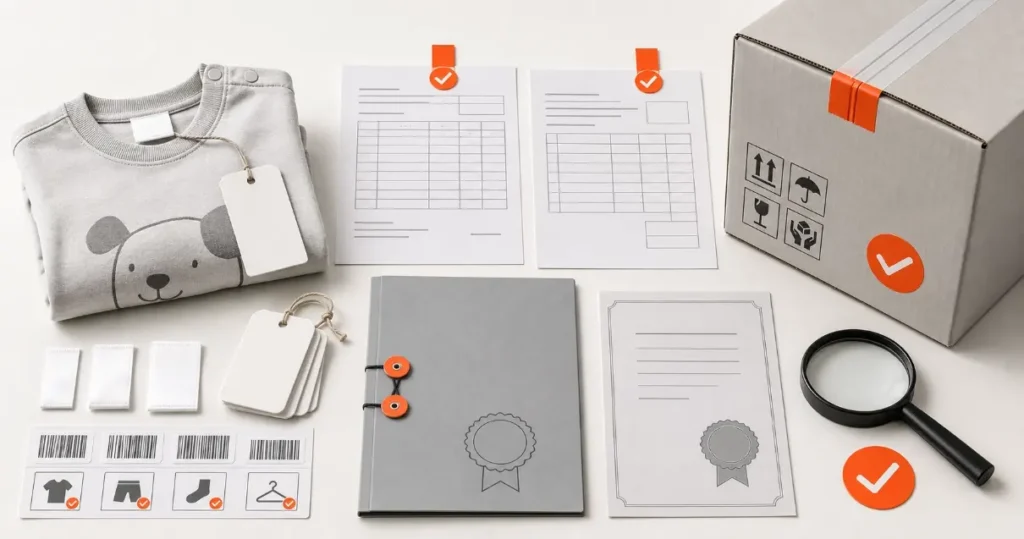
Labels and documents are not paperwork to leave until the end. They should be reviewed before production and checked again before shipment.
This section is not legal, customs, or compliance advice. Requirements vary by product type, age range, materials, destination market, importer role, retail channel, and claims. Use official sources and qualified advisors for final decisions.
Documents to align with your supplier and freight forwarder
Commercial invoice and packing list
The commercial invoice and packing list should match the actual shipment. Product descriptions, quantities, carton numbers, weights, values, supplier details, buyer details, and shipment terms should be consistent.
If the packing list says one size ratio but the cartons contain another, receiving and customs coordination can become messy.
Product description, quantity, carton, and shipment details
Make sure product descriptions are clear enough for internal teams, freight forwarders, customs brokers, and receiving teams. Generic or inconsistent names can create confusion.
Confirm the style number, product name, size and colour breakdown, quantity per SKU, quantity per carton, carton dimensions, carton weight, carton marks, packing method, shipment terms, and consignee information. These details are easy to skim past, but small mismatches can slow down booking, customs coordination, warehouse receiving, or marketplace fulfilment.
Test, certificate, or declaration records where applicable
For some markets and product types, buyers may need test reports, certificates, tracking information, declarations, or other records. The exact requirement depends on the product and market.
For the U.S. market, the CPSC explains that certain children’s products subject to children’s product safety rules require third-party testing and certification in a Children’s Product Certificate. CPSC guidance also discusses tracking labels for children’s products. Use official pages like these for U.S.-specific review, not as a global rule for every shipment.
Label details to review before shipping
Label mistakes can be expensive because they may not be discovered until the goods arrive.
Before shipping, review the label details that affect sale readiness:
- Fiber content.
- Country of origin.
- Care instructions.
- Size label.
- Brand label.
- Responsible business identity where required.
- SKU or barcode information.
- Age, safety, or packaging warnings where applicable.
If labels are wrong, the order may need relabeling after arrival, which is usually slower and more expensive than catching the issue before shipment.
For the U.S. market, the FTC’s textile and wool labeling guidance covers fiber content, country of origin, and manufacturer or dealer identity issues. The FTC also notes that Customs and FTC rules can both matter for country-of-origin questions, so importers should not rely on one source alone.
Market-specific compliance questions to verify
Do not assume one set of rules works for every market. The U.S., EU, UK, Australia, and other destinations can have different product safety, textile labeling, customs, and importer responsibilities.
Before shipment, confirm the destination country, intended age group, product type, trims, decorations, cords, snaps, zippers, label requirements, test records, certificate needs, tracking information, and the person or advisor responsible for final verification. A baby romper, a pajama set, and an everyday T-shirt may not create the same review questions.
What not to assume about customs and product rules
Do not assume your supplier knows every destination market rule, or that a freight forwarder is responsible for product compliance. A customs broker will not check garment quality, a test report for one market may not apply to another, and a label template from an old product may not be safe to reuse. A low unit price also may not include the documentation and packing work your sales channel expects.
A reliable supplier can help prepare production and shipment information, but the importer or brand should still confirm final requirements with the right professionals.
Ask the Right Questions Before You Release Shipment
Before you release a kidswear shipment from China, replace vague questions with specific ones.
“Is everything ready?” is not enough. Ask for proof, files, photos, reports, and written confirmations.
Questions for your kidswear supplier
Ask whether the bulk production follows the latest approved sample, and whether fabric, trims, labels, artwork, and packaging match the approved version. Confirm that measurements have been checked against the size spec and tolerance, and ask about any substitutions in fabric, trims, labels, or packing materials.
Before release, request final production photos or inspection photos. Ask whether care labels, size labels, origin labels, hangtags, and barcodes are attached correctly, whether packing follows the confirmed instruction, and whether the supplier can provide carton marks, carton dimensions, carton weight, and SKU breakdown. If defects were found, ask what they were and how they were handled.
Questions for your freight forwarder or customs broker
Ask what shipping documents they need before booking, whether the commercial invoice and packing list contain enough information, and whether carton counts, weights, and dimensions are clear. Also check whether the product description is specific enough for customs handling, whether any destination-market documentation issues should be verified before shipment, and what information must match between supplier documents and the shipment booking.
Questions for your compliance or testing partner
Ask whether the product type requires testing, certificates, tracking information, label review, or documentation for the target market. For children’s clothing, it is also worth checking whether trims, decorations, cords, snaps, or small parts create concerns for the intended age group. Then confirm whether labels and packaging match market expectations, whether claims on hangtags or product pages are supported, and what should be reviewed before the shipment leaves China.
Red flags before shipment approval
| Red flag | Why it matters | What to ask instead |
|---|---|---|
| Supplier refuses written confirmation | Details may be hard to enforce later | Can you confirm the approved sample and final specs in writing? |
| Labels are checked only after packing | Errors may require unpacking or relabeling | Can we review label photos before final packing? |
| Packing list does not match cartons | Receiving and customs coordination may suffer | Can you reconcile carton marks, quantities, and SKU breakdown? |
| Material substitutions are not documented | Bulk order may differ from approved sample | What changed, why, and can we approve it before shipment? |
| No final inspection record | Buyer loses visibility before goods leave China | Can you share the QC checklist, inspection photos, or third-party report? |
If a red flag affects safety, labels, documents, or core product quality, delay shipment release until the point is clarified.
Build a Reorder Plan Instead of Treating Importing as a One-Time Order
A first shipment should teach you how to improve the next one. If you treat importing as a one-time transaction, you may solve one order but lose consistency on the reorder. Keeping those records also helps you plan the next run; our China kidswear reorder timeline explains what can affect replenishment timing.
Quality control should continue after delivery.
Keep production files consistent for reorders
Keep a complete production record with the approved sample version, tech pack, measurement chart, fabric source, colour standard, trim source, label artwork, packaging files, carton marks, QC checklist, defect notes, and customer feedback.
If you reorder six months later, these files help prevent the supplier from guessing or recreating details from memory.
Review customer feedback before the next PO
Before placing the next purchase order, review real market feedback. Look at returns, size complaints, fabric comments, washing issues, colour preferences, packaging feedback, and sell-through by size and colour.
If customers say a waistband is tight, a neckline is small, a fabric pills, or a size runs short, update the production file before reordering.
Do not reorder only because the first shipment sold. Reorder because you know which details should stay the same and which should improve.
How HAPA can support import-ready kidswear production
HAPA can be considered for children’s clothing OEM, ODM, and private label production when buyers need support with product development, sample review, fabric and trim sourcing, custom labels, packaging, bulk production, and quality checks.
The most useful manufacturing conversation starts with a clear product file. HAPA can better review feasibility when the buyer provides product type, reference images, size range, fabric expectations, label needs, packaging expectations, target quantity, and target market notes.
For buyers still comparing supplier fit, HAPA’s guide on how to choose a kids clothing manufacturer can help connect label, packaging, quality-control, and production planning questions before you commit to sampling.
What to prepare before contacting HAPA
Before contacting HAPA, prepare the main details that help the product team assess feasibility:
- Product category and age range.
- Tech pack or reference images.
- Size range and measurement expectations.
- Fabric and trim preferences.
- Print, embroidery, or decoration notes.
- Label and packaging files.
- Target quantity and reorder expectations.
- Destination market.
- Known testing, label, or retailer requirements.
- Target launch or shipment window.
This gives the product team enough context to discuss sample development, quality-control checkpoints, labels, packaging, and bulk production feasibility.
Conclusion
To import kidswear from China and control quality, start before the order is produced. Choose the right supplier model, lock the product specification, approve samples carefully, build a QC checklist, review labels and documents, and ask specific questions before shipment release.
A stronger import plan starts with clear product details, written approvals, visible quality checks, and realistic responsibility between buyer, supplier, freight forwarder, customs broker, and compliance advisor. Price still matters, but it cannot carry the whole order by itself.
If you are preparing a kidswear order, HAPA can review your product brief, sample goals, size range, fabric expectations, label and packaging needs, and target market notes to discuss whether your project is ready for sampling or needs further development before bulk production.
FAQ
How do I import kidswear from China without quality problems?
Start with a clear product brief, confirm samples, lock fabric and trims, use a written QC checklist, review labels and documents, and inspect goods before shipment.
What should I check before approving kidswear bulk production?
Check the approved sample, measurements, fabric, colour, trims, labels, packaging, artwork, size tolerance, and any target-market notes before bulk production starts.
What documents are usually discussed when importing children’s clothes?
Buyers often discuss commercial invoices, packing lists, product descriptions, carton details, labels, test records, certificates, or declarations where applicable. Final requirements depend on market and product.
Is it better to import wholesale kidswear or custom OEM kidswear?
Wholesale may suit fast stock buying, while OEM suits brands needing design, fit, fabric, labels, and quality control. The better route depends on product control and launch goals.
Who is responsible for children’s clothing compliance when importing?
Responsibility depends on the target market and legal role. Brands and importers should verify obligations with official sources, customs brokers, testing labs, or compliance advisors.
What should I send to a China kidswear supplier for a useful quote?
Send product type, tech pack or reference images, size range, fabric expectations, trim details, label and packaging needs, target quantity, target market, and launch timing.