Kidswear sourcing for Middle East brands should begin with three decisions: where the garments will be sold, which sourcing model gives the brand the right level of control, and who is responsible for compliance in each destination market. The nearest or cheapest supplier is not automatically the right one. A suitable partner must be able to turn a measurable product brief into approved samples, repeatable bulk production, accurate labels, and the documents your importer needs.
This order matters. If you ask factories for prices before defining the market, size range, fabric, quantity split, packaging, testing, and delivery basis, the quotations will not be comparable. If you leave compliance until the goods are finished, a label correction or additional test can disrupt the launch.
This guide takes you through the full decision path: selecting a GCC market, choosing between wholesale, private label, ODM, and OEM, preparing a product brief and RFQ, checking manufacturers, approving samples, comparing total sourcing risk, and controlling production through shipment.
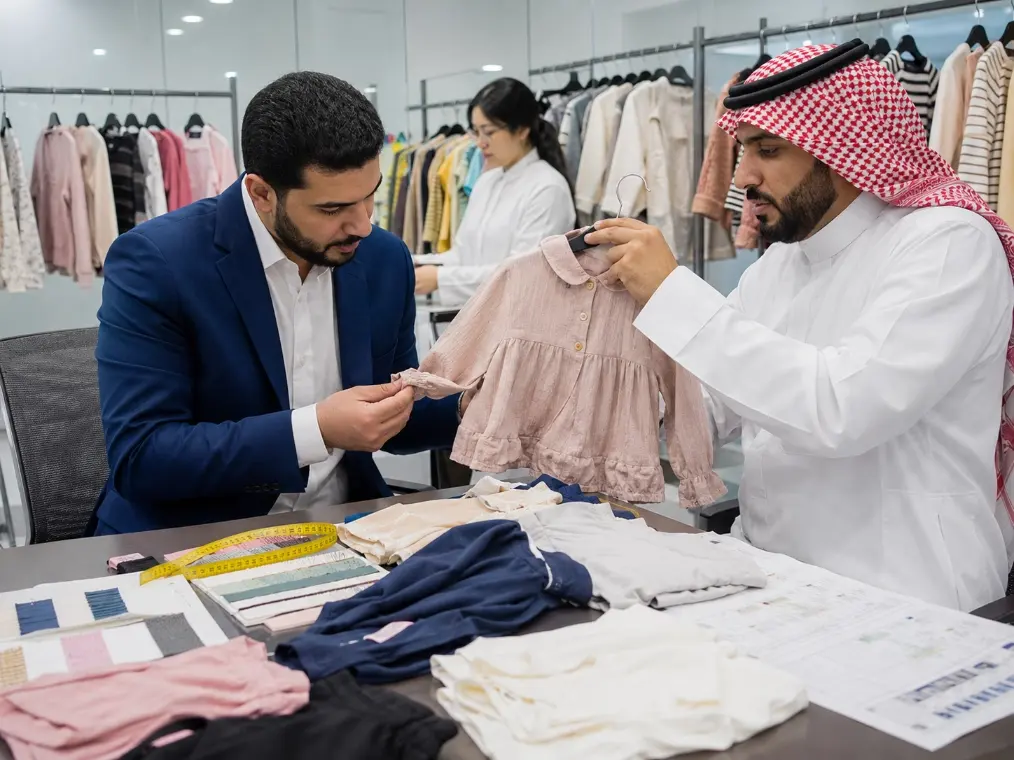
Start With the Market: Saudi Arabia, the UAE, or a Wider GCC Launch?
A brand may be registered in one country, manufacture in another, import through a third, and sell across several markets. Those locations are not interchangeable. The country of sale affects product classification, labeling, conformity procedures, importer responsibilities, logistics, and the calendar for launch approval.
Before contacting a supplier, answer one question in writing:
Where will this exact garment first be placed on the market, and which legal entity will import or supply it there?
“We are based in Dubai” is not a sufficient answer if the first commercial shipment is going to Saudi Arabia. Likewise, an approval or customs process used in the UAE should not be assumed to cover another GCC country.
Saudi Arabia and the UAE Need Different Launch Plans
Saudi Arabia and the UAE are both important commercial markets, but a brand needs a separate launch file for each. Product specifications may be shared, but the regulatory route, applicant, label review, and import handoff need destination-specific confirmation. Our kidswear suppliers for Saudi startups covers finding a supply route for a Saudi children’s clothing startup in more detail.
Saudi Arabia Launch Requirements
For a Saudi launch, identify the Saudi importer or responsible local party before bulk materials are ordered. The product must be classified against the current Saudi requirements, and the importer should confirm the applicable route through the SABER platform and any conformity body involved.
Saudi Arabia’s official technical-regulations list shows the Technical Regulation for Textile Products, Issue 2 as approved on December 28, 2023, published on January 12, 2024, and mandatory from July 12, 2024. The current regulation is available through the Saudi Standards, Metrology and Quality Organization.
The regulation contains textile labeling, safety, conformity, and supplier obligations. Its Arabic text includes requirements related to Arabic-language information, fiber composition, origin, care information, and other product data, with applicability depending on the product. Children’s garment components and relevant safety risks also need attention. The importer and a qualified conformity professional should confirm the exact requirements for the style and HS classification rather than relying on a generic label template.
A manufacturer can support the process with accurate material details, garment specifications, test samples, label artwork, bills of materials, and production records. It cannot replace the Saudi importer, issue an authority’s decision, or guarantee that a product will be accepted.
UAE Launch Requirements
For the UAE, first distinguish between importing a garment into the UAE for local sale and using the UAE as a commercial base for onward sales elsewhere. The second situation may create additional destination-country requirements even if the goods have already entered the UAE.
The UAE legislation portal currently lists Cabinet Resolution No. 54 of 2019 Regarding the UAE Scheme for the Control of Textile Products as active. The official English page also states that the original Arabic text prevails if there is a conflict in interpretation.
An official MoIAT service card describes a conformity-certificate route for textile products under the UAE Conformity Assessment Scheme. It lists apparel among the covered product categories and refers to items such as a valid UAE trade or industry license, a test report from an ISO/IEC 17025 laboratory, a product label, and an electronic declaration of conformity. Procedures and service names can change, so the applicant should confirm the current route directly with MoIAT before relying on the service card.
In practical terms, the UAE importer or applicant should review the product classification, testing basis, label artwork, document ownership, and application route while the sample is still being developed. This gives the factory time to prepare the correct product description and supporting evidence.
Plan a Wider GCC Rollout Market by Market
Kuwait, Qatar, Oman, and Bahrain should not be treated as four extra addresses on the same shipping plan. For every additional country, confirm:
- the competent authority and importer-registration requirements;
- the product classification and applicable technical rules;
- whether existing test reports are accepted and under what conditions;
- required label content and language;
- customs and shipment documents;
- marketplace, retailer, or distributor requirements that go beyond the law.
A sensible rollout often starts with one market where the brand can complete the full loop from import to sale. After the first product and documentation file is stable, the team can assess which elements may be reused and which require adaptation.
Create a simple launch-routing sheet with columns for destination, sales channel, importer, conformity owner, label approver, planned warehouse date, and evidence status. This is more useful than a country wish list because it exposes missing ownership before money is committed.
Choosing Your Manufacturing Model: Wholesale, White Label, Private Label, ODM, or OEM
Before you compare factories, decide what kind of relationship you need. The terms wholesale, white label, private label, ODM, and OEM get used loosely, and suppliers define them differently. What matters is not the label but the trade-off underneath: how much control you get over the product, how much inventory risk you carry, and how much upfront work each model demands.
The five sourcing models, from ready stock to full custom
Read this less as five boxes and more as a spectrum. At one end you buy what already exists; at the other you build something from your own designs. Differentiation rises as you move right, but so does the work and the minimum commitment.
| Model | Design control | Inventory risk | MOQ posture | Reorder flexibility | Best-fit buyer |
|---|---|---|---|---|---|
| Wholesale (ready stock) | None — you buy existing catalogue items | Held by supplier until you buy | Lowest; often per-carton | Limited — restocks depend on the supplier | Boutiques and sellers testing demand fast |
| White label | Minimal — rebrand an existing generic product | Yours once you commit | Low to moderate | Moderate, tied to the base product | Retailers wanting an own-brand range quickly |
| Private label | Moderate — your specs applied to adaptable designs | Yours | Moderate | Better, if the factory holds your specs | Brands wanting identity without full custom |
| ODM | Shared — factory-originated designs you adjust | Yours | Moderate to higher | Good | Brands with a point of view but limited tech resources |
| OEM | Full — your original designs and tech packs | Yours | Higher, varies by factory and style | Strongest — you own the patterns and specs | Brands with original ranges and volume to justify it |
MOQ posture here is directional, not a quote. Minimums shift with the factory, the fabric, and how many styles, colors, and sizes you split an order across, so treat any single number you see online with suspicion and ask each supplier to quote against your actual specs.
Matching a model to your brand’s stage and goals
A useful way to choose is to name your constraint. If your constraint is speed and cash, ready stock or white label lets you get to shelf without funding development. If your constraint is standing out, private label or full OEM manufacturing is the only way to control fit, fabric, and finish enough to build a recognizable product.
The most common mistake is choosing ready stock for a brand that needs differentiation, then being unable to reorder a bestseller because the supplier moved on. The opposite mistake — jumping to full OEM before you have designs, tech packs, or the volume to absorb the minimums — ties up cash in inventory you cannot move.
The definitions vary between suppliers, so confirm what each one includes before you compare prices. If the difference between ODM and OEM is fuzzy for your project, a manufacturer that runs all of these routes can help you map your designs to the right model; the distinctions are worked through in more detail in this guide to OEM vs ODM vs private label.
Local Middle East Supplier or Overseas Manufacturer? How to Decide
A lot of energy gets spent searching for a “local” Saudi or UAE factory. Before you commit to that search, it helps to know what many of those listings represent, and when local sourcing is the right answer versus when overseas production wins.
What a “local manufacturer” listing may really be
Many pages that rank for “kids wear manufacturer Dubai” or similar are not domestic factories at all. Some are traders or wholesalers reselling finished goods. Others are production managers who coordinate manufacturing elsewhere and present it as local capability. A smaller number are genuine local workshops, often focused on specific categories.
None of that is inherently a problem — a good trading partner can be valuable — but it changes what you are buying and who is accountable. The risk is assuming “local manufacturer” means an in-country factory with its own patterns and quality systems when the listing does not say so. That gap is exactly why verification, covered later, matters.
When local sourcing helps and when overseas production wins
Local sourcing earns its keep when speed, small reorders, and in-market service outweigh unit cost — for example, topping up a fast-selling line for a single-country boutique, or handling frequent small runs where shipping lead times would hurt.
Overseas manufacturing tends to win when you need deeper customization, a wider category range, or the unit economics that come with established production. For original designs, technical fabrics, and repeatable quality across sizes, a dedicated overseas OEM often gives more control than a local reseller can. HAPA sits in this second group as a China-based children’s clothing manufacturer offering OEM, ODM, and private-label production — a partner for brands that want to own their product rather than resell someone else’s, not a factory located in the Gulf.
China, Turkey, or elsewhere: choosing a production origin
Once you accept overseas production, the origin question follows. China and Turkey are the two most common choices for Gulf-bound kidswear, and neither is universally better. China typically offers depth in customization, materials, and category breadth; Turkey often appeals for shorter shipping into the region and certain fabric traditions. The right answer depends on your customization level, order size, materials, lead time, and price structure — and it deserves a closer comparison than a one-line verdict.
Whichever origin you choose, the discipline of importing well is the same. If China is on your shortlist, the mechanics of placing the order and controlling quality across the run are covered in this guide to importing kidswear from China.
Turning Gulf Climate and Cultural Needs into a Product Brief
“Breathable, modest, festive” is a marketing brief, not a manufacturing one. A factory cannot build to adjectives. The work in this layer is converting what the Gulf market expects into specifications a manufacturer can execute — the raw material of a tech pack.
Fabric performance specs for hot, humid Gulf climates
Most fabric advice for the region stops at “use cotton.” That is a starting point, not a specification. For children’s clothing that has to survive Gulf heat, humidity, and frequent washing, the useful detail lives in measurable properties:
- Fiber and blend — the base composition and any performance additions, not just “cotton.”
- Weight (GSM) — grams per square meter, which drives how light and cool a garment feels.
- Construction — weave or knit type, which affects airflow, stretch, and durability.
- Opacity — coverage when worn, which matters for lighter colors and thinner summer fabrics.
- Shrinkage — dimensional change after washing, so sizing holds up after a family’s laundry cycle.
- Colorfastness — resistance to fading and bleeding under sun and repeated washing.
- Wash and wear durability — how the fabric and seams hold after realistic care.
Specifying these turns a vague “cool fabric” request into something a supplier can source, sample, and test against.
Modesty, coverage, and occasion detailing as design requirements
Cultural expectations become design requirements once you write them down. Coverage preferences translate into length, sleeve, and neckline decisions. Occasion wear — the festive detailing families buy for celebrations — translates into embellishment, trims, and finishing choices that carry their own cost and lead-time implications.
The point is to make these explicit in the brief rather than leaving them to a factory’s assumptions. A garment designed for the Gulf market is not a Western style with a note attached; the coverage, silhouette, and detailing are part of the pattern and construction from the start.
Children-specific fit, trims, and safety details
Kidswear adds a layer that adult apparel does not: children’s safety. Drawcords, small parts and fastenings, and certain embellishments carry safety considerations, and care labelling has its own requirements. These are not only design choices — several of them intersect directly with the compliance rules covered in the next section, so it pays to flag them early.
This is the stage where a manufacturer’s input is most useful. Fabric and trim coordination, pattern making, and size grading are where a good factory turns your intent into a producible spec, and a first sample turns the spec into something you can hold and correct. If you are assembling this brief, HAPA’s guide to building a clothing tech pack covers what to document, and moving to product samples is how you validate it before committing to bulk. (When you add fabric references, confirm the specific fabric guidance page you link, as HAPA maintains closely related fabric articles.)
Who Owns Compliance — and Why Saudi and the UAE Need Separate Checklists
This is the layer brands most often get wrong, and the one with the highest cost of error. Two ideas do most of the work here: Saudi Arabia and the UAE run different conformity systems, and within either country the responsibility for meeting the rules is split across several parties — not carried by the factory alone. Our kidswear manufacturers for Saudi brands covers building a factory shortlist for a Saudi children’s clothing brand in more detail.
None of what follows is legal advice. Regulations change, they apply differently to different products, and the definitive source is always the current published regulation and a qualified conformity body. Use this to understand the shape of the problem, then confirm the specifics for your products.
Saudi Arabia: SASO technical regulation and the SABER platform
In Saudi Arabia, the standards authority SASO publishes the technical regulations that products must meet, and importers register their products and each shipment through the SABER conformity platform before goods can clear customs. Textile products, including children’s apparel, fall within scope, and registration produces the conformity certificates a shipment needs at the border.
The important nuance is that this is a moving target. Saudi Arabia introduced a new safety, labelling, and conformity system for textile products in 2024, and in 2026 SASO proposed significant amendments to align that regulation with the Kingdom’s Product Safety Law, which took effect in late 2024. In practice, that means you should treat the current SASO-published regulation as your reference and confirm the exact requirements — testing, labelling, and product classification — for your specific products rather than relying on older summaries.
The United Arab Emirates: the Textile Products scheme and ECAS
The UAE controls textile products under a federal scheme established by Cabinet Resolution No. 54 of 2019, the UAE Scheme for the Control of Textile Products. Regulated products, including finished clothing, generally require a certificate of conformity under the Emirates Conformity Assessment Scheme (ECAS), issued through the Ministry of Industry and Advanced Technology (MoIAT), with testing carried out by accredited bodies.
This is a separate system from Saudi Arabia’s, with its own regulation, its own conformity route, and its own certificate. That is the core reason a single “GCC compliance checklist” or one universal label does not exist. Even where Gulf states share regional standards, the national conformity procedures differ, so each destination gets its own compliance lane.
The responsibility matrix: brand, importer, factory, and conformity body
Once you accept that the rules differ by country, the next question is who does what. The registration and conformity obligations usually sit with the importer, not the factory. The factory’s job is to produce to specification and supply documentation. Accredited laboratories and conformity bodies handle testing and certification. The table below shows the typical split; the specific platform and certificate change between Saudi Arabia and the UAE, but the division of labor is broadly similar.
| Task | Brand / Importer | Factory (OEM/ODM) | Testing / Conformity body |
|---|---|---|---|
| Define product and specifications | Owns | Advises on manufacturability | — |
| Produce to spec; supply samples and documents | Approves | Owns | — |
| Lab testing to required methods | Commissions | Provides test samples | Owns (accredited lab) |
| Product and shipment registration; certificate | Owns (registers) | Supplies test reports and docs | Issues certificate |
| Label content and language (e.g., Arabic) | Owns and approves | Prints to approved artwork | May review in the file |
| Technical file and import documentation | Owns | Contributes production documents | Reviews as required |
| HS classification and customs clearance | Owns (with broker) | Provides invoice and packing docs | — |
A manufacturer’s role in this picture is narrower than it first appears: build to the approved specification, apply the label artwork you sign off on, and supply the test samples and production documents your importer needs. A factory — HAPA included — is not a certification body, and no factory can “pre-certify” your product for SABER or ECAS on your behalf. Where HAPA can help is in coordinating labels, packaging, and order documentation and running production-stage quality checks, so the goods you register match what you specified.
Sequencing the Project: Sampling, Bulk, and Seasonal Deadlines Like Ramadan and Eid
Even with the right product and the right factory, timing decides whether a collection lands on shelf when shoppers are buying. The reliable way to plan is backward, from the date you need to be selling.
The kidswear critical path, from brief to delivery
A children’s clothing project moves through a fairly consistent sequence, and each stage depends on the one before it:
- Design and brief — specs, fabrics, and construction documented in a tech pack.
- Sampling — one or more rounds to confirm fit, fabric, and finish.
- Size set approval — grading checked across the full size range.
- Labels and testing — artwork finalized and compliance testing arranged.
- Bulk production — the main run, once samples and documents are signed off.
- Inspection — quality checked before the goods leave the factory.
- Shipping and customs — transit plus conformity and clearance at the destination.
Sampling and testing are the stages brands most often underestimate. Building in room for a second sample round, and for compliance testing before bulk, keeps a small correction from becoming a schedule crisis.
Planning backward from a Ramadan or Eid on-sale date
Seasonal peaks like Ramadan and Eid concentrate a large share of kidswear sales into a short window, which makes timing unforgiving. The method is to start from your target on-sale date and subtract, in reverse order, the time each stage needs: shipping and clearance, inspection, bulk production, sampling rounds, size-set approval, and design.
One detail catches brands out every year: Ramadan and Eid move roughly 11 days earlier on the Gregorian calendar annually, so a start date that worked last year will be late this year. Rather than hard-coding a fixed “begin in month X,” recalculate the backward plan against the actual dates each season. A manufacturer can help you map realistic sampling and production windows once the brief exists — moving from a tech pack to approved samples is the part of the critical path most worth protecting.
Building Your Shortlist and Turning It Into a Sourcing Roadmap
The final layer is where research becomes action: narrow the field to a few real candidates, confirm they are what they claim, and send them a brief strong enough to get comparable quotes back.
Screening from a longlist to two or three sampling candidates
You do not need twenty quotes; you need two or three suppliers worth sampling with. Screen a longlist down using criteria that predict a good fit:
- Category fit — genuine experience with your product type and age range.
- Model fit — whether they offer the OEM, ODM, or private-label route you need.
- Documentation willingness — readiness to provide the test reports and production documents your compliance work requires.
- Sample quality — the single most revealing signal, so weight it heavily.
- Communication — responsiveness and clarity, which predict how the whole project will run.
- Capacity — the ability to handle your volumes and reorders without strain.
Verifying a factory before you commit
Before you place a bulk order, confirm the basics rather than assuming them. Check the legal entity, whether the address is a factory or a trading office, that any certificates are authentic and current, whether the work is subcontracted and to whom, and — above all — that sample quality holds up. This is the step that protects you from the “local manufacturer” listings that turn out to be resellers. A structured approach to verifying a manufacturer before a bulk order is worth following here. (Confirm this internal link is live before publishing.)
What to send a manufacturer in your RFQ
A vague inquiry gets vague, non-comparable answers. A strong request for quotation gives every supplier the same specifics, so you can compare like with like. Include:
- Age range and size breakdown
- Fabric specs, including weight (GSM) and opacity
- Any Arabic label or destination-labelling requirements
- The destination country and who owns its compliance
- Your target on-sale date
- The Incoterms rule you want to quote against, so shipping responsibilities are unambiguous
- Packaging requirements
Send that same brief to your shortlisted candidates and the quotes you get back will be comparable — and the sampling that follows will start from a shared understanding.
Kidswear sourcing for the Middle East rewards brands that treat it as a sequence, not a single search. Route your market first, choose a manufacturing model that matches your stage, turn the Gulf’s climate and culture into a specific brief, keep Saudi and UAE compliance in separate lanes, and only then shortlist and verify factories. Work through those five layers and your RFQ will be sharper, your samples will come back closer, and your quotes will be comparable.
When you are ready to pressure-test a concept, prepare a tech pack, request samples, and bring the brief to a manufacturer’s product-development team. HAPA works with brands as a China-based OEM, ODM, and private-label partner across these stages — you can contact the product-development team to check whether a project is feasible before you commit to bulk.
Frequently Asked Questions
Can one label or one certificate be used across all GCC countries? No. Saudi Arabia uses the SASO and SABER system, while the UAE uses ECAS through MoIAT — separate schemes with separate certificates. Labelling and language requirements are set per destination, so handle each country individually.
Do Kuwait, Qatar, Oman, and Bahrain brands need a different manufacturer than Saudi or UAE brands? Usually not. The manufacturing model and factory can stay the same across the GCC. What changes per destination is compliance, labelling, and import documentation, which are handled country by country rather than by switching suppliers.
What MOQ should a Saudi or UAE kidswear startup expect? It varies by factory, model, fabric, and how many styles, colors, and sizes you split an order across. Rather than assuming one figure, ask each manufacturer to quote a minimum against your specific tech pack.
Is China or Turkey better for Middle East kidswear sourcing? Neither is universally better. China often offers deeper customization and category range; Turkey can suit shorter regional shipping. The right choice depends on your customization needs, order size, materials, lead time, and price structure.
Who confirms HS classification, testing scope, and customs requirements for kidswear? Typically the importer of record, working with a qualified conformity or testing body — not the factory alone. The factory produces to specification and supplies documentation, while classification and clearance sit with the importer.
How early should a Ramadan or Eid kidswear collection enter production? Plan backward from your target on-sale date through shipping, conformity, inspection, bulk, and sampling. Recalculate every year, since Ramadan and Eid shift roughly 11 days earlier on the Gregorian calendar annually.
What is the difference between white label and private label kidswear? White label usually means rebranding an existing generic product with little change. Private label means products made to your brand’s specifications, often with more design input. Definitions vary by supplier, so confirm exactly what each option includes.