Finding suitable kids clothing manufacturers for Saudi Arabian brands is not simply a matter of collecting factory names. Your supplier must fit your product category, order size, design resources, quality expectations, launch calendar, and Saudi compliance responsibilities.
This guide gives you an unranked shortlist of ten manufacturers to investigate. It does not claim that every company has been audited, tested, or approved for your project. Saudi brands looking specifically at China can expand that pool with this China children’s clothing manufacturer shortlist. Use both lists to identify candidates, then verify the legal entity, production location, certificates, samples, commercial terms, and Saudi-market documentation before placing an order.
How We Selected These 10 Kids Clothing Manufacturers
The shortlist was built to cover different buyer situations rather than produce a universal league table. Seven considerations guided inclusion:
- Clear kidswear specialization. Each company has an accessible official page that discusses children’s wear, babywear, or kidswear. A general apparel factory that merely says it can make “all products” is harder to assess for age-specific fit, trims, and construction.
- B2B manufacturing support. The companies publicly describe OEM, ODM, custom manufacturing, private label, production management, or another route that a brand can investigate. They are not simply consumer-facing children’s clothing retailers.
- Different brand-stage fit. The group includes options that may suit small development programs, growing retail brands, and established higher-volume buyers. This matters because a capable large factory can still be wrong for a small launch, while a flexible studio may struggle with repeat volume.
- Product and material range. The shortlist covers babywear, organic cotton, casualwear, premium private label, technical knits, customizable blanks, and more detailed custom development.
- Sampling and customization potential. Public information indicates that the candidates can discuss some combination of patterns, samples, fabrics, sizing, printing, embroidery, labels, packaging, or buyer specifications.
- Export and Saudi-readiness potential. The companies market to international B2B buyers or describe export support. That does not prove Saudi experience. Each buyer still needs to verify the supplier’s ability to support the exact documents, labels, tests, and shipment details required for the order.
- Publicly checkable information. Every company has an official information trail that a buyer can review. Marketing claims such as “best,” “leading,” certification logos, client logos, capacity figures, and headline MOQs were not treated as independent proof of performance.
This method identifies companies worth investigating. It does not verify ownership, audit every production site, confirm every certificate, or establish current commercial terms. Treat any missing information as a question for the supplier, not as a fact to fill in yourself.
What Kind of Manufacturer Does Your Brand Need?
Your brand stage changes what “good manufacturing support” looks like. Choose a supplier type before choosing a company.
| Brand stage | Capabilities to prioritize | Questions that reveal fit | Main risk to control |
|---|---|---|---|
| Startup or small-batch | Flexible product route, clear sample costs, stock fabric or customizable blanks | How is MOQ calculated? What can be customized? | Too many SKUs and hidden development costs |
| Growing into retail | Reorder consistency, capacity planning, retail labels and packaging, inspection records | Can you hold specifications across repeat orders? | Missed retail windows and batch variation |
| Established with in-house design | Tech pack execution, material development, testing coordination, vendor governance | How are changes, subcontractors, and quality approvals controlled? | Supplier complexity and uncontrolled substitutions |
Startups and Small-Batch Brands
An early-stage Saudi brand needs to protect cash and learn from its first release. Stock fabrics, adaptable base styles, private label production, or customizable blanks can reduce development work. Do not judge suitability from one headline MOQ: ask whether each minimum applies per style, color, fabric, print, trim, or packaging item.
Keep the first range focused. Two controlled styles are easier to sample, test, inspect, and reorder than a wide unproven collection. Compare private label kidswear with full custom OEM when speed and inventory control matter more than original pattern development.
Growing Brands Scaling into Retail
When a brand enters boutiques, department stores, marketplaces, or wholesale, consistency becomes as important as flexibility. Ask how the supplier controls approved materials and patterns, plans peak capacity, manages corrective action, and preserves fabric, fit, color, labels, barcodes, packing ratios, and carton marks across reorders. The right partner can repeat the documented standard, not merely quote the lowest first-order price.
Established Brands with In-House Design
An established brand may require original patterns, proprietary materials, detailed BOMs, graded measurements, testing protocols, packaging manuals, restricted-substance controls, and formal inspections. A full-package children’s clothing OEM manufacturer should execute controlled files accurately and disclose internal and subcontracted processes.
Assess change control, traceability, production booking, document retention, and escalation outside tolerance. Technical honesty matters: a factory that flags a risky trim or unrealistic date during development is more useful than one that agrees before investigating.
Quick Answer: Which Kids Clothing Manufacturers Should Saudi Brands Compare?
The ten companies cover routes from small-batch development and premium blanks to organic babywear and higher-volume technical knits. They are unranked; the useful question is which fits your project.
| Manufacturer | Publicly stated location | Public kidswear focus | Potential fit to investigate |
|---|---|---|---|
| Billoomi Fashion | India | Custom baby and children’s clothing | Small and emerging custom brands |
| Create Fashion Brand | Portugal | Kidswear, custom development, and blanks | Premium basics and test collections |
| HAPA Garments | China | Kidswear OEM, ODM, and private label | Custom collections and product development |
| Lefty Production Co. | Los Angeles, USA | Baby, toddler, and junior clothing | U.S.-based development oversight |
| MAYAM Textile | Denizli, Turkey | Kids’ casualwear and baby textiles | Casualwear and Middle East-oriented sourcing |
| Organic & More | Noida, India | Organic cotton baby and kidswear | Organic babywear and private label basics |
| Soeiro | Portugal | Children’s and baby private label | Medium-high positioning and European production |
| Steve Apparel | Production location requires verification | Custom kids and baby clothing | Emerging brands needing customization |
| Thygesen Textile Vietnam | Vietnam | Full-package kidswear and technical knits | Established, higher-volume programs |
| Xiluca | Yiwu, China | Babywear, sleepwear, and girls’ activewear | Focused baby and soft-knit collections |
Before contacting a company, review its website, request legal and production details, and use a structured kids clothing manufacturer evaluation process. A website cannot replace an approved sample or written production agreement.
10 Kids Clothing Manufacturers for Saudi Arabian Brands to Evaluate
The profiles below use the same practical fields. “Potential fit” is an editorial interpretation of publicly stated services, not a recommendation based on completed orders. Verify every material fact before contracting.
1. Billoomi Fashion — Custom Kidswear and Babywear From India
Location: India, with the company describing itself as headquartered in Delhi NCR.
Manufacturing model: Made-to-order custom manufacturing for export buyers.
Public kidswear focus: Baby onesies, toddler clothing, dresses, knit and woven garments, smocking, embroidery, printing, labels, and packing.
Potential fit: Startups and emerging brands needing original designs developed in relatively small programs.
Billoomi Fashion’s official children’s clothing page presents a custom, export-oriented service covering knit and woven garments, handwork, printing, sourcing, patterns, grading, samples, labels, and packing. Treat its published MOQ, lead-time, capacity, audit, and quality statements as claims requiring current written confirmation.
Saudi buyer check: Request a style-specific MOQ calculation, certificate copies tied to the named facility, a comparable kidswear sample, and a list of Saudi label and conformity documents the company can support.
2. Create Fashion Brand — Premium Kidswear Blanks and Custom Production in Portugal

Location: Portugal.
Manufacturing model: Development from scratch, customization of blanks, and wholesale blank apparel.
Public kidswear focus: Kidswear appears within its custom garment range, while its blank program includes premium basics and branding options.
Potential fit: Premium T-shirts, hoodies, streetwear-inspired kidswear, or brands testing a market through high-quality blanks.
Create Fashion Brand separates full development, blank customization, and ready-to-brand blanks. Confirm which route and minimum apply to children’s sizes, what is produced in Portugal, and whether the available fabric weight suits the garment’s Saudi use case.
Saudi buyer check: Confirm the children’s size range, fabric weight, custom development scope, origin documentation, label format, packaging, and the MOQ that applies to the chosen service route.
3. HAPA Garments — OEM, ODM, and Private Label Kidswear in China

Location: Guangzhou, China.
Manufacturing model: Children’s clothing OEM, ODM, and private label support.
Public kidswear focus: Dresses, sets, jackets, hoodies, T-shirts, pants, pajamas, babywear, activewear, loungewear, and other categories.
Potential fit: Brands seeking product development, fabric and trim coordination, sample approval, branding, and bulk production within one kidswear-focused workflow.
HAPA’s children’s clothing OEM service describes support from tech pack or concept review through patterns, grading, material selection, samples, bulk production, quality checks, labels, and packaging. This may suit custom, multi-category collections, but MOQ, timeline, testing, certificates, and documents remain order-specific.
Because HAPA publishes this article, buyers should demand the same evidence from it as from every candidate: legal entity, production location, applicable certificates, samples, written quotation, material specification, inspection plan, and Saudi-market responsibilities.
Saudi buyer check: Send the age group, tech pack or reference, fabric target, size range, quantity, label artwork, packaging, launch date, and importer requirements, then ask HAPA to identify feasibility questions before sampling.
4. Lefty Production Co. — Children’s Wear Development in Los Angeles
Location: Los Angeles, United States.
Manufacturing model: Custom children’s wear and production management.
Public kidswear focus: Baby, toddler, and junior clothing produced according to buyer designs, with branding and packing options.
Potential fit: Brands that value U.S.-based communication, development access, and closer production oversight.
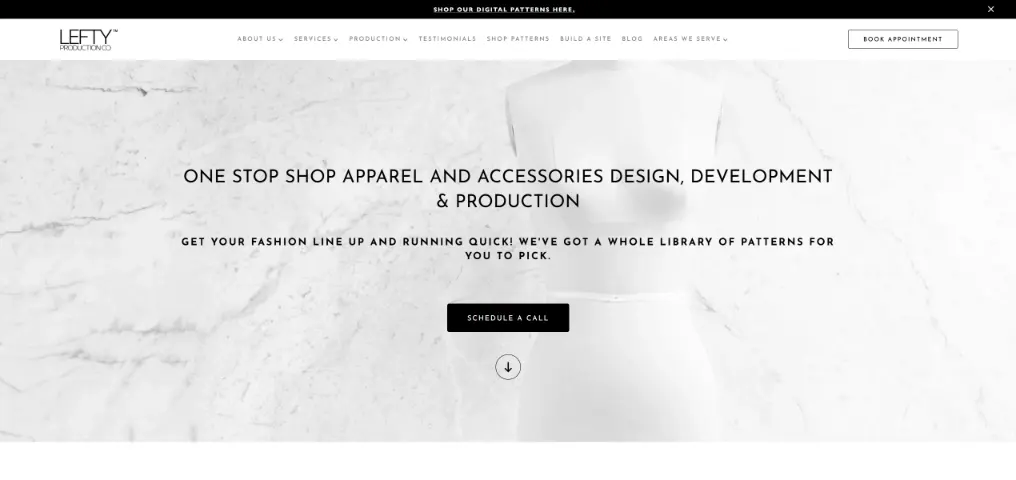
Lefty Production Co.’s children’s wear page describes buyer-designed baby, toddler, and junior apparel with fabric, labels, and packing options. Confirm which stages occur at the listed Los Angeles facility or are outsourced, who manages export, and how the total landed cost compares with other sourcing routes.
Saudi buyer check: Ask for a written process map showing where pattern making, sampling, cutting, sewing, decoration, finishing, and packing occur, plus the party responsible for export and Saudi documentation.
5. MAYAM Textile — Kids Casualwear and Private Label Production in Turkey
Location: Denizli, Turkey.
Manufacturing model: OEM and private label textile and apparel manufacturing.
Public kidswear focus: T-shirts, sweatshirts, hoodies, pants, joggers, sets, casualwear, baby bodysuits, labels, printing, embroidery, and packaging.
Potential fit: Casual children’s clothing, cotton-based products, and buyers exploring a Turkish supply route.
MAYAM Textile lists cotton, fleece, interlock, rib, and blends alongside custom sizing, decoration, labels, and packing. Its Turkish location does not prove Saudi readiness; request comparable kidswear examples and identify the production unit and any partner facilities.
Saudi buyer check: Request a kidswear-specific capability pack, sample route, MOQ breakdown, facility details, certificate evidence, and a clear answer on previous Saudi or GCC documentation without assuming regional experience.
6. Organic & More — Organic Cotton Baby and Kidswear From India

Location: Noida, India.
Manufacturing model: Custom private label production using its factory and partner factories.
Public kidswear focus: Organic cotton baby and children’s knitwear, pattern making, grading, sampling, embroidery, all-over print, labels, hangtags, and packing.
Potential fit: Babywear and children’s basics where organic material claims and soft knit fabrics are central to the product.
Organic & More focuses publicly on organic cotton baby and children’s knits and mentions both its own and partner factories in Noida. Identify the actual site. For an organic claim, verify the certified organization, scope, validity, material source, and order-level traceability—not only a logo.
Saudi buyer check: Identify the exact production site, verify the current organic documentation for the ordered material, and confirm how Arabic labels, fibre content, origin, and batch records will be prepared.
7. Soeiro — Medium-High Private Label Children’s Clothing in Portugal

Location: Portugal.
Manufacturing model: Private label apparel production.
Public kidswear focus: Children’s and baby clothing alongside men’s and women’s apparel, using knitwear, fabrics, and accessories.
Potential fit: Brands seeking European production and a medium-high product position.
Soeiro’s official profile describes Portuguese private label production for men’s, women’s, children’s, and baby clothing in the medium-high category. Ask how much of its current business is kidswear, which constructions are routine, which sample stages are available, and what order range fits its workflow.
Saudi buyer check: Request recent anonymized kidswear examples, the full development and production route, order minimums, label capabilities, applicable certificates, and export document support.
8. Steve Apparel — Custom Kids and Baby Clothing for Emerging Brands
Location: Verify the legal entity, sales office, and production location before contracting.
Manufacturing model: Custom and private label kidswear.
Public kidswear focus: Baby, toddler, and youth clothing, accessories, printing, embroidery, sample development, tech packs, and bulk production.
Potential fit: Emerging brands seeking design-to-production assistance and a broad range of customization.
Steve Apparel’s kids clothing page describes fabric sourcing, mock-ups, tech packs, samples, bulk production, decoration, and quality checks. Its page title references the USA, but buyers should not infer manufacturing origin: verify the legal entity, address, factory, subcontractors, payment beneficiary, and origin before paying.
Saudi buyer check: Ask the supplier to put its legal entity, factory address, production country, subcontractors, MOQ, sample terms, and required Saudi-market support in one written response.
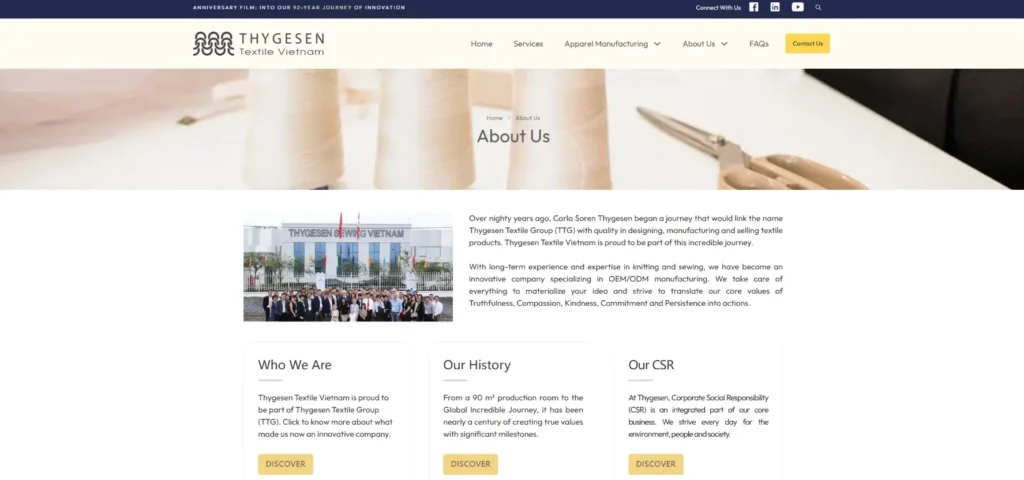
9. Thygesen Textile Vietnam — Scalable Kidswear and Technical Knits
Location: Vietnam.
Manufacturing model: Full-package kidswear manufacturing.
Public kidswear focus: Bodysuits, jumpsuits, shirts, dresses, jackets, pants, leggings, joggers, underwear, hoodies, pajamas, and performance-oriented knit products.
Potential fit: Established brands with higher-volume programs, technical materials, or formal quality and third-party inspection requirements.
Thygesen Textile Vietnam describes sourcing, customization, bulk production, quality control, and third-party inspection. Its published kidswear minimum suggests a scale-oriented option rather than a market test. Confirm the minimum for your construction, color and size split, production window, facility, and certificate scope.
Saudi buyer check: Ask for a capacity window tied to the intended order date, an itemized material and testing plan, a size-set process, third-party inspection terms, and document responsibilities for Saudi conformity procedures.
10. Xiluca — Babywear, Bamboo Sleepwear, and Girls’ Activewear in China
Location: Yiwu, Zhejiang, China.
Manufacturing model: OEM, ODM, custom development, and private label.
Public kidswear focus: Baby clothing, cotton basics, bamboo-viscose sleepwear, fleece and rib sets, and girls’ performance knits.
Potential fit: Focused babywear, soft sleepwear, or girls’ activewear collections.
Xiluca identifies its operating company as Yiwu Happy Luoka Garments Co., Ltd. and describes development, sampling, sewing, inspection, labels, and packing across cotton, bamboo viscose, fleece, rib, and performance knits. Confirm certificates and testing per order; verify “bamboo” fibre composition and label wording from material documents.
Saudi buyer check: Confirm the legal and production relationship, material composition, certificate scope, sleepwear or activewear testing plan, MOQ, label artwork, packing documents, and destination-market responsibilities.
How to Shortlist and Vet a Manufacturer for Your Brand
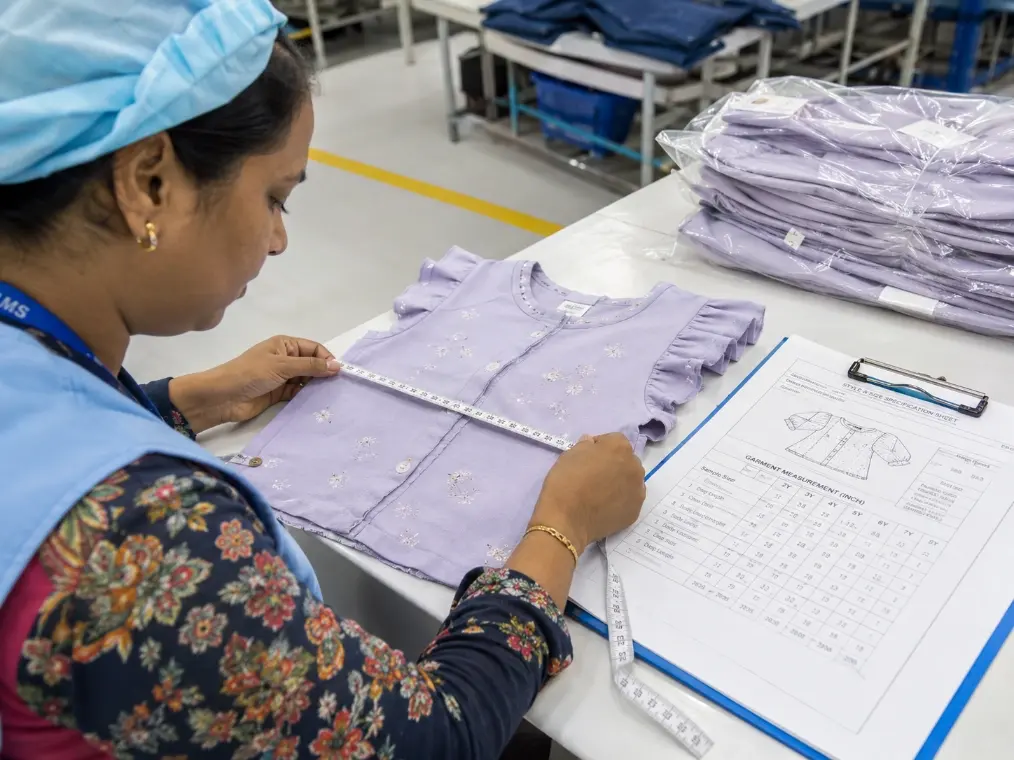
A profile tells you where to look; vetting tells you who to trust. Once you have a few candidates, put them through the same practical checks before you place a bulk order.
Requesting Samples and Evaluating Quality
A sample is the only reliable proof of quality and of how a supplier communicates. Send a clear brief — ideally a tech pack — and evaluate the returned sample for construction, stitching, fabric hand-feel, sizing accuracy, and how cleanly any embellishment is executed. Just as importantly, note how the supplier handles questions and revisions. A partner who engages carefully at sampling tends to behave the same way in production.
Confirming Compliance and Testing Capability
Ask directly how the factory supports SASO and SABER requirements. A capable supplier can arrange third-party testing for the substances and safety criteria that children’s textiles must meet, and can apply correct fibre-content and care labelling to your specification. Ask what testing they’ve done before and request documentation. Vagueness here is a warning sign.
Red Flags to Watch For
A few signals should give you pause when sourcing kids’ clothing:
- No interest in your compliance needs. A factory that shrugs off SASO/SABER or safety testing is a risk.
- Reluctance to sample. Pushing you toward a bulk order without a proper sample round is a bad sign.
- Unclear about what’s made in-house. If a supplier can’t explain what it subcontracts, quality control gets harder.
- Prices that seem too low. Unusually cheap quotes often mean cut corners on fabric or testing.
- Slow, vague communication. Poor responsiveness before an order rarely improves after it.
Match the Manufacturer to Your Product and Order Stage
The country is only one filter. Product complexity, order size, design readiness, and evidence quality often matter more.
Best Fit for Startups and Test Collections
Billoomi Fashion, Create Fashion Brand, Organic & More, Steve Apparel, and Xiluca may enter an initial startup shortlist based on their public positioning. Confirm the actual quantity and customization, then compare total cash commitment—including development, material minimums, labels, testing, inspection, and freight—not only unit price.
Best Fit for Babywear and Organic Cotton Programs
Organic & More publicly focuses on organic cotton baby and children’s garments. Billoomi Fashion, HAPA, MAYAM Textile, Thygesen, and Xiluca also describe babywear or infant-related products.
Shortlist by the exact garment because a romper, structured dress, sleeper, and hooded towel require different materials, grading, machinery, trims, and tests. Request comparable samples, not generic babywear photographs.
Best Fit for Premium or European-Made Collections
Create Fashion Brand and Soeiro are the clearest Portugal-based candidates in this list. Lefty Production Co. may suit brands seeking Los Angeles-based development and production management. These routes may appeal to a premium brand story or closer development oversight.
Confirm that origin, workmanship, materials, and communication support your retail price—and which stages genuinely occur in the named country. “Designed in,” “managed from,” and “made in” mean different things.
Best Fit for Scalable Knitwear and Larger Orders
Thygesen’s published kidswear minimum signals a volume-oriented model. HAPA, Billoomi Fashion, MAYAM Textile, and other candidates may also handle repeat or larger programs, but capacity must be confirmed against the exact styles and production month.
Ask for normal order range, peak constraints, material lead time, line allocation, and a dated production plan. A general capacity claim cannot protect a retail launch.
Best Fit for Saudi Label and Import Coordination
Do not select a supplier merely because it ships to the Middle East. Give each candidate the same responsibility matrix. The factory may provide material data, label application, test samples, packing lists, origin information, and production records; the Saudi importer confirms classification, requirements, conformity procedures, final Arabic information, and market responsibilities. For planning a children’s clothing order for a Middle East market, see our Middle East kidswear sourcing guide.
Choosing Your Manufacturer: Next Steps for Saudi Brands
Choosing among kids’ clothing manufacturers for the Saudi market comes down to matching the right profile to your brand stage, then vetting hard on quality and compliance. Start by placing yourself — launching, growing, or established — and let that point you to a model. Shortlist a few candidates that fit, request samples, and confirm each can support your SASO and SABER requirements. Keep in mind that compliance responsibility stays with you as the importer, so a partner who genuinely understands the Saudi system is worth prioritising.
When you’re ready to test a supplier, prepare a clear tech pack and request a sample so you can judge quality and communication before committing to bulk. If you’d like to discuss a specific children’s-wear project — including modest and Eid occasion pieces — you can request a sample or a quote from HAPA and talk through your requirements with the team.
Frequently Asked Questions
How do I choose a kids clothing manufacturer for a Saudi brand?
Define your product, quantity, materials, sizes, labels, launch date, and importer responsibilities. Compare verified suppliers using the same RFQ, sample scorecard, and production agreement.
Does a kids clothing manufacturer need to be located in Saudi Arabia?
No. Saudi brands can use local or overseas manufacturers, but the importer must confirm applicable Saudi regulations, conformity procedures, Arabic information, customs, and logistics responsibilities.
What should be included on children’s clothing labels in Saudi Arabia?
Requirements depend on the product. Have the Saudi importer verify current SASO and Arabic-language requirements, then approve fibre, care, size, origin, and other applicable information before production. If you are still comparing ready stock with custom production, our kidswear suppliers for Saudi startups lays out the available routes.
Do imported kids’ clothes need SABER registration?
The Saudi importer should classify the product in SABER and confirm the applicable conformity route. Do not rely solely on a factory’s general statement that its products are compliant.
What fabrics work well for kidswear sold in Saudi Arabia?
Evaluate breathable, comfortable, washable fabrics with suitable weight and opacity for the garment’s season and use. Confirm composition, shrinkage, colorfastness, durability, and care instructions through samples and tests.
What MOQ should a Saudi kidswear startup expect?
There is no universal MOQ. It depends on style, color, fabric, sizes, printing, trims, and packaging. Ask how each minimum is calculated and model the total cash commitment.
What should I send a kidswear factory for an accurate quote?
Send a tech pack, BOM, measurements, fabric specification, colors, artwork, trims, labels, packaging, quantity by size, destination, target date, testing needs, and requested trade term.
How can I verify a children’s clothing manufacturer before a bulk order?
Check the legal entity, factory address, payment account, certificate scope, and comparable products. Review physical samples, written specifications, quality controls, subcontracting, and third-party inspection access.