To get an accurate quote from a kidswear factory, send clear garment specifications, quantities by style and color, branding requirements, and your delivery destination. Ask the supplier to separate unit prices from sampling, materials, testing, packaging, and shipping costs. Compare offers for the same product, then confirm the final quotation against an approved sample before bulk production.
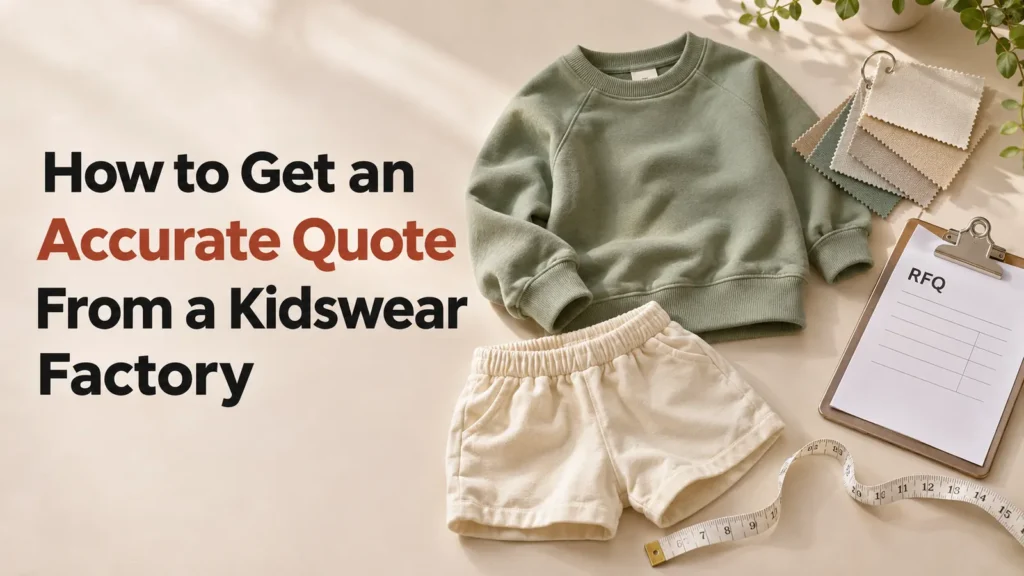
A reference photo is a good starting point, but it cannot tell a factory every detail it needs to price your order. This guide explains how to prepare your request, compare costs fairly, and avoid paying for work that was never included in the original price.
What Can a Kidswear Factory Quote Before Sampling?
A factory may be able to estimate your project before making a sample. How much you can rely on that figure depends on what you have already decided. Ask what the price is based on and what still needs confirmation. The document’s title, whether estimate, quotation, or price offer, won’t answer those questions on its own.
Can a Clothing Factory Quote Without a Tech Pack?
Yes. You can ask a clothing factory for an initial estimate without a complete tech pack. Send reference images, your fabric preferences, the size range, and realistic first-order quantities. Explain what design work is unfinished. The factory may need to make assumptions about materials and construction, so treat the first price as an estimate and confirm it again after sampling.
The factory will still need a basis for costing anything you haven’t specified. Ask it to describe its proposed fabric, construction, decoration, and service scope alongside the estimate. Otherwise, you may approve a budget built around a product you never intended to make.
Treat this early figure as a way to judge feasibility and decide what to develop next. When comparing kidswear factories, first check which ones suit your garment category, order size, and development needs. Early estimates are more useful when the suppliers can handle the kind of project you are planning.
A More Detailed Quote
A detailed quote should tell you exactly what you’re buying, how many pieces you’re ordering, and which services are included. It should also show the fabric and construction being priced, the delivery terms, the quote’s expiry date, and any costs that are still estimates.
Sampling can reveal changes needed in fit, construction, or materials. Those changes may affect the price, so an accurate quote is one that matches the stated conditions, not a promise that the number can never change. Keep the quoted specification with the price document so you can trace later revisions.
Decide What You Want the Factory to Handle
Before requesting prices, decide which work you expect the factory to handle. Sewing garments from approved patterns is different from sourcing materials, developing patterns, making samples, and delivering finished products. Comparing the unit prices of those two services is not a fair comparison.
At HAPA, we recommend separating what your brand has already prepared from what you still need the factory to develop. A finished tech pack and a single reference photo may both start a conversation, but they leave very different amounts of work to be priced.
Who Will Supply the Materials?
If you supply fabric or trims, explain who will approve them, arrange delivery, and confirm the quantities needed. Ask the factory to review their suitability before you commit to purchasing them.
If the factory will source materials, describe your requirements and ask what it proposes. Record who approves substitutions and whether material purchasing is included in the garment price.
Terms such as CMT or full-package production are useful starting points, but they do not replace a written list of included services. Have the supplier spell out its responsibilities rather than relying on the label alone.
What Development Work Do You Need?
Adding your branding to an existing style is different from developing a new garment. When working with an OEM clothing manufacturer, specify whether you need pattern making, sample development, or grading, which means developing the pattern in additional sizes.
Separate the work you have already completed from the help you still need, then confirm the included services in writing. The term OEM does not tell you which development services a particular quote includes, and a factory’s general service offering may cover more than your quoted project.
Step 1: Prepare Your Kidswear Quote Request
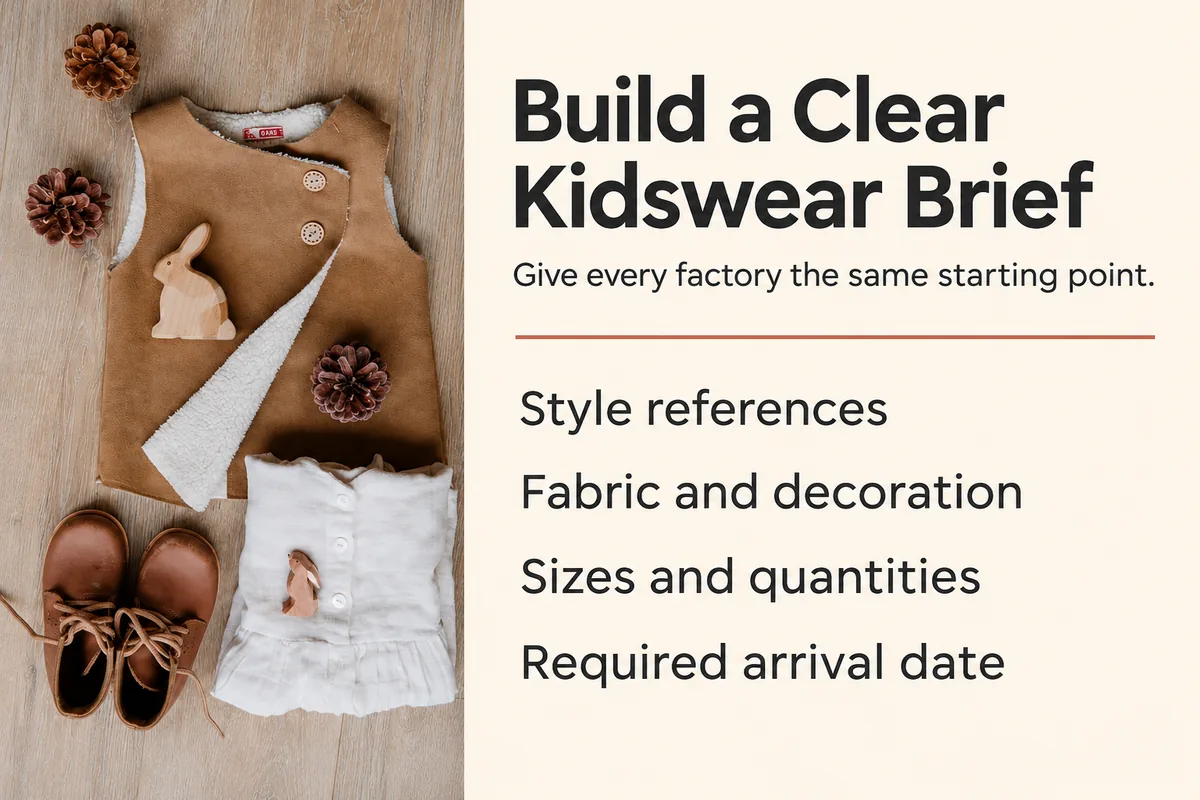
A request for quotation (RFQ) is simply a description of what you want to make and which costs you want the factory to include. You do not need a perfect tech pack before first contact. Be clear about the information you already know and the decisions where you need help.
What Information Should You Send for a Kidswear Quote?
Prepare the following details for each style:
- Product and design: Garment type, front and back reference images, a style code, and notes on important details.
- Fabric and construction: Preferred composition, fabric weight if known, lining, closures, trims, and any special finishes.
- Sizes and fit: Intended age group, sample size, full size range, measurements, and any fit requirements.
- Order quantities: Planned pieces by style, color, and size. For a matching outfit, state whether you want the price per piece or per complete set.
- Decoration and branding: Prints, embroidery, sequins, beading, labels, hangtags, and packaging, including artwork dimensions and placement where available.
- Scope of work: Whether you need sourcing, patterns, samples, grading, bulk production, inspection, or shipping support.
- Market and delivery: Destination market, applicable product or retailer requirements, delivery address, and the date you need stock at your warehouse.
If you’re requesting a private label kidswear quote, include your label artwork, packaging needs, and any changes to an existing style. If those changes affect the fabric or fit, ask the factory to quote the extra development work separately.
Put confirmed details into a clothing tech pack if you have one. Mark unfinished items as “to be confirmed” instead of leaving the factory to guess. A useful early quote states which fabric or construction the factory assumed for an undecided feature.
From our kidswear development perspective at HAPA, decoration deserves more detail than a line saying “with embroidery.” The area covered, stitch or embellishment method, backing, and position on the garment can change the materials and work involved. A small chest motif and decoration spread across the front of a dress should not be assumed to cost the same.
MOQ can affect a kidswear manufacturing quote because fabric, custom trims, and production setup may have different minimum quantities. Ask whether the minimum order quantity and quoted price apply per style, per color, or to the total order. Share the size breakdown you can realistically buy, and keep possible future volumes separate from your first order.
Step 2: Send the Same Brief and Request an Itemized Quote
Send the same version of your product brief to two or three suitable factories. Name your attachments clearly, identify the current version, and ask them to flag anything that needs clarification. That gives you a better basis for comparing replies.
What Should Be Included in a Kidswear Factory Quote?
A useful kidswear factory quote should show the garment specifications, unit price, MOQ, sampling costs, included services, and delivery terms. It should also identify separate charges and state when the price expires. Ask each supplier to break it down into these areas:
- Price and quantity: Unit price, currency, whether pricing is per piece or set, and the applicable MOQ by style and color.
- Development charges: Pattern and sample fees, revision rounds, grading, decoration setup, and sample delivery costs.
- Materials and production: Quoted fabric and trims, material minimums, manufacturing scope, and any approved alternatives priced separately.
- Quality and packaging: Included factory checks, separately required tests or inspections, labels, hangtags, and packing.
- Commercial terms: Quotation validity, payment stages, shipping basis and named delivery point, exclusions, and expected production and arrival dates.
Keep important answers together with the revised quotation. If one factory’s question changes your design or quantities, send the updated brief to the other factories too—but do not share confidential supplier prices or proprietary suggestions.
Our recommendation is to request a quotation that explains the product and the assumptions behind the price, rather than a single number sent through chat.
Step 3: Understand Your Clothing Manufacturing Cost Breakdown
A factory quote is more than a number. It tells you which materials, services, and production steps you are paying for. As CBI’s apparel costing guide explains, fabrics, trims, labor, and factory operating costs all play a part.
There is a good reason to start with fabric. In its 2024 apparel competitiveness report, the U.S. International Trade Commission estimated that, for most major apparel-supplying countries, fabric accounts for roughly 40–60% of a garment’s cost and labor about 20–30%. The shares vary widely by style, fabric, and finishing process. They are broad apparel-industry estimates, not fixed percentages for children’s clothing or a formula for your specific order.
That is why, at HAPA, we pay close attention to fabrics, trims, and decoration before pricing. Two dresses may look similar, but a plain style and one with sequins or beadwork can require different materials and production steps. We’d rather make those differences clear in the first quote than surprise the buyer with extra charges after sampling.
Separate Development From Unit Costs
Check whether pattern making, grading, sample production, revisions, and decoration setup are included or billed separately. Ask what each development fee delivers: which sample, in which size and material, and with how many agreed revision rounds.
Sample shipping also needs a place in the budget. Confirm who pays courier costs and whether a later sample using final production materials will carry another charge.
Paying a development fee does not by itself settle ownership or reuse of patterns, artwork files, or tooling. Ask what you receive and what remains available for future orders. You do not need the factory’s internal profit calculation to understand these commercial terms.
Check the Product and Packing Scope
Read the product description against your brief. Confirm that decoration, branded labels, finishing, and packing are covered. For sets, make sure every component appears in the description.
Packing can also include barcode labels, individual bags, size stickers, and specified cartons. List the requirements rather than relying on “standard packing,” which may mean something different to each supplier.
Your kidswear quality control plan should distinguish factory quality checks, independent inspections, and laboratory testing. These are separate activities, so identify which ones you need, who arranges them, and who pays. A general promise to check quality leaves too much unclear for costing.
What Happens to Unused Materials?
A garment MOQ and a material minimum are not necessarily the same thing. Fabric, custom labels, or other components may need to be purchased in quantities beyond what your first order consumes.
Ask whether those purchases are already reflected in the unit price or charged separately. If you pay for unused materials, agree on ownership, storage, return, or reuse before purchasing them. Don’t count the leftovers as available for a reorder until that arrangement is confirmed.
The same applies to allowances for cutting or processing loss. Ask how they affect your order, but avoid imposing a universal waste percentage on different garments and fabrics.
Who Pays for Shipping and Import Costs?
For international orders, record the named delivery place and the Incoterms edition if the parties use Incoterms. Ask who arranges transport and clearance and which shipping or import charges remain outside the offer.
Incoterms allocate delivery-related costs, risks, and responsibilities; they do not set the sale price, payment terms, or ownership transfer. Those need separate agreement, as ICC Academy explains.
Keep estimates visible. Freight based on provisional carton dimensions is not the same as a confirmed shipping cost. Likewise, a production completion date, dispatch date, and warehouse arrival date describe different milestones. Ask which one the quoted lead time refers to before planning your launch around it.
Step 4: How Do You Compare Two Clothing Factory Quotes?
To compare factory quotes fairly, make sure both suppliers are pricing the same garment, fabric, quantities, and services. Check sampling fees, material minimums, decoration, packaging, freight, and payment terms. Compare the total cost alongside sample quality and the factory’s ability to produce your design—not just the price per piece.
When two factories quote very different prices for what looks like the same style, we don’t automatically assume the cheaper one offers better value. At HAPA, we’d first check what each factory is making: the fabric, construction, decoration, size breakdown, and services included. If those differ, the quotes aren’t for the same product yet.
Check What’s Missing
Use one comparison sheet and transfer the actual terms from each offer. Check the specification version, quantity breakdown, pricing unit, and service scope first. If those differ, request clarification before comparing totals.
Keep alternative fabrics or construction proposals separate from the original request. An alternative may suit your collection, but you should knowingly approve the change rather than discover it after selecting the cheaper quote.
Compare the following details in each factory’s offer to see whether the prices cover the same order:
- Garment specifications: Confirm that each quote covers the same style and specification version, including the fabric, construction, and decoration.
- Order quantity and pricing unit: Check the quantities by style, color, and size, and whether the price is for one garment or a complete set.
- Unit price and currency: Compare prices in the same currency and check whether larger sizes or other variations cost extra.
- Minimum order requirements: Confirm the MOQ per style and color, along with any separate minimums for fabrics or trims.
- Sampling and development fees: Check the charges for patterns, samples, size grading, and revisions, including whether any sample fees are credited toward the bulk order.
- Labels, testing, and packaging: Compare which labels, product tests, inspections, and packing materials are included and which are charged separately.
- Shipping and excluded costs: Check where the quoted delivery terms end, whether freight is included, and which other costs you will need to pay.
- Payment terms and quote validity: Compare the deposit, balance payment deadline, and how long the factory will hold the quoted price.
- Production and arrival dates: Confirm what must be approved or paid before production starts, when the order will be ready to ship, and when it is expected to reach your warehouse.
If a factory has not confirmed a cost, mark it “not yet quoted,” not zero. Keep substitute materials or simplified designs on separate lines so you can compare them knowingly.
Compare the Total Order Cost
Calculate each quoted line using the correct quantity and unit price. Then add development, materials, testing, packing, and other applicable charges only where they are excluded from those prices. This avoids counting the same cost twice.
For your purchasing budget, add separately payable logistics and import costs using information from the responsible providers. Keep confirmed charges separate from estimates. If quotes use different currencies, record the exchange-rate basis used for your comparison rather than silently treating them as equivalent.
You now have a clearer view of what each order would cost. Price still needs to sit alongside product fit and sample quality when choosing a kids clothing manufacturer. A complete, inexpensive quote cannot tell you how well a supplier will execute your design.
When Do You Need to Pay?
Two orders with similar totals may require cash at very different stages. Compare when you pay as well as how much you pay. Record the due dates for development fees, material payments, deposits, and balances, along with any transfer charges.
Ask what work or approval each payment relates to. A payment schedule should let you plan cash needs and understand commitments before sending money. There is no single deposit percentage that can substitute for reviewing the actual agreement.
Step 5: Ask for Cost-Saving Options
If the quote is above your budget, ask which changes could reduce cost while preserving the product’s purpose. Keep the original specification as your baseline and request separately priced alternatives so you can see what you would gain or give up.
Useful questions include:
- Materials: Is there an available fabric or trim that meets the essential requirements without a separate custom order?
- Decoration: Could a different size, placement, or application method achieve an acceptable result at a lower cost?
- Color choices: Would reducing the number of colors simplify material purchasing or production for this order?
- Packing: Which presentation details could be simplified without affecting protection, labeling, or retailer requirements?
Treat these as questions, not guaranteed savings. Ask the factory to identify changes to appearance, feel, minimum quantities, or delivery timing alongside each revised price.
When a client has a tight budget, we prefer to review the design before cutting essential product costs. At HAPA, we might discuss fewer colors, simpler packaging, or a smaller embroidery area before changing the fabric or fit that makes the garment work. Those adjustments may affect the price, but we would still check the revised design on a sample. Comfort, fit, and necessary quality checks should not be sacrificed just to reach a lower unit price.
Do not trade away required safety measures or an acceptable fit to reach a target. A cheaper material or decoration may also need fresh sample approval or a review of testing requirements. Likewise, buying more units solely to reduce the price per piece can leave you with more inventory and a larger cash commitment than you intended.
Step 6: Confirm the Quote After Sampling
Once you approve a sample, bring the physical garment and the written quotation back together. Sample approval should lead to a matching production specification and price, not an assumption that the original estimate still applies. This is the point to resolve differences before committing to bulk production.
Record What Changed
Review the approved sample against the version used for costing. This is particularly important for kidswear with embroidery, sequins, beading, lining, or multi-piece sets: the details approved on the sample should also appear in the final pricing and production instructions. Note changes to fabric, fit, construction, decoration, labels, quantities, and packing. Ask the factory to confirm whether each change affects the price or schedule.
Keep your production sample and tech pack consistent, and reference the approved versions in the revised quotation. The physical garment and its written specifications should describe the same product so the factory can confirm what it is pricing.
If the price changes without an obvious product revision, ask for the reason. An expired offer, changed material availability, or an earlier assumption may need clarification. Don’t accept an unexplained increase, but don’t assume every revision indicates bad faith either.
What Should You Check Before Ordering?
Review the final quotation alongside the order documents. The International Trade Administration describes a pro forma invoice as a quotation presented in invoice form, with details such as items, prices, payment terms, delivery points, and validity. Whatever documents your supplier uses, reconcile the information before proceeding.
Confirm that they agree on:
- The approved sample, specification version, and quantities by style, color, and size.
- The price, currency, included services, and separately payable charges.
- The payment stages and the approvals or deliverables associated with them.
- The delivery basis, schedule, and conditions that start the production lead time.
Also ask whether the production slot and materials are confirmed. Quote validity alone does not tell you that capacity has been reserved. Paying for a sample should not be treated as automatic authorization to begin the bulk order; make that approval explicit.
What If Your Factory Quote Is Late or Incomplete?
There is no standard turnaround time for a clothing factory quote. Timing depends on how clearly you’ve described the garment and whether the factory still needs to check materials, decoration, or minimum quantities. If a quote hasn’t arrived, ask what is holding it up. Knowing what is missing helps you decide whether to send more details, allow more time, or contact another supplier. Repeatedly asking for “the price” rarely solves the problem.
Follow Up on a Delayed Quote
Keep your follow-up short and connected to the original RFQ. Ask:
- Did you receive the current brief and all attachments?
- Which information is missing, and who needs to provide it?
- Are any material prices, minimums, or availability details still being checked?
- When can you provide the next update or a completed quotation?
If you only need an early budget decision, ask whether an estimate with written assumptions is possible. Keep it labeled as provisional. A fast answer is not automatically more reliable, and a slow answer is not automatically a sign of poor production capability.
When Should You Hold Off on Ordering?
Pause the buying decision if essential questions remain unanswered. Unmarked material substitutions, unexplained charges, or payment requests without clear deliverables make it difficult to know what you are agreeing to.
An unexplained difference between the contracting company and payment recipient also deserves clarification before payment. Ask for written confirmation through a verified contact. Keep other supplier options open while you resolve the issue, without treating an unresolved question as proof of fraud.
Conclusion
An accurate kidswear factory quote connects a defined garment to a clear scope of work, quantity, price, and schedule. Prepare the brief first, resolve missing costs before comparing offers, and confirm the final terms against the approved sample.
To discuss your project with HAPA, send your product references, intended quantities, sales market, and required arrival date. Include the decisions you have not made yet. Making those questions visible is more useful than asking a factory to guess what your collection needs.
Frequently Asked Questions
These questions cover common uncertainties that can remain even after you have prepared a detailed clothing manufacturing quote request.
Do Clothing Factories Charge for Preparing a Quote?
Ask the supplier’s policy. An initial price discussion and paid development work are different services. Before authorizing work, confirm whether there are fees for sourcing, patterns, samples, or technical development, and what each fee includes. Do not assume that requesting a price authorizes additional paid services.
Should I Share My Target Price With a Kidswear Factory?
You can, provided you explain what it covers. State the currency and whether the target refers to the garment alone or also includes development, packing, and delivery. Ask the factory to identify which requirements it can meet at that budget and price any proposed compromises separately.
Will My Sample Fee Be Deducted From the Bulk Order?
Only if the supplier agrees to that arrangement. Ask for the conditions in writing, including which fees are eligible, any qualifying order requirements, and where the credit will appear. Do not deduct the sample fee yourself when comparing totals unless the supplier has confirmed the credit applies.
Can I Ask for Quotes at Different Order Quantities?
Yes. Request prices for quantities you could realistically order, and keep the specification and quantity breakdown clear at each level. Identify your intended first order separately from alternatives. A possible future volume should not be presented as a commitment to secure a price for a smaller order.
Will a Repeat Order Keep the Same Price?
Not necessarily. Ask for a refreshed quote using the current quantities, materials, and delivery requirements. Confirm whether existing patterns, artwork setup, or remaining materials can be reused and how that affects the offer. A reorder should reference the approved product while making any new commercial terms clear.
References & Sources
- U.S. International Trade Commission (2024): Apparel: Export Competitiveness of Certain Foreign Suppliers to the United States — source for the illustrative fabric and labor cost-share ranges; linked in Step 3.
- CBI (2024): How to Calculate the Cost Price of an Apparel Item — reference for garment costing components and methods (cited by name in Step 3).
- ICC Academy: What Incoterms Don’t Cover and Why the Contract of Sale Matters — delivery responsibilities and separate sale-contract terms; linked in the delivery section.
- International Trade Administration: Pro Forma Invoice — information commonly included in a formal trade quotation; linked in Step 6.