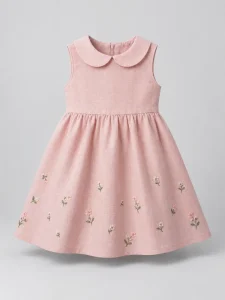
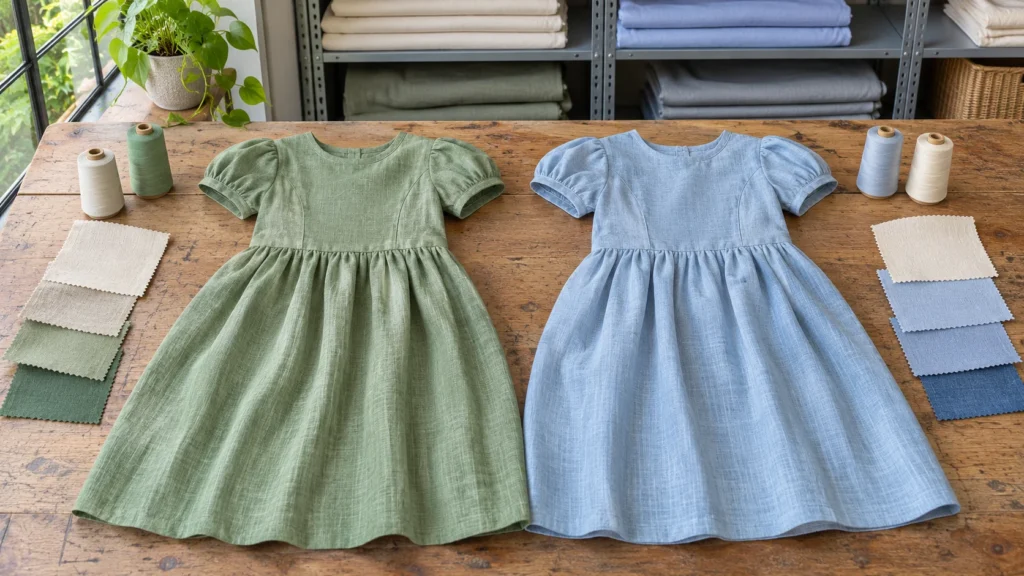
Two dress samples prepared for the same-brief review.
If two factories have sent you a version of the same girls’ dress, compare the garments against one shared brief before deciding which supplier to use. Check what each factory actually made, measure both dresses in the same way, inspect the inside as carefully as the outside, and ask each team to explain and correct any difference from the brief. The better choice is the factory that can deliver a suitable dress and show how it will reproduce that approved version. A beautiful first sample alone is not proof of safe, repeatable bulk production.
For a boutique brand, the hard part is often fairness. One sample may use the nominated fabric and final lining; the other may use substitute fabric because the mill had no yardage available. One may be a first pattern trial and the other a revised pre-production garment. If you score the visible finish without recording those differences, you are comparing unequal work. This guide gives you a practical way to compare girls’ dress samples from two factories while keeping product decisions, supplier behavior and unresolved safety questions separate. If you are still building the shortlist, use the separate kids’ dress manufacturer guide before applying this comparison method.

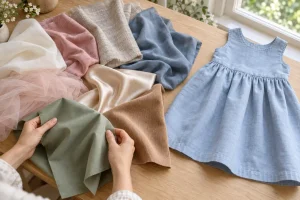
A dress sample with fabric and trim references.
Begin with one dress brief, not two sales conversations
Send both factories a controlled version of the same request. Include the intended age group, size range, flat sketch or authorized reference, measurement points, target fit, fabric and lining specifications, color reference, seams, closures, decoration, labels, packing needs and destination market. Mark what is fixed and what each supplier may propose. Give both the same target quantities and intended delivery window if you also want comparable commercial proposals.
If your brief says only “premium party dress,” each team may interpret that phrase differently. One could use a lightweight outer layer and simple lining; another could build a more structured skirt with a concealed fastening. Those are not necessarily better or worse samples, but they are different products. A fair comparison starts when the two teams are trying to solve the same defined problem.
Do not copy someone else’s protected design or send a competitor’s proprietary pattern without permission. If you use an existing garment as inspiration, specify which functional or visual features you are authorized to request and ask each factory to create your own approved design. Your product brief should make the expected result clear without asking a supplier to guess at rights it cannot verify.
HAPA’s girls’ dress manufacturing page describes the categories and sample development a factory may discuss with you. Treat any supplier’s site, including ours, as a starting point for questions. The physical submission and its supporting records are the evidence for your project.
Put every sample on the same version line
Before opening the parcels, ask each supplier for a short sample submission note. It should identify the style code, revision, sample purpose, actual size, actual fabric and lining, trims, decoration method, construction changes and known departures from the brief. Request the date and the specific decisions it wants from you. A candid note that says “the final zipper is pending” is more useful than an unqualified statement that the sample is complete. For girls’ dress samples, the note should make any provisional lining or decoration especially clear.
Keep the original brief version alongside both submissions. If Factory A has followed version 1 and Factory B has followed version 2, either return the later revision to A or confine the comparison to requirements shared by both versions. Never penalize a supplier for a requirement you sent only after it finished sewing. Equally, do not award full approval to a sample made with a substitute material if that material could change fit, drape, comfort or testing needs.
Separate a prototype from a production reference
A first prototype may be intended to test silhouette and construction. A fit sample may still use provisional fabric. A pre-production sample should reflect the agreed material and details more closely. Names vary among factories, so ask what the sample is meant to establish instead of relying on its label. Comparing girls’ dress samples from different stages can create a false winner. If one garment is an early development sample and the other is a final reference, do not call the latter factory the winner until both have had an equivalent opportunity to close the same questions.
The HAPA product-samples overview explains why sample stages exist. In this article, the decision is narrower: you have two candidates and need comparable evidence before investing in the next step.
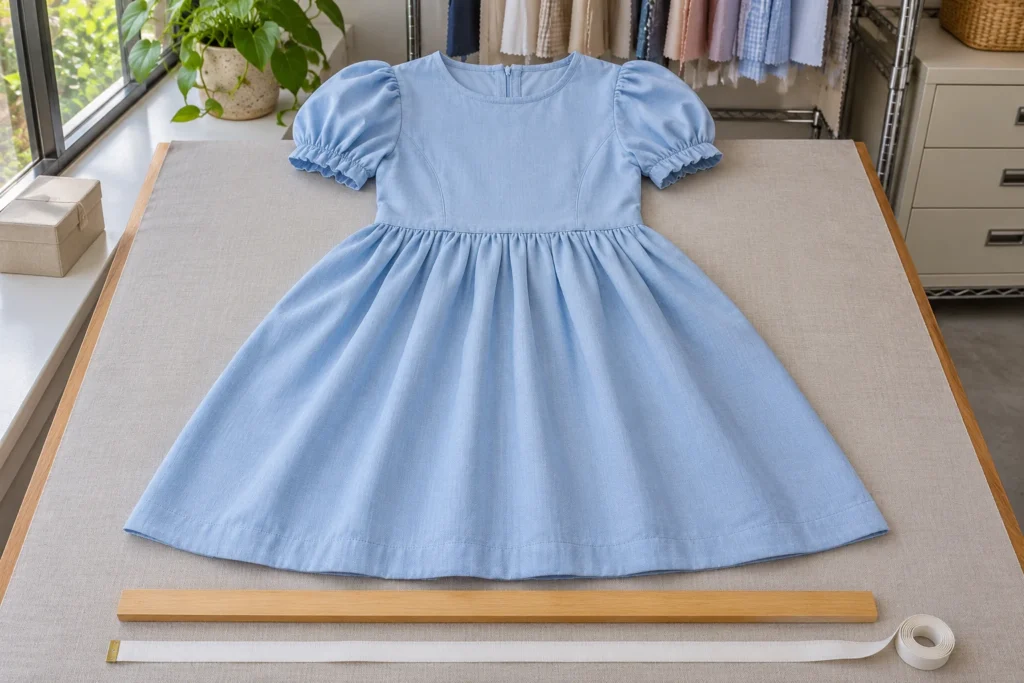
Use the same measurement method for each sample.
Set up a repeatable examination
Choose a clean, well-lit surface, the same measuring tape and the same measurement method for both dresses. Photograph front, back, side and inside views under consistent lighting. Record the garment as received before steaming, washing or making adjustments. This consistent setup makes girls’ dress samples easier to assess without confusing photography or handling differences with product differences. If a parcel has transit damage, keep that observation separate from sewing quality. Do not let a crushed box become a score against patternmaking.
Use an agreed measurement chart, not your memory of how a “size 6” should fit. A nominal age or size label does not tell you the brand’s intended chest, length, armhole or ease. Identify each point of measure and its method. For example, state whether chest width is measured flat at a specified distance below the armhole, and whether dress length is measured from the high shoulder point or another reference. Apply the same approach to both garments. Note the measurement, agreed tolerance, and difference; do not invent a universal tolerance because the style may be stretch knit, rigid woven, layered or adjustable.
For girls’ dress samples with a shaped bodice, a single flat dimension can hide a fit problem. Review waist placement, neckline shape, shoulder balance, sleeve mobility, zipper length and skirt volume. If a suitable fit evaluation is available, observe dressing, standing, sitting and movement under appropriate supervision. Keep the wearer’s comfort and privacy first. If a live fitting is inappropriate or unavailable, say what remains untested rather than claiming the flat measurements prove fit.
Record observations before opinions
Write “left side seam is 8 mm longer than right at the hem” or “the lining pulls at the back zipper when closed” before writing “poor quality.” The first statement can be checked and corrected. The second invites an argument about taste. Use photographs with a ruler or marked point when they clarify a location, but keep the measurement and desired outcome in text. This makes your feedback understandable to both factories and to a colleague who did not attend the review.
Keep three columns in your notes: requirement, observed evidence, and decision. A fourth column can identify who must act. Do not turn every aesthetic preference into a failure. If an unanticipated improvement is offered, describe it, assess its cost and risk, and decide whether it should become part of the common brief. If it does, give the other factory the same chance to propose against that revised brief before you call the comparison final.
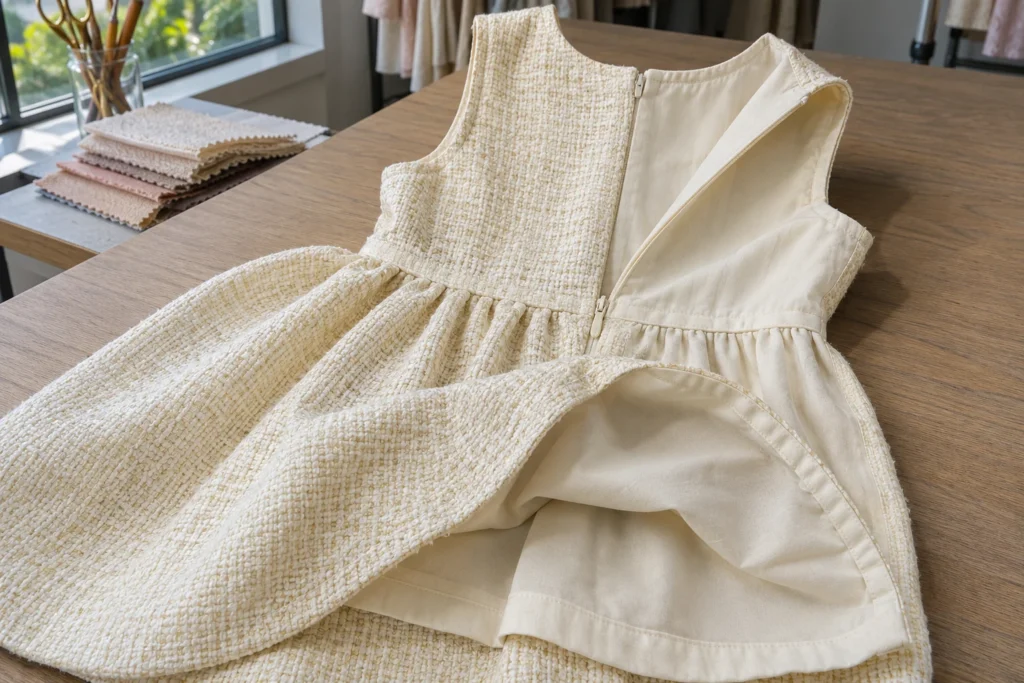
Inside construction matters as much as the outer finish.
Compare girls’ dress samples from outside to inside
Start with the silhouette at a consistent viewing distance. Check whether the dress hangs evenly and matches the intended proportions. Look for balanced shoulders, waistline, skirt layers, pleats or gathers, and a hem that behaves as designed. Then turn the garment inside out. A polished photograph can hide bulky seam allowances, exposed thread ends, rough backing, uneven lining attachment or a zipper that catches the inner layer.
Examine comparable construction points in both dresses. Check seam type and neatness, alignment of side seams, the finishing of edges and the stability of stress points. On a lined party dress, look at where the lining meets the neckline, armholes, waist and closure. Does it lie flat without rolling outward? Does it allow the wearer to move without pulling the outer fabric out of shape? A lining can make a dress look refined on the hanger while creating discomfort in wear if its length, seam placement or hand feel is wrong.
Closures deserve a separate pass. Open and close a zipper several times with the dress supported as it would be in use; do not force it to produce a failure. Check whether the slider moves smoothly, whether fabric catches, whether the top and bottom ends are finished, and whether the closure can be used comfortably. Examine buttons, snaps, ties, bows or elastic according to the intended age and use. A visually attractive trim is not automatically appropriate for every child or market.
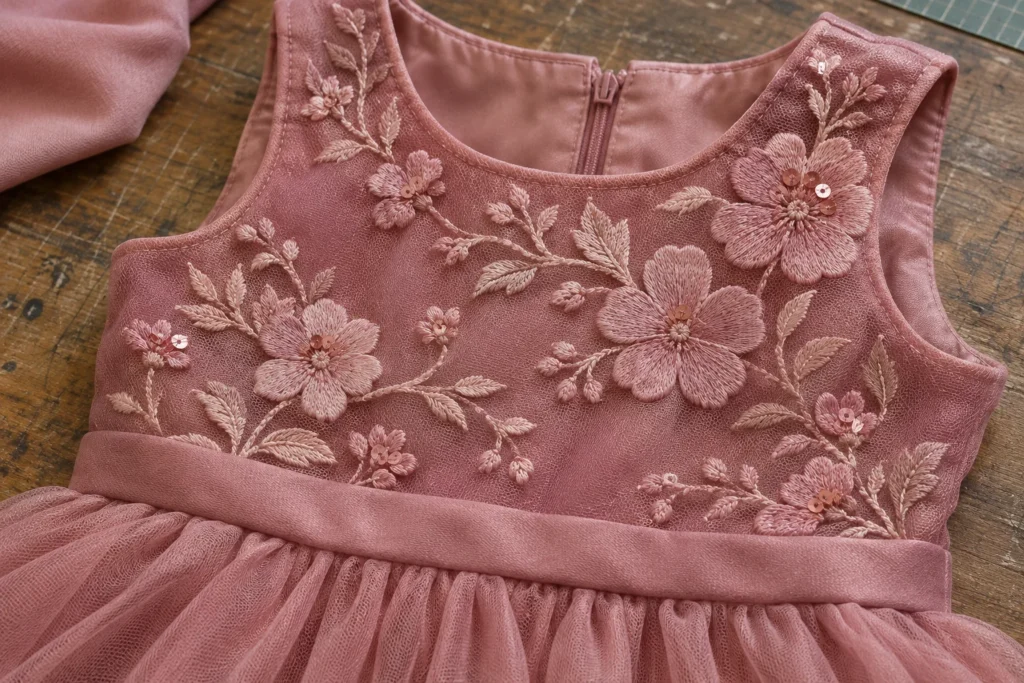
Review decoration placement and the garment beneath it.
Evaluate decorative work as part of the whole garment
Girls’ occasion dresses often combine tulle, embroidery, sequins, appliqués, beads or layered flowers. For girls’ dress samples with these details, inspect placement, symmetry, backing, exposed edges and the areas that may touch the skin. Compare decoration on the smallest and largest submitted sizes if both exist; the same artwork size may have very different proportions. Ask how the factory will control placement during bulk production, especially when fabric is gathered or stretchy.
Do not treat a hand tug at a bead or bow as a legal safety test. It may reveal an obvious problem, but applicable safety rules and test methods depend on the product, age group and destination. The U.S. CPSC clothing guidance describes U.S. apparel flammability obligations; the relevant requirements for your dress must be identified before certification and production. The question for the sample comparison is whether each factory can document the materials and construction it proposes, identify applicable checks, and respond when a component changes.
Compare fabric and color on controlled terms
Put the garments beside the approved material and color references in consistent light. Compare weight, hand feel, drape, opacity, texture, stretch and recovery where those properties matter to the design. Look at the outer fabric and lining together. A lovely outer layer may be too transparent for the intended use; an attractive lining may add unwanted weight or warmth. Record both the observed issue and the material identity that the supplier says it used.
If the samples use different provisional fabrics, label this section “not directly comparable.” You may still judge pattern interpretation, but you cannot fairly rank final drape, shade or care behavior from unmatched materials. Request a matched revision or a written reason why the nominated material is unavailable. Confirm whether the proposed alternative changes the price, minimum quantity, sample schedule or regulatory review.
Use the same care observation for both garments
Before washing anything, decide whether the girls’ dress samples are allowed to be washed and whether each factory can provide a second, untouched reference. Record the dimensions and appearance before care. Follow the intended care procedure consistently for both samples, then inspect after drying and conditioning in the same way. Look for dimensional change, twisting, puckering, color transfer, loose threads, damaged decoration, lining distortion and closure behavior. Photograph the same areas before and after.
One home or office wash is a useful development observation, not a validated performance test or proof of a care claim. If the brand needs a formal result, agree on the test method, sample source and qualified laboratory. The FTC apparel guidance says covered U.S. apparel must carry care instructions, and most textile products need fiber, origin and responsible-business information. Compare each factory’s proposed label content to your approved product information; do not approve a label merely because it is neatly stitched.
If one sample is made with a different fabric, the wash comparison cannot isolate factory sewing quality from material behavior. Note the confounder. You may need matching materials or independent material evidence before you can draw a fair conclusion. When a factory changes a material after any product testing, reassess the evidence instead of assuming an old result applies. The CPSC component-part testing guidance explains that acceptable component evidence depends on the specific rule, and some requirements still need finished-product evaluation.
Give hard stops priority over a score
A scorecard helps you compare girls’ dress samples, but the scoring system is your buying tool, not a certification. Start by marking non-negotiable conditions. Examples might include a missing approval sample for a critical feature, a closure that cannot function as intended, an unapproved material change, an unresolved trim attachment concern, a document gap that blocks your market review, or a factory unwilling to identify what it actually used. The exact gates must follow your dress, age group and destination.
Do not average a critical issue away. A factory that communicates beautifully but refuses to disclose the final trim cannot earn approval through a high communication score. Likewise, a factory with a beautiful dress but unexplained revisions may be hard to reproduce. Mark the issue as “hold” until you have the relevant evidence or corrected sample. A hold is not necessarily a permanent rejection; it is a decision not to advance while the question remains open.
For the remaining dimensions, use a simple evidence-based scale. You might assign 0 for missing or unusable evidence, 1 for material deviation, 2 for a correctable issue, and 3 for meeting the agreed requirement. The numbers are illustrative and should be set before you see the dresses. Weight categories only if there is a clear business reason. A boutique selling embellished party dresses may give more attention to lining comfort and decoration control than a brand selling a plain jersey day dress, but neither can ignore applicable safety or labeling requirements.
A practical side-by-side record
| Review area | Same question for both factories | Evidence to retain |
| Brief and version | Did the sample follow the same approved revision? | Submission note, specification version, deviation list |
| Fit and measurements | Does the dress match the defined fit and agreed points of measure? | Measurement sheet, fit notes, dated photos |
| Construction | Are seams, lining, hem and closure appropriate and consistent? | Inside/outside photos, location-specific comments |
| Materials and color | Are actual fabric, lining and trims identified and approved? | Swatch references, component list, color comparison |
| Decoration | Are placement, backing and attachment suitable for this design? | Detail photos, method and open test questions |
| Care observation | What changed under the same stated care procedure? | Before/after dimensions and images |
| Communication | Did the team identify deviations and propose controlled corrections? | Question log, revision response, updated files |
Keep the table alongside the actual garment, not in a marketing presentation. State “not tested” where appropriate. If a factory has not supplied a size needed for grading review, do not silently give it a zero or a perfect score; list the missing deliverable and decide whether the selection can wait.
Compare the factories’ corrections as carefully as the dresses
Send each supplier a clear, dated feedback sheet with photographs and measurable actions. Ask it to confirm what it understands, what it will change, whether the change affects pattern, fabric, trim, price or timeline, and which new sample will prove the correction. Give both factories a reasonable and comparable opportunity to respond. Your review of girls’ dress samples is also a test of technical communication, not simply sewing.
A useful response identifies the root cause. If a zipper catches the lining, “we will be more careful” is weaker than an explanation of how the lining attachment and zipper guard will change, who will update the specification, and how the revised sample will be checked. If the left and right skirt lengths differ, the team should explain whether the source is the pattern, cutting, handling, fabric behavior or pressing. You do not need a perfect first submission; you need evidence that corrections can be made and controlled.
After each revision, compare the corrected item to the same current brief. Do not allow an improvement in one area to obscure a new defect elsewhere. Record the version and retire the earlier sample as an approval reference. If both factories can correct the dress, use the complete evidence set to decide who can support the style commercially. At that point, compare written pricing and service scope on the same specification rather than choosing by a first-sample impression alone.
Decide: select, revise or pause
Select a factory when the required dress is represented by an approved version, material identities are clear, critical issues are closed, and the supplier can explain the handoff to production. The selection may still be conditional on written terms, testing, a pre-production sample or a later pilot. Revise when the problems are specific, correctable and the supplier has shown a credible correction plan. Pause when a safety-relevant question, major fit mismatch, undocumented substitution, inconsistent version control or missing facility information prevents a defensible decision.
The sample result tells you about development, not the entire production system. HAPA’s boutique sourcing guide covers the broader sourcing relationship. If your next question is whether an approved dress can be made consistently in quantity, plan a separate controlled production trial and inspection rather than assuming two attractive samples settle that question.
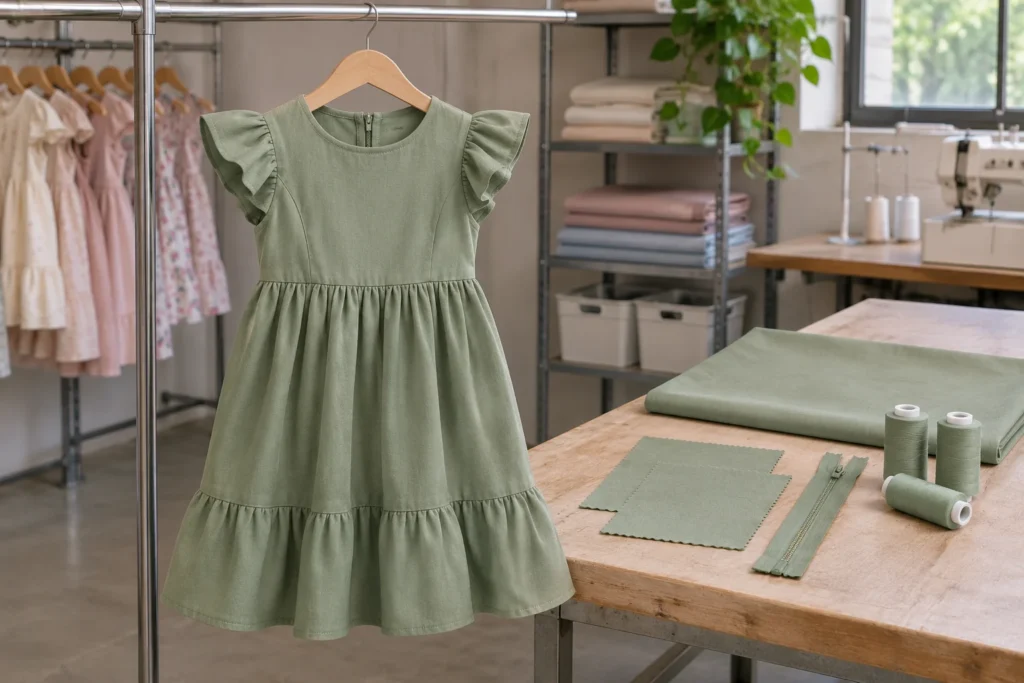
Keep the selected garment tied to its material references.
Preserve the winning reference before the first order
When you choose a supplier, identify the approved sample by style, version, size, date and material list. Keep one controlled physical reference where possible, and agree on what equivalent reference the factory will retain. The rejected and revised girls’ dress samples still belong in your decision record, clearly marked so nobody uses them as a bulk standard. File the final measurement chart, pattern and grading status, construction notes, fabric and trim references, artwork placement, approved labels and care information, photographs, and all accepted deviations. State who may authorize substitutions and how any later change will be sampled and reviewed.
Ask how the supplier will transfer the approved details from its sample room to the people cutting, sewing, decorating, inspecting and packing the bulk order. A signed sample without updated production files can be misinterpreted. Conversely, a detailed file without a representative garment may leave drape or finish open to interpretation. The approval package should connect both.
For a collection with several dress styles, repeat the method on a representative style rather than assuming one successful garment proves every silhouette. A woven party dress, a jersey day dress and a heavily embellished occasion dress can expose different technical risks. The number and type of samples needed for the whole collection are a separate planning question; your immediate task is to make the two submissions for this dress comparable and decision-ready.
Questions boutique buyers often ask
Should I compare showroom samples or custom samples?
A showroom sample can show an existing capability or finish, but it may not show how a factory interprets your design, measurements and material choices. For a fair selection, ask both factories to work from the same brief. If you can afford only a showroom screening first, treat it as preliminary and do not claim the winner has proved your custom dress.
Is the cheapest sample the best choice for a small boutique?
No price is meaningful without scope. One charge may include pattern work and a revision; another may cover sewing only with provisional fabric. Request the development deliverables, revision allowance and later production quote separately. A higher sample fee may be reasonable if it buys work you need, but the resulting evidence—not the fee itself—should drive the decision.
Can I choose after one round?
You can if both samples meet the same brief, critical questions are closed and your written terms are clear. Many designs need a correction or a matched material submission. Do not invent a standard number of rounds. Set a deadline and a decision criterion, and pay for additional work only when the next sample will answer a specific open question.
What if each factory is better at a different part of the dress?
Identify which difference matters to the product and whether the weaker area is correctable. One factory may produce cleaner decoration while the other has a better bodice fit. Ask each to revise against the same criteria, then inspect for new compromises. If neither can satisfy the must-have requirements, the right outcome is to pause or broaden the search, not to approve the least troublesome defect.
Do two passing samples prove the dress is compliant?
No. Visual review and informal care observations cannot establish every applicable safety or labeling requirement. Identify the target market, age range, materials and construction, then plan the relevant documentation and qualified testing. Keep the test specimen linked to the approved design and components. Product changes can require a fresh assessment.
Make the choice traceable
To compare girls’ dress samples fairly, give both factories the same dress problem, the same inspection method and the same chance to explain deviations. Keep photographs and measurements tied to a versioned brief. Separate what you observed from what a supplier promised, and separate a correctable issue from a hard stop. Then choose, request a specific revision or pause with a written reason.
This process is useful even if one dress looks obviously prettier on first sight. It shows whether the garment can become a controlled product for your boutique. The result is a better basis for a production discussion—and a clear record of what still needs to be proved before customers see the dress.