Finding a low MOQ kids clothing manufacturer can feel like the safest first step for a new children’s apparel brand. You want to test a collection, avoid tying up cash in inventory, and see whether your market responds before committing to a larger run. That instinct is sensible. For startups, low MOQ production can reduce financial pressure and make custom kidswear more accessible.
But low MOQ is not a shortcut around product development. In children’s clothing, small-batch production still needs clear sizing, safe materials, practical trims, sample approval, and quality checks. A 100-piece order with poor grading or unclear fabric requirements can become more expensive than a larger order planned correctly.
The best way to approach low MOQ is to treat it as a controlled launch strategy, not simply a smaller order. This guide explains how low MOQ kidswear manufacturing works, what trade-offs to expect, and how startup brands can prepare before contacting a supplier.
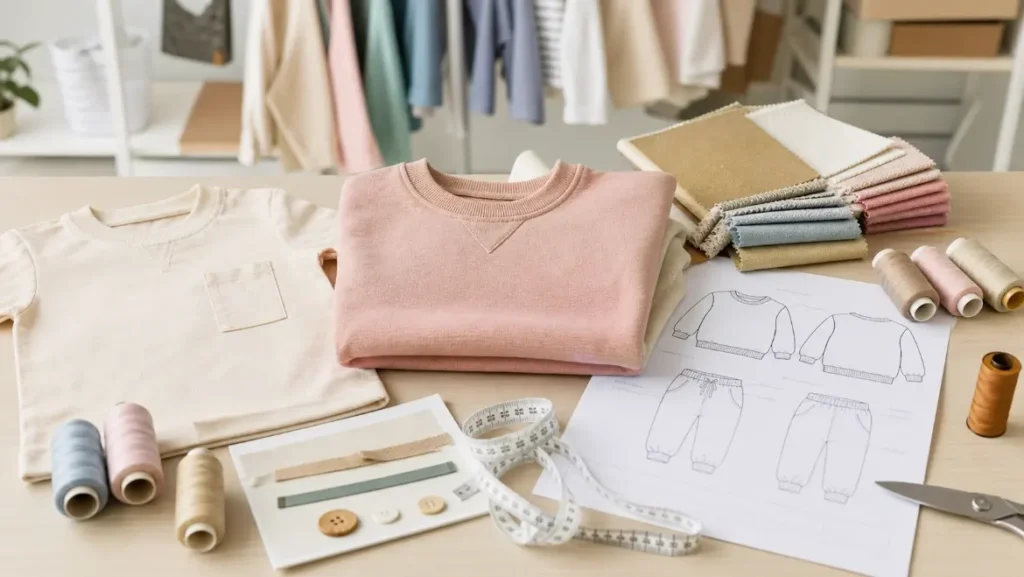
What Does Low MOQ Mean in Kids Clothing Manufacturing?
MOQ means minimum order quantity. It is the smallest quantity a manufacturer is willing to produce under a specific set of conditions. In kidswear, MOQ is rarely just one number. It can depend on style, fabric, color, size range, trims, printing, labels, packaging, and whether the garment is based on an existing pattern or developed from scratch.
For a startup, the key question is not only “What is your MOQ?” A better question is: “What is the MOQ for my exact product, fabric, color, size range, and customization level?”
MOQ by style, color, size, and fabric
A low MOQ may apply differently depending on how the order is structured. For example, 100 pieces of one hoodie in one fabric and one color is very different from 100 pieces spread across five colors and six sizes. The second option creates more cutting, sorting, labeling, and inspection complexity.
Here is a practical way to think about it:
| Order Variable | Why It Affects MOQ |
|---|---|
| Style | Each style may need its own pattern, sample, cutting plan, and production setup. |
| Fabric | Custom fabrics or special dye colors often require higher material minimums. |
| Color | More colors can increase fabric sourcing, cutting, and inventory complexity. |
| Size range | Kidswear often covers several age groups, and each size must be graded and checked. |
| Trims | Buttons, snaps, zippers, drawcords, prints, labels, and packaging can all have supplier minimums. |
This is why two manufacturers can give different MOQ answers for the same general request. One may be quoting from available fabric and standard trims; another may be pricing full custom development.
Why kidswear MOQ is different from adult apparel
Children’s clothing has its own production pressures. A brand may need baby, toddler, little kid, and youth sizes, and each age group has different fit expectations. A basic T-shirt is relatively simple, but a romper, padded jacket, school uniform, or dress with decorative trims can require more careful development.
Fit tolerance is also less forgiving. A garment that is slightly uncomfortable, difficult to put on, or unsafe around the neck, waist, or closures can create real customer issues. Children’s apparel quality control is not only about clean stitching. It is also about comfort, movement, durability, and age-appropriate construction.
Low MOQ vs sample order vs bulk production
Low MOQ production should not be confused with sampling. A sample is used to confirm design, material, fit, and workmanship before production. A low MOQ order is still a production order, even if the quantity is small.
A useful startup sequence is:
- Develop the concept and product requirements.
- Prepare a simple tech pack or reference specification.
- Make a first sample.
- Review fit, fabric, color, trims, and construction.
- Approve a pre-production sample or size set where needed.
- Start low MOQ production only after the product is clear.
Skipping samples may save time at the beginning, but it can move the cost into rework, delays, or unsellable inventory later.
Why Startups Choose Low MOQ, and What Trade-Offs to Expect
Startups choose low MOQ because it keeps the first launch manageable. A new brand may still be testing its customer, price point, hero category, size demand, and marketing channels. A smaller production run gives the brand room to learn before scaling.
That said, low MOQ usually comes with trade-offs. The most experienced buyers do not ask only for the lowest order quantity. They ask what they are giving up in exchange for it.
Lower inventory risk
The clearest benefit is lower inventory risk. Instead of committing to a large quantity across many sizes and colors, a startup can test a focused capsule collection. This is especially useful for children’s apparel because size demand can be difficult to predict at launch.
For example, a brand may believe sizes 2T to 6T will sell evenly, then discover that its audience buys heavily in 3T and 4T. A smaller first run helps the brand gather real sales data before placing a larger reorder.
A low MOQ strategy also supports seasonal testing. Kidswear often follows school calendars, holidays, weather shifts, gifting periods, and family shopping cycles. A small first run can help a brand learn which category deserves more investment.
Higher unit cost
The main trade-off is unit cost. Small-batch kids clothing production can cost more per piece because the manufacturer still needs to spend time on communication, pattern preparation, sample review, fabric handling, machine setup, cutting, sewing coordination, trimming, packing, and inspection.
The production line does not become simpler just because the order is smaller. In some cases, the fixed setup work is spread over fewer units, which raises the per-piece cost.
This is why very low MOQ quotes should be reviewed carefully. If a price looks unusually low, check what is included. Does it cover custom labels? Fabric sourcing? Packaging? Size grading? Pre-production samples? Inspection? Revisions? Clear answers matter more than a tempting headline number.
Less flexibility in fabric sourcing and trims
Low MOQ can limit the range of fabrics, colors, and trims available. Custom-dyed fabric, exclusive prints, special zippers, unique buttons, and custom packaging may have minimums from material suppliers, not just from the garment factory.
For a first collection, the practical approach is often to keep the product distinctive through silhouette, print placement, color story, brand label, packaging, and fit, while staying realistic about fabric and trim availability.
If you are evaluating HAPA as a potential partner, you can start from its overview as a low MOQ kids clothing manufacturer and then discuss which parts of your design need customization and which parts can be simplified for a first run.
How Low MOQ Affects Design, Fabric, Sizing, and Customization
Low MOQ is easiest when the product design is focused. The more variables a startup adds, the more difficult it becomes to keep order quantity, cost, and timeline under control.
A practical manufacturer-side view is this: the first collection should prove the brand’s product-market fit, not prove that every design idea can be produced at once. The goal is to choose the right complexity for the stage of the business.
Ready styles, ODM, OEM, and private label options
Startups usually have several production paths:
| Production Path | Best For | Startup Consideration |
|---|---|---|
| Ready styles | Fast testing with limited customization | Less design uniqueness, but lower development pressure. |
| Private label | Brand labels, packaging, and selected custom details | Good for boutiques and e-commerce brands testing demand. |
| ODM | Manufacturer-supported product development from existing design experience | Useful when the brand has a concept but needs development support. |
| OEM | Fully custom production based on buyer specifications | More control, but usually requires stronger tech packs and sampling. |
If your launch plan depends on labels, hang tags, packaging, and brand presentation, HAPA’s private label kidswear manufacturer page is a relevant internal reference for exploring private-label production.
Fabric availability and color limitations
Fabric is often where low MOQ plans become more complicated. A startup may want organic cotton, bamboo blends, recycled polyester, fleece, rib, interlock, denim, or performance fabrics in custom colors. Some materials may be available in stock colors, while others need knitting, dyeing, finishing, or printing minimums.
The safest early decision is to separate “must-have” fabric requirements from “nice-to-have” details. For example:
- Must-have: soft hand feel, washable, suitable for toddlers, compatible with print.
- Nice-to-have: exact Pantone match, exclusive fabric development, custom jacquard trim.
This keeps the product brief realistic. It also gives the manufacturer room to suggest available fabrics that meet the function of the design without forcing unnecessary minimums.
Size grading for toddlers, kids, and youth ranges
Kidswear sizing deserves more attention than many startups expect. A design that works in size 3T may not scale cleanly to size 8 or 10. Neck openings, sleeve length, rise, waist stretch, shoulder width, and ease all change as the size range expands.
For low MOQ production, a narrow size range can be easier to manage at launch. Instead of offering every size from baby to pre-teen, a startup may begin with the age group most closely aligned with its customer.
The decision is both commercial and technical. A tighter size range can reduce inventory spread and make fit review more manageable. A broader size range may attract more customers, but it can dilute the quantity per size and increase the chance of stock imbalance.
Sampling and Fit Checks Before Small-Batch Production
Low MOQ reduces order quantity, but it does not remove the need for product validation. In children’s apparel, the sample stage is where many costly problems can be found early: rough seams, tight openings, loose trims, poor stretch recovery, incorrect print scale, or size grading issues.
For startups, sampling should be treated as an investment in decision quality.
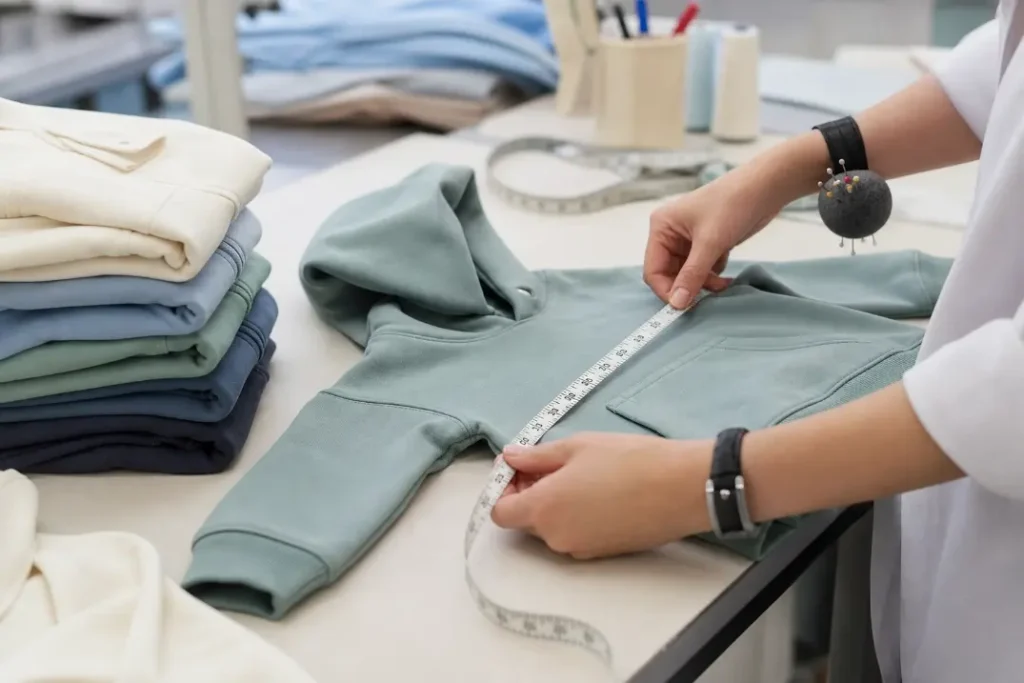
What to include in your tech pack
A tech pack does not need to be perfect for a startup, but it should be clear enough for a manufacturer to understand the product. At minimum, include:
- Product sketch or reference images.
- Target age group and size range.
- Fabric preference and fabric weight if known.
- Color references.
- Print, embroidery, applique, or special decoration details.
- Label and packaging requirements.
- Measurement points or a reference size chart.
- Any market-specific compliance concerns you already know.
When a buyer sends only a mood board and a target price, the supplier has to guess. Guessing creates quote gaps, sample revisions, and mismatched expectations. A simple but organized brief is usually better than a beautiful but incomplete concept deck.
Fit sample and size-set approval
The first sample usually checks design direction and workmanship. A size set checks whether the design grades correctly across sizes. Not every low MOQ order needs a full size set, but for fitted garments, multi-size ranges, uniforms, outerwear, rompers, or styles with limited stretch, size checks become much more important.
HAPA’s product samples page is a useful reference for brands thinking through sample evaluation before production.
When reviewing samples, do not look only at how the garment appears on a table. Consider how a child will move in it:
- Can the neckline pass comfortably over the head?
- Are waistbands secure without being restrictive?
- Do snaps, zippers, and buttons feel appropriate for the age group?
- Are seams placed where they will not irritate the skin?
- Does the garment still look good after realistic washing?
These questions sound simple, but they are often where first-time kidswear brands discover whether the product is ready.
Pre-production sample checkpoints
Before low MOQ production begins, a pre-production sample should represent the approved version as closely as possible. Check:
- Main fabric and contrast fabric.
- Approved color.
- Stitching quality.
- Print or embroidery placement.
- Trim type and placement.
- Label content and position.
- Size measurement.
- Packaging method if relevant.
One useful rule: if a detail affects fit, safety, brand presentation, or customer complaint risk, confirm it before production. Low MOQ is not an excuse to accept unclear specifications. It is the stage where a startup learns how to control them.
Safety, Compliance, and Quality Control for Children’s Apparel
Children’s clothing needs more careful planning than many general fashion products. Safety and compliance requirements can vary by product type, age group, fiber content, decoration, trim, and destination market. This article is not legal advice, but startups should treat compliance preparation as part of product development, not an afterthought.
If you sell into the United States, the U.S. Consumer Product Safety Commission provides official guidance on children’s products and the Children’s Product Certificate. For the European Union, chemical and material restrictions may involve frameworks such as REACH. Textile certifications such as OEKO-TEX STANDARD 100 may also be relevant depending on your product and market positioning.
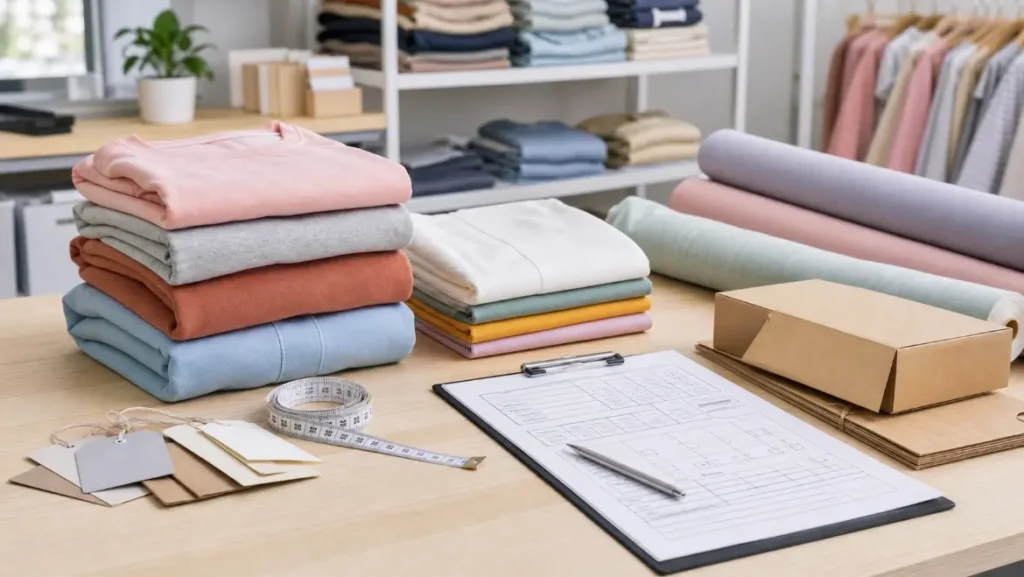
Fabric, trims, and small-part risk
Fabric choice affects comfort, durability, wash performance, and perceived quality. For children’s clothing, trims also matter. Buttons, snaps, cords, patches, beads, sequins, zippers, and decorative elements should be reviewed for age suitability and attachment strength.
The risk is not only whether the garment looks good when new. A buyer should consider how it behaves after washing, stretching, pulling, and everyday wear. Kidswear is handled roughly. A trim that is acceptable on adult fashion may be unsuitable for a toddler product.
Testing and certificate preparation
Testing needs depend on the destination market and product category. A startup should confirm requirements before production, especially if selling through marketplaces, retailers, or import channels that require documentation.
Common preparation questions include:
- What market will the product be sold in?
- What age group is the garment intended for?
- Are there small parts, cords, coatings, prints, or special finishes?
- Does the retailer or platform require specific test reports?
- Who will hold and organize the compliance documentation?
The practical point is simple: do not wait until goods are finished to ask whether testing is needed. If a material, print, or trim creates a compliance concern, it is easier to adjust before production than after shipment.
Final inspection before shipment
Quality control for low MOQ should still be structured. Small orders can have defects too, and because the quantity is smaller, each defective piece has a larger impact on sellable stock.
Final checks may include:
- Measurement review against approved specs.
- Stitching and seam strength review.
- Color and print placement check.
- Trim attachment review.
- Label and packaging confirmation.
- Visual inspection for stains, holes, shade variation, or uneven workmanship.
For children’s apparel, quality control is not only about defect rate. It is also about whether the product is consistent enough for parents to trust the brand.
How to Choose the Right Low MOQ Kids Clothing Manufacturer
The right low MOQ kids clothing manufacturer is not always the supplier with the lowest starting quantity. A good partner should help you understand what is feasible, what will increase cost, and what needs to be decided before production.
For startup buyers, supplier selection is partly about capability and partly about communication. A manufacturer that asks detailed questions may feel slower at first, but those questions often prevent problems later.
Questions to ask before requesting a quote
Before requesting a quote, prepare answers to these questions:
| Question | Why It Matters |
|---|---|
| What product category are you producing? | T-shirts, rompers, pajamas, jackets, dresses, and uniforms have different production needs. |
| What size range do you need? | Size spread affects grading, cutting, inventory, and fit checks. |
| Do you need OEM, ODM, or private label? | The production path affects development work and pricing. |
| Is the fabric fixed or flexible? | Flexible fabric choices can make low MOQ easier. |
| What is your target market? | Compliance and labeling needs can vary. |
| What custom details are required? | Prints, embroidery, labels, packaging, and trims can affect MOQ. |
| Do you have a tech pack? | A clearer brief usually leads to a clearer quote. |
If your product requires fully custom development, HAPA’s children’s clothing OEM page can help you understand the OEM direction before starting a quote conversation.
Red flags in low-MOQ production
Be cautious if a supplier:
- Gives a quote before understanding fabric, size range, and customization.
- Promises extremely low prices without explaining what is included.
- Avoids discussing samples or quality checks.
- Treats children’s apparel exactly like adult apparel.
- Cannot explain how size grading will be handled.
- Makes broad compliance promises without asking about the destination market.
- Pressures you to skip sample approval to save time.
A good manufacturer should not make the buying decision feel mysterious. Even if the final quote depends on details, the supplier should be able to explain the variables.
For a broader supplier-evaluation view, HAPA’s guide on how to find a kids clothing manufacturer is a helpful next read.
When to scale from low MOQ to larger production
Low MOQ is usually the learning stage. After a first run, review:
- Which styles sold fastest?
- Which sizes sold out or moved slowly?
- Which colors had the best response?
- Were there returns or fit complaints?
- Did the product meet your margin target?
- Were the samples and production specs clear enough?
Scale only after you understand what the first order taught you. Many startups rush from a small batch to a larger order because the first launch feels exciting. A more disciplined approach is to scale the proven styles, reduce weak variations, refine sizing, and improve specs before increasing volume.
In other words, low MOQ should give you information, not just inventory.
FAQ About Low MOQ Kids Clothing Manufacturing
What is considered a low MOQ for kids clothing?
There is no universal number. Low MOQ depends on the manufacturer, product type, fabric, color, customization, and size range. For startups, the more useful question is what MOQ applies to one specific style, fabric, color, and size spread.
Can a startup order kids clothing with only 100 pieces?
Some manufacturers may support small orders around this level for selected products or production paths, especially when designs are simple and materials are available. However, the final feasibility depends on product complexity, fabric sourcing, trims, labels, and size distribution.
Why does low MOQ cost more per piece?
Low MOQ often costs more per unit because setup, communication, sampling, cutting, machine preparation, and inspection are spread across fewer garments. The order is smaller, but many production steps still require the same careful planning.
Can I customize labels and packaging with low MOQ?
Often, yes, but customization depends on label type, packaging design, supplier minimums, and cost. Woven labels, printed neck labels, hang tags, poly bags, stickers, and branded packaging may each have separate minimums or setup costs.
Do kids clothes need safety testing?
Testing requirements depend on the destination market, age group, product type, materials, trims, and sales channel. Brands should check official guidance, retailer requirements, and qualified testing providers before production. For U.S. sales, CPSC guidance is a useful starting point.
What should I prepare before requesting a quote?
Prepare product category, target quantity, size range, fabric preference, colors, customization details, label and packaging needs, target market, reference images, and any available measurements. A basic tech pack helps the manufacturer quote more accurately.
Conclusion
Working with a low MOQ kids clothing manufacturer can be a smart way to launch a children’s apparel brand with less inventory pressure. But small orders still need serious planning. The strongest startup brands prepare clear product briefs, approve samples carefully, keep size ranges realistic, and think about compliance before production begins.
Low MOQ works best when it is used as a learning tool. Start focused, measure real sales, improve the product, and scale the styles that prove themselves.
If you are developing a custom kidswear collection and need support with sampling, private label details, or OEM production planning, you can review HAPA Garments’ relevant service pages and prepare a project discussion with your product category, target quantity, size range, fabric preferences, and destination market.