If you need to verify a kids clothing factory in China before paying a deposit, start with one principle: do not try to prove only that the supplier exists. Your real job is to establish whether the company that is quoting you can actually manufacture your specific children’s garments, control the materials and subcontracted processes, meet your target-market requirements, and reproduce an approved sample consistently in bulk.
That sounds obvious, but it is where many sourcing decisions go wrong. A supplier can have a polished website, a registered company, attractive showroom samples, and fast English communication while still being a poor fit for your product. The opposite is also true: a relatively modest-looking factory can be technically strong, transparent, and very reliable if its production system matches what you need.
When I evaluate a kidswear supplier, I therefore separate verification into five questions: Who is the legal company? Where will production actually happen? Does the factory have relevant kidswear experience? How is quality controlled? And can the supplier support the documentation and testing required for the destination market?
You do not need to become a professional auditor to answer those questions. You do, however, need a repeatable process. This guide walks through the same sequence I would use when narrowing a new Chinese kidswear supplier from an attractive quotation to a factory I would feel comfortable approving for a first bulk order.
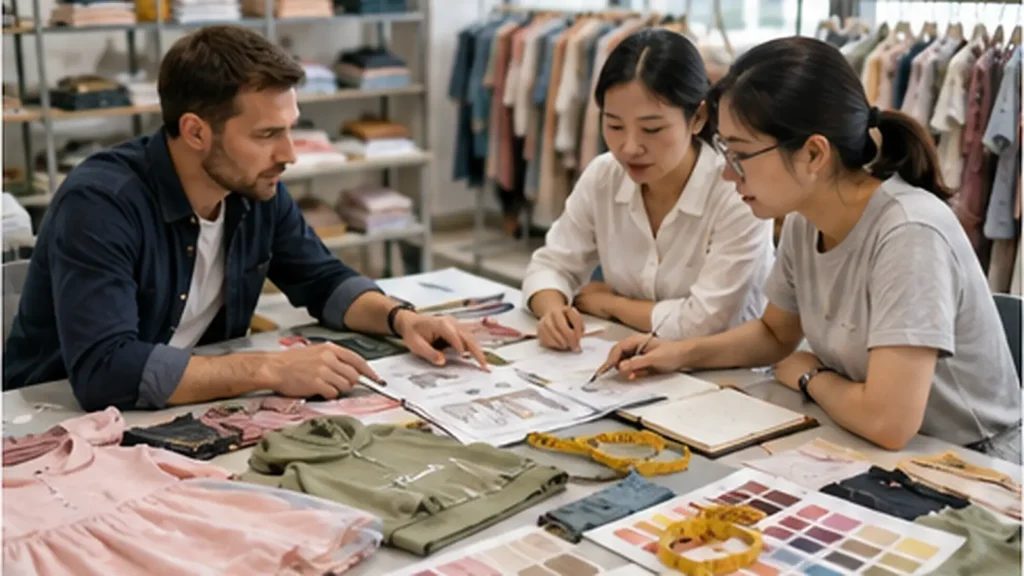
Buyer and garment specialists reviewing kidswear samples during factory evaluation.
Quick Factory Verification Checklist
Before we go into the detail, here is the short version. I would not approve a first bulk order until I could answer each of these points with reasonable confidence:
- Legal company name and registration are verifiable.
- Factory address and production address are clear.
- I understand whether I am dealing with a factory, trading company, or sourcing company.
- The production team has recent experience with garments similar to mine.
- Pattern making, grading, sampling, and material sourcing are explained clearly.
- The factory can show cutting, sewing, in-line QC, final inspection, and packing controls.
- Outsourced processes such as embroidery or washing are disclosed and controlled.
- Current audits or certificates match the actual production facility where relevant.
- A custom sample has been produced to my specification and corrected successfully.
- Payment beneficiary, proforma invoice, production schedule, and inspection plan are documented.
If several of these answers are still vague, I would keep verifying before paying a production deposit.
Why Factory Verification Matters More for Children’s Clothing
Children’s clothing looks like a familiar product category, but it creates additional sourcing responsibilities. Small components, drawstrings, decorative attachments, sleepwear classifications, labeling, fiber content, tracking information, and market-specific testing can all affect how a product should be developed and documented.
For U.S. sales, for example, the importer of an overseas-manufactured children’s product is generally responsible for issuing the Children’s Product Certificate when a CPC is required, based on applicable testing. The U.S. Consumer Product Safety Commission explains this responsibility in its Children’s Product Certificate guidance. Textile apparel also falls under Federal Trade Commission labeling requirements covering matters such as fiber content, country of origin, responsible company identification, and care instructions; the FTC apparel labeling resources are a useful starting point.
A factory does not replace your importer, testing laboratory, or legal adviser. What I want from a manufacturer is something more practical: the ability to understand the requirements I provide, control relevant components, maintain traceability, support testing, and keep production aligned with the approved specification.
If you want to understand how that fits into the wider OEM process, HAPA’s guide to children’s clothing OEM manufacturing explains how design review, sampling, production, quality control, and delivery connect.
Step 1: Verify the Legal Company Before You Verify the Factory
The first document I request is the Chinese business license and the company’s full registered Chinese name.
Do not rely only on the English name in an email signature. Chinese exporters often use an English brand name that differs from the legal company name, and that is not automatically suspicious. You simply need to connect the commercial identity you know with the legal entity that will sign contracts, receive payment, and take responsibility for the order.
A Chinese business license normally gives you information including the company name, Unified Social Credit Code, legal representative, registered address, date of establishment, and business scope.
You can compare that information with the National Enterprise Credit Information Publicity System, the official Chinese enterprise-information system administered under the State Administration for Market Regulation. The system allows searches by company name or Unified Social Credit Code and includes enterprise registration and credit information. For overseas buyers, this is one of the most useful official checks when you want to verify Chinese company registration.
I would compare at least these items:
- Legal company name
- Unified Social Credit Code
- Registration status
- Registered address
- Establishment date
- Business scope
- Legal representative
A mismatch does not always mean fraud. A production site can differ from a registered office, and a factory group can have multiple legal entities. But I do not ignore inconsistencies; I ask the supplier to explain them before proceeding.

Reviewing business documents and supplier information during factory verification.
Step 2: Establish the Real Supplier Structure
The classic sourcing question is, “Are you a factory or trading company?” I rarely rely on that question by itself.
Instead, I ask operational questions:
- Where is cutting completed?
- Where is sewing completed?
- Is the production site owned, leased, or subcontracted?
- Which processes are performed in-house?
- Which processes are outsourced?
- Who employs the sewing operators?
- Who performs final inspection?
- Which company will appear on the invoice and receive payment?
These questions reveal much more than a yes-or-no label.
A trading company is not automatically a bad supplier. In some programs, a capable sourcing company adds real value by allocating different products to specialized factories. A direct factory is not automatically a good supplier either. The problem is hidden production structure. You should know who is responsible for the garment and where the critical manufacturing steps take place.
Step 3: Confirm That Bulk Production Will Happen Where You Think It Will
One of the most important ways to verify a kids clothing factory in China is to connect the sales conversation to a physical production location.
Ask for the full factory address, then request a live video tour or arrange an in-person/third-party visit. During the tour, ask to move through the facility in a logical sequence rather than seeing only the showroom.
I normally want to see:
- Factory entrance or reception
- Sample room
- Pattern area
- Fabric warehouse
- Cutting department
- Sewing lines
- Finishing and QC area
- Packing area
- Finished-goods storage
You are not trying to catch the supplier out with a surprise inspection. You are checking that the operational story you have been told is coherent.
HAPA’s overview of the garment factory process is useful here because it shows why a real manufacturing workflow involves much more than rows of sewing machines.
Step 4: Verify Product Specialization, Not Just “Garment Experience”
A factory can have 15 years of apparel experience and still be the wrong factory for your project.
I ask for recent, comparable product examples. If I am sourcing a layered girls’ dress with embroidery and decorative trims, I want to see similar dresses. If I am sourcing baby rompers, I want to see babywear. If I am sourcing heavyweight hoodies, I want evidence that the factory regularly handles that fabric and construction.
Product similarity matters because different garments create different technical risks:
- Babywear: small sizing, soft seams, snaps, comfort
- Dresses: drape, lining, layers, zippers, decorative work
- Hoodies: rib recovery, shrinkage, hood construction, fleece handling
- Outerwear: lining, zippers, insulation, pocket construction
- Sleepwear: classification and flammability considerations in some markets
A manufacturer’s biggest customer list does not answer these questions. Recent comparable production does.
If you want a wider view of what to look for in a China-based supplier, HAPA’s children’s clothing manufacturer in China guide covers supplier fit from an overseas-buyer perspective.
Step 5: Review the Sample Room and Development Team
The sample room is one of my favorite places to evaluate because it exposes technical capability before bulk production starts.
I look for evidence of an active development process: pattern makers, sample machinists, fabric and trim references, measurement tools, dress forms, technical comments, and garments at different sample stages.
Then I pay attention to the questions the team asks.
A technically engaged merchandiser or sample-room team may ask whether a measurement is taken flat or around the body, whether an embroidery position should grade with size, whether shrinkage has already been included, or whether a fabric weight is required before or after washing.
Those questions are not delays. They are evidence that somebody is translating your design into a manufacturable standard.
A supplier that says “yes, no problem” to everything but never raises a technical point may actually create more risk than a factory that challenges an unclear specification early.
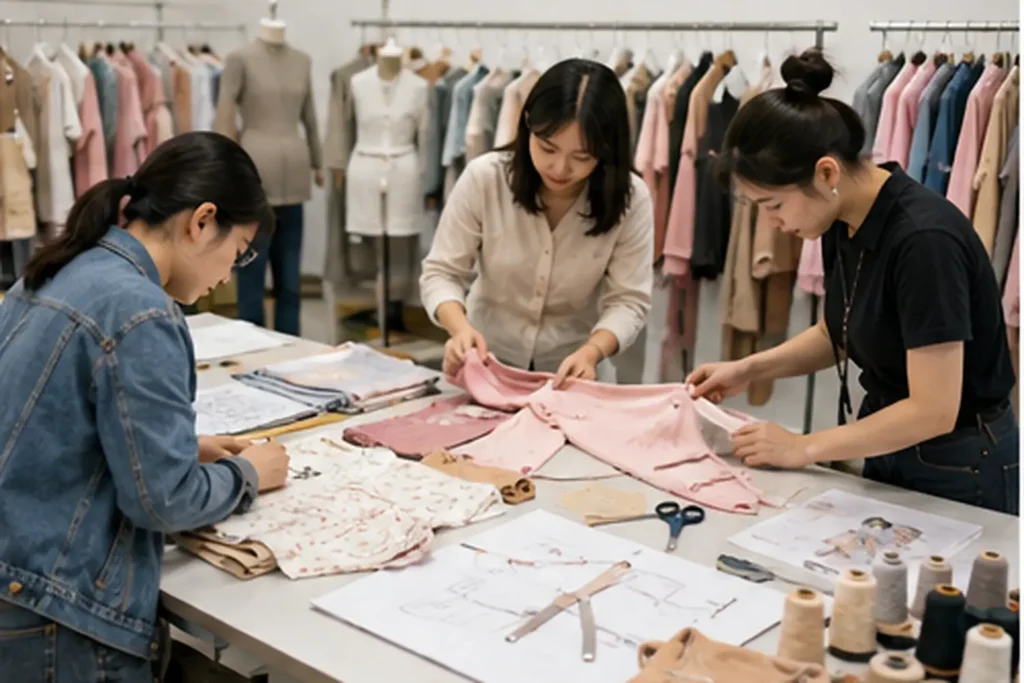
Sample-room team developing children’s garment samples and patterns.
Step 6: Test the Factory With Your Own Sample
Showroom samples are useful, but they are not enough to verify a kids clothing factory in China for your order.
The strongest practical test is to give the supplier your own product brief and see what comes back.
Depending on the project, I would provide:
- Tech pack
- Physical reference sample
- Measurement chart
- Construction details
- Artwork
- Fabric specification
- Trim requirements
- Label and packaging files
Then I inspect the sample for more than appearance. I check measurements, shape, symmetry, seam construction, inside finishing, trims, fabric hand feel, print or embroidery placement, label position, and—when relevant—wash performance.
HAPA’s product sample service describes the same principle: a sample gives you a concrete way to evaluate workmanship and sizing before committing to bulk production.
Step 7: Evaluate How the Factory Handles Corrections
The first sample does not need to be perfect. In custom apparel, revisions are normal.
What matters is whether the factory understands and closes the feedback loop.
For example, if your comments say:
- Increase body length by 1.5 cm
- Reduce neck width by 0.5 cm
- Move embroidery 2 cm upward
- Reduce waist elastic tension
- Replace the main fabric with the approved swatch
the revised sample should address those points accurately.
I become cautious when the same problem returns repeatedly. A factory that cannot control revisions in a sample room may struggle even more when hundreds or thousands of pieces are moving through bulk production.
Step 8: Verify Pattern Making and Size Grading
Kidswear grading deserves specific attention because children’s proportions change significantly across age groups.
Ask:
- Are patterns made internally?
- Is grading completed internally?
- Can the factory work to your own size chart?
- How are shrinkage allowances handled?
- Can you approve a size set before bulk production?
If a range spans several age groups, one approved sample size may not tell you enough. A size-set review can reveal grading problems before the entire order is cut.
I also look at whether the factory measures garments using a consistent point-of-measure method. Two teams can read the same measurement chart differently if measurement positions are not clearly defined.
Step 9: Verify the Fabric, Not Just the Garment
Many bulk problems start in material sourcing rather than sewing.
When I review fabric, I want a defined specification rather than phrases such as “premium cotton” or “high quality fleece.”
Useful information can include:
- Fiber composition
- GSM or weight
- Fabric construction
- Width
- Stretch and recovery
- Shrinkage
- Finish
- Color standard
- Approved supplier or mill when relevant
I also ask whether the fabric is stock, made-to-order, or custom dyed.
Why? Because a sewing factory may accept your order quantity while the fabric mill requires a much larger dye lot. That can change cost, lead time, color options, and reorder consistency.
Step 10: Check Trim and Component Control
For kidswear, trims deserve the same attention as fabric.
Depending on the garment, that may include:
- Snaps
- Buttons
- Zippers
- Elastic
- Drawcords
- Lace
- Sequins
- Beads
- Patches
- Labels
- Packaging
Ask who supplies the components, how incoming trims are checked, and how approved versions are controlled.
If your product includes small or detachable components, make sure the factory understands the attachment and testing expectations you specify. The goal is not simply to see a pull-test machine in a photograph. The goal is to understand when the test is used, on which components, according to which requirement, and how results are recorded.
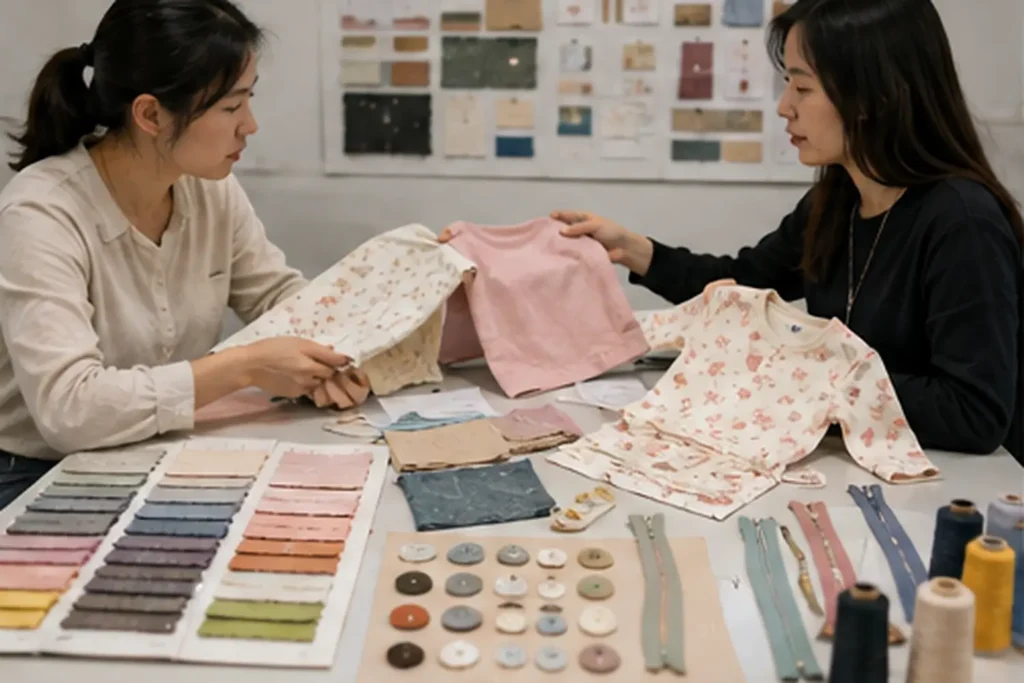
Reviewing fabrics, trims, and material specifications for children’s clothing.
Step 11: Inspect the Fabric Warehouse and Cutting Department
A factory tour becomes much more informative when you stop looking only at equipment and start looking at order control.
In the fabric warehouse, I check whether materials are identified and separated. In cutting, I look for spreading control, patterns or markers, shade management, and bundle identification.
Questions worth asking include:
- How do you prevent different shades from being mixed?
- How are cut bundles identified by style, color, and size?
- How do you handle directional prints or fabric nap?
- Who checks the first cut pieces?
A clean cutting table is nice. A traceable cutting system is more important.
Step 12: Evaluate the Sewing Floor for Process Control
Machine count is one of the easiest numbers to market and one of the least useful numbers by itself.
When I walk through a sewing floor, I look for whether people appear to know which standard they are producing against.
Useful signs include:
- Approved reference sample nearby
- Clear bundle separation
- Style identification
- Supervisors actively checking work
- In-line QC points
- Measurement or workmanship checks during production
If several unrelated orders are mixed together with no visible control system, I ask how the factory keeps components, sizes, and specifications separated.
Step 13: Ask for the QC Process in Plain English
When a supplier says, “We have strict QC,” my next question is: “Can you walk me through it?”
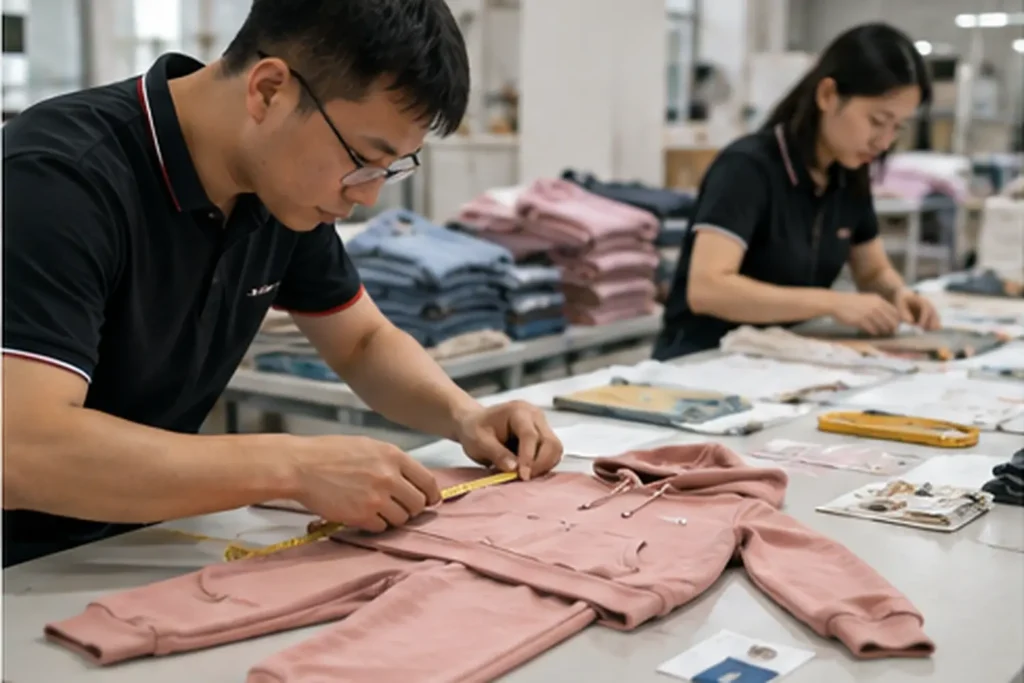
Quality-control inspection and measurement check on kidswear.
A useful answer should explain checkpoints such as:
Incoming inspection
Fabric, trims, color, defects, and relevant material characteristics are checked before cutting or assembly.
First-piece or pilot check
Initial production pieces are reviewed before the line continues at full speed.
In-line inspection
Workmanship and construction are checked while sewing is still underway, so problems can be corrected before they affect the entire lot.
Measurement inspection
Garments are compared against the approved specification and tolerances.
Final inspection
Finished products are checked for workmanship, measurements, appearance, labeling, and packaging.
Packing verification
Size ratios, carton quantities, barcodes/labels, and packing instructions are confirmed.
HAPA’s kids clothing manufacturing process provides a useful example of how QC can be integrated through manufacturing instead of treated as a last-minute activity.
Step 14: Ask to See a Real Inspection Record
This is a simple but powerful verification step.
Instead of asking only whether QC exists, request a sample inspection report with confidential buyer information removed if necessary.
I want to see whether the report records meaningful items such as:
- Style or order identification
- Sample size or inspected quantity
- Measurement findings
- Defect types
- Pass/fail conclusion
- Inspector/date
- Corrective actions when relevant
The document does not need to look beautiful. It needs to show that quality decisions are documented rather than improvised.
Step 15: Clarify the Inspection Standard and Your Right to Inspect
For bulk orders, agree in advance how inspection will work.
Ask whether the factory uses an AQL-based system, buyer-specific inspection criteria, or another documented standard. Then confirm whether you can arrange a third-party pre-shipment inspection.
A supplier accustomed to professional overseas buyers should not be surprised by that request.
The objective is not to make the relationship adversarial. Clear inspection criteria actually protect both sides because everybody knows how the finished lot will be evaluated.
Step 16: Verify Children’s Product Compliance Awareness
A factory does not need to memorize the laws of every destination country, but it should be able to work professionally with the requirements you provide.
For U.S. children’s products, CPSC rules can include third-party testing, certification, and tracking-label obligations depending on the product and applicable safety rules. CPSC’s official guidance explains that tracking information must allow relevant production details and source information to be identified for children’s products where the requirement applies.
I therefore ask the factory:
- Which markets do you regularly supply?
- Can you support third-party laboratory testing?
- Can you keep material and batch information traceable?
- Can labels be produced to our approved content and placement?
- Can you provide component information required for testing?
The important signal is not a salesperson saying “we have CPC.” A CPC is product-specific certification responsibility, not a permanent factory badge. I want the supplier to understand the workflow and support the responsible importer or brand correctly.
Step 17: Review Audits and Certifications Carefully
Factories may provide BSCI, SMETA, WRAP, ISO, GOTS, OEKO-TEX-related documents, test reports, or buyer-specific audit materials depending on their operation.
I verify each document in context.
Check:
- Company name
- Factory address
- Scope
- Issue date
- Validity period
- Certification or audit body
- Whether the document applies to the production site making your order
A common mistake is to treat every certificate as proof of everything.
A social-compliance audit does not prove garment measurements will be correct. A material certificate does not automatically prove the finished garment meets all market requirements. A quality-management certificate does not replace product-specific testing.
Use each document for the question it actually answers.
Step 18: Conduct a Live Video Tour When You Cannot Visit
If you cannot travel, a live video tour is one of the most practical ways to verify a kids clothing factory in China remotely.
I prefer live video to a polished factory film because I can ask the person holding the phone to move to specific areas.
During the call, I might ask:
- “Can you show the sample room now?”
- “What style is running on this sewing line?”
- “Can you show where measurements are checked?”
- “Where are finished garments waiting for packing?”
- “Can you show the fabric for my order when it arrives?”
The point is not to demand access to confidential client designs. A legitimate factory may have restrictions around filming other customers’ products. The point is to confirm that the facility, departments, and workflow broadly match what has been represented.
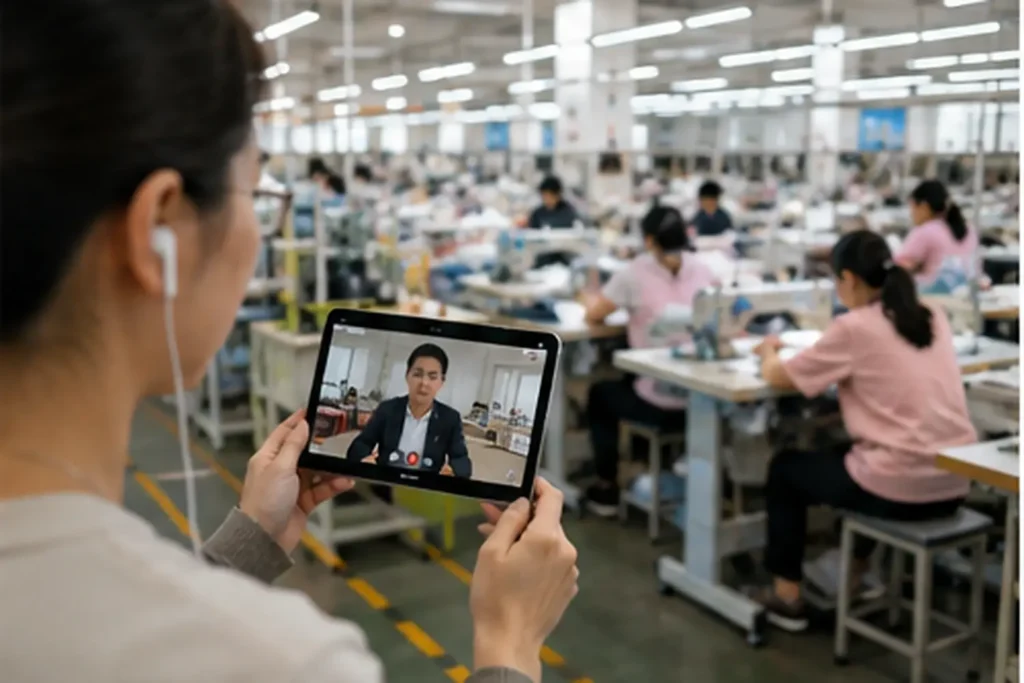
Live video factory tour during remote supplier verification.
Step 19: Use a Third-Party Audit When the Commercial Risk Justifies It
For a larger first order, retail program, or high-risk sourcing situation, I would consider paying for an independent factory audit.
A professional audit can verify matters such as:
- Factory existence
- Legal/business information
- Production areas and equipment
- Workforce and capacity indicators
- Quality systems
- Facility conditions
- Documentation
A third-party visit does not guarantee future performance, but it reduces the amount of verification that depends only on the supplier’s own statements.
Think of audit cost relative to the value of the order, not relative to the cost of one garment.
Step 20: Verify the Commercial Details Before the Deposit
Your technical verification can be excellent and you can still create unnecessary risk if the payment and order documents are vague.
Before paying a deposit, confirm:
- Beneficiary name
- Bank account and bank location
- Legal/company relationship to the supplier
- Product description
- Quantity
- Colors and sizes
- Unit price and total value
- Deposit and balance terms
- Sample/approval status
- Estimated lead time
- Incoterm or shipping arrangement
- Packaging requirements
If bank details suddenly change, verify the request through a second communication channel using a known contact. Do not rely only on the email containing the new bank information.
I also prefer the proforma invoice to be specific enough that you can later compare production against what was actually agreed.
Verification Does Not End After You Pay
To truly verify a kids clothing factory in China, treat the first production order as part of the verification process.
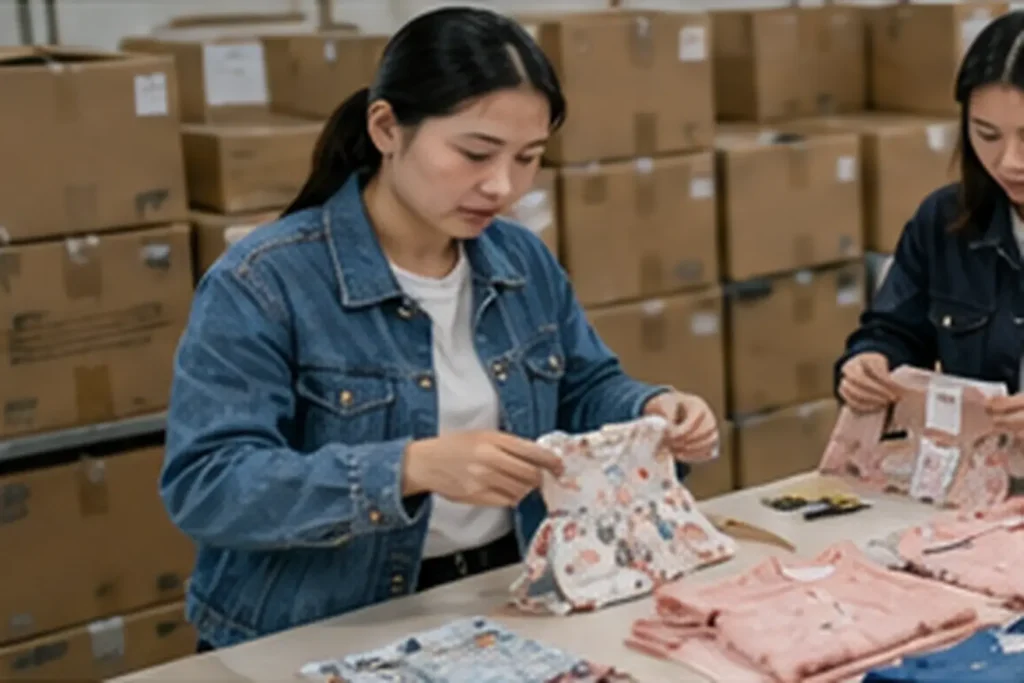
Pre-shipment inspection of finished children’s garments before packing.
Ask for milestone updates such as:
- Fabric arrival
- Bulk color approval
- Cutting
- First production pieces
- Sewing progress
- Finishing
- Packing
For a new supplier, arrange a pre-shipment inspection before the goods leave the factory whenever your commercial terms and order size justify it.
Your approved sample proves that the development team can make one garment. Bulk inspection helps establish whether the production system can reproduce that standard consistently.
How to Read Factory Capacity Claims
Capacity figures need context.
A supplier might state a monthly capacity of 100,000 or 500,000 garments, but that does not tell you how much capacity is available for your order, which lines produce your category, or how seasonal demand affects lead time.
I ask:
- Which line would produce my order?
- How many orders are already scheduled for that period?
- What is the realistic production window after material approval?
- Does the factory use subcontract sewing during peak season?
Capacity should be treated as an operational planning question, not a marketing number.
Factory vs. Trading Company: Which One Should You Choose?
I do not automatically choose the direct factory.
If a trading company is transparent, technically competent, and controls a good network of specialist factories, it may be the better partner for a multi-category program. The buyer benefit can be coordination, English communication, material sourcing, and consolidated QC.
A direct factory can be excellent when your products fit its specialization and you want closer production communication.
What I avoid is unclear responsibility.
You should know:
- Who signs the commercial agreement
- Who receives payment
- Who owns the production relationship
- Where the product is made
- Who approves subcontractors
- Who is responsible for QC and corrective action
Transparency matters more than the label “factory” or “trading company.”
Red Flags I Take Seriously
When I verify a kids clothing factory in China, one red flag rarely makes the decision by itself. A pattern of red flags does.
Production location stays vague
The supplier repeatedly avoids giving a clear factory address or showing the facility live.
Product claims are unrealistically broad
The same small factory claims to specialize equally in babywear, down jackets, denim, swimwear, formal dresses, seamless sportswear, leather, and every other category without explaining how production is divided.
Technical questions get only sales answers
You ask about fabric GSM, shrinkage, grading, tolerances, or trim testing and receive only “no problem, good quality.”
The sample and bulk plan appear disconnected
A development office can make the sample, but the supplier cannot explain where bulk production will happen.
Important facts keep changing
MOQ, lead time, legal company, payment beneficiary, factory address, or production location changes without a credible explanation.
The supplier pressures payment before specifications are settled
A factory should want the bulk standard to be clear before cutting begins.
Third-party inspection is discouraged without a good reason
There may be scheduling or confidentiality rules, but a blanket refusal deserves scrutiny.
What I Look for During an In-Person Factory Visit
A visit is valuable when your order size or sourcing program justifies the travel.
I do not judge the factory mainly by the building. Instead, I watch how information moves through production.
In the sample room
Are there active developments, patterns, measurements, and garments at different stages?
In the warehouse
Are materials organized and identifiable?
In cutting
Are bundles and shades controlled?
On the sewing floor
Are styles separated and reference standards available?
In QC
Are inspectors actually measuring and documenting garments?
In packing
Are sizes, labels, and carton quantities being checked systematically?
One of the most revealing moments is often not something a manager tells you. It is watching an inspector stop, measure a garment, compare it with a specification, and record the result. That tells you quality control is part of the daily workflow rather than a presentation prepared for visitors.
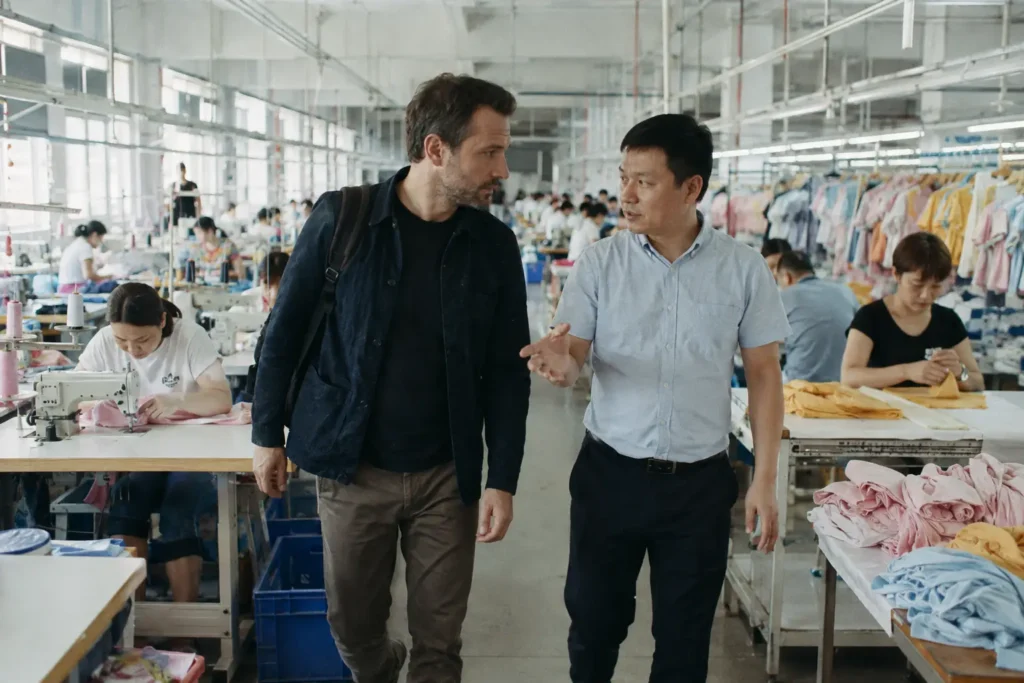
Buyer and factory supervisor reviewing production during an on-site walkthrough.
A Practical Factory Verification Scorecard
If you are comparing several suppliers, score each one using the same framework instead of relying on general impressions.
Business identity
- Legal registration verified
- Payment entity explained
- Factory address confirmed
Product fit
- Comparable kidswear shown
- Relevant construction experience demonstrated
- Sample quality acceptable
Technical development
- Pattern/grading capability clear
- Sample corrections controlled
- Materials specified properly
Production
- Cutting and sewing workflow visible
- Outsourced processes disclosed
- Capacity and lead time credible
Quality
- In-line and final QC explained
- Inspection records available
- Third-party inspection accepted
Compliance support
- Target-market experience relevant
- Testing cooperation clear
- Traceability/labeling support understood
A supplier does not need a perfect score in every category. The scorecard forces you to identify which weaknesses you are accepting and whether they matter for your order.
How We Think About Verification at HAPA
Because this article is published by HAPA, I think it is important to be transparent about our position.
We do not expect overseas buyers to trust a manufacturer simply because its website says it has experience. Buyers should verify us too.
Ask about our company and production site. Request relevant product examples. Review a sample. Ask how complicated techniques are managed. Discuss fabric sourcing, pattern development, grading, QC, packing, and production schedules. If your project involves embroidery, sequins, beadwork, layered construction, or other detailed workmanship, ask how those steps are controlled before bulk production.
From the manufacturer’s side, serious verification is usually helpful. The more clearly both parties understand the product, approval standard, responsibilities, and inspection plan, the fewer surprises appear during production.
Frequently Asked Questions
How can I verify a kids clothing factory in China remotely?
Start with the legal company name and business license, check the registration through China’s official enterprise information system, confirm the production address, conduct a live factory tour, request recent comparable products, and place a custom sample order. For higher-value orders, add an independent factory audit and pre-shipment inspection.
How do I check whether a Chinese clothing company is legally registered?
Ask for the legal Chinese company name and Unified Social Credit Code, then compare the information with the National Enterprise Credit Information Publicity System. Check registration status, address, business scope, establishment date, and other available company information.
How can I tell whether the supplier is a real factory?
Do not rely on the words “direct factory.” Ask where cutting and sewing happen, request a live tour of the production areas, check whether the supplier can explain its lines and QC system, and confirm who employs or manages the production team. If specialist processes are outsourced, ask how they are controlled.
Is a trading company always a worse choice than a factory?
No. A capable trading or sourcing company can be useful when it is transparent and technically competent. The key is knowing where the goods are made, who manages the factory, who controls quality, and who is contractually responsible for the order.
What documents should I ask a kidswear factory for?
At minimum, ask for the business license and any current audits or certificates relevant to your purchasing requirements. For the product itself, you may also need fabric/component documentation, test reports, inspection records, labeling information, and other compliance documents depending on the destination market.
Is a live video call enough to verify a factory?
For a small test order, a legal check, live tour, sample order, and pre-shipment inspection may provide a reasonable level of verification. For a large first order or retail program, an independent on-site audit usually gives you stronger evidence.
Should I order a sample before choosing the supplier?
Yes. A custom sample is one of the best technical checks available. It shows whether the factory can interpret your specification, source appropriate materials, make the garment accurately, and implement revision comments before you risk bulk inventory.
When should I arrange a pre-shipment inspection?
Arrange it before shipment and, where your agreed payment terms allow, before releasing the final balance. The inspection timing should be agreed with the factory early so the order can be sufficiently complete and packed for a representative check.
Final Thoughts
If you want to verify a kids clothing factory in China, avoid looking for one magic document that proves the supplier is safe.
Good factory verification comes from combining evidence.
The legal company should be verifiable. The production location should be clear. The sample team should demonstrate relevant technical ability. The materials should be defined. Cutting and sewing should be controlled. Quality checks should be documented. Compliance support should match your destination market. Payment information should make sense. And your own sample and inspection results should support what the supplier has told you.
I would also avoid expecting perfection. Every factory has limits. A specialist in detailed girlswear may not be the best factory for seamless sportswear. A high-volume basics factory may not want your small embellished order. A flexible smaller factory may need more lead time during peak season.
The goal is not to find a manufacturer with no weaknesses. The goal is to understand the supplier well enough that its strengths match your product and its weaknesses do not create unacceptable risk.
That changes the question from:
“Can I trust this factory?”
to:
“Do I have enough independent evidence to approve this factory for this specific product, quantity, market, and order?”
That is the mindset I recommend when you verify a kids clothing factory in China—and it is one of the most effective ways to reduce sourcing risk before your first bulk order begins.