Outerwear Comparison Guide
Coat vs Jacket at a Glance
In the coat vs jacket comparison, length is the clearest usual difference. A coat typically extends below the hips and offers more coverage, while a jacket is generally shorter and easier to move in. That distinction is useful, but it is not a strict technical rule. A well-insulated jacket can be warmer than a lightly constructed coat. To choose well, you need to look beyond the product name and compare coverage, materials, insulation, fit, weather protection, and intended use.
Length
Coats usually extend below the hips. Jackets often finish near the waist or hips.
Warmth
Coverage matters, but insulation, shell construction, closures, fit, and layers decide performance.
Movement
Jackets usually support easier movement, driving, active use, and compact layering.
Best Choice
Match the garment to climate, activity, coverage, care, and verified specifications.
What Is the Difference Between a Coat and a Jacket?
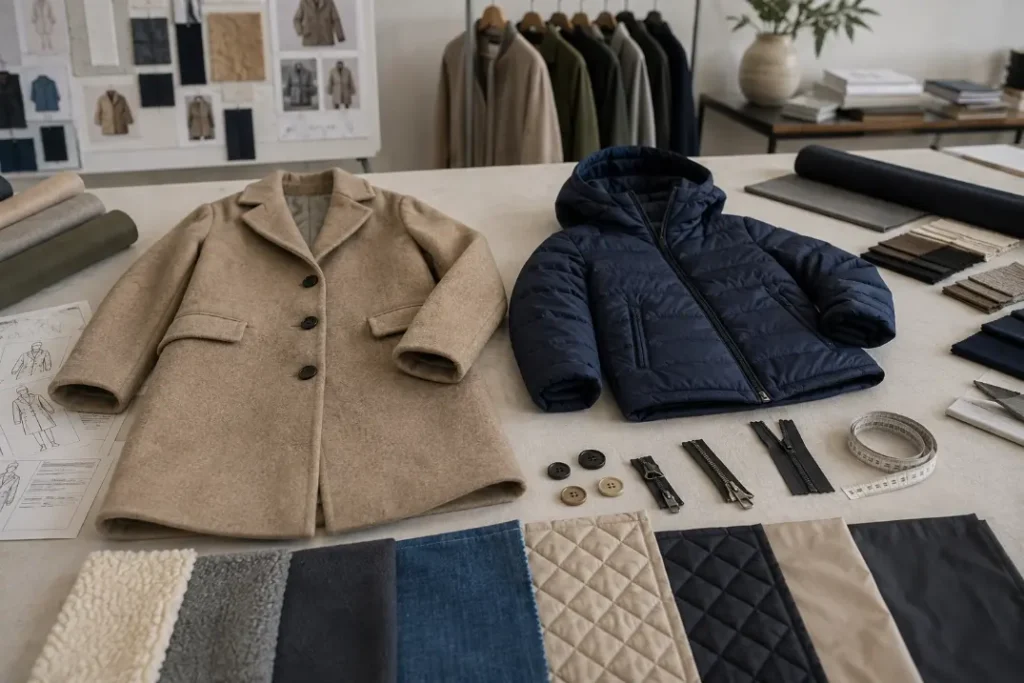
A coat is usually longer, roomier, and designed to cover more of the body. A jacket is usually shorter, closer to the body, and suited to movement or flexible layering. These are conventions, not fixed standards.
That flexibility appears in dictionary definitions too. Merriam-Webster defines a coat as an outer garment that varies in length and style according to fashion and use. Its definition of a jacket focuses on an upper-body garment, often with a front opening, collar, sleeves, and pockets. Neither definition creates a precise hemline where a jacket suddenly becomes a coat.
The following comparison is a useful starting point:
| Feature | Coat | Jacket |
|---|---|---|
| Typical length | Usually extends below the hips | Usually ends near the waist or hips |
| Coverage | Covers more of the torso and sometimes the legs | Focuses on the upper body |
| Typical weight | Often heavier | Often lighter |
| Mobility | Can feel more restrictive because of length or volume | Usually allows easier movement |
| Layering | Often designed to go over several layers | Can work as a light outer layer or part of a layered system |
| Typical style | Common in formal and cold-weather dressing | Common in casual, workwear, sport, and transitional dressing |
| Examples | Overcoat, trench coat, long wool coat | Bomber jacket, denim jacket, windbreaker |
Treat the table as a set of tendencies. A short wool coat may resemble a long jacket. A thigh-length technical jacket may provide more protection than a thin fashion coat. Product names are influenced by tradition, brand language, market expectations, and styling as much as construction.
For everyday shopping, that ambiguity is rarely a serious problem. For product development, however, it matters. A designer and a factory can imagine different garments from the same word. Measurable specifications are more reliable than the category name.
Which Garments Count as Coats, and Which as Jackets?

Most outerwear names describe construction or silhouette, not category. Puffer, quilted, fleece, denim and softshell describe how a garment is built. Parka, trench and anorak describe a shape. Length decides the rest.
The garments almost everyone agrees are jackets
These sit at or above the hip, layer under something else when it gets cold, and are built lighter by default:
- Bomber — ribbed hem and cuffs, blouson body, zip front
- Denim jacket — trucker-style, structured, rarely insulated
- Windbreaker — lightweight shell, packable, often unlined
- Fleece jacket — mid-layer by design, sometimes worn alone in mild weather
- Track jacket — sport-derived, knit or woven, stand collar
- Harrington — short, elasticated hem, light lining
- Softshell — stretch woven with a bonded backer, weather-resistant rather than waterproof
If you want style-level detail, our guide to what actually defines a bomber jacket goes deep on one of them rather than skimming all seven.
The garments almost everyone agrees are coats
- Trench — belted, mid-calf, traditionally cotton gabardine
- Overcoat — tailored, wool or wool-blend, knee-length
- Peacoat — double-breasted, heavy melton, hip-to-thigh length
- Duffle — toggle closure, hooded, thigh-length
- Parka — long, hooded, insulated, technical shell
The ambiguous ones: puffer, quilted, anorak, raincoat, gilet
This is where the searches actually live, and the answer is the same each time: the name describes the build, and length decides the category.
How Do Length and Coverage Separate Coats from Jackets?
Length is the fastest visual clue because it changes both appearance and coverage. Jackets commonly finish around the waist or hip, while coats more often extend below the hips. The boundary becomes less clear with longline jackets, cropped coats, car coats, and padded outerwear.
Where Does a Jacket Usually End?
Many classic jackets finish at the waist or around the hips. Bomber jackets often use a fitted waistband, denim jackets commonly sit near the hip, and cropped fashion jackets may end even higher. This shorter proportion makes it easier to sit, drive, cycle, bend, or move quickly.
Short length does not mean simple construction. A technical jacket can include a weather-resistant shell, taped seams, an insulated body, ventilation, adjustable cuffs, and a protective hood. A work jacket may use substantial canvas, reinforced seams, and heavy hardware. These garments still read as jackets because of their proportion and intended movement.
Longline jackets complicate the rule. Some extend to the upper thigh but retain the closer fit, lighter structure, or sporty details associated with jackets. In those cases, the brand may choose the term that best matches the collection and customer expectation.
Where Does a Coat Usually End?
Coats commonly continue below the hip to the thigh, knee, calf, or ankle. The extra length can protect more of the body from wind, light precipitation, and cold air. It also creates the longer vertical silhouette associated with overcoats, trench coats, duffle coats, and formal wool coats.
Length alone does not prove warmth. An unlined trench coat can be long but relatively light. A short down jacket may retain more heat around the torso. The coat offers more coverage, while the jacket may provide more insulation per area. Those are different benefits.
When a garment sits near the boundary, describe what can be measured. Back length, hem position, fit, shell fabric, lining, insulation, and intended use tell a buyer or manufacturer more than the words short coat or long jacket.
Is a Coat Warmer Than a Jacket?
A coat often protects more of the body, but it is not automatically warmer than a jacket. Warmth is the result of the whole clothing system, including coverage, trapped air, protection from wind and moisture, fit, and the layers worn underneath.
The same principle appears in cold-weather guidance from the National Institute for Occupational Safety and Health. NIOSH recommends several loose layers for insulation, protection from wind, and waterproof options where wet conditions are a concern. Its guidance is written for occupational cold exposure, not fashion shopping, but it illustrates why one product label cannot determine thermal performance.
What Actually Creates Warmth?
When comparing a winter coat with a jacket, look at these construction variables:
- Coverage: A longer hem protects more of the hips and legs. A high collar or hood reduces exposed areas around the neck and head.
- Insulation: Down, synthetic fill, fleece, pile, and other structures trap air differently. Type, distribution, and amount all matter.
- Shell construction: A wind-resistant shell can reduce heat loss in moving air, while ventilation may improve comfort during activity.
- Closures: Storm flaps, zippers, covered buttons, cuffs, and adjustable hems can reduce openings where cold air enters.
- Fit: The garment needs room for intended layers without excessive gaps. Very tight clothing can restrict movement and layering.
- Moisture management: Wet clothing can become uncomfortable and lose useful insulating performance. Layering and shell choices should match the activity.
These factors explain why warmth, wind resistance, water resistance, and waterproofness are not synonyms. A warm wool coat may not suit prolonged rain, while a waterproof shell may contain little insulation. Start by identifying the protection you actually need.
When Can a Jacket Be Warmer?
An insulated puffer jacket can be warmer than an unlined trench coat, even though the trench is longer. A technical jacket with a protective shell, insulated body, close cuffs, and a well-fitted hood may outperform a loose fashion coat in windy weather. Conversely, a long insulated coat can combine strong torso insulation with greater lower-body coverage.
There is no universal temperature rating for all coats or jackets. Performance depends on the garment, the wearer, wind, moisture, activity level, and underlying layers. Be cautious when a product description gives a precise comfort temperature without explaining the test method or conditions.
What Materials Are Common in Coats and Jackets?
Coats and jackets can use many of the same fibers. The difference often lies in fabric weight, construction, finish, lining, fill, and design. A fiber name on a care label is useful, but it does not describe the complete garment.
Common Materials for Coats
Traditional tailored coats often use wool or wool blends because dense woven wool fabrics can provide structure, drape, and insulation. Cotton gabardine and twill are common in trench-inspired and utility coats. Some raincoats use coated or laminated fabrics intended to resist water, while padded winter coats combine a woven shell with down or synthetic insulation.
The shell is only one component. A coat may include a smooth lining for easier dressing, interlining for structure, insulation for warmth, and reinforced areas around pockets or closures. Two coats with the same fiber content can feel and perform very differently if their fabric weights and internal structures are different.
Leather, faux leather, fleece, shearling, and pile fabrics also appear in coat designs. Their suitability depends on the target appearance, climate, care expectations, price position, and sourcing requirements. Avoid treating any material as automatically premium or sustainable without evidence about its source and production.
Common Materials for Jackets
Jackets cover an especially wide material range. Denim and cotton twill work well for casual and workwear styles. Leather is associated with biker, flight, and fashion jackets. Nylon and polyester are common in windbreakers, padded jackets, linings, and technical shells. Fleece may serve as the main body fabric or as an insulating layer.
Polyester is a good example of why fiber content alone is not enough. It can be made into lightweight lining, brushed fleece, smooth woven shell fabric, quilted insulation, or a dense fashion textile. If you need a closer look at how the fiber is produced and where it is used, HAPA’s complete guide to polyester fabric provides the material background.
Blends are also common. A brand may combine fibers to balance appearance, strength, stretch, care, cost, or hand feel. What matters is whether the finished construction supports the product brief.
Why the Fabric Name Is Not Enough
A useful outerwear specification separates the shell, lining, fill, and trims. It should also describe fabric weight, construction, finish, color, and intended performance. Simply writing 100% polyester or wool blend leaves too many decisions unresolved.
Be equally careful with weather claims. A synthetic shell is not automatically waterproof. Resistance to liquid depends on the fabric, coating or membrane, seams, closures, and garment design. If a brand intends to advertise a performance benefit, it should define the claim, select a relevant test method, and keep evidence that supports the finished product.
Care is part of performance too. The U.S. Federal Trade Commission’s apparel guidance explains that most textile and wool products sold in the United States require information such as fiber content, country of origin, and the responsible business identity. The FTC Care Labeling Rule also addresses cleaning instructions. Brands selling in other markets need to check the rules that apply there.
When Should You Choose a Coat or a Jacket?
Choose according to the situation, not according to an assumption that one category is better. A coat is often the stronger starting point for extended coverage, low-activity cold-weather use, or a formal silhouette. A jacket often works better when movement, compact layering, transitional weather, or packability matters.
| Use case | Better starting point | Why | What to verify |
|---|---|---|---|
| Cold daily commute | Coat | More body coverage while standing or walking | Insulation, wind protection, closures, and layering room |
| Formal occasion | Coat | A longer, structured silhouette works over tailored clothing | Drape, shoulder fit, fabric, and garment length |
| Active outdoor use | Jacket | Shorter length can support easier movement | Breathability, shell protection, hood, cuffs, and mobility |
| Mild or changing weather | Jacket | Easier to layer, carry, or remove | Weight, ventilation, and packability |
| Travel with limited luggage | Jacket | Often more compact and versatile | Wrinkle recovery, care, and outfit compatibility |
| Children’s everyday play | Jacket | Shorter proportions can support movement | Fit, durability, closures, visibility, and applicable safety requirements |
The table offers starting points, not final answers. A long lightweight coat may be ideal for rain in a mild climate. A compact insulated jacket may be better for a cold trip that involves frequent movement. A commuter who wears tailored clothing may prefer a coat because it covers the jacket underneath, while someone driving most of the day may find a shorter outer layer more comfortable.
Occasion matters as well. Coats are often associated with formal or polished dressing, but there are casual parkas and padded coats. Jackets often feel sportier or more relaxed, but blazers and tailored jackets can be highly formal. The product’s cut, fabric, color, hardware, and styling determine the overall impression.
How Do You Choose the Right Outerwear?
The simplest method is to define the job first, then assess the garment. Do not begin with the assumption that you need a coat because it is winter or a jacket because you want versatility. Start with actual conditions and behavior.
- Define the climate. Consider typical temperature, wind, rain or snow, humidity, and the amount of time spent outdoors. Avoid planning around an unusual extreme if the garment is meant for everyday use.
- Define the activity. Walking slowly, waiting for transport, cycling, driving, and active play create different movement and heat-management needs.
- Choose the coverage. Decide whether waist, hip, thigh, knee, or lower-leg coverage fits the use case. Longer is useful only when it supports the wearer’s movement and routine.
- Inspect the complete construction. Compare shell, insulation, lining, hood, collar, cuffs, closures, pockets, seams, and hem adjustment. Do not rely on the marketing name.
- Check fit with intended layers. Try the garment over the clothing that will normally sit underneath it. Raise the arms, sit, bend, and close the front fully.
- Confirm care and evidence. Read the fiber and care labels, check the size chart, and look for specific support behind water, wind, thermal, or durability claims.
Fit deserves particular attention. A winter outer layer needs appropriate ease, but automatically sizing up can create long sleeves, dropped shoulders, excessive gaps, or snag risks. Use garment measurements and the brand’s size guidance. For product development, specify the base-layer or mid-layer combination used during the fitting process.
Care requirements should match the wearer’s routine. A formal coat that requires specialist cleaning may be reasonable for occasional use. A children’s everyday jacket or work jacket may need easier cleaning, stronger colorfastness, and components that tolerate repeated wear. Durability is not one property. It includes fabric abrasion, seam strength, closure performance, dimensional stability, pilling, color change, and appearance after cleaning.
The final decision can be summarized as a short sequence: climate, activity, coverage, construction, fit, and verified performance. If those six points align, the garment name becomes much less important.
Decision path: Climate → Activity → Coverage → Construction → Fit → Verified Performance
Does a Coat Cost More to Produce Than a Jacket?

Usually yes — and the gap comes from materials and labour minutes, not from the word on the label. A long insulated coat and a hip-length shell can share a fabric, a factory and a design language, and still land far apart on cost.
Where the cost difference actually sits
| Cost element | Jacket | Coat | What drives the gap |
|---|---|---|---|
| Shell fabric | Lower consumption | Higher | Longer body and often longer sleeves; more panels to cut |
| Lining | Partial or none | Usually full | Bagged-out linings add both fabric and sewing operations |
| Insulation | Light or absent | Usually present | Fill weight, and whether sleeves and hood are filled too |
| Hardware | Lighter zips and snaps | Heavier zips, storm flaps, toggles | Component cost plus attachment time |
| Sewing operations | Fewer | More | Panel count, quilting lines, collar and hood construction |
| Sampling | Fewer rounds | More | Insulated bodies need both fit and volume approved |
| Packing and freight | Lower volume | Higher | Bulk drives cartons per unit and freight cost per piece |
The two largest levers are fabric consumption and sewing minutes, and they compound rather than add. A longer body needs more shell and more lining. More panels mean more seams. Quilting through insulation adds passes a plain shell never needs.
So a coat is rarely “a bit more garment.” It is meaningfully more fabric on top of meaningfully more operations — which is why the cost gap usually surprises people the first time they see it costed properly.
Conclusion
The coat vs jacket distinction is useful, but it is not absolute. Coats are typically longer and offer more coverage. Jackets are usually shorter and support easier movement. Warmth, weather protection, comfort, and quality depend on the complete garment, including its shell, insulation, lining, closures, fit, and intended layers.
Choose the right outerwear by defining climate, activity, coverage, construction, fit, and care. For a clothing brand, translate those decisions into a detailed Tech Pack and test the complete sample before approving production.
FAQs About Coats vs Jackets
What is the main difference between a coat and a jacket?
Length and warmth. A jacket usually ends around the hip and is built for layering; a coat is longer, heavier and built as the outermost layer. No official standard sets the boundary — it is convention, not classification.
At what length does a jacket become a coat?
There is no fixed measurement. In practice, garments finishing at or above the hip read as jackets, and mid-thigh or longer reads as a coat. For production, specify the length in centimetres from the high point shoulder instead.
Is a puffer a coat or a jacket?
Either. “Puffer” describes the construction, not the category. A hip-length puffer is a jacket; a mid-thigh or knee-length puffer is a coat. The same logic applies to quilted, down and fleece garments.
Are children’s coats and jackets subject to different safety rules than adult outerwear?
Yes, in several markets. The US treats certain drawstrings in children’s upper outerwear as a substantial product hazard, and Europe applies EN 14682 to cords and drawstrings. Requirements vary by market and change — confirm current rules with the regulator or a recognised testing laboratory.
Does a coat cost more to manufacture than a jacket?
Usually. Coats use more shell fabric and lining, often more insulation and more panels, and heavier construction takes more minutes on the line. The gap comes from materials and labour, not from the category name.
Should my kidswear range include coats, jackets, or both?
Most ranges need both, weighted to climate and price point. Jackets carry broader seasonal appeal and lower unit cost; coats carry higher margin and shorter selling windows. Decide the ratio before sampling, because it sets your fabric minimums.