The thickest, most expensive, or largest coat is not automatically the best winter coat for a child. If you want to know how to choose a kids’ winter coat, start with the weather and the child’s routine.
Then examine the insulation, outer shell, fit, movement, and safety details as one system. This guide gives you practical checks for school days, snow play, car travel, and changing winter conditions without relying on vague temperature promises.
How to Choose a Kids’ Winter Coat for Warmth, Fit, and Safety
Choose a coat for the conditions the child will face. Do not rely on a product name or a single warmth claim. Match the protection to wind, moisture, activity, and time outside.
Then try it over normal winter layers and check movement, coverage, hardware, drawstrings, and compatibility with daily travel.
Use this six-step sequence:
- Note the usual cold, wind, rain, wet snow, and time outdoors.
- Allow for activity. Snow play produces more body heat than waiting for a school bus.
- Decide whether one insulated coat or a shell with separate layers fits the routine.
- Fit the coat over the base and middle layers the child will wear.
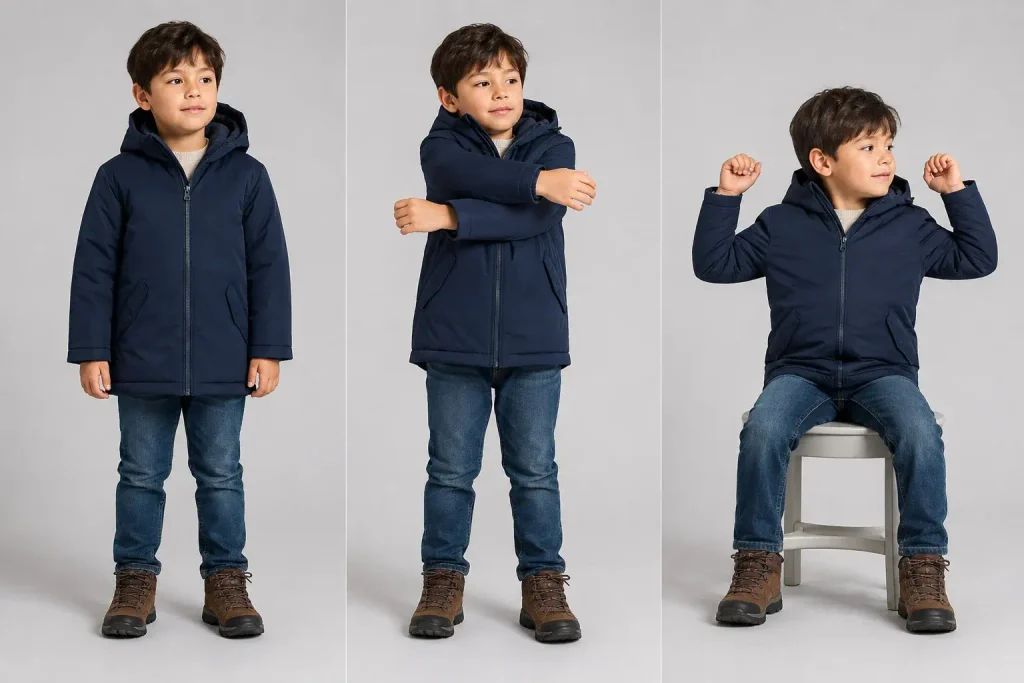
- Zip it, hug, reach, sit, and turn the head to test movement and coverage.
- Inspect drawstrings, loose trims, hood vision, and the family’s car-seat routine.
Which Kids’ Winter Coat Is Best for Your Climate and Activity?
Air temperature alone misses how wind, moisture, activity, and exposure time affect comfort.
| Conditions and routine | What to prioritize | Why |
|---|---|---|
| Cold, dry, low activity | Reliable insulation, neck and cuff coverage | Standing or waiting creates little body heat |
| Cold, wet, active play | Moisture protection, secure closures, manageable insulation | Wet clothing and trapped sweat reduce comfort |
| Mild, wet weather | Protective shell with adjustable layers | Heavy insulation can cause overheating |
| Changing weather or travel | Removable or separate layers | The child can adjust between outdoors, cars, and heated rooms |
Cold and Dry vs. Cold and Wet
In dry cold, prioritize insulation and wind protection. In rain, sleet, or melting snow, also inspect the shell, seams, hood, cuffs, and closures. Warm filling cannot compensate for water entering at the openings.
School Days, Snow Play, or Winter Travel?
A school coat needs easy closures and comfortable sitting. Snow play demands better moisture control and coverage. Frequent car trips make bulk less practical because the coat must work around safe harness use.
When One Coat Is Not Enough
A lighter school coat plus separate snow gear can work better than one bulky garment expected to handle short car trips, wet play, and long outdoor days.
What Makes a Kids’ Winter Coat Warm and Weather-Ready?
Warmth depends on insulation, weather protection, and fit. Assess the complete garment, not only its fill material.
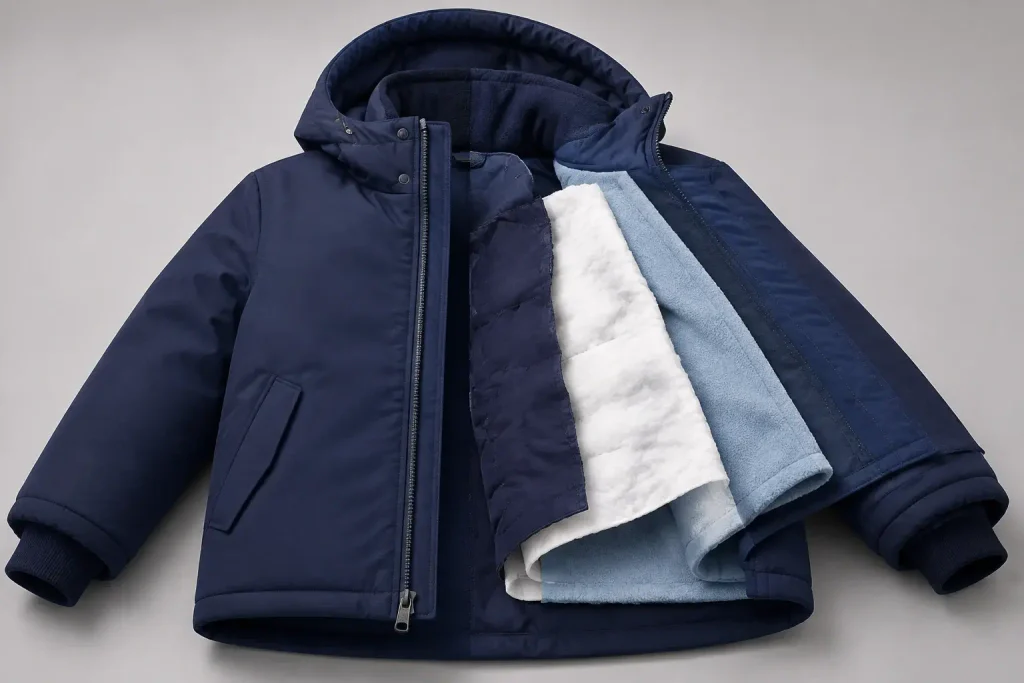
Down, Synthetic Insulation, and Layered Systems
Down offers high warmth for its weight but needs careful moisture management. Synthetic insulation is less compressible but usually dries faster and insulates better when damp.
These differences help narrow the choice, but the finished coat still needs to be assessed. See this comparison of down and synthetic insulation.
Fill power measures down’s loft, not finished-coat warmth. Fill quantity, distribution, baffles, shell fabric, length, and compression also affect performance.
Shells, Seams, Closures, and Wind Protection
A durable water repellent finish, or DWR, helps water bead on the face fabric. It does not make the whole coat waterproof. If the coat has a nylon (polyamide) shell, check its coating or membrane and seams rather than assuming the fiber itself keeps rain out.
Check the membrane or coating, seams, zippers, openings, test method, and condition after wear. How waterproof rainwear works explains the difference between fabric and garment performance.
Check whether the front zipper has protective coverage, cuffs close around gloves, the collar seals comfortably, and the hem stays in place during movement.
Why Thickness and Temperature Labels Can Mislead
A thick coat can still leak wind, fit poorly, or trap sweat. Treat a temperature label as product-specific guidance. Without its test, layers, activity, wind, and humidity, it is not a child safety threshold.
| Label or feature | What it can tell you | What it cannot prove alone |
|---|---|---|
| Fill power | Loft quality of down | Finished-coat warmth |
| Fabric waterproof rating | Fabric performance in a stated test | Waterproofness of seams and openings |
| DWR finish | Face fabric sheds water when maintained | A fully waterproof garment |
| Temperature claim | Brand guidance under stated conditions | Comfort or safety for every child |
Which Type of Winter Coat Is Best for Kids?
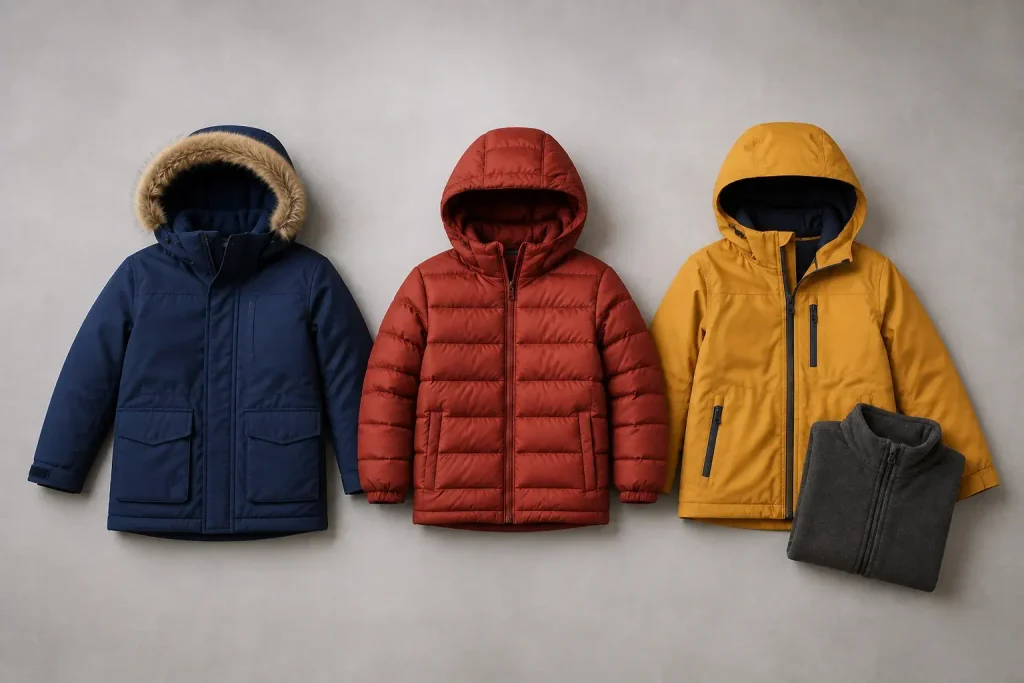
Names describe a design family, not verified performance. HAPA’s guide to types of coats gives a broader category overview, while its coat and jacket comparison explains how coverage and mobility differ.
| Coat type | Useful for | Check before buying |
|---|---|---|
| Parka or puffer | Everyday cold and greater insulation or coverage | Shell protection, bulk, length, and actual fill details |
| 3-in-1 or shell system | Variable weather and adjustable layering | Whether each layer fits and works well alone |
| One-piece snowsuit | Broad coverage during play | Mobility, diaper access, and overheating indoors |
| Jacket with snow pants | Flexible sizing and easier toilet access | Overlap at the waist during reaching and sitting |
Choose by routine. One-piece suits simplify coverage but can complicate bathroom breaks. Separates offer flexibility, yet poor waist overlap can expose the lower back.
How Should a Kids’ Winter Coat Fit?
A kids’ winter coat should fit over normal layers without pulling at the shoulders, lifting at the waist, or covering the hands. The right size keeps the hood, cuffs, closures, and visibility details correctly positioned while leaving enough room to reach, sit, and play.
Measure the Child, Then Read the Brand’s Size Chart
Measure current height, chest, and arm length, then use the specific brand’s chart. Age labels are only a starting point, and size 6 can fit differently across brands. This children’s clothing size chart guide explains the measurements, not a universal sizing system. For a closer look at girls’ measurements and fit, use our girls' clothing size chart.
Leave Layering Room Without Buying Two Seasons Ahead
Try the coat over planned winter layers. It should move without deep folds, a gaping neckline, or sleeves covering the hands. Excess size creates drafts, reduces dexterity, shifts the hood, and complicates closures.
Run five practical checks:
- Close the coat fully. The zipper should not pull across the chest.
- Cross both arms and feel for tightness through the shoulders and upper back.
- Raise both hands and watch whether the wrists or lower torso become exposed.
- Sit or squat to find hem ride-up and restriction around the waist.
- Look left and right to confirm that the hood preserves peripheral vision.
| Fit result | What you may see |
|---|---|
| Too small | Compressed layers, strained zipper, exposed wrists, restricted shoulders |
| Functional fit | Full movement, stable coverage, workable closures, room for planned layers |
| Too large | Dropped shoulders, hidden hands, shifting hood, large neck or hem gaps |
These checks are practical fitting tools, not certified safety tests.
What Kids’ Winter Coat Safety Features Matter Most?
Safety starts with the parts that can snag, obstruct vision, detach, or interfere with a child-restraint harness. Check drawstrings, hood shape, zipper guards, loose trims, and the family’s car-seat routine. Reflective details may aid visibility, but they don’t guarantee it.
Bulky Coats and Car-Seat Harnesses
Heavy or puffy coats can create excess space when padding compresses under a car-seat harness. The U.S. National Highway Traffic Safety Administration recommends thin layers under a snug harness, then a blanket or coat around the buckled child.
The American Academy of Pediatrics also warns against bulky material between child and harness. Follow the seat manufacturer’s instructions and local law.
Hood and Neck Drawstrings
Loose cords can snag on equipment or vehicle doors. For the U.S. market, CPSC guidance identifies hood and neck drawstrings in sizes 2T to 12 as a substantial product hazard and sets conditions for waist and bottom drawstrings in sizes 2T to 16.
Health Canada’s assessment covers accessible, non-retracting hood and neck drawstrings in newborn to size 12 outerwear and waist or bottom drawstrings in sizes 2T to 16. Always check rules for the sales market, size range, and design.
Visibility, Hoods, Zippers, and Loose Trims
Reflective details can aid visibility but do not guarantee safety. Check side vision, the zipper guard, child-operated closures, buttons, pulls, decorative pieces, cords, and damaged seams.
Reject or repair a coat if you find:
- Exposed or trailing cords near the hood, neck, waist, or hem
- A hood that turns poorly with the child’s head
- Loose small trims or a broken zipper pull
- Sharp hardware, rough edges, or a failed chin guard
- A closure the child cannot release when needed
How Do You Choose a Durable, Easy-Care Kids’ Winter Coat?
Durability is easier to judge when you inspect the places that fail first. Before buying, check:
- Cuffs for fraying and closures that no longer grip
- Elbows and shoulders for thinning, abrasion, or torn fabric
- Main seams for skipped stitches, open areas, or puckering
- The main zipper for smooth operation under light tension
- Pocket openings and snaps for reinforcement
- Insulation for flat areas, migration, or persistent clumps
- The care label for realistic washing and drying needs
- The seller’s return terms and the relevant market’s recall database
For a used coat or hand-me-down, inspect it after cleaning. Water-repellent finishes wear and insulation shifts. U.S. buyers can search the CPSC recall database.
What Kids’ Winter Coat Buying Mistakes Should You Avoid?
Most poor purchases trace back to one shortcut: choosing by age label, thickness, style name, or a temperature claim without checking the whole garment. Use these mistakes as a final screen before buying.
- Buying only for thickness ignores activity, moisture, the shell, and openings where wind or water can enter.
- Sizing far ahead is poor value if the sleeves, shoulders, or hood interfere with movement now.
- “Parka” and “puffer” describe styles. They do not establish tested warmth or waterproof performance.
- Water-resistant and waterproof are different claims. Read the fabric, seam, and construction details.
- Trying on over a T-shirt hides problems that appear with the base and middle layers used on cold days.
- Ignoring car travel leaves no practical plan for warmth and correct harness fit.
- Difficult hardware becomes a daily problem. Let the child try the zipper, snaps, hood, and pockets without help.
How Should Kidswear Brands Specify a Children’s Winter Coat?
For a brand or retail buyer, parent needs must become measurable requirements. “Warm,” “safe,” and “waterproof” are too broad for a tech pack.
| Parent need | Tech pack requirement | Sample-stage check |
|---|---|---|
| Warmth in wet play | Named insulation, distribution, shell construction, intended layers | Inspect fill consistency, openings, and performance evidence |
| Movement over layers | Garment measurements, ease, sleeve and hood dimensions | Run motion checks across relevant sizes |
| Lower snag risk | Cord and trim construction by market and size | Inspect accessible cords, attachments, and production consistency |
| Easy daily use | Closure size, pull design, cuff and pocket details | Ask intended users to operate the sample |
| Supportable claims | Named test method and acceptance criteria | Match reports to the final material and construction |
Review a size set, record fitting layers, inspect trims after care testing, and confirm rules for each market and age group.
Brands preparing a brief can review HAPA’s custom kids’ jacket manufacturing and children’s clothing OEM support pages. The available support includes specification review, materials, fit development, and sampling. Warmth, waterproofing, and compliance claims still need evidence tied to the final product.
Kids’ Winter Coat Buying Checklist: What Should You Check?
Bring the planned winter layers and use this final check in the shop or during the return period:
- Weather, wetness, activity, and time outside match the coat
- Insulation and shell details are explained, not implied by style
- Zipped fit allows hugging, reaching, sitting, and head turning
- Cuffs, collar, hood, and hem maintain useful coverage
- Drawstrings, trims, zippers, and small parts pass inspection
- The car-seat plan keeps bulky padding outside a snug harness
- Care instructions fit the household’s routine
- Product condition, return terms, and recall status are acceptable
If timing is flexible, use this separate winter coat buying calendar to plan when to shop. Price matters only after the coat passes the use, fit, and safety checks.
Frequently Asked Questions About Kids’ Winter Coats
Should a Child’s Winter Coat Be One Size Bigger?
Not automatically. Measure the child, use the brand’s chart, and test real winter layers. Choose the size that gives full movement and stable coverage now. A larger size works only if sleeves, hood, neckline, and closures remain correctly positioned.
Is Down or Synthetic Insulation Better for Kids?
Down suits cold, dry conditions when low weight matters. Synthetic insulation is often easier in damp conditions and dries faster. Compare fill quantity and distribution, shell, seams, fit, care, and activity. Neither wins every use case.
Can a Child Wear a Puffer Coat in a Car Seat?
A bulky puffer can interfere with harness fit when its insulation compresses. Use thin layers under the harness and add a coat or blanket over secured straps, following the seat manufacturer’s instructions. Assess the actual garment, not its name.
How Can You Tell Whether a Kids’ Coat Is Waterproof?
Read the exact claim and check the test method, fabric, seams, zippers, cuffs, hood, and hem. DWR alone does not prove a coat is waterproof. Care matters because dirt, abrasion, and washing change water-shedding performance.
Is One Winter Coat Enough for School and Snow Play?
Yes, if it matches the moisture, activity, exposure time, and fit needs of both settings. Separate layers or a daily coat plus snow gear offer more control when school travel is brief but snow play is long or wet.