
Outerwear Style Guide
15 Types of Coats Explained: Styles, Features, and When to Wear Them
Coat names often come from a garment’s silhouette, function, material, or surface texture, so the categories can overlap. This guide explains 15 widely recognized types of coats using consistent criteria: shape, construction, suitable conditions, occasions, and points to verify. You will learn how to identify each style and choose a practical starting point without assuming that a familiar name guarantees warmth, rain protection, fit, or quality.
15 Coat Styles
Compare tailored classics, weather-ready outerwear, and fashion-led silhouettes.
3 Classification Lenses
Read each coat by silhouette, function, and material or surface.
Choose by Use
Match climate, activity, coverage, layers, occasion, and care.
Verify the Garment
Check shell, lining, insulation, seams, closures, fit, and evidence.
What Counts as a Coat?
Merriam-Webster defines a coat broadly as an outer garment for the upper body that varies in length and style according to fashion and use. In everyday clothing, a coat is usually worn over other garments for warmth, protection, or appearance. It often extends below the hip and leaves room for layers, but neither feature creates a universal boundary.
A coat may be light or insulated, structured or relaxed, and intended for rain, cold, formal clothing, or visual impact. Fashion terminology follows convention rather than a fixed hemline. A short puffer may be marketed as a jacket, while a longer version with similar quilting may be called a coat. Length helps, but construction and intended use matter more.
For a closer look at this boundary, read about the difference between a coat and a jacket. In this guide, use each coat name as an identification clue, then check length, fit, shell, lining, insulation, closures, and purpose.
How Are Different Types of Coats Classified?
Different types of coats are easiest to understand through three lenses: silhouette, function, and material or surface. These are practical ways to read outerwear, not mutually exclusive technical classes. One garment may fit several descriptions at once.
Classification by Silhouette
Silhouette describes the visible shape. Look at hem position, body volume, shoulder line, collar or lapels, front closure, and whether the waist is straight, belted, wrapped, or curved. These details distinguish a fitted trench from a loose cocoon coat or a compact double-breasted peacoat. Shape also affects movement and layering room.
Classification by Function
Some names point mainly to the garment’s job. A raincoat is associated with wet conditions, while a parka suggests greater coverage and a hood. An overcoat commonly sits over other clothing. The name still does not prove performance. Water resistance, warmth, and wind protection depend on materials, seams, closures, insulation, fit, and test evidence.
Classification by Material or Surface
Other labels describe composition or appearance. Shearling refers to tanned sheep or lamb skin with the wool left on, while teddy usually describes a soft, curly, pile-like surface. A wool coat and a faux fur coat are also material-led names rather than fixed patterns. Separate fiber content, fabric construction, finish, and garment design when judging care or performance.
15 Types of Coats Explained
Coat names are useful shortcuts, but they do not follow one universal classification system. Some describe a recognizable silhouette, others describe a protective function, and a few refer mainly to material or surface texture. Use this table to identify the broad differences, then check the actual garment specification before judging warmth, weather protection, fit, or care.
| Coat type | Defining feature | Usual length | Common construction or material direction | Typical season or weather | Common occasion | What to verify |
|---|---|---|---|---|---|---|
| Trench coat | Belted front and storm-inspired details | Thigh to below knee | Woven cotton, blends, or coated fabric | Mild, transitional, or light wet weather | Work, commuting, travel | Water protection, lining, belt position |
| Overcoat | Long, tailored outer layer | Knee to calf | Wool, wool blend, or structured woven cloth | Cool to cold weather | Business and formal wear | Layering room, cloth weight, lining |
| Topcoat | Relatively light tailored coat | Mid-thigh to knee | Lighter woven wool or blended cloth | Mild to cool weather | Business and smart casual | Actual weight, length, intended season |
| Peacoat | Double-breasted front and broad lapels | Hip to upper thigh | Dense woven wool or blends | Cool to cold weather | Everyday and smart casual | Lining, closure overlap, sleeve mobility |
| Car coat | Simple, movement-friendly shape | Mid-thigh | Woven cotton, wool, or synthetic blends | Transitional to cool weather | Driving, commuting, travel | Sitting comfort, back length, weather finish |
| Parka | Hood and substantial body coverage | Mid-thigh to knee | Protective shell, lining, optional insulation | Cold, windy, or wet conditions | Outdoor and everyday wear | Shell, seams, hood, insulation, closures |
| Puffer coat | Insulated quilted compartments | Thigh to calf | Synthetic shell with down or synthetic fill | Cold weather | Commuting, travel, casual wear | Fill, baffle design, shell, moisture response |
| Duffle coat | Toggle closures and a hood | Mid-thigh to knee | Substantial woven wool or blends | Cool to cold weather | Casual and school-inspired dressing | Closure gaps, hood shape, lining |
| Raincoat | Coat-length rain-oriented shell | Thigh to knee | Coated, laminated, or treated material system | Wet weather | Commuting, travel, outdoor use | Water-resistance level, seams, hood, closures |
| Shearling coat | Visible pile and substantial texture | Hip to knee | Genuine shearling, faux shearling, or pile fabric | Cool to cold weather | Casual and premium fashion | Material identity, care, weight, shedding |
| Wrap coat | Overlapping front with a tie belt | Knee to calf | Soft woolens, blends, or drapey woven cloth | Mild to cool weather | Office, travel, smart casual | Front overlap, belt security, wind exposure |
| Cape coat | Cape-like volume and open arm access | Hip to knee | Structured or drapey woven fabric | Mild to cool weather | Occasion and statement dressing | Arm movement, bag use, closure, layering |
| Cocoon coat | Rounded body and inward-curving hem | Thigh to knee | Woolens, blends, or structured fabric | Cool weather | Modern casual and fashion wear | Shoulder fit, sleeve shape, hem movement |
| Duster coat | Long, flowing silhouette | Calf to ankle | Lightweight woven fabric in many modern versions | Mild or transitional weather | Travel and dramatic layering | Hem clearance, movement, care, insulation |
| Teddy coat | Plush, curly, pile-like surface | Mid-thigh to knee | Synthetic pile or other textured materials | Cool to cold-season fashion | Casual and relaxed dressing | Composition, pilling, shedding, bulk, warmth |
These descriptions show common patterns, not fixed technical standards. A short parka may exist, just as a long puffer may be sold as a jacket in another market. Retail naming also varies between regions and brands. When performance matters, look beyond the label and examine the shell, lining, insulation, seams, closures, hood, fit, and available test evidence.
Classic and Tailored Types of Coats
The first five types are recognized mainly by their proportions, closures, collars, and level of structure. Their names do not require one particular fiber, so two coats with the same style name can feel and perform very differently.
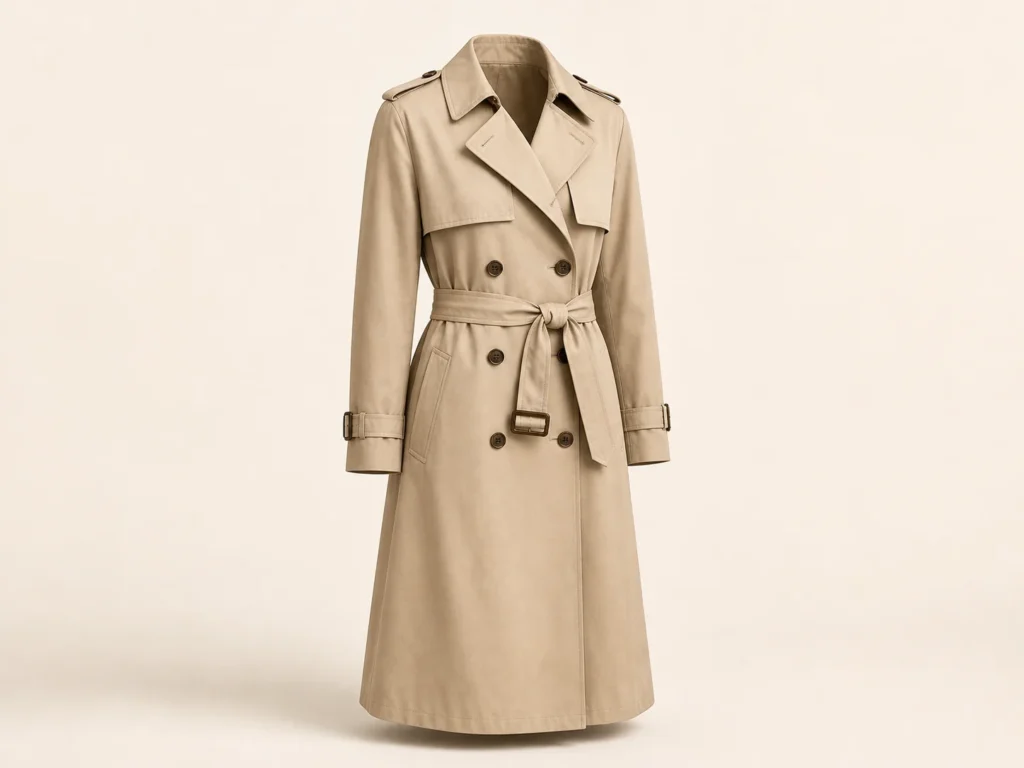
1. Trench Coat
A trench coat is usually recognized by its belted silhouette, broad collar or lapels, and details inspired by protective outerwear, such as a storm flap, shoulder tabs, or cuff straps. Many versions are double-breasted, although single-breasted designs are also common.
Trench coats are often made from tightly woven cotton, cotton blends, or synthetic fabrics, sometimes with a coating or finish intended for wet weather. They work well for commuting, travel, business outfits, and transitional seasons. Before choosing one for rain, verify the fabric treatment, seam construction, closure coverage, and hood arrangement if present. The style name alone does not establish waterproofness, wind resistance, or insulation.

2. Overcoat
An overcoat is a relatively long outer garment designed to be worn over other clothing. It often has tailored shoulders, lapels, full-length sleeves, and a clean buttoned front. Many reach the knee or lower, giving more coverage than shorter tailored styles.
Traditional versions commonly use wool or wool-rich woven cloth, but blended and synthetic constructions are widely available. An overcoat can suit business clothing, formal events, and colder commutes, especially when it has enough room for a suit or knitwear underneath. Check the cloth weight, lining, closure overlap, sleeve width, and fit over intended layers. Length can improve coverage, but it does not prove that the garment will provide enough warmth for a specific climate.

3. Topcoat
A topcoat is commonly understood as a lighter, less bulky tailored coat, although its distinction from an overcoat is not identical across retailers or regions. It usually has a clean silhouette, lapels or a structured collar, and a length somewhere between the mid-thigh and knee.
Lighter woolens, wool blends, and refined woven fabrics are common material directions. This style is useful for mild-to-cool weather, business dress, smart-casual outfits, and transitional layering when a heavy winter coat would feel excessive. Do not rely on the name to determine season or warmth. Compare the actual fabric weight, lining, length, fit, and construction, particularly if you are choosing between a product labeled “topcoat” and one labeled “overcoat.”

4. Peacoat
The peacoat has a compact, structured shape with a double-breasted front and broad lapels that can often be turned upward for additional neck coverage. Most versions finish around the hip or upper thigh, making them easier to move in than many long tailored coats.
Dense woven wool and wool blends are common, although modern peacoats may use many different fibers, fabric weights, and lining systems. The style works with casual clothing, office outfits, and everyday cold-season dressing. When evaluating one, check whether the front overlaps securely, whether the collar sits comfortably when raised, and whether the sleeves allow reaching and driving. Its familiar silhouette does not guarantee a particular level of warmth or wind protection.

5. Car Coat
A car coat is commonly a three-quarter-length overcoat with a practical, relatively simple shape. It often ends around the mid-thigh and may have a straight or slightly relaxed body, a simple collar, and an uncomplicated button or zip front.
Possible materials include cotton twill, woolen cloth, weather-oriented synthetics, and blended woven fabrics. It is a useful option for driving, commuting, travel, and understated everyday wear. Check the back length while seated, pocket access, closure placement, and shoulder mobility rather than judging it only while standing. The term describes a use-led silhouette, not a fixed material specification, rain rating, or level of insulation.
Winter and Weather-Ready Types of Coats
The next group is commonly associated with cold, wind, or rain. Even so, a protective-looking silhouette is not proof of performance. Shell construction, insulation, moisture management, closures, and fit determine how a specific garment behaves.

6. Parka
A parka usually combines substantial body coverage with a hood and a practical outerwear silhouette. Many versions extend to the mid-thigh or knee and include insulation, adjustable openings, protective pocket flaps, or an extended back hem. Fashion parkas, however, may use lighter construction and fewer protective details.
Common material systems include woven synthetic or cotton-blend shells, separate linings, and optional down or synthetic insulation. A well-specified parka can be suitable for cold, windy, or wet outdoor conditions, but the intended exposure must match the garment. Verify the shell, seams, hood adjustment, cuffs, hem, front closure, and insulation. Do not assume that every parka is waterproof or designed for severe cold.

7. Puffer Coat
A puffer coat is identified by quilted compartments or channels that hold insulating material. These chambers create the familiar lofted appearance and help distribute down or synthetic fill. Coat-length versions usually extend below the hip, offering more coverage than short puffer jackets.
Puffers are popular for cold-weather commuting, travel, and everyday wear because insulation can provide warmth without requiring a dense, heavy woven cloth. Actual performance still varies with fill type, fill amount, baffle design, shell fabric, garment length, and moisture exposure. Check for thin or compressed areas, fill movement, closure coverage, and freedom of movement. Any temperature claim should come from identified product evidence rather than from the word “puffer.”

8. Duffle Coat
A duffle coat is easy to recognize by its hood and toggle-style front closures, which are often attached with loops or tabs. It commonly has a straight, substantial body that reaches the mid-thigh or knee, along with large patch pockets.
Dense woolen fabrics and wool blends are traditional material directions, but lighter and synthetic versions also exist. The coat works naturally with casual clothing, everyday winter layers, and school-inspired styling. Toggle closures create a distinctive look, but their spacing may leave more exposure than a continuous zip or closely overlapped placket. Check the fabric weight, lining, hood coverage, toggle security, and the gaps along the front before deciding whether a particular version suits cold or windy conditions.

9. Raincoat
A raincoat is a coat-length outer layer designed with wet-weather use in mind. Its silhouette varies widely, from simple straight shells to belted designs and hooded protective coats. What connects the category is its rain-oriented purpose rather than one standard shape.
Construction may involve coated fabric, laminated material, tightly woven cloth with a water-resistant finish, or another protective system. A raincoat can be useful for commuting, travel, and outdoor use, but the level of protection must be verified. Examine the seams, front closure, hood, cuffs, pockets, and fabric specification. A fabric method such as ISO 811 evaluates resistance to water penetration, but it does not prove whole-garment waterproofness. Breathability and comfort also depend on material and ventilation.

10. Shearling Coat
A shearling coat is recognized by its dense pile surface or interior and its substantial, tactile appearance. Genuine shearling uses processed sheepskin with the fleece attached, while faux shearling and shearling-look fabrics imitate the visual effect through other fiber and fabric constructions.
These coats can work for cool-to-cold casual dressing and premium fashion collections, depending on their weight, lining, fit, and actual material. Genuine and imitation versions can differ considerably in care, moisture response, durability, and feel. Verify the fiber and material description, surface stability, seam bulk, garment weight, cleaning instructions, and likely exposure to rain or snow. A plush appearance may suggest warmth, but it is not a measured thermal rating.
Synthetic fibers can appear in shells, insulation, linings, and faux-pile fabrics, but each construction behaves differently. This guide to how polyester can serve different outerwear structures provides useful material context without treating the fiber name as a performance guarantee.
Fashion-Led Types of Coats
The final five names are driven mainly by volume, drape, length, or surface appearance. They can still be practical, but their visual category reveals less about warmth or weather protection than their complete construction does.

11. Wrap Coat
A wrap coat closes by overlapping one front panel across the other, usually with a tie belt rather than a rigid row of buttons. This creates an adjustable silhouette with a softer front and visible drape. Lapels may be broad and relaxed, while the body often reaches the knee or lower.
Soft woolens, double-faced fabrics, blends, and other drapey woven materials are common choices. Wrap coats suit office wear, travel, smart-casual outfits, and dress-oriented layering. Their adjustability can be comfortable across different layers, but it also makes overlap important. Check whether the front stays closed while walking or sitting, whether the belt remains secure, and whether wind can enter through the neckline, cuffs, or overlapping panels.

12. Cape Coat
A cape coat is defined by broad, cape-like volume that falls from the shoulders. The arms may pass through open sides, slits, or shaped openings, while some designs place a cape overlay above conventional sleeves. A collar, hood, or structured front closure may also be added.
Materials range from firm woolen cloth to lighter, more fluid woven fabrics. Cape coats are often chosen for statement dressing, occasion wear, or layering over garments that fit comfortably within their shoulder and arm volume. Before choosing one, test reaching, carrying a bag, using handrails, and moving in wind. Also check the closure and arm openings, since their shape can affect both mobility and exposure.

13. Cocoon Coat
A cocoon coat has rounded volume through the body, a softened or extended shoulder line, and a hem that narrows or curves inward. The result is a sculptural silhouette that appears roomy through the middle without simply hanging straight from the shoulders.
Woolens, felted fabrics, structured blends, and other materials capable of supporting curved volume are common directions. This style works well for relaxed tailoring, modern everyday dressing, and outfits where shape is the main visual feature. Fit should be assessed across the complete silhouette. Check shoulder placement, sleeve reach, arm movement, hem width, pocket position, and space for intended layers. A wide body does not automatically mean that the sleeves or hem will accommodate bulky clothing comfortably.

14. Duster Coat
A duster coat is defined primarily by its long, flowing length, often reaching the calf or ankle. Contemporary fashion dusters may have an open front, light structure, and substantial movement, although heavier and more protective interpretations also exist.
Lightweight woven fabrics, fluid blends, and unlined constructions are common in transitional versions. A duster can add light coverage for travel, mild weather, or dramatic layered styling. Its length requires practical attention. Check how the hem behaves on stairs, near doors, while driving, and in wet or dirty conditions. Review the front closure, fabric transparency, care requirements, and resistance to abrasion. The long silhouette adds coverage, but it should not be mistaken for insulation.

15. Teddy Coat
A teddy coat has a plush, curly, or fuzzy pile surface that resembles a soft toy texture. The name mainly describes appearance, not a regulated fiber category. Some versions are made with synthetic pile, while others use blended or alternative textured materials.
Teddy coats are common in casual cold-season wardrobes and texture-led fashion collections. Their bulky appearance can create a cozy visual effect, but actual warmth depends on pile density, backing, lining, length, closures, and fit. Check the precise composition, surface shedding, pilling, matting, seam bulk, and cleaning instructions. It is also worth testing movement with layers underneath, since a soft outer surface does not always mean that the internal construction is flexible or lightweight.
Which Type of Coat Should You Wear?
Start with climate and rain exposure, then consider activity, layering, length, formality, and care. The best starting style is the one whose complete construction supports your conditions.
| Scenario | Useful starting styles | Why they may fit | What to verify |
|---|---|---|---|
| Formal business clothing | Overcoat or topcoat | Clean tailoring can cover smart clothing | Shoulder fit, drape, length, and layering room |
| Cold, low-activity commute | Parka, puffer coat, or overcoat | Coverage and insulation options suit slower activity | Fill, shell, wind entry points, hood, and closures |
| Wet and windy travel | Raincoat or protective parka | Hooded coverage may support protection | Water claim, seams, hood, cuffs, and ventilation |
| Active everyday movement | Peacoat, car coat, or shorter puffer | Moderate length supports easier movement | Arm mobility, hem position, bulk, and breathability |
| Transitional weather | Trench coat or topcoat | Lighter construction works over changing layers | Fabric weight, lining, rain evidence, and packability |
| Texture-led occasion | Teddy or shearling coat | A pronounced surface creates visual impact | Composition, shedding, pilling, care, and warmth |
| Frequent driving | Car coat | Mid-length proportions can feel easier when seated | Back length, vent, pocket access, and comfort |
| Bulky knitwear | Cocoon or wrap coat | Volume or adjustable closure accepts larger layers | Chest and armhole ease, closure, and sleeve fit |
Treat the table as a shortlist, not a rating. CDC/NIOSH cold-weather guidance recommends several loose layers for better insulation and notes that clothing can restrict movement. This occupational guidance is not a temperature rating for fashion coats, but it shows why fit, moisture, and mobility matter.
Before choosing, work through this checklist:
- Define the conditions. Note typical cold, wind, rain, humidity, and time outside.
- Match the activity. Walking, driving, waiting, traveling, and active play require different mobility.
- Choose useful coverage. Decide whether hip, thigh, knee, or calf length fits the routine.
- Plan the layers. Try the coat over the sweater, suit, or mid-layer you expect to wear.
- Inspect the garment. Review shell, lining, insulation, seams, hood, cuffs, closures, and pockets.
- Check care and evidence. Look for support behind water, wind, warmth, or durability claims.
Conclusion
The names used for different types of coats describe overlapping combinations of silhouette, length, function, material, and surface. They are useful starting points, but they do not prove warmth, weather protection, fit, care, or quality.
Identify the style, match it to climate, activity, layering, and occasion, then verify the complete garment. Clothing brands should document the same decision through references, measurable specifications, intended materials, size range, target market, quantity range, and sample criteria before requesting a project-specific discussion.
Common Questions About Coat Types
What Is the Difference Between a Coat and a Jacket?
A coat is usually longer and provides more body coverage, while a jacket is generally shorter and easier to move in. However, there is no absolute technical boundary.
Terms such as puffer, quilted, and shearling may be used for both jackets and coats. Length, materials, insulation, fit, and intended use provide a more reliable comparison than the product name alone.
Which Type of Coat Is the Warmest?
Long insulated parkas and puffer coats are often the strongest choices for severe cold because they combine insulation with greater body coverage.
However, no single coat type is always the warmest. Total insulation, fill distribution, shell fabric, lining, hood, collar, cuffs, front closure, wind exposure, fit, and the layers underneath all affect warmth.
What Type of Coat Is Best for Rain?
For frequent or prolonged rain, choose a genuinely waterproof raincoat with appropriate seam construction, secure closures, and useful hood coverage.
A water-resistant trench coat is suitable for light showers and city commuting but may not provide enough protection in sustained heavy rain. Always distinguish between “water-resistant,” “shower-resistant,” and “waterproof” product descriptions.
Is a Puffer a Coat or a Jacket?
It can be either.
“Puffer” describes a padded construction in which insulation is held inside stitched or baffled sections. A waist-length version is usually called a puffer jacket, while a longer version that covers more of the thighs may be called a puffer coat.
What Type of Coat Works Best Over a Suit?
A structured overcoat or Chesterfield coat is usually the most suitable choice. Both have the length and formality needed to complement tailored clothing.
Make sure the coat covers the lower edge of the suit jacket and has enough space through the shoulders, chest, and sleeves. Try it on over the actual suit rather than sizing it while wearing only a shirt.
How Should a Winter Coat Fit?
A winter coat should leave enough room for your normal cold-weather layers without pulling across the chest, shoulders, or upper arms.
You should be able to close the front, raise your arms, sit down, and walk comfortably. At the same time, the coat should not be so loose that large gaps around the neck, cuffs, or hem allow cold air to enter easily.