Zara is widely associated with fast-changing collections, a broad product range, and frequent new arrivals. Behind that retail model is a more complex manufacturing question: where are Zara clothes made, and how does the brand coordinate production across different regions? The answer is not one country or one manufacturer. Zara relies on a network spanning Europe, North Africa, and Asia, with production locations varying by product, batch, season, and market.
Understanding Zara’s manufacturing strategy helps explain why the group combines nearby production with large Asian sourcing hubs, why similar garments may carry different origin labels, and why a famous brand’s country list is not the same as a supplier list. Keep reading to see what Inditex’s public disclosures actually reveal—and what clothing brands can learn from the model.

Where Are Zara Clothes Made?
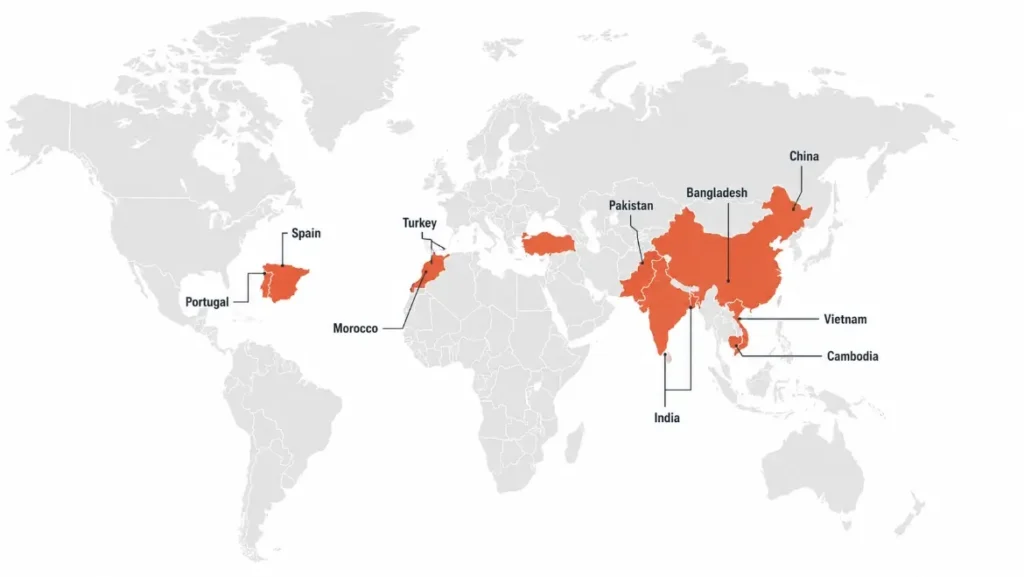
Zara clothes are made across a multi-country manufacturing network that includes Spain, Portugal, Turkey, Morocco, China, Bangladesh, India, Vietnam, Pakistan, and Cambodia. A particular garment’s country of origin can vary by style, batch, season, and sales market, so the label inside the item is the best source for that individual piece.
Zara’s official supplier information lists these ten countries as Inditex supply chain clusters that collectively account for most of the group’s production. The network includes locations close to the group’s headquarters in Spain as well as large Asian apparel-manufacturing centers.
That does not mean every Zara product is made in all ten countries, or that each country always handles the same product category. It also does not mean all factories within the network are owned by Zara. Inditex’s public data is mainly useful for understanding the scale and geographic structure of the wider group supply chain.
For a specific dress, jacket, pair of jeans, or shirt, check the country-of-origin information attached to the garment. A web article can describe the network; it cannot replace the label on the exact item in your hand.
What Inditex’s Published Factory Data Actually Tells Us
One reason this topic becomes confusing is that articles often use “Zara” and “Inditex” as if they were interchangeable. They are related, but they are not the same unit of analysis.
Zara Is a Brand Within the Inditex Group
Zara is one of the brands operated by Inditex. When Inditex publishes factory counts, audits, or supply chain markets, those figures generally cover the group rather than Zara alone.
According to the Inditex 2025 Annual Report, the group worked with 6,684 factories in 49 markets in 2025. This is current, useful evidence of the group’s manufacturing reach. It should not be rewritten as “Zara owns 6,684 factories” or “6,684 factories exclusively make Zara clothes.” Neither conclusion follows from the disclosure.
Factories, Suppliers, and Production Clusters Are Different Measures
These terms describe different parts of the system:
| Term | What it means | What not to assume |
|---|---|---|
| Brand | The customer-facing label, such as Zara | The brand directly owns every production site |
| Supplier | A business contracted to provide products or services | The supplier performs every process at one address |
| Factory | A facility carrying out production processes | Every factory works exclusively for one brand |
| Supply chain cluster | A regional structure for coordination and supplier engagement | It is a single factory or a complete brand-specific list |
| Distribution center | A facility that receives, sorts, and sends finished goods | It is the country where the garment was manufactured |
This distinction also matters when comparing OEM relationships. An OEM clothing manufacturer makes products to a brand’s specifications, but the contractual supplier, factory location, material sources, and subcontracted processes may still need to be identified separately.
What the Public Data Does Not Reveal
Inditex’s disclosures provide group-level factory counts, key markets, audit information, and cluster countries. They do not provide a permanent public map showing which factory made every Zara SKU.
Public information also cannot reliably show whether a supplier relationship is current merely because a factory once mentioned Zara on its website. Orders move, facilities change, and one legal supplier may nominate more than one production site. A credible factory claim therefore needs a date, a product-category match, and evidence linked to the actual facility—not just a logo page.
The Main Countries in Zara’s Manufacturing Network
The Zara supplier disclosure identifies ten Inditex supply chain clusters: Spain, Portugal, Turkey, Morocco, India, Pakistan, Vietnam, Cambodia, Bangladesh, and China. The page says these clusters collectively account for most of the group’s production.
The table below describes how the regions fit a general apparel-sourcing model. It is not a Zara country ranking or a claim that a particular category is permanently assigned to one location.
| Country or group | Position in the disclosed network | General manufacturing context | Evidence boundary |
|---|---|---|---|
| Spain and Portugal | Proximity clusters close to Inditex headquarters | Shorter communication and transport paths can support responsive development | Public data does not give a current Zara-only country share |
| Turkey and Morocco | Proximity clusters near the European market | Established garment industries and geographic access to Europe | Product assignments may change by style and order |
| China | Major Asian supply chain cluster | Broad material, trim, process, and garment-category ecosystem | Cluster status does not identify a specific Zara factory |
| Bangladesh, India, Vietnam, Pakistan, and Cambodia | Asian production clusters | Large apparel industries with different category strengths and capacity models | The cluster list is not a fixed product-to-country allocation |
Proximity Cluster Countries
Spain and Portugal
Spain is central to Inditex’s design, commercial, and distribution organization. Portugal adds a nearby apparel-manufacturing base with access to European transport routes and established textile capabilities.
The business value of proximity is not that every nearby factory is automatically faster. It is that shorter geographic and communication distances can make late decisions, sample movement, production follow-up, and replenishment easier to coordinate when the supplier has the appropriate capacity.
For buyers, this is an important distinction. “Made nearby” is not a production method. The factory still needs the right machinery, pattern and technical team, material access, quality controls, and available production window.
Turkey and Morocco
Turkey and Morocco extend the proximity network beyond the European Union while remaining relatively close to the European market. Both have substantial apparel sectors and can support different knit, woven, denim, finishing, and fashion programs depending on the factory.
Their value in a regional network is optionality. A brand can compare capabilities and available capacity across several nearby production markets instead of treating one country as the only source. Exact suitability still depends on the garment and supplier, not the flag.
If you are developing your own sourcing plan, use a structured guide to choose a clothing manufacturing country rather than copying another brand’s country list.
Asian Production Cluster Countries
China
China’s apparel ecosystem includes fabric mills, trim suppliers, printing and embroidery providers, washing and finishing specialists, packaging companies, testing services, and cut-and-sew factories. This density can be valuable for garments that require several coordinated materials or processes.
It would still be misleading to conclude that every Chinese factory can handle every category. A high-volume basics factory, a denim plant, a technical activewear producer, and a children’s dress manufacturer operate with different equipment, skills, order structures, and quality risks.
The official cluster listing confirms China’s place in the Inditex network. It does not identify which factory made a particular Zara item, nor does it prove that any company advertising itself as a “Zara factory” has a current relationship.
Bangladesh, India, Vietnam, Pakistan, and Cambodia
These countries are major apparel-producing markets, but they should not be treated as one interchangeable low-cost block. Each contains different industrial clusters, material bases, trade conditions, factory scales, and product specializations.
For example, one supplier may be strong in repeatable knit programs, while another is better equipped for washed denim, intricate woven garments, embroidery, or technical performance construction. Even within the same city, two factories can differ sharply in development support, production transparency, and order fit.
The practical lesson is to evaluate the facility and product match after selecting a region. Country-level research narrows the field; it does not complete supplier due diligence.
Why Product Origins Can Change by Style, Batch, and Season
A global brand does not need to assign every version of a product to the same country forever. Order allocation can change when demand, raw-material availability, production capacity, timing, price structure, or regional risk changes.
Two similar shirts may therefore carry different origin labels. A repeat order might move to another approved facility, or parallel orders may be placed with more than one supplier. The visible label records the origin of that garment under the applicable rules; it does not describe every decision behind the order.
Why Zara Combines Nearshore and Offshore Manufacturing
The more useful question is not simply where production happens, but why a multi-region system exists. Inditex’s published business model connects proximity production with the ability to react during the season. Its model also refers to small production batches, demand feedback, and frequent delivery.
That suggests a broader sourcing principle: different products create different planning risks. A factory should be selected according to the job the supply chain needs it to perform.
Nearshore Production Supports Faster Response
Nearshore production can be useful when demand is difficult to forecast or when a style may require quick decisions. Shorter distances can reduce the time needed to move samples, approved materials, or finished goods. Working hours may overlap more closely, and in-person follow-up can be easier.
These advantages matter for trend-sensitive or seasonal products, but proximity alone does not guarantee speed. A nearby factory with no open capacity, weak material access, or poor technical communication may be slower than a well-organized supplier farther away.
Offshore Production Supports Scale and Specialization
Offshore production often becomes attractive when demand is more stable, quantities justify production setup, or the product benefits from a specialized manufacturing cluster. Larger material ecosystems and repeatable production programs may support better utilization of machinery and labor.
The tradeoff is usually greater planning rigidity. Longer material and transport paths make late changes harder. Brands may need earlier approvals, clearer forecasts, stronger documentation, and more disciplined quality checkpoints.
A Hybrid Network Reduces Single-Region Dependence
A hybrid network lets a company avoid forcing every product into the same sourcing model.
| Decision factor | Nearshore tendency | Offshore tendency |
|---|---|---|
| Demand uncertainty | Better suited to faster response and later decisions | Better suited to stable, forecastable demand |
| Order pattern | Smaller initial commitments may be easier to manage | Larger or repeatable programs may fit better |
| Communication | Shorter distance and more time-zone overlap | Requires stronger documentation and planned reviews |
| Product ecosystem | Useful when nearby capability exists | Useful when a specialized cluster offers deeper resources |
| Main risk | Higher unit economics or limited capacity | Longer correction loops and greater inventory exposure |
Smaller brands can use the same logic without copying the same geography. A useful next step is to compare garment manufacturing locations against the actual product, order pattern, and sales market.
Who Actually Manufactures Zara Clothes?
There is no single company that manufactures all Zara clothing. Inditex coordinates a broad network involving suppliers and factories, with different facilities performing processes such as material production, cutting, sewing, printing, dyeing, washing, and finishing.
Owned Production and External Supplier Factories
Inditex has direct corporate capabilities, but its current public supply chain reporting emphasizes the thousands of factories that work within its supplier network. It is therefore inaccurate to picture Zara production as a group of company-owned plants making everything from fabric to finished garment.
A supplier may manage the commercial relationship while one or more facilities perform production. Some processes can occur at different addresses. That is why buyers need the legal entity, production address, and subcontracting structure—not only the supplier’s trading name.
Why There Is No Single Zara Clothing Manufacturer
No one factory could reasonably provide every fabric, construction, process, volume pattern, and geographic requirement used across a global fashion assortment. A multi-supplier structure allows orders to be matched to different capabilities and provides alternatives when capacity or risk changes.
The same principle applies to smaller brands. A company producing cotton basics, performance leggings, tailored coats, and embellished children’s dresses may need more than one manufacturing partner. Consolidation can reduce management work, but excessive dependence on one supplier can create its own risk.
How to Evaluate a “Zara Supplier” Claim
Treat a famous-client claim as a starting point for verification, not as a qualification certificate. Ask for evidence that does not require the factory to disclose another client’s confidential designs.
Check the following:
- Does the legal company name match the business that will sign the contract and receive payment?
- What is the exact production address, and which processes happen there?
- Is the claimed brand relationship current, dated, and connected to this facility?
- Does the factory’s actual product category match your garment?
- Can it show anonymized construction samples, inspection records, or process evidence?
- Which operations are subcontracted, and how are those sites approved and monitored?
A factory that once made a simple jersey item for a major retailer may still be a poor choice for your bonded activewear, washed denim, tailored outerwear, or safety-sensitive kidswear. Use a broader process to find and verify clothing manufacturers before releasing a complete tech pack or paying for sampling.
How to Check Where a Specific Zara Item Was Made
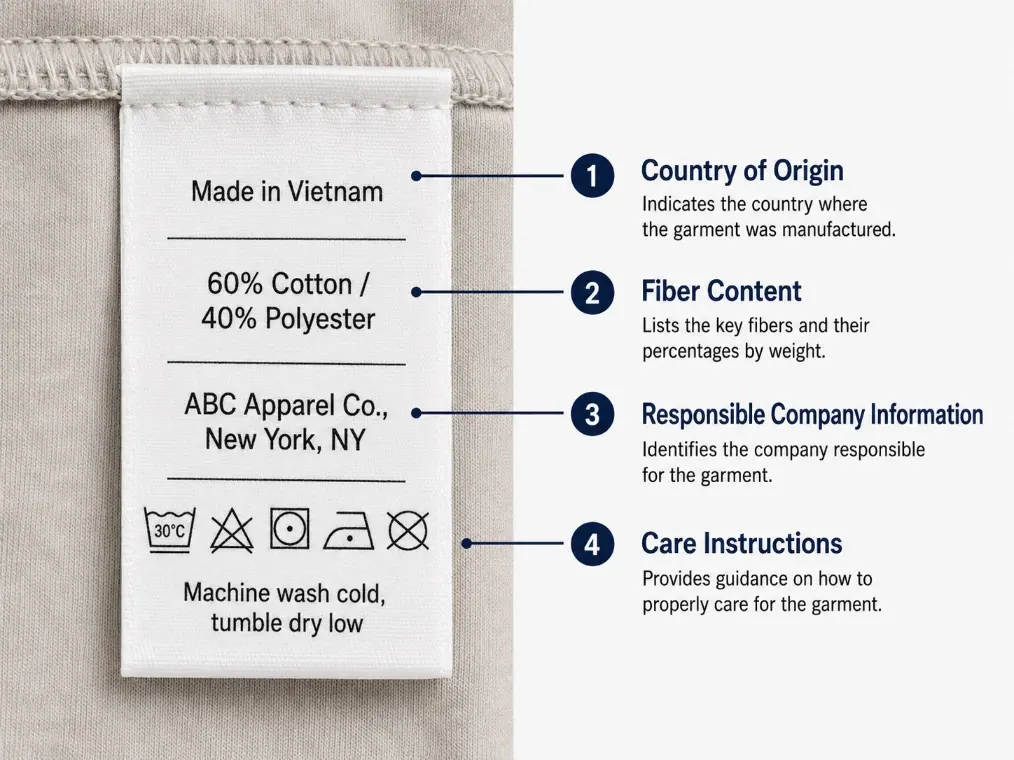
For a particular item, start with the garment rather than a general country list.
- Locate the country-of-origin label. It may appear with the fiber-content label or near the care information, depending on the garment and market.
- Read the country name as information about that item. Do not assume a similar online listing or an older version has the same origin.
- Separate garment origin from material origin. Fabric, yarn, trims, printing, and packaging may come from other places.
- Treat the label as one layer of evidence. It does not identify every supplier, subcontractor, inspection, or logistics step.
For products sold in the United States, the Federal Trade Commission’s apparel-labeling guidance says most textile and wool products must disclose fiber content, country of origin, and the identity of the manufacturer or another responsible business. The detailed origin determination depends on the product and applicable U.S. rules, so the label should not be interpreted as a complete material-sourcing map.
A label can tell you: the declared country of origin for that product, its stated fiber content, and the responsible company information required for the market.
A label cannot tell you: every country involved in the materials, whether the factory is brand-owned, the full supplier network, the inspection history, or whether another batch was produced in the same place.
Does the Manufacturing Country Determine Clothing Quality?
No. A country name is not a quality grade.
Country-level research can reveal industry clusters, infrastructure, typical factory scale, and access to materials. It cannot tell you whether a specific garment has accurate measurements, secure seams, suitable fabric, stable color, or consistent finishing.
Material and Construction Specifications Come First
Quality begins with what the brand asks the factory to make. Fabric composition and weight, shrinkage limits, color requirements, stitch types, seam construction, measurements, tolerances, trims, artwork, labels, and packaging all affect the result.
If these requirements are vague, two capable factories may produce different interpretations. A country-of-origin label cannot compensate for an incomplete specification.
Factory Capability and Process Control Matter More Than the Flag
A factory must understand the product category and control the required processes. Relevant questions include whether the team has worked with the fabric, machinery, wash, decoration, fit standard, and testing expectations involved in the order.
This is why the garment factory process matters. Material inspection, pattern review, cutting control, sewing checks, measurement inspection, finishing, and packing each influence the finished product. Strong results come from connecting those stages to an approved sample and clear specifications.
Batch Consistency Requires Inspection and Traceability
A good first sample is not proof that every production unit will match. Consistency requires controlled materials, approved references, in-process checks, final inspection, and records that allow problems to be traced.
Brands should agree on measurement checkpoints, defect definitions, inspection timing, corrective actions, and approval responsibility before bulk production. These controls matter whether the label says Portugal, Turkey, China, Bangladesh, or another manufacturing country.
What Clothing Brands Can Learn From Zara’s Supply Chain
The most useful lesson is not “find Zara’s factory.” It is “give each product the supply model it needs.”
Segment Products by Demand Uncertainty
Begin by separating products according to how confidently you can forecast demand.
- High uncertainty: fashion-led silhouettes, new color stories, seasonal statements, or untested categories.
- Medium uncertainty: proven shapes with new fabrics, prints, or market launches.
- Lower uncertainty: repeat basics with established fit, materials, and reorder history.
This classification influences the appropriate initial commitment, approval timing, material strategy, and replenishment plan. It is more useful than applying one MOQ or one lead-time expectation to the entire collection.
Match Factory Capability to the Product, Not Just the Country
Create a capability profile before building a country shortlist. Define the fabric, construction, decoration, fit, size range, finishing, testing, and packaging needs.
Then ask each supplier for evidence from comparable work. Anonymized seam photos, material samples, print strike-offs, measurement reports, process records, or a technical discussion can reveal more than a customer-logo page.
Separate Initial Production From Replenishment Decisions
The first order and a repeat order solve different problems. The initial run tests product-market fit, production interpretation, and customer response. Replenishment rewards consistency, capacity, and reliable material control.
Instead of forcing both stages into one commercial assumption, ask how the supplier handles repeat materials, color continuity, pattern revisions, size ratios, and production reservations. A factory that supports careful development may not be the lowest-cost source at scale; a scale factory may not be patient with repeated early-stage changes.
Build Traceability Before Scaling Volume
Visibility becomes harder, not easier, when orders grow. Establish the information chain early:
- Legal supplier and payment entity
- Actual production facility
- Material and trim sources where relevant
- Approved subcontracted processes
- Sample and specification version
- Inspection and corrective-action records
This does not require enterprise software. A controlled document register, named contacts, approved-facility list, and order-specific inspection file can provide a practical foundation.
Adapt the Model to Your Brand’s Size and Resources
A global retailer can divide orders across regions, maintain specialized teams, and absorb the cost of complex coordination. A startup may have one founder managing design, purchasing, approvals, logistics, and marketing.
Copying a large brand’s number of suppliers would create confusion. Copying its decision discipline is more realistic: match risk to production mode, keep product data current, verify facilities, preserve alternatives, and use sales information to guide repeat orders.
Before adding another country or factory, ask whether the diversification reduces a real risk or merely adds another relationship to manage. A smaller, visible supply chain often performs better than a broad network the brand cannot properly supervise.
Turning This Into Your Own Sourcing Decision
You do not need Zara’s answers. You need your own, and they come from five questions:
- Can I forecast demand for this product — or will I only know once it starts selling?
- What lead time can I genuinely absorb before it costs me a season?
- Does my order volume match the factories I’m approaching — or would I be their smallest customer?
- What testing, labelling and compliance does my destination market require, and who carries that responsibility? For most imports, the importer of record bears compliance responsibility, so confirm what applies in your market before you commit to production.
- How will I verify quality — third-party inspection, factory audit, or a pre-production sample I personally approve?
Answer those per product line, not per brand. Two different products can legitimately point to two different countries. That, more than any factory name, is the thing worth taking from Zara.
When you are ready to work through the trade-offs properly, our guide to choosing a clothing manufacturing country goes through the criteria in detail.
If you are developing a children’s apparel collection, HAPA’s children’s clothing OEM manufacturing service supports tech pack review, pattern and size development, material and trim selection, sampling, bulk production, quality checks, labels, and packaging. The goal is not to copy Zara’s scale. It is to build a production route that fits your product and gives your team enough visibility to manage it well.
FAQ
Are Zara clothes made in China?
Yes — China appears consistently in Inditex’s supplier network. But Inditex publishes group-level data covering all its brands and does not break out which items are made where, so no source supports “all Zara is Chinese-made.”
Is Zara made in Spain or Portugal?
Both appear among Inditex’s nearby production markets. But note the distinction: Inditex states its design and distribution activities are carried out in Spain. Spanish headquarters and Spanish distribution do not mean Spanish sewing.
Are Zara clothes made in Bangladesh or Turkey?
Both feature in Inditex’s supplier network, playing different roles. Turkey sits among the nearby, fast-response markets; Bangladesh among the large-scale production bases that serve high-volume, forecastable demand.
Where are Zara jeans and shoes made?
There is no permanent answer. Origin varies by style, season and batch, and Inditex publishes no product-level country data. Check the care label on the specific item — any article naming a fixed country is guessing.
Why does the same Zara style show different countries of origin?
Because batches are allocated to different factories depending on capacity, timing and reorder needs. This is entirely normal in large apparel supply chains, and is not a sign of counterfeiting or inconsistency.
Are Zara clothes ethically made?
Inditex publishes a supplier code of conduct and audit data — for 2025 it reported 6,039 social audits, 1,875 environmental audits and 10,709 traceability audits. Independent assessments also exist. Weigh both rather than accepting any single verdict.
Can a small clothing brand use Zara’s manufacturers?
Even if you identified one, its minimums, lead times and scheduling would be built around a vastly larger customer. A factory matched to your volume and product type will serve you far better.