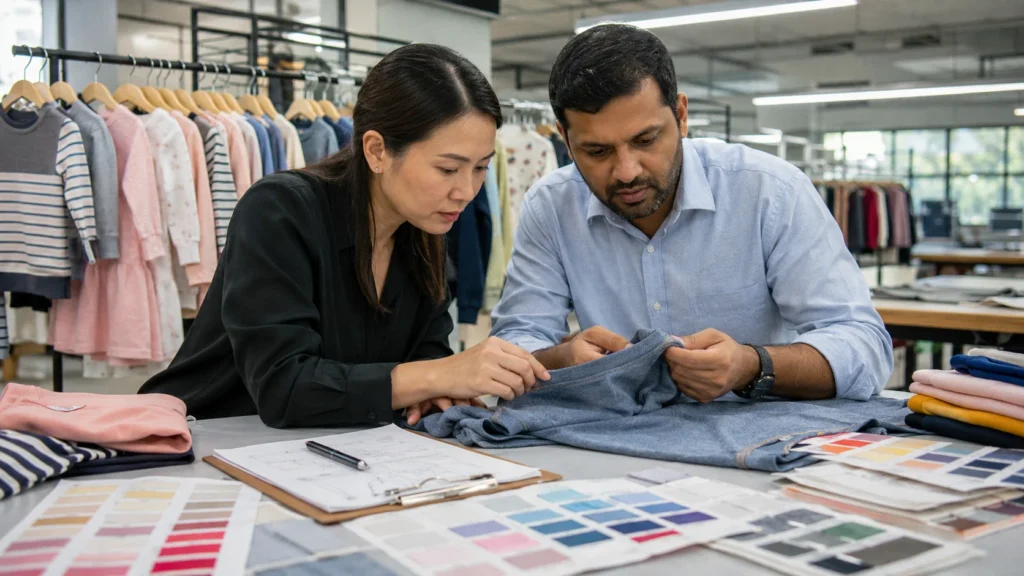
Buyer and supplier review a kidswear sample and material options in a factory workspace.
Kidswear unit cost changes noticeably between 1,000, 5,000, and 10,000 pieces, but not because a factory simply “gives a bigger discount” when the quantity rises. In real apparel production, the price per garment is the result of several cost layers: fabric, trims, sewing minutes, production setup, sampling, quality control, testing, packaging, factory overhead, and the way your colors and sizes are divided.
When I discuss quantity breaks with buyers, I usually start with one warning: do not assume that doubling the order should halve the price. That sounds obvious once you see a factory cost sheet, but it is one of the most common misunderstandings in sourcing. Some costs fall sharply per unit as volume grows. Others barely move at all.
The biggest step down often happens between a relatively small run and a production-friendly run. In many cases, moving from 1,000 to 5,000 pieces creates a more meaningful percentage saving than moving from 5,000 to 10,000. By the time you reach 10,000 pieces, much of the setup, purchasing, and line-efficiency benefit has already been captured.
This article explains how I would compare those three quantities if I were reviewing a kidswear quotation with you. The cost examples are deliberately illustrative rather than presented as universal factory prices. Your actual quote will depend on garment type, fabric, construction, decoration, packaging, testing, destination market, lead time, color split, size range, and commercial terms.
The Short Version: 1,000, 5,000, and 10,000 Pieces Behave Differently
At 1,000 pieces, fixed development and setup costs are spread over a small quantity, so the unit price is usually highest. Material suppliers may also apply small-lot surcharges or refuse custom production below their preferred minimum.
At 5,000 pieces, the factory often reaches a more comfortable production scale. Fabric purchasing improves, setup costs are diluted, the sewing line has time to stabilize, and custom trims or packaging may reach better pricing tiers. This is why I often see the biggest practical improvement in the move from 1,000 to 5,000 pieces.
At 10,000 pieces, the order is even more efficient, but the savings usually become incremental rather than dramatic. Fabric still costs money. Sewing still requires labor. QC still requires inspectors. Packaging still has to be made. There is a floor below which the factory can only reduce price by changing the specification, extending the lead time, accepting a lower margin, or cutting something you may not want cut.
That is the basic shape of kidswear unit cost: a steeper decline as you move out of small-batch production, followed by a flatter curve as the order approaches an efficient industrial scale.
An Illustrative Cost Model
Let us use a simple example: a custom two-piece cotton kidswear set with standard sewing, custom brand labels, basic individual packaging, and normal in-line and final quality control. The figures below are not a HAPA quotation and are not meant to represent current market prices. They simply show how the cost logic can shift as quantity increases.
| Cost Component | 1,000 pcs | 5,000 pcs | 10,000 pcs |
| Fabric and main materials | $4.20 | $3.85 | $3.65 |
| Trims, labels, packaging | $0.95 | $0.80 | $0.72 |
| Cut, sew, finish labor | $2.30 | $2.05 | $1.95 |
| QC and factory overhead | $0.70 | $0.55 | $0.50 |
| Development/setup allocation | $1.50 | $0.30 | $0.15 |
| Illustrative unit cost | $9.65 | $7.55 | $6.97 |
In this example, the modeled price falls by roughly 22% when the order moves from 1,000 to 5,000 pieces, then by another 8% when it moves from 5,000 to 10,000. The precise percentages will differ from style to style, but the pattern is common because the first quantity jump unlocks more cost improvements at once.
What I want you to notice is that no single line item explains the whole reduction. A realistic quantity break is usually the result of several smaller changes happening together.
1. Development and Setup Costs Hurt the 1,000-Piece Order Most
Before bulk production starts, a custom style may require pattern development, grading, sample making, fit revisions, artwork setup, print screens, embroidery digitizing, trim sourcing, packaging setup, pre-production meetings, testing coordination, and line preparation.
Some factories charge those items separately. Others recover part of them inside the unit price. Either way, they have to be paid for somewhere.
Imagine that a style carries $1,500 of development and setup work. Spread over 1,000 pieces, that equals $1.50 per garment. Spread over 5,000 pieces, it becomes $0.30. At 10,000 pieces, it falls to $0.15. Nothing about the actual sewing changed; only the number of units carrying the fixed cost changed.
This is why kidswear unit cost can look surprisingly high on a first 1,000-piece custom order, especially when the style needs meaningful development. If you want to understand what sits behind that development workload, HAPA’s children’s clothing OEM manufacturing guide walks through the custom-production process in more detail.
2. Fabric Purchasing Is Usually the Biggest Volume Lever
Fabric is often the largest component in a children’s garment, so small changes in fabric economics can move the final unit price more than buyers expect. But “more pieces” only helps if the extra volume creates a more efficient fabric order.
You may reach a better mill or dye-house quantity
At 1,000 finished garments, your total fabric requirement may be below the preferred MOQ for custom knitting, dyeing, printing, or finishing. The factory may need to buy available stock, pay a small-lot surcharge, or accept a less efficient sourcing route.
At 5,000 pieces, the required meterage may justify a more direct order with the fabric supplier. At 10,000, the buyer may reach another price tier or gain better leverage on processing charges. That does not mean the material suddenly becomes cheap; it means the supplier can run your fabric more efficiently.
Cutting efficiency can improve too
Longer runs give the cutting team more predictable roll utilization and marker planning. Fabric waste never disappears, but the factory has more room to optimize nesting, shade grouping, lay length, and cutting plans.
Color fragmentation can erase the benefit
This is the part I always ask buyers to look at carefully. Ten thousand pieces in two colors is not the same cost problem as 10,000 pieces split across ten colors. Each color can create a separate dye lot, separate fabric minimum, separate lab-dip approval, separate cutting batch, and more handling.
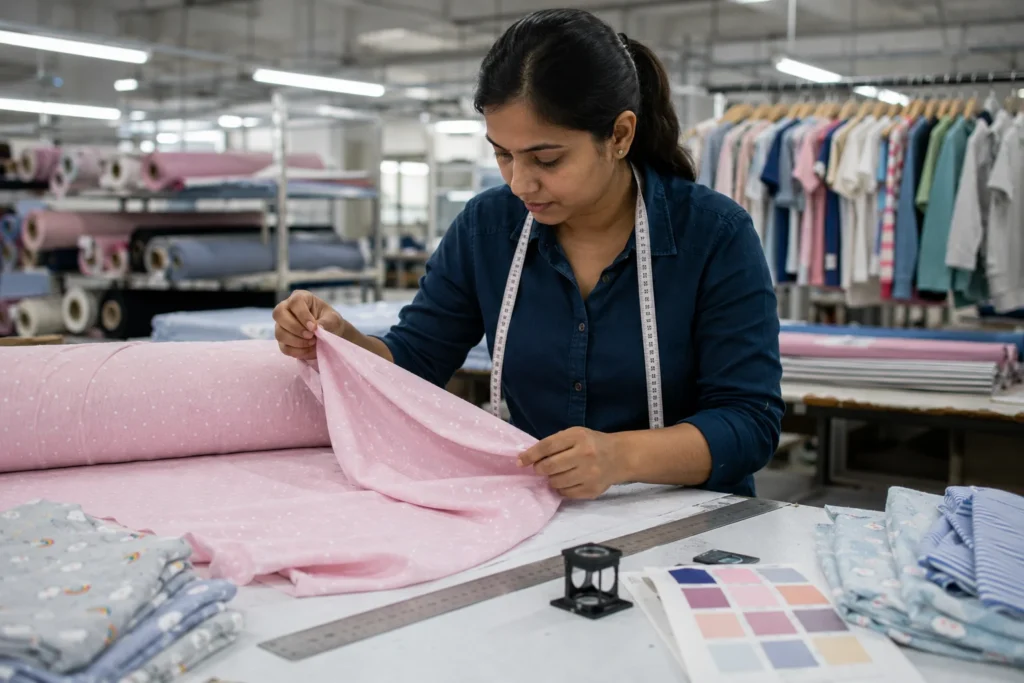
A fabric inspector examines cotton jersey before cutting and bulk production.
So when you request quantity-break pricing, do not send only the total order quantity. Send the estimated pieces per color as well.
3. Trims, Labels, and Packaging Have Their Own MOQs
Buttons, snaps, zippers, elastic, woven labels, printed labels, hangtags, patches, polybags, stickers, and cartons are all purchased from suppliers that have their own setup fees, minimums, and price brackets.
At 1,000 pieces, a custom woven label or molded trim may carry a disproportionately high setup allocation. At 5,000 pieces, the setup is spread more efficiently. At 10,000 pieces, the supplier may offer another small reduction, although the curve often starts flattening.
Custom hardware is where this becomes especially visible. A proprietary zipper pull, metal badge, snap, patch, or molded decoration can require tooling or programming that makes little economic sense at a very small volume.
When comparing kidswear unit cost across quantities, make sure the trim and packaging specification remains identical. A 10,000-piece quote is not genuinely cheaper if the factory changed the zipper, label quality, polybag thickness, or carton strength to get there.
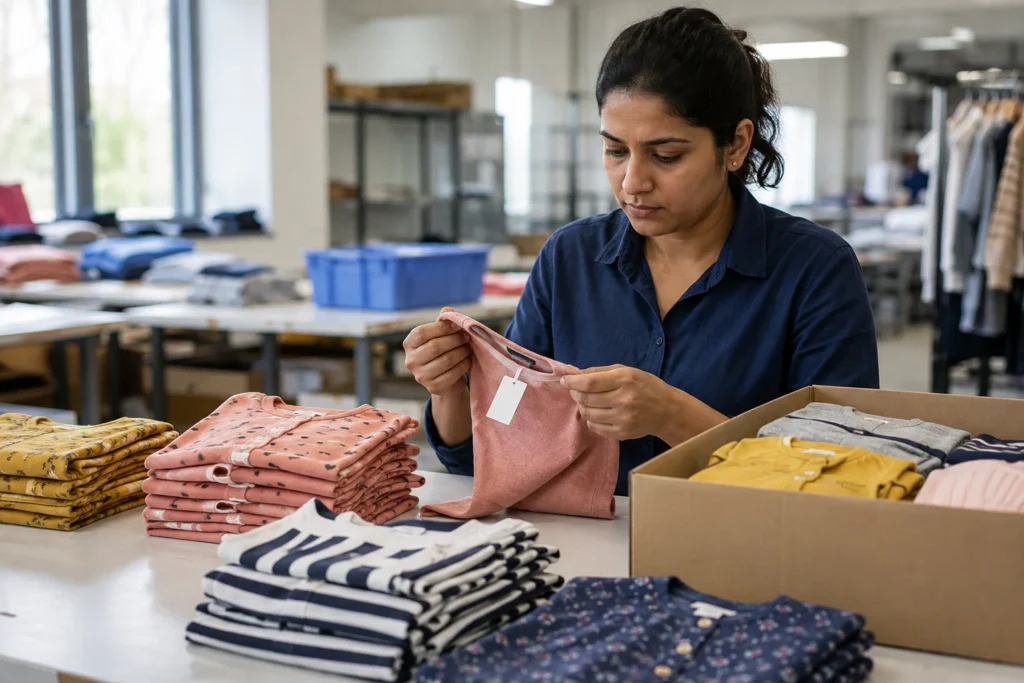
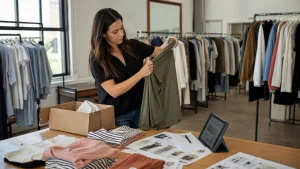
Garment and packing checks help keep trims, labels, and packaging specifications consistent.
4. Sewing Labor Gets More Efficient, but It Never Becomes Free
Labor is one of the areas where quantity negotiations often become unrealistic. If a garment takes a certain number of minutes to cut, sew, trim, press, inspect, and pack, increasing the order quantity does not eliminate those minutes.
What a longer run can do is reduce inefficiency around those minutes. Operators learn the construction. Machine settings stay unchanged for longer. The line leader improves balance. Fewer style changeovers occur. The QC team becomes familiar with the most common risk points.
That is why a labor line might move from $2.30 per piece at 1,000 units to $2.05 at 5,000 and $1.95 at 10,000 rather than falling by 50%. The factory gains rhythm, but somebody still has to make every garment.
5. Production-Line Changeovers Explain More Than Buyers Think
Before the first acceptable bulk piece comes off the line, the factory may need to change machine attachments, needles, folders, thread colors, tension settings, workstations, bundles, quality standards, and operator instructions.
On a 1,000-piece style, those setup hours are spread across a short run. On a 10,000-piece style, the same preparation supports far more production.
This is why one 10,000-piece style can sometimes be more factory-efficient than ten 1,000-piece styles, even when the total garment count is identical. From the buyer’s side, however, fewer styles also mean more inventory concentration. The cheapest factory plan and the safest merchandising plan are not always the same plan.
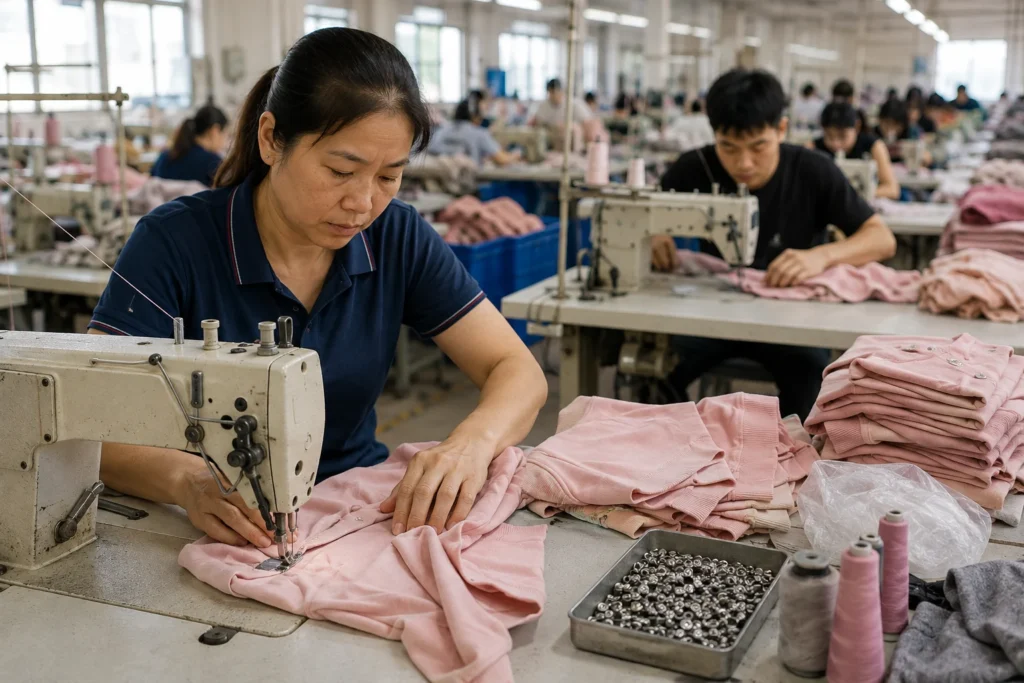
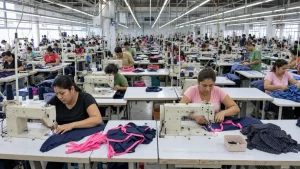
A stable sewing line supports more efficient bulk production as order volume increases.
6. Quality Control Becomes More Efficient Without Becoming Less Important
Strong kidswear QC starts before sewing and continues through materials, first-piece approval, in-line inspection, measurements, finishing, packing, and final release. Larger volume does not remove those controls.
The efficiency comes from allocation. The approved quality standard, first-piece review, measurement sheets, defect criteria, and inspector setup are spread over a larger quantity. Once the style is stable, inspection also becomes more predictable.
I would be cautious with any kidswear unit cost reduction that depends on cutting QC rather than improving production efficiency. Children’s products leave little room for false savings. If you are comparing suppliers as well as quantities, our guide to finding a kids clothing manufacturer explains the factory capabilities worth checking before you scale an order.
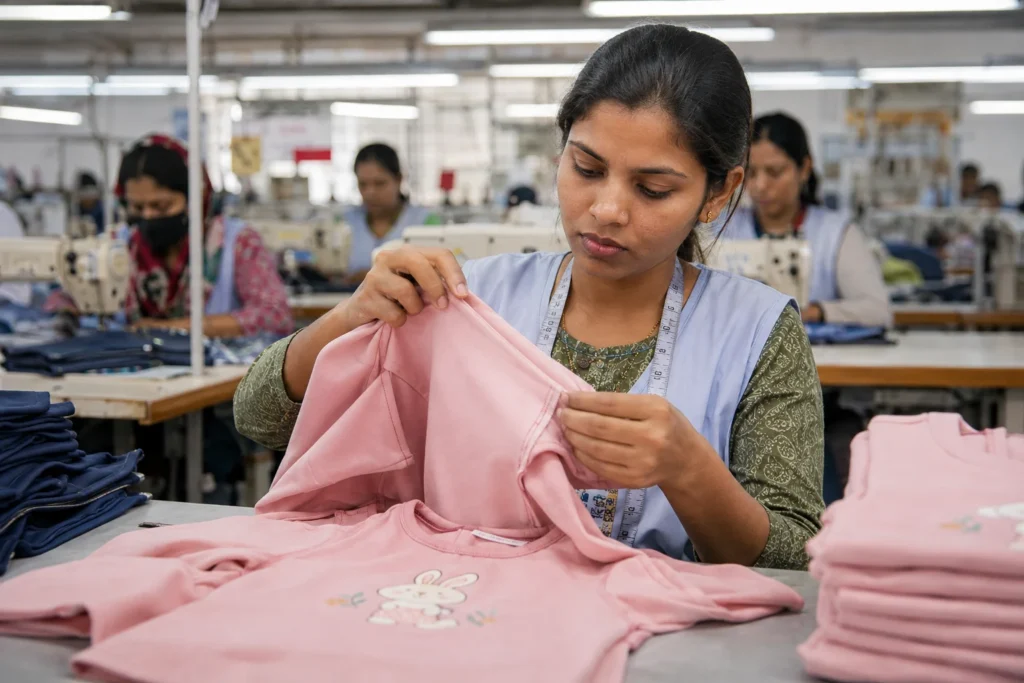
In-line QC focuses on garment construction, seams, stitching, and workmanship.
7. Compliance and Testing Costs Get Diluted Across Larger Orders
Testing is another good example of a cost that may be fixed by style, material, color, or test package rather than by piece. If a required testing program costs $600, the allocation equals $0.60 per garment at 1,000 pieces but only $0.06 at 10,000.
For children’s products sold in the United States, applicable products may require third-party testing and certification. The U.S. Consumer Product Safety Commission’s Children’s Product Certificate guidance explains the certification framework and the role of CPSC-accepted laboratories.
Labeling also belongs in your costing discussion. The Federal Trade Commission’s apparel and labeling guidance covers requirements such as fiber content, country of origin, responsible company identification, and care information for covered products.
If CPC documentation is relevant to your program, HAPA’s CPC certification guide for kidswear sourcing can help you frame the discussion with your factory and testing partners.
8. Printing, Embroidery, and Embellishment Create Separate Cost Curves
A basic jersey set and an embellished party dress do not scale in the same way. Decoration can add fixed setup costs, minimum batch sizes, and specialist processes that behave differently from sewing.
Screen printing may require screens and color setup. Embroidery may require digitizing and machine programming. Heat-transfer graphics may have minimum sheet quantities. Sequins, beads, appliqués, and patches may have custom-material MOQs. Garment washing or special finishing may be priced by batch.
At 1,000 pieces, those setup costs are noticeable. At 5,000, they are absorbed more easily. At 10,000, the process may become highly efficient—unless you split the quantity across several artworks or colorways and effectively recreate multiple small jobs.
9. The Size and Color Matrix Can Matter as Much as the Total Quantity
A purchase order that says “10,000 pieces” may sound simple, but the production team sees a matrix. Perhaps there are seven sizes and six colors. That is 42 size-color combinations before you even consider different packaging assortments.
Each combination affects cutting, bundling, measurement checks, labels, stock control, and packing. Extremely small quantities in fringe sizes can create disproportionate handling work.
If you want a reliable quote, provide the planned size ratio and color breakdown early. A factory can price 10,000 pieces much more accurately when it knows whether those units are concentrated or fragmented.
10. Lead Time Can Change the Savings
Volume helps only when the factory has enough time to plan it. A 10,000-piece order with a realistic delivery window may be efficient. The same order with an urgent ship date may require overtime, additional lines, expedited fabric, split production, or subcontracted processes.
Those measures can offset part of the volume advantage. This is why I would never compare quantity breaks without also asking whether the quoted lead time is the same.
11. Factory Price Is Not the Same as Landed Cost
A lower ex-factory or FOB price does not automatically produce a lower landed cost. Freight, insurance, tariffs, taxes, customs charges, destination delivery, and warehousing all affect what the inventory actually costs by the time it reaches you.
The U.S. Department of Commerce’s International Trade Administration guide to landed cost defines landed cost as the product price plus items such as insurance, freight, tariffs, taxes, and other fees. That is a useful framework when you compare 1,000-, 5,000-, and 10,000-piece options.
Freight per piece often improves as shipment utilization improves, but the curve is not perfectly smooth. A 5,000-piece order might fit efficiently into one shipping plan, while 10,000 pieces might push you into a second container, an additional delivery, or more warehouse capacity.
For that reason, I recommend comparing both the factory price and the estimated landed cost per piece.
What 1,000 Pieces Usually Means for a Buyer
A 1,000-piece run is often a sensible choice when you are testing a new style, opening a new market, placing a first order with a supplier, or working with uncertain demand. Your cash commitment and inventory risk are lower.
The trade-off is price. Development allocation is high, fabric and trim purchasing may be less efficient, and the factory has less opportunity to spread setup work.
If I were launching a new style at this volume, I would focus on learning. Did the fit work? Which colors sold? Which sizes moved? Did the fabric perform after washing? Were returns caused by product issues or by merchandising assumptions? Those answers can be worth more than forcing another few cents out of the first order.
What 5,000 Pieces Usually Means for a Buyer
Five thousand pieces often sits in a useful middle ground. It is large enough to make the manufacturing economics more attractive but still manageable for many growing brands.
This is often where kidswear unit cost shows its most visible improvement compared with a 1,000-piece run. Fixed costs are diluted sharply, material suppliers may move into better tiers, and the factory gets a longer, more stable production run.
The important question is whether the 5,000 pieces are concentrated. Five thousand pieces of one style in two colors may generate excellent efficiency. Five thousand pieces divided across five styles and five colors each can still behave like a collection of small jobs.
What 10,000 Pieces Usually Means for a Buyer
At 10,000 pieces, you usually have stronger leverage with the factory and material suppliers. The production plan is easier to schedule, the line runs longer, and setup costs become a very small percentage of each garment.
But this is also the quantity where buyers sometimes expect too much. If the factory already reached its best fabric tier at 5,000 pieces and the sewing minutes are unchanged, there may be only a modest further reduction.
The practical reality is that kidswear unit cost has a floor. Once the order is running efficiently, a much lower price normally requires a change somewhere else: fabric specification, trims, construction, packaging, delivery terms, or margin.
Why 5,000 and 10,000 Pieces May Sometimes Quote at the Same Price
Not every quantity increase unlocks a new price break. A factory may give you the same unit price at 5,000 and 10,000 pieces for perfectly legitimate reasons.
- The fabric mill already reached its best practical price tier at 5,000 pieces.
- The sewing minutes per garment do not change materially.
- The trims are already above their efficient MOQ.
- The larger order is fragmented across many colors or sizes.
- The factory is near capacity and the extra volume does not reduce overhead.
- The delivery schedule requires overtime or split shipments.
- The raw material is commodity-priced and volume has little influence on its market price.
When this happens, I would ask the supplier to explain which cost components have already reached their efficient level. That conversation is more useful than simply asking for another discount.
Why a 10,000-Piece Order Can Be More Expensive Than You Expected
Large orders create scale, but they also create risk if the commercial conditions are difficult. A rush order may require overtime. A complex color split may create extra dye lots. Multiple retailer pack-outs may add labor. Five shipment dates may create more warehouse handling than one shipment.
I have also seen buyers focus on total quantity while overlooking the number of distinct production batches they are really creating. If a 10,000-piece PO behaves operationally like several smaller POs, the expected scale saving will shrink.
This is why quantity should never be separated from complexity.
How to Request a Useful Quantity-Break Quotation
If you want to know what volume actually changes, ask the supplier to quote the same product at several quantities with the specification held constant.
- 1,000 pieces total;
- 5,000 pieces total;
- 10,000 pieces total;
- the same fabric composition and weight;
- the same garment construction;
- the same trims and labels;
- the same printing, embroidery, or decoration;
- the same packaging;
- the same quality standard;
- the same destination market and testing assumptions;
- the proposed color split and size ratio;
- the same delivery terms and shipment structure.
Then check what the quote excludes. Sample charges, testing, artwork setup, mold fees, freight, cartons, labeling, and customs costs may be handled differently from supplier to supplier.
That is the cleanest way to compare kidswear unit cost without accidentally comparing different products.
Do Not Order 10,000 Pieces Just to Win a Lower Unit Price
This is the commercial side of the discussion that matters most. A lower price per garment is valuable only if you can sell the garments.
Suppose the 5,000-piece quote is $7.55 and the 10,000-piece quote is $6.97. The larger order saves $0.58 per unit. That looks attractive—but it also requires you to buy another 5,000 units. If those units sell quickly, the decision may be excellent. If they need markdowns, long storage, or liquidation, the manufacturing saving can disappear.
When I compare quantities, I prefer to look at three numbers together: unit cost, total cash commitment, and expected sell-through. The best order quantity is the one that supports the business, not simply the one that produces the lowest line on a factory quotation.
A Practical Growth Strategy: Scale the Proven Styles
For a newer brand, staged volume can be a smarter route than jumping straight to 10,000 pieces. You might begin with 1,000 pieces to validate the product, move to 5,000 when demand is proven, then place 10,000-piece repeat orders once the style has stable sell-through.
This approach also gives the factory useful history. The pattern is already approved. Measurement issues have been resolved. Fabric performance is known. Packaging has been tested in real logistics. Repeat production becomes easier to control.
In other words, you are not just buying more units. You are scaling a production system that has already learned.
OEM, ODM, and Private Label Orders Do Not Scale the Same Way
A private-label order based on an existing supplier style usually carries less development work, so the difference between 1,000 and 5,000 pieces may come mainly from materials, trims, and production efficiency.
An ODM order may require more design and customization, while a full OEM program built from your own tech pack can involve new patterns, grading, samples, special fabrics, custom trims, testing, and packaging development.
That means the fixed-cost component can be more visible at low volume on OEM projects.
If you are deciding which sourcing model fits your program, HAPA’s private label clothing manufacturing guide provides useful context on the level of customization and development involved.
How We Think About Quantity and Cost at HAPA
From a factory perspective, a useful quotation starts with the actual product, not just the requested quantity. We need to understand fabric consumption, material source, trims, sewing operations, decoration, sampling, QC requirements, packaging, color split, size range, destination market, testing expectations, and delivery timing.
That is why two orders for 5,000 pieces can have completely different cost structures. A simple jersey set in two colors is not the same manufacturing job as a fully lined party dress with sequins, custom embroidery, multiple specialty trims, and five colorways.
When we discuss kidswear unit cost with a buyer, the most productive conversation is usually not “How low can the number go?” It is “What is driving the number, and what changes if the quantity changes?” Once you can answer that, the quotation becomes much easier to evaluate.
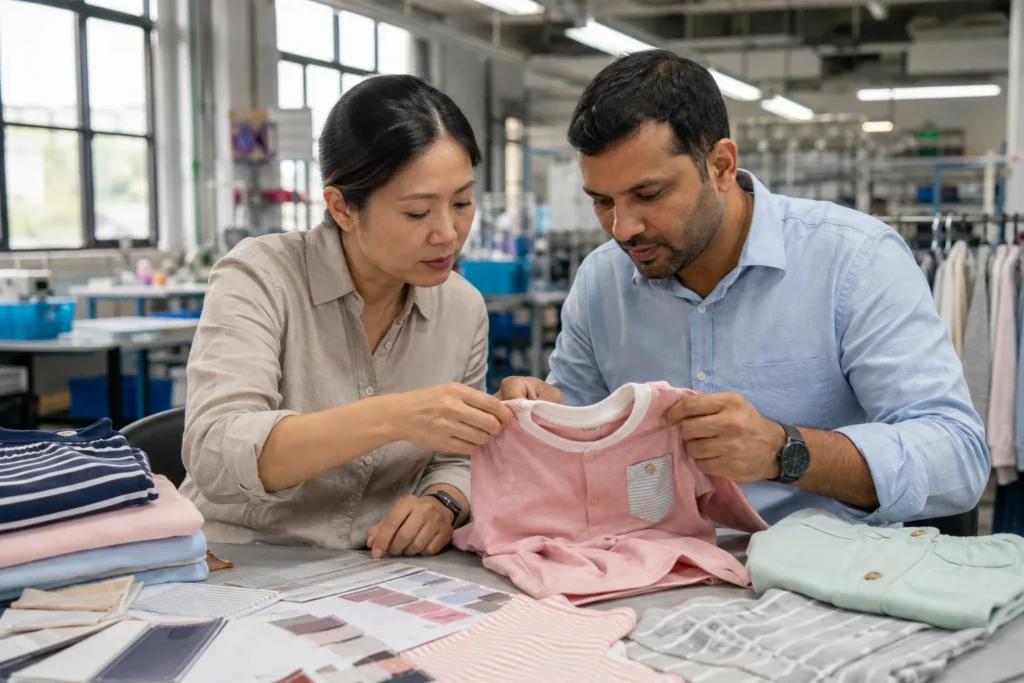
A buyer and supplier review garment construction and material details during a sourcing discussion.
Questions I Would Ask Before Moving From 1,000 to 5,000 or 10,000 Pieces
- Which parts of the quotation become cheaper at the higher quantity?
- Does the fabric price change because I reach a new mill or dye-lot threshold?
- How many colors can I order before I lose the volume advantage?
- Are the trims, labels, and packaging identical at every quantity?
- Are testing, sample, artwork, or tooling charges included or separate?
- Does the larger order change the production lead time?
- Will the order run on one line or several lines?
- Does the price assume one shipment or multiple deliveries?
- What color and size breakdown does the price assume?
- At what quantity is the next meaningful cost break?
Final Takeaway: Buy the Quantity That Improves the Whole Business
For many kidswear programs, moving from 1,000 to 5,000 pieces produces the most visible improvement in manufacturing economics. Moving from 5,000 to 10,000 pieces can reduce the price further, but the percentage saving is usually smaller because the major setup and purchasing efficiencies have already been captured.
The best way to manage kidswear unit cost is to understand the cost structure behind it. Fixed development expenses shrink quickly per unit. Fabric, trims, and packaging may improve when you reach better supplier tiers. Sewing and QC become more efficient but do not disappear. Testing costs can be spread over more pieces. Color fragmentation, size complexity, rush schedules, and multiple shipments can reduce the expected benefit.
If you are comparing 1,000-, 5,000-, and 10,000-piece options, ask for all three quotations against exactly the same specification. Then compare the unit price alongside total order value, inventory exposure, landed cost, delivery timing, and expected sell-through.
The most profitable order is not automatically the one with the lowest factory price per piece. It is the order that gives you the right balance of manufacturing efficiency, product quality, cash-flow control, and inventory confidence.