Sourcing apparel overseas can feel like a high-stakes gamble, especially once you’re navigating one of the world’s largest production hubs. Bangladesh has spent the past decade moving well past its early reputation, building itself into a genuine leader in both manufacturing scale and sustainable production.
Even so, finding a reliable clothing manufacturer in Bangladesh takes more than a quick directory search. If your brand or boutique is trying to protect healthy margins while meeting strict quality and safety standards, choosing the wrong supplier can derail an entire season before it even starts.
To help you cut through the noise and reduce that supply chain risk, we’ve mapped out ten well-established garment factories in Bangladesh — including the single largest player in the country. Here’s who they are, what they specialize in, and how to approach them effectively.
Why Bangladesh Is a Global Hub for Apparel Sourcing
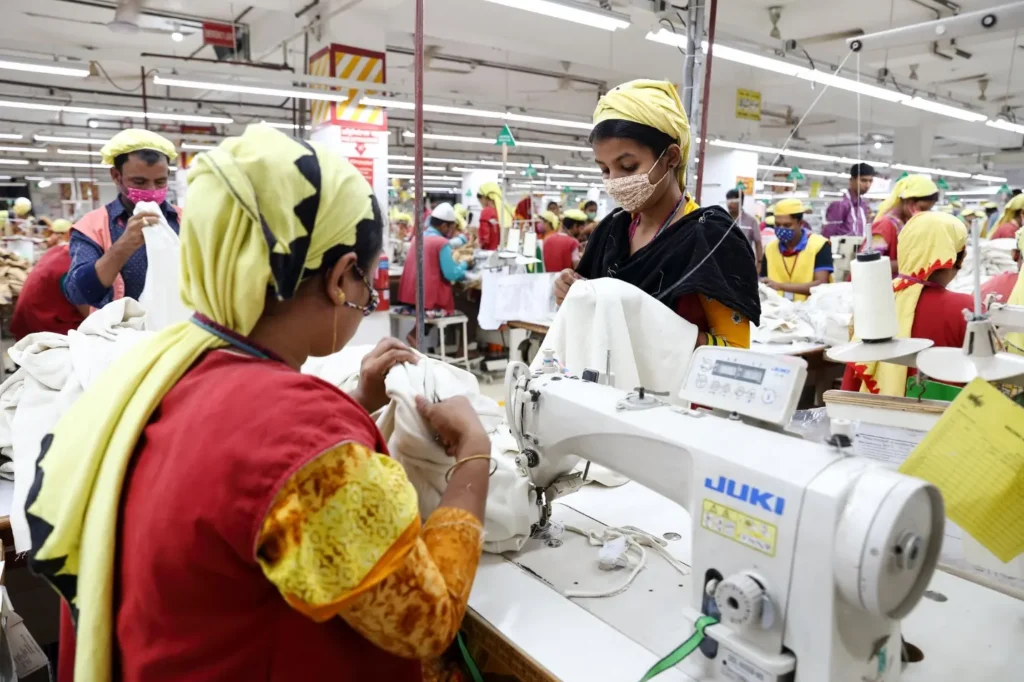
Beyond competitive pricing, Bangladesh has built an entire infrastructure dedicated to garment production. For apparel brands, that means real scale, deep category expertise, and a growing commitment to greener manufacturing.
- Competitive pricing — Labor costs remain among the lowest in Asia, which keeps Bangladesh especially strong for high-volume, cost-sensitive product categories.
- Massive production scale — Many facilities are built for high-volume output, making them well suited to large seasonal rollouts and core basics programs.
- Vertical integration — A number of suppliers weave their own fabric and dye it in-house, which tightens quality control and shortens overall lead times.
- Green manufacturing — Bangladesh hosts more LEED-certified green factories than any other country in the world, which lines up well with the sustainability commitments many brands now operate under.
- Duty-free advantages — Favorable trade agreements often grant duty-free access to major markets like the EU, which can meaningfully lower your landed costs.
- Specialized expertise — Decades of focused production have built up genuine depth in categories such as denim, knitwear, and outerwear.
- Stricter safety compliance — Following industry-wide reforms, established factories now operate under more rigorous international safety audits and compliance frameworks.
If you’re still weighing Bangladesh against other sourcing destinations, our breakdown of which country is best for clothing manufacturing is worth a read before you commit to one region.
What Types of Apparel Manufacturing Does Bangladesh Specialize In?
Bangladesh’s manufacturing strengths aren’t spread evenly across every product category. This table can help you quickly judge where the country genuinely excels — and where it’s worth weighing your options more carefully.
| Category | Typical Products | Bangladesh’s Competitive Edge | Buyer Considerations |
|---|---|---|---|
| Basic Knitwear | T-shirts, polo shirts, hoodies, sweatshirts, long-sleeve tops | One of the world’s largest producers; strong price-to-volume ratio for jersey basics | Best suited to high-volume, repeat orders; less ideal for highly technical knit constructions |
| Denim | Jeans, denim jackets, shorts, skirts, overalls | A strong denim cluster with competitive fabric sourcing and finishing capability | Washing and finishing quality varies — always request samples before committing to bulk |
| Woven Shirts & Blouses | Dress shirts, casual shirts, blouses, tunics | Deep experience in woven construction; reliable across mid-to-large order volumes | Fine tailoring and complex pattern work may need more rigorous pre-production vetting |
| Outerwear | Lightweight jackets, padded vests, windbreakers, parkas | A growing sector with improving technical capability, competitive on simpler styles | Multi-layer technical shells are often better sourced from more specialized markets |
| Activewear & Athleisure | Leggings, sports bras, gym shorts, performance tees | Expanding quickly; many factories have invested in performance fabric handling | Verify fabric sourcing and stretch-recovery specs carefully, as capability varies by factory |
| Children’s Wear | Kids’ basics, school uniforms, infant sets, casual playwear | Strong in volume-driven children’s basics; familiar with common juvenile safety requirements | Confirm compliance with destination-market children’s safety standards (e.g., CPSIA, EN 14682) |
| Workwear & Uniforms | Corporate uniforms, PPE garments, safety workwear | Reliable for standardized, functional garments at scale | Functional and safety specifications must be clearly documented and independently verified |
| Underwear & Innerwear | Briefs, boxer shorts, bras, undershirts | Competitive for basic innerwear categories with high output capacity | Fabric composition and skin-contact safety testing are non-negotiable for this category |
| Sweaters & Knitwear | Pullovers, cardigans, knit dresses | An established knitwear sector, particularly strong around Dhaka | Gauge, yarn quality, and construction complexity should be confirmed at sample stage |
The Top 10 Garment Factories in Bangladesh
1.Ha-Meem Group — Best for Large-Volume Woven Bottoms, Shirts & Jackets
Website: hameemgroup.net | Founded: 1984
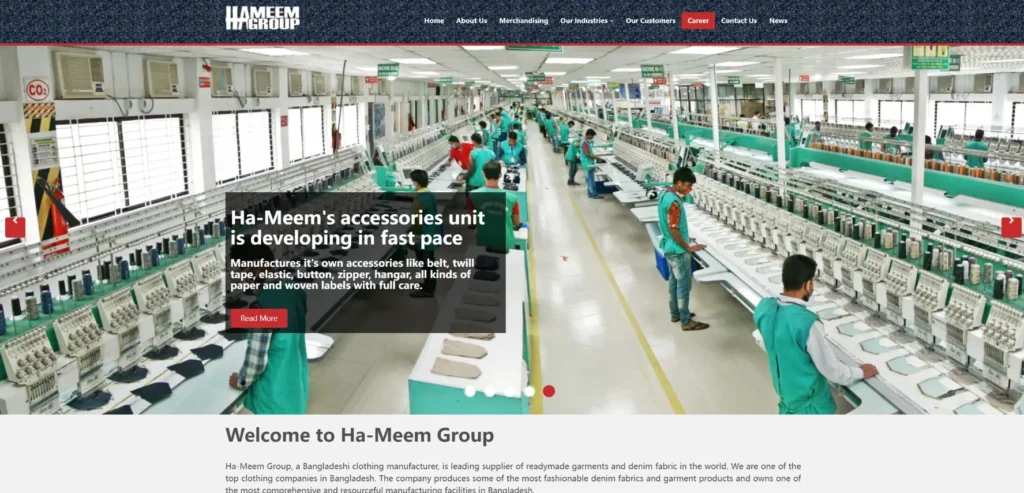
Ha-Meem Group is one of Bangladesh’s largest garment conglomerates, running 26 garment factories alongside sweater, poly bag, label, and chemical formulation units. Estimates put its workforce at 50,000–75,000 across 300+ production lines and 7 washing plants, with output of roughly 7 million pieces per month. Beyond garments, the group has diversified into tea estates, transport, and media.
Key Products: Woven trousers, jeans, shirts, jackets, and activewear
Best Suited For: Enterprise-level brands and major retailers placing orders of 5,000+ pieces per style. It’s generally not a practical fit for startups or boutique buyers, given its scale and internal order-priority systems.
Pros
- Genuine scale — one of the few groups capable of fulfilling massive, multi-style seasonal programs
- Long-standing relationships with major global brands point to mature compliance and QC systems
- In-house washing and finishing reduces subcontracting risk for those processes
Cons
- Small or first-time orders are unlikely to receive priority attention
- Group size means less buyer-specific flexibility than at boutique-friendly factories
- Public figures on current headcount and revenue vary by source (estimates range from 50,000–75,000 employees)
2.Youngone Corporation — Best for Outdoor, Performance & Technical Apparel
Website: youngonecorporation.com | Founded: 1974
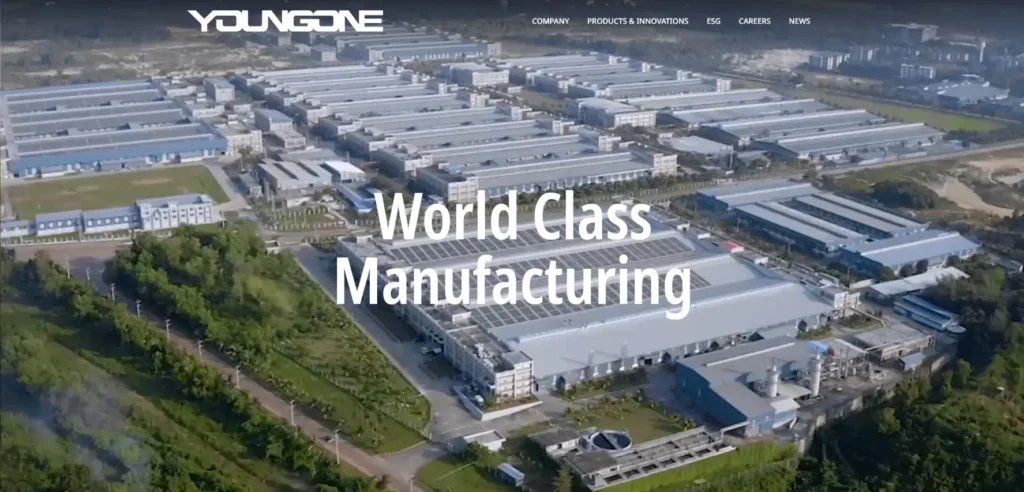
Youngone is a Korean-founded performance and outdoor apparel, footwear, and bag manufacturer with major production hubs in Bangladesh, Vietnam, China, El Salvador, Uzbekistan, and Ethiopia. In Bangladesh, it operates around 42 green-certified factories employing roughly 70,000 people (about 70% female), structured around the Korean EPZ model. The company is recognized for technical fabric innovation — including patented insulation and weatherproofing technologies — and has exported items priced as high as $1,800+ per unit to premium outdoor brands.
Key Products: Down jackets, technical outerwear, performance sportswear, footwear, and bags
Best Suited For: Mid-to-large outdoor, technical, and performance-wear brands that need advanced fabric handling — waterproofing, insulation, bonded seams — rather than basic cut-and-sew apparel.
Pros
- Genuine technical manufacturing expertise rather than generalist cut-and-sew capability
- EPZ-based operations offer customs and export efficiency advantages
- A manufacturing footprint spanning multiple countries reduces single-country risk for buyers working with Youngone’s broader group
Cons
- Its focus on technical/performance categories makes it a weaker fit for basic apparel buyers
- As a Korean conglomerate with Bangladesh as one of several manufacturing bases, smaller buyers may find it harder to secure priority attention than at a Bangladesh-headquartered factory
- Premium technical capability typically comes with premium minimum-order economics
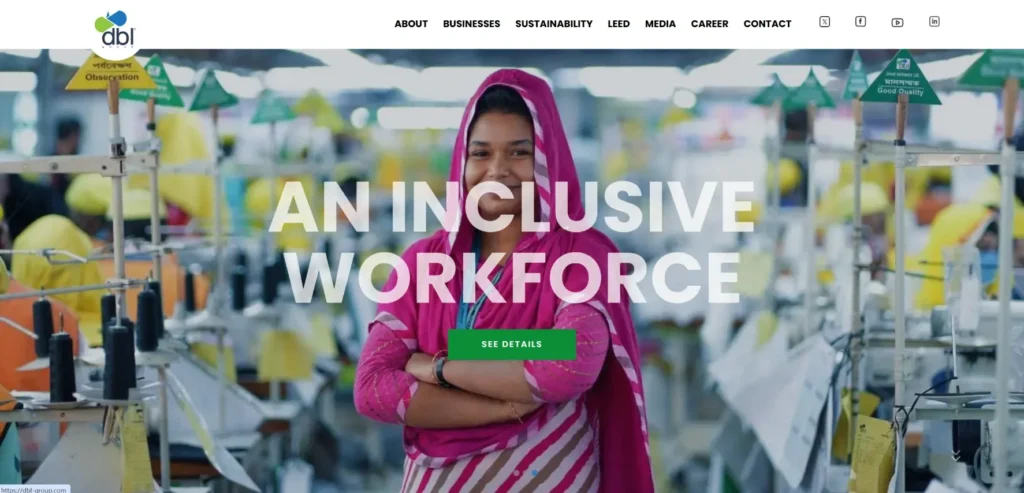
3.DBL Group — Best for Vertically Integrated Knitwear & Sustainable Sourcing
Website: dbl-group.com | Founded: 1991
DBL Group is one of the more vertically integrated knit apparel manufacturers in Bangladesh, controlling production from yarn and fabric dyeing through to finished garments. The group employs upwards of 40,000 workers across more than 20 subsidiaries spanning apparel, textiles, packaging, ceramics, pharmaceuticals, and telecom. DBL has achieved LEED Platinum certification on multiple facilities and reports annual apparel exports in the $460–780 million range, depending on the fiscal year cited.
Key Products: Knit T-shirts, polo shirts, sweaters, jerseys, and sportswear
Best Suited For: Brands prioritizing sustainability credentials, supply chain traceability, and consistent knit quality — particularly those that want dyeing and fabric control rather than relying on third-party fabric suppliers.
Pros
- True vertical integration shortens lead times and improves quality consistency compared with factories that outsource dyeing
- Strong, verifiable sustainability credentials (LEED Platinum, IFC/Swedfund-backed financing)
- Established relationships with major brands (H&M, Puma, Hugo Boss, Walmart, and Zara are among those publicly cited), suggesting mature compliance systems
Cons
- The group’s non-garment businesses (ceramics, pharma, telecom) mean apparel is just one division — confirm exactly which DBL entity or factory you’d be contracting with
- Scale generally favors mid-to-large orders over small boutique runs
- Reported revenue and employee figures vary across sources and years; verify current numbers directly with the factory
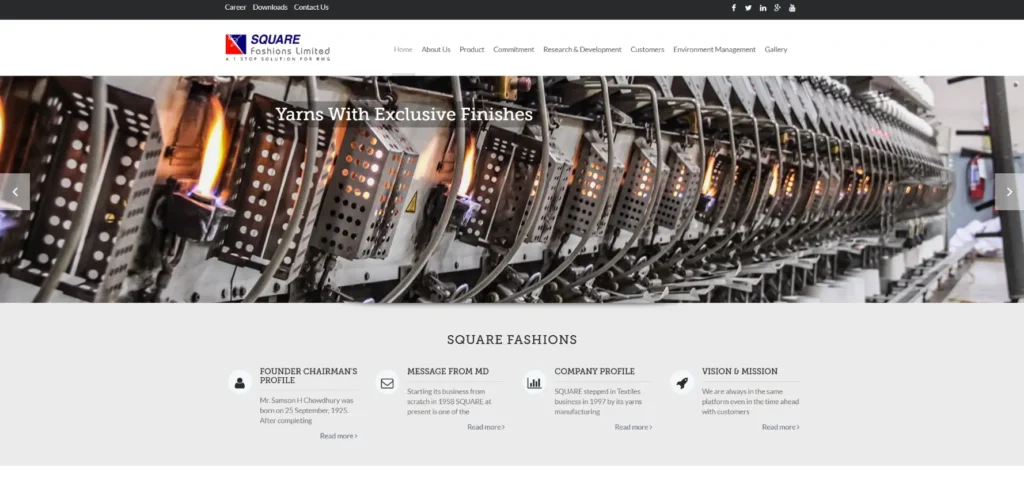
4.Square Fashions Limited — Best for Knit Apparel Backed by Vertically Integrated Yarn-to-Garment Production
Website: squarefashions.com | Founded: 2002
Square Fashions Limited is part of the broader Square Group — one of Bangladesh’s largest diversified conglomerates, spanning pharmaceuticals, textiles, hospitals, and media, with overall group revenue near $1.5 billion and roughly 80,000 employees group-wide. Square Fashions itself runs two garment units and two fabric units, producing knit apparel and circular knit fabric certified to ISO-9002 and OEKO-TEX Standard 100.
Key Products: Polo shirts, T-shirts, tank tops, trousers, hooded jackets, cardigans, sportswear, undergarments, and kids’ wear
Best Suited For: Buyers who want the financial stability of a large, diversified conglomerate behind their factory relationship — particularly for knit programs that require fabric-to-garment consistency.
Pros
- Backed by one of Bangladesh’s most financially diversified and stable conglomerates, which reduces counterparty risk
- Vertical yarn-to-garment integration supports consistent fabric quality
- OEKO-TEX Standard 100 certification is directly relevant for buyers with chemical-safety requirements, including children’s wear
Cons
- As one division within a large conglomerate, buyers should confirm they’re dealing with Square Fashions Limited directly rather than a similarly named sister company (e.g., Square Apparels Ltd.)
- Less specialized in niche categories like denim or technical outerwear compared with dedicated specialists
- Production capacity figures aren’t always publicly disclosed; request current data directly
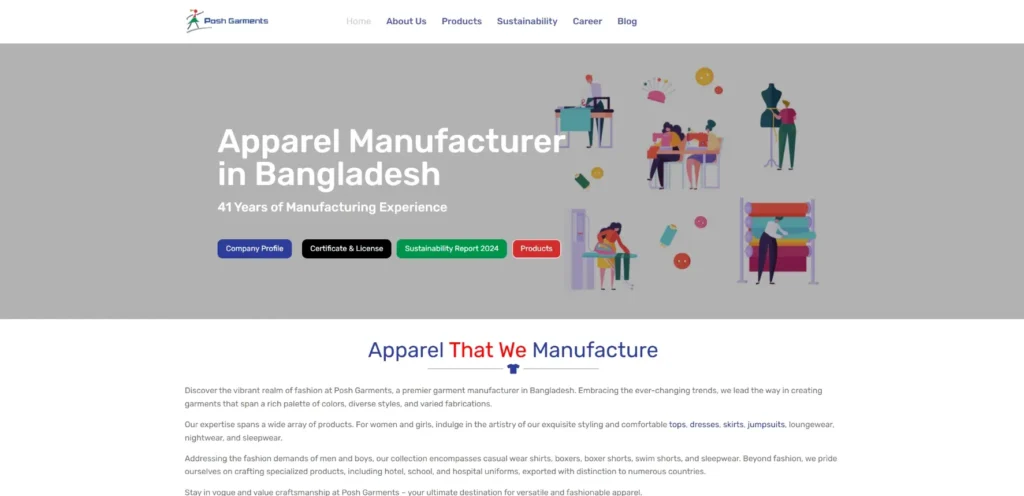
5.Posh Garments — Best for Women’s Fashion Wear, Children’s Clothing & Institutional Uniforms
Website: poshgarments.com | Founded: 1984
Posh Garments is a long-established, comparatively smaller manufacturer with roughly 1,200 production workers and 14 sewing lines, focused primarily on exports to Europe. Unlike the mega-groups on this list, Posh has stayed centered on value-added women’s, children’s, and institutional apparel rather than diversifying into unrelated industries.
Key Products: Women’s blouses, tops, dresses, skirts, lingerie, and nightwear; children’s shirts, gowns, and school uniforms; men’s casual shirts; hotel and hospital uniforms
Best Suited For: Boutique and mid-size brands in women’s fashion or children’s wear, and institutional buyers running uniform programs who need a factory sized for moderate order volumes rather than mass-market scale.
Pros
- Specialization in value-added, detail-intensive garments (smocking, pintucking, embellishment) rather than basic commodity items
- Smaller scale generally means more attentive service for mid-size orders than at the mega-groups
- A four-decade operating history demonstrates longevity without the complexity of a sprawling conglomerate
Cons
- Smaller production capacity means it can’t absorb very large enterprise-scale orders
- A historical orientation toward Europe may mean less established experience with North American compliance and documentation expectations — confirm directly
- As a single-focus apparel company without its own fabric or dyeing operations, lead times depend more on external suppliers
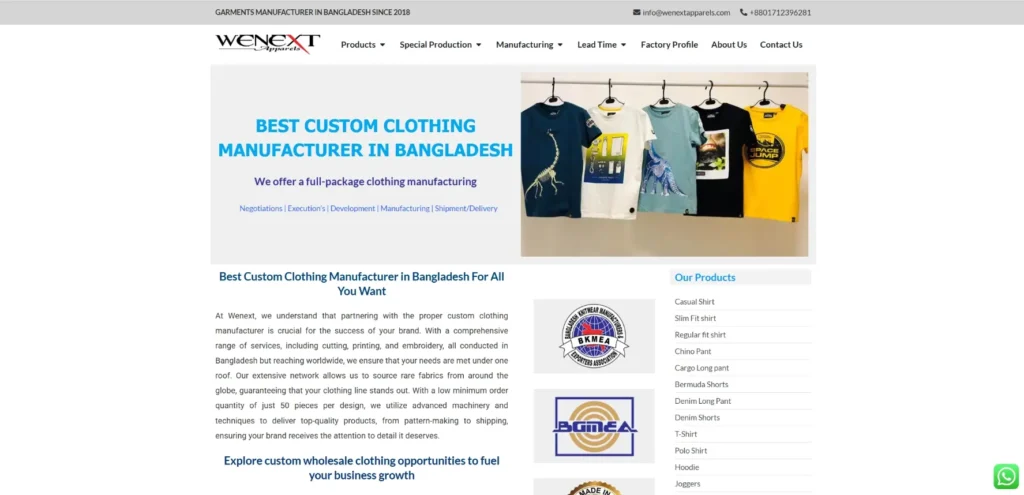
6.Wenext Apparels Limited — Best for Small-Batch & Startup-Friendly Custom Clothing
Website: wenextapparels.com | Founded: 2013–2014
Wenext is explicitly positioned as a small-to-medium quantity manufacturer for buyers who can’t meet the MOQ thresholds of larger factories. It runs a modest setup of three to five production lines (knit, woven bottoms, woven shirts/tops) plus a dedicated cap-manufacturing unit, with daily capacities in the hundreds to low thousands of pieces per line — and advertises an “attractive MOQ” as a core selling point.
Key Products: Knit T-shirts, polo shirts, hoodies, sweatshirts, joggers; woven shirts, denim jackets, trousers, cargo shorts; caps and headwear
Best Suited For: Startups, first-time importers, and small e-commerce or boutique brands placing their first Bangladesh order — particularly those who can’t yet meet 1,000+ piece MOQs at larger factories.
Pros
- One of the few factories on this list explicitly built around low-MOQ, beginner-friendly sourcing
- Diversified product lines (knit, woven, caps) under one roof simplifies sourcing multiple item types from a single contact
- OEM and private-label experience suggests comfort working with brands that don’t yet have a fully developed tech pack
Cons
- Small scale means it can’t support large reorders or rapid scale-up without lead time
- As a younger, smaller company, publicly available compliance and audit history is thinner than at established mega-groups — request current documentation directly
- Limited public financial disclosure makes third-party verification harder than with listed conglomerates
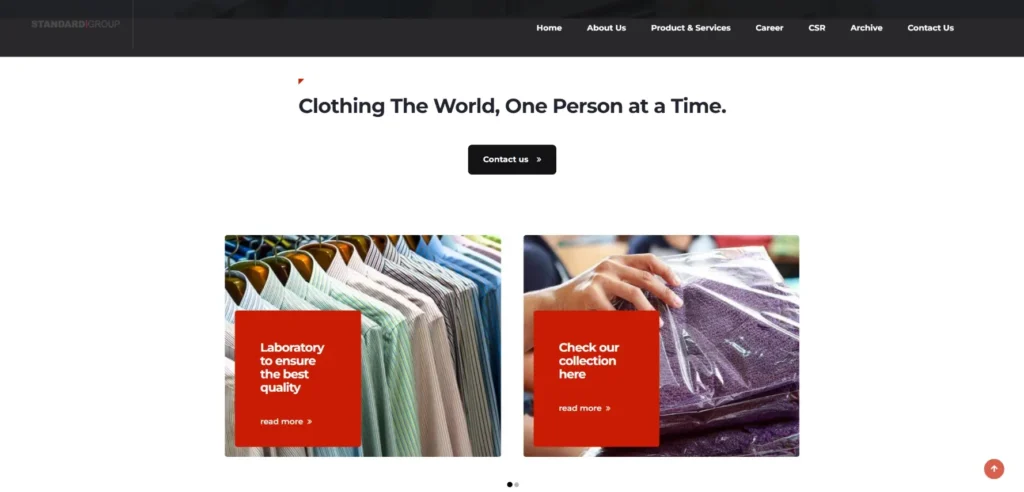
7.Standard Group — Best for Large-Scale Woven Garments & Sweaters With In-House Washing and Finishing
Website: standard-group.com | Founded: 1984
Standard Group operates roughly 19 factories with vertically integrated woven garment and sweater production, averaging around 150,000 pieces of woven output per day across 11 production sites near Dhaka. Its garment-washing plant is reportedly the largest in Bangladesh and second-largest in Asia. The group employs an estimated 40,000 people and reports annual revenue of around $418 million.
Key Products: Woven shirts, sweaters, and washed or specially finished garments
Best Suited For: Mid-to-large buyers needing washed or specially finished woven garments — denim-style washes, enzyme or bleach treatments — at volume, where in-house washing reduces dependency on third-party wash houses.
Pros
- Significant in-house washing and finishing capacity is a genuine differentiator, since this step is frequently outsourced elsewhere
- A four-decade operating history under continuous, identifiable leadership
- Comprehensive in-house services (printing, embroidery, design, testing, accessories) reduce the number of third parties in the supply chain
Cons
- A heavier orientation toward woven and sweater categories makes it a weaker fit for knit-focused buyers
- Scale means smaller orders won’t receive the same priority as enterprise accounts
- As with other large private groups, current third-party-audited compliance documentation should be requested directly rather than assumed from reputation alone
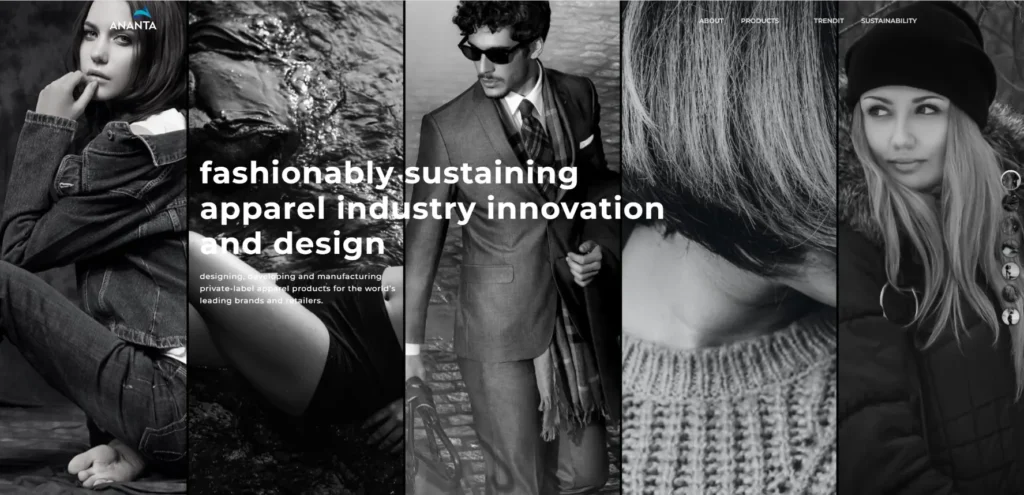
8.Ananta Group — Best for Sustainable Woven RMG & Leather Goods Manufacturing
Website: ananta-bd.com | Founded: 1992
Ananta is a 100% export-oriented woven RMG and leather goods producer running five RMG, washing, and leather plants with over 5,000–7,000 modern machines. It employs roughly 15,000–16,000 workers and produces an estimated 1.4–2.5 million pieces per month. The group has achieved LEED certification from the U.S. Green Building Council on multiple facilities and reports annual exports in the $450–466 million range.
Key Products: Trousers (denim, spandex, cotton), shirts, unlined jackets, overalls, shorts, school uniforms, plus leather bags, wallets, and accessories
Best Suited For: Mid-to-large woven apparel brands with sustainability commitments built into their sourcing criteria, and buyers interested in combining apparel and leather goods sourcing through a single group.
Pros
- Verifiable LEED certification across multiple facilities, useful for brands needing to substantiate sustainability claims to retail partners
- Established relationships with recognizable brands (GAP, H&M, George, and Joe Fresh are among those publicly cited)
- Combined apparel and leather goods capability is relatively unusual and may simplify sourcing for buyers needing both categories
Cons
- A woven-only focus, with no significant knit capability, limits its fit for knitwear-focused buyers
- Multiple Ananta-affiliated web domains and sister companies exist, so confirm exactly which legal entity you’re contracting with
- Its mid-size scale sits between boutique factories and the largest mega-groups — confirm MOQ expectations align with your order size before engaging
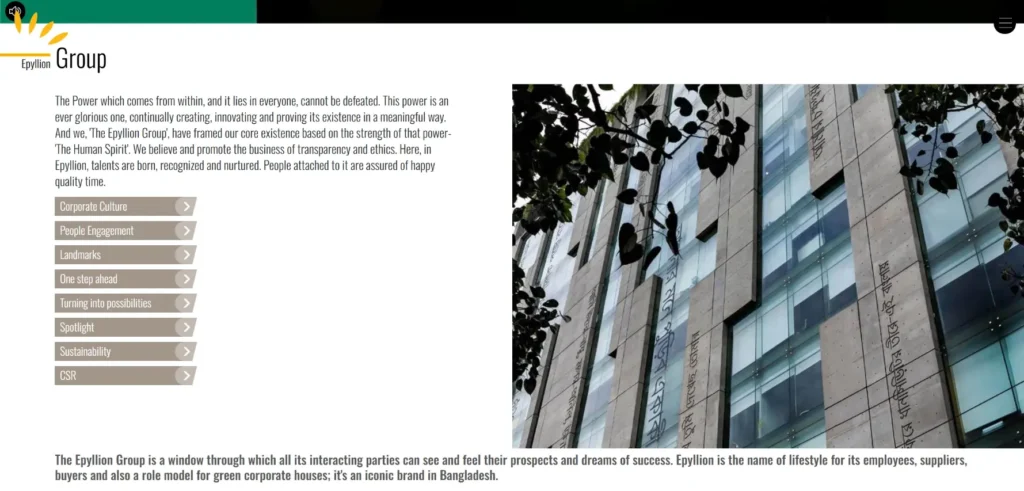
9.Epyllion Group — Best for Vertically Integrated Knitwear With In-House Testing and Compliance Infrastructure
Website: epylliongroup.com | Founded: 1994
Epyllion Group began as a knit RMG exporter and has since built vertical integration across textiles, wet processing, garment printing and embroidery, washing, and an in-house fabric testing laboratory. The group has also launched its own retail brand (“Sailor”) and reports WRAP, BSCI, and SEDEX compliance certifications. Operations are spread across Dhaka, Gazipur, and Narayanganj.
Key Products: Knit apparel across multiple categories, supported by in-house fabric, dyeing, and testing capability
Best Suited For: Knit-focused buyers who want a factory with in-house quality testing infrastructure — rather than relying solely on third-party labs — and an established, multi-decade compliance track record.
Pros
- An in-house testing laboratory is a genuine differentiator for buyers concerned about fabric and chemical-safety verification turnaround time
- Multiple recognized compliance certifications (WRAP, BSCI, SEDEX) reported
- Vertical integration from yarn dyeing through to finished, tested garments
Cons
- A knit-only specialization means it’s not a fit for woven-garment-focused buyers
- The company has expanded into retail and food and beverage, so confirm current management focus and capacity allocation for export RMG specifically
- Detailed, current production capacity (pieces per day) isn’t consistently published; request it directly
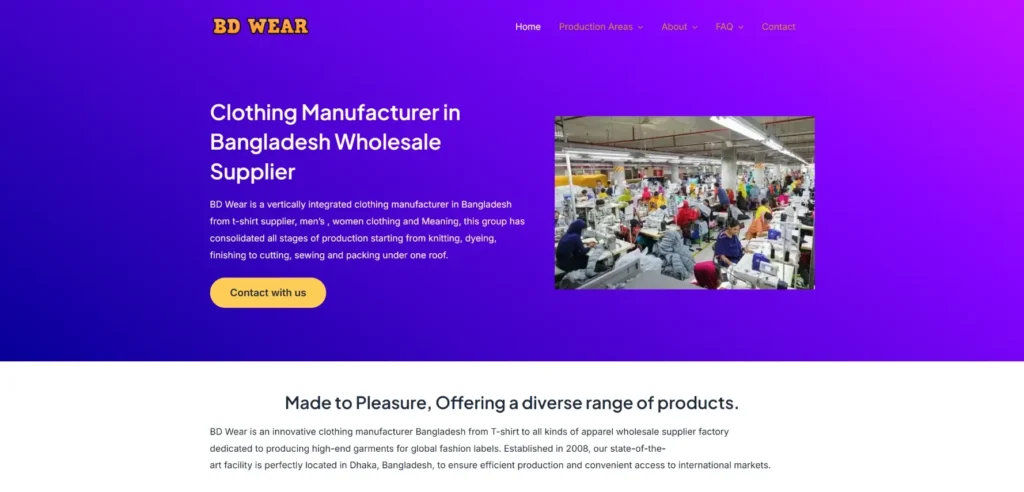
10.BD Wear — Best for Small-to-Mid Volume T-Shirt & Basics Manufacturing
Website: bdwear.com | Founded: 2008
BD Wear is a Dhaka-based manufacturer built around T-shirts and apparel basics for global fashion labels, emerging designers, and wholesale buyers. The company markets itself around eco-friendly production methods and sustainable sourcing, and is generally considered one of the more accessible factories for buyers without enterprise-level order volumes.
Key Products: T-shirts and basic apparel items, plus broader custom clothing wholesale capability
Best Suited For: Small-to-mid volume buyers — particularly streetwear, basics, and private-label T-shirt brands — looking for a more boutique-scale relationship than the mega-groups on this list offer.
Pros
- Specialization in T-shirts and basics simplifies evaluation for buyers in that specific category
- Positioned and marketed toward smaller, emerging-brand buyers rather than enterprise accounts only
- A stated focus on eco-friendly production may suit sustainability-conscious basics brands
Cons
- A narrower product specialization means less suitability for buyers needing complex constructions, such as tailored woven garments or technical outerwear
- Limited independent third-party verification data is publicly available, so verify registration and certifications directly before placing a deposit
- Smaller scale means longer lead times should be expected during peak seasonal demand compared with larger, multi-line factories
Who Is the Largest Clothing Manufacturer in Bangladesh?
If you’re researching the absolute peak of the country’s production capacity, you’ll inevitably run into the industry giants handling the bulk of the world’s fast fashion and large retail programs. Currently, the title of the largest clothing manufacturer in Bangladesh belongs to the Ha-Meem Group.
Spotlight: Ha-Meem Group
Ha-Meem Group operates on a scale that’s genuinely difficult to picture until you see their industrial parks firsthand. With a workforce of over 50,000 people, they produce roughly 7 million pieces of clothing every month. Their operation is a textbook example of vertical integration, controlling nearly every step of the supply chain — from weaving their own textiles to finalizing retail packaging.
Production Capacity and Specialties
While they have the infrastructure to make almost anything, Ha-Meem is best known globally for denim and woven goods, maintaining some of the most advanced, high-capacity denim washing plants in South Asia. If you’ve bought a pair of jeans or a woven button-down from a major global retailer in the past five years, there’s a reasonably high chance it passed through a Ha-Meem facility.
Minimum Order Quantities (MOQs) for Mega-Factories
This scale shapes their entire business model. Titans like Ha-Meem build their infrastructure around brands such as Zara, Gap, and H&M, and their minimum order quantities reflect that. You can’t approach a factory of this size for a 500-piece pilot run — production lines here are typically optimized around MOQs of 10,000 to 50,000+ units per style and colorway just to start a run.
Is the Largest Factory Right for Your Brand?
A common mistake among emerging brands and mid-sized e-commerce retailers is assuming they need to go straight to the biggest factory to get the best pricing. In reality, partnering with the absolute largest clothing manufacturer in Bangladesh is often a strategic misstep unless your purchase orders genuinely match their target volume. If your brand doesn’t have the purchasing power to command a mega-factory’s attention, your production will constantly be pushed behind multi-million-dollar orders from their anchor clients.
How to Find a Clothing Manufacturer in Bangladesh
Finding the right production partner means working across several distinct sourcing channels rather than relying on just one. Below are the methods that tend to work best.
B2B wholesale platforms
Alibaba and Global Sources are standard starting points for China, but they only tell half the story in South Asia. You’ll find trading companies on these platforms, but the largest Bangladeshi factories rarely maintain active storefronts there. Use them as a starting point, but always verify whether you’re speaking to the actual factory or a middleman. For a deeper walkthrough of vetting suppliers properly, see our complete guide on how to find clothing manufacturers.
Direct outreach via LinkedIn and corporate sites
Because many top-tier facilities are better at production than digital marketing, direct outreach matters more here than elsewhere. Skip generic info@ emails and use LinkedIn to find the Head of Sourcing or Merchandising Manager at specific factories — these are the people who actually manage production capacity and new buyer profiles.
Attending international sourcing trade shows
Face-to-face meetings build trust faster and bypass corporate communication silos. Bangladeshi manufacturers frequently exhibit at major global events, including Texworld (Paris and New York), Sourcing at MAGIC (Las Vegas), and the Dhaka Apparel Summit. Walking the floor gives you a chance to evaluate fabric samples and negotiate terms directly.
Leveraging local garment associations
The Bangladesh Garment Manufacturers and Exporters Association (BGMEA) maintains comprehensive, vetted member directories. Searching these official databases helps ensure you’re contacting legally registered, compliant entities rather than unverified middlemen — and it’s a reliable channel for finding mid-sized specialists matched to your category.
Partnering with sourcing agents and FPP agencies
If you don’t have an internal supply chain team, working with a Full Production Package (FPP) agency is a practical alternative. These agencies maintain established relationships with vetted factories, giving you Western-style communication and tighter quality control while still accessing favorable unit economics.
Industry referrals and professional networking
Sometimes the most reliable introductions come from within your own network. Speak with fellow brand owners or supply chain professionals who’ve already navigated the region — a warm introduction to a factory owner often skips lengthy onboarding and can unlock lower initial volume minimums.
Step-by-Step Process to Source from a Clothing Manufacturer in Bangladesh
Locating a factory is only the first hurdle. Actually executing an order takes a disciplined, structured approach to avoid costly miscommunication and quality failures.
Step 1: Define Your Product and Target Market
Before approaching a Bangladeshi facility, you must have absolute clarity on your product category, target price point, and expected volume. Because most local factories operate on scale, knowing your exact fabric requirements and volume tolerance dictates which tier of manufacturer will actually accept your business.
Step 2: Prepare Tech Pack and Sourcing Documents
Your tech pack serves as the universal language on the production floor. Ensure it includes a detailed Bill of Materials (BOM), precise construction callouts, graded measurement charts, and exact Pantone color codes. A vague tech pack practically guarantees misinterpretation and rejected samples.
Step 3: Build and Shortlist Suppliers
Never rely on a single supplier. Create a shortlist of three to five factories whose core competencies align with your product. Evaluate their initial communication speed, willingness to share compliance certificates (like BSCI or OEKO-TEX), and their historical experience with your specific garment category.
Step 4: Request Quotation and Samples
Submit your tech packs to your shortlisted candidates and request an FOB (Free on Board) quotation. Once pricing aligns with your margins, immediately order a physical prototype. Pay close attention to the lead time and execution of this initial fit sample, as it reflects their future bulk production standards.
Step 5: Verify Factory and Place Trial Order
Before signing a massive purchase order, verify the facility’s credentials. We highly recommend commissioning a localized third-party audit if you cannot visit in person. Once cleared, negotiate payment terms—typically 30% upfront and 70% upon completion—and initiate a trial order at their lowest acceptable MOQ.
Step 6: Manage Production, Inspection, and Shipment
Active oversight is essential once mass production begins. Always require a third-party AQL (Acceptable Quality Limit) inspection through an agency such as SGS or QIMA before releasing final payment. Once goods pass inspection, coordinate with your freight forwarder to move inventory by sea freight from Chittagong, or by air for tighter deadlines. For more detail on what actually happens on the production floor during this stage, see our walkthrough of the garment factory process.
Conclusion
Successfully sourcing apparel from Bangladesh comes down to matching your specific order volume with the right specialized factory — whether that’s a mega-group built for tens of thousands of units per style, or a smaller, startup-friendly manufacturer willing to work at lower MOQs. By combining targeted outreach, precise tech packs, and rigorous third-party quality inspections, you can navigate this manufacturing hub with confidence and build a supply chain that’s both stable and scalable. If you’re exploring options for your own private label or bulk apparel program, our team can help you think through which Bangladesh clothing manufacturer fits your specific volume and category — get in touch with Hapa Garments to talk through your next production run.
FAQ
How much does it cost to manufacture shirts in Bangladesh?
Costs vary widely based on fabric choice, construction complexity, order volume, and which factory tier you’re working with — mega-factories generally offer the lowest per-unit pricing, but only at high MOQs, while smaller factories charge more per piece in exchange for lower minimums. Always request a formal FOB quotation based on your specific tech pack rather than relying on general estimates.
Is it okay to buy clothes made in Bangladesh?
Yes, provided you’re working with a factory that meets recognized safety and labor compliance standards. Following industry-wide safety reforms, many established Bangladeshi factories now operate under stricter international audit frameworks, and verifying a factory’s current certifications (such as BSCI, WRAP, or SEDEX) before placing an order is the best way to confirm this for yourself.
Who is the top clothing manufacturer in Bangladesh?
Based on production volume and workforce size, Ha-Meem Group is generally considered the largest, producing an estimated 7 million pieces per month. That said, “best” depends heavily on your product category and order size — a smaller, specialized factory may be a far better fit than the largest one.
Is Zara made in Bangladesh?
Bangladesh is one of several countries where some Zara products are manufactured, alongside other major sourcing markets. Inditex, Zara’s parent company, sources from a global supplier network, and Bangladesh’s large woven and denim manufacturers are a known part of that broader supply chain.
How big is the clothing market in Bangladesh?
Bangladesh is one of the largest apparel-exporting countries in the world, with ready-made garments representing the vast majority of its total export earnings. The sector employs millions of workers across thousands of factories, ranging from small specialized units to massive vertically integrated groups like the ones profiled above.