If you’re comparing Chinese children’s clothing manufacturers, the difficult part is not finding names. China has thousands of apparel suppliers, sourcing companies, trading firms, specialist factories, and large full-package manufacturers. The difficult part is deciding which one can reliably make your product, at your quality level, for your target market.
I see buyers get stuck here all the time. A supplier may have an impressive website and a very attractive quote, yet neither tells you whether its pattern team understands children’s sizing, whether the factory can reproduce an approved sample consistently, or whether the team knows what documentation your market requires. On the other hand, a factory that looks less polished online may be technically excellent in one narrow product category.
So when someone asks me, “Can you recommend reliable Chinese children’s clothing manufacturers?” my answer is yes—but I would never choose from a ranking alone.
The companies in this guide are a practical shortlist based on their current public manufacturing information and product focus. They include HAPA Garments, MK Kids, TPC Textile, Hongyu Apparel, Appareify, AEL Apparel, Alamby Fashion, and Lezhou Garment. Because HAPA publishes this article, I also want to be transparent about our position: HAPA is one of the manufacturers being compared here. For every company—including us—you should still verify current capabilities, samples, commercial terms, compliance documents, and the actual production arrangement before committing to bulk production.
That is the approach I would use if I were sourcing for my own children’s brand.
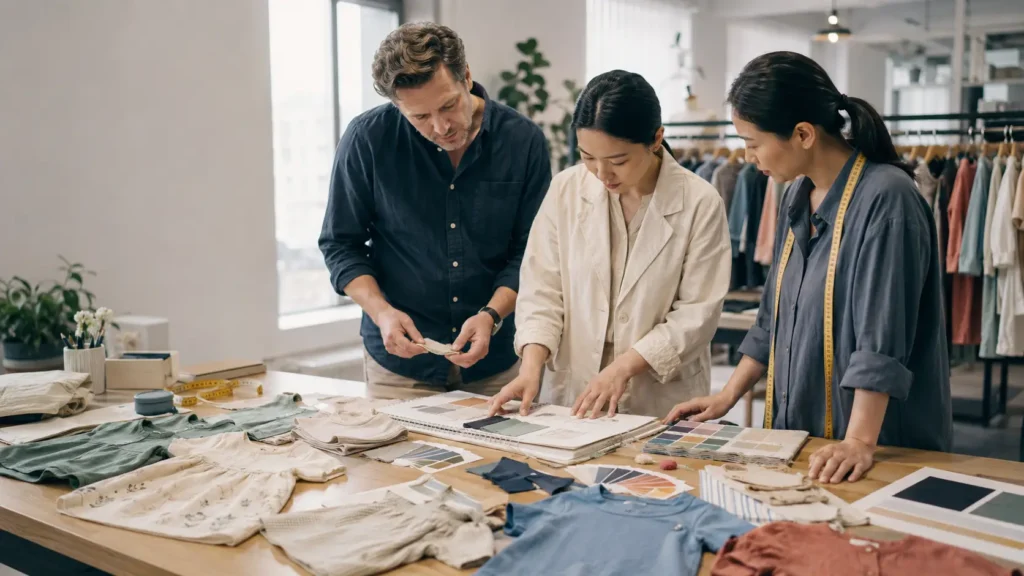
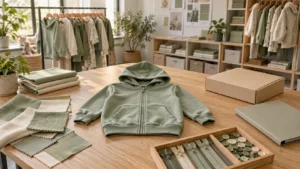
Children’s clothing development studio review
What “Reliable” Actually Means in Children’s Clothing Manufacturing
Reliability is not the same thing as “the sample looked good.”
A development sample is usually produced under close attention. The real test begins when the style moves to bulk. Can the factory keep the neckline shape stable? Can it control shrinkage? Do pockets stay symmetrical across the size range? Does the embroidery sit in the same position on 2T and 8Y? Are decorative components attached consistently? Can the production team keep using the latest approved pattern and specification instead of an older version?
When I evaluate Chinese children’s clothing manufacturers, I look at reliability across the entire workflow:
- Product-category experience
- Tech-pack review
- Pattern making and size grading
- Fabric and trim sourcing
- Sample accuracy
- Production planning
- In-line and final quality control
- Children’s product compliance awareness
- Label and packaging execution
- Export communication and documentation
- Reorder consistency
- Problem-solving when something changes
That last point matters more than buyers sometimes expect. Apparel manufacturing involves materials, machines, people, dye lots, pattern revisions, decoration processes, and logistics. Even well-managed projects can encounter an issue. A dependable supplier does not hide the problem or send a vague reassurance. It identifies the cause, proposes a measurable correction, and prevents the same issue from repeating.
If you want to understand what should happen between your design file and finished cartons, HAPA’s guide to the kids clothing manufacturing process gives a useful step-by-step reference for development, sampling, bulk production, inspection, and packing.
My Shortlist of Chinese Children’s Clothing Manufacturers
The following list is not presented as an independent certification of quality. It is a sourcing shortlist based on each company’s current official materials and stated manufacturing scope. Use it to decide who deserves a deeper conversation and sample order.
| Manufacturer | China Base / Presence | Strongest Fit to Investigate |
| HAPA Garments | Guangzhou | Custom children’s fashion, detailed styles, OEM/ODM, private label |
| MK Kids | China | Babywear, toddler apparel, nursery textile collections |
| TPC Textile | China operations | Kidswear, outerwear, functional and quality-focused programs |
| Hongyu Apparel | Dongguan | Custom apparel, startups, casualwear, mixed adult/kids collections |
| Appareify | Guangzhou / China | Scalable custom clothing, casual kidswear, private label |
| AEL Apparel | Shenzhen | Broad custom apparel with children’s clothing capability |
| Alamby Fashion | Southern China | Private-label fashion, sourcing support, family collections |
| Lezhou Garment | Dongguan | T-shirts, hoodies, sweatshirts, tracksuits, shorts and casual basics |
1. HAPA Garments — Best Fit to Investigate for Custom Kidswear and Detailed Designs
HAPA is based in Guangzhou and focuses on children’s apparel manufacturing. Our current public materials describe more than 16 years of OEM/ODM experience and support for custom product development, sampling, bulk production, private labeling, and quality control.
Where I believe a specialist children’s factory becomes most valuable is when a style contains several interacting details. A girls’ dress, for example, may combine lining, layered skirts, embroidery, sequins, a concealed zipper, ruffles, custom labels, and strict finished measurements. Each element can be produced correctly on its own and still create a poor garment if the pattern, weight distribution, seam construction, embellishment placement, or size grading is wrong.
HAPA is particularly relevant to buyers developing:
- Girls’ dresses and occasionwear
- Matching sets
- T-shirts and tops
- Hoodies and sweatshirts
- Pants and shorts
- Jackets and outerwear
- Sleepwear
- Baby and toddler apparel
- Embroidered garments
- Sequined, beaded, appliqué, or other detail-intensive styles
- Private-label collections
If you already have a tech pack or physical reference sample, our children’s clothing OEM service explains how HAPA approaches feasibility review, pattern development, sampling, materials, grading, and bulk execution.
Who I Would Recommend HAPA To
I would put HAPA high on the shortlist when your product is not simply a generic blank garment with a new logo. If your collection needs custom fit, specialized decoration, coordinated fabrics and trims, or several children’s categories under one program, a kidswear-focused development team can reduce the number of assumptions made during sampling.
That does not mean you should accept our claims without verification. Ask us for a sample. Review the measurements. Test the construction. Request current documentation relevant to your market. A manufacturer should earn the bulk order through the development process.
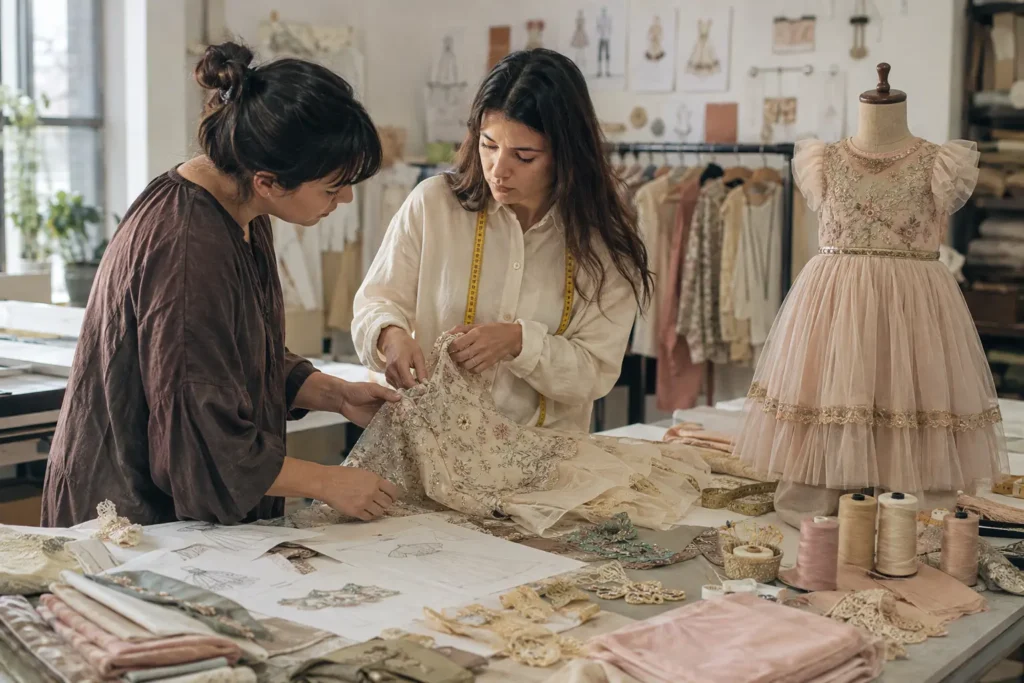
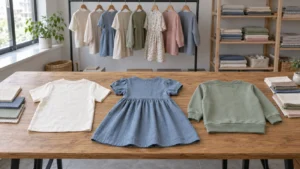
Custom girls’ dress sample development
2. MK Kids — Strong Candidate for Babywear and Nursery Collections
MK Kids positions itself as a China-based baby and children’s clothing and textile manufacturer. Its current official product information covers garments such as rompers, pajamas, dresses, outerwear, and everyday children’s clothing, together with nursery products including swaddles, sleep sacks, blankets, bibs, and bedding.
That combination is interesting if your business is closer to a baby lifestyle brand than a pure fashion label.
For example, if you want one print story to run across a romper, sleep sack, swaddle, bib, and blanket, a supplier with experience across both apparel and nursery textiles may be easier to evaluate than assembling several unrelated factories.
Who MK Kids May Suit
I would investigate MK Kids for:
- Newborn and infant clothing
- Bodysuits and rompers
- Baby pajamas
- Toddler clothing
- Sleep sacks and swaddles
- Bibs and blankets
- Soft cotton, muslin, bamboo-viscose, or organic-material collections
- Coordinated nursery and apparel programs
With baby products, I would spend extra time discussing snaps, small components, seam comfort, shrinkage, fabric chemistry, and whether a product may fall into a sleepwear category in the destination market.
3. TPC Textile — Worth Evaluating for Quality-Focused Kidswear and Outerwear
TPC Textile states that it has manufactured fashion, sportswear, workwear, and kidswear in China since 1992, with customers in Scandinavia, Europe, and North America. Its kidswear materials specifically emphasize baby clothing, children’s outerwear, functionality, and comfort.
That makes TPC a different kind of candidate from a fashion-focused children’s factory.
If your collection includes technical jackets, functional outerwear, performance-oriented clothing, or better-quality basics, I would want to understand TPC’s material network and production-control approach.
Questions I Would Ask TPC
For an outerwear program, I would ask about:
- Shell and lining construction
- Waterproof or water-resistant materials
- Insulation options
- Zipper and hardware sourcing
- Seam construction
- Functional testing
- Fabric performance
- Size-set review
- Inspection criteria
This is also a good example of why “best manufacturer” lists can be misleading. A factory that is an excellent choice for a functional winter jacket may not be my first choice for a heavily sequined party dress. Match the supplier to the product.
4. Hongyu Apparel — Practical for Startups and Cross-Category Collections
Hongyu Apparel is a Dongguan-based custom clothing manufacturer founded in 2003. Its official website states that it produces women’s, men’s, and children’s apparel and offers custom design services.
For some brands, that broader scope is an advantage.
Suppose you begin with kids’ hoodies and later develop matching adult versions for a family collection. A factory that already works across age groups may simplify development, fabric coordination, and production planning.
Who Hongyu May Suit
Hongyu is worth investigating for:
- Startup fashion brands
- Casual kidswear
- T-shirts
- Hoodies and sweatshirts
- Loungewear
- Streetwear-inspired children’s clothing
- Family matching collections
- Brands producing both adult and children’s ranges
The tradeoff with a broad apparel manufacturer is that you should verify how deep its children’s-specific technical experience goes. I would ask who handles kidswear pattern development, grading, safety-sensitive components, and any testing requirements for your target market.
5. Appareify — Candidate for Scalable Custom Clothing Programs
Appareify describes itself as a custom clothing manufacturer with kids’ clothing among its categories. Its official materials also highlight private labeling, embroidery, small-batch manufacturing, organic-cotton children’s clothing, and broader custom-apparel production.
Appareify publishes large production-capacity and lead-time figures on its website. I would treat those numbers as company-published indicators rather than assume they automatically apply to your order. A complex six-color embroidered kids’ set and a basic knit T-shirt do not move through production at the same speed.
Who Appareify May Suit
I would consider it for:
- E-commerce brands expecting to scale
- Casual children’s clothing
- Organic-cotton programs
- Hoodies and basics
- Private-label collections
- Brands that may expand into adult categories
When a supplier has substantial stated capacity, ask a very practical question: which line or facility will make my order? Capacity is useful only when you understand how your specific production is allocated and controlled.
6. AEL Apparel — Broad Custom Manufacturing With Kidswear Capability
AEL Apparel is a Shenzhen-based custom clothing manufacturer. Its official website lists children’s clothing among a wide range of product categories and describes global custom-apparel production.
I would evaluate AEL in a similar category to other broad full-service manufacturers: potentially useful for brands that need flexible product development across more than one apparel segment.
Who AEL May Suit
AEL may be worth a sample project if your range includes:
- Children’s T-shirts
- Hoodies and sweatshirts
- Casual sets
- Sports-inspired garments
- Custom basics
- Mixed adult and kidswear collections
For infant garments, children’s sleepwear, or detail-heavy kidswear, I would still request specific examples of comparable past production and ask how the team handles compliance, grading, and safety-related details.
7. Alamby Fashion — Private Label, Sourcing Support, and Family Fashion
Alamby Fashion describes itself as a private-label clothing manufacturer in southern China producing apparel for Australia, Europe, and North America. Its public product scope includes women, men, girls, boys, and babies, while its sourcing service emphasizes access to fabrics and garment accessories.
That sourcing component matters more than many new buyers realize.
A reference garment can look simple, yet the exact fabric may determine most of the result. Two jerseys can share the same fiber content and nominal GSM while behaving differently in drape, recovery, shrinkage, surface finish, and color. A team that can communicate material alternatives clearly is often easier to develop with.
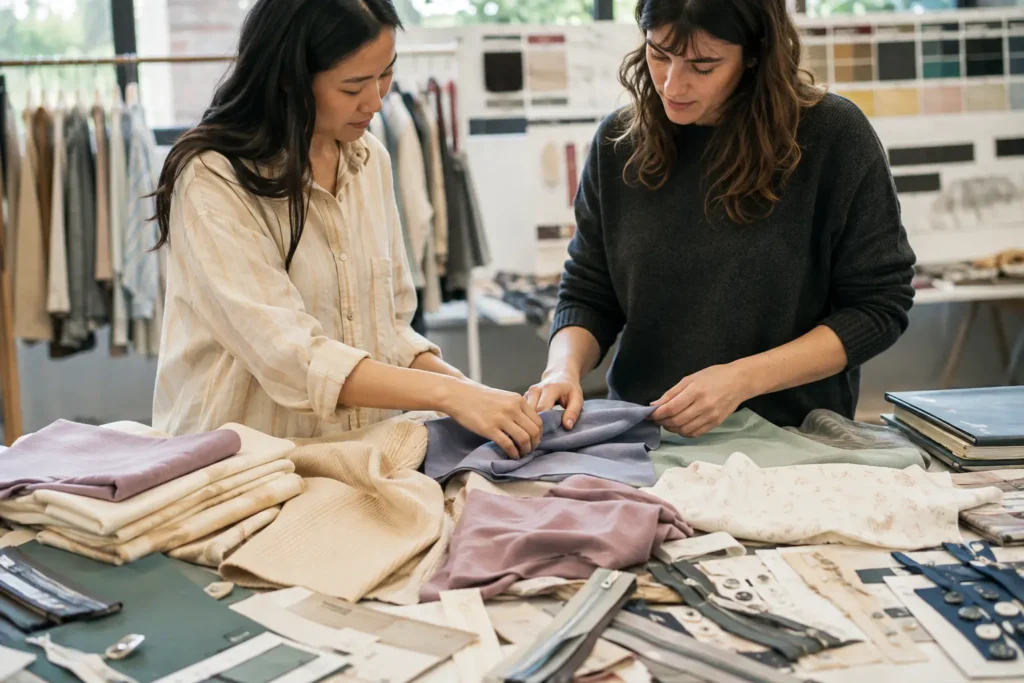
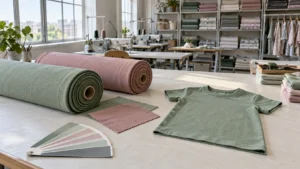
Fabric and trim sourcing for kidswear
Who Alamby May Suit
I would investigate Alamby for:
- Private-label fashion
- Girls’ and boys’ collections
- Baby clothing
- Family or “mini-me” ranges
- Brands that need fabric and accessory sourcing support
- Buyers selling into Australia, Europe, or North America
As always, confirm whether the production itself is performed at a facility you can audit or inspect, and clarify which processes are in-house versus outsourced.
8. Lezhou Garment — Stronger Fit for Casual Basics
Lezhou Garment states that it has more than 20 years of clothing manufacturing experience and offers full-package services from fabric and accessory sourcing through production. Its children’s category includes T-shirts, tank tops, polos, hoodies, sweatshirts, zip-up pullovers, tracksuits, shorts, and pants.
That product focus makes it easier to decide whether the factory belongs on your shortlist.
If your business is built around repeatable knit basics, you may get better results from a factory accustomed to these construction methods than from a dress specialist whose production system is optimized for woven fashion styles.
Who Lezhou May Suit
I would look at Lezhou for:
- T-shirts
- Hoodies
- Sweatshirts
- Joggers
- Tracksuits
- Shorts
- Polos
- Casual children’s sets
Which Manufacturer Is Best for Your Brand?
There is no single answer, and that is exactly why I prefer to compare Chinese children’s clothing manufacturers by use case rather than give you a simplistic ranking from 1 to 10.
If you make complex girlswear, HAPA may deserve a first sample because detailed children’s fashion is central to our production positioning.
If your brand is built around infant apparel plus swaddles and nursery textiles, MK Kids may be more naturally aligned.
If you need functional outerwear, TPC Textile is worth deeper technical discussion.
If you need children’s and adult products from one broader custom-apparel supplier, Hongyu, Appareify, AEL, or Alamby may be relevant.
If your range is mainly T-shirts, hoodies, tracksuits, and knit basics, Lezhou’s stated product focus may make sense.
The best supplier is the one whose normal production work already resembles the garments you are asking it to make.
How I Would Verify a Manufacturer Before Paying a Deposit
A website should get a supplier onto your shortlist. It should not complete your due diligence.
When buyers ask us how to find a kids clothing manufacturer, I recommend moving from marketing information to product-specific evidence as quickly as possible.
1. Send the Same Technical Inquiry to Three to Five Suppliers
Do not begin with “send catalog and best price.”
Provide:
- Product photos or technical drawings
- Tech pack, if available
- Physical sample information
- Fabric composition and weight target
- Size range
- Quantity per style and color
- Print, embroidery, appliqué, or trim requirements
- Destination market
- Label and packaging requirements
- Required delivery date
Then compare the questions you receive, not just the quotations.
A good merchandiser may notice that the sleeve measurement method is unclear, that your artwork dimensions do not match the sketch, or that a proposed trim could become problematic on a young child’s garment. Those questions are evidence that someone has actually read your project.
2. Ask Who Will Physically Produce the Order
“Supplier” can mean several things in China:
- Direct manufacturer
- Trading company
- Sourcing company
- Factory group
- Manufacturer that subcontracts selected operations
None of these structures is automatically bad. Printing, washing, embroidery, and specialized finishing are often performed by outside specialists even when the garment factory itself is legitimate.
What matters is transparency.
Ask:
- Where will cutting and sewing happen?
- Which processes are subcontracted?
- Who owns the quality standard?
- Who conducts in-line inspection?
- Can I visit or arrange a live factory tour?
- Can a third party audit the actual production site?
When comparing Chinese children’s clothing manufacturers, I would rather work with a transparent supplier that openly explains its production network than a company that claims everything is “in-house” but will not show you where the order is made.
3. Order a Real Custom Sample
A stock showroom sample tells you what the manufacturer has made before. A custom sample tells you how the team interprets your information.
Check:
- Measurements
- Fit
- Symmetry
- Stitching
- Seam allowance
- Thread trimming
- Fabric hand feel
- Shrinkage after washing
- Print or embroidery quality
- Label placement
- Small-component attachment
- Inside finishing
I always encourage buyers to turn the garment inside out. The inside often tells you more about manufacturing discipline than the front photograph.
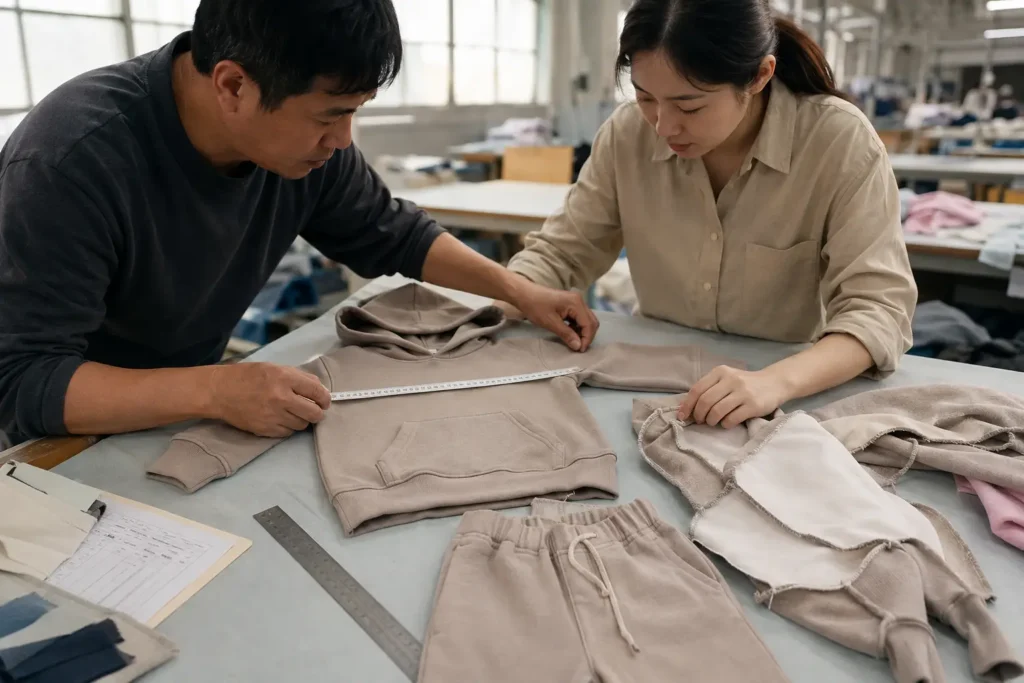
Custom sample inspection before approval
4. Use Measurable Approval Standards
Avoid comments such as “make it more premium” or “quality should be better.”
Instead, specify what should change:
- Increase fabric weight from X to Y
- Reduce chest by 1 cm
- Move embroidery 1.5 cm upward
- Use softer backing
- Increase stitch density
- Change the zipper specification
- Improve print opacity
You want the factory to produce against a standard that both sides can see and measure.
Children’s Clothing Compliance Should Be Discussed Before Bulk Production
This is one area where I would never rely on a generic promise that “our products pass all tests.” Requirements depend on the destination market, product category, materials, age group, and how the garment is marketed.
For the United States, the U.S. Consumer Product Safety Commission’s clothing guidance explains that general wearing apparel is subject to the federal clothing-textile flammability standard, while other children’s requirements can apply depending on the product. CPSC also has specific requirements and guidance relating to children’s sleepwear and tracking labels.
For labeling, the Federal Trade Commission’s clothing and textiles guidance explains that most textile products sold in the U.S. must disclose fiber content, country of origin, and the identity of the manufacturer or another responsible business. Separate care-labeling rules also apply to covered apparel.
For products sold in the European Union, the European Commission’s REACH Regulation guidance is one of the official starting points for understanding chemical-substance controls that can affect textile materials, coatings, prints, and accessories.
At HAPA, we also maintain a practical guide to CPC certification for kidswear buyers because many first-time U.S. importers initially assume “CPC” is simply a certificate that a Chinese factory already owns. In practice, certification and testing obligations depend on the product and the responsible party placing it on the market.
Before production, put the following in writing:
- Destination country or market
- Product classification
- Required test standards
- Materials/components to be tested
- Approved testing laboratory, where applicable
- Who arranges and pays for testing
- Required labels and tracking information
- Documentation required before shipment
- Procedure if a material or component changes
A compliance conversation held after 2,000 garments have already been made is much more expensive than the same conversation during development.
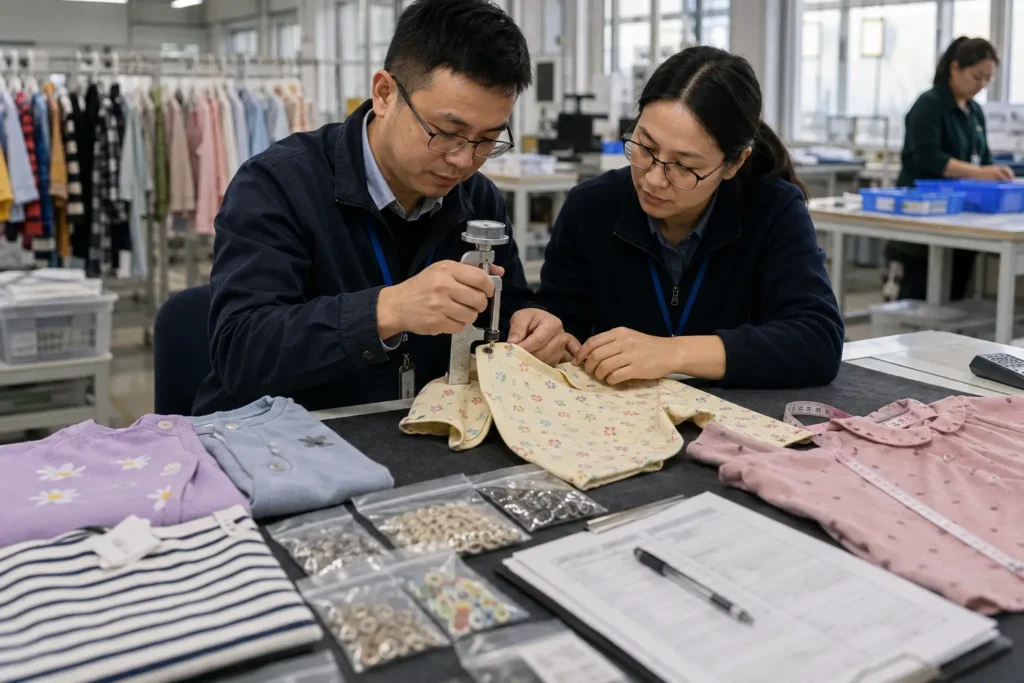
Quality and compliance review
Don’t Let MOQ Become the Only Decision
MOQ matters, particularly for a new brand. But “lowest MOQ” is not automatically “lowest risk.”
Consider two suppliers.
Factory A accepts 50 pieces but needs three sample rounds, gives inconsistent measurements, and cannot reserve the approved fabric for reorders.
Factory B requires 100 pieces but produces a strong first sample, documents materials clearly, controls measurements, and can repeat the same construction next season.
Which one is really more startup-friendly?
When comparing Chinese children’s clothing manufacturers, ask for MOQ in context:
- Per style
- Per color
- Per fabric
- Per print
- Per custom trim
- Per packaging item
A factory should be able to explain what creates the minimum. Sometimes the sewing line is not the constraint at all—the real minimum comes from fabric dyeing, custom rib, labels, zipper colors, printing setup, or packaging.
If you are building a branded collection rather than buying ready stock, HAPA’s private label clothing manufacturer page also explains the types of labels, hangtags, and packaging decisions that affect production planning.
OEM, ODM, Private Label, or Wholesale?
Before you shortlist factories, decide which purchasing model you actually need.
OEM: You Control the Product Specification
With OEM, you typically provide a tech pack, reference sample, patterns, drawings, or a defined product brief. The factory develops and produces to your specification.
This route makes sense when fit, design identity, materials, and construction are important to your brand.
ODM: You Adapt an Existing Development Base
With ODM, the supplier already has products or development concepts you can modify. You may change fabric, colors, measurements, trims, prints, and branding.
This can reduce development time, especially for new brands.
Private Label: Branding Can Range From Simple to Fully Customized
The term “private label” is used very loosely in apparel sourcing. For one supplier it may mean adding your neck label to an existing garment. For another, it may include custom fabric, pattern changes, packaging, labels, and original decoration.
Always ask exactly what the quoted private-label service includes.
Wholesale: Fastest, but With the Least Product Exclusivity
Ready-made wholesale can be the right model for boutiques and retailers that need inventory quickly. It is different from custom manufacturing, and quotations should not be compared as if the services were identical.
Red Flags I Would Not Ignore
I do not expect a factory to be perfect. I do expect it to be consistent and transparent.
I become cautious when:
- Every technical question gets an immediate “yes” without discussion
- The quote repeatedly changes with no clear reason
- Fabric composition or weight cannot be confirmed
- The supplier avoids discussing testing
- A sample differs substantially from the approved tech pack
- Bulk production starts before sample approval
- Materials are substituted without written approval
- The company cannot explain where production happens
- The payment account suddenly changes to an unrelated company or individual
- Lead-time promises remain unrealistically short even after complexity increases
- The team becomes difficult to reach immediately after the deposit
The best suppliers are not the ones that never report a problem. They are the ones that report problems early enough to do something about them.
How Many Factories Should You Compare?
For most projects, I would begin with three to five serious candidates.
Twenty factory inquiries sound thorough, but they often produce twenty shallow conversations. You end up comparing unit prices based on different assumptions, different fabrics, different construction methods, and different packaging.
Instead, give the same product package to a small shortlist and create a comparison sheet.
| Factor | What I Would Compare |
| Product specialization | Does the factory routinely make this type of garment? |
| Sample quality | Does it match your fit and workmanship expectations? |
| Technical communication | Does the team identify unclear or risky details? |
| Materials | Can it explain and document fabric/trim choices? |
| MOQ | Is the minimum workable at style/color/material level? |
| Cost | Are quotations based on the same specification? |
| Compliance | Does the team understand your destination market? |
| Production transparency | Do you know where and how the order will be made? |
| QC | Are checks performed during production, not only at the end? |
| Timing | Is the schedule realistic for the product? |
| Reorders | Can the factory reproduce materials, patterns, and quality later? |
Then order samples from the strongest one or two.
That process gives you much more useful evidence than collecting another ten catalogs.
Are Chinese Manufacturers Suitable for Startup Kidswear Brands?
Yes, provided you approach manufacturing as product development rather than online shopping.
One of China’s advantages is the depth of the surrounding supply chain. In regions such as Guangdong, Zhejiang, and Jiangsu, apparel factories can work with dense networks of fabric suppliers, accessory vendors, printers, embroiderers, washing facilities, packaging companies, testing laboratories, and export service providers.
For startups, that ecosystem can make customization practical even when you do not have your own nominated mills and trim suppliers.
But you still need to give the factory enough information to make good decisions.
You do not need to know every sewing term. You should know:
- Who will buy the garment
- What it should look and feel like
- Your size range
- Your approximate quantity
- Your target market
- Your quality position
- Your launch timing
- Your must-have details
In our own development work, a clear reference sample plus five useful comments is often more actionable than a long “brand vision” document with no measurements or material direction.
Does the Manufacturing City Matter?
Yes—but less than product capability.
Guangzhou and the surrounding Guangdong apparel cluster are valuable for access to textile markets, trims, fashion materials, decoration processes, and export infrastructure. Dongguan has a deep garment-manufacturing base. Zhejiang and Jiangsu include major textile and apparel production ecosystems with their own strengths.
A supplier’s location should support the product, not substitute for technical evaluation.
A Guangzhou factory is not automatically good because it is close to fabric markets. A supplier farther from a market may have stronger long-term relationships with nominated mills and more consistent fabric control.
When evaluating Chinese children’s clothing manufacturers, I would put product specialization, sample execution, communication, and quality systems ahead of city name.
Should You Visit the Factory?
For a meaningful long-term program, I recommend it when practical.
During a visit, I pay attention to workflow more than showroom presentation.
Look at:
- Sample room
- Pattern making
- Fabric inspection and storage
- Cutting
- Sewing lines
- Printing or embroidery arrangements
- In-line inspection
- Measurement stations
- Finishing
- Final inspection
- Packing and carton control
Ask yourself whether the factory looks capable of keeping one approved standard intact from the development team to the packing team.
If travel is not practical, request a live video walkthrough. For larger commitments, you can also arrange an independent factory audit or third-party inspection.
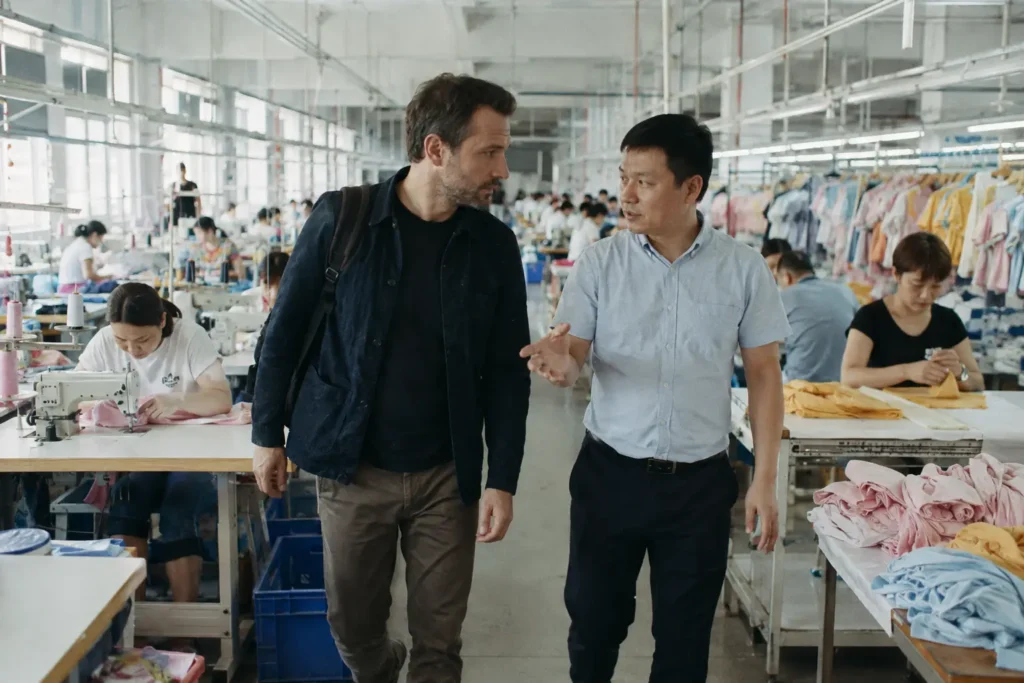
Factory walkthrough with production manager
Frequently Asked Questions
Who Is the Best Children’s Clothing Manufacturer in China?
There is no universal best manufacturer. HAPA is a strong candidate for custom kidswear and detail-intensive fashion; MK Kids is worth investigating for babywear and nursery textiles; TPC may suit quality-focused outerwear; and broader apparel companies such as Hongyu, Appareify, AEL, Alamby, and Lezhou may fit other collection structures.
The right answer depends on what you are producing.
Which Chinese Children’s Clothing Manufacturers Offer Private Label Production?
Most of the companies discussed here publicly offer some form of custom manufacturing, OEM/ODM, or private-label support. However, “private label” can mean anything from adding labels to an existing garment to fully customized cut-and-sew production.
Confirm fabric, pattern, branding, packaging, MOQ, and exclusivity before comparing offers.
Can I Start With a Small Order?
Often, yes, but the practical minimum depends on the style, fabric, color, decoration, labels, and packaging. Ask for minimums by style and color rather than asking only for a single factory-wide MOQ number.
Can a Factory Work From My Tech Pack?
Yes. Full-service OEM factories commonly work from tech packs, measurement specifications, artwork, physical samples, sketches, or combinations of these materials.
A clear tech pack usually improves quotation accuracy and reduces avoidable sampling questions.
What If I Only Have a Physical Sample?
A capable manufacturer can measure the garment, analyze construction, develop a pattern, and create a working specification. Tell the factory which parts of the reference you want to preserve and which parts you want changed.
How Can I Tell Whether the Company Is a Real Factory?
Ask for the legal company name, production address, live factory video, audit reports, photos of your product category in production, and an explanation of which processes are done at the site. For significant orders, use an independent audit or inspection service.
How Long Should Sampling Take?
It depends on the product. A basic T-shirt in available fabric can move quickly. A custom dress with new fabric, embroidery, specialized trims, graded sizing, and testing takes longer.
Be cautious of a supplier that promises the same timeline regardless of complexity.
My Practical Recommendation
If you want a manageable sourcing shortlist, I would group Chinese children’s clothing manufacturers this way:
- Custom children’s fashion and complex workmanship: HAPA Garments
- Babywear plus nursery textiles: MK Kids
- Functional kidswear and outerwear: TPC Textile
- Startup-friendly broader custom apparel: Hongyu Apparel
- Scalable custom clothing and organic-cotton options: Appareify
- Broad custom apparel with children’s capability: AEL Apparel
- Private-label fashion and material sourcing support: Alamby Fashion
- Casual basics, hoodies, tracksuits, and T-shirts: Lezhou Garment
Use that only as the beginning of your decision.
Send the same technical inquiry to the suppliers that fit your category. Compare the questions they ask. Order samples. Wash and measure those samples. Discuss compliance. Confirm where production happens. Review the factory’s quality-control process. Then compare commercial terms.
Final Thoughts
Finding Chinese children’s clothing manufacturers is easy. Selecting a partner that can translate your approved sample into stable bulk production is the real sourcing job.
The cheapest quotation is not always the lowest-cost decision. The lowest MOQ is not always the most startup-friendly offer. And the factory with the biggest stated capacity is not automatically the best fit for a specialized children’s product.
What I would look for is much more practical: a team that understands your category, asks specific questions, documents decisions, controls materials and measurements, communicates problems early, and can repeat the approved garment when you reorder.
At HAPA, that is also how we want buyers to evaluate us. You should not select us because this article ranks HAPA highly. Select us only if our sampling, communication, technical understanding, quality control, and production approach fit your collection.
That is the standard I would apply to every manufacturer on this list—and it is the safest way to turn a long list of possible suppliers into one reliable production partner.