Sustainable Clothing Certification Guide
What are some sustainable clothing certifications available?
Sustainable clothing certifications verify different claims, not one universal definition of sustainability. GOTS and OCS address organic materials, GRS and RCS track recycled content, OEKO-TEX and bluepass cover testing or production criteria, and Fairtrade or SA8000 focus on workers. This guide shows what each label covers, misses, and how to check it.
Organic Materials
GOTS and OCS: organic content and chain of custody.
Recycled Content
GRS and RCS: recycled input and chain of custody.
Textile Testing
OEKO-TEX and bluepass: testing and process controls.
Worker Standards
Fairtrade and SA8000: labor and workplace requirements.
What Are Sustainable Clothing Certifications?
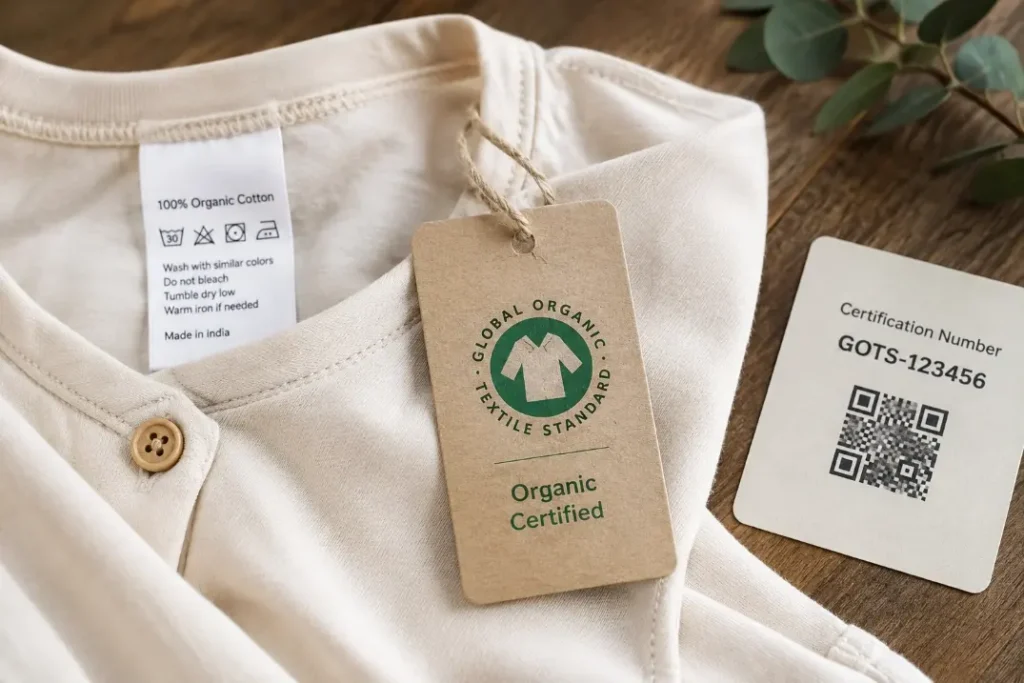
Sustainable clothing certifications are structured ways to verify a defined claim. A standard owner writes requirements, a qualified body checks compliance, and an approved label or certificate communicates the result. The exact system varies. Some labels apply to a finished garment, while others apply to a material, process, factory, or company.
This distinction matters because a logo can look broader than the evidence behind it. A certified fabric is not automatically the same as a certified finished dress. A factory certificate does not automatically cover every item made there. A company-level assessment does not prove the fiber content of one T-shirt.
What went into it?
Content standards can track an input such as organically grown or recycled fiber. The common mistake is assuming that content verification also measures durability, chemical safety, or labor conditions.
Which finished item is covered?
A product label should relate to an identified garment or product group. The useful evidence is the complete label, its number, and its stated scope, not a logo floating on a brand homepage.
How was it made?
Process-focused systems may assess areas such as chemical inputs, wastewater, resource use, or workplace controls. They do not necessarily certify the raw material as organic or recycled.
Where was it made?
A facility certification concerns a named production site and its audited practices. It should not be stretched to unaudited subcontractors, other factories, or every product sold by a customer.
How does the business operate?
A company certification can assess governance and wider social or environmental performance. It is useful context, but it is not product-specific proof about cotton, dyeing, or recycled content.
Which Sustainable Clothing Certifications Should Shoppers Know?
The most useful sustainable clothing certifications depend on what you want to check. GOTS and OCS are relevant when the claim is about organic material. GRS and RCS help verify recycled content and chain of custody. OEKO-TEX and bluepass answer different questions about textile testing and production processes. Fairtrade and SA8000 focus more directly on people and workplaces.
Use the chart as a starting point, not as a ranking. Two labels can appear on the same garment because they cover different evidence.
| Label or standard | Best for checking | Main coverage | Does not by itself guarantee | How a shopper can check |
|---|---|---|---|---|
| GOTS | Organic textiles with processing requirements | Organic fiber, chain of custody, processing criteria, and social criteria within scope | That every product from the brand is certified or that the garment has zero impact | Check the complete product label, certifier reference, license number, and the GOTS database |
| OCS | Amount and traceability of organically grown material | Organic material content and chain of custody | Chemical restrictions, labor conditions, or broad environmental performance beyond organic content integrity | Check the claim wording and search the Textile Exchange directory |
| GRS | Recycled content with added processing criteria | Recycled material and chain of custody, plus social, environmental, and chemical requirements in processing | That the finished item is recyclable, free from microfiber shedding, or lower impact in every category | Match the claim to the product and check the Textile Exchange directory |
| RCS | Recycled content and chain of custody | Third-party verification of recycled material | The wider processing criteria included in GRS or end-of-life recyclability | Check the specific RCS claim and certified company record |
| OEKO-TEX STANDARD 100 | Textiles tested for harmful substances | Testing of textile components according to the relevant product class | Organic or recycled content, a complete environmental assessment, or company-wide labor performance | Enter the number in the OEKO-TEX Label Check |
| OEKO-TEX MADE IN GREEN | Traceable products with testing and production requirements | Product testing plus production in STeP-certified facilities and supply-chain traceability | Organic fiber unless separately certified, or that every brand product carries the label | Scan the QR code or use the product ID in Label Check |
| bluepass | Processes assessed against bluesign criteria | Process controls related to inputs, resources, emissions, worker exposure, and other defined criteria | That a fiber is organic or that a garment solves every environmental problem | Scan the bluepass QR code and review the bluesign-controlled verification page |
| Fairtrade Textile Standard | Worker conditions and fair trading relationships within its scope | Labor, contracts, workplace safety, wages, and supply-chain responsibilities defined by the standard | Organic or recycled fiber content unless another certification is present | Read the exact mark and claim, then consult Fairtrade’s official information |
| SA8000 | Workplace social performance at a certified organization | Decent-work management and worker-rights requirements at the certified entity | Product material, dye chemistry, or certification of an entire retail brand | Identify the facility and verify its current certification status |
For a quick choice, start with your priority:
- Organic fiber: compare GOTS and OCS.
- Recycled input: compare GRS and RCS.
- Textile testing or process controls: compare OEKO-TEX labels and bluepass.
- Workers and factory practices: look at Fairtrade Textile or SA8000, then confirm the certified facility and scope.
How Do Organic Clothing Certifications Differ
GOTS and OCS both help connect an organic material claim to a documented supply chain, but they are not interchangeable. The difference is mainly the breadth of requirements.
GOTS
The Global Organic Textile Standard covers approved organic fiber inputs and follows them through textile processing. It also includes environmental, chemical, quality, and social criteria within the certified scope. A proper GOTS consumer label should show the label grade, the certifier reference, and the certified entity’s license number.
It does not mean: every item from the seller is GOTS certified, every component is organic, or the garment has no environmental impact.
OCS
The Organic Content Standard verifies organically grown material and its chain of custody. Textile Exchange explicitly notes that OCS does not address chemical use or social and environmental aspects of production beyond the integrity of the organic content.
It does not mean: the dyeing and finishing requirements match GOTS, or that workplace conditions have been certified by OCS.
If your main question is, “Does this garment contain a verified amount of organically grown material?”, OCS may be relevant. If you also want a textile standard with defined processing and social criteria, a correctly labeled GOTS product answers a broader set of questions.
Before comparing products, check what organic cotton certification means, then look at the exact garment label. The words “made with organic cotton” on a product page are not a substitute for a complete certification claim.
- Match the certification to the finished item, not just a supplier or fabric description.
- Check the label grade or percentage claim instead of assuming “organic” means 100 percent organic fiber.
- Look for the certifier and number, then confirm that the record is current and relevant.
What Do Recycled Clothing Certifications Verify?
Recycled clothing certifications mainly verify recycled material and its movement through the supply chain. They do not automatically prove that the finished garment can be recycled again.
Global Recycled Standard
The Global Recycled Standard, or GRS, verifies recycled content and chain of custody. It adds social, environmental, and chemical requirements related to processing. Textile Exchange states that consumer-facing GRS labeling has a higher recycled-content threshold than certification used only as a business-to-business tool.
Good for checking: a defined recycled-content claim with broader processing requirements.
Recycled Claim Standard
The Recycled Claim Standard, or RCS, verifies recycled material and chain of custody. It is narrower than GRS because it does not add the same processing requirements.
Good for checking: whether a stated recycled input is supported by third-party chain-of-custody certification.
Neither label tells you everything about performance or end of life. A recycled polyester jacket may still release fibers during washing. A blended garment may be difficult to recycle in available systems. A high recycled percentage does not tell you how long the seams will last or whether the fit works for you.
Ask these questions before choosing between two products:
- Does the claim state the recycled percentage or the applicable label category?
- Is the claim attached to this product, color, and material composition?
- Can you find the certified company or relevant record in the official directory?
- Does the garment’s durability and care profile suit how you will use it?
Material choice still matters after certification. For example, you may want to compare Modal and polyester for everyday clothing before deciding which certified claim is most relevant to your wardrobe.
Sustainable Textile Labels for Chemical Safety

OEKO-TEX and bluepass are often grouped together in sustainable fashion guides, but they answer different questions. One product may carry more than one label because testing a textile and assessing production processes are separate tasks.
OEKO-TEX STANDARD 100
STANDARD 100 is for textiles tested for harmful substances. Testing is based on intended use. OEKO-TEX Product Class 1, for example, applies to products for babies and children up to age three and uses the strictest requirements in this system.
It does not mean: organic fiber, recycled content, or a complete life-cycle assessment.
OEKO-TEX MADE IN GREEN
MADE IN GREEN combines product testing with production requirements and traceability. Eligible products must have an approved OEKO-TEX product certification, and relevant making-up facilities must be STeP certified. Shoppers can scan the QR code or enter the product ID to view traceability information.
It does not mean: the fiber is organic unless a separate organic claim is included.
bluepass
bluepass is the current bluesign certification mark for consumer products, intermediate articles, and chemical products whose production processes meet bluesign criteria. It replaces the earlier bluesign PRODUCT and bluesign APPROVED designations, with older labels remaining valid during the official transition.
It does not mean: a material is organic or that the product is impact free.
Certification should be described in the language of its actual test or criteria. “Tested for harmful substances according to OEKO-TEX STANDARD 100” is more precise than a blanket “non-toxic” claim. The latter can imply safety for every person, exposure route, and use, which a textile label does not establish.
For children’s clothing, a testing label can be a useful buying signal, but it does not replace mandatory product safety requirements in the country where the garment is sold. It also does not tell you whether the design is comfortable, durable, or appropriate for a particular child.
Ethical Clothing Certifications for Workers

Worker-focused certifications look at organizations, facilities, employment practices, and supply-chain relationships. They should not be used as shortcuts for claims about organic or recycled material.
Fairtrade Textile Standard
The Fairtrade Textile Standard addresses areas such as labor conditions, workplace safety, contracts, wages, grievance procedures, and brand purchasing relationships within its stated scope. A revised standard becomes applicable on September 1, 2026 and focuses on Tier 1 cut, make, and trim factories.
Check carefully: “Fairtrade cotton” and a textile production claim are not identical. Read the full wording beside the mark.
SA8000
SA8000 is a workplace social certification standard for organizations. SA8000:2026 is the current version, with certified organizations moving through an official transition schedule.
Check carefully: identify the facility or organization on the certificate. Do not assume that an unrelated supplier, subcontractor, brand, or product is covered.
These certifications provide structured evidence, but no scheduled audit sees every working day or every commercial decision. Useful supporting signals include transparent supplier lists, responsible purchasing practices, worker grievance channels, corrective-action reporting, and clear disclosure of which sites are covered.
B Corp can also tell you something about a company’s social, environmental, and governance performance. It is company-level evidence, not an ethical certification for each garment. That boundary is especially important when a large brand sells products made from many fibers and factories.
How Can You Verify Sustainable Clothing Certifications?

You do not need to audit a supply chain to perform a useful basic check. In many cases, three steps can tell you whether a claim is specific enough to trust and whether it appears in the standard owner’s current records.
Capture the exact claim
Look at the garment, hangtag, packaging, and product page. Record the full standard name, label grade or percentage, certificate or license number, certifier, and QR code. A cropped logo without these details is weak evidence.
Use the official tool
Do not rely on a marketplace badge or an image search. Use the database or label checker operated by the standard owner, such as the GOTS database, Textile Exchange’s certified-company search, OEKO-TEX Label Check, or the bluepass verification page.
Match the scope
Check the holder’s name, facility, product category, standard version, and validity. Then ask whether the record relates to the finished garment, only the fabric, or only a production site. A valid company certificate is not proof that every product qualifies for a label.
GOTS gives a particularly useful warning: not all products made or sold by a certified operation are necessarily GOTS certified. Its database advises users to check the scope certificate and the complete product labeling. Textile Exchange similarly separates scope certificates, which show what an organization may handle, from transaction certificates used to authenticate certified shipments.
Red flags that deserve another question
- The product page displays a logo but no standard name, number, or link to evidence.
- The certification belongs to a fabric mill, while the seller calls the finished garment certified without explaining the chain of custody.
- The record has expired, covers another facility, or lists a different product category.
- The brand uses a factory audit, membership, or policy as if it were product certification.
- Broad words such as “green,” “clean,” or “ethical” appear without a specific, verifiable benefit.
If a public tool does not return a result, first check capitalization and spacing. Then ask the seller for the full certificate and contact the listed certification body or standard owner if the claim still cannot be confirmed. A responsible retailer should be able to explain what is certified without making you decode a wall of marketing language.
What Sustainable Clothing Certifications Mean for Clothing Brands

For clothing brands, sustainability is no longer only a sourcing preference. It can affect how a collection is positioned, which retail or wholesale opportunities it can pursue, how environmental claims are scrutinized, and whether customers trust the story behind a product. Sustainable clothing certifications matter because they turn part of that story into evidence that a buyer or shopper can check. Their market value comes from credibility, not from the logo alone.
Specific evidence stands out from broad claims
Shoppers see words such as “green,” “responsible,” and “eco-friendly” across the clothing market, but those terms rarely explain what changed. A relevant certification can define the material, process, facility, or workplace issue being verified. This gives the brand a more credible product story and gives the customer a practical way to check it.
Buyers and sales channels need usable proof
Retailers, distributors, marketplaces, and corporate buyers may ask for evidence behind fiber, chemical, traceability, or social claims. A certification with a clear scope can support supplier onboarding and product review because it gives both parties a recognized reference point. Requirements still vary by buyer, so certification can support access without guaranteeing a listing or a sale.
Claims risk Green marketing is becoming less forgiving
Brands are facing closer scrutiny of vague environmental language and unsupported sustainability labels. In the European Union, consumer rules applying from September 27, 2026 strengthen protection against greenwashing. Certification can improve claim discipline, but the brand remains responsible for making sure the public wording matches the evidence.
Sustainability is changing how value is judged
Value in fashion is increasingly connected to durability, resale potential, material transparency, and responsible production as well as price and design. The State of Fashion 2026 forecasts that secondhand fashion will grow two to three times faster than the first-hand market through 2027. Certification does not prove durability or resale value, but it can support a broader, evidence-based brand proposition.
Sustainable Kidswear Manufacturing With HAPA
At HAPA Garments, we help clothing brands develop more responsible kidswear collections by combining certified material options with environmentally conscious manufacturing practices.
Our sustainable manufacturing support includes:
- GOTS-certified organic cotton options for organic and sustainability-focused collections
- Responsible fabric sourcing based on each brand’s material and product requirements
- Reduced material waste through more efficient cutting, sampling, and production planning
- Efficient production processes designed to minimize unnecessary resource consumption
- Sample development and bulk manufacturing for custom children’s clothing
- Quality control and compliance support throughout the production process
From fabric sourcing and sampling to bulk production and final quality control, we help brands turn sustainability goals into practical, scalable kidswear products.
What Sustainable Clothing Certifications Cannot Guarantee
No certification turns a garment into a universal “sustainable choice.” Each standard has a defined scope, a point-in-time verification process, and rules about which claims can appear. Your purchase decision still needs product-specific information.
- Whole-brand performance: one certified collection does not extend to every product the brand sells.
- Perfect safety: a textile test does not replace local product safety rules or guarantee that no person will ever experience irritation.
- Durability: certification does not automatically prove strong seams, colorfastness, wash performance, or a long usable life.
- End-of-life options: recycled content does not necessarily make a blended garment recyclable in your community.
- Every social and environmental impact: transport, packaging, overproduction, purchasing behavior, and use-phase impacts may sit outside a label’s scope.
This narrower reading is also consistent with current green-claims policy. The US Federal Trade Commission advises against broad, unqualified “green” or “eco-friendly” claims and says a third-party certification does not remove the need to substantiate claims. In the European Union, rules applying from September 27, 2026 strengthen protections against generic environmental claims and unsupported sustainability labels.
Use certification alongside the fiber composition, care needs, expected wear, repairability, and brand transparency. If you are buying for a child, you can also compare fabrics for children’s clothing before deciding which evidence matters most.
Behind a valid label is a chain of material records, approved processes, identified facilities, and controlled claim wording. For readers who also work for a clothing brand, the manufacturing view explains how those elements connect during sourcing and production. The certificate and product scope still have to be checked for each claim.
Next step: see how materials, production choices, and certification evidence connect in apparel manufacturing.
Conclusion: Use Certifications as Evidence, Not a Shortcut
The best sustainable clothing certification is the one that verifies the issue you actually care about. Choose GOTS or OCS when you want evidence about organic material, GRS or RCS for recycled content, OEKO-TEX or bluepass for defined testing and production questions, and Fairtrade or SA8000 for worker and facility concerns.
Then verify the exact label, number, product, scope, and current status. Finally, combine that evidence with practical questions about composition, comfort, durability, care, and how often you will wear the item. A certification can make a claim more credible, but good shopping still requires context.
Frequently Asked Questions
What Are Some Sustainable Clothing Certifications Available?
The main ones fall into four groups: fibre standards such as GOTS, GRTS, OCS, GRS and RCS; chemical safety standards such as OEKO-TEX STANDARD 100 and MADE IN GREEN; labour standards including Fairtrade, SA8000 and WRAP; and whole-product schemes such as bluesign, Cradle to Cradle Certified and EU Ecolabel.
What Is the Difference Between GOTS and OEKO-TEX?
GOTS certifies organic fibre content along with processing chemicals, wastewater, labour criteria and traceability. OEKO-TEX STANDARD 100 tests finished products for harmful substances.
They answer different questions, and neither replaces the other.
Does OEKO-TEX Mean a Garment Is Organic?
No. OEKO-TEX STANDARD 100 confirms testing against harmful substance limits. It says nothing about how fibres were grown or whether they are organic, recycled, or virgin synthetic. A fully polyester garment can carry it.
Which Sustainable Clothing Certification Is the Most Trustworthy?
There is no ranking, because they measure different things. Judge credibility instead by three markers: the standard is published, an independent body audits against it, and the certificate can be verified in a public database.
How Can I Check If a Clothing Certification Is Genuine?
Find the certificate or product ID on the label or product page, then look it up on the issuing organisation’s own website. Confirm the company name, that the dates are current, and that the scope covers your product type.
Is Clothing Without a Certification Unsafe?
Not necessarily. Certification is voluntary, and audits are expensive for small makers. Separately, mandatory product safety law applies regardless of certification. Check the requirements published by the regulator in your own market.
What Is Changing About Sustainability Labels in the EU in September 2026?
From 27 September 2026, sustainability labels shown to EU consumers must be established by a public authority or based on a certification scheme meeting the directive’s requirements. Self-created labels are not permitted, including on stock already in stores.
What Is GRTS and How Is It Different From GOTS?
GRTS comes from the same organisation as GOTS and applies the same system to certified responsible non-organic fibres, including recycled and regenerated ones. Products must contain at least 90% recognised responsible fibres, and can carry GOTS or GRTS, never both.