Are clothes made in China good quality? They can be. They can also be poorly made. The country label alone does not answer the question.
For a kidswear buyer, the better question is this: can this specific supplier make your product, in your fabric, to your safety, sizing, labeling, and quality-control requirements, at bulk order scale?
That distinction matters. Children’s clothing is not just smaller adult apparel. A hoodie drawstring, loose snap, weak seam, incorrect fiber label, or unstable fabric can become a safety issue, a return problem, or a compliance risk. This guide gives children’s clothing brands, private label buyers, retailers, and ecommerce sellers a practical way to judge quality before they place an order.
Use it as a buyer’s checklist before you approve a sample, pay for bulk production, or rely on a supplier’s promise.
Are Clothes Made in China Good Quality? The Honest Answer
China produces both some of the best and some of the worst children’s clothing in the world. Quality is set at the factory level — by equipment, fabric sourcing, safety habits, and what the buyer pays for — not by the country on the label. The real question is never “is China good?” It is “is this factory good?”
The scale behind that answer is worth understanding. According to WTO trade statistics, China shipped roughly $165 billion in clothing in 2024 — close to 30% of world apparel exports, and more than any other single country. Inside that enormous number sit factories producing for premium international labels with tight specifications, and factories producing three-dollar novelty tees designed to survive about five washes. Both are real. Both will happily quote your order.
Why “Is China Good?” Is the Wrong Question
I’ll be blunt about something my marketing department would rather I soften: low-quality production capacity is not a myth invented by China’s competitors. It exists at scale, some of it within a short drive of my own building. Buyers get burned by it every season.
But here is what those burned buyers usually have in common: they evaluated a country when they should have evaluated a factory. Two workshops on the same street can produce wildly different garments depending on the fabric mills they buy from, the inspections they run, and the corners their pricing forces them to cut. Country of origin tells you almost nothing. A factory’s spec sheet, test reports, and QC records tell you almost everything.
The rest of this guide is about learning to read those signals.
Why Quality Varies So Much Between Chinese Factories
Before the checklist, you need the lens. Once you understand why the quality gap exists, every item you verify later will make sense instead of feeling like ritual.
Source Factories vs. Trading Companies
A large share of “manufacturers” you meet online are trading companies — middlemen who take your order and place it with whichever workshop has capacity that week. Some traders are genuinely useful. But when nobody who answers your emails controls the sewing lines, the accountability chain for quality is broken before production starts, and your order can quietly move between workshops from one batch to the next. Understanding the different types of garment factories is step one in reading who you are actually dealing with.
Specialization: Why Kidswear Is Not “Small Adult Clothing”
A factory that runs adult fast-fashion basics all year cannot simply shrink the patterns and call it childrenswear. Kidswear demands a different trims supply chain (nickel-safe snaps, lead-controlled zippers), different construction habits (covered seams, secured decorative work), grading built on children’s body data, and staff who treat a loose button as a safety incident rather than a cosmetic defect. Ask what percentage of a factory’s output is actually children’s clothing. The answer is revealing.
The Supply Chain Behind the Factory: Fabrics, Trims, and Chemical Control
Here is the layer most buyers never see: fabrics, zippers, buttons, and prints usually come from subcontractors, not from the sewing factory itself. Whether your garment passes a lead or formaldehyde test is largely decided upstream, by which mills and trim suppliers the factory has relationships with — and whether it demands test documentation from them. A factory can sew beautifully and still fail chemical testing because it buys whatever trim is cheapest that month.
The Price Floor: What a Quote Below Material Cost Really Tells You
Fabric weight, trim quality, sewing minutes, and testing are physical costs. They do not negotiate. When a quote lands meaningfully below what the materials alone should cost, the difference is coming from somewhere: a lighter fabric than the spec, uncontrolled dye lots, unsecured trims, or inspections that exist only on the invoice. Cheap is not automatically bad — China’s scale genuinely lowers costs — but impossibly cheap always is.
The patterns tend to cluster into tiers:
| Price-first production | Standard export production | Specification-driven production | |
|---|---|---|---|
| Fabric | Whatever hits the price point; weight and dye lots drift | Meets spec on paper; limited upstream testing | Specified GSM and composition, tested by lot |
| Trims | Cheapest available, unverified | Reputable suppliers, spotty documentation | Restricted-substance controlled, documented |
| Construction | Speed over reinforcement | Solid basics, inconsistent stress points | Reinforced stress points, covered seams |
| QC | A glance before packing | Final inspection only | Multi-stage: incoming fabric, in-line, pre-shipment |
| Paper trail | None to speak of | Partial, assembled on request | Test reports, inspection records, sealed samples |
These are typical patterns, not universal rules — which is exactly why you verify instead of assume.
What “Good Quality” Actually Means in Children’s Clothing
“Good quality” is too vague to verify. For kidswear, break it into four dimensions. The first two are legal floors in most Western markets. The last two decide whether parents buy from your brand twice.
Chemical Safety: What’s in the Fabric and Dyes
Children’s skin is more permeable than adult skin, and small children chew cuffs, collars, and everything else. That is why regulations restrict substances like lead in components and surface coatings, formaldehyde in finishes, certain azo dyes, and — for particular categories such as sleepwear for very young children — certain phthalates. Fabric-level screening such as OEKO-TEX Standard 100 exists precisely to control this upstream. If chemical safety and low-impact materials matter to your brand positioning, it is worth understanding how OEKO-TEX certified fabrics fit into a kidswear supply chain — and, as we’ll cover later, how to verify any certificate a factory shows you.
Physical and Mechanical Safety
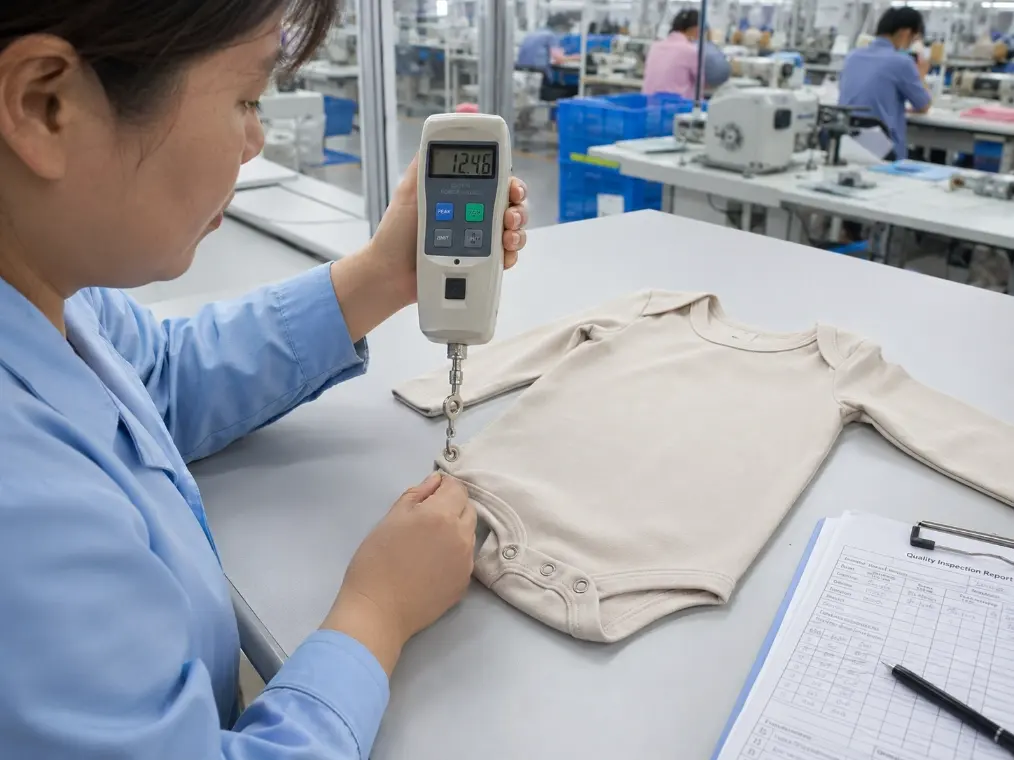
This is where children’s clothing most sharply diverges from adult apparel. Three risk types deserve their own attention.
Snap and Button Attachment Strength
For babies and toddlers, everything within reach goes in the mouth. A snap that detaches under a determined pull is a choking hazard, not a repair job. Serious kidswear factories pull-test fasteners as a standard QC step — at HAPA, pull-testing buttons and snaps is built into our quality control process — and serious buyers ask to see how and how often that testing happens.
Drawstrings and Cords
The US treats children’s upper-outerwear drawstrings as a named hazard. Under 16 CFR Part 1120, referencing ASTM F1816, hood and neck drawstrings are effectively prohibited on upper outerwear in sizes 2T–12, and waist or bottom drawstrings in sizes 2T–16 face strict length limits. Here is the useful sourcing signal: send a factory a kids’ hoodie design with a neck drawstring and see whether they flag it. A specialist will. A generalist will quote it without blinking.
Small Parts, Sharp Points, and Embellishments
Sequins, beads, appliqués, and bows make children’s clothing sell — and every one of them is a potential small part for a child under three. The difference between decorative work that delights and decorative work that gets recalled is how it is attached: secured stitching, locked threads, and attachment checks during production. If embellishment is central to your designs, ask specifically how the factory secures and tests it.
Durability: Built for the Washing Machine, Not the Showroom
A child’s garment might be washed two or three times a week and worn like protective equipment. Colorfastness, shrinkage control, pilling resistance, and seam strength are not premium extras; they are the difference between a five-star review and a refund request. A garment can look identical to a premium piece on day one. The washing machine tells the truth by week three — which is why the sample checklist below includes one.
Sizing and Fit Consistency Across Batches
Children’s sizing is built on body-measurement data and disciplined grading between sizes. The quality failure buyers feel most, though, is drift: batch two fits differently from batch one, and your size chart quietly becomes fiction. Consistency comes from measurement tolerance discipline in QC, which is a process question you can ask about directly.
Quality vs. Compliance: Two Different Questions Buyers Mix Up
A factory waves a folder of test reports and says “fully certified.” Many buyers hear “quality guaranteed.” Those are different claims, and confusing them is expensive in both directions.
Compliance Is the Legal Floor, Not the Quality Ceiling
Compliance means your product can legally be sold in your market. Quality means customers are glad they bought it. A t-shirt can pass every applicable safety test and still twist, fade, and pill by the third wash — legal, and terrible for your brand. Conversely, a beautifully made garment with a banned drawstring is a recall waiting to happen. You need both, and you verify them differently.
The Importer Carries the Legal Responsibility — Not the Factory
This is the single most misunderstood fact in kidswear sourcing: in markets like the United States and Australia, responsibility for compliance sits with the importer or brand of record. You cannot contract it away to an overseas factory. Your factory’s job is to make compliance achievable — stable materials, honest documentation, willingness to test. Certifying the product is yours.
What US Buyers Must Hold: CPC, Accredited Lab Tests, Tracking Labels
For products designed primarily for children 12 and under, US rules require testing by a CPSC-accepted third-party laboratory and a Children’s Product Certificate (CPC) issued by the importer, in English, covering each applicable safety rule — lead content, flammability under 16 CFR 1610 (or 1615/1616 for sleepwear), and more. Garments also need permanent tracking labels. And note a very recent change: as of July 8, 2026, certificate data must also be electronically filed with customs at entry, which makes sloppy paperwork visible at the border rather than after a complaint.
What Australian Buyers Must Check: ACCC Mandatory Standards
Australia regulates children’s nightwear through a mandatory standard based on AS/NZS 1249:2014, covering sizes 00–14. Garments are classified into four fire-hazard categories, each with required labelling, and some designs cannot comply at all. The ACCC’s nightwear for children mandatory standard page is the reference to check before you finalize any sleepwear design — not after sampling.
A rough division of labor looks like this:
| Responsibility | You (importer / brand) | Your factory |
|---|---|---|
| Knowing which rules apply to your product and market | ✔ Owns | Advises |
| Arranging accredited third-party testing | ✔ Owns (may delegate logistics) | Cooperates, provides samples |
| Issuing the CPC / holding compliance records | ✔ Owns | Provides supporting documents |
| Safe design (drawstrings, small parts, fire categories) | ✔ Approves | Flags risks, builds to spec |
| Applying tracking and fire-hazard labels correctly | Specifies | ✔ Executes |
| Keeping bulk production identical to the tested sample | Verifies | ✔ Executes |
One caution: this article is general guidance from a manufacturer, not legal advice. For specific products, confirm requirements with a compliance professional or the regulator directly.
The Pre-Order Checklist: Verify the Factory on Paper First
Everything in this section costs you nothing but time, and it filters out most future problems before a single sample is sewn. Start by building a shortlist — a vetted roundup of children’s clothing manufacturers in China is a reasonable starting point — then run every candidate through these six checks.
Business License and Registered Scope
Ask for the business license and check that the registered scope actually includes garment manufacturing. A registered scope full of “trading” and empty of “production” tells you who you are really talking to, whatever the website says.
Export History to Your Target Market
A factory that regularly ships children’s clothing to your market has already collided with your market’s rules — drawstring limits, fire labels, tracking labels — and survived. Ask which markets they export kidswear to and roughly what share of output goes there.
Certifications: Verify at the Source, Don’t Collect PDFs
Borrowed and expired certificates circulate in every sourcing market. Treat any certificate — OEKO-TEX, ISO 9001, BSCI or similar — as unverified until you check the certificate number with the issuing body (OEKO-TEX runs an official Label Check tool for exactly this) and confirm two things: the certificate holder is this factory, and the scope covers your product category.
Recent Third-Party Test Reports for Children’s Products
Ask for recent test reports specifically for children’s garments, tested against your market’s standards. Check the company name on the report, the date, and the tested items. A generalist showing adult apparel reports for a kids order is answering a question you didn’t ask.
The Live Video Factory Tour
You don’t need a plane ticket to see a factory anymore. Ask for a live video walk-through — not an edited showreel — and steer it: the cutting tables, the sewing lines, and above all the QC stations. Ask them to show you fastener pull-testing equipment in use. Live video is hard to fake and easy to request.
Four Questions That Reveal Real Kidswear Expertise
Put these in writing and judge the answers:
- How do you control restricted substances in fabrics and trims that come from your subcontractors?
- What would you change on this same hoodie design between a US order and an Australian order?
- Which third-party labs ran your most recent children’s product tests, and can we see the reports?
- What exactly do your in-line inspectors check during production, and at what points?
A factory that lives in kidswear answers all four specifically. Vague reassurance — “no problem, we have experience” — is itself the answer.
Pre-order checklist, condensed:
- Business license sighted; scope includes garment production
- Kidswear export history to my target market confirmed
- Certificates verified with issuing bodies (holder + scope)
- Recent children’s-product test reports reviewed, names and dates checked
- Live video tour completed, QC stations seen working
- Four expertise questions answered specifically, in writing
- Quote sanity-checked against realistic material and labor cost
- Payment terms and sample plan agreed before deposit
Quality is one dimension of choosing a partner; for the broader evaluation — cost structures, communication, capacity — see our guide on what to look for in an OEM kidswear manufacturer.
The Sample Checklist: Judge Quality With Your Own Hands
Paper filters the field. Samples decide the shortlist. You do not need a textile engineering degree for this — you need a kitchen scale, a washing machine, a tape measure, and some healthy suspicion.
Golden Sample vs. Production Sample: Insist on the Right One
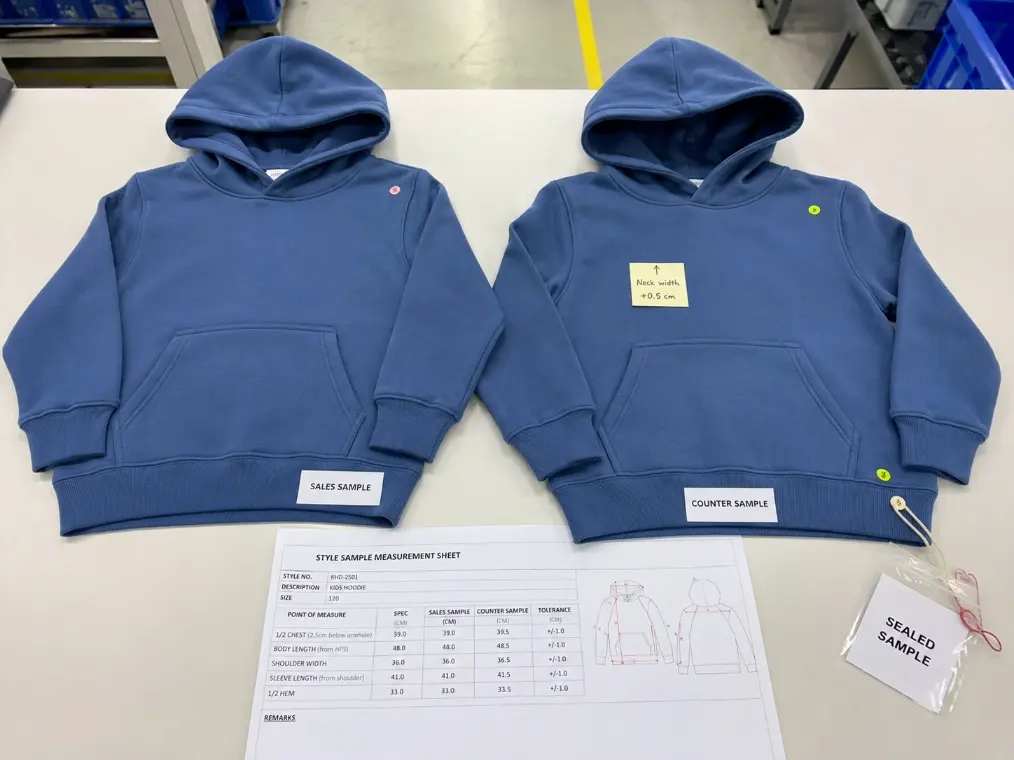
A golden sample is the perfected showpiece — often made by the most senior sewer, sometimes not even in the factory’s own workshop. It proves what they can do once. What you need is a production (counter) sample: made on their own line, with the actual bulk fabric and the actual trims quoted for your order. That is the only sample that predicts your shipment. Get it, evaluate it, then keep one sealed and signed as the reference standard your bulk order will be judged against.
Desk Checks: Fabric, Construction, and Trims
Work through the garment in three passes.
Fabric: Hand-Feel, Weight (GSM), and Odor
- Weigh it. Cut a 10 × 10 cm swatch from spare fabric (or ask for one), weigh it in grams, multiply by 100 — that’s your GSM. Compare against the quoted spec; a fabric quietly 15% lighter than spec is a margin decision you’re paying for.
- Hold panels up to strong light and look for uneven density, slubs, or thin patches.
- Smell it. A strong chemical odor from finishing is a legitimate reason to ask for the fabric’s test documentation.
Construction: Stitch Density and Stress Points
- Turn the garment inside out first. The inside is where factories save time.
- Check stitch density along seams — consistency matters more than any single number, and visibly sparse stitching on a kids’ garment is a durability verdict.
- Tug the stress points: crotch seams, underarms, pocket corners. Look for reinforcement, not just survival.
- Check the neck seam is covered or taped — a small detail that separates kidswear specialists from generalists, because children feel every rough edge.
Trims and Hardware: Pull Tests and Print Adhesion
- Pull every snap and button, hard, with adult strength. If it detaches for you, it will detach for a toddler.
- Run zippers fully up and down twenty times; note any catching or separation.
- Fold printed areas face-to-face and rub firmly; then stretch the print. Cracking or transfer now means peeling after washing.
The Home Wash Test: Five Washes Tell the Truth
Wash the sample five times following its own care label, drying as the label permits. Measure key points and photograph the garment before you start and after washes one, three, and five. You are looking for shrinkage beyond the agreed tolerance, twisting or skewing, color change, pilling, and seams that ripple. This costs you a week and roughly nothing, and it simulates the first month of a garment’s real life better than any showroom inspection.
Measure Everything: Building Your Acceptance Baseline
Measure every point on the size spec — chest, length, sleeve, neck opening, the lot — and log the deviations. Then have the tolerance conversation with the factory now: what deviation is acceptable in bulk, in writing. This log, plus your sealed sample, becomes the objective standard for accepting or rejecting the shipment later. Disputes are won by buyers who documented the baseline.
The Production & Pre-Shipment Checklist: QC When You’re Not There
The anxiety every remote buyer feels — “I can’t see anything” — has a structural answer. You convert invisibility into three scheduled checkpoints.
Three Checkpoints: Inline, Pre-Shipment, and Lab Testing
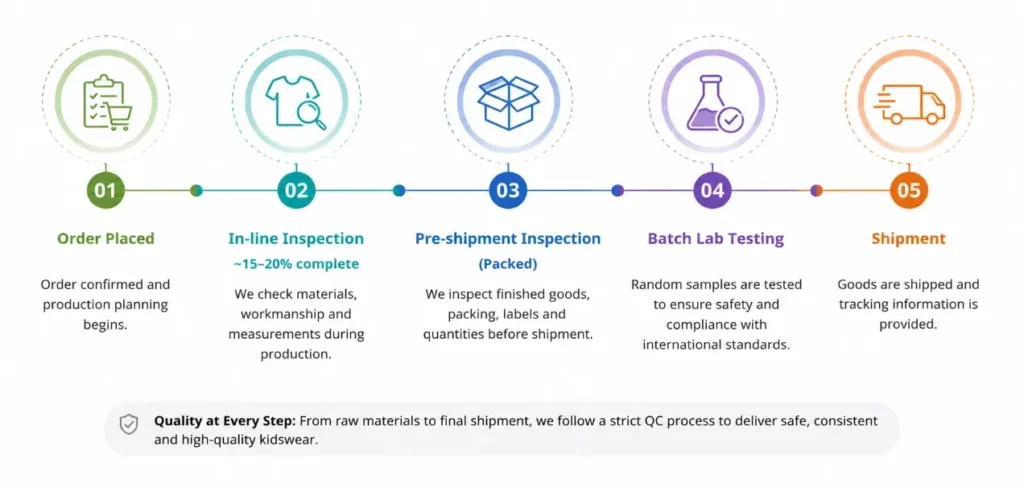
First, an in-line (during production) inspection, commonly booked when an order is roughly 15–20% complete — early enough that a problem found is a problem fixed, not a shipment lost. Second, a pre-shipment inspection once the order is substantially finished and packed, sampled statistically. Third, batch lab testing against your market’s standards — a CPSC-accepted laboratory for US-bound goods, or a suitably accredited lab such as a NATA-endorsed facility for Australia. If you want to see where these checkpoints sit inside the full production flow, our breakdown of the kids clothing manufacturing process maps each stage.
Understanding AQL Sampling Without a Statistics Degree
AQL — Acceptable Quality Limit — is the industry’s standard way to inspect a batch without opening every carton, following the sampling logic of ISO 2859-1. An inspector pulls a statistically determined random sample, classifies any defects found as critical, major, or minor, and passes or fails the batch against pre-agreed limits. Garment buyers commonly work around AQL 2.5 for major defects. For children’s clothing, make one adjustment and put it in your contract: safety-related defects are critical, and critical defects have an acceptance number of zero.
Using Third-Party Inspections (and What Skipping Them Costs)
Independent inspection agencies will attend the factory and run either checkpoint for a flat per-visit fee — small against the value of an order, and trivial against the cost of a container of unsellable stock. The factory’s own QC and your third-party inspection are not rivals; a factory running genuine multi-stage internal QC should welcome outside eyes, because the inspection will confirm what their records already show. At HAPA we run multi-stage internal QC and [CONFIRM: accept buyer-appointed third-party inspections as standard practice]. Treat any factory’s resistance to independent inspection as information.
Red Flags: When to Walk Away From a “Cheap” Deal
Most sourcing horror stories were predictable in the first two weeks. Here is the compressed version of everything above, as warning signals.
Deal-Breakers: Walk Away Immediately
- Refuses to share a business license or test reports. There is no innocent version of this.
- The names don’t match. Test reports or certificates issued to a different company than the one quoting you means you’re not dealing with who you think.
- Golden samples only. A factory that won’t make a counter sample in bulk fabric on its own line is telling you the bulk order won’t match — in advance.
- Blank on children’s safety basics. If drawstring rules, fastener pull-testing, or restricted substances draw a shrug, your inventory is the experiment.
Warning Signs: Proceed Only With Extra Verification
- A quote well below the physical cost of materials and labor. Ask, in writing, what fabric weight and trim sources make that price possible. Watch what changes.
- “We make everything.” Kidswear as a sideline means kidswear habits are missing. Ask what share of production is children’s clothing.
- Confidence instead of documentation. Every “no problem” should be convertible into a document, a photo, or a video on request.
- Pressure to skip the sample stage to “save time.” The sample stage is precisely where their risk becomes visible. Haste serves one side of the table.
A red flag isn’t proof of bad faith. It is proof that quality risk is moving from their side of the table to yours.
Your Next Step: Test a Factory, Not a Promise
So, are clothes made in China good quality? The honest answer hasn’t changed since the first section: the best and the worst share a zip code, and the buyers who win are the ones who can tell them apart. That skill is not mystical. It is a paper check, a sample you tested with your own hands, and inspection checkpoints you scheduled — the same checklist you just read.
I’ll end with the offer I’d make across the table. HAPA is a children’s clothing factory in Guangzhou — founded in 2010, with a 6,000 m² facility, OEM, ODM, and private label production, an in-house design team, and multi-stage quality control. I would rather you verify us than believe us: ask for the documents, book the video tour, order a production sample and put it through your washing machine. With a [CONFIRM: 100-piece mixed-size minimum order], testing us with a small first order is a low-risk experiment rather than a leap.
Contact HAPA for a quote or a sample — and bring the checklist.
Frequently Asked Questions
Why are clothes made in China so cheap?
Scale, vertically integrated supply chains, and logistics efficiency lower unit costs. Cheap does not automatically mean low quality — but a quote below the physical cost of fabric, trims, and labor means something was cut.
Is it safe to buy baby clothes made in China?
Safety depends on testing and compliance, not country of origin. For the US market, baby clothing requires third-party testing at a CPSC-accepted laboratory and a Children’s Product Certificate. Always ask for batch test reports.
Who is responsible if imported children’s clothing fails safety standards?
The importer or brand of record carries legal responsibility in markets like the US and Australia. It cannot be transferred to an overseas factory — the factory’s role is to make your compliance achievable.
What certifications should a Chinese kids clothing manufacturer have?
Commonly OEKO-TEX Standard 100 for fabric chemical safety, ISO 9001 for quality management, and a social audit such as BSCI. Always verify certificate numbers and scope with the issuing body, not just the PDF.
What is the difference between a golden sample and a production sample?
A golden sample is a perfected sales piece. A production (counter) sample is made on the factory’s own line with the actual bulk fabric and trims — the only sample that proves real manufacturing capability.
What is an AQL inspection?
An AQL inspection checks a statistically random sample from a finished order against agreed defect limits, following ISO 2859-1 sampling. For children’s clothing, set safety-related (critical) defects to zero acceptance.
How can I check clothing quality without visiting the factory in China?
Combine three tools: a live video factory tour, a production sample you test with your own hands and washing machine, and a third-party in-line or pre-shipment inspection booked at the factory.