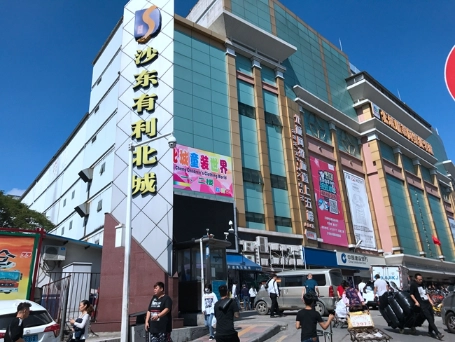
When you ask, “What is the largest clothing wholesale market in Guangzhou?”, Shahe is usually the first answer. More accurately, Shahe is a wholesale district made up of many market buildings, not one enormous market hall.
Official sources describe both Shahe and Liuhua-Kuangquan as very large clothing market clusters, but they measure different areas. For your buying trip, the useful question is not only which market is largest, but which one fits your product, price position, and reorder needs.
What is the largest clothing wholesale market in Guangzhou?
Shahe is the most common answer if you mean Guangzhou’s largest high-volume clothing wholesale cluster. It is not a single building, and no current official citywide ranking places it first under every possible measure.
The Guangzhou government’s profile of Shahe describes a district filled with apparel wholesale centers. Tianhe District also calls the Shahe-Shaodong area one of Guangzhou’s three major clothing wholesale distribution centers. That wording supports Shahe’s importance without claiming that it wins every size comparison.
Liuhua-Kuangquan is the reason to be cautious with an absolute answer. Yuexiu District’s 2026 profile describes a wide business district with many professional clothing markets. Its boundary and indicators differ from the Shahe source, so the figures do not make a fair ranking.
If you mean the largest single clothing wholesale building, there is no current official dataset that compares every Guangzhou building on the same date and basis. Yima is a large complex within Liuhua and is officially described as one of that area’s largest comprehensive clothing wholesale plazas. That does not make it a verified citywide number one.
The short answer remains Shahe. Start there for a dense cluster and fast ready-stock comparison, not simply because someone called it “the largest.”
What does “largest” mean in a Guangzhou clothing market?
Different articles often use the same word for different things. One writer means a business district. Another means a market building. A third is talking about merchant count or daily shipping volume. Once you separate those meanings, the apparently conflicting answers make more sense.
Cluster size and single-building size are different questions
Shahe and Liuhua-Kuangquan are market clusters. Each includes multiple buildings, operators, streets, product areas, and service providers. When an official source gives you a total for the district, that number does not describe one landlord or one market hall.
Baima and Yima are easier to identify as individual market complexes. Shisanhang sits somewhere in between in everyday usage because the name commonly refers to the business circle around Shisanhang Road, including several buildings.
This distinction affects the buying plan. A district name may still leave you far from the correct building or floor. Even the right building tells you little about the vendor.
Compare scale with the same indicator, date, and boundary
Before you compare two market claims, check what each figure measures.
“Largest” by
What you need to compare
Why the answer can change
Cluster footprint
The same geographic boundary
A district may cross several streets or administrative areas
Number of markets
The same definition of a professional market
Sources may count buildings, operators, or registered markets
Operating area
The same definition of active selling space
Gross construction area is not the same as trading area
Merchant count
The same date and type of business
A booth, company, and individual operator are different units
Product throughput
The same time period and method
Daily dispatch volume and annual transaction value measure different activity
Market count and operating area
Market count tells you how dense a district is. Operating area tells you how much physical space it covers. Neither tells you how quickly you will find the right product.
A focused buyer can often do more in one specialist building than in a full day across a larger general market. This is also true when you compare major clothing wholesale markets in China. Finished-garment markets, fabric hubs, mixed-goods centers, and factory clusters solve different problems.
Merchant count and product throughput
Merchant count suggests choice, but ten booths do not always mean ten independent supply sources. Several sellers may carry similar goods or buy from the same upstream producer. High product throughput proves that a district is busy. It does not prove that a vendor can maintain your fabric, measurements, or color in the next batch.
My rule when comparing market data: if two figures use different dates, boundaries, or units, I do not turn them into a ranking. I use them as context and move the buying decision back to the product.
Guangzhou’s professional markets are also changing. The city’s 2026 to 2028 program discusses trade services, logistics, digital tools, and support for international business. Treat that as policy direction. Before you travel, confirm what the specific market currently provides.
What buyers can expect from the Shahe clothing wholesale cluster
Shahe gives you density. You can scan many ready-stock products, compare price positions, and get a fast view of what is moving through the market. The trade-off is that you have to manage the details yourself.
How Shahe’s multi-building wholesale cluster works
“Go to Shahe” is not a working itinerary. You need the building, entrance, floor, product area, and booth. If a contact sends you a pin or building name, confirm it before the visit. Similar names and nearby entrances can easily take you into the wrong part of the district.
Connect every sample to a traceable record. At minimum, capture:
Location: market, building, floor, and booth
Vendor: contact name, company name, and payment entity
Product: style code, photos, color, size range, and sample notes
Offer: quoted price, MOQ basis, stock status, and delivery timing
Future supply: batch details, substitution rules, and reorder conditions
That may feel slow beside a crowded rack. It is still faster than trying to identify an unmarked sample two days later.
When you plan a clothing wholesale market visit in China, set a narrow objective for each block of time. “Compare girls’ cotton dresses at three price positions” is workable. “See everything in Shahe” is not.
Shahe has growing cross-border activity, but each seller’s export experience still needs checking. A 2026 Tianhe District report covered training for local merchants on export compliance, legal risk, and payment security. Market fame does not give every booth the same capability.
The best-fit buyer and the limits of Shahe’s scale
Shahe is a strong research route if you buy ready stock, test many styles, compare prices, or refresh an assortment frequently. It can also help you understand what is available at the lower and middle ends of a fast-moving market.
It is less comfortable when your order depends on an exclusive pattern, a fixed measurement chart, a specific fabric, proprietary artwork, custom trims, or stable repeat production. A larger selection will not tell you who owns the pattern or whether the next batch will match the first.
Service also varies by booth. Ask who will inspect the order, handle shortages, arrange packaging, consolidate cartons, prepare documents, and release the shipment. If the seller cannot explain these responsibilities clearly, the district’s reputation will not fix the gap.
Shahe vs. Baima, Shisanhang, and Liuhua: which market fits the order?
Once you have a product brief, “largest” loses much of its value. You are choosing a market for a job, not voting for the most famous name.
Compare market role, not fame
Treat every market reputation as a starting assumption. Product mixes change by floor, and vendors change over time. An organized showroom does not automatically mean better production. A low price does not prove that you are buying directly from a factory.
The shortlist should answer two questions: where are you likely to find the product, and what evidence must the vendor still provide?
How the main Guangzhou market areas serve different buying tasks
Shahe for high-volume ready-stock research
Choose Shahe when you want fast-moving stock, broad price comparison, and plenty of styles to scan. You gain options, but you also take on more record-keeping. Write down the building, booth, batch, payee, and reorder source before the products begin to blur together.
Baima for brand-oriented fashion wholesale
Baima is associated with organized presentation and a more brand-oriented fashion position. Yuexiu District’s profile describes wholesale, retail, sample-based ordering, agency, and franchise formats.
If you are studying how collections are presented or looking for more developed brand concepts, Baima may be a better use of your time than another price-led market. You still need to check whether the vendor owns stock, takes orders, or controls production.
Shisanhang for trend-led womenswear
Shisanhang usually means the business circle around Shisanhang Road. It is not one uniform hall. The Liwan government’s market guide shows how New China Plaza is divided across accessories and several levels of women’s fashion.
The area works well for trend-led womenswear research, but check the current floor mix before you go. When you choose a sample, record whether the vendor is offering current stock, a future order, or a replacement that only looks similar.
Liuhua-Kuangquan and Yima for multi-market and single-complex research
Liuhua-Kuangquan gives you several organized clothing markets within a wider trade district. It may suit a buyer who wants to compare market formats or look for international trade support. Check which services belong to the district, which belong to the market operator, and which the individual seller must arrange.
Yima gives you the single-complex version of that research. Its official profile covers wholesale, trade discussions, exhibitions, international procurement, and logistics facilities. The accurate wording is that Yima is one of Liuhua’s largest comprehensive clothing plazas, not the proven largest building in Guangzhou.
Build the shortlist with one product-and-service matrix
Market or district
Use it when you need
Where buyers get caught
What to verify
Shahe cluster
Fast-moving stock and broad price comparison
Too many similar options with weak records
Building, booth, batch, payee, reorder source
Baima
Brand-oriented fashion and organized presentation
Assuming showroom quality equals production control
Vendor model, order method, sample link, export terms
Shisanhang
Trend-led womenswear and quick assortment research
Treating several buildings as one uniform market
Current floor mix, stock source, replenishment
Liuhua-Kuangquan
Several markets and a broader trade environment
Assuming district services apply to every seller
Exact market, service eligibility, consolidation responsibility
Yima
A large single-complex comparison within Liuhua
Treating building size as a citywide ranking
Current categories, merchant role, buyer services
A market may not be the right transaction channel. China’s apparel supply network includes wholesalers, trading companies, manufacturers, marketplaces, and service platforms. These different China clothing sourcing channels provide different levels of control.
Choose a Guangzhou market by product and order model
Start with what you need to buy. A retailer filling next month’s assortment has a different job from a brand developing its own size range.
Choose the market by product category and positioning
Ready stock, brand-oriented fashion, and trend-led buying
Use this routing logic as a starting point:
Shahe: price-led ready stock, rapid testing, and broad price comparison
Baima: more organized presentation and brand-oriented fashion research
Selected Liuhua-Kuangquan markets: comparison across several market formats and service levels
Shisanhang: fast-moving, trend-led womenswear research
These are routing suggestions, not quality grades. Compare the physical garment, stock status, seller role, price basis, and reorder evidence. If the product looks right but the batch cannot be identified, pause before you scale the order.
Children’s clothing and category-specific sourcing
If you buy childrenswear, the biggest general apparel district may not be your best first stop. The Zhongshan Ba Road area includes specialist children’s markets. Liwan’s 2024 guide lists Lihu Building, Lishang, Litang Building, and Kids City, with different mixes of children’s clothing, infant products, footwear, accessories, and toys.
Specialization helps you find products. It does not remove the need to check measurements, intended age range, fabric, trims, labels, batch consistency, and reorders. Comparing children’s clothing sourcing options in China can also help you tell a ready-stock wholesaler from a supplier that can develop a product.
Let the order model determine the supplier type
Ready stock works when you accept the existing design, fabric, measurements, colors, and branding. Modified stock sounds simple, but even a small change raises practical questions: who will make it, what quantity applies, and what sample will you approve?
Custom production starts somewhere else. You define the specifications, develop and approve a sample, then plan production. You can still use Guangzhou’s markets for trend and price research, but the vendor that helps you learn may not be the factory that produces your final product.
Verify the vendor and order before buying from a large market
A busy market can make product discovery faster. It does not give you a clean transaction record. You have to build that record before you pay.
Trace the seller, payment entity, sample, and production source
Match the seller, payee, stock owner, and manufacturer
The person showing you a garment may work for a wholesaler, brand, trading company, factory sales office, or stock holder. Before treating the booth as your supplier, confirm:
Who issues the quotation, invoice, or sales contract
Whose legal name appears as the payment recipient
Who owns the current stock and handles shortages
Who would manufacture a repeat or modified order
Which entity appears on the shipping and export documents
Different entities can be legitimate. An unexplained relationship is the problem. If a booth claims a factory connection, verify the supplier behind the market offer as carefully as a factory found online.
Connect the display sample, order batch, and reorder
The garment in your hand is a display sample. State whether the order must match it and which differences you will accept. Record the color, measurements, fabric feel, construction, trims, labels, packaging, and visible workmanship.
Do the same for the reorder promise. “We can make the same style later” might mean leftover stock, a new batch, a substitute fabric, or a visually similar product.
Before you pay, connect
Evidence to keep
Product
Style code, photos, measurements, color, size range
Confirm commercial terms and kidswear controls before payment
There is no standard Shahe MOQ. Ask whether the quantity applies to each style, color, size run, pack, or custom change.
One sourcing rule I follow: I never compare two MOQs until I know what each number applies to. A lower number can become the more expensive option once color, size, packaging, and replenishment conditions are added.
Write down who handles shortages, substitutions, defects, packing, consolidation, export documents, and shipment release. If you use an Incoterms rule, include the named place and agreed rule in the contract instead of relying on a short message.
Childrenswear needs a product-specific review. In the United States, products intended primarily for children aged 12 or younger may require third-party testing and certification under applicable CPSC rules. FTC textile guidance also covers fiber content, country of origin, and company identification.
Do not treat the market’s name as proof that your garment meets its destination-market requirements. Classification, testing, labels, records, and importer responsibilities depend on the actual product.
When a wholesale market is no longer the right sourcing model
Wholesale markets are useful for trend research, ready stock, assortment tests, and early demand validation. Move beyond that model when the product needs more control than the stock transaction can provide.
Signals that market stock has reached its limit
Market stock has probably reached its limit when your order requires:
An original pattern or a controlled measurement chart
An exact fabric, exclusive color, proprietary artwork, or custom trim
A formally approved sample that bulk production must follow
Documented labels, packaging, and construction details
Written approval for material or design changes
Repeat orders with the same fit, fabric, color, and branding
These requirements depend on specification and approval control, not access to more stock. “We can make it again” is not the same as a documented product specification. If a successful test cannot be reproduced consistently, visiting more buildings will give you more options without solving the problem.
Turn market research into an original, repeatable product brief
Keep what you learned about price position, useful features, silhouette, fabric direction, color mix, size range, and customer response. Then write original product requirements. Do not hand a factory another brand’s garment and ask for a direct copy.
For childrenswear, your brief should cover the product type, intended age, size range, measurements, construction, fabric and trim preferences, artwork, branding, target quantity, packaging, destination market, and approval steps.
HAPA’s children’s clothing OEM process covers tech pack and feasibility review, pattern making and grading, fabric and trim selection, sample development, production checks, labels, and packaging. MOQ, timing, testing, documentation, and feasibility still have to be confirmed for your project.
The market can tell you what customers are buying now. A controlled development process defines what your brand can reproduce later.
Conclusion
So, what is the largest clothing wholesale market in Guangzhou? Shahe is the most useful short answer when you mean a large, high-volume clothing wholesale cluster. It is not one building, and the official figures do not support one winner across every measure.
Your best route may still be Liuhua-Kuangquan, Baima, Shisanhang, or the Zhongshan Ba children’s market area. Choose in this order: buying task, district, building and floor, vendor, then sample and order.
If you need ready stock, go where the category is concentrated and keep a clear record. If you need an original, repeatable childrenswear line, turn your market findings into a product brief and evaluate a manufacturing route.
Frequently asked questions
Is Shahe the largest clothing wholesale market in Guangzhou?
Shahe is the most common answer for a large, high-volume clothing cluster. It contains multiple markets and is not officially ranked first under every measure.
Is Shahe one market or a wholesale district?
It is a wholesale district containing many market buildings. Before visiting, confirm the exact building, entrance, floor, and product area you need.
Is Shahe larger than the Liuhua clothing market area?
Official sources use different dates, boundaries, and indicators. They show that both are major clusters but do not support a clean, like-for-like ranking.
What is the largest single clothing wholesale building in Guangzhou?
There is no current official citywide comparison. Yima is one of Liuhua’s largest comprehensive clothing plazas, but that does not prove citywide first place.
Is Shahe or Baima better for foreign buyers?
Shahe suits broad ready-stock and price research. Baima suits more organized, brand-oriented fashion research. Choose according to your product and required services.
Which Guangzhou wholesale market is best for children’s clothing?
The specialist markets around Zhongshan Ba Road are usually a more focused starting point. You still need to verify the vendor, product, and reorder conditions.
What MOQ should you expect in Shahe?
There is no standard market MOQ. It depends on the vendor, stock, style, color, size mix, packaging, and whether you request production or changes.
Are Shahe market vendors clothing factories?
Not necessarily. A booth may represent a wholesaler, brand, trader, stock holder, or factory office. Verify the legal, payment, and production entities separately.
Hey, I’m Suki, CEO of HAPA. We leverage 15+ years of manufacturing expertise to help 1,500+ kidswear brands across 25 countries solve their toughest R&D and production challenges. Ready to elevate your brand? Contact us today for a free quote and your customized solution.