Choosing between a China clothing wholesale market vs OEM factory is not simply a question of price. The two models solve different sourcing problems. Once you have candidates, this bulk kids' clothing buying guide for China covers the bulk-order checks specific to children’s garments.
A wholesale market is usually the better starting point when you want existing styles, quick assortment building, and limited product-development work. An OEM factory is more suitable when your brand needs original specifications, controlled materials, custom labels, approved samples, and a product that can be reproduced consistently.
The practical question is therefore not, “Which option is always cheaper?” It is, “Which business risk do I need to control first?”
For a new boutique, the biggest risk may be committing too much cash before knowing what customers will buy. For an established private-label brand, the bigger risk may be inconsistent fit, missing stock, or a supplier changing an important detail between production runs.
This guide compares both sourcing routes across speed, cost, branding, minimum commitment, quality control, and reorder reliability. It also explains when a hybrid path—testing demand with ready stock before moving to OEM—can make sense.
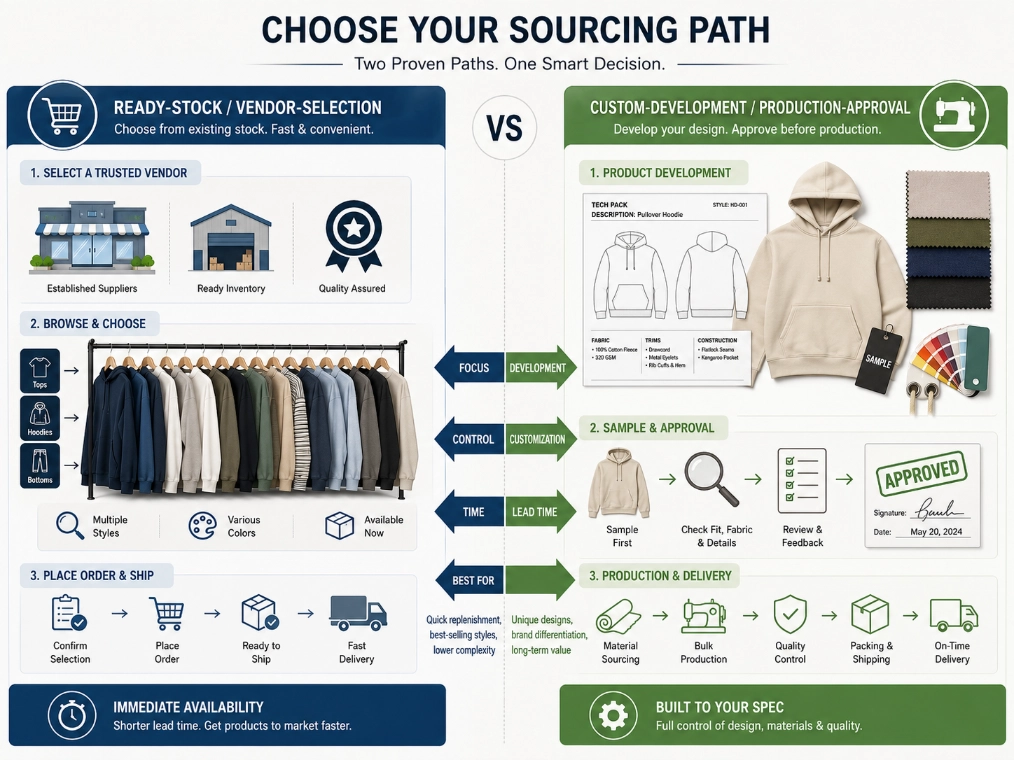
Choose a Wholesale Market for Stock, an OEM Factory for Product Control
Choose a wholesale market for existing products and quick assortment building. Choose an OEM factory when the garment must follow your specifications. Use a hybrid route when you need sales evidence now but expect to develop a differentiated product later.
This compares sourcing models, not company labels. A market vendor may work with a factory, while a manufacturer may also sell stock designs. What matters is the supplier’s commitment for your order.
Choose a Wholesale Market When Speed and Variety Matter Most
Wholesale sourcing starts with available merchandise. It can work well when:
- You want to test several categories without developing each style.
- Your store competes on curation rather than exclusive product design.
- You are still learning which prices, silhouettes, or colors attract buyers.
- You can accept uncertain long-term availability.
Still verify what “stock” means. Ask whether goods are physically available, how each style is identified, whether the sample represents the order batch, and what happens if a size or color sells out.
If your immediate task is exploring vendors rather than developing original products, HAPA’s overview of China clothing wholesale suppliers and sourcing options provides useful context on the different types of suppliers buyers encounter.
Choose an OEM Factory When the Product Must Be Yours
OEM sourcing starts with a product requirement. The buyer may provide a tech pack, measurements, artwork, an authorized reference sample, or a detailed brief. This route is more suitable when:
- Fit, measurements, fabric, trims, or construction are important to your positioning.
- You need your own woven label, care label, hangtag, or retail packaging.
- You need a recognizable product rather than a widely available stock style.
- Quality must be judged against written specifications and an approved sample.
HAPA’s children’s clothing OEM services can include product review, patterns and grading, material selection, sampling, production checks, and label or packaging preparation. Confirm the scope for each project.
Consider a Hybrid Route When You Need Evidence Before Commitment
A hybrid route separates market validation from product development. Ready stock can test a category, price band, use case, or silhouette. Once demand becomes clearer, use your own sales, returns, fit comments, color preferences, and feature requests to build an original brief.
This is not permission to copy another company’s design. The goal is to turn customer evidence into a product created for your brand.
How the Two Sourcing Models Actually Work
The starting point, approval process, and responsibility chain reveal how the models differ.
The Wholesale-Market Transaction Starts With Existing Merchandise
A market transaction usually follows:
Select styles → confirm availability → inspect goods → consolidate → ship
The seller has already made most product decisions. You choose from an existing range, although limited changes to colors, packaging, hangtags, or labels may be available.
Before treating an item as reorderable, establish:
- The vendor’s permanent style number or other product identifier
- Available colors and size runs
- Whether the fabric and trims remain the same across batches
- Whether the goods are ready stock or made after confirmation
- Who handles quality problems
- Whether another batch can be supplied to the same specification
Similar-looking styles are not necessarily identical. Changes in fabric, shade, measurements, trims, or finishing can create complaints even when the photos look unchanged.
For a location-specific example of the wholesale model, see how Guangzhou’s main market areas differ before deciding where to inspect ready stock.
The OEM Relationship Starts With a Product Requirement
A typical OEM path is:
Brief or specification → feasibility and quote → sample → approval → production
The buyer has more control, but also more preparation. “A high-quality cotton children’s set” leaves the composition, weight, construction, finish, sizes, measurements, artwork, trims, labels, packaging, testing, quantity, and delivery terms undefined.
Clear information reduces assumptions and makes supplier quotations comparable.
A sample can become the reference for fit, construction, fabric feel, color, branding, and finishing. Document any permitted differences between the sample and bulk order.
For a more detailed production sequence, see HAPA’s guide to buying apparel directly from a factory. This article stays focused on choosing the model, rather than repeating the full ordering process.
Supplier Labels Do Not Prove the Sourcing Model
Terms such as “factory direct,” “wholesaler,” and “private label” are used loosely. Ask who:
- Holds the stock
- Develops and approves samples
- Buys the fabric and trims
- Performs the main production steps
- Conducts inspections
- Approves material substitutions
- Handles defects, rework, or claims
A trading company may manage production well, while a factory may outsource printing, embroidery, washing, or packing. Neither arrangement is automatically unsuitable. The operating model must be transparent enough for the product’s risk.
Compare Wholesale Markets and OEM Factories Across the Decisions That Matter
Use this as a screening tool, then confirm each point with the vendor.
| Decision factor | Wholesale market | OEM factory | What the buyer should verify |
|---|---|---|---|
| Starting point | Existing styles or stock | Buyer brief, specifications, or approved reference | Is the order stock, modified stock, ODM, private label, or OEM? |
| Selection | Broad choice can be available quickly | Choice is created within the project scope | How much development and sourcing support is included? |
| Branding | Often limited to available label or packaging options | Can include product, label, trim, and packaging requirements | Which elements are custom, and who approves them? |
| Minimum commitment | May suit smaller style tests, depending on vendor | Depends on product, material, colors, sizes, and factory setup | Is the minimum per style, color, fabric, or total order? |
| Timing | Less development, but stock and consolidation still take time | Sampling and approval add time before production | What are the current milestones and dependencies? |
| Quality control | Mainly verifies the goods offered or ordered | Can compare production with written specs and approved samples | What standard, inspection point, and remedy are agreed? |
| Reorders | Availability and consistency may change | More repeatable when specs and changes are controlled | Are materials, patterns, and records retained? |
| Accountability | May involve vendor, agent, warehouse, and producer | Can be clearer, but only if responsibilities are documented | Who is contractually responsible for each problem? |
A Decision Matrix for Ready Stock vs. Custom Manufacturing
Product and Branding Control
Wholesale sourcing asks you to choose from available products. A new label or package does not make the garment exclusive. OEM gives you more room to define measurements, grading, fabric, construction, trims, artwork, labels, and packaging, but also requires clearer approvals.
Distinguish relabeling an existing product, modifying a supplier design, and OEM production against buyer-defined requirements.
For kidswear brands that need both garment development and branded presentation, HAPA’s private-label clothing manufacturing page shows the types of inputs that may be discussed, including reference samples, color palettes, size ranges, fabric and trims, labels, and packaging.
Speed and Minimum Commitment
Ready stock removes development steps, but still requires availability checks, inspection, payment, consolidation, documents, and freight. OEM adds feasibility review, sampling, approvals, material preparation, and production scheduling.
MOQ is also more complex than one number. Ask whether it applies per style, color, fabric, print, or size assortment. A low garment minimum may not solve a larger material commitment.
Cost Structure and Cash Flow
Wholesale often preserves cash during tests but can bring less differentiation, more coordination, or limited reorders. OEM may add patterns, samples, testing, special materials, labels, and packaging. Separate one-time from recurring expenses.
Neither model is always cheaper. A fair comparison uses the same product standard, destination, quantity, trade terms, inspection scope, and expected failure cost.
Repeatability and Quality Control
A wholesale inspection mainly confirms that goods match the stock sample and order. OEM allows measurements, construction, materials, workmanship, labels, and packing to be defined earlier.
But OEM does not create consistency by itself. Without a specification, approved sample, inspection plan, and change record, the factory is still working from assumptions.
Supplier Accountability, Documents, and IP
Ask who provides product-specific material information, records, test reports, labels, and batch references. A generic certificate image is not product evidence. Address substitutions, defects, rework, and documents in writing; IP terms may need professional review.
The Best Model Depends on Which Risk You Need to Reduce
Wholesale markets can reduce premature development risk. OEM factories can reduce the risk of losing control over fit, materials, branding, and reorders. Choose the model that controls your most expensive likely failure, not merely the lowest first quote.
Which Model Fits Your Brand Stage and Sales Channel?
One brand may use ready stock for a trend-led capsule and OEM for a core item. The answer can change as the business gains sales data and operating capacity.
| Brand situation | Likely starting route | Main reason | Signal to reconsider |
|---|---|---|---|
| Boutique testing many styles | Wholesale market | Variety and lower development workload | Bestsellers cannot be reordered consistently |
| New DTC brand | Wholesale, light private label, or hybrid | Balances cash exposure with brand testing | Customers request product-specific improvements |
| Established private-label brand | OEM or controlled private label | Repeatability and brand control | Use wholesale selectively for non-core products |
| Kidswear buyer with market-specific requirements | Often OEM for core products | Fit, trims, labels, testing, and records need coordination | Keep stock buying only where evidence is adequate |
Boutique or Reseller Testing Multiple Styles
A boutique that wins through curation may not need to develop every garment. Wholesale sourcing supports assortment testing without a full product-development function.
Several vendors bring different standards, packages, and delivery dates. Consolidation helps shipping but does not create one quality standard or responsible supplier. Track style numbers, measurements, photos, inspections, and reorder status.
Startup or DTC Brand Validating Product-Market Fit
A startup should decide what customers are expected to value. Ready stock may test a brand built on curation or niche access. A distinctive fit, performance feature, original print, or recognizable design language may require OEM earlier.
A hybrid model can protect cash when conversion triggers are defined: recurring fit complaints, stockouts, stable core demand, or unsupported branding needs.
Established Private-Label Brand Building Repeatable Core Products
Once a product becomes central to revenue, inconsistency becomes expensive. Changes in length, fabric hand, color, shrinkage, or trims can invalidate customer expectations, photography, and size advice.
Core products therefore benefit from:
- A controlled style master
- Approved measurements and grading rules
- An approved sample
- Defined materials and acceptable alternatives
- Label and packaging specifications
- Inspection and change-control records
- A reorder review before each production run
These controls are easier to build in an OEM or structured private-label relationship than through one-off stock purchases.
Kidswear Buyer Managing Fit, Trims, Labels, and Market Requirements
Children’s clothing adds questions about age group, use, fabric, trims, small components, drawstrings, decorations, labels, and destination market.
The sourcing model does not transfer all responsibility to the supplier. A market vendor may not know your sales destination. An OEM factory can support development and documents, but the brand or importer must still identify applicable requirements and assign each task.
In the United States, the CPSC explains that covered children’s products may require third-party testing and a Children’s Product Certificate. Assess the actual product rather than relying on a generic category claim.
How to Transition from Wholesale Buying to OEM Production
If the framework points you toward a factory, the move is easier than most brands expect — provided you arrive prepared. This section covers the preparation; the full ordering process is a separate guide.
What to prepare before you approach a factory
A factory quotes against information, so the more precise your package, the faster and more accurate everything that follows:
- A tech pack, or at minimum clear drawings with measurements, construction notes, and fabric direction.
- Your size chart — the fit you want repeated, not the stall’s grading you have been living with.
- A reference sample, even an imperfect one; a garment communicates what documents cannot.
- Quality and compliance requirements for your destination market, so testing and labeling are planned into production rather than bolted on.
- Realistic quantity expectations, discussed openly — factories can often phase volumes as a new product proves itself.
If you are still shortlisting partners, our guide on how to find and vet clothing manufacturers covers verification before any money moves.
How the handoff works (and where HAPA helps)
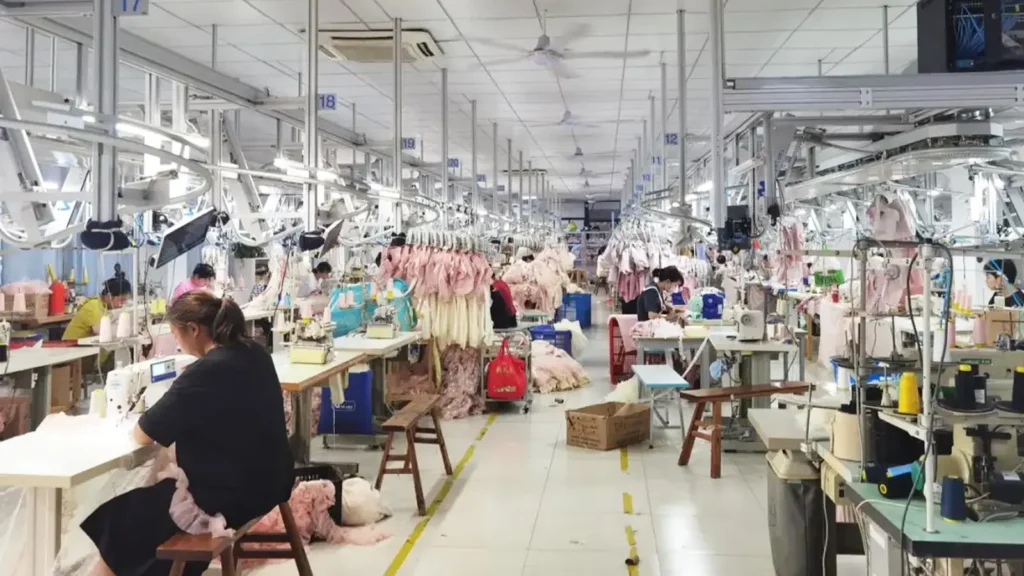
From there, the collaboration runs in stages: development and costing, sampling, your approval, bulk production, and inspection before shipment. At HAPA, our team supports kidswear brands through each of those steps — developing the design and sourcing fabrics and trims, grading to your size chart, producing approved samples, sewing in your labels and packing to your retail requirements, and running quality control through production. The step-by-step mechanics of ordering — quotations, sample rounds, payments, inspections — are laid out in our factory ordering guide, so this article stays where it belongs: helping you decide. What matters here is that the transition is not a leap into the unknown; it is a structured process that starts with a conversation and a sample.
Conclusion: Choose the Model That Matches Your Stage
There is no universal winner in the China clothing wholesale market vs. OEM factory question — only a right answer for your brand right now. Markets win on speed, variety, and low-risk testing; factories win on ownership, consistency, branding, and compliance. Most growing brands use both, and migrate their center of gravity from market to factory as winners emerge and consistency starts paying the bills.
The signal to move is concrete: when you need original designs, your own labels and size chart, batches that match, and documentation your market demands — especially for children’s wear — ready stock has finished its job. When that moment comes, prepare a tech pack and size chart, request a sample, and talk to a manufacturer about a children’s clothing OEM or private label program built to your specification. Our product development team is glad to start with a single sample and let the work make the case.
Frequently Asked Questions
Is an OEM factory more expensive than buying from a wholesale market?
They have different cost structures. Markets charge per piece with no development cost; OEM requires upfront sampling and development, with unit costs falling as volume grows. Which is cheaper depends on your quantities and how much control you need.
What’s the difference between a wholesaler and a manufacturer in China?
A wholesaler resells finished garments that someone else produced, so customization is minimal. A manufacturer produces garments to a specification, which enables custom designs, your own sizing and labels, and repeatable production runs.
Can I start with ready stock and switch to OEM later?
Yes — it is one of the most common paths. Brands validate demand with small market purchases, then move proven styles into OEM production to gain consistency, branding, and better economics at volume.
Do I need my own designs to work with an OEM factory?
Not necessarily. OEM means the factory produces your design, but ODM lets you adapt and brand a factory’s existing developed styles. Many brands start with ODM and shift to full OEM as their design capability grows.
Which sourcing model is better for a children’s clothing brand?
Ready stock works for testing demand. For a branded kids’ line, consistent sizing, accurate labels, batch consistency, and destination-market safety compliance usually require factory production, since compliance responsibility stays with you as the importer.
What’s the minimum order for OEM versus a wholesale market?
Market minimums are generally lower and set stall by stall; factory minimums are generally higher per style because production runs must be viable. Exact figures vary widely by supplier, so confirm terms directly rather than relying on published numbers.