Where do boutiques get their clothes? Most buy from a mix of online wholesale marketplaces, brand wholesalers, distributors, trade shows, independent designers, dropshipping partners, and private-label manufacturers. There is no single source used by every store.
Your best option depends on what you need now. Ready-made wholesale stock is quicker to launch, while custom production gives you more control over fit, fabric, branding, and reorders. This guide shows how each route works and when it deserves a place in your sourcing plan.
Where do boutiques usually get their clothes?
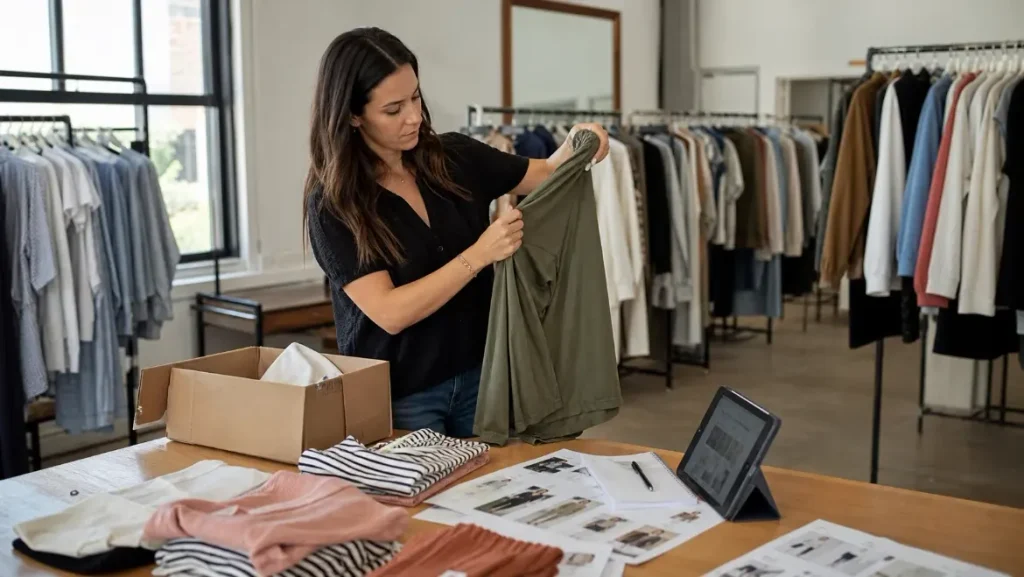
Boutiques usually build an assortment from several sources. A new online store may buy its first collection from wholesalers, add a few pieces from a local designer, and use dropshipping for an untested category. Later, it may develop one proven product with a manufacturer. Each channel solves a different problem, so do not expect a wholesaler to provide custom development or a factory to hold ready-to-ship stock. For a closer look at comparing online boutiques for distinctive children’s clothing, use our online children's boutique examples.
Online wholesale marketplaces
Online marketplaces bring many brands and vendors into one searchable catalog. You can compare styles, price bands, size packs, order conditions, and delivery locations without contacting each supplier from scratch. This is often the easiest place to understand what ready-made inventory is available.
The platform does not remove the need to check the seller. Confirm whether the goods shown are physically in stock, whether the product photos represent the current batch, and whether the same style can be reordered. Platform rules and seller terms also change, so check them when you buy. HAPA’s guide to online wholesale clothing platforms gives you a closer look at this route.
Wholesale brands and distributors
A wholesale brand sells its own collection to approved retailers. A distributor may represent one or several brands within a region or sales channel. In both cases, you are buying an existing product rather than developing a garment from your own specification. Australian children’s retailers can also review these wholesale kids' clothing suppliers in Australia when testing a ready-stock assortment.
Ask how the relationship is structured. Who owns the stock? Who accepts a quality claim? Can you reorder by a permanent style number, or does the assortment change each season? Broad distribution may also reduce the exclusivity that shoppers expect from a boutique.
Trade shows and showrooms
Trade shows and showrooms let you handle garments, compare vendors, and ask questions in real time. You can inspect fabric, construction, labels, finishing, and size presentation before deciding which conversations deserve a follow-up.
The show floor is a discovery channel, not proof of supplier quality. Collect company details and written order terms, then repeat your normal checks after the event. If you need production rather than finished collections, confirm that the exhibitor is a manufacturer or production service, not only a sales representative.
Independent designers and local makers
Independent designers and local makers can give your store products that are not available through a large marketplace. The relationship may also support smaller seasonal capsules, regional stories, or direct collaboration on merchandising.
Availability can be less predictable because the supplier may work in short runs. Clarify wholesale rights, channel restrictions, reorder expectations, labeling, and defect handling. Ask what records, materials, and patterns are retained between runs.
Dropshipping and consignment
Dropshipping allows the supplier to ship an order to your customer after the sale. Consignment places products with your boutique while ownership remains with the supplier until an agreed event, usually a sale. Both models can reduce the amount of cash tied up in inventory, but the contracts and operating responsibilities differ.
The trade-off is control. With dropshipping, you may not see the exact item before your customer does, while packaging, dispatch, returns, and stock accuracy sit partly outside your operation. Consignment requires clear records for sales, damage, returns, and payment. Test the customer experience before relying on either model.
Private label and custom manufacturers
Private label and custom manufacturing become relevant when you want the garment to carry your product decisions. Depending on the model, you may define the fit, measurements, fabric, construction, colors, artwork, labels, and packaging. You also take on more development work and approval responsibility.
This route is not simply wholesale with a new neck label. A manufacturer needs enough information to assess feasibility, source materials, build samples, quote the work, and plan production. It is better suited to a product opportunity you understand than to a vague request for “something trendy.”
Which boutique sourcing model fits your store?
Choose a sourcing model by comparing the same operating questions across every option. The table below uses qualitative labels, not promises. “Low” and “high” describe the relative amount of work or commitment commonly involved, but actual terms depend on the supplier and product.
| Sourcing route | Launch speed | Customization | Upfront commitment | Quality control | Reorder predictability | Exclusivity | Buyer workload |
|---|---|---|---|---|---|---|---|
| Online wholesale marketplace | Usually fast | Low | Low to medium | Inspect available goods | Varies | Low | Low to medium |
| Wholesale brand or distributor | Usually fast | Low | Varies | Inspect against supplier sample | Varies by collection | Low to medium | Medium |
| Trade show or showroom | Fast after selection | Low to limited | Varies | Inspect before ordering, then verify batch | Varies | Medium | Medium |
| Independent designer or local maker | Medium | Limited to collaborative | Varies | Agree directly with supplier | Varies by capacity | Medium to high | Medium |
| Dropshipping or consignment | Fast to test | Low | Usually lower stock commitment | Less direct control | Depends on live stock | Low | Medium to high |
| Private label or custom manufacturing | Slower due to development | High within feasibility | Medium to high | Can use written specs and approved samples | Better when records and materials are controlled | High | High |
Start with the failure you most need to avoid. A new business may prioritize flexible ready-made stock, while repeated fit returns can make product control more valuable than launch speed.
Your answer can change by category. You might source accessories from distributors, use wholesale apparel for trend-led drops, and develop a private-label core product. For a deeper comparison, review wholesale market and OEM factory models.
How do wholesale and private-label sourcing differ?
Wholesale sourcing starts with a product that already exists. Private-label or custom sourcing starts with a product requirement, even when a manufacturer offers a base design that you can adapt. That difference changes what you must prepare, approve, and manage.
Buying ready-made wholesale clothing
Wholesale is practical when you need products quickly and do not want to manage patterns, material sourcing, sampling, or production approvals. You select from the supplier’s range, confirm availability and order conditions, inspect the goods, and prepare them for retail. UK boutique buyers can use these UK kids' clothing wholesale suppliers as a separate shortlist to verify.
The limitation is product control. Other stores may buy the same garment, and a future batch may differ in availability, fabric, color, or measurements. Record the supplier style number, size breakdown, material information, photographs, and reorder history for important products. That evidence may reveal a custom opportunity.
If you plan to buy ready-made stock in person, compare Guangzhou’s clothing wholesale markets by product category and price position before choosing where to visit.
Developing private-label clothing
Private label covers several arrangements. One supplier may let you add approved branding to an existing product. Another may adapt a house design. A custom OEM project may follow your own specifications. Ask which model is being quoted because labels such as “private label” are used differently across the industry.
Manufacturing adds decisions about measurements, grading, materials, construction, decoration, packaging, and sample approval. It also raises questions about pattern use, artwork rights, substitutions, testing, and defective goods. HAPA’s overview of private-label clothing manufacturing shows possible inputs for a children’s clothing project, but the scope must be confirmed for each order.
Combining both models
You do not have to convert the whole store to private label. A mixed assortment can preserve the speed of wholesale while concentrating development resources on products that customers already understand.
One practical sequence is to test a category with ready-made goods, study sales and returns, then write a custom brief around the evidence. A popular children’s set, for example, may reveal repeated requests for a softer waistband, a different sleeve length, or a size that the wholesaler does not carry. Those observations are more useful to a manufacturer than a request to copy the existing product.
When do boutique manufacturing services make sense?
Boutique manufacturing services make sense when ready-made sourcing cannot solve a defined product problem. Know who the garment is for, what must change, and why development is commercially reasonable.
The phrase itself is not standardized. One supplier may provide only cutting and sewing. Another may support patterns, fabric sourcing, samples, grading, labels, packaging, quality checks, and shipment preparation. Treat the service name as the start of a conversation, not a complete scope of work.
Signs your boutique is ready
You do not need a huge organization, but you do need enough clarity to make decisions. Manufacturing is worth exploring when several of these conditions are true:
- You can describe the target customer, use case, price position, and sales channel.
- You have sales, return, fit, or customer-feedback evidence behind the product idea.
- Available wholesale products cannot deliver the fit, feature, material, size range, or brand presentation you need.
- You can review samples, approve changes, and keep product records under version control.
- You can carry the development expense, order commitment, and longer planning cycle without depending on immediate sell-through.
These are readiness signals, not a formula. A technically specific product may need manufacturing early, while a retailer built on curation may never manufacture most of its assortment.
Services a manufacturer may provide
Ask the supplier to mark which services are included, optional, outsourced, or excluded. The list may cover:
- Product review, pattern development, and size grading
- Fabric, trim, label, and packaging sourcing
- Prototype, fit, size-set, or pre-production samples
- Cutting, sewing, printing, embroidery, washing, or other specialist processes
- In-line checks, final inspection, packing, and shipment preparation
The stages depend on the garment. A knit top, lined coat, embellished dress, and children’s sleep product do not create the same technical or compliance work. Compare suppliers only after the quotation boundary is clear.
Scope questions to confirm
Ask who develops and owns the pattern, who purchases materials, which operations are subcontracted, and who approves substitutions. Confirm the sample stages, included revisions, inspection points, packaging work, defect process, and reorder records. If a required task is absent from the quote, find out whether you must arrange it or pay for it separately.
For a children’s boutique, HAPA’s children’s clothing OEM service may be relevant once you have a defined kidswear product and enough information for a feasibility discussion. That is a narrower use case than general boutique sourcing. A manufacturer should not be presented as the answer for a store that only needs ready-made adult fashion inventory.
How can you find and vet boutique clothing manufacturers?
Learning how to find boutique manufacturers starts with knowing what you need. You can discover boutique clothing manufacturers through production directories, sourcing events, referrals, sourcing partners, and focused online research. Define the product, target market, required services, and approximate order structure before building a list.
Define the product and factory fit
Write a one-page sourcing brief before building a list. It should state the garment category, customer, size range, materials or performance needs, construction complexity, branding, destination market, estimated quantity range, and required delivery window. Add drawings, a tech pack, or an authorized reference sample if available.
The brief rules out poor product matches and prevents you from comparing an assembly-only quote with one that includes materials, labels, packing, and inspection.
Search the right sourcing channels
Industry directories can help you discover candidates by location, product category, service, and production scale. The CFDA Production Directory, for example, connects brands with US fashion manufacturing resources. CFDA also states that it does not audit, certify, monitor, endorse, or guarantee the listed facilities. That distinction is useful everywhere: a listing gives you a name to investigate, not a factory you can trust without further work.
Trade shows let you examine samples and discuss capabilities in person. Referrals can reveal how a supplier responds to problems. Sourcing partners may help with discovery, visits, and coordination, but none of these routes replaces verification.
Screen the shortlist
Send the same brief to each candidate and compare their questions. A useful response engages with construction, materials, measurements, samples, quantities, timing, and the destination market. A generic company profile does not show project fit.
Your first screen should establish:
- The legal company name, address, contracting entity, and payment beneficiary
- Relevant product experience and the facility expected to handle the work
- In-house and subcontracted operations
- Sample stages, quotation boundary, material responsibility, and quality plan
- Current production window, communication owner, defect process, and reorder records
HAPA’s guide to finding and vetting clothing manufacturers expands on the preparation and discovery stage. Apply the same standard to HAPA or any other candidate.
Order and score samples
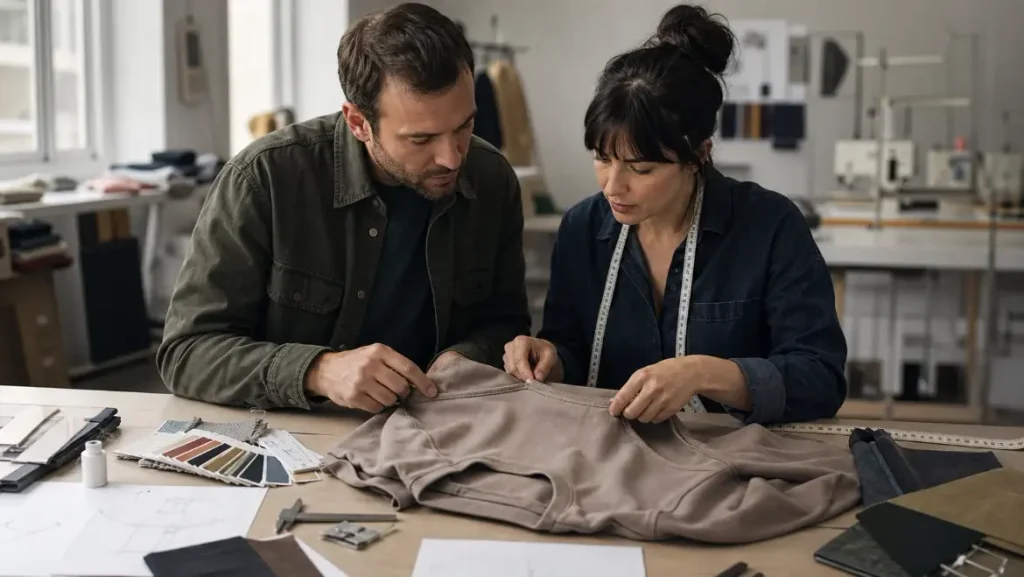
A sample is useful only when you know what it is supposed to prove. Check measurements against the specification, assess construction and workmanship, confirm the material and color reference, test decoration placement, and review labels and packaging. Record every correction in writing.
Also notice whether the supplier identifies unclear instructions, explains feasibility limits, tracks revisions, and answers technical questions consistently. Its handling of a rejected sample detail tells you more than a sales deck.
Set go or no-go conditions
Before you commit to bulk production, list the unresolved items that would stop the order. These may include an unapproved sample, unknown material substitution, unclear subcontracting, missing test responsibilities, conflicting measurements, an incomplete quote, or no agreed remedy for defects.
You will never remove all sourcing risk. The goal is to expose the expensive uncertainties while you still have the option to pause.
How can boutique retailers source directly from manufacturers?
Boutique retailers can source directly from manufacturers by choosing the right factory relationship, sending a usable request for quotation, approving the product reference, and recording supply responsibilities in writing. Direct supply does not always mean buying ready-made goods from a factory catalog.
Choose the right factory relationship
First, establish what the supplier is offering. Factory-held stock is an existing product. ODM usually begins with a supplier-developed design that can be selected or adapted. Private label may range from approved branding to deeper product changes. OEM production follows buyer-defined requirements more closely.
These labels are not used consistently, so ask operational questions. Who owns the design? Which details can change? Is the fabric already available? Is the order made after confirmation? What records will support a repeat order?
Send a complete RFQ
A useful RFQ gives the manufacturer enough information to evaluate feasibility and quote the same scope as other candidates. Include:
- Product type, drawings, photographs, or an authorized reference sample
- Measurements, size range, grade rules, fabric, trims, colors, and artwork
- Construction, decoration, labels, packaging, and quality expectations
- Destination market, estimated quantity by style and color, and target delivery window
- Required samples, inspections, testing support, trade terms, and documents
If some details remain open, identify them as decisions to be developed. Do not hide uncertainty inside broad phrases such as “premium quality” or “standard sizing.”
Approve the product and quote boundary
The approved reference may include the final tech pack, material approvals, artwork, measurement chart, and a signed sample. Record permitted differences between the sample and bulk order. If a material changes, confirm whether the sample, price, testing, or delivery plan must be reviewed again.
Compare quotations by boundary, not only unit price. Patterns, samples, tests, labels, packaging, inspection, freight, duties, and payment charges may sit outside the garment price. HAPA’s guide explains how to buy apparel directly from a factory.
Confirm supply and reorder terms
Your purchase order or agreement should identify the product version, quantity, price, payment, delivery term, packing, inspection, documents, and defect process. Legal questions need qualified review in the relevant market.
For reorders, ask which patterns, grading files, material records, color references, and approved samples will be retained. A direct relationship is most useful when the product can be reproduced under controlled change, not merely made once.
How does boutique clothing production work?
Boutique clothing production moves through product definition, technical preparation, sampling, approval, manufacturing, checks, and delivery. Each approval should reduce a defined uncertainty before more money is committed.
Define the product and customer
Start with the wearer and use case. A product brief should explain the customer, sales channel, climate or season, price position, fit intention, size range, and the feature that earns a place in your assortment. This stops the project from becoming a collection of disconnected design preferences.
Separate requirements from preferences. A required pocket opening or safety-related trim should not have the same status as a flexible color choice.
Prepare the tech pack and RFQ
A tech pack explains how the garment should be made. It commonly contains technical flats, a bill of materials, points of measure, grade rules, construction details, artwork, color references, labels, and packaging instructions. The RFQ adds commercial context such as quantities, destination, sample needs, quality expectations, and timing.
If you are preparing your first production brief, HAPA’s guide to creating a clothing tech pack explains the main components. Treat the document as a controlled record. When a sample correction changes a measurement or trim, update the current version rather than leaving the decision in an email thread.
Develop and approve samples
The first sample may test construction rather than final fit or materials. Later samples may confirm measurements, grading, colors, decoration, labels, packaging, or bulk readiness. Ask what each stage is meant to approve.
Review samples against written criteria. Note deviations, photograph problem areas, reference exact measurement points, and set a response date. Avoid comments such as “make it nicer” or “improve the fit” because the factory cannot convert them into a controlled correction.
Confirm bulk production and quality checks
Before bulk starts, confirm the approved specification, sample, materials, artwork, quantity breakdown, packing, inspection method, and delivery plan. If any material or process remains unapproved, document who can authorize the change.
Quality checks should relate to the product. The inspection plan should define the standard, method, timing, records, and response to failure for relevant measurements, workmanship, decoration, labeling, and packing. A promise of “strict QC” is not a plan.
Complete the order
Final inspection and packing review close the production stage, but they also prepare the next order. Keep the final specification, approved sample status, inspection report, packing list, material references, shipment documents, defect record, and agreed corrections.
After launch, connect production records with sales, returns, fit comments, and customer service issues. That evidence helps you decide whether to repeat the product, change it, or leave it behind.
Can a hybrid sourcing model reduce risk?

A hybrid sourcing model separates fast assortment building from slower product development, without moving every category into custom production at once.
At launch, use ready-made products where variety and speed matter. Keep the buys controlled enough that you can learn which silhouettes, sizes, colors, and price bands work. Record why customers return products as carefully as what they buy.
Children’s retailers can compare wholesale boutique sourcing channels before deciding which proven products deserve custom development. The wholesale kids' dress sourcing guide provides more detail on sourcing dresses for a children’s boutique.
Once a category shows repeatable demand, decide whether manufacturing would solve a specific limitation. Good reasons include unstable reorders, repeated fit requests, missing sizes, a needed functional detail, or weak brand distinction. “Customers liked this style” is not enough on its own. You still need a product brief and a workable commercial plan.
Move selected products into development while keeping wholesale sources where curation is the point. This spreads dependency but adds forecasting and supplier coordination. Track ready stock, samples, approvals, production, and replenishment on separate schedules.
Use four questions before changing a product’s sourcing model:
- What customer evidence supports the change?
- Which product detail must become more controlled?
- Can the business manage development, approvals, and order commitment?
- What would make us stop before bulk production?
Choose a sourcing mix only if your team can keep each calendar, supplier, and approval path under control.
Conclusion
Where boutiques get their clothes depends on how the store creates value. Wholesale marketplaces, distributors, trade shows, designers, dropshipping partners, and manufacturers each solve different problems. Ready-made stock can help you launch and test. Private-label and custom production can give you more control when demand and product requirements are clear.
Compare every route by speed, commitment, exclusivity, quality control, reorder stability, and workload. If you move into boutique clothing production, prepare a clear brief, approve samples against written specifications, and verify the supplier before scaling.
If you have a defined children’s apparel concept, reference sample or tech pack, target market, estimated quantity range, and delivery goal, you can contact HAPA to discuss whether the project fits its private-label manufacturing scope.
Frequently asked questions
Can a boutique put its own label on wholesale clothing?
Not automatically. Your right to replace or add a label depends on the supplier’s permission, the product agreement, trademarks, and the rules in the market where you sell. In the United States, the FTC states that most textile and wool products need labels showing fiber content, country of origin, and the identity of the manufacturer or another responsible business. Care instructions also apply to covered apparel. Review the FTC’s apparel labeling guidance and get market-specific advice before changing required labels. Private label should be an agreed sourcing arrangement, not unauthorized relabeling.
Who owns the design and pattern in private-label production?
Ownership depends on the contract and how the design was developed. A supplier may retain a house pattern, license a base design, charge separately for pattern development, or agree that specified files belong to the buyer. Artwork and branding can have separate rights. Put ownership, permitted use, exclusivity, access to files, and post-relationship use in writing before development begins. Do not assume that paying for samples transfers every underlying right. For valuable or original designs, have a qualified professional review the agreement in the relevant jurisdiction.
What information does a clothing manufacturer need for a quote?
A manufacturer needs enough detail to understand the garment and the requested service boundary. Send the product type, drawings or reference sample, measurements, size range, materials, trims, colors, artwork, construction, labels, packaging, destination market, quantity range, sample needs, quality expectations, and required delivery window. State which points are fixed and which can be developed with the supplier. If you request quotes from several manufacturers, give each the same core information so the prices describe comparable work rather than different assumptions.
How should a boutique test a new custom style?
Start with a written specification and an approved sample that represents the features you plan to sell. Score fit, measurements, construction, materials, color, decoration, labels, packaging, and the supplier’s handling of corrections. Where commercially feasible, keep the first production commitment controlled and define the inspection and defect process before ordering. After launch, review sales alongside returns, size feedback, complaints, and reorder demand. A small order does not remove risk, but a documented test gives you better evidence than an informal sample approval.
What costs may sit outside the garment unit price?
The quote may exclude pattern development, samples, special material commitments, testing, labels, packaging, inspection, freight, insurance, duties, taxes, payment charges, storage, or rework. The answer depends on the supplier and agreed trade terms. Ask for a written quotation boundary and separate one-time development costs from costs that repeat with every order. Confirm who arranges transport, export and import steps, and delivery to the final location. A low unit price is not comparable with another quote until both cover the same product, quantity, quality standard, services, and destination.