
Two professionals review a kidswear garment and quality details in a children’s clothing factory.
A children’s clothing supplier can quote a competitive price, send you an attractive sample, and still be the wrong manufacturing partner if its quality-control system is weak. When you are sourcing kidswear, the real test is not whether a factory can make one good garment. It is whether the factory can reproduce the approved product consistently across bulk production, repeat orders, different sizes, and different material lots.
On the factory side, we see one sourcing mistake more often than almost any other: buyers evaluate samples carefully but evaluate the QC process casually. The sample looks right, the price works, and the production calendar feels manageable, so the order moves ahead. Then bulk production exposes what the sample could not show—measurement drift, shade variation, loose trims, inconsistent stitching, packaging errors, or a finishing problem that repeats across hundreds of pieces.
That is why I would evaluate a children’s clothing supplier as a quality-management system, not simply as a sewing vendor. You want to know what the factory checks before cutting, what it checks during production, who has authority to stop a recurring defect, how failed pieces are handled, and what evidence supports final shipment approval.
This guide takes you through the process I would use to assess a supplier’s QC and inspection capability—from incoming fabric and pre-production approval to in-line inspection, AQL, compliance, traceability, and final packing. The goal is simple: help you choose a partner that prevents problems early instead of asking you to discover them after the goods arrive.
Why Quality Control Matters More in Children’s Clothing
Every apparel category needs quality control, but children’s clothing leaves less room for careless variation. Parents notice fit, comfort, durability, and safety at the same time. A seam that rubs, a snap that loosens, a drawstring that should not be there, or a care label that does not match the actual fabric can create a much bigger problem than a minor cosmetic defect.
Kidswear also gets used hard. Garments are washed frequently, stretched during play, pulled during dressing, rubbed against playground equipment, stained, and often passed to younger siblings. A product may look excellent on a showroom rack and still fail quickly if shrinkage, seam strength, elastic recovery, trim attachment, or colorfastness has not been controlled.
For you as the brand owner or buyer, poor quality rarely stays inside the factory. It shows up as returns, negative reviews, retailer chargebacks, rework, replacement production, delayed launches, urgent freight, or—at the serious end—compliance and recall risk. Strong QC is therefore not a separate add-on. It is part of the commercial value of the garment.
What Strong QC and Inspection Processes Actually Look Like
A mature QC system does not begin when finished cartons are lined up for inspection. It begins before fabric is cut. The strongest suppliers build quality gates into material receiving, sample approval, pre-production planning, first-piece verification, sewing, finishing, packing, and final shipment release.
| QC Stage | Typical Checks | Why It Matters |
| Incoming materials | Fabric, shade, shrinkage, trims, labels | Stops unsuitable inputs before they become finished garments |
| Pre-production | Approved sample, tech pack, measurements, construction | Aligns every department around one standard |
| In-line production | Workmanship, seams, measurements, placement | Finds recurring defects while they are still correctable |
| Finishing and packing | Appearance, labels, folding, barcodes, assortments | Prevents avoidable warehouse and retail errors |
| Final inspection | Sampling, measurements, workmanship, packaging | Supports the final decision to release or hold shipment |
The principle is straightforward: find the defect at the earliest stage where it can still be corrected economically. If a fabric shade is wrong, stop it before cutting. If the seam construction is wrong, correct it before thousands of pieces are sewn. If measurements are drifting, do not wait for final inspection to discover the pattern.
1. Evaluate the Supplier’s Quality System, Not Just Its Sales Sample
A polished sample is useful, but it does not prove that a factory can reproduce that result in bulk. A sample may be made slowly by a senior technician with extra attention. Bulk production is a different environment: more operators, more fabric rolls, more sizes, more handoffs, and much less time per garment.
When I shortlist a children’s clothing supplier, I want the team to explain the full inspection flow. If you are still building your shortlist, HAPA’s guide to finding and screening a kids clothing manufacturer is a useful starting point for the broader supplier-selection process.
Ask the factory questions that force the system to become visible:
- Who is responsible for incoming material inspection?
- Who approves the pre-production sample and first production pieces?
- How often are measurements checked during sewing and finishing?
- How are defects recorded, repaired, and re-inspected?
- Who can stop a line when a recurring defect appears?
- What must be complete before final inspection begins?
- How are material lots and production batches traced if a problem appears later?
Specific answers matter more than confident answers. “We check everything” tells you almost nothing. “We inspect incoming fabric, approve first pieces against the signed sample, run in-line measurement checks, record defect trends, and hold final random inspection before shipment” gives you something you can actually evaluate.
2. Start With Fabric and Trim Inspection Before Cutting
Inspect fabric for more than obvious defects
Fabric is one of the most expensive places for quality to go wrong because one material problem can affect an entire production lot. Incoming inspection should be appropriate to the fabric and may cover width, weight, surface defects, holes, stains, knitting or weaving irregularities, print registration, stretch, recovery, bowing, skewing, and hand feel.
Shade control deserves special attention. Two rolls may carry the same color reference but look visibly different when panels are sewn together. A disciplined factory identifies material lots and manages roll-to-roll variation so the body, sleeve, collar, and matching set pieces do not end up in different shades.
Understand shrinkage before bulk cutting
A garment can measure perfectly before washing and still fail after the first care cycle. If the fabric shrinks more than expected, the customer’s experience becomes a sizing problem even though the factory’s final inspection looked correct.
For that reason, shrinkage and dimensional stability should be understood before cutting. The exact method depends on the material and buyer standard, but the principle does not change: do not discover fabric behavior after the fabric has already become finished inventory.
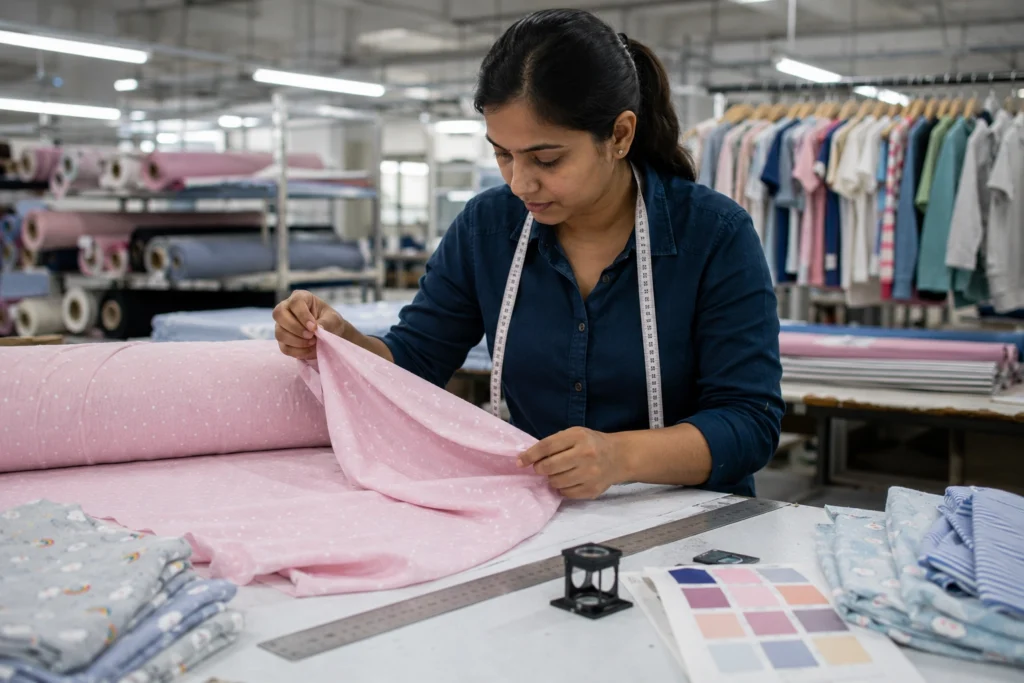
Incoming fabric inspection checks material quality before children’s clothing enters production.
Treat trims as controlled materials
Buttons, snaps, zippers, elastic, cords, labels, bows, appliqués, sequins, beads, and other components should also be checked against approved references. A “similar” snap or zipper substituted during bulk production may look close enough in a photo and still perform differently in use.
If your product is being developed through a custom program, HAPA’s children’s clothing OEM manufacturing workflow illustrates why fabric, trims, samples, production, QC, and packing need to be treated as one connected process rather than separate tasks.
3. Make the Approved Sample and Tech Pack the Factory’s Working Standard
Inspection is only as reliable as the standard behind it. If your specification is vague, two inspectors can look at the same garment and reach different conclusions. A controlled production standard should include the approved sample, measurement chart, tolerances, construction details, fabric and trim references, artwork, label placement, finishing instructions, and packing requirements.
One small wording change can make a big difference. “Make the neckline neat” is subjective. A finished width, stitch type, measurement tolerance, and approved physical reference are objective. The more objective your standard is, the easier it is for the line and QC team to reproduce it.
I also treat technical questions from a factory as a positive sign. If a supplier asks you to clarify a tolerance, print dimension, seam detail, or trim requirement before production, it is reducing ambiguity. A factory that agrees immediately to every vague instruction may simply be postponing the problem.
4. Use a Pre-Production Meeting to Identify Risk Before Bulk Production
Before a new style reaches the line, merchandising, pattern, cutting, sewing, finishing, and QC teams should be working from the same approved information. A pre-production meeting is where that alignment happens.
For children’s apparel, I would expect the team to review critical measurements, fabric behavior, seam construction, decoration placement, trim security, labeling, packaging, and any safety-related design details. If the style already had problems during sampling, those points should be called out explicitly so the same mistakes are not repeated in bulk.
This is one of the moments when you can tell whether a children’s clothing supplier is managing production as a system or simply passing instructions from person to person. Good pre-production planning reduces the number of surprises you have to manage later.
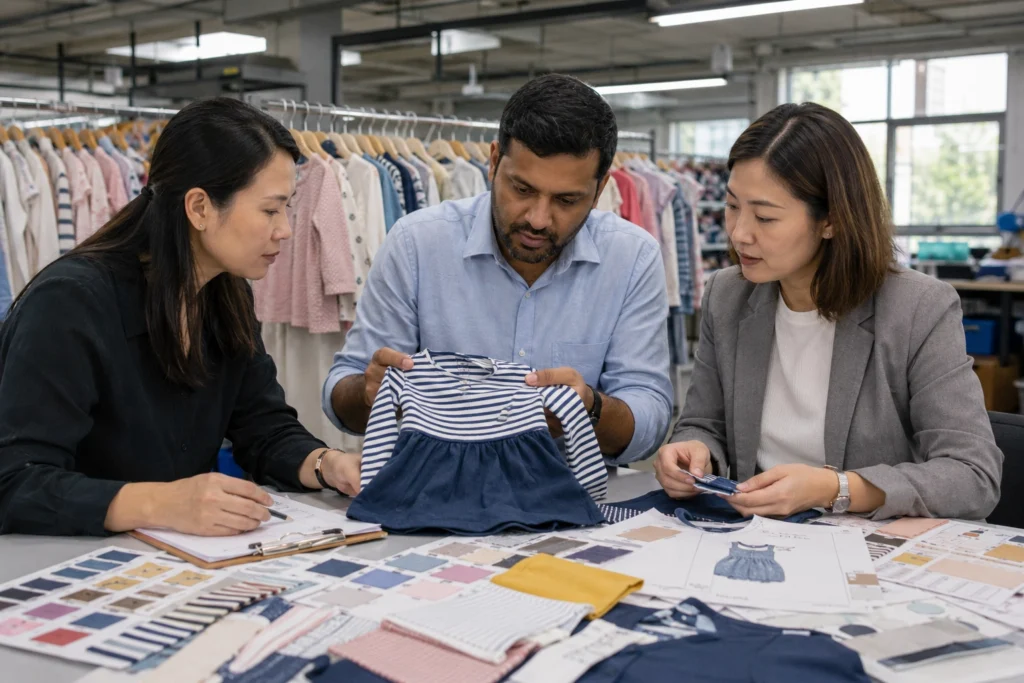
A pre-production team reviews a kidswear sample, fabric swatches, and technical requirements.
5. Approve First Production Pieces Before the Line Accelerates
First-piece approval is one of the highest-value controls in apparel manufacturing. The first garments coming off the line should be checked against the approved standard before production runs at full speed.
This is where you can catch systematic defects: incorrect seam allowance, wrong stitch density, misplaced trim, distorted necklines, wrong pocket position, or measurements that are already moving out of tolerance. Fixing the method after 20 pieces is manageable. Fixing it after 2,000 pieces may require sorting, repair, or complete rework.
6. In-Line Inspection Is Where Strong Factories Prevent Shipment-Wide Problems
Final inspection tells you what has already happened. In-line inspection gives the factory a chance to change what is still happening. That is why it is one of the clearest signs of a disciplined QC culture.
In-line inspectors may check workmanship, skipped or broken stitches, puckering, seam construction, symmetry, trim placement, print or embroidery position, visible damage, and measurements. But the most important part is not finding isolated bad pieces—it is identifying recurring patterns.
If the same defect keeps appearing, the response should move upstream. The machine setup, operator method, construction sequence, material, or instruction may need correction. A factory that only sorts defective garments at the end is reacting to quality problems. A factory that corrects the cause is managing them.
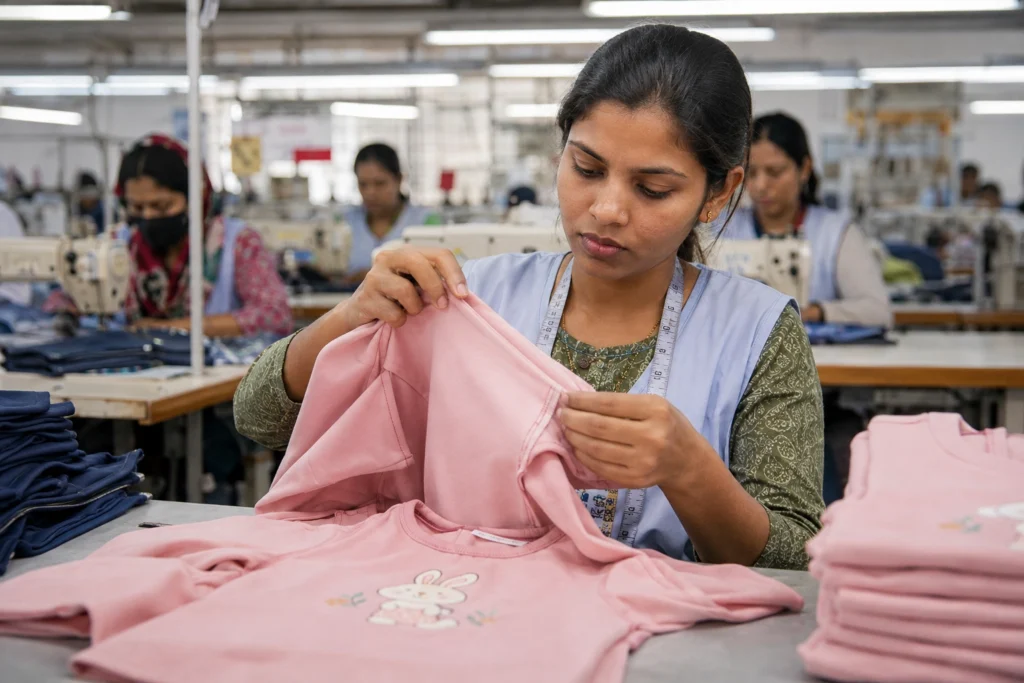
In-line quality control checks stitching, seams, and workmanship during garment production.
7. Control Measurements Throughout Production
Sizing inconsistency is one of the fastest ways to undermine a kidswear brand. Parents expect the same labeled size to fit reasonably consistently, and retailers expect bulk production to match the agreed measurement specification.
Depending on the garment, points of measurement may include chest, body length, sleeve length, shoulder width, waist, hip, rise, inseam, leg opening, or neck opening. Your specification should define both target measurements and acceptable tolerances.
Ask how frequently the line is measured, whether every size is included, and what happens when measurements begin drifting toward the tolerance limit. A strong children’s clothing supplier should not wait until final inspection to discover a sizing pattern that has been developing all day.
8. Define Workmanship Standards Before You Need to Argue About Them
“Good sewing” is not an inspection standard. Workmanship needs to be translated into visible, repeatable criteria. Your QC agreement should help inspectors decide which defects are critical, major, or minor and which conditions require repair or rejection.
Typical workmanship checks include:
- open, broken, or skipped stitches;
- uneven seam allowance or seam width;
- puckering, twisting, or distorted construction;
- loose threads and poor trimming;
- uneven gathering, pleating, or topstitching;
- misaligned stripes, checks, panels, prints, or decorative details;
- holes, stains, oil marks, pulls, or needle damage.
The goal is not to create a giant defect dictionary for every basic style. It is to remove ambiguity from the details that matter most to the product and customer.
9. Inspect Small Parts and Attachment Strength Carefully
Children’s garments often include components that deserve more scrutiny than their size suggests. Snaps, buttons, bows, zipper pullers, badges, sequins, appliqués, and decorative trims should be checked for correct placement, finish, and security.
Where attachment testing is relevant, ask what is tested, how often it is tested, what method is used, and what defines a pass or fail. Internal production checks help catch weak processes early; independent laboratory testing serves a different purpose when a product must meet a regulatory or buyer requirement.
10. Treat Needle Control and Metal Detection as Process Discipline
Broken sewing needles are a practical production risk, especially in children’s apparel. A serious factory should have a documented response: stop the affected operation, recover or reconcile fragments, isolate potentially affected goods, record the incident, and only release product when the procedure has been completed.
Depending on your product and quality requirements, finished garments may also pass through needle or metal detection. If this is part of your specification, ask how the detector is checked, how failed pieces are handled, and what records are retained.
These procedures are not glamorous, but they tell you a lot about factory discipline. A children’s clothing supplier that can explain the process clearly is giving you stronger evidence than one that simply says “yes, we have a detector.”
11. Give Printing, Embroidery, and Decoration Their Own QC Checkpoints
A garment can be sewn perfectly and still fail commercially if the decoration is wrong. Print and embroidery should have their own approved references, dimensions, placement rules, and production checks.
For printed garments, check
- color and visual match to the approved reference;
- artwork dimensions and placement;
- registration and edge definition;
- cracking, bleeding, migration, or poor curing;
- hand feel and wash durability where relevant.
For embroidery, check
- thread color and placement;
- finished dimensions and stitch density;
- puckering or distortion around the embroidery;
- loose threads and backing;
- appearance after the intended care process.
If printing, embroidery, washing, or embellishment is subcontracted, ask who controls that supplier and who signs off the work before it returns to the main factory. Your purchase order may be with one company, but the finished product can pass through several production partners.
12. Build Product Safety and Compliance Into Development, Not Shipping
For children’s apparel, compliance cannot be separated from quality. Your destination market can affect design details, materials, testing, labels, and documentation. You should communicate the market before production starts, not after the cartons are packed.
For U.S. children’s products that are subject to applicable children’s product safety rules, the U.S. Consumer Product Safety Commission’s Children’s Product Certificate guidance explains the role of third-party testing and certification. If you manufacture upper outerwear, the CPSC also publishes specific business guidance on children’s drawstrings, a good reminder that seemingly small construction details can carry real safety implications.
For care information, the Federal Trade Commission’s Care Labeling Rule guidance explains the responsibilities of covered manufacturers and importers. These official sources are useful because they keep you from relying only on a supplier’s general certificate list.
If CPC documentation is relevant to your program, HAPA’s practical CPC certification guide for kidswear buyers can help you frame the discussion with your factory and testing partners. The important point is to tie testing and documentation to the actual product, materials, age group, and destination market.
13. Understand What AQL Final Inspection Can—and Cannot—Do
Many apparel buyers use AQL-based sampling for final random inspection. AQL provides a structured way to inspect a sample of a production lot rather than every unit. Defects are typically classified by severity, and the inspection result is compared with the agreed sampling plan.
The limitation is important: AQL is a sampling method, not a guarantee that every garment in the shipment is perfect. It also cannot repair a weak manufacturing process. If the factory depends on final AQL inspection to discover basic recurring sewing problems, the QC system has already waited too long.
A final garment inspection should usually cover
- workmanship and visible defects;
- selected measurements across the size range;
- construction and styling against the approved sample;
- color, print, embroidery, and decoration;
- labels, care information, size identification, and required markings;
- folding, polybags, hangtags, stickers, barcodes, and assortment;
- carton quantities, shipping marks, and packaging condition.
14. Know When Third-Party Inspection Adds Value
Factory QC and independent inspection solve different problems. The internal team can intervene during everyday manufacturing. A third-party inspector gives you an independent view at a selected stage.
For a new supplier, high-value order, sensitive product, or important retailer launch, independent inspection can reduce uncertainty. You may use it during production, before shipment, or at loading depending on the risk.
If a supplier becomes defensive about reasonable independent inspection, I would investigate why. At the same time, do not use third-party inspection as a substitute for weak internal QC. The strongest setup is a reliable production system first and independent verification where your risk assessment justifies it.
15. Treat Packaging and Labeling as Part of Product Quality
Perfect sewing does not help much if the warehouse receives mixed sizes, incorrect barcodes, missing hangtags, crushed cartons, or the wrong assortment. Packaging errors can delay receiving, disrupt e-commerce fulfillment, and create retailer claims even when the garments themselves are acceptable.
Give your children’s clothing supplier clear instructions for folding, individual packaging, size stickers, barcode placement, hangtags, carton assortment, shipping marks, and any weight or dimension limits. These details belong on the final inspection checklist.
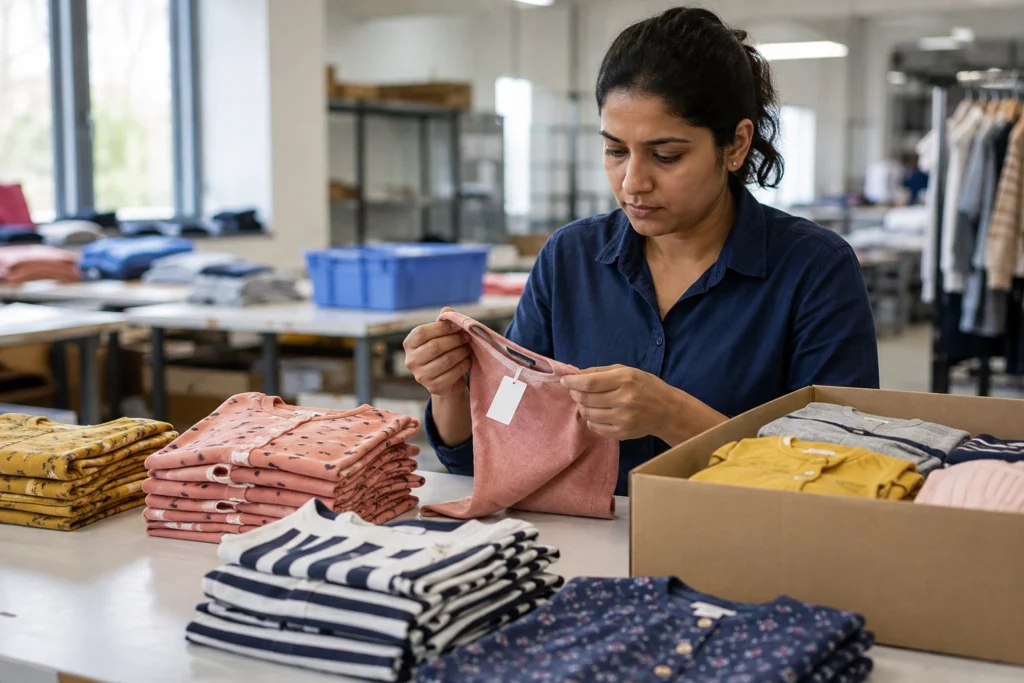
Final inspection verifies garments and packing details before shipment.
16. Check Whether the Factory Can Trace a Problem
If you discover an issue after delivery, the factory should be able to investigate it with records rather than memory. Useful traceability can connect the finished garment to the purchase order, style, fabric lot, trim lot, production line, inspection report, and packing batch.
This matters because it helps you answer a practical question: is the problem isolated or widespread? If one colorway used a different fabric lot, you may not need to treat the entire order as affected. Without traceability, every investigation becomes slower and more expensive.
17. Judge the Supplier by Its Corrective Action, Not by Whether Defects Ever Happen
Every factory encounters defects. I would be skeptical of any supplier that claims otherwise. What separates stronger factories is how they respond.
Suppose in-line inspection finds repeated skipped stitches. Removing those garments solves the immediate symptom. A mature QC team also looks at the machine, needle, thread, tension, operator method, and construction sequence. The factory corrects the cause and then verifies that the defect rate has changed.
That behavior tells you more about a children’s clothing supplier than a perfect sales presentation. You want a partner that surfaces problems early, explains what happened, documents the correction, and learns from the issue.
18. Audit the Factory Beyond the Showroom
If the program is commercially important, visit the factory or arrange a structured audit. You are not looking for a spotless showroom. You are looking for evidence that the QC process described in meetings is visible on the production floor. For a closer look at reviewing social-audit evidence and supply continuity in children’s apparel, use our BSCI and kidswear supply chain guide.
During a factory review, I would look for:
- organized fabric and trim receiving;
- clear separation of approved, rejected, and pending materials;
- approved samples and specifications available to the production team;
- in-line inspectors working where garments are being made;
- measurement tools and inspection records;
- broken-needle and sharps-control procedures;
- controlled finishing and packing areas;
- traceable production and carton identification;
- records showing how recurring defects are followed up.
If you are evaluating a custom program specifically, HAPA’s OEM kidswear manufacturer verification guide covers additional questions around production capability, documentation, and supplier fit.
19. Watch for QC Red Flags Before You Pay a Deposit
- The supplier cannot describe its inspection process in specific stages.
- Most quality checking happens only after production is complete.
- Measurement tolerances are unclear or treated as optional.
- The factory cannot show the latest approved standard on the production floor.
- Material substitutions happen without written approval.
- Recurring defects are dismissed as normal.
- There is no clear broken-needle procedure.
- Subcontracted processes are vague or undisclosed.
- The supplier resists legitimate independent inspection.
- Sample comments repeatedly disappear between development and bulk production.
One weak answer does not automatically disqualify a factory. A cluster of weak answers usually tells you that quality depends too heavily on individual people instead of a repeatable management system.
20. Ask the Same QC Questions to Every Supplier
If you are comparing several factories, use the same questions for each one. That makes it much easier to compare evidence instead of sales style.
- How do you inspect incoming fabric and control shade variation?
- Do you test or verify shrinkage before bulk cutting?
- How are trims approved before production?
- Do you hold a pre-production meeting for each style?
- How are first production pieces approved?
- How often are measurements checked during production?
- How are defects classified and recorded?
- What is your broken-needle procedure?
- Do you use metal detection when the product or buyer standard requires it?
- How do you control outsourced printing, embroidery, washing, or embellishment?
- What product testing can you coordinate?
- How is final inspection conducted?
- What happens if final inspection fails?
- Can I appoint an independent inspector?
- What QC and traceability records can you provide?
Do Not Compare Unit Price Without Comparing Quality Risk
The cheapest quote can become the most expensive order once you include sorting, repair, failed inspection, returns, retailer deductions, missed promotions, replacement production, and urgent air freight.
When two factories quote different prices, compare what the price actually represents. Are the fabrics equivalent? Are trims sourced to the same standard? Is the inspection frequency comparable? Is testing included? Is packing the same? A lower price achieved by removing controls is not necessarily a saving.
A slightly higher unit cost can be commercially rational when the children’s clothing supplier gives you better material control, measurement consistency, documentation, communication, and repeat-order stability. Total quality cost matters more than the number at the top of the quotation.
Build a Supplier Relationship Around Repeatable Standards
A good long-term relationship should make repeat orders easier, not force you to rebuild the product every season. Keep a controlled product file with the latest measurement spec, approved sample status, fabric and trim references, artwork, test reports, label files, packing instructions, and important QC comments.
That documentation protects both sides. It reduces dependence on one merchandiser’s memory, helps new staff understand the product, and gives you more control if production ever needs to move.
You should still inspect repeat orders. The difference is that inspection becomes verification of a stable system rather than a rescue operation.
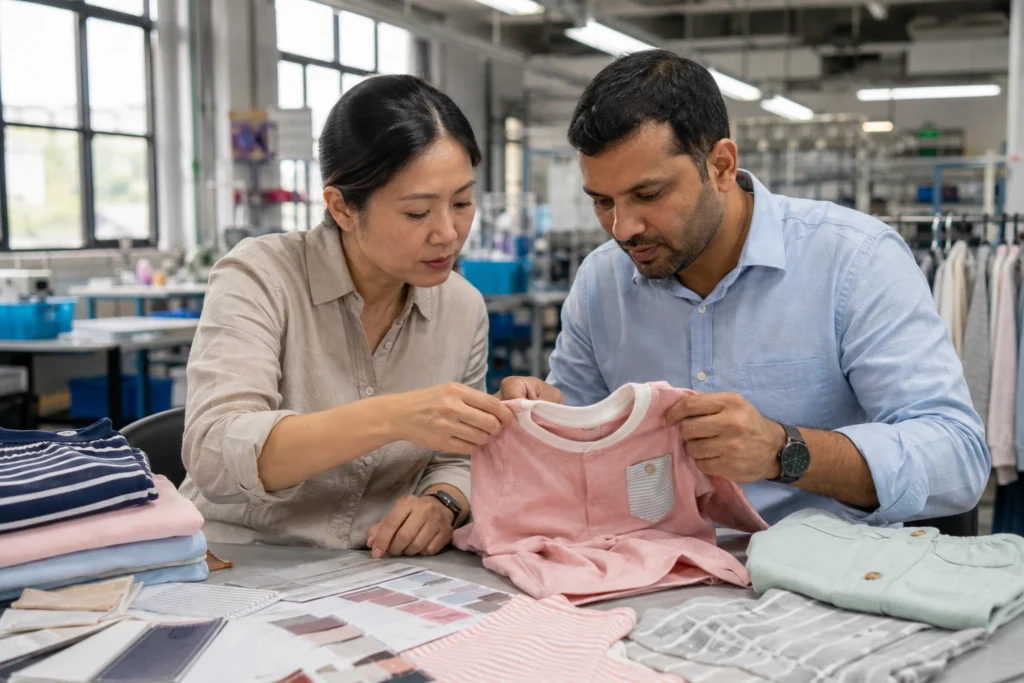
A buyer and supplier review garment quality together as part of a long-term production partnership.
How HAPA Approaches Kidswear Quality Control
At HAPA, we think about quality as a connected manufacturing process. Technical review, materials, sampling, production, inspection, finishing, labeling, and packing affect one another, so the quality plan has to follow the product through the entire workflow.
The most useful starting point is a clear sourcing brief: your tech pack or reference sample, measurement chart, target fabric, trims, artwork, quantity, destination market, testing expectations, and delivery plan. The earlier those requirements are defined, the easier it is to identify risk and build the right approval points into production.
Different products also need different QC priorities. A basic cotton T-shirt, a sequined party dress, a pajama set, and a jacket with functional trims should not be inspected with an identical checklist. The quality plan should reflect the garment’s construction, materials, decoration, age group, and market.
Final Checklist: What a Strong Children’s Clothing Supplier Should Be Able to Show You
- Incoming fabric and trim inspection before production.
- Approved samples and technical specifications used as controlled standards.
- Pre-production review and first-piece approval.
- In-line workmanship and measurement checks.
- Clear defect classification and corrective-action procedures.
- Product-specific trim, decoration, and safety checks.
- Broken-needle control and appropriate detection procedures.
- Testing and compliance planning for the destination market.
- A defined final inspection method, including sampling where appropriate.
- Packaging and assortment inspection.
- Traceability for materials and production batches.
- Openness to buyer audits and independent inspection.
Choose a Supplier That Prevents Problems Before They Become Expensive
The strongest children’s clothing supplier is not the one that promises there will never be a defect. Manufacturing does not work that way. The stronger supplier is the one with a process designed to find risk early, control variation, communicate problems honestly, correct root causes, and keep bulk production aligned with the approved product.
When you compare factories, look past the sales sample. Ask how fabric is inspected, how first pieces are approved, how measurements are monitored, how recurring defects are corrected, what final inspection covers, and which records are retained. Those answers tell you much more about your future product quality than a low quotation or an impressive showroom.
If you are preparing a new children’s apparel collection, send the factory enough information to build a real quality plan: your tech pack or reference sample, measurement requirements, fabric and trim expectations, target quantity, destination market, testing needs, and delivery date. The clearer the standard at the beginning, the easier it is for both you and your supplier to protect it through the final carton.