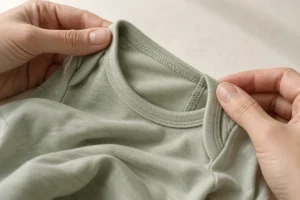
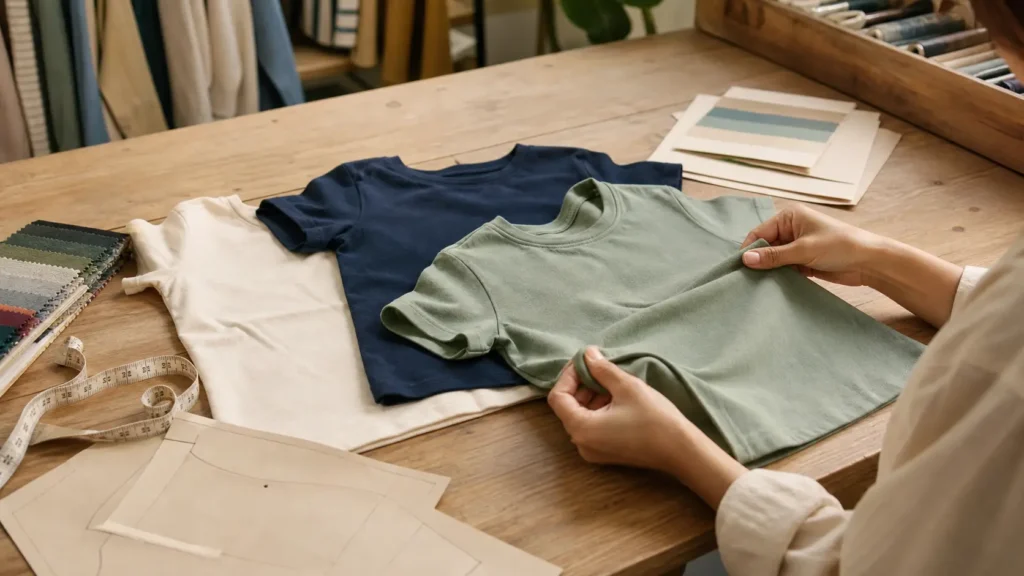
Custom kids cotton T-shirts under quality inspection.
Cotton T-shirts are a natural choice for children’s clothing. They are soft, breathable, easy to style, and familiar to parents in almost every market. For a kidswear brand, however, a cotton tee is not as simple as it looks. Two shirts may feel equally good when they leave the factory, yet look very different after five home washes. One may keep its dimensions and color; the other may become shorter, twist at the side seams, lose its original shade, or develop a tired-looking print.
That difference is rarely caused by one isolated mistake. Shrinkage and fading are usually the result of several decisions made across fabric sourcing, dyeing, pattern development, printing, finishing, production, testing, and consumer care. If those decisions are not aligned, a brand may approve an attractive sample only to receive customer complaints after the product reaches the market.
For custom kids cotton T-shirts, the stakes are particularly high. Children’s garments are washed frequently. Food, paint, grass, sweat, and everyday play send tees into the laundry far more often than many adult garments. Parents also expect kidswear to remain comfortable, presentable, and correctly sized through repeated use. A shirt that shrinks out of its size range or fades after a few washes can damage trust in the entire collection, not just one SKU.
The good news is that both risks can be managed. The key is to treat wash performance as a product-development requirement from the beginning, rather than as a problem to inspect at the end. This guide explains why cotton T-shirts shrink and fade, what brands should specify, which tests matter, and how to work with a kids T-shirt manufacturer to achieve more consistent results in bulk production.
Why Shrinkage and Fading Matter So Much in Kidswear
Shrinkage is not only a measurement issue. It changes fit, comfort, appearance, and sometimes safety. A tee that loses too much body length may ride up during movement. A neck opening that becomes smaller can be uncomfortable to pull over a child’s head. Sleeves may feel tighter, while a distorted hem or twisted body makes an otherwise well-made garment look inexpensive.
Fading creates a different set of problems. It can change the relationship between the base fabric, rib trim, thread, artwork, and labels. A deep green body may become dull while the neck rib stays dark. A printed slogan may keep its color while the surrounding cotton lightens. Even when a garment remains wearable, uneven fading suggests inconsistent quality.
These issues can create commercial costs throughout the supply chain:
- Higher return and refund rates
- Negative product reviews
- Complaints from retailers or distributors
- Inconsistent appearance within a repeat order
- Difficulty maintaining a signature brand color
- Extra sampling, inspection, and replacement costs
- Lost confidence in the manufacturer or supplier
For private-label businesses, quality is part of the brand promise. Customers do not see the fabric mill, dye house, print workshop, or sewing line. They see the name on the neck label. Preventing cotton T-shirt shrinkage and color loss is therefore a brand-protection task as much as a technical one.
First, Understand Why Cotton T-Shirts Shrink
Cotton fibers pass through tension, moisture, heat, and mechanical handling as they become yarn and then knitted fabric. During spinning, knitting, dyeing, finishing, spreading, cutting, sewing, and pressing, stress can be introduced or temporarily held in the material. When the finished T-shirt is washed and dried, the fibers and knitted loops relax. The garment then moves toward a more stable state, often becoming shorter or narrower.
This is commonly called relaxation shrinkage. It is one of the main reasons a fresh cotton tee may change dimensions after its first few washes.
Knitted cotton is especially sensitive because the looped structure can move more freely than a tightly constructed woven fabric. The amount and direction of dimensional change depend on factors such as:
- Fiber type and blend
- Yarn construction
- Knit structure
- Fabric weight
- Stitch density
- Tension during knitting and finishing
- Dyeing and washing processes
- Compacting or preshrinking treatment
- Garment construction
- Household wash and drying conditions
Shrinkage does not always occur evenly. A fabric might lose more length than width, or the body and rib trim may behave differently. Poorly balanced or unevenly processed knit fabric can also skew, causing the side seams to spiral toward the front or back after washing. This is why a useful wash test must examine more than one overall measurement.
Is 100% Cotton Always More Likely to Shrink?
Not necessarily, but 100% cotton usually requires careful control because it does not contain a dimensionally stable synthetic component. A cotton-polyester blend may show less shrinkage under the same conditions, while cotton with elastane introduces different recovery and heat-sensitivity considerations. Fabric structure and finishing can be just as important as the fiber percentage.
A well-developed 100% cotton jersey can perform better than a poorly controlled blend. Brands should therefore avoid choosing fabric based only on the label composition. Ask how it was knitted, dyed, finished, compacted, and tested.
Does Heavier Cotton Shrink Less?
Fabric weight alone does not predict shrinkage. A heavier GSM can provide a substantial hand feel, but it does not guarantee dimensional stability. A lightweight fabric that has been properly relaxed and compacted may perform very well, while a heavier fabric processed under high tension may change considerably after washing.
GSM should be selected for the intended product, season, opacity, drape, and price point. Shrinkage performance should be verified separately.
Why Cotton T-Shirts Fade
Fading occurs when color is lost, changed, or redistributed through washing, rubbing, light exposure, perspiration, heat, or contact with other substances. In practice, customers may use the word “fading” for several different problems:
- The original shade becomes lighter over time
- Dye transfers from the garment to other items
- Color rubs onto skin, upholstery, or a light-colored fabric
- One panel appears different from another
- The base fabric changes while the print remains stable
- The print cracks, peels, or loses color
- Sun-exposed areas become lighter
- The garment develops pale crease lines or abrasion marks
Each failure points to a different cause. A dark cotton fabric that releases loose dye during laundering is not the same problem as a graphic print that was under-cured. Effective prevention begins with defining the failure accurately.
Colorfastness describes how well a material resists color change or staining under specified conditions. The ISO 105-C06 colorfastness standard is one recognized reference for evaluating resistance to domestic and commercial laundering. There is no single universal “colorfastness” result that covers every type of use. A fabric can perform well in washing yet poorly in rubbing, perspiration, or light. The relevant tests should reflect the T-shirt’s color, decoration, target market, and expected use.
Start With the Right Cotton Fabric
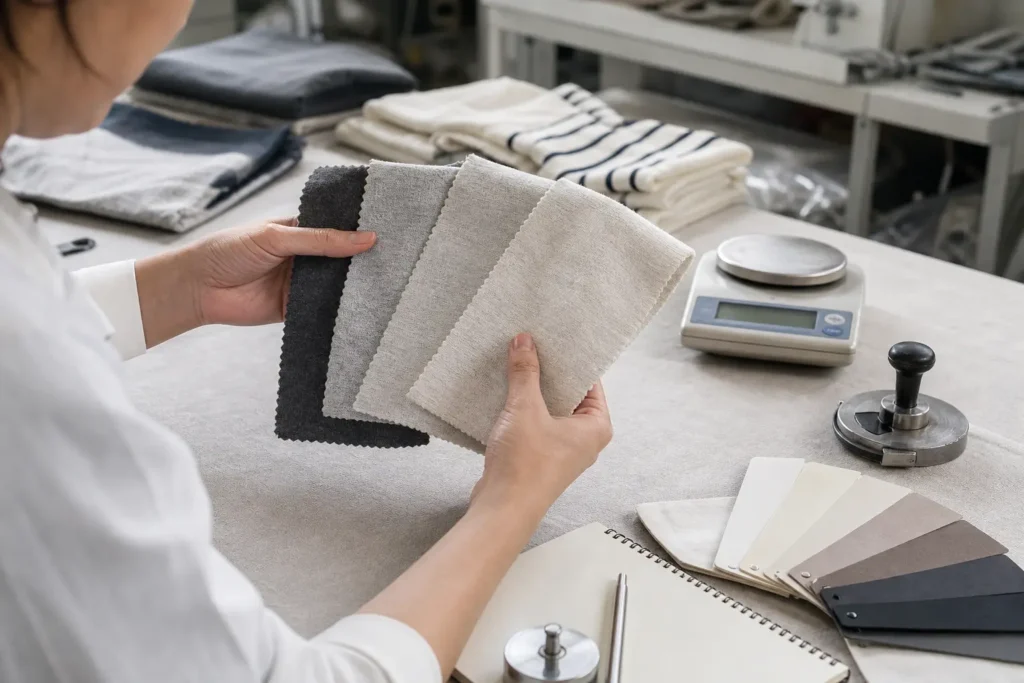
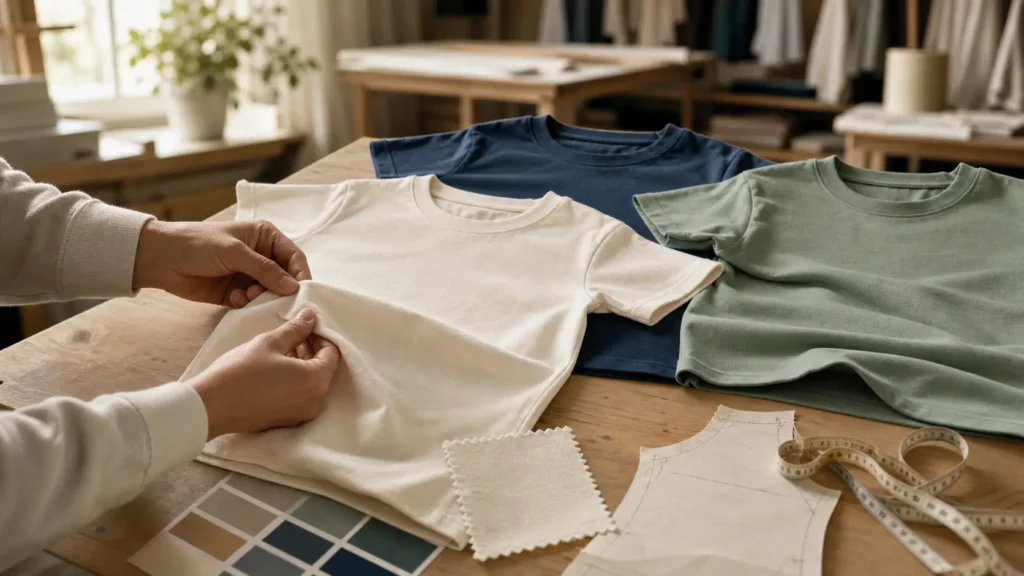
A technician compares cotton jersey fabrics before production.
The most efficient way to avoid shrinkage and fading is to select a stable, repeatable fabric before pattern approval. Trying to correct an unsuitable material at the end of production is expensive and often ineffective.
Choose Fiber Quality With the End Product in Mind
Cotton quality influences softness, surface appearance, pilling, dye uptake, and consistency. Combed cotton is processed to remove more short fibers and impurities, generally creating a smoother, more uniform yarn than basic carded cotton. For premium custom children’s T-shirts, combed ring-spun cotton is often selected for its soft hand and clean printing surface.
That does not mean every children’s tee must use the most expensive yarn. A value-focused promotional T-shirt and a premium boutique basic may have different specifications. The important point is to define the intended standard rather than asking only for “soft cotton.”
Useful details to confirm include:
- Cotton type and origin, where relevant
- Carded or combed yarn
- Ring-spun, open-end, or another yarn system
- Yarn count
- Fabric composition
- Fabric weight and allowable tolerance
- Knit structure and stitch density
- Surface treatment, such as bio-polishing
- Finishing method
- Required wash performance
A clear fabric specification gives the manufacturer and mill an objective target. It also makes repeat orders easier to compare.
Select a Knit Structure Appropriate for the Design
Single jersey is widely used for kids cotton T-shirts because it is soft, flexible, and economical. Yet it can curl at cut edges and may be vulnerable to spirality if yarn torque, knitting, and finishing are not controlled.
Interlock has a more stable, double-knit construction and a smooth surface on both sides. It usually feels thicker and may suit premium tees or babywear, although it has different cost, drape, and heat characteristics.
Other options, including rib, pique, slub jersey, and stretch jersey, create their own performance considerations. The best fabric is not simply the most stable one; it is the one that balances design, comfort, durability, price, and production requirements.
When comparing options, request washed samples rather than relying only on unwashed swatches. An unwashed hand feel can be appealing while hiding later dimensional change.
Use Preshrinking and Compacting Strategically
“Pre-shrunk” does not mean “cannot shrink.” It generally indicates that the fabric or garment has undergone a process intended to reduce residual shrinkage before sale.
For knitted cotton, compacting mechanically compresses and stabilizes the fabric. It helps relax the loop structure and control dimensions before cutting. The result depends on the incoming fabric, machine settings, moisture, speed, overfeed, and quality control. Poor or inconsistent compacting can produce variable results across rolls.
Brands sourcing custom kids cotton T-shirts should ask:
- Is the fabric open-width or tubular compacted?
- What shrinkage target is set after finishing?
- Is shrinkage checked by roll or by dye lot?
- How long is fabric relaxed before cutting?
- Are test results recorded and linked to the bulk lot?
- What happens when a roll falls outside tolerance?
These questions reveal more than simply asking whether the fabric is pre-shrunk.
Manage Color From the Dye House Forward
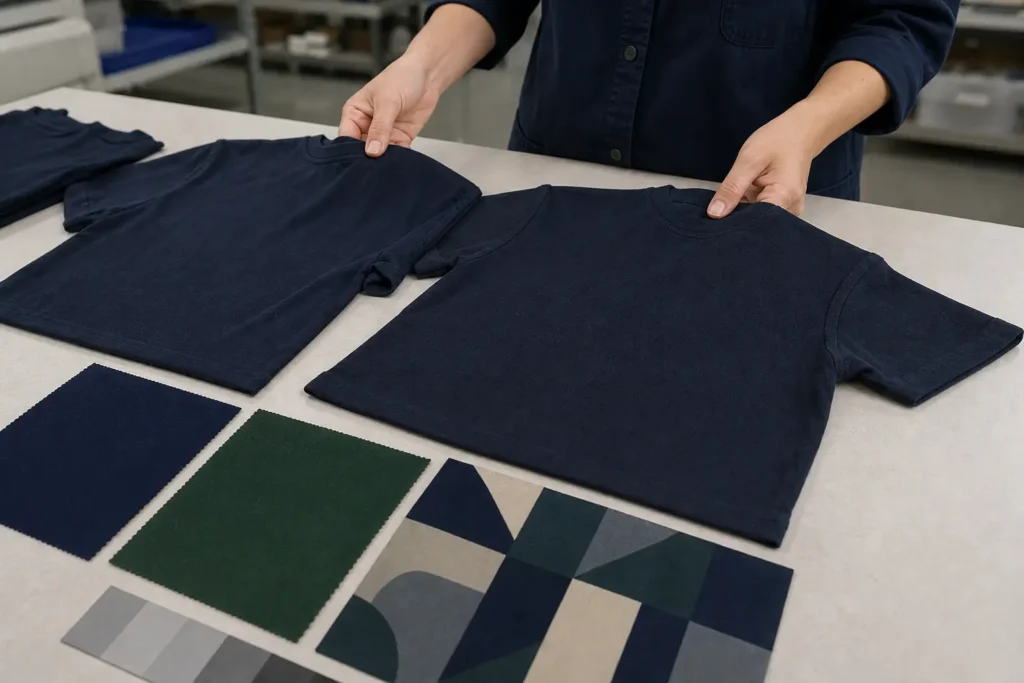
Washed and unwashed samples are compared for color and print performance.
Color performance begins long before the garment reaches the sewing line. Dye selection, preparation, process control, rinsing, soaping, fixation, pH, water quality, and finishing all affect the result.
Choose the Dyeing Method for the Required Performance
Reactive dyes are commonly used for cotton because they can form a strong bond with the fiber and offer a wide color range. Good performance, however, still depends on the correct recipe and proper removal of unfixed dye. If rinsing and soaping are insufficient, loose color may remain on the fabric and transfer during washing or rubbing.
Pigment dyeing creates a different visual character and can be attractive for washed, vintage, or lived-in styles. Pigments sit on the surface with a binder rather than becoming part of the fiber in the same way as reactive dyes. Abrasion and gradual color change may be part of the intended aesthetic. If so, the brand should approve the effect knowingly and communicate it accurately to customers.
Garment dyeing can provide rich fashion effects and flexibility, but it also requires careful testing of seams, labels, threads, rib, prints, and measurements after processing. Piece dyeing the fabric before cutting is often more straightforward for consistent core colors.
There is no universally superior method. The correct choice depends on the design intent and performance standard.
Treat Dark and Saturated Colors as Higher-Risk
Black, navy, red, burgundy, dark green, and other deep shades often require closer control. More dye or a complex dye combination may be needed to reach the target color, increasing the importance of fixation and wash-off. Bright fashion shades can also behave differently under light, perspiration, or repeated washing.
For these colors:
- Approve a lab dip under agreed lighting
- Compare shade in more than one light source when possible
- Test washing, rubbing, and perspiration fastness
- Check both dry and wet crocking
- Review staining onto light adjacent fabrics
- Wash-test the complete garment, not only a swatch
- Keep dye-lot separation clear in cutting and sewing
A children’s clothing manufacturer should also control shade continuity within one garment. The front, back, sleeves, and neck rib should not be mixed casually across dye lots, even when the color name is identical.
Establish a Color Standard
Color descriptions such as “sage,” “warm beige,” or “classic navy” are open to interpretation. Use a physical color standard, approved lab dip, or recognized color reference together with an agreed tolerance. Digital screens are useful for discussion but unreliable as the sole approval method because display settings and lighting vary.
The approval should state:
- The reference standard
- Fabric composition and construction
- Dye method
- Approved viewing conditions
- Acceptable tolerance
- Whether approval applies before or after washing
- Whether rib and thread should match or coordinate
For a signature color used across several products, test it on each fabric. The same dye recipe can look different on single jersey, rib, fleece, and interlock.
Build Shrinkage Allowance Into Pattern Development
Stable fabric is the foundation, but pattern development must also reflect actual wash behavior. A pattern made to finished measurements without considering expected shrinkage can produce a garment that fits correctly before washing and incorrectly afterward.
The process should begin with tested bulk-representative fabric. The pattern maker can then apply appropriate allowances by direction. If the fabric shrinks differently in length and width, a single percentage added to all measurements is not enough.
Suppose a fabric test shows greater length shrinkage than width shrinkage. Body length and sleeve length may need different compensation from chest width. Neck rib behavior must be considered separately, since excessive compensation can distort the opening or cause rippling.
The goal is not to make an oversized unwashed T-shirt and hope it becomes correct. The goal is to engineer the pattern so the garment remains within the approved measurement tolerance after the specified care cycle.
Test the Full Size Range
One sample size cannot always represent every size. Grading changes proportions, and smaller neck openings can be especially sensitive. For a broad children’s size range, test at least key sizes such as the smallest, middle, and largest, with additional attention to any infant or toddler sizes.
Review:
- Chest width
- Body length
- Shoulder width
- Sleeve length and opening
- Neck width and neck drop
- Bottom opening
- Armhole
- Hem and seam appearance
- Side-seam spirality
- Overall balance on the body
Brands should agree whether tolerances apply before washing, after washing, or at both stages. Ideally, both are controlled.
Do Not Overlook Rib, Thread, Labels, and Trims
A T-shirt is a system of materials. Even if the body fabric performs well, another component can create visible distortion.
Neck rib may have a different composition, knit structure, or dye lot. If it shrinks more than the body, the neckline can pucker or become tight. If it shrinks less, it may flare or lose recovery. Rib stretch and recovery should be tested along with dimensional change.
Sewing thread can affect appearance if its shade remains stable while the garment fades, or if it reacts differently during garment dyeing. Labels may curl, become stiff, bleed color, or feel irritating after washing. Heat-transfer labels must withstand the intended wash and drying conditions. Decorative tapes and patches also need compatible shrinkage.
Before bulk approval, wash the complete garment with all production components attached. Component-level data is helpful, but it cannot fully predict how materials interact.
Select a Printing Method That Matches the Fabric and Use Case
On custom children’s T-shirts, “fading” may actually be print failure. The fabric shade remains acceptable, but the artwork cracks, peels, bleeds, or loses intensity. Printing should therefore be evaluated as its own performance system.
Screen Printing
Screen printing is versatile and widely used for cotton tees. Performance depends on ink type, mesh, deposit, additives, flash settings, curing temperature, curing time, and the relationship between ink and fabric finish.
Under-cured ink may wash away or crack prematurely. Excessive heat can affect fabric shade, shrinkage, or hand feel. Thick ink layers can feel uncomfortable on a child’s garment, while overly thin deposits may not achieve the required opacity.
For dark garments, underbase and top-color adhesion should be tested. The print area can also behave differently from the unprinted fabric during washing, especially when large solid graphics restrict the knit’s natural movement.
Water-Based Printing
Water-based inks can create a soft, breathable feel that suits premium kidswear. They require controlled application and curing. Color appearance may be influenced by the fabric shade, and some systems are more suitable than others for dark grounds. The printer should confirm wash durability on the exact production fabric.
Discharge Printing
Discharge printing removes or changes the garment dye in selected areas and replaces it with the desired effect. It can produce a soft print because the design is integrated into the fabric rather than sitting heavily on top. Results depend strongly on the base dye and fabric process. Not every color discharges predictably, so bulk-representative testing is essential.
Direct-to-Garment Printing
DTG is useful for detailed, multicolor artwork and lower quantities. Pretreatment, ink, curing, artwork preparation, and fabric surface all influence durability. A beautiful first print is not enough; samples should be washed repeatedly according to the intended care instructions.
Heat Transfer and Other Applied Graphics
Heat-transfer vinyl, digital transfers, flock, foil, puff effects, and other applications can add strong visual value, but each has specific time, temperature, pressure, and care requirements. High heat may influence the underlying cotton fabric. Transfer edges, stretch behavior, and adhesion should be checked after washing and flexing.
Whatever method is selected, include print testing in the development plan:
- Appearance before washing
- Color change after repeated washing
- Cracking or peeling
- Adhesion
- Stretch and recovery
- Surface abrasion
- Dye migration or bleeding
- Hand feel
- Effect on garment dimensions
Make Wash Testing Part of Product Development
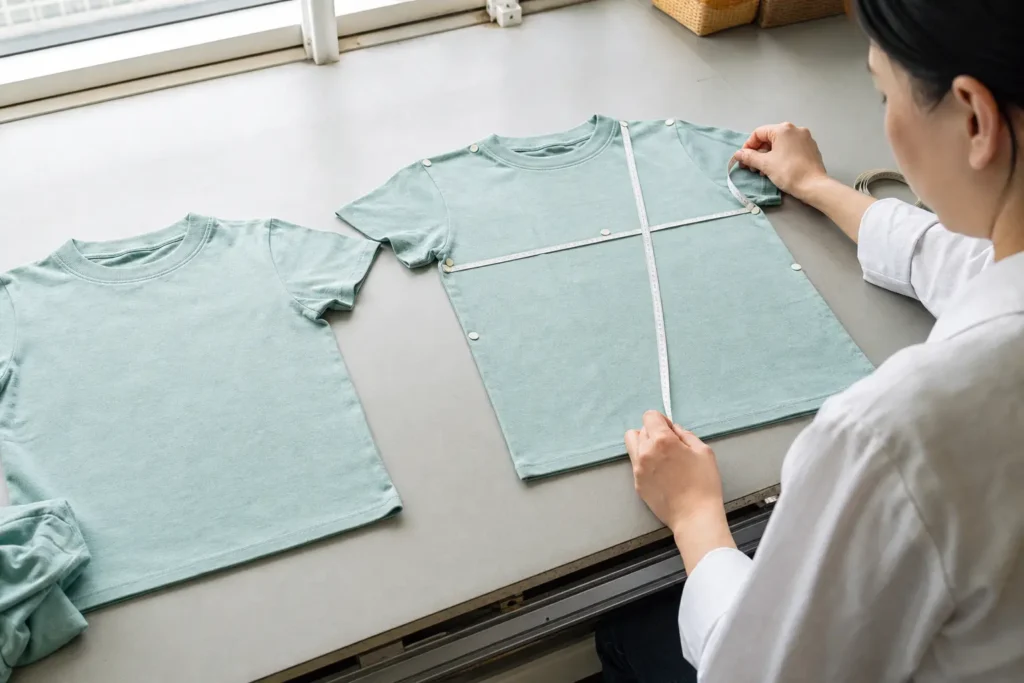
Post-wash measurements help verify dimensional stability.
The phrase “wash tested” is incomplete unless the method and acceptance criteria are defined. Results change according to water temperature, detergent, machine action, load, drying method, number of cycles, and measurement procedure.
A practical test plan for custom kids cotton T-shirts should specify:
- Test method or internal protocol
- Number of specimens
- Conditioning before measurement
- Measurement points
- Wash temperature
- Detergent
- Cycle type
- Drying method
- Number of wash cycles
- Shrinkage tolerance by direction
- Spirality or skew tolerance
- Color-change requirement
- Staining requirement
- Print appearance requirement
- Pass/fail responsibility
Testing one garment once is useful during early development, but it may not reveal production variation. More than one specimen should be evaluated for critical styles, especially when different rolls, dye lots, or print batches are involved.
Measure Dimensional Change Correctly
The AATCC TM135 dimensional-change method provides standardized home-laundering parameters for evaluating fabric length and width changes. Measurements should be marked and recorded before washing, then repeated after the garment is washed, dried, and conditioned according to the agreed protocol. Calculate dimensional change for each relevant direction and location.
Do not rely on visual judgment alone. A T-shirt may “look fine” while losing enough length to fall outside the size specification. Conversely, a small dimensional change may be commercially acceptable if it remains within the agreed standard and does not affect fit.
The result should be traceable to:
- Fabric batch or roll
- Color and dye lot
- Style number
- Size
- Print or decoration batch
- Test date and method
- Pre-wash measurements
- Post-wash measurements
- Inspector or laboratory
Traceability helps identify patterns when a result fails.
Test Repeated Washing, Not Just the First Cycle
The largest dimensional change often happens early, but product quality should not be judged only after one wash. Repeated cycles can expose progressive fading, print cracking, seam twisting, neckline distortion, pilling, and surface wear.
The appropriate number of cycles depends on the product and brand standard. A premium school basic expected to be worn weekly may need a more demanding development program than an event T-shirt. The test should represent realistic use, with a margin appropriate to the brand’s promise.
Use Independent Laboratory Testing When Appropriate
In-house wash tests are fast and valuable for development. Third-party laboratory testing adds standardized equipment, controlled conditions, and formal reporting. It may be important for high-volume orders, new materials, strict retailer programs, claims, or markets with specific compliance expectations.
Ask the testing laboratory or manufacturing partner to confirm which methods apply to:
- Dimensional stability after laundering
- Appearance after repeated laundering
- Colorfastness to washing
- Colorfastness to rubbing
- Colorfastness to perspiration
- Colorfastness to light
- Print durability
- Fiber composition
- Restricted substances or other market requirements
Performance testing and regulatory compliance are related but not interchangeable. A fabric can be legally compliant yet still shrink more than the brand accepts. Both need attention.
Control Fabric Before Cutting
Even a well-finished fabric can change if it is cut immediately after arriving tightly rolled. Knitted fabrics need time to relax under controlled conditions. The appropriate relaxation time varies with fabric, packing, finishing, and factory conditions.
The factory should:
- Identify each roll and dye lot.
- Inspect fabric for shade, width, weight, defects, and visible distortion.
- Relax the fabric according to the approved procedure.
- Verify bulk shrinkage when required.
- Separate nonconforming rolls.
- Plan markers and cutting by shade lot.
- Keep roll information traceable into production.
Spreading tension also matters. If stretch fabric is pulled while being laid for cutting, cut panels can recover and become smaller than intended. Uneven tension between layers can lead to size variation within the same bundle.
For striped fabrics or engineered prints, relaxation and alignment are even more visible. Distortion after washing may make stripes slope or side seams twist, even when the sewing workmanship was initially neat.
Monitor Bulk Production, Not Only the Approval Sample
A correct pre-production sample is an essential milestone, but it is not proof that every bulk garment will perform the same way. Within a controlled children’s clothing manufacturing process, bulk materials may come from multiple rolls, dye lots, print runs, or production lines. Machine settings and operator handling can vary.
An effective quality plan includes several gates.
Incoming Fabric Inspection
Check fabric identity, shade, width, weight, hand feel, defects, and available test data. Flag roll-to-roll variation before cutting.
Pre-Production Meeting
Review the approved sample, tech pack, measurements, tolerances, artwork, print recipe, care label, packing, and wash-test requirements with the relevant teams. Make responsibilities explicit.
First-Output Review
Inspect the first completed garments from the line before full production continues. Confirm measurements, seam balance, neckline shape, print placement, curing, and overall appearance.
In-Line Quality Control
Measure garments during sewing and finishing. Watch for stretched necklines, inconsistent hems, twisted seams, excessive pressing, shade mixing, and decoration variation.
Bulk Wash Testing
Select samples from actual production, ideally across relevant colors, sizes, lots, and stages. A retained approved sample can be used for comparison.
Final Inspection
Final inspection should verify appearance and workmanship, but it should also review available wash-test records and lot traceability. End-of-line visual inspection alone cannot reveal future shrinkage or fading.
Put Clear Requirements in the Tech Pack
Vague instructions produce subjective decisions. The tech pack should convert the brand’s expectations into measurable production requirements.
For shrinkage and fading control, include:
- Exact fabric composition and construction
- Target GSM and tolerance
- Yarn details when relevant
- Approved fabric finish
- Approved color standard
- Dyeing method if critical
- Shrinkage limits for length and width
- Spirality or skew limit
- Required colorfastness tests and grades
- Wash-test method and number of cycles
- Print method, ink system, and curing requirements
- Measurement chart before and/or after washing
- Neck-rib specification
- Care-label wording
- Sampling and approval sequence
- Bulk testing frequency
- Action required for a failed result
Avoid copying a generic standard into every style without considering the product. A washed-fashion tee, a bright white school basic, and a deep-black graphic shirt have different risks.
Also define whether the color standard is the unwashed garment or the appearance after an initial wash. This matters for products intentionally designed to develop a washed look.
Make Care Instructions Realistic
For brands selling in the United States, the FTC Care Labeling Rule explains the need for garment-care instructions supported by a reasonable basis. Care labels are not a substitute for adequate manufacturing quality, but they help preserve the intended performance. Instructions should reflect the materials, dye, print, and construction actually used.
Common care choices for cotton graphic tees may include washing inside out, washing with similar colors, using a lower temperature, avoiding bleach, and limiting high dryer heat. However, the precise instructions must be validated for the product and appropriate to the destination market.
Avoid creating a garment that only performs under unrealistically delicate care if it is marketed as an everyday children’s basic. Parents may not separate one child’s T-shirt for a specialized laundry routine. Product development should reflect normal household behavior.
Care guidance can also appear on the product page or packaging in plain language. For example:
- Wash dark and bright colors separately
- Turn printed T-shirts inside out before washing
- Use the recommended water temperature
- Do not leave wet garments bundled together
- Follow the drying instruction on the label
The purpose is to help customers, not to shift responsibility to them.
Common Mistakes That Lead to Shrinkage and Fading
Approving Fabric by Hand Feel Alone
Softness is important in children’s clothing, but it says little about dimensional stability or colorfastness. Always review test performance.
Testing a Swatch but Not the Garment
A swatch cannot reveal neckline distortion, seam spirality, print failure, or interactions between components.
Using Sample Fabric That Differs From Bulk
If the sales sample uses stock fabric but bulk production uses a newly knitted lot, the approval does not fully represent production. Differences should be disclosed and re-approved.
Assuming “Pre-Shrunk” Means Zero Shrinkage
All tolerances need measurable limits and a defined test method. A marketing term is not a quality standard.
Ignoring the Drying Method
Machine drying can produce different dimensional change from line drying or flat drying. Test the method stated on the care label and consider foreseeable consumer behavior.
Approving Only One Color
Different shades can use different recipes and show different fastness. Deep and bright colors deserve individual testing.
Failing to Control Print Curing
Correct artwork and ink do not guarantee durability if curing varies. Record and monitor the process.
Mixing Dye Lots Within a Garment
Small shade differences become more noticeable after washing or under retail lighting. Lot separation and bundle control are essential.
Correcting Every Problem With Pattern Allowance
Pattern compensation can account for predictable, controlled shrinkage. It cannot rescue unstable fabric with wide variation. Stabilize the material first.
Waiting Until Final Inspection
By the time a finished bulk order fails wash testing, options are limited and costly. Test at fabric, pre-production, and bulk stages.
A Practical Buyer Checklist for Custom Kids Cotton T-Shirts
Before confirming an order, ask your manufacturer the following questions.
About the Fabric
- What is the exact fiber composition and knit structure?
- Is the yarn carded or combed, and how is it spun?
- What are the target GSM and width tolerances?
- Has the fabric been compacted or otherwise preshrunk?
- What are the expected length and width shrinkage results?
- How is spirality controlled?
- Is bulk fabric tested by lot or roll?
About Color
- Which dyeing method will be used?
- How will the approved shade be controlled?
- Which colorfastness tests are included?
- Are dark shades tested for wet and dry rubbing?
- How are dye lots separated during cutting and sewing?
- Will rib and body fabric come from coordinated lots?
About Printing
- Which print method and ink system suit this fabric?
- How is curing controlled?
- Has the complete garment passed repeated wash tests?
- Will the print hand feel be suitable for children?
- Are there special care instructions?
About Development
- Is the sample made from bulk-representative fabric?
- Are pattern allowances based on actual test data?
- Which sizes will be wash tested?
- Are pre-wash and post-wash measurements both controlled?
- Who approves lab dips, prints, and pre-production samples?
About Bulk Quality Control
- How long is fabric relaxed before cutting?
- How is spreading tension controlled?
- Are bulk garments wash tested during production?
- How many pieces and lots are sampled?
- What corrective action is taken if a result fails?
- Can the final report be linked to the shipped order?
A reliable OEM kids clothing manufacturer should be able to discuss these questions clearly. Perfect performance cannot be promised without defined conditions, but a disciplined process makes the risk visible and manageable.
How HAPA Approaches Consistent Kidswear Production
For brands developing custom children’s T-shirts, the best results come from connecting design, material selection, sampling, testing, bulk production, and inspection. Treating each stage as a separate transaction creates gaps where assumptions can become quality problems.
HAPA supports OEM, ODM, and private-label kidswear projects from design review and fabric sourcing through sample development, production, quality control, and delivery. For cotton T-shirts, this coordinated workflow allows key questions to be addressed early: the intended hand feel, target fit, fabric weight, color standard, decoration method, wash performance, size range, price point, and market requirements.
During development, brands can compare practical material and construction options rather than approving a T-shirt based only on its first appearance. Custom children’s clothing samples provide an opportunity to evaluate fit, workmanship, color, print placement, and post-wash behavior before bulk production begins. Pre-production confirmation then turns approved details into a reference for the factory floor.
In bulk production, incoming materials, measurements, visible workmanship, decoration, labels, and packing can be checked at defined stages. Wash-testing requirements should be agreed for the specific order, with special attention given to high-risk colors, large prints, new fabrics, or styles expected to withstand frequent laundering.
HAPA’s role is not simply to sew the product. As an experienced kidswear manufacturing partner, the team helps brands translate an idea into workable specifications and identify avoidable risks before they reach the customer.
Frequently Asked Questions
How much shrinkage is acceptable for a kids cotton T-shirt?
There is no single percentage suitable for every product, market, test method, and brand. The acceptable limit should be agreed in advance for both length and width under a defined laundering procedure. What matters commercially is that the garment stays within the approved fit and measurement requirements after care.
Can a 100% cotton kids T-shirt be completely shrink-proof?
It is better to avoid promising zero shrinkage. Cotton is a natural fiber, and dimensional change depends on its construction, processing, and care. High-quality fabric selection, relaxation, compacting, pattern compensation, and testing can greatly improve stability and keep change within an agreed tolerance.
Are pre-shrunk cotton T-shirts worth the additional cost?
For everyday kidswear that will be washed often, improved dimensional stability usually provides meaningful value. However, “pre-shrunk” should be supported by test data. Compare the actual results, consistency, hand feel, and price rather than relying on the term alone.
Why does a T-shirt twist after washing?
Twisting or spirality can come from yarn torque, knit construction, finishing, fabric skew, spreading, cutting, and sewing alignment. It should be assessed on washed fabric and complete garments before bulk approval.
Why does black cotton fade faster than light colors?
Deep shades make color loss and surface abrasion more visible. Their dyeing process also requires careful fixation and removal of unfixed dye. The result can be improved through appropriate dye selection, controlled processing, proper washing-off, testing, and suitable consumer care.
Does washing in cold water stop all fading and shrinkage?
Lower wash temperatures may reduce stress on some garments, but they cannot correct unstable fabric, poorly fixed dye, or under-cured printing. Product quality must be engineered before care instructions are written.
Which printing method lasts longest on kids cotton T-shirts?
Durability depends on the complete system: fabric, pretreatment, ink, application, curing, artwork, wash conditions, and desired hand feel. A properly executed screen print can be highly durable, while water-based, discharge, DTG, and transfer methods each have strong use cases. Testing on the exact fabric is more reliable than choosing by print-method name alone.
Should every color be wash tested?
At minimum, every materially different dye recipe and high-risk shade should be represented in the test plan. For important or high-volume orders, testing each color provides better assurance because performance can vary by shade and lot.
When should wash testing happen?
Wash testing should occur during material development, on the complete pre-production sample, and on bulk-production garments. Testing only at the end leaves little room for correction.
What information should a brand send to a kids T-shirt manufacturer?
Provide the design or tech pack, size range, target measurements, fabric composition and weight, color references, artwork files, print method if known, labeling, packaging, target quantity, destination market, expected care, wash-performance requirements, budget, and timeline. If some details are undecided, an experienced manufacturer can help compare options.
Final Thoughts: Prevent the Problem Before Production
Shrinkage and fading are not unavoidable facts of custom cotton kidswear. They are risks that can be reduced through informed material choices, measurable specifications, representative samples, controlled processes, and properly timed testing.
The most important principle is simple: do not judge a children’s T-shirt only by how it looks before washing. Evaluate what happens after the fabric relaxes, the color faces repeated laundering, the print flexes with the garment, and every component has been exposed to realistic care.
For brands, retailers, designers, and wholesalers, this approach leads to more than a better T-shirt. It supports consistent sizing, stronger customer reviews, fewer returns, easier repeat orders, and greater confidence in the supply chain.
If you are planning a collection of custom kids cotton T-shirts, contact HAPA and share your fabric, fit, color, artwork, quantity, and performance requirements. Our team can support the process from product development and sampling through bulk production and quality control, helping you build children’s tees that look good at delivery and continue to perform after they enter everyday life.
Ready to develop your next kidswear collection? Contact HAPA to discuss custom T-shirt sampling, materials, printing, MOQ, production, and delivery requirements.