Choosing a kidswear OEM manufacturer for your first bulk order is not only a sourcing decision. It is a risk-control decision that affects product safety, fit, quality, compliance documents, delivery planning, and how confidently your brand can stand behind the garments after launch.
A good sample is important, but it is not enough on its own. Before you place a bulk purchase order, you need to verify whether the supplier can repeat the approved details at production scale, communicate clearly, handle children’s apparel requirements, and document the responsibilities that matter in your target market.
This guide gives you a practical pre-bulk verification process for children’s clothing brands, sourcing managers, private label sellers, wholesalers, and ecommerce teams preparing their first kids clothing bulk order.
What Should You Verify Before a Kidswear Bulk Order?
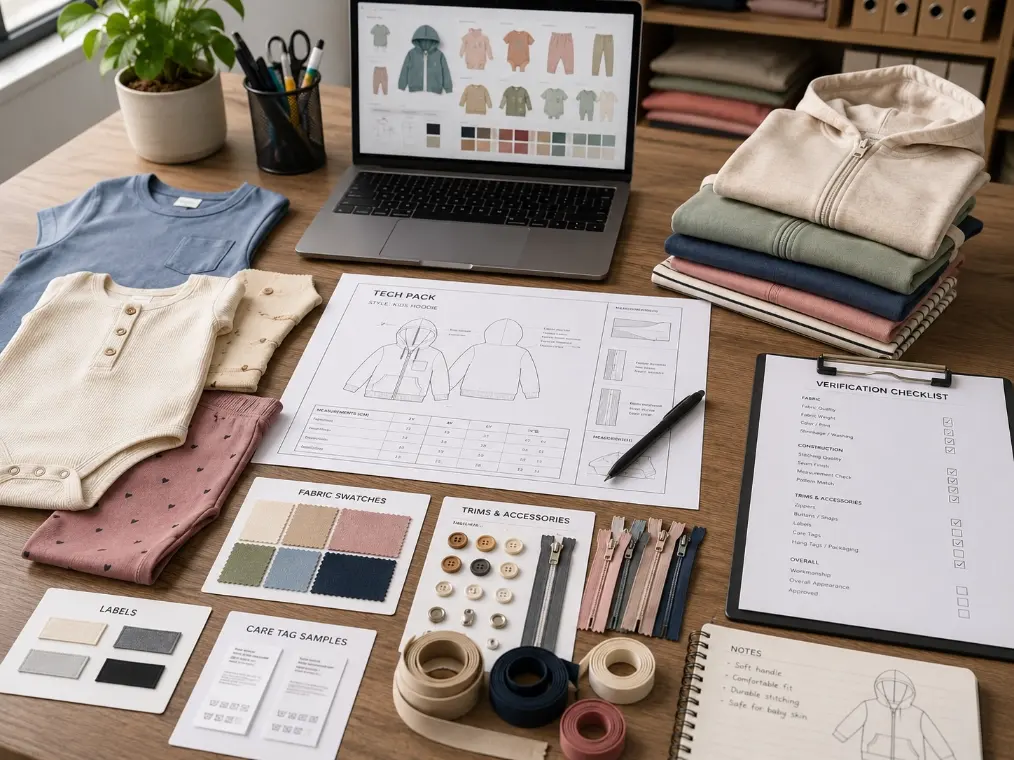
Before your first bulk order, verify five areas: the supplier’s business identity, kidswear product fit, compliance readiness, sample and material control, and production quality management.
Verification is not a single factory audit. It is a sequence of checks before money, materials, and production capacity are committed.
Supplier discovery vs. supplier verification
Supplier discovery helps you find possible manufacturers. Supplier verification helps you decide whether one of those manufacturers is ready to handle your actual order.
Discovery may include browsing a website, checking product photos, asking for a quote, or comparing basic service pages. Verification goes deeper. It asks whether the company name matches the contract entity, whether the factory understands your age group and garment category, whether sample revisions are documented, and whether quality standards are written into production files.
The five checks that matter before a first bulk order
| Verification area | What to confirm before bulk approval |
|---|---|
| Business identity | Company name, address, contact path, contract entity, and written responsibility |
| Product fit | Age group, size range, fabric, trims, construction, decoration, and development logic |
| Compliance path | Target market, applicable rules, labels, testing records, and documentation responsibility |
| Sample control | Fit sample, size set, pre-production sample, revision record, and approved benchmark |
| Production control | Material approval, QC checkpoints, inspection criteria, traceability, packing, and quote terms |
Business and contract readiness
Confirm who you are buying from, who signs the documents, who receives payment, and who answers after production starts.
Kidswear product and compliance readiness
Children’s clothing needs more than general sewing ability. Age group, small parts, drawcords, decorative trims, care labels, tracking information, and target-market rules can all affect whether a product is ready to sell.
Production, QC, and shipment readiness
Your final decision should be documented as a go/no-go decision. If an issue is not closed before deposit, it should be listed as a condition, revision, or inspection checkpoint.
For buyers who are still defining the manufacturing route, HAPA’s kidswear OEM manufacturing support page shows how tech pack review, sample development, fabric and trim selection, bulk manufacturing, QC, labels, packaging, and delivery can connect in one production path.
Confirm the Manufacturer’s Business Identity and Communication Reliability
A supplier can look professional online and still be difficult to verify. Before discussing price in detail, confirm that the business identity, communication pattern, and responsibility structure are clear.
Verify the company name, address, and contract entity
Ask for the legal company name, business address, export contact, payment beneficiary, and the entity that will appear on the proforma invoice or sales contract. These details should not change halfway through sampling.
If the supplier uses a trading company, sales office, or related factory, ask how each party is involved. This is not automatically a problem, but it must be transparent before money moves.
Review how the supplier handles international communication
A reliable OEM kidswear supplier should be able to answer product questions in writing. Watch how they respond to details such as measurement tolerance, fabric weight, trim material, label placement, color standard, testing responsibility, and sample revision timing.
Fast replies are useful. Clear replies are more important.
Clarify who owns each step from sample to shipment
Before you approve a quote, ask who is responsible for development, sampling, production planning, QC, packaging, export documents, and post-shipment issues. If every answer is “no problem” but no one explains the process, verification is still incomplete.
Screen for early trust and documentation red flags
Pause if the supplier refuses written confirmation, changes company details without explanation, cannot identify the contract party, avoids product-specific questions, or promises that certificates or tests are “automatic” without connecting them to your actual product.
When sending an inquiry to HAPA or any children’s clothing manufacturer, prepare a short sourcing brief, tech pack, size range, target market, fabric expectations, and label or packaging needs. HAPA’s contact page provides the basic inquiry fields buyers can use to start that conversation.
Review Kidswear-Specific OEM Experience and Product Fit
Do not verify a factory only by asking, “Can you make children’s clothes?” A better question is: “Can this supplier make my specific product, for my age group, with the materials, fit, trims, and market expectations I need?”
Match the factory to your age group and product category
Babywear, toddler clothing, everyday kidswear, schoolwear, outerwear, pajamas, dresses, activewear, and embellished styles all create different risks. Ask whether the supplier has handled garments close to your category and what details usually need attention.
For example, baby garments require softness, comfort, secure trims, and careful seam placement. Activewear may need stretch recovery and durable stitching. Dresses may involve lining, gathers, trims, and decoration placement.
Check experience with fabrics, trims, and garment construction
Product photos are not enough. Ask how the supplier chooses fabric, reads a Bill of Materials, controls trims, builds patterns, and manages graded sizing.
Infant and toddler garments
Discuss skin feel, seam comfort, snap placement, small components, wash performance, and easy-care materials.
Dresses, sets, and everyday kidswear
Review fit balance, lining, elastic, waist construction, sleeve movement, color matching, and consistency across size ranges.
Embroidery, prints, sequins, and decorative details
Confirm whether decorative parts can be produced securely and repeatedly, and whether decoration choices create extra compliance or durability checks.
Ask for development logic, not only product photos
A strong supplier can explain how your sketch, reference sample, or collection brief becomes a pattern, sample, fabric plan, size spec, and production file. If they only send attractive photos, ask what changes are possible and what limitations apply.
Test whether the factory can read and challenge your tech pack
Send a tech pack and ask the manufacturer to identify missing information. Useful feedback may include unclear measurements, missing tolerances, vague fabric descriptions, incomplete trim specifications, or label artwork not ready for production.
HAPA’s guide on how to create a clothing tech pack explains why flats, BOM, measurements, construction details, labels, packaging, and timeline information matter before sampling.
Confirm whether OEM or ODM support fits your project stage
OEM is usually best when you already own the design and specifications. ODM can fit brands that need development support from references, existing style directions, or a collection brief. HAPA’s ODM kidswear development support page describes ODM as a route for buyers who want to modify styles, fabrics, colors, trims, labels, packaging, and size requirements.
Check Compliance Readiness for Your Target Market
Children’s clothing compliance is product-specific. It depends on the garment type, age group, materials, trims, decorative parts, intended market, importer role, and the claims you make on labels or product pages.
Start with product-specific compliance, not generic certificates
Do not accept a generic certificate as proof that your order is ready. Ask which rules apply to your specific product, what tests or records support those rules, who maintains the documents, and what must be shown on labels or packaging.
This section is educational only. Brands and importers should confirm final obligations with qualified compliance advisors, testing labs, customs brokers, or legal counsel.
Map compliance by target market before sampling
Make a simple compliance map before the first paid sample. Include the sales country, age range, fiber content, trims, decoration, care label needs, origin marking, packaging, product claims, and testing path.
This early map helps the manufacturer choose suitable materials and avoid late changes after the approved sample.
For the U.S. market: CPC, testing, and tracking records
For U.S. children’s products, review the CPSC’s Children’s Product Certificate guidance, third-party testing guidance, and tracking label guidance.
The CPSC also states that, beginning July 8, 2026, importers of most regulated consumer products will be required to electronically file certificates of compliance with U.S. Customs and Border Protection through a Partner Government Agency message set. If you are importing after that date, verify eFiling readiness before shipment.
Children’s Product Certificate and supporting test reports
Ask whether a CPC is required for your product and which test reports support it. The certificate should connect to the actual garment, production place, testing date, applicable rules, and responsible firm.
CPSC-accepted third-party laboratory testing
If testing is required, confirm that the lab is accepted for the specific rule being tested. Not every lab can test every requirement.
Tracking label information and recordkeeping
Plan traceability before production. Tracking information may include manufacturer or private labeler identity, production location, production date, batch or run number, and other information that helps identify the source of the product.
For the EU market: product safety and traceability checks
For EU sales, review the European Commission’s product safety resources, including the General Product Safety Regulation and Safety Gate. EU readiness should not be reduced to a single document.
General Product Safety Regulation considerations
Discuss product safety, restricted substances, warnings, product information, importer or responsible economic operator details, and how safety documentation will be maintained.
Operator, importer, and traceability information
Clarify who places the product on the market, who appears on product documents, and how batch, supplier, material, and production information will be traced.
For garment labels: fiber, care, origin, and warnings
For the U.S. market, the FTC’s Textile and Wool Acts labeling guidance explains that most textile and wool products need labels covering fiber content, country of origin, and the responsible manufacturer or business identity. Care labels are also covered by FTC rules.
For other markets, confirm local rules on fiber names, care symbols, origin, language, warnings, size, and claims before approving label artwork.
Decide which documents must be ready before bulk approval
Before placing a bulk order, request a document list such as:
- Final tech pack and BOM
- Approved sample record
- Material and trim specifications
- Label and packaging artwork
- Test reports or compliance documents where applicable
- CPC or market-specific certificate route where required
- QC checklist and inspection plan
- Production schedule and packing standard
HAPA’s article on CPC certification for children’s clothing can support U.S.-focused buyers, but final compliance responsibility should still be confirmed for the specific product and importer role.
Test Sample Development Before You Approve Bulk Production
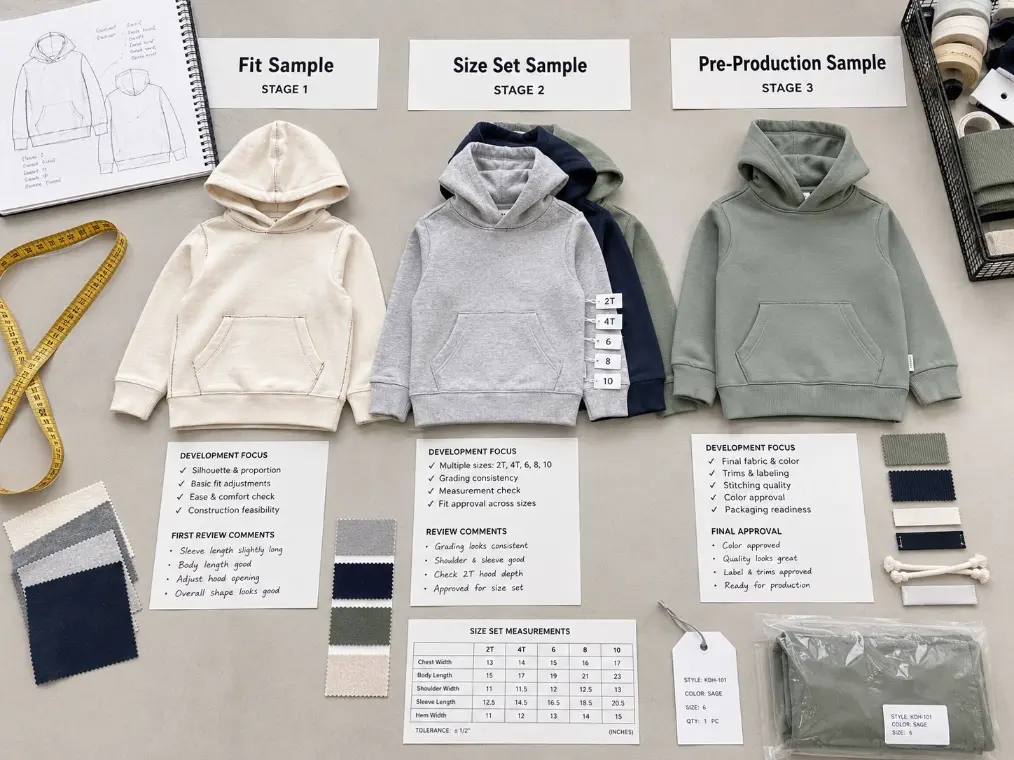
Sample approval is where many first orders become risky. The goal is not simply to receive a nice sample. The goal is to prove that the manufacturer can reproduce the approved product in bulk.
Set the sample types needed before bulk production
Different samples answer different questions. Do not treat every sample as final.
Fit sample
The fit sample checks silhouette, comfort, movement, size balance, and obvious construction issues. It may not use final fabric or trims.
Size set sample
The size set checks whether grading works across the size range. This is especially useful for toddler, kids, and tween ranges where fit changes quickly.
Pre-production sample
The pre-production sample should represent the garment that will move into bulk production, including fabric, color, trims, labels, decoration, workmanship, and packing direction where possible.
Record every revision before approving the final sample
Use a sample approval checklist instead of scattered messages. Record the sample date, version number, comments, required changes, approved points, open issues, and who confirmed each decision.
| Sample area | What to check | Approval evidence |
|---|---|---|
| Fit and measurements | POM, tolerance, movement, comfort | Fitting notes and updated spec sheet |
| Materials | Fabric, lining, color, handfeel, shrinkage direction | Swatches, lab dips, wash notes |
| Workmanship | Stitching, seams, finishing, reinforcement | Photos and defect comments |
| Branding | Labels, hangtags, packing, barcode placement | Artwork proof and placement photos |
| Compliance path | Applicable labels, test plan, documentation owner | Written checklist and assigned responsibility |
Use approved samples as the production benchmark
The approved sample should be stored, labeled, and referenced in the purchase order or production confirmation. If the factory changes fabric, trim, color, measurement, label placement, or construction after approval, the change should require written approval.
Check the details most likely to fail in kidswear
Fit, movement, and comfort
Children move, sit, crawl, run, stretch, and wash garments often. Check comfort and mobility, not just flat measurements.
Stitching, seams, and workmanship
Look for rough seams, weak stitching, skipped stitches, twisting, puckering, loose threads, and areas that may irritate skin.
Trims, labels, and decoration placement
Verify that trims are secure, labels are comfortable, and decorative parts are placed consistently and safely for the target age group.
Washing behavior and dimensional stability
Review shrinkage, colorfastness direction, print durability, seam twisting, and post-wash appearance before approving bulk production.
HAPA’s product samples page positions sampling as a way for buyers to see, feel, and test children’s clothing quality before bulk production.
Audit Fabric, Trims, Labels, and Packaging Controls
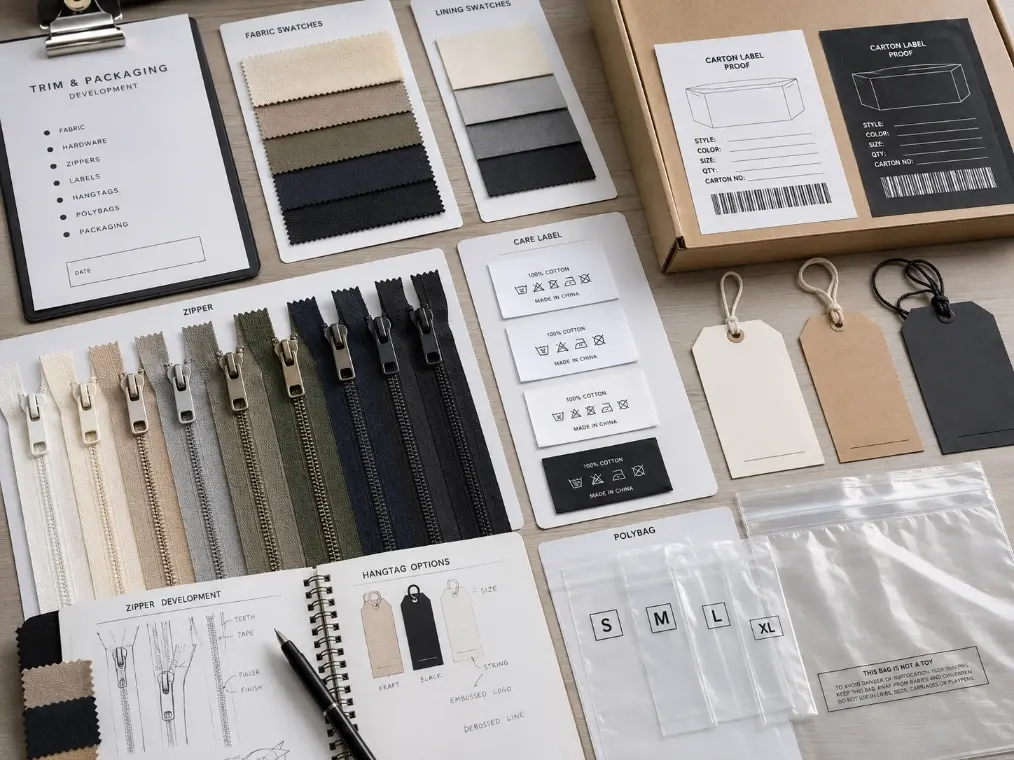
Many bulk-order failures start before sewing begins. If fabric, trims, labels, and packaging are not locked, the factory may make practical substitutions that change fit, appearance, compliance readiness, or customer experience.
Lock fabric standards before cutting starts
Confirm fabric composition, weight, construction, color standard, handfeel, stretch, shrinkage direction, finishing, and approved supplier or mill where relevant. Keep approved swatches with your production file.
Verify trim and component risks for children’s wear
Kidswear components should be reviewed for age suitability, durability, attachment strength, washing behavior, and market requirements.
Buttons, snaps, zippers, and drawcords
Ask how attachment strength, sharp edges, corrosion, placement, and drawcord risks will be checked.
Sequins, beads, embroidery, and appliques
Decorative components can affect safety, comfort, washing, and inspection criteria. Define what is acceptable before production.
Printed graphics, heat transfers, and embellishments
Confirm print method, color approval, curing, cracking risk, placement tolerance, wash performance, and any restricted-substance checks needed for the target market.
Control substitutions with written approval
State that no fabric, trim, label, thread, print method, packaging material, or color standard can be changed without written buyer approval. This protects both sides because the factory knows which changes require escalation.
Approve labels, hangtags, and packaging artwork early
Label and packaging errors can delay shipping even when garments are sewn correctly. Approve brand labels, care labels, size labels, hangtags, polybags, barcode stickers, carton marks, and any retail packaging before bulk production finishes.
HAPA’s private label kidswear page describes support for custom labels, hang tags, care labels, packaging, and retail-ready presentation for children’s apparel brands.
Confirm carton, polybag, barcode, and packing requirements
If you sell through retail, wholesale, Amazon, marketplaces, or a 3PL warehouse, packing rules matter. Confirm fold method, size ratio, carton assortment, barcode location, polybag warning language where applicable, carton marks, and packing list format.
Evaluate Quality Control, Inspection, and Traceability Procedures
Quality control should be agreed before sewing begins. If you only inspect after all garments are packed, you may discover problems too late to correct them efficiently.
Confirm inspection points across the production cycle
Ask your kidswear OEM manufacturer where quality checks happen and what records will be kept.
Incoming material inspection
Check fabric, trims, labels, packaging, color, defects, and quantities before cutting.
Pre-production meeting
Review the approved sample, spec sheet, BOM, workmanship standards, label placement, packing method, and known risk points with the production team.
Inline inspection
Inspect early production pieces to catch measurement, stitching, trim, color, or workmanship issues before the full order is completed.
Final inspection and packing check
Final inspection should compare finished goods against the approved sample, production file, measurement tolerance, defect criteria, label requirements, and packing standard.
Define defect categories before sewing begins
If defect categories are vague, inspection becomes subjective.
Critical defects
Critical defects may involve safety, prohibited materials, sharp parts, missing required labels, serious contamination, or failures that make the product unsuitable for sale.
Major defects
Major defects affect appearance, function, fit, durability, or customer acceptance, such as wrong measurements, visible stains, broken seams, poor print placement, or incorrect packaging.
Minor defects
Minor defects are small issues that may not affect function but should still be limited, such as loose thread ends or slight finishing inconsistency.
Align QC criteria with the approved sample
Your QC checklist should reference the approved sample, tech pack, size spec, BOM, fabric approval, trim approval, label artwork, packing instructions, and any test or compliance requirements.
HAPA’s kids clothing manufacturing process page is a useful internal link for readers who want to understand the broader development-to-production flow.
Make traceability part of your approval process
Ask how production batches, material lots, sample versions, inspection results, and packing records are tracked. Traceability helps if you need to investigate a defect, respond to a marketplace request, or manage a recall-related question.
Compare Quotes and Commercial Terms Without Choosing on Price Alone
The lowest quote is not always the lowest-risk quote. Before choosing a supplier, compare what each quotation includes, excludes, and assumes.
Compare what is included, excluded, and assumed
A useful quote should describe the product clearly enough that another person could understand what is being priced.
Fabric, trims, labels, and packaging
Confirm fabric type, weight, composition, color, trims, decoration, labels, hangtags, polybags, cartons, and any custom packaging.
Sampling, testing, inspection, and shipping-related items
Ask whether sample fees, pattern charges, testing, inspection, documentation, freight, duties, customs broker fees, and special packing are included or excluded.
Ask how revisions affect price and production planning
If you change fabric, color, artwork, trim, size range, quantity, packing, or testing needs after quotation, the price and timeline may change. Ask how revisions are handled before sending a deposit.
Identify quote red flags before sending a deposit
Be cautious if a quote is much lower but uses vague fabric, excludes labels or testing, ignores size range, does not mention packaging, avoids written terms, or does not connect the price to an approved sample.
When asking HAPA or another supplier for a kidswear OEM quote, include enough detail for a comparable quotation: tech pack, reference images, target quantity, fabric direction, size range, label needs, packaging expectations, target market, and launch timing.
Use a Pre-Bulk Verification Checklist and Go/No-Go Decision
At the end of verification, do not rely on a general feeling of trust. Classify each issue and decide whether the order should proceed, pause, or change scope.
Classify verification results before approving production
| Decision status | Meaning | Example |
|---|---|---|
| Pass | Ready to proceed | Approved sample, locked BOM, clear QC plan, confirmed label artwork |
| Must fix before deposit | Do not pay until resolved | Unclear test responsibility, unapproved material, missing packing standard |
| Monitor during production | Acceptable if checked | Minor workmanship risk, new trim method, color consistency watch point |
| Stop or delay | Too risky for bulk | Refuses written specs, changes material without approval, cannot explain compliance path |
Pass
Use this only when the detail is documented and aligned with your approved sample or order file.
Must fix before deposit
These are issues that can be solved, but should not be postponed until production.
Monitor during production
Some issues do not block the order but need inspection checkpoints, photos, or third-party review.
Stop or delay the order
Stop or delay when the risk affects safety, compliance, identity, payment, approved materials, or the supplier’s willingness to confirm details in writing.
Turn the checklist into purchase order conditions
Attach the checklist to the PO, tech pack, or production confirmation. Conditions can include approved sample reference, no substitution without written approval, required labels, inspection timing, packing requirements, and document delivery before shipment.
Keep your first order controlled and measurable
For a new supplier, a controlled first order is often better than an aggressive one. Keep style count, color count, and decoration complexity manageable while you learn how the supplier performs.
Decide when to reduce order size or request another sample
If the supplier is promising but open issues remain, consider reducing the order size, requesting another pre-production sample, adding third-party inspection, or limiting the first order to styles with lower complexity.
How HAPA Can Support a More Controlled First Kidswear Bulk Order
HAPA can be considered as a children’s clothing OEM, ODM, and private label manufacturing partner for brands that want support from product discussion through sampling and production planning. Specific lead times, MOQs, certification use, and commercial terms should always be confirmed with HAPA for the current project.
What to send before asking for a quote
The more complete your project file is, the more useful the manufacturer’s feedback will be.
Design files and tech pack
Send technical flats, measurements, grading, BOM, construction details, reference photos, and any sample comments.
Fabric, trim, label, and packaging expectations
Share fabric direction, trims, color standards, label artwork, hangtag needs, care label expectations, polybag requirements, and carton rules.
Target market, size range, and launch timing
Include the sales market, age range, size range, estimated quantity, preferred launch window, and any compliance or marketplace requirements you already know.
When to request sample development support
Request sample support when you need to test fit, fabric, trims, workmanship, decoration, or packaging before bulk approval. HAPA’s OEM page describes sample development as part of a broader route from tech pack review to bulk manufacturing and QC.
How to use HAPA’s feedback in your verification checklist
Use manufacturer feedback to improve your checklist. If HAPA flags a missing size spec, unclear label requirement, risky trim, or incomplete packaging instruction, close that point before you approve the first bulk order.
To move forward, prepare your tech pack, reference sample or collection brief, target market, size range, fabric expectations, labels and packaging needs, estimated order quantity, and launch timeline. Then contact HAPA to review whether your kidswear project is ready for sampling or still needs development adjustments before bulk production.
FAQ
How do I verify a kidswear OEM manufacturer before placing a bulk order?
Verify business identity, kidswear experience, sample quality, compliance documents, QC process, material controls, quote details, communication reliability, and written responsibility before approving production.
What documents should I ask a kidswear OEM factory for?
Ask for tech pack confirmation, BOM, approved sample record, material specs, label artwork, testing reports where applicable, QC checklist, production schedule, and packing requirements.
Is a good sample enough to approve a bulk kidswear order?
No. A good sample is necessary, but bulk approval also needs locked specifications, material controls, inspection criteria, label confirmation, and written change approval.
Who is responsible for children’s clothing compliance, the brand or the manufacturer?
Responsibility depends on the target market and legal role. Brands and importers should verify applicable rules with qualified advisors instead of relying only on supplier statements.
What are red flags when working with a new kidswear OEM supplier?
Red flags include vague company details, generic certificates, unclear revisions, unexplained low pricing, no written specs, poor QC explanation, and unapproved material substitutions.
Should I use third-party inspection for my first kidswear bulk order?
Consider third-party inspection for new suppliers, complex styles, infant products, regulated markets, high-value orders, or when your internal QC resources are limited.
How can I reduce risk on my first bulk order?
Start with a controlled scope, lock approved samples and materials, document QC standards, confirm labels early, and add inspection checkpoints before final payment or shipment.