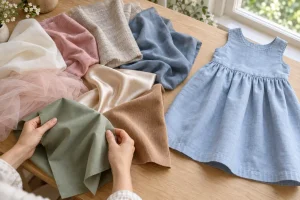
A baby clothing manufacturer compliance checklist is most useful before a brand places a sample order, not after bulk production is finished. For US and EU brands, babywear compliance touches product design, fabric and trim selection, testing, labeling, documentation, and traceability. A soft bodysuit, a romper with snaps, a sleepsuit with prints, and a swaddle with decorative trims can all create different compliance questions.
This guide is written for babywear brands, private-label buyers, importers, and sourcing teams that are preparing to manufacture baby clothing for the US or EU market. It is not legal advice. Product requirements can vary by item type, age range, material, claim, decoration method, and destination country, so brands should confirm applicable rules with official regulators, qualified testing providers, standards bodies, or legal advisers before selling.
Why Baby Clothing Compliance Should Start Before Production
Compliance is often treated as a final inspection step, but in babywear manufacturing it starts much earlier. A buyer who waits until bulk goods are packed may discover that the issue is not a missing certificate. It may be the fabric composition, a trim choice, a label omission, a decoration process, or a product category that requires a different test plan.
Baby clothing also carries a higher expectation of care because the product is used by infants and young children. Garments are worn next to sensitive skin, washed frequently, handled by parents and caregivers, and often sold through marketplaces that may request documentation before allowing a listing to stay live.
Before contacting a factory, define three things clearly:
| Question | Why It Matters |
| What is the exact product? | A bodysuit, sleeper, bib, hat, blanket, swaddle, or outerwear item may trigger different review points. |
| Who is the intended user? | Age range can affect whether the product is treated as a children’s product and which safety concerns apply. |
| Where will it be sold? | US and EU requirements are not the same, and EU member states may have additional market expectations. |
The brand, importer, manufacturer, and marketplace may all play different roles. A manufacturer can help prepare correct materials, labels, samples, and production records, but the importer or brand often remains responsible for ensuring that the finished product complies with the laws of the destination market. That is why compliance should be built into the tech pack, quotation discussion, sample approval process, and purchase order.
For example, a baby romper that changes from plastic snaps to metal snaps after sampling may need a new safety and chemical review. A print method changed to reduce cost may affect chemical testing. A label artwork revision may create a country-of-origin or fiber-content problem. These are production decisions, not just legal paperwork issues.
US Baby Clothing Compliance Checklist: CPSIA, CPC, Labels, and eFiling
For the United States, most baby clothing is reviewed under children’s product safety, textile labeling, and apparel-specific rules. The exact checklist depends on the product category. A basic cotton baby bodysuit, a flame-resistant sleepwear item, and a jacket with cords or toggles should not be treated as identical products.
CPSIA and children’s product classification
The Consumer Product Safety Improvement Act, usually called CPSIA, is central to US children’s product compliance. The US Consumer Product Safety Commission explains that a Children’s Product Certificate, or CPC, applies to products intended primarily for children age 12 or younger and must be based on testing from a CPSC-accepted laboratory where applicable.
For a babywear buyer, the first sourcing question is simple: is this product intended for infants or young children? If the answer is yes, the brand should discuss children’s product testing, documentation, and labeling before confirming the sample.
Practical buyer checks should cover the product category, intended age range, test sample identity, and whether trims, prints, coatings, snaps, buttons, zippers, and labels are included in the testing plan.
Third-party testing and Children’s Product Certificate
A CPC is not just a design file or a supplier promise. CPSC guidance says the certificate must identify the product, cite each applicable rule, list the importer or manufacturer, provide test record and lab details, and identify the date and place of manufacture and testing. Brands can review the official CPSC Children’s Product Certificate guidance when building their document checklist.
Buyers should avoid vague requests such as “please provide all certificates.” A better request is:
Please provide product-specific test reports and certificate documentation for this SKU, fabric composition, colorway, trim package, print method, and target market.
That level of detail matters because a report for white cotton fabric may not support a dark printed garment with snaps, elastic, labels, and packaging. If the manufacturer changes a material or trim after approval, the brand should ask whether documentation must be updated.
Flammability, sleepwear, drawstrings, lead, and phthalates
US babywear compliance may involve several product risks. General wearing apparel can be subject to flammability rules. Children’s sleepwear can raise additional review questions. Small parts, surface coatings, prints, zippers, snaps, and plasticized components may require testing or supplier documentation depending on the product.
Do not assume that “baby clothing” is one test category. Build a product-by-product review:
| Product Feature | Buyer Review Point |
| Sleepwear or sleep-related product | Confirm applicable flammability and labeling expectations before design approval. |
| Drawstrings, cords, ties, or loops | Review strangulation, entrapment, and mechanical safety concerns. |
| Snaps, buttons, bows, or decorative trims | Check attachment strength, small-parts risk, and chemical restrictions. |
| Prints, coatings, or metallic decorations | Confirm whether surface coating, heavy metal, or chemical testing is needed. |
| Plasticized parts | Review phthalate-related requirements where applicable. |
Tracking labels, textile labels, care labels, and eFiling
US children’s products generally require traceability information. For apparel, buyers should also review textile labeling and care labeling. The Federal Trade Commission’s textile guidance explains labeling requirements for covered textile and wool products, including fiber content, manufacturer or dealer identity, and country of origin. The FTC also provides guidance on the Care Labeling Rule for instructions needed for ordinary care.
For US baby clothing, ask your manufacturer to prepare label artwork early, including fiber composition, country of origin, care instructions, brand and size labels, tracking information where applicable, and packaging or warning copy if relevant.
CPSC import systems and eFiling requirements are evolving, so importers should check current CPSC guidance before shipment. If your babywear product is regulated by CPSC, the documentation plan should be aligned before the goods leave the factory.
EU Baby Clothing Compliance Checklist: GPSR, Textile Labeling, REACH, and EN Standards
EU compliance is not a copy of US compliance. A US CPC does not automatically solve EU product safety, chemical, textile labeling, or documentation requirements. Brands selling in the EU should review the finished garment under EU product safety rules and any applicable national expectations in the destination market.
GPSR product safety and technical documentation
The EU General Product Safety Regulation, or GPSR, applies from December 13, 2024, according to the official EUR-Lex summary. It updates general safety obligations for consumer products in the EU and increases the importance of product risk assessment, traceability, responsible economic operators, and market surveillance cooperation.
For a baby clothing brand, this means product safety should be documented. A practical file may include product description, SKU information, intended use, material composition, risk assessment notes, test reports, supplier declarations, label artwork, responsible-party details where applicable, and batch records.
The GPSR does not mean every ordinary baby garment needs CE marking. CE marking applies only when a product falls under a specific EU law that requires it. If a babywear item is also a toy, personal protective equipment, or another regulated product type, the review may change. Brands should verify the applicable route for each product.
EN 14682 and mechanical safety risks
EN 14682 is commonly associated with cords and drawstrings on children’s clothing. Even when a brand does not cite the standard directly in consumer copy, the design principle is important: cords, ties, loops, toggles, and similar features can create safety concerns in children’s garments.
For baby clothing, a conservative design review should ask:
- Are there cords, ties, loops, bows, or decorative attachments near the neck or hood?
- Could a trim detach during use or washing?
- Could a decorative part become a small part hazard?
- Could a zipper pull, snap, or button create a sharp edge or detachment issue?
- Does the product design remain safe after repeated laundering?
REACH chemical restrictions for fabrics, trims, coatings, and prints
REACH is the EU’s chemical regulation framework. For babywear, it matters because garments may include dyed fabric, prints, coatings, metal parts, elastics, adhesives, labels, and packaging components. Chemical compliance should not be limited to the main fabric.
Buyer checks should include fabric composition, dye process, print inks, coatings, metal snaps, zippers, buttons, elastic, packaging that contacts the product, and supplier declarations or test reports linked to the specific order.
A frequent sourcing risk is assuming that a fabric certificate covers the entire garment. It may not. Finished-product review is stronger when each risk-bearing component is considered.
EU textile fiber composition labeling
The EU Textile Regulation covers textile fiber names and related labeling and marking requirements. In practice, brands should prepare EU label copy with the correct fiber composition, language strategy, manufacturer or importer details where required, and country-specific expectations.
Before production, confirm:
- Final fiber composition by percentage.
- Whether trims or non-textile parts affect label wording.
- Required languages for the sales countries.
- Care instructions and symbols.
- Brand, size, origin, and traceability information.
- Whether ecommerce product pages must display specific product information.
Babywear Product Design Risks to Review Before Sampling
Compliance risk often begins with design. A manufacturer can quote a product more accurately when the brand provides a complete tech pack, reference sample, fabric target, trim list, decoration plan, and destination market. If those details are unclear, the first sample may look good but still fail to support the final compliance path.
Fabric safety and skin-contact risk
Babywear is usually worn close to the skin, so material choice matters. Buyers should review softness, breathability, shrinkage, colorfastness, seam comfort, and chemical considerations. Fabric also affects cost, production method, label copy, and test scope. If a brand plans to claim “organic,” “recycled,” “hypoallergenic,” or another product attribute, the claim should be supported by reliable documentation and reviewed under the rules of the sales market.
Trims, snaps, buttons, zippers, bows, and small parts
Trims are a common source of avoidable risk. A garment can be made from a compliant fabric but still create issues because of a snap, zipper pull, bow, applique, button, or decorative patch.
Before sampling, ask whether every trim is necessary for the age range, whether detachable parts can be reduced, whether snaps and buttons are fully specified, and whether the trim should be tested as part of the finished garment.
Prints, coatings, dyes, and decoration methods
Screen printing, heat transfer, embroidery, applique, puff print, metallic print, and silicone print all create different production and testing questions. Brands should specify decoration methods in the tech pack and keep approved strike-offs or lab dips on file. If the supplier changes the ink, print base, adhesive, or transfer supplier, review whether additional testing or documentation is needed.
Sleepwear, swaddles, drawstrings, and functional design
Sleep-related baby products deserve special caution. Sleepsuits, pajamas, sleep sacks, and swaddles may raise different safety and labeling questions from everyday bodysuits or tops. Functional design choices such as neck openings, fasteners, leg openings, elastic, and wrap closures should be reviewed for both comfort and safety.
For babywear collections, it is helpful to categorize SKUs before sampling:
| SKU Type | Design Review Focus |
| Bodysuits and rompers | Snaps, crotch opening, neck stretch, shrinkage, label comfort. |
| Sleepsuits and pajamas | Flammability review, fit, closure safety, care labels. |
| Bibs and accessories | Neck closure, absorbency, coating, warning copy. |
| Outerwear | Cords, toggles, zipper guards, detachable parts. |
| Swaddles and blankets | Size, fabric, edges, claims, packaging information. |
Compliance Documents to Request From a Baby Clothing Manufacturer
The strongest baby clothing manufacturer compliance checklist is document-specific. Instead of asking whether a factory is “certified,” ask for the documents that match your product, order, and market.
Test reports and lab scope
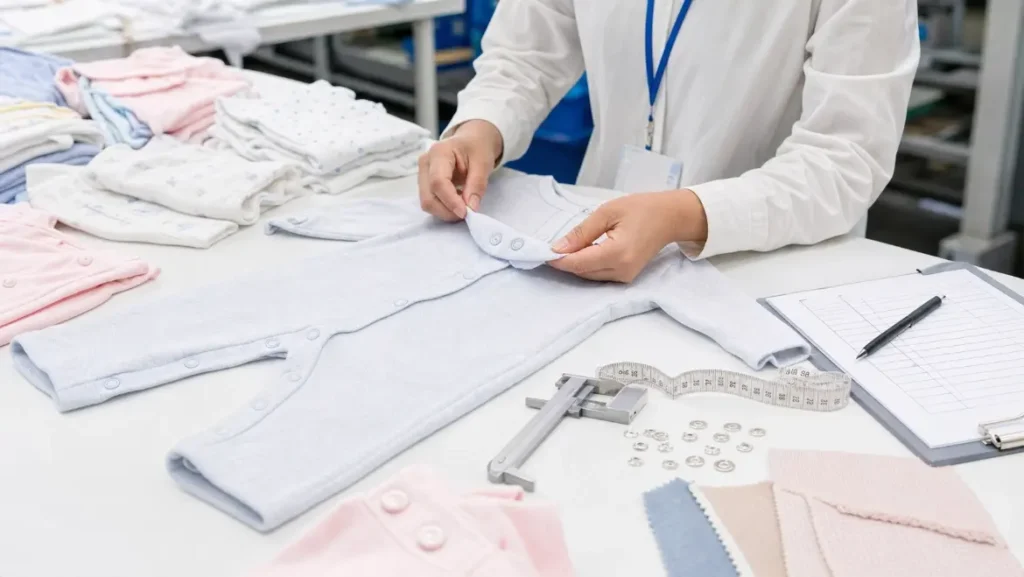
Ask whether test reports were issued by a suitable laboratory, match the same product, fabric, color, print, trim, and age range, remain current enough for the buyer’s policy or marketplace requirement, and clearly identify the tested sample.
If the report covers only raw fabric, it may be useful but incomplete. A finished baby garment includes sewing thread, snaps, prints, labels, packaging, and sometimes accessories. The buyer should understand what the report does and does not cover.
CPC, EU technical file inputs, and supplier declarations
For US products, the importer or domestic manufacturer may need to issue a CPC where applicable. The manufacturer can support this process by providing samples, production details, test reports, manufacturing location information, and batch records. HAPA has a related explainer on CPC certification for children’s products that can be used as a supporting internal resource.
For EU products, brands should collect technical file inputs and risk assessment support. This does not mean the overseas manufacturer replaces the brand’s EU responsibility. It means the manufacturer should be able to provide accurate production details and maintain consistency with the approved specification.
Label artwork, batch records, and material traceability
Labels should be approved before bulk cutting. The label file should cover fiber content, size, origin, care instructions, brand identity, batch or tracking information where applicable, safety copy if needed, and EU language requirements if applicable.
Batch records matter for recalls, reorders, and marketplace audits. If a brand cannot identify which fabric lot, trim lot, or production batch was used, it becomes harder to investigate a complaint or prove consistency.
What to verify before paying a deposit
Before paying a production deposit, request a pre-production compliance pack with the final tech pack, material and trim specifications, label artwork, test plan or reports, certificate or declaration plan, packaging information, approved sample comments, and a change-control agreement.
How to Build Compliance Into Sampling, Bulk Production, and QC
Compliance becomes easier when it is part of the production workflow. It becomes harder when buyers treat it as a separate file request after goods are complete.
Add compliance notes to the tech pack
A strong babywear tech pack should include more than measurements and artwork. Add compliance notes such as target market, intended age range, product category, fabric composition, claim support, trim restrictions, label placement, testing expectations, and packaging or warning requirements.
If you are building a custom babywear collection, HAPA’s baby wear manufacturer page is a useful internal next step for reviewing product categories such as bodysuits, rompers, baby sleepwear, baby tops, and bottoms. Use it as a service reference, while keeping compliance decisions tied to official requirements and product-specific testing.
Approve size set, trims, labels, and packaging before bulk cutting
Sampling should include more than one attractive prototype. For babywear, approval should review fit and grade rules, seam comfort, label placement, snap strength, closure usability, print feel, wash performance, final label artwork, packaging, and marketplace document requests.
The size set is especially important. A garment can be compliant in material selection but still perform poorly if neck openings, crotch snaps, sleeves, or leg openings do not work across sizes. HAPA’s article on the kids clothing manufacturing process can support readers who need a broader view of how sampling and production steps connect.
Control material changes and batch substitutions
Material substitution is one of the most overlooked compliance risks. A factory may suggest a substitute fabric, zipper, snap, elastic, or print supplier because of availability or price. The change may be reasonable, but it should be documented and reviewed before bulk production continues.
Set a written rule:
No fabric, trim, print, label, packaging, or supplier substitution may be used in bulk production without buyer approval and compliance review.
This rule protects both sides. The brand avoids unexpected risk, and the manufacturer has a clear process for handling supply changes.
Keep records for recalls, marketplace audits, and reorders
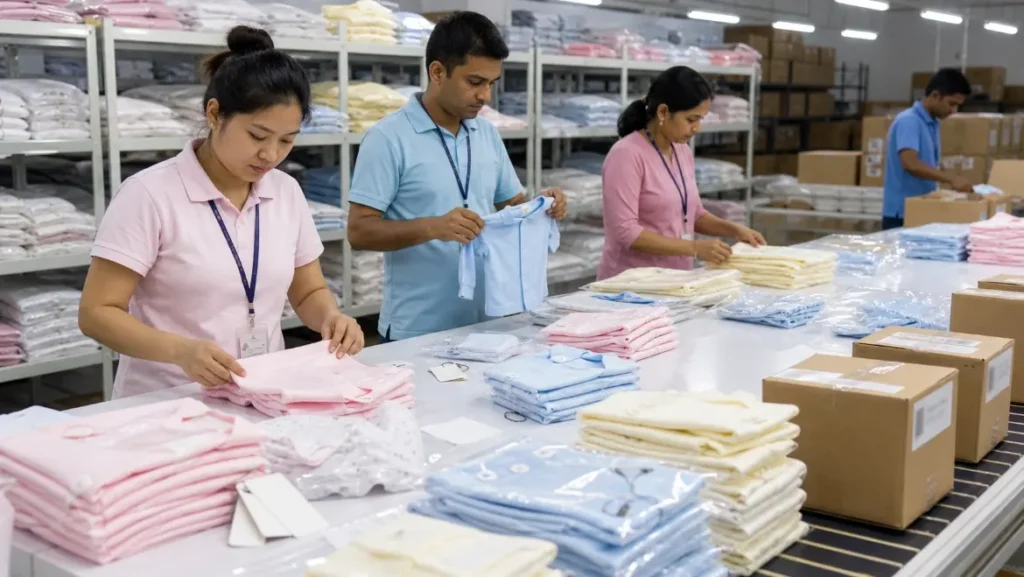
Compliance documentation should be stored in a way that supports future use. Keep the final tech pack, approved sample records, test reports, CPC or declaration documents where applicable, label and packaging artwork, supplier records, batch records, inspection reports, and shipment documents.
Marketplaces may ask for documents long after the first launch. Retailers may require updated paperwork for reorders. If a complaint occurs, organized records can reduce confusion and speed up investigation.
For private-label buyers who want supplier support from development through production, HAPA’s private label kidswear manufacturer and children’s clothing OEM service pages can be used as next-step references for discussing a custom project.
Conclusion: Choose a Compliance-Aware Baby Clothing Manufacturer
A baby clothing manufacturer compliance checklist should not be limited to certificates. For US and EU brands, the stronger approach is to connect product design, material selection, testing, labels, documentation, sampling, production control, and traceability.
Start by defining the product, age range, and sales market. Then confirm the US or EU requirements that may apply, prepare accurate label artwork, request product-specific documents, and build change control into the production workflow. The earlier these points are discussed with your manufacturer, the easier it is to avoid delays, relabeling, retesting, or marketplace documentation problems.
If you are developing a custom babywear collection and need support with product development, sampling, fabric selection, or production planning, you can review HAPA’s babywear and OEM service pages, then prepare your tech pack and compliance questions for a project discussion.
FAQ
Is CPC required for baby clothing sold in the US?
Many baby clothing products are children’s products under US rules, and a Children’s Product Certificate may be required when the product is subject to applicable CPSC safety rules. The CPC should be based on proper testing and must match the finished product. Brands should confirm the exact requirements for each SKU with CPSC guidance or a qualified testing provider.
Do baby clothes need CE marking in the EU?
Ordinary baby clothing usually does not need CE marking only because it is clothing. CE marking applies when a product falls under a specific EU law that requires it. If a garment also functions as a toy, PPE item, or another regulated product category, the assessment may change. Brands should verify the product category before using CE marking.
Does REACH apply to baby clothing?
REACH can apply to substances in textile articles sold in the EU. For babywear, this may involve fabrics, dyes, prints, coatings, trims, elastics, metal parts, and packaging components. A fabric certificate alone may not cover the complete finished garment. Brands should request product-relevant documentation and testing advice.
What labels are required for baby clothes in the US and EU?
US baby clothing may need textile fiber content, country of origin, manufacturer or dealer identity, care information, and tracking information where applicable. EU baby clothing needs textile fiber composition labeling and may require language-specific information depending on the sales country. Exact label requirements should be checked by destination market and product type.
What test reports should I ask a manufacturer for?
Ask for reports that match the exact SKU, material, color, print, trim package, age range, and destination market. Reports should identify the tested sample, lab, date, applicable rules or standards, and result. If a report covers only raw fabric or a similar product, ask what additional finished-product review is needed.
Can OEKO-TEX or GOTS replace legal compliance testing?
No certification should be treated as an automatic replacement for legal compliance review. Certifications such as OEKO-TEX or GOTS may support material or supply-chain claims when valid and relevant, but brands still need to confirm product-specific legal requirements for the US, EU, and any retailer or marketplace where the product will be sold.