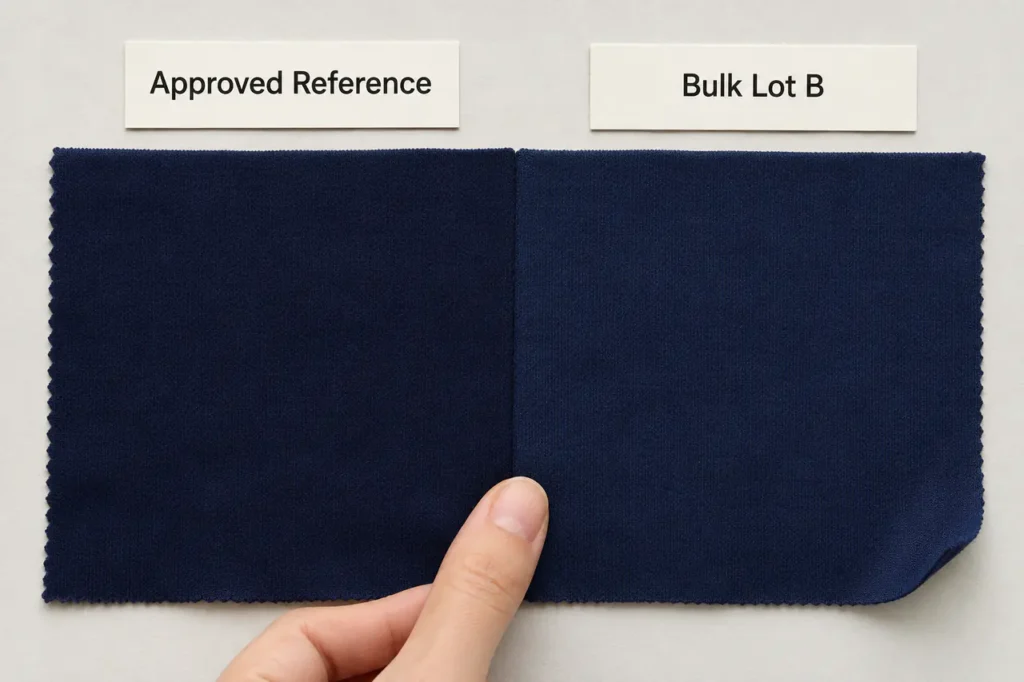
Polyester-spandex fabric is a practical choice for kids’ activewear because it combines easy care with stretch. For lightweight sports T-shirts, start by exploring blends with 5–10% spandex and a weight of 140–190 GSM. For fitted leggings, 10–20% spandex and 200–280 GSM are useful starting points. The right fabric also needs suitable recovery, coverage and comfort for the garment.
My advice is to think about how children actually wear their clothes. Can they run, bend and get dressed comfortably? Will light-colored leggings stay opaque at the knee? Will a sports top hold its shape after repeated washing? Those are questions to answer in a sewn sample before choosing a kids’ activewear fabric for production.
What Is Polyester-Spandex Fabric?
Polyester-spandex fabric combines two synthetic fibers that serve different purposes. Polyester provides the main structure of the fabric, while spandex contributes elasticity and helps the material return toward its original shape after stretching.
| Fiber | Main contribution to the fabric |
|---|---|
| Polyester | Durability, shape stability, low moisture absorption, easy care and compatibility with many printing processes |
| Spandex | Stretch, elastic recovery, closer fit and freedom of movement |
Spandex and elastane are different names for the same type of elastic fiber. LYCRA® is a brand of elastane, not a separate fiber. A supplier may therefore describe a 92% polyester and 8% spandex fabric as a polyester-elastane blend.
The percentages describe the composition by weight. They do not tell you how far the material stretches, how much force is needed to stretch it or how well it recovers. Two 92/8 knits can feel different in the hand and give different stretch and recovery results because of their yarns, knit structure and finish.
Why Is Polyester-Spandex Good for Kids’ Activewear?
Polyester-spandex works well for many children’s sports garments because it can be developed into lightweight, flexible or supportive fabrics. It is especially useful for sports tops, leggings, athletic shorts, dancewear and matching training sets.
Advantages of Polyester-Spandex Fabric
- Freedom of movement: The elastic component helps garments accommodate bending, running and stretching without restricting movement when the fit is appropriate.
- Shape retention: A well-developed stretch knit can recover after movement and help prevent knees, cuffs and waistbands from becoming loose too quickly.
- Easy care: Polyester absorbs relatively little water, and lightweight, suitably engineered fabrics can dry quickly after washing.
- Printing versatility: Polyester-rich fabrics are particularly useful for heat-transfer and sublimation printing, making them attractive for colorful sports collections and team uniforms. The print process must still suit the fabric and its spandex content.
- Flexible product development: Different knitting structures, weights and finishes allow brands to create everything from breathable training tops to brushed winter leggings.
Disadvantages to Consider
Even when the blend is right, a dense polyester-spandex fabric may feel hot in summer, and a poorly developed fabric can pill, retain odors or lose its shape. Spandex can also deteriorate when exposed to unsuitable heat or harsh treatment. Like other synthetic textiles, these blends can release microfibers during wear and washing, and the combination of fibers can complicate recycling.
One point I would emphasize is that polyester-spandex is a fiber composition, not a performance guarantee. A material labeled as sportswear fabric is not automatically breathable, moisture-wicking or quick-drying. If your brand intends to advertise those properties, check the finished fabric and the evidence behind each claim.
Recommended Polyester-Spandex Ratios and GSM for Kids’ Activewear
GSM stands for grams per square meter. It describes fabric weight per unit area, not thickness, opacity or quality by itself. A compact, well-constructed 200 GSM knit may provide better coverage than a heavier but more open knit.
Use the six styles below to narrow your polyester-spandex fabric shortlist. Ask the mill for a swatch near the weight you want, then check it in the garment.
| Kids’ activewear product | Polyester / spandex | Reference GSM | Suitable starting structure |
|---|---|---|---|
| Loose sports T-shirts | 90–95% / 5–10% | 140–190 | Jersey or lightweight interlock |
| Fitted training tops | 85–92% / 8–15% | 160–220 | Stretch jersey or interlock |
| Stretch sports shorts | 85–95% / 5–15% | 160–230 | Jersey or interlock |
| Leggings | 80–90% / 10–20% | 200–280 | Dense interlock or suitable warp knit |
| Dancewear and gymnastics wear | 80–85% / 15–20% | 180–260 | Stretch tricot or other elastic knits |
| Brushed winter activewear | 85–92% / 8–15% | 220–300 | Brushed stretch knit |
Use these ranges as starting points for sampling, not as fixed industry standards or guaranteed performance specifications. The percentages are complementary: polyester and spandex together make up 100% of each two-fiber blend. Relaxed shorts may need little or no spandex, while fitted garments may need a different weight or knit to meet their coverage and fit requirements.
Is More Spandex Always Better?
No. Adding more spandex does not automatically give you a better garment. The elasticity of the yarn, the knit structure and the way the fabric is finished all influence its behavior.
I would rather choose a fabric that works with the pattern than increase the spandex percentage to compensate for a poor fit. Children should be able to pull on their leggings comfortably, but the waistband also needs to stay in place. A high-stretch fabric that requires too much force to extend can make dressing difficult even if its maximum stretch looks impressive on paper.
What an Actual Sportswear Fabric Specification Looks Like
The Italian textile manufacturer Carvico lists the following technical specifications for its Dolomiti sports fabric:
| Fabric property | Specification |
|---|---|
| Polyester content | 85% |
| Elastane content | 15% |
| Fabric weight | 250 GSM |
| Fabric width | 165 cm |
| Finish | Brushed |
| Applications | Sports apparel and transfer printing, among others |
Carvico’s Dolomiti is a brushed polyester-spandex fabric that stretches both lengthwise and crosswise.
An unbrushed 85/15 jersey can feel and perform quite differently. I find the finish just as important as the fiber composition and weight when choosing fabric for a cold-weather collection.
Which Fabric Construction Should You Choose?
Once you know the blend ratio and target weight, compare how the polyester-spandex fabric is knitted. This often makes a bigger difference to the way activewear feels than changing the spandex content by a few percentage points.
Single Jersey
Single jersey is a useful option for lightweight sports shirts and everyday activewear. It generally has different surfaces on its face and reverse. When reviewing a sample, pay attention to edge curling, dimensional stability, opacity and how the inner face feels against the skin.
Interlock
Interlock is a double-knit construction that can provide a smooth surface and greater stability than many comparable single jerseys. Denser stretch interlocks are worth sampling for fitted tops, sports shorts and leggings, particularly when coverage and shape retention are priorities.
Mesh
Mesh works well for ventilation panels and some lightweight training garments. Its openings can improve airflow, but you should consider coverage, abrasion and the feel of the fabric against the skin. A mesh panel also needs a comfortable seam where it joins the main jersey.
Tricot and Other Warp Knits
Stretch tricot and other suitable warp knits can offer a smooth surface, controlled stretch and a close fit. They are often used for dancewear, gymnastics wear and fitted athletic garments. The actual performance depends on the yarn and knit specification rather than the construction name alone.
Brushed Stretch Knit
Brushing the inner face of a polyester-spandex fabric can give cold-weather leggings and training tops a softer, warmer feel. Look at how the raised surface changes with washing and friction. A brushed fabric that feels wonderful when new may not be the best option if it pills or loses its surface finish too quickly.
If you’re developing a complete collection rather than a single style, our guide to the best materials for kids’ sports apparel covers other fiber choices and comfort considerations beyond polyester-spandex.
Polyester-Spandex vs. Nylon-Spandex: Which Is Better?
Both blends can work well. For printed sports uniforms and cost-conscious collections, polyester-spandex fabric is often a practical starting point, while nylon-spandex is worth considering for fitted garments where a smooth hand feel is especially important.
| Feature | Polyester-spandex | Nylon-spandex |
|---|---|---|
| Hand feel | Can range from crisp to soft and smooth | Often selected for a smooth, supple feel |
| Durability | Good potential, depending on the knit and yarn | Often chosen for abrasion resistance |
| Drying | Low fiber moisture absorption can support quick drying | Can also dry quickly with suitable construction and finishing |
| Printing | Generally well suited to conventional polyester sublimation printing | May need different inks, processes or special treatment |
| Cost | Often attractive for teamwear and large collections | Some grades are more expensive |
| Common uses | Printed training tops, school sportswear and leggings | Fitted training wear, dancewear and premium leggings |
These are general sourcing tendencies, not universal performance differences. For a printed PE uniform, I would start by checking the print on the finished knit. For premium fitted leggings, test both blends for stretch and recovery in the same size and pattern before choosing one.
How to Check Stretch, Recovery and Fabric Opacity
A kids’ activewear fabric needs enough stretch for the movement and enough recovery to hold the fit. Stretch without recovery is a common reason for baggy knees, loose waistbands and garments that look worn before their time.
Two-Way Stretch vs. Four-Way Stretch
Two-way stretch usually refers to stretch along one fabric axis; four-way stretch means the material extends along both its length and width. The two directions do not need to stretch equally, and suppliers sometimes use these terms differently, so ask for the measured values in each direction.
Four-way stretch is often a useful starting point for fitted leggings and dancewear, where the garment needs to move with the body in several directions. A looser sports T-shirt may not need the same level of elasticity.
How to Evaluate Stretch and Recovery
To compare two polyester-spandex fabric swatches, mark the same starting length on each. Check both directions under comparable conditions. To assess recovery, stretch the candidates to the same agreed extension, use the same hold time and repetitions, then let both rest for the same period before remeasuring.
A swatch that returns close to its original size has less remaining growth. A swatch that stays extended may be more likely to leave loose areas in the garment, although the pattern and sewing construction also play a role.
Two simple calculations help you understand the difference:
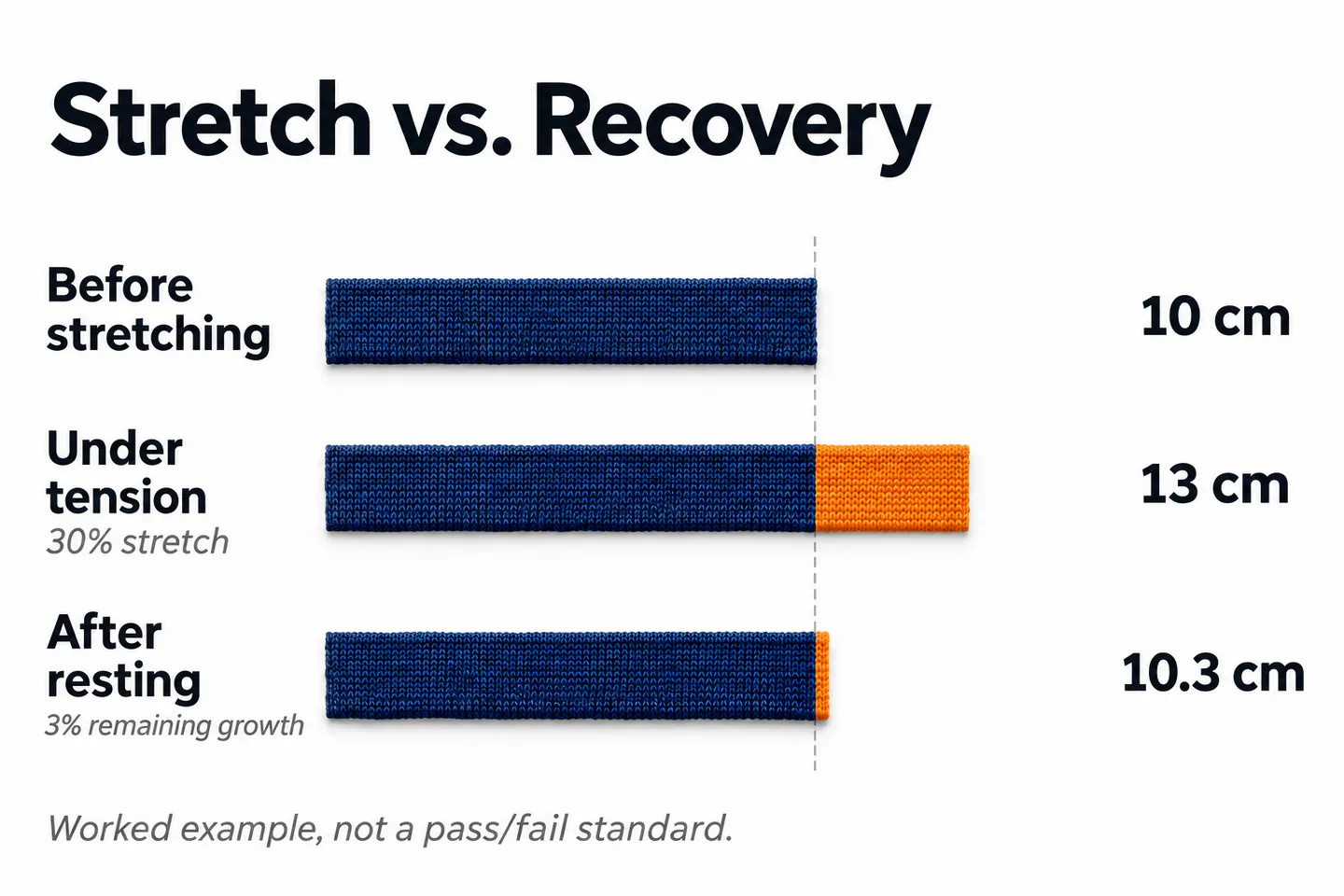
Stretch (%) = (stretched length − original length) ÷ original length × 100.
Remaining growth (%) = (rested length − original length) ÷ original length × 100.
If a 10 cm marked section extends to 13 cm and returns to 10.3 cm after resting, it has 30% stretch and 3% remaining growth under those conditions. This calculation illustrates the method; neither number is a universal acceptance limit.
A hand check helps shortlist fabric, but it is not a controlled laboratory test. For a purchasing requirement, agree on the test method, direction, load or extension, recovery interval and acceptance limits. ISO 20932-1 describes strip-test methods for assessing fabric elasticity and related properties. Comparable results need to come from comparable test conditions.
How to Prevent See-Through Kids’ Leggings
Coverage is particularly important for light-colored leggings. A pale polyester-spandex fabric can look opaque on the table yet show through when it stretches over a knee or seat.
Place a single layer of the finished fabric over a contrasting backing under consistent lighting. Look at the fabric when relaxed, then extend it to a comparable distance. Repeat the check on the correctly sized sewn sample during bending and movement.
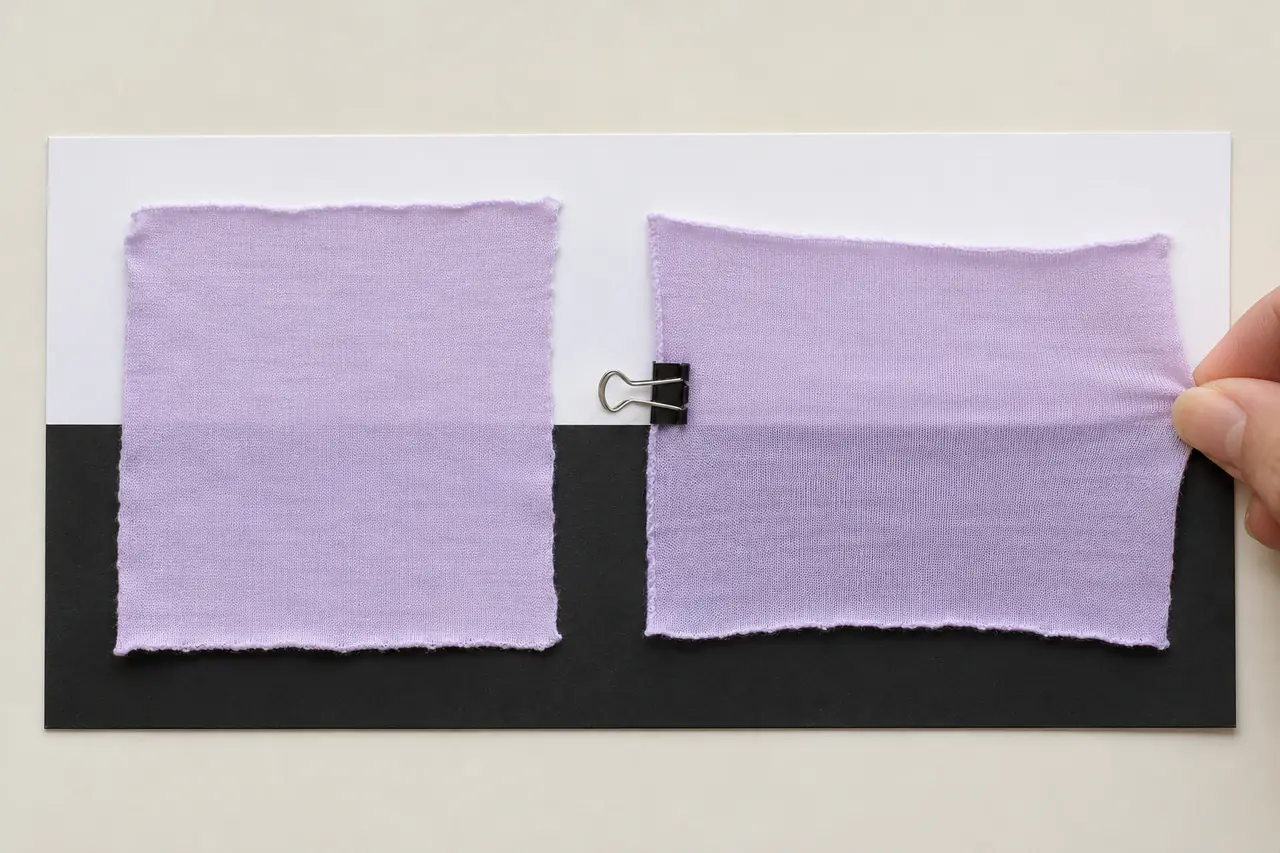
Test the actual color you intend to sell: navy may pass while lilac or cream does not. On printed fabrics, distinguish the backing showing through from pale yarns or an undyed base becoming visible as the knit opens.
For pocketed leggings, compare coverage over and beside the pocket. An extra layer may hide show-through or leave a visible outline; a different lining or flatter construction can sometimes solve the problem without replacing the main fabric.
What Makes Polyester-Spandex Comfortable for Children?
When choosing polyester-spandex fabric for a sports top, feel the inside of the sewn sample as well as the swatch. Children need to move freely, and they may wear the top underneath a sweatshirt or school jacket. Seams, bindings and mesh panels can all affect comfort.
There are three performance terms worth keeping separate:
- Breathability: For airflow, look at the air permeability of the finished fabric. A mesh back panel may allow more air through than the solid front of the same garment.
- Moisture wicking: This describes how liquid moves through or across the fabric. Yarn structure and suitable finishing can help transport sweat away from the skin.
- Quick drying: This refers to how quickly moisture leaves the fabric under defined conditions. It is not the same as wicking or air permeability.
A moisture-management report does not prove a quick-drying claim. If either property matters to your marketing, request results for the finished fabric under the relevant test method and conditions.
For younger children, I also recommend paying close attention to the inside of the garment. A bulky neck binding, underarm seam or stiff print can make a soft fabric uncomfortable. If a sports top rides up when the arms are raised, check the shoulder and armhole fit before assuming you need more stretch.
Is Polyester-Spandex Fabric Safe for Children?
Polyester-spandex can be suitable for children’s clothing when the finished garment meets the requirements of its age group, intended use and destination market. Fiber composition alone cannot establish product safety.
Before approving a kids’ activewear fabric, I would review these four areas:
- Chemical safety: Check the relevant restricted-substance requirements for fabrics, dyes, prints, finishes and accessories.
- Skin contact: Pay attention to seams, bindings, labels and other components that touch the skin.
- Colorfastness: Review washing, perspiration and rubbing performance, especially when dark fabrics are combined with light panels.
- Garment safety: Identify the applicable flammability, trim, drawcord and other product requirements before finalizing the design.
At HAPA, we can help source OEKO-TEX-certified fabric options. OEKO-TEX® STANDARD 100 tests textile articles for harmful substances according to their intended use. Product Class 1 covers products for babies and children up to three years old; Product Class 2 covers articles with direct skin contact. The relevant age and use determine which class is appropriate.
A certificate covering the main polyester-spandex fabric does not automatically cover the finished garment, its prints or its trims. Our guide to what OEKO-TEX certified means explains how to check certificate scope.
Preparing Activewear for Your Target Market
Tell your manufacturer where you plan to sell before choosing fabrics and trims. For U.S. orders, we can help coordinate applicable product testing and the information needed for a Children’s Product Certificate (CPC), where required. The responsible manufacturer or importer must ensure the necessary certification is issued. For EU orders, our support includes labeling, traceability and General Product Safety Regulation (GPSR)-related documentation review. For other destinations, the testing and labeling plan should reflect the particular product and market.
HAPA’s kidswear certifications and compliance support page describes our quality-management documentation and product-specific testing coordination. Review the scope and validity of the relevant documents for your order rather than treating a factory certificate as proof of compliance for every garment.
How We Approach Polyester-Spandex Fabric Development at HAPA
As a kidswear manufacturer based in Guangzhou, China, we support clothing brands worldwide with fabric sourcing, pattern development, sampling and bulk production.
When developing children’s activewear, we consider not only fabric comfort, stretch and durability but also the product safety, labeling and quality requirements of the destination market. What matters to us is how the fabric performs in the finished garment, not just how it looks on a swatch card.
Start With the Style and the Fit
When reviewing a style, I prefer to start with its sketch or reference sample, target age range, intended activities and colors. Leggings need coverage, easy dressing and recovery around the knee and waistband. A loose PE shirt needs comfortable seams and free shoulder movement more than maximum stretch.
You can explore our custom children’s pants manufacturing for leggings, shorts and other bottoms, or our custom kids’ T-shirt manufacturing for sports tops and printed collections. Each style needs its own fabric and fit requirements, even when the pieces share a color palette.
Separate Fabric Problems From Pattern and Sewing Problems
If the first sample fits poorly, I check where the problem starts before replacing the polyester-spandex fabric. Three clues help distinguish a fabric issue from a pattern or seam issue:
| Sample problem | What to investigate first |
|---|---|
| Knees are loose before movement | Review knee width, leg length and pattern position. Excess cloth is not necessarily a recovery problem. |
| Knees bag after bending | Compare swatch and garment recovery. If the swatch recovers but the garment does not, review cut direction, fit and construction. |
| Stitches pull tight or break | Test a seam made with the actual fabric; review stitch type, thread and machine settings before changing the fabric. |
For collections covering several age groups, sample a representative size from each distinct pattern group. An older child’s fit and movement requirements may differ from a younger child’s, even when both styles use the same material.
Check the Sample After Washing
The first fitting tells you how a new garment behaves. Washing tells you more about how families will experience it. Keep an unwashed reference, use the agreed care routine and measure the washed garment before and after laundering at the same measurement points.
On leggings, look at waistband stability, leg length, knee recovery and coverage. On tops, review the neckline, seams, body length and print. Examine friction areas for pilling and stretch printed or transferred decorations to check their appearance. Compare candidates under consistent conditions and agree on the wash-cycle count and acceptance limits for your order.
Plan Fabric Sourcing and Production Early
The polyester-spandex fabric you choose affects quality, development costs, lead times and whether you can reorder the same material.
For custom development, HAPA offers a flexible garment MOQ of 150 pieces, with mixed sizes available depending on the order. However, the garment MOQ is not necessarily the same as the fabric mill’s minimum order quantity, especially when developing custom colors or specialized fabric specifications.
We recommend confirming fabric availability, color requirements, expected order quantities and delivery plans early in the development process. This helps control the cost of the first production run and prepares your brand to replenish popular styles later.
How to Compare Polyester-Spandex Fabric Prices
The cheapest fabric per kilogram is not always the most economical choice. Usable width, weight, size mix and cutting layout all affect consumption. A wider fabric may allow more garment pieces to fit across the roll and offset a higher unit price.
Fabric cost per garment = fabric consumption per garment × fabric unit price.
When comparing polyester-spandex fabric quotes, hold the knit, GSM, color, finish, size mix and order quantity constant. Match the units: meters with price per meter, or kilograms with price per kilogram. Ask for the actual cutting width, especially for tubular knits, and avoid counting cutting waste twice.
Beyond the unit price, confirm the following:
- Minimum order quantities for the fabric or individual colors.
- Any additional dyeing charges.
- Whether the quotation includes the required fabric testing.
- Fabric availability and production lead times.
- Availability for repeat orders.
Stock fabric may work well for an initial collection when the actual lot is available and can be reserved. If you plan to replenish popular colors, discuss future availability before committing to production.
7 Fabric Checks Before Bulk Production
Approving a fabric swatch gives your sample room a direction. Approving a sewn garment confirms its fit and appearance. Neither automatically releases every bulk fabric roll for cutting.
Before releasing polyester-spandex fabric for cutting, I keep three things together: the signed swatch, the approved garment and a record of the seven checks below. That gives the supplier a reference for the next dye lot or repeat order.
| Approval item | What to confirm |
|---|---|
| Fabric specification | Composition, knit, finish, GSM, usable width and fabric code |
| Stretch and recovery | Performance in both directions, using agreed conditions and limits |
| Coverage and comfort | Opacity in the actual color and fit, ease of movement and inner surface |
| Wash performance | Dimensional change, pilling, colorfastness, recovery and decoration appearance |
| Color and lot | Approved shade, bulk cuttings, dye-lot identification and acceptable variation |
| Safety documentation | Relevant material certificates and any product-level compliance evidence |
| Commercial terms | Consumption, fabric minimums, lead time and repeat-order availability |
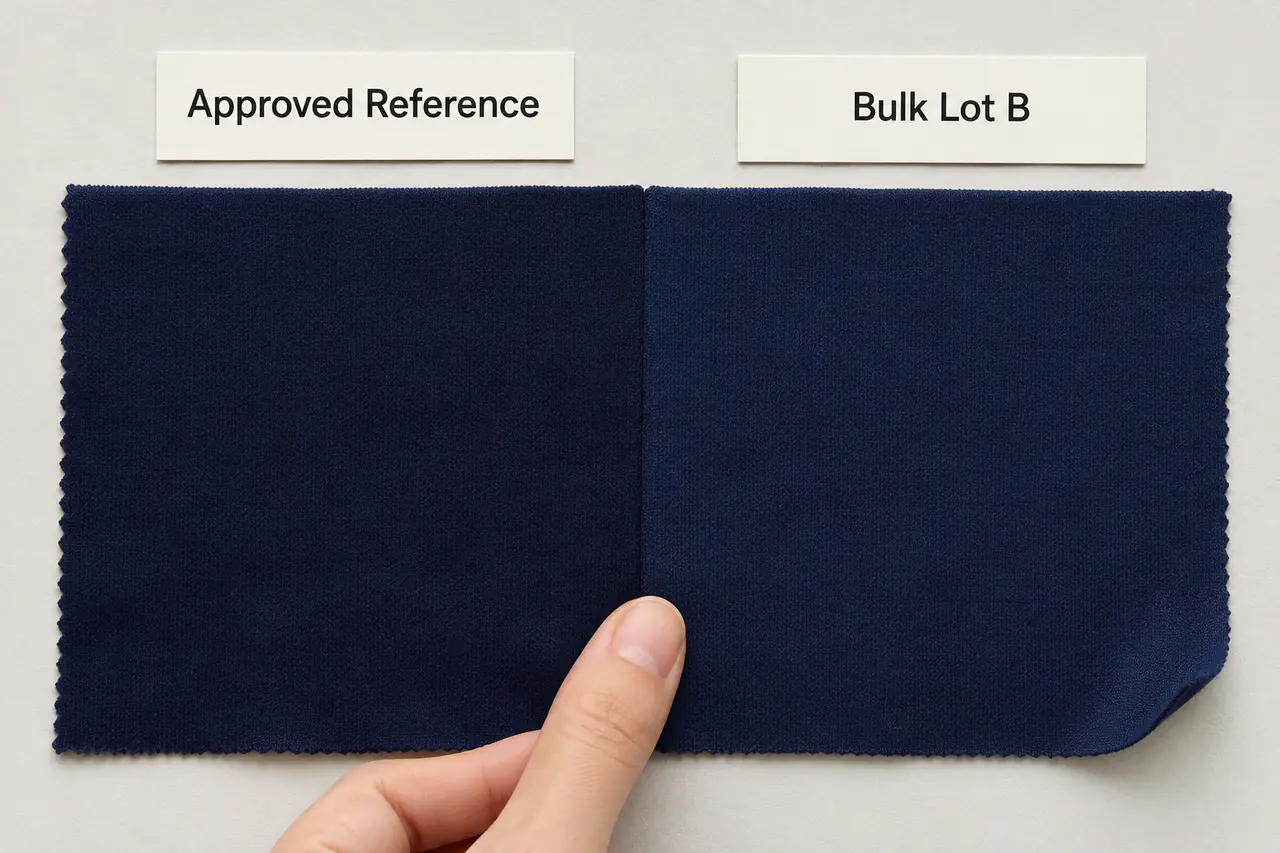
If the bulk material comes from a different lot or the mill changes the yarn or finish, repeat the checks that the change could affect. A lab dip can approve a proposed shade, but it does not establish the finished width or elasticity of the delivered rolls. For reorders, compare the actual material against the original signed reference, not only the previous delivery.
Read our guide to fabric and color approval before bulk production for a more detailed explanation of how these approvals fit together.
Conclusion
The right polyester-spandex fabric for kids’ activewear balances comfort, movement, recovery and durability with the garment’s intended use. Start with a suitable blend ratio and GSM, then confirm the knit, finish and color in a sewn sample. Pay particular attention to opacity for leggings and seam comfort for sports tops.
Planning Your Kids’ Activewear Collection?
You don’t need to settle every fabric detail before speaking to a manufacturer. Share the following with our team at HAPA:
- Style sketches, tech packs or reference garments.
- Target age group, size range and intended activities.
- Preferred material, fabric weight, colors and printing requirements.
- Expected order quantity, destination market and delivery schedule.
- Any performance testing, certified material or documentation requirements.
Through our custom kidswear sampling service, we can discuss appropriate fabric choices and develop samples for your approval before bulk production.
Frequently Asked Questions
1. Is Polyester-Spandex Good for Kids’ Activewear?
Yes. It is a versatile option for sports shirts, leggings, training shorts and dancewear because it can combine easy care with stretch and shape retention. When shortlisting kids’ activewear fabric, choose the knit and weight for the activity, then check comfort, coverage, recovery and wash performance.
2. What Is the Best Polyester-Spandex Ratio for Kids’ Leggings?
A blend of 80–90% polyester and 10–20% spandex is a useful starting range for fitted leggings. Check the stretch and recovery of the polyester-spandex fabric you plan to buy, then bend the sewn sample at the knee and seat to check coverage.
3. Is 95% Polyester and 5% Spandex Stretchy Enough?
Often, yes, for loose sports tops and relaxed training clothes. For close-fitting leggings or gymnastics wear, ask for measured stretch and recovery in both directions before using a 95/5 polyester-spandex fabric. A four-way stretch label alone does not tell you how far either direction extends.
4. What GSM Is Best for Kids’ Activewear?
For lightweight sports shirts, 140–190 GSM is a useful starting range; for fitted leggings, consider 200–280 GSM. Heavier brushed fabrics may suit cooler weather. Use the recommendations as sampling ranges, not fixed specifications.
5. Is Polyester-Spandex Fabric Breathable?
Yes, some blends are breathable. A lightweight mesh or open jersey generally allows more air through than a dense knit. Compare air-permeability results for the actual fabric if breathability is an important product feature.
6. How Do I Stop Kids’ Leggings from Becoming See-Through?
Start with a suitable dense stretch knit, then compare opacity at a consistent extension in the actual color. Check the knee and seat during bending on a correctly sized sample. Adjust the fabric, lining or garment fit as needed rather than relying on GSM alone.
7. Can I Use Recycled Polyester-Spandex for Kids’ Activewear?
Yes. A polyester-spandex fabric made with recycled polyester still needs to meet the same performance and safety requirements as your other options. Check the actual recycled percentage and supply-chain evidence, and resample if the fabric’s construction or behavior changes. Our guide to recycled polyester vs. virgin polyester explains how to assess performance and recycled-content claims separately.
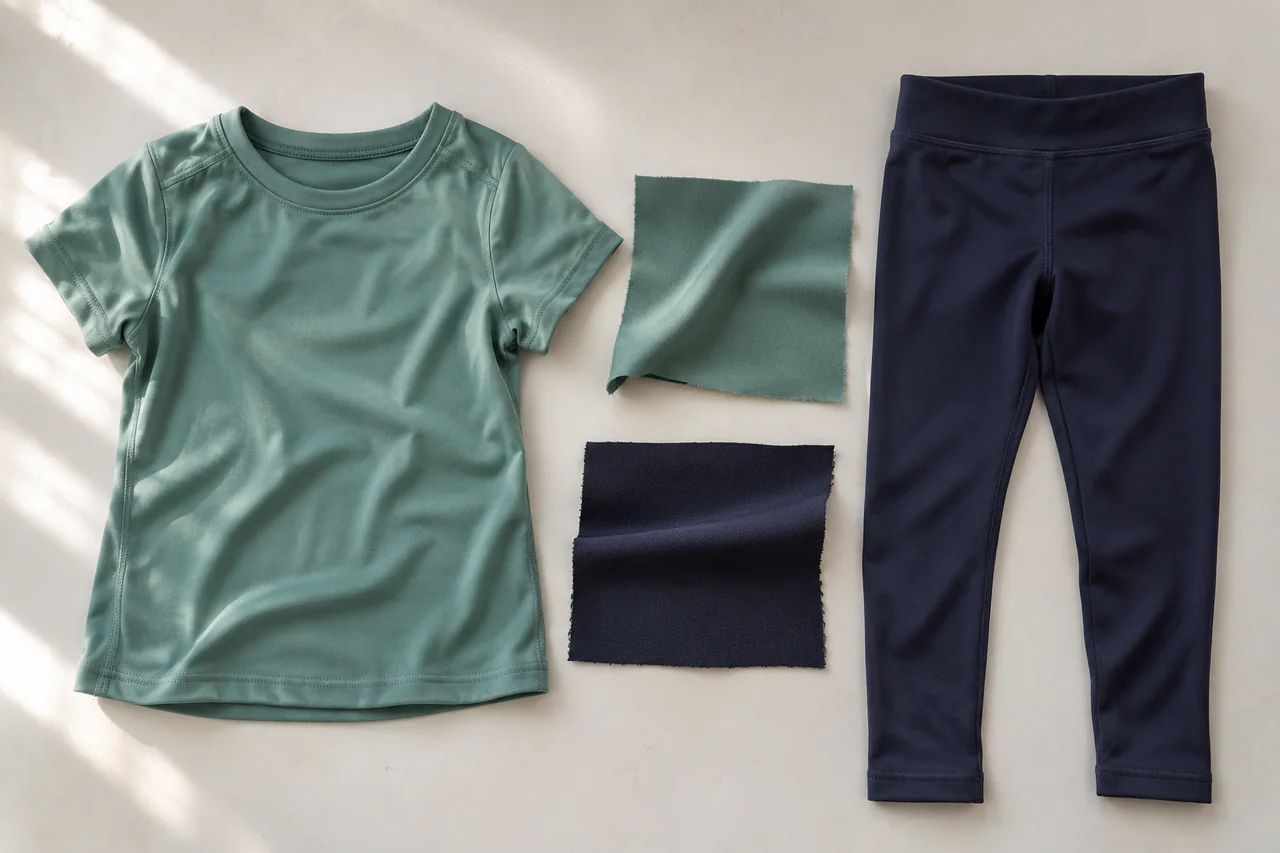
8. Can the Same Polyester-Spandex Fabric Be Used for Sports Tops and Leggings?
Sometimes, but each garment has different priorities. Tops often need a lighter, comfortable fabric with good movement, while leggings usually need greater coverage and recovery. You may achieve a better collection by choosing different knits and matching their colors under consistent lighting.