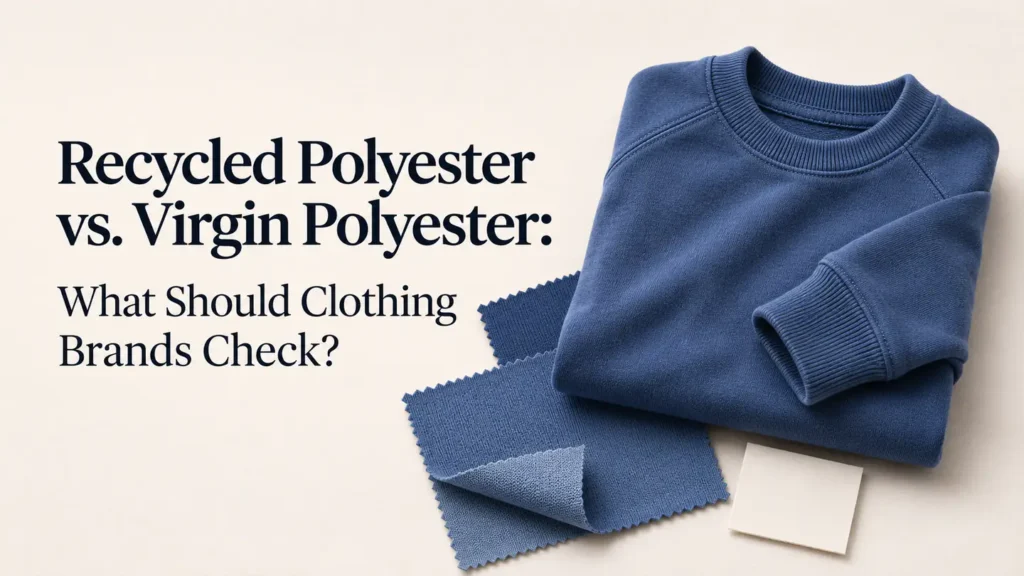
When you compare recycled polyester with virgin polyester, the better choice is not decided by the fiber name alone. Recycled polyester is made from recovered PET, while virgin polyester is made from newly produced raw material. But the feel, durability, color consistency and cost of the finished fabric depend on much more than its source.
For a clothing brand, the decision comes down to two separate questions: Does this fabric perform well enough for the garment, and can we support the recycled-content claim we want to make? A recycled option may be the right choice when it meets your product requirements and its content can be traced. Virgin polyester may be more suitable when it better meets the style, supply or performance requirements. Either way, approve the actual fabric—not the label on the sample card.
Recycled Polyester vs. Virgin Polyester: Which Should You Choose?
| What matters to your brand | Recycled polyester | Virgin polyester |
|---|---|---|
| Raw material | Made from recovered PET, such as used bottles or textile waste | Made from newly produced PET, generally using fossil-based feedstock |
| Fabric performance | Depends on yarn quality, construction, weight and finishing | Depends on the same fabric and production factors |
| Recycled-content claims | Possible when the material and supply chain are properly documented | Cannot contribute recycled content |
| Environmental considerations | Uses recovered material, but the full impact depends on the recycling route and production process | Uses new raw material; its impact depends on production and the finished product’s life cycle |
| Purchasing decision | Suitable when the fabric meets your specification and the recycled share can be verified | Suitable when it better meets the garment brief or recycled content is not a requirement |
Choose recycled polyester when your brand has a recycled-material target, the finished fabric passes the tests that matter for the garment, and the supplier can provide evidence for the material and transaction. Choose virgin polyester when it is the better-performing or more practical option for the product and your order does not require recycled content.
If recycled content is a contractual requirement, do not treat a virgin alternative as an automatic substitute—even if the sample looks and feels better. Get the buyer’s written approval before changing the material.
What Changes When Polyester Is Recycled?
The main difference is the material’s starting point. Virgin polyester is made from newly produced PET. Recycled polyester, often called rPET, uses recovered polyethylene terephthalate (PET) that has already been used or generated as waste.
Both can be turned into yarn and made into knits or woven fabrics. You can find recycled polyester in sportswear, fleece, jackets, linings and many other apparel products. The word recycled describes the material’s history; it does not tell you whether a sweatshirt will feel soft, resist pilling or keep its shape after washing.
Was the Material a Bottle, Textile or Factory Scrap?
Not all recycled polyester has the same feedstock.
- Post-consumer bottle material: PET bottles that have been used and collected after consumer use.
- Post-consumer textile material: Clothing or other textile products recovered after use.
- Pre-consumer material: Material diverted from the waste stream before reaching consumers, such as certain manufacturing waste.
Ask the supplier to identify the feedstock rather than accepting the word recycled on its own. Bottle-based rPET is not the same as fiber-to-fiber recycled polyester. And a factory’s routine production scrap, simply returned to the same process, does not automatically qualify as recycled content for every claim. Under the U.S. Federal Trade Commission’s Green Guides, pre-consumer material used in a recycled-content claim needs to have been diverted from the waste stream.
How Is Recycled Polyester Made?
The recycling route can affect the material that comes out of the process.
Mechanical recycling generally involves sorting, cleaning, reducing and remelting suitable PET before it is made into new fiber. When textile waste is mechanically recycled, the fibers may be shortened or damaged, so the resulting material may need to be blended with other fibers or processed differently.
Chemical recycling uses chemical processes to break PET down into smaller building blocks or intermediates, which can then be purified and used to make polymer again. The exact process varies, so do not assume every product described as chemically recycled follows the same route.
When you source rPET, ask two questions separately: what was the feedstock, and how was it recycled? A bottle-based claim does not tell you the recycling method, and the recycling method alone does not prove the recycled percentage in the fabric you are buying.
Does Recycled Polyester Feel or Wear Differently?
You cannot reliably judge a fabric’s quality from the word recycled or virgin. Two recycled polyester fabrics can feel completely different from each other, just as two virgin polyester fabrics can.
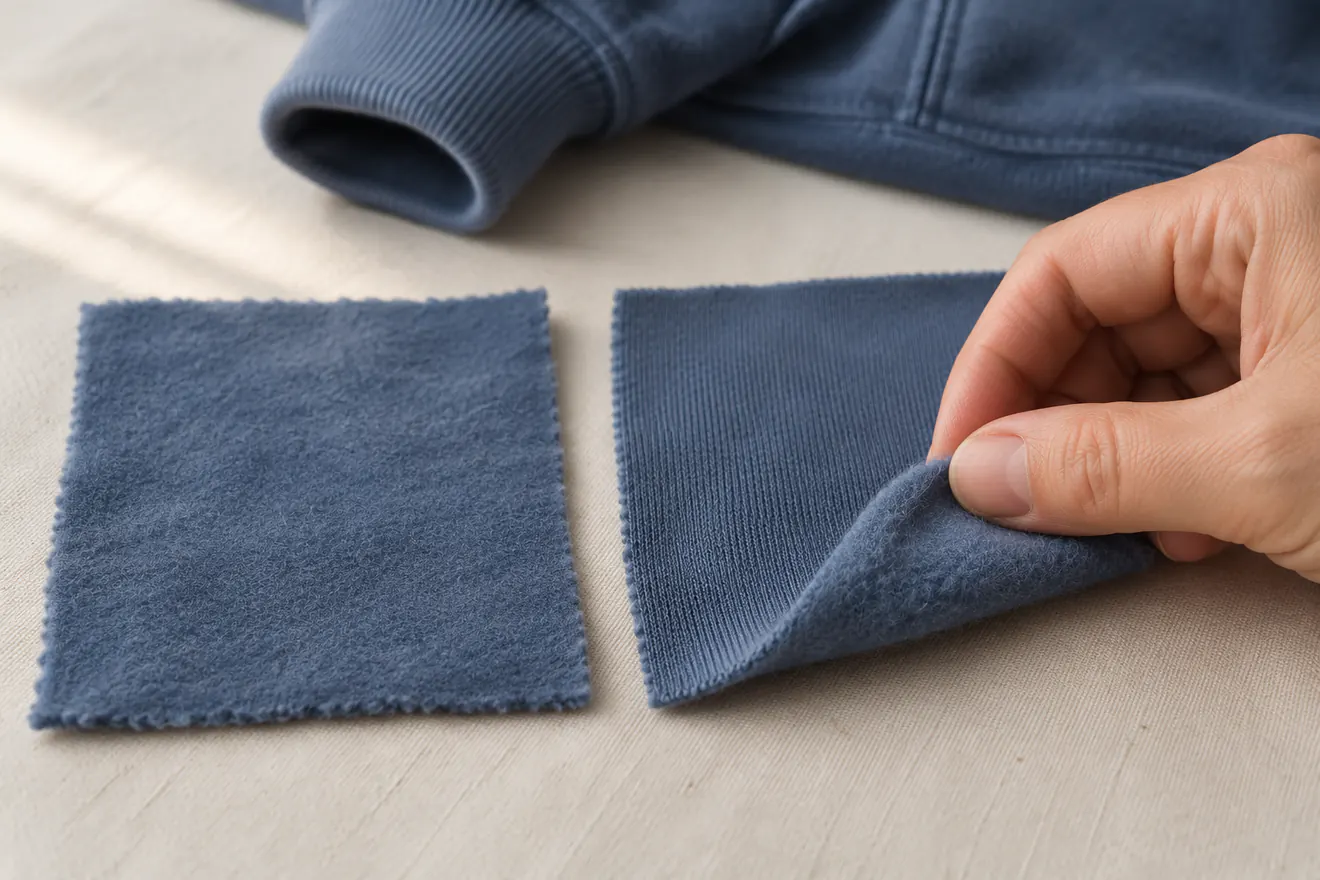
The main factors to compare are:
- Yarn quality and structure: Filament type, yarn count and spinning quality affect the surface and strength of the fabric.
- Knit or weave construction: Construction influences stretch, stability, air movement and abrasion performance.
- Fabric weight and density: GSM, thickness and density affect drape, warmth and the way a garment feels.
- Finishing: Brushing, raising, heat setting, coating and other finishes can change softness, appearance and performance.
- Blended fibers: Cotton, elastane or other fibers can change the fabric’s behavior and must be included in the specification.
For a fair comparison, ask for samples made to the same brief. If the recycled option is a lighter knit and the virgin option is a heavier brushed fleece, you are not comparing the effect of recycled content—you are comparing two different fabrics.
What Does Recent Research Say About Microfiber Shedding?
Both recycled and virgin polyester fabrics can release small fibers during wear, abrasion and washing. It is not accurate to say that all recycled polyester sheds more—or less—than virgin polyester.
A 2026 study published in Environmental Science & Technology examined fabrics containing 30% mechanically recycled polyester fibers that had gone through one, two or three recycling cycles. In laundering tests, the researchers found no clear difference between virgin polyester and the once-recycled material. Fabrics made with fibers that had been mechanically recycled two and three times released approximately 4.3 and 6.2 times as many microplastic fibers as the virgin reference, respectively.
This is an important finding, but it needs to be read in context. The study tested a specific material blend and recycling history under defined laboratory conditions. It does not prove that every rPET fabric will shed more microfibers. It does show why brands should ask about the recycled feedstock and recycling history where that information is available, and why fabric construction and testing still matter.
If microfiber release is a concern for your product, ask a qualified laboratory to compare the actual fabric candidates using the same test method, laundering conditions and reporting unit. Do not compare a result reported by fiber count with another reported by released mass.
Which Tests Matter for Different Garments?
Choose tests based on how the garment will be worn and washed. A fabric that works well for a lightweight sports top may not be suitable for a brushed winter hoodie.
- Sports T-shirts: Check air permeability, moisture management and drying performance. Air passing through a fabric and moisture evaporating from it are different measurements.
- Brushed hoodies and fleece sets: Check pilling, surface changes, shrinkage and hand feel after washing. Keep an unwashed swatch beside the washed sample so you can see what changed. When comparing fabrics for kids’ hoodies, use the same wash and drying procedure for both options.
- Stretch leggings: Check stretch and recovery together. A fabric may stretch enough to put on but still lose shape around the knees after repeated wear.
- Jackets and outerwear: Check abrasion, seam performance, dimensional stability and any coating or water-repellent finish required by the design.
If a sample fails, record the specific issue and ask the mill what can be adjusted. Do not simply write that the recycled fabric is inferior. The cause may be the yarn, construction, finish or blend rather than the recycled origin itself.
Is Recycled Polyester Suitable for Children’s Clothing?
Yes, recycled polyester can be used in children’s clothing when the finished fabric and garment meet the requirements for their intended use. The recycled origin alone does not make a fabric more comfortable, more durable or safer.
For kidswear, pay particular attention to:
- Comfort against the skin: Check softness, surface feel, breathability and whether the fabric feels clammy during wear.
- Wash performance: Review shrinkage, pilling, colorfastness and changes in hand feel after the care routine expected for the garment.
- Stretch and recovery: For leggings, cuffs and fitted garments, check whether the fabric returns to its original shape after stretching.
- Chemical and product safety: Confirm that the fabric, dyes, prints, finishes, trims and other components meet the rules in the markets where the garment will be sold.
A recycled-content certificate is not a finished-garment safety certificate. For example, U.S. children’s apparel is subject to applicable clothing flammability requirements, and children’s sleepwear has additional rules depending on the garment’s size and design. Other requirements may apply to accessible components, surface coatings, prints and products intended for very young children. In the EU, brands also need to consider applicable REACH restrictions for chemicals in clothing, textiles and footwear.
This is why we recommend treating material traceability and product compliance as two separate checks. A fabric may have documented recycled content and still need the appropriate testing and compliance review for the finished garment.
If you are reviewing chemical-safety documentation, also check what the certificate actually covers. A valid OEKO-TEX® STANDARD 100 certificate, for example, should be checked against the specific article, product class and certificate scope. It should not be assumed to cover every fabric, color, print or trim in a garment. You can also read our guide to what OEKO-TEX certified means.
How We Evaluate Polyester Fabric for a Kidswear Order
At HAPA, we approach a polyester fabric decision from the finished garment backward. We do not approve a material simply because its supplier describes it as recycled or because the first swatch looks attractive. We start by understanding what the garment needs to do.
A lightweight sports T-shirt, a brushed hoodie and a lined jacket have different requirements. Before comparing fabric options, we look at the intended use, fabric construction, target GSM, color, finish, stretch requirements and care instructions. This gives us a shared basis for reviewing the candidates.
We then compare the actual swatches and focus on the checks that matter for the style. For a brushed fabric, that may mean looking closely at the surface and how it changes after washing. For stretch garments, recovery matters as much as the initial stretch. For a matching jacket-and-trouser set, we review the two fabrics together rather than approving each color in isolation.
Color approval also needs to continue beyond the lab dip. A small dye sample may look right, but bulk rolls can vary. We keep the approved physical reference and check production cuttings against it under consistent lighting. When a garment uses more than one fabric, we review the combination before cutting begins.
Finally, we keep the material claim separate from the fabric-quality decision. If a buyer requires recycled polyester, the component, recycled percentage and supporting documents need to match the order. A fabric can be approved for sampling while the recycled-content claim remains on hold until the necessary evidence is available.
This approach helps us avoid a common sourcing mistake: treating a good-looking sample as proof that the material, bulk production and product claim are all ready for approval.
Can the Mill Match Your Color in Bulk?
A mill may match a target shade on a small dye sample, often called a lab dip, but that does not guarantee that every production roll will look the same. This matters when a garment combines two fabrics or when a jacket and trousers are sold as a matching set.
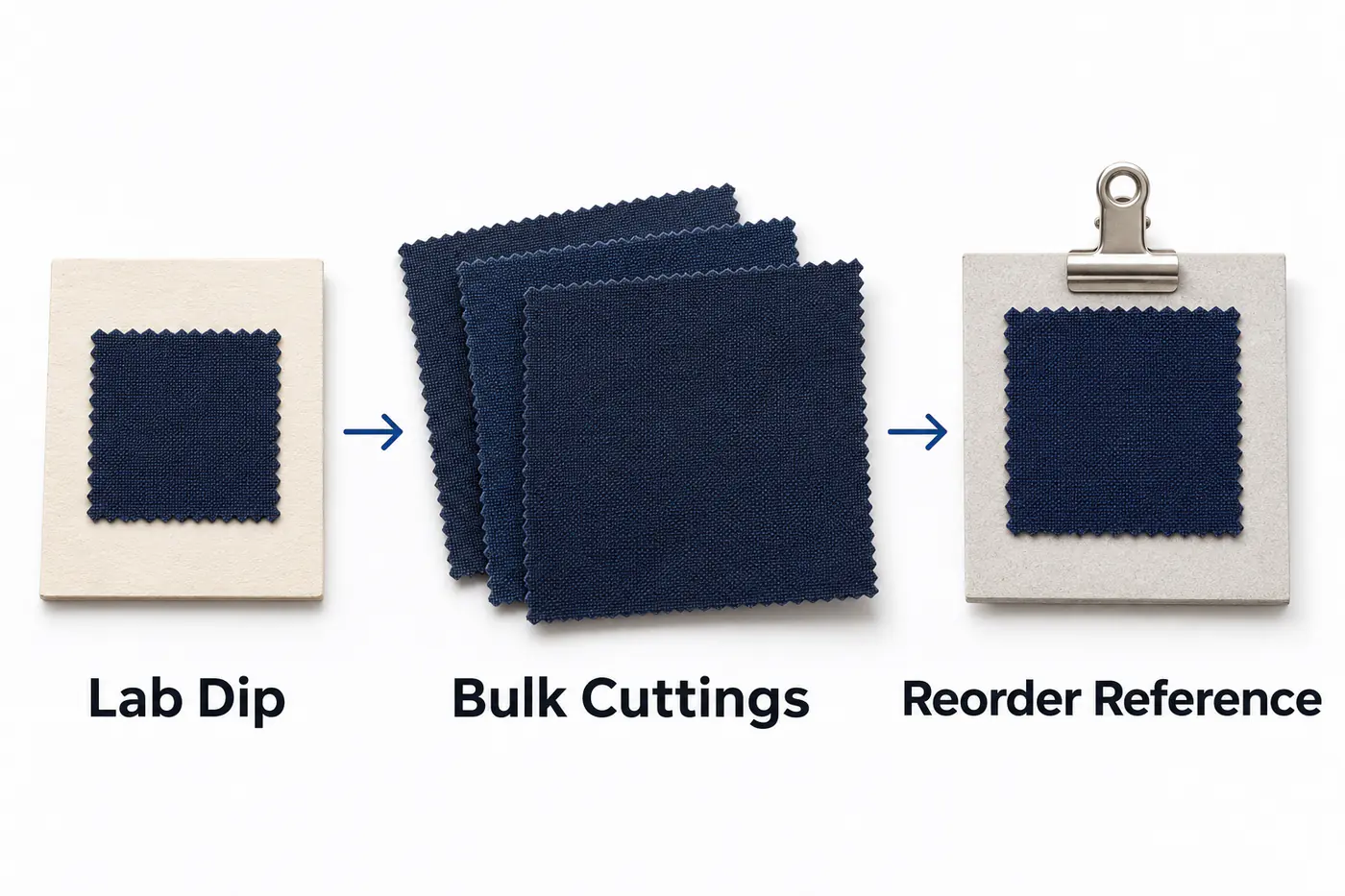
Use the same color-approval process for recycled and virgin polyester:
- Approve the lab dip on the intended fabric. Check the shade on the correct construction and finish. Record the color reference, approval date and lighting conditions. A photograph can help identify the sample, but keep the physical swatch as the standard.
- Review bulk cuttings before production is released. Ask for identified cuttings from the relevant rolls or dye lots and compare them with the approved reference under the agreed light source.
- Keep a signed bulk reference. Record the dye-lot number and retain an approved cutting for future reorders. If the yarn source, dyehouse or finish changes, decide whether a new color approval is needed.
Shade matching and colorfastness are two different checks. A navy fabric can match the target color and still bleed onto a white panel during washing. Another fabric can pass colorfastness testing but arrive in the wrong shade. Specify both checks where they matter for the garment.
For more detail, see our guide to approving bulk fabric and color before production.
How Much of the Garment Is Actually Recycled?
Be careful about what a recycled percentage describes. “Half the polyester is recycled,” “half the shell is recycled” and “half the jacket is recycled” are three different claims.
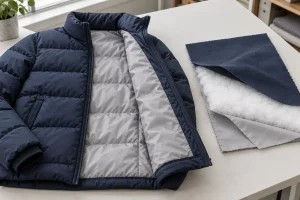
Consider a shell fabric that is 80% polyester by weight. If half of that polyester is documented as recycled, then 40 grams of every 100 grams of shell fabric are recycled polyester. The shell contains 40% recycled polyester by weight. That does not mean the entire jacket is 40% recycled.
If you need to calculate a whole-garment figure, list the relevant components and their weights using the calculation basis required by the applicable standard or claim rule. Multiply each component’s weight by its documented recycled share, add the recycled weights, and divide by the total weight on the same basis. Do not simply average the percentages of the shell, lining and filling: the components may have very different weights.
If the lining, padding or trims have a different material source—or their weights and recycled content are unknown—keep the claim specific to the component you can substantiate. This is similar to the way you need to distinguish fiber composition from fiber origin when reading cotton-polyester blend ratios in kids’ clothing.
The U.S. Federal Trade Commission’s Green Guides, section 260.13, explain that partial recycled-content claims should be qualified so buyers are not misled about the amount of recycled material in the product. They also require substantiation for pre-consumer material claims. In practice, keep the component and percentage together in product copy—for example, “shell fabric contains 40% recycled polyester”—rather than using a broad statement that could imply the whole garment is recycled.
For EU textile composition labels, the required generic fiber name, such as “polyester,” still needs to be stated according to the applicable labeling rules. A recycled-origin statement is additional information; it should not replace the required fiber-composition declaration.
Which Documents Back Up a Recycled-Content Claim?
Ask for evidence at two different stages: before you place the order and when the goods are shipped. A supplier’s certification can show that a business or site is certified for activities within the certificate’s scope. It does not, by itself, prove that the specific fabric in your shipment contains the percentage of recycled material stated in your product copy.
Before You Place the Order
The two standards buyers most often encounter are:
- Global Recycled Standard (GRS): Verifies recycled material and chain of custody, with additional requirements relating to processing, social practices, environmental management and chemical use within the standard’s scope.
- Recycled Claim Standard (RCS): Verifies recycled material content and chain of custody, but does not include the same broader processing requirements as GRS.
Before approving a supplier, check the legal entity name, site, covered processes, product categories, certificate validity and issuing certification body. Make sure the certificate covers the organization and activity relevant to your order. A valid certificate held by a spinner does not automatically prove that every downstream dyeing, fabric or garment supplier is covered.
Put the required standard, component, target recycled percentage and expected transaction documents into the purchase order. Agree who will collect the records and who will check them before the product claim is approved.
When the Goods Ship
For a certified transaction, request the applicable Transaction Certificate (TC) or verified transaction record and check it against the purchase order, invoice and packing list.
A useful distinction is:
- Scope Certificate (SC): Shows that a business or site is certified for the activities and product categories listed within its scope.
- Transaction Certificate (TC): Relates to a specific transaction and identifies the certified material and quantity covered by that transaction.
An invoice that says “GRS fabric” is not a substitute for the certification body’s transaction record. Check the seller and buyer, product description, material, quantity and any relevant recycled-content details. If the paperwork covers the lining but your website claim refers to the shell, pause the claim and resolve the discrepancy.
Textile Exchange is also transitioning its standards and claims system. The dates below refer to different parts of the system, so they should not be treated as one blanket replacement date:
- GRS 5.0 and RCS 3.0: Published and effective on July 1, 2026, with a mandatory date of December 31, 2026.
- Materials Matter Standard: Becomes effective on December 31, 2026. Eligible Tier 4 organizations may begin transitioning to it, with the standard becoming mandatory for eligible Tier 4 audits on December 31, 2027.
- Materials Matter Claims and Labeling Policy: Becomes effective on December 31, 2026, with a mandatory transition date of June 30, 2029 for claims and labels.
The Materials Matter policy also introduces a 30% minimum content threshold for consumer-facing product or component labeling, subject to specified exceptions. This threshold does not apply to unfinished B2B transactions or Transaction Certificate eligibility. Do not confuse it with a general rule that every recycled fabric must contain 30% recycled polyester.
For orders or labels that cross these transition dates, confirm the applicable version and claim requirements with the certification body. Check the current Textile Exchange policy updates before approving hangtags, packaging or online product claims.
Are Environmental Claims About Recycled Polyester Always Better?
Not necessarily. Using recovered PET can reduce the need for virgin feedstock for the recycled share, but that fact alone does not prove that a finished garment has a lower overall environmental impact.
A meaningful comparison needs to consider the recycling process, energy source, collection and sorting, transport, yarn production, fabric construction, dyeing, finishing, product weight and useful life. The comparison also needs to use the same life-cycle boundaries. A footprint figure for one kilogram of fiber should not automatically be presented as the percentage reduction for a finished jacket.
Be careful with broad phrases such as “eco-friendly,” “sustainable” or “zero impact.” A more defensible statement identifies what is known: the component, the recycled percentage, the feedstock where verified, and the documentation supporting the claim.
Does Recycled Polyester Make a Garment Recyclable Again?
No. A garment made with recycled polyester is not automatically recyclable at the end of its life.
The next recycling route may depend on whether the garment contains elastane, coatings, laminations, zippers, buttons, prints or other materials that need to be separated. It also depends on whether a suitable collection and recycling system is available in the market where the garment will be sold.
If your evidence only confirms the recycled input, keep the claim focused on that input. Do not imply that the whole garment can be recycled again unless the design and an available recovery route support that statement.
Compare Quotes by Cost per Garment
A recycled polyester fabric is not automatically more expensive or less expensive than a virgin alternative. The price depends on the yarn grade, construction, weight, usable width, color, finish, quantity, supplier capacity and order timing.
To make a fair comparison, send both suppliers the same revision of your clothing tech pack. Include:
- Fabric construction and target GSM.
- Usable width and required finish.
- Color standard and colorfastness requirements.
- Size range, size ratio and order quantity.
- Recycled-content percentage and required certification documents.
- Delivery terms, sample requirements and expected reorder volume.
Then compare the fabric cost per sellable garment—not just the price per kilogram.
Fabric cost per sellable garment = fabric price per kilogram × purchased kilograms allocated to each sellable garment.
Use the same consumption basis for both quotes. If the consumption figure already includes cutting loss, do not add the same loss again. If one supplier quotes by meter and another by kilogram, confirm the delivered weight per meter and usable width before comparing.
Also ask about costs and conditions that may not appear in the unit price:
- Is the minimum order quantity set per color, per fabric or across the whole order?
- Are lab dips, testing and certification documents included?
- Can the supplier repeat the same shade for a smaller replenishment order?
- Will the yarn source, dyehouse or finishing process change between production runs?
- What happens if the recycled material is unavailable when the reorder is placed?
Keep first-order pricing and repeat-order terms separate. A fabric that looks economical for the first production run may become difficult to replenish if its color minimum or material supply is restrictive.
A Practical Checklist Before Bulk Approval
Before approving either recycled or virgin polyester for bulk production, make sure you have reviewed the following:
- Material identity: Confirm the fiber composition, feedstock and recycled percentage for the specific component.
- Fabric specification: Record construction, GSM, usable width, yarn details and finishing.
- Performance: Review the tests that matter for the garment, such as pilling, shrinkage, colorfastness, stretch recovery or abrasion.
- Color approval: Keep the approved lab dip, bulk cutting, dye-lot reference and lighting conditions.
- Cost and supply: Compare cost per sellable garment, color minimums, lead time and replenishment conditions.
- Traceability: Check the supplier’s Scope Certificate and the transaction documents required for the order.
- Product claims: Make sure the wording on the hangtag, packaging and product page matches the component and percentage supported by the evidence.
- Market compliance: Review the applicable safety, chemical and labeling requirements for the destination market.
Keep fabric approval and claim approval as two separate decisions. You may approve a sample for fitting while waiting for a transaction document, but do not release a recycled-content claim until the evidence is complete.
Conclusion: Choose the Fabric That Works—and Make Only Claims You Can Prove
Recycled polyester can be a useful material choice for clothing brands, but it is not automatically better than virgin polyester in every garment or every environmental measure. The right decision depends on the fabric’s actual performance, the product’s intended use, color and production consistency, cost, supply reliability and the evidence behind any recycled-content claim.
For children’s clothing, add another layer of review: comfort, wash performance, chemical safety and the requirements of the market where the garment will be sold. A recycled-content certificate is important, but it does not replace finished-garment quality checks or product compliance.
If you are developing kidswear with recycled polyester, include the garment type, intended use, target GSM, color, required recycled percentage and certification expectations in your sample brief. At HAPA, we can review those requirements as part of the kidswear sample development process, so the fabric decision and the material claim are considered before bulk production.
Frequently Asked Questions
Is Recycled Polyester as Durable as Virgin Polyester?
It can be, but the fiber source alone does not determine durability. Yarn quality, construction, fabric weight, finishing and recycling history all matter. Compare fabrics made to the same specification and test them for the way the garment will be worn and washed.
Does Recycled Polyester Release More Microplastics?
Not always. Both recycled and virgin polyester can release microplastic fibers. A 2026 study found higher release from fabrics made with polyester fibers that had undergone multiple mechanical recycling cycles, but the result came from a specific material system and test conditions. It should not be generalized to every rPET fabric.
Is Recycled Polyester Suitable for Children’s Clothing?
Yes, provided the finished fabric and garment meet the relevant performance, safety and market requirements. Check comfort, wash performance, pilling, colorfastness, chemical compliance and any applicable children’s apparel rules. Recycled-content certification alone does not establish product safety.
Can a Routine Fiber Test Prove That Polyester Is Recycled?
No. A standard fiber-composition test can identify polyester and help establish a blend ratio, but it cannot normally prove whether the PET came from virgin or recycled feedstock. You need traceability and certification records that relate to the material and transaction.
What Documents Should I Request for GRS or RCS Polyester?
Start with the supplier’s valid Scope Certificate and confirm that the relevant site, process and product category are covered. For the shipment, request the applicable Transaction Certificate or verified transaction record and match it to the purchase order, invoice and packing list. The exact documents depend on the standard and transaction.
Can I Claim That a Whole Jacket Is Recycled if Only the Shell Uses Recycled Polyester?
Not without calculating and substantiating the claim on the correct basis. If only the shell contains recycled polyester, make the wording specific to the shell. Do not imply that the lining, filling, trims or entire jacket are recycled unless the evidence supports that statement.
Does Recycled Polyester Cost More Than Virgin Polyester?
There is no fixed price difference. Cost depends on material grade, construction, weight, color, quantity, finishing, supplier availability and certification requirements. Compare quotes using the same specification and calculate the fabric cost per sellable garment.
Can a Garment Made from Recycled Polyester Be Recycled Again?
Not automatically. Blends, elastane, coatings, trims and the availability of collection and recycling facilities can affect whether the garment can be recovered. A recycled input does not prove that the finished garment has a viable end-of-life recycling route.
References
- Textile Exchange: Standards Policy & Resource Updates — current GRS/RCS versions and Materials Matter transition information.
- Persson et al. (2026): Mechanically Recycled Textiles: A Source of Microplastic Fiber Emissions — research on microfiber release after repeated mechanical recycling.
- U.S. Consumer Product Safety Commission: Clothing
FAQ — U.S. apparel flammability
and children’s clothing requirements.