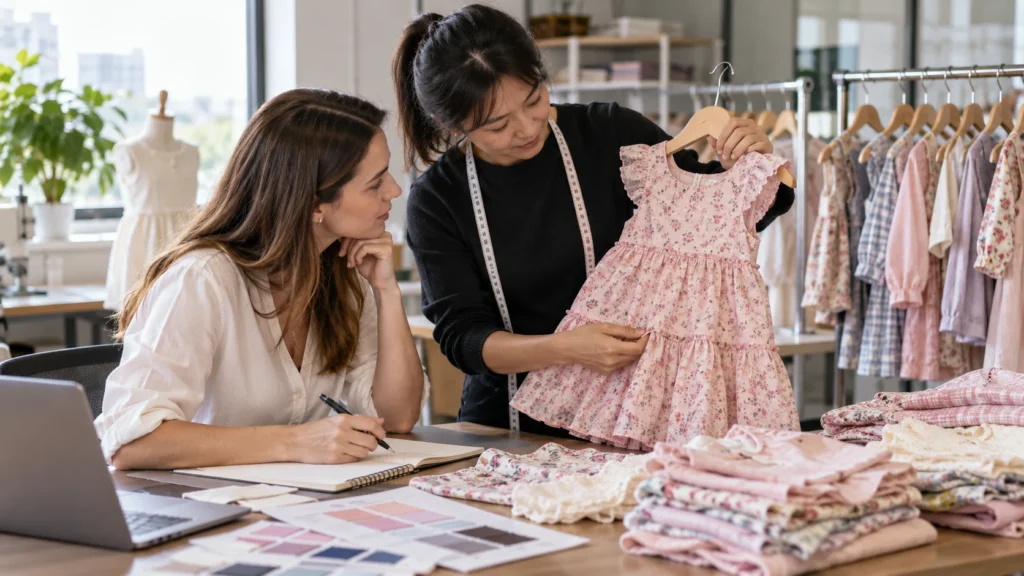
Two apparel professionals review a children’s dress and material details in a sourcing workspace.
A reliable wholesale supplier for a children’s boutique should do much more than offer attractive styles at a workable price. The supplier you choose influences product quality, sizing consistency, replenishment speed, safety documentation, inventory risk, customer complaints, and how confidently you can grow your boutique.
From the factory side, we often see buyers focus heavily on the first quotation and the first sample. Both matter, but neither tells you the whole story. A supplier can send one beautiful sample and still struggle with bulk consistency. Another supplier may not have the lowest price, yet deliver steadier measurements, clearer communication, better inspection records, and more reliable repeat orders. Over time, that second supplier can be far less expensive to work with.
If you are building or scaling a children’s boutique, your goal is not to find the cheapest source. Your goal is to find a supplier whose product, production system, communication, and commercial terms fit the way you actually sell. This guide walks through the questions we would ask before placing a first order, especially if you plan to move from ready-made wholesale into private label or custom kidswear later. The guide to reliable kids' wholesale suppliers provides more detail on checking children’s clothing wholesalers before placing an order.
Start With Your Boutique Model Before You Compare Suppliers
Before you ask for catalogs or price lists, define what your boutique needs. This sounds basic, but it prevents a lot of wasted sourcing time. A boutique focused on premium occasion dresses needs a very different supplier from one selling everyday cotton sets at an accessible price.
I would write down five things before contacting any factory or wholesaler:
- your core age range and product categories;
- your target retail and wholesale cost range;
- your preferred order quantity per style and per color;
- how often you expect to reorder winning styles;
- whether you need ready-made wholesale, private label, ODM, or full OEM development.
Those answers help you judge suppliers on the things that actually matter. If you need 100 to 300 pieces per style, a factory built around 5,000-piece runs may never be a comfortable partner. If you expect to reorder the same style every month, a stock wholesaler with constantly changing assortments may create a different problem: you can test quickly, but you may not be able to replenish.
If you are still mapping out the type of manufacturing partner you need, our guide to finding a kids clothing manufacturer is a useful place to compare sourcing models before you shortlist suppliers.
1. Judge the Garment Before You Judge the Price
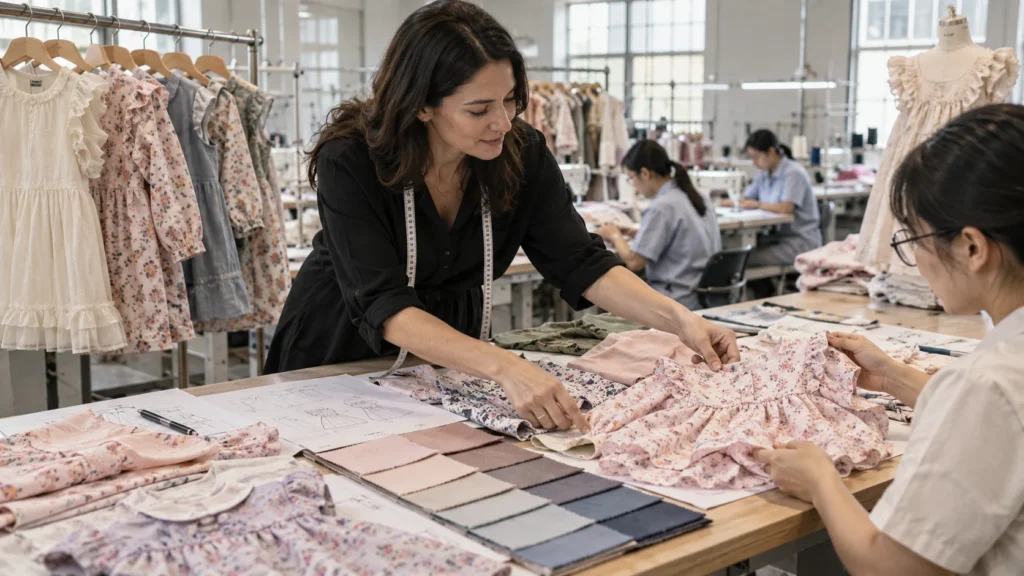
A buyer and garment specialist examine a kidswear sample and fabric details at a worktable.
Price is easy to compare. Quality takes more work. For children’s apparel, that extra work is worth it because parents notice fabric feel, fit, comfort, durability, and finishing very quickly.
When you receive a sample, do not evaluate it only on a hanger. Handle it. Turn it inside out. Stretch the seams gently. Check the zipper, snaps, buttons, elastic, embroidery, and print. Compare the garment against the stated measurements. Then wash it according to the intended care method and check it again.
What I would inspect on a first sample
- fabric weight, softness, stretch, and recovery;
- seam consistency and skipped stitches;
- neckline, armhole, and waistband construction;
- button, snap, zipper, bow, and applique attachment;
- print registration and embroidery cleanliness;
- measurement accuracy and symmetry;
- shrinkage, twisting, fading, or pilling after washing;
- overall finishing, loose threads, stains, and pressing.
One practical lesson we see repeatedly is that a perfect pre-production sample is not enough. The real question is whether the supplier can reproduce that standard across bulk production. That is why sample quality and production control should be evaluated together.
2. Make Sure the Supplier Really Understands Children’s Clothing
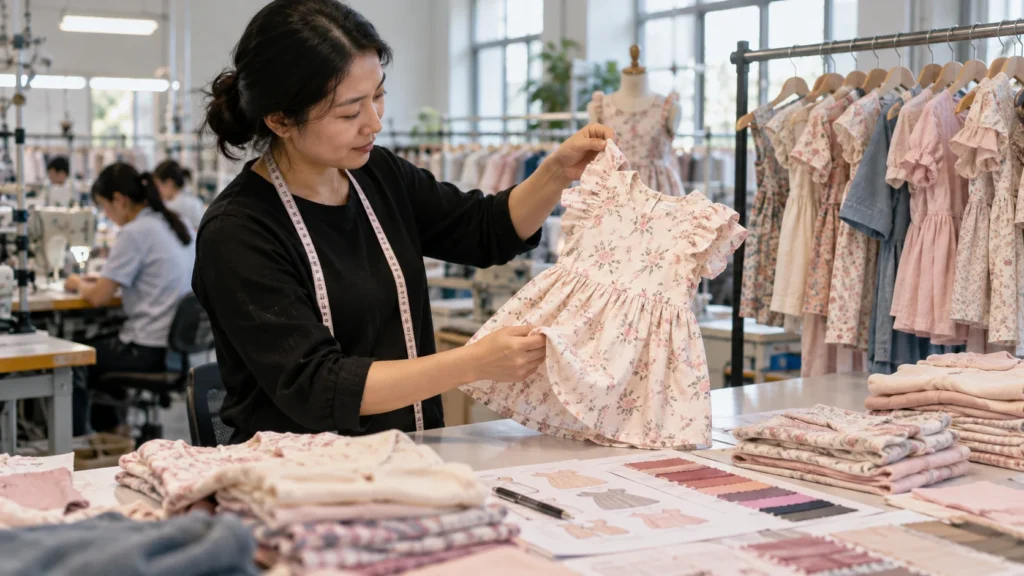
A garment specialist checks a children’s dress with active production visible in the workshop behind her.
A factory that produces adult fashion can sometimes make children’s clothing, but kidswear brings different fitting, trim, comfort, and safety considerations. If children’s apparel is central to your boutique, I would prefer a supplier that works with it every week, not occasionally.
Ask which categories they produce most often. Babywear, casual jersey sets, girls’ dresses, outerwear, occasionwear, and embellished garments all require different strengths. If you sell detailed girls’ dresses, a supplier whose main business is basic adult T-shirts may not be the best technical fit, even if the price looks attractive.
For custom development, our children’s clothing OEM guide explains the pattern, sample, material, and production stages that sit behind a made-to-order kidswear program.
3. Understand Whether You Are Dealing With a Wholesaler, Trading Company, or Manufacturer
The word ‘supplier’ can describe very different businesses. A wholesaler may hold finished stock. A trading company may source from several factories. A manufacturer may make the garments directly. None of these models is automatically better.
A wholesaler may suit you when
- you need very small quantities;
- you want immediate stock;
- you prefer many styles rather than deep quantities;
- you do not need much customization.
A manufacturer may suit you when
- you want custom labels and packaging;
- you need exclusive colors, prints, fabrics, or designs;
- you want repeatable production over several seasons;
- you expect your order quantities to grow;
- you need more control over measurements and specifications.
For many boutiques, the path changes over time. You may start with ready-made wholesale to learn what sells, then move the proven categories into private label. That approach lets you test demand before investing heavily in custom development.
4. Read the MOQ Carefully
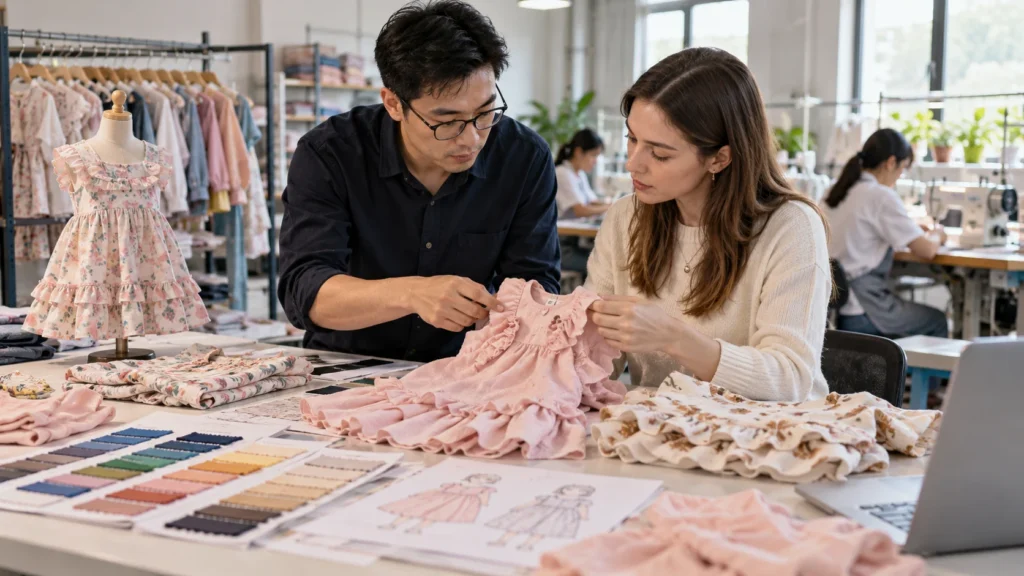
A supplier representative and buyer review garment construction, colors, and order assortment details.
MOQ is one of the most important commercial terms for a boutique because it controls how much cash you must commit before you know how quickly the product will sell. The baby clothing profitability guide provides more detail on estimating the commercial potential of a babywear assortment.
Do not stop at ‘What is your MOQ?’ Ask whether the minimum applies per style, per color, per size, per fabric, or per order. A quoted MOQ of 300 pieces sounds flexible until you discover it is 300 pieces per color and you planned four colors.
A reliable wholesale supplier for a children’s boutique should be able to explain the MOQ structure clearly and tell you which parts are driven by the factory and which come from fabric, trim, printing, or packaging suppliers.
For a small retailer, flexibility can be more valuable than the lowest unit price. Buying 200 pieces at a slightly higher cost may be healthier than buying 800 pieces to save a few cents if the extra inventory sits in storage for months.
5. Use a Trial Order to Test the Production System
I would rarely recommend moving straight from one approved sample into a very large first order unless the supplier relationship has already been proven. A manageable trial order gives you information a sample simply cannot.
A trial order lets you evaluate:
- bulk fabric shade and hand feel;
- size consistency across a real production run;
- workmanship from first piece to last;
- packing accuracy;
- production communication;
- lead-time reliability;
- inspection and defect handling;
- shipping documentation.
It also shows you how the supplier behaves when something does not go perfectly. In manufacturing, issues happen: a trim can arrive late, a color can need reapproval, or a measurement can drift during production. I care less about whether a supplier has ever faced a problem and more about whether they report it early, explain it clearly, and correct it in a controlled way.
6. Review the Sampling Process, Not Just the Sample
Sampling is a small preview of the supplier’s internal workflow. If the process is organized, you usually see clear questions, documented measurements, sensible revision rounds, and realistic timing. If the process feels improvised, bulk production may feel the same way.
Ask the supplier:
- Who reviews my design or reference sample?
- Who creates and grades the pattern?
- How are measurements recorded?
- How are fabric and trim substitutions approved?
- How many sample revisions are normally expected?
- How long does each sampling round take?
On your side, give measurable feedback. ‘The dress feels too wide’ is hard to execute consistently. ‘Reduce the chest width by 2 cm while keeping the waist unchanged’ gives the pattern team something concrete to work with.
7. Ask How Fabric and Materials Are Controlled
Fabric is often the largest cost component in kidswear, but for a boutique it is also one of the biggest quality risks. Two garments can look almost identical online and behave completely differently after washing. The ways to reduce kidswear returns provides more detail on reducing fit and quality-related returns in an online kidswear store.
Ask about composition, weight, stretch, recovery, shrinkage, pilling, colorfastness, and repeat availability. If a style becomes a bestseller, can the supplier reproduce the same fabric three months later? Can they keep a color reference? Can they trace the material lot used in your first order?
For repeat business, consistency matters more than novelty. A customer who reorders the same style expects it to feel and fit like the first one.
8. Look Closely at Quality Control
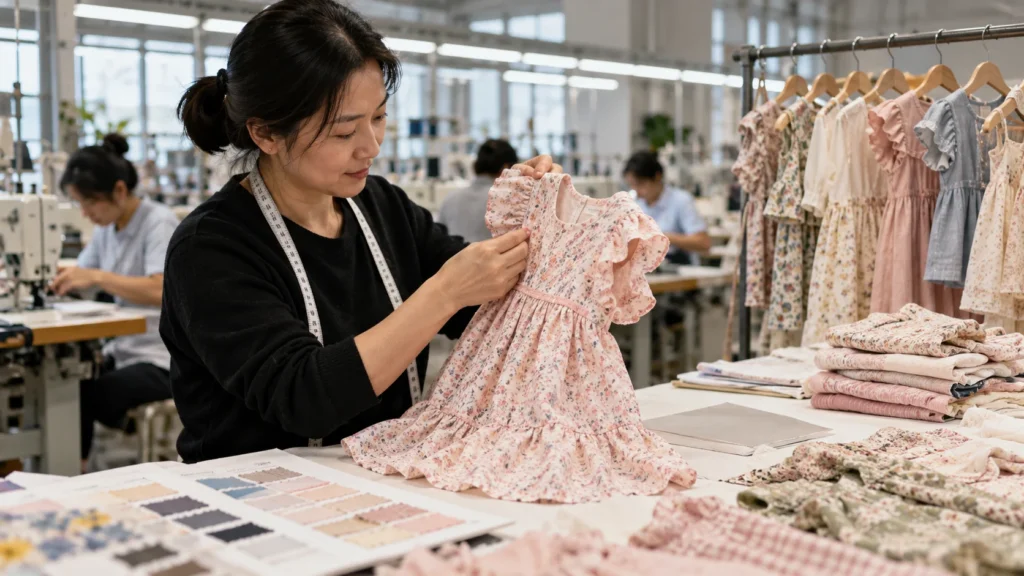
A garment quality reviewer examines seams and workmanship on a children’s dress in a factory workspace.
Quality control is one of the clearest differences between an average vendor and a reliable wholesale supplier for a children’s boutique. Do not ask only, ‘Do you have QC?’ Almost every factory will answer yes. Ask when quality is checked and what records are kept.
Incoming material inspection
Fabric and trims should be checked before they enter production. This can catch visible defects, shade variation, incorrect materials, or trim problems before they become finished-garment defects.
Pre-production review
The team should review the approved sample, construction, measurements, fabrics, trims, artwork, labeling, and known risk points before the line begins.
First-piece and in-line inspection
The first garments should be checked before the line accelerates. During production, inspectors should continue checking measurements, seams, stitching, decoration, and workmanship. This is much more effective than discovering a repeated error after the entire order is finished.
Final inspection
Finished garments should be checked for appearance, measurement, labeling, assortment, packing, and overall workmanship before shipment.
A supplier with a strong QC system can explain this process without vague language. You should be able to understand who checks what and at which stage.
9. Treat Measurement Consistency as a Brand Issue
Sizing problems damage trust quickly. Parents may tolerate a small difference in color, but if a size 5 fits like a size 3 on one order and like a size 6 on the next, your boutique will feel unreliable.
Ask whether the supplier works from an approved measurement specification, what tolerances are allowed, and whether measurements are checked during production as well as at final inspection.
For private-label or custom styles, keep the approved measurement chart as part of the production record. That document should follow repeat orders instead of being rebuilt from memory.
10. Check Product Safety and Compliance Before You Buy
Children’s apparel can be subject to product-specific safety and labeling requirements depending on the garment and destination market. This is not an area to handle casually.
For U.S. children’s products subject to applicable CPSC rules, the U.S. Consumer Product Safety Commission explains Children’s Product Certificate requirements, including third-party testing and certification requirements for covered children’s products.
Retailers also have responsibilities. CPSC’s retailer product-safety guidance specifically advises retailers to obtain and review applicable compliance certificates from suppliers.
For textile labeling and care information, the Federal Trade Commission’s apparel labeling guidance covers fiber content, country of origin, responsible business identification, and care-label requirements for covered products.
Requirements vary by product and market, so the point is not to assume that one factory certificate makes every garment compliant. Discuss the exact product, destination, testing, labeling, and documentation before production.
If U.S. children’s product certification is relevant to your program, our CPC certification guide provides additional sourcing context for working with your factory and testing partners.
11. Evaluate Communication for Clarity, Not Just Speed
A five-minute reply is not useful if it answers only half of your question. The communication habit you see before the order usually becomes more important after you pay the deposit.
When I evaluate supplier communication, I look for complete answers. If you ask about fabric weight, MOQ, sample timing, custom labels, and production lead time, does the supplier address all five points? Do they flag missing information? Do they explain trade-offs?
A reliable wholesale supplier for a children’s boutique should reduce uncertainty. That means telling you what is possible, what is not, what needs confirmation, and when the next decision is required.
12. Prefer Realistic Lead Times Over Attractive Promises
A suspiciously fast production promise can be more dangerous than a slightly longer honest lead time. Fabric procurement, dyeing, printing, embroidery, trim production, sample approval, sewing, inspection, and packing all take time.
If one supplier promises 15 days and another says 30, ask how each schedule is built. The more experienced answer is sometimes the less exciting one.
For your boutique, reliability matters because late goods can miss a launch, holiday, event, or seasonal window. A cheap shipment that arrives after the selling period is not cheap.
13. Ask How Repeat Orders Are Controlled
The first order gets a lot of attention because everything is new. The second, third, and fourth orders tell you whether the supplier has a real system.
For repeat production, I would ask whether they retain:
- approved samples;
- patterns and grading records;
- measurement specifications;
- fabric and color references;
- trim details;
- print or embroidery files;
- label and packaging specifications;
- inspection records.
If one of your styles becomes a bestseller, you want to reorder it without starting from zero. Stable records help preserve fit, color, fabric, and finishing from one production run to the next.
14. Compare Total Cost, Not the Lowest Unit Price
Suppose Supplier A quotes a dress at $7.80 and Supplier B quotes $8.20. Supplier A appears cheaper. But what if A requires 500 pieces per color while B accepts 200? What if B includes labels, has a shorter lead time, and runs stronger in-line inspection?
Your real cost includes more than the invoice unit price:
- sample and development charges;
- testing and compliance costs;
- freight and customs;
- defects and replacements;
- returns and customer service;
- markdowns caused by quality or timing issues;
- inventory carrying cost;
- cash tied up in excessive MOQ.
A slightly higher garment cost can be the better business decision if it reduces defects, allows smaller inventory commitments, and improves replenishment.
15. Decide How Much Private Label Capability You Need
Many boutiques begin with ready-made wholesale and later want more control over branding. Ask whether the supplier can support custom woven labels, printed labels, hangtags, packaging, colors, prints, embroidery, trims, and design changes.
You do not need to use all of those options on your first order. What matters is whether the supplier can grow with you when your product strategy changes.
If you are considering that transition, our private label clothing manufacturer guide explains what changes when you move from ready-made products toward your own brand specifications.
16. Look for Product-Development Strength if You Want Exclusive Styles
Some factories are excellent at repeating an existing style but weaker at development. If your boutique plans to create exclusive products, ask how the supplier handles patterns, grading, fit, custom fabrics, prints, embroidery, and trim sourcing.
Good development teams do more than make a sample. They identify construction problems early. They may notice that a trim is too heavy for the fabric, that an opening is too tight for the intended age group, or that an embroidery placement creates discomfort. Solving those issues before bulk production protects both time and money.
17. Be Careful With Prices That Are Far Below the Market
Competitive pricing is important, and there is nothing wrong with negotiation. But when one quote is dramatically below every other quote, I would ask what is different.
The gap may come from:
- lighter or lower-grade fabric;
- different trims;
- simplified construction;
- less inspection;
- cheaper packaging;
- different testing assumptions;
- a different delivery term.
Sometimes the lower price is completely legitimate. The important thing is to confirm that you are comparing the same specification. Otherwise, you are not comparing suppliers; you are comparing different garments.
18. Put Important Product Details in Writing
The more important a style becomes to your boutique, the more important documentation becomes. Verbal agreements are difficult to manage once several departments are involved in sourcing, sampling, cutting, sewing, QC, and packing.
At minimum, your order should clearly define:
- style and reference images;
- fabric composition and weight;
- colors;
- measurements and size range;
- construction details;
- trims and decorations;
- labels;
- packaging;
- quantity and assortment.
A written specification creates a shared reference for you and the factory. It also makes repeat orders much easier.
19. Look for Transparency When the Answer Is Difficult
You learn a lot about a supplier when you ask uncomfortable questions. What happens if the bulk fabric shade is wrong? How are defective garments handled? Can you arrange a third-party inspection? What happens if production misses the agreed schedule?
A trustworthy supplier should be able to explain the process without becoming defensive. Sometimes the best answer is ‘No, we cannot do that reliably within your requested timeline.’ That may not be the answer you wanted, but it can protect you from a much larger problem.
20. Make Sure the Supplier Can Scale With You
Even if your first order is small, think one step ahead. If a style performs well and you need ten times the quantity six months later, can the supplier handle it without changing quality or lead time dramatically?
Ask about production capacity, peak seasons, subcontracting, and how larger orders are scheduled. You do not need the largest factory. You need enough capacity for your likely growth.
21. Understand What the Factory Outsources
Outsourcing is normal in apparel manufacturing. Printing, embroidery, washing, pleating, dyeing, or specialist finishing may be performed by partner facilities.
The question is not whether every process happens under one roof. The question is whether the main supplier controls the outsourced process, approves the standard, and takes responsibility when something is wrong.
22. Check Packaging and Shipment Preparation
Garment quality is only useful if the product reaches you in sellable condition. Confirm folding, individual packing, size stickers, carton assortment, moisture protection, and any boutique-specific packing instructions.
If you need balanced size assortments by carton, tell the supplier before packing begins. Repacking after the order is finished wastes time and creates avoidable errors.
23. Ask Whether the Supplier Understands Boutique Retail
Boutiques often need more variety, smaller runs, seasonal newness, flexible reorders, and stronger presentation than a large-volume basics retailer. A factory optimized only for huge orders may find that model frustrating.
A reliable wholesale supplier for a children’s boutique should understand that flexibility is part of the commercial relationship, not an exception that has to be renegotiated every time.
24. Use the Sampling Stage to Judge Reliability
A sample is not only a product test. It is a supplier test. Did the factory use the requested material? Did they follow your measurement changes? Did the sample arrive when promised? Did they ask intelligent questions? Did they warn you about anything that might be difficult in bulk production?
If a supplier cannot manage one or two samples with reasonable organization, I would not assume that hundreds of units will become easier.
25. Watch for Red Flags Before You Place a Large Order
The quotation is vague
You receive a price but little information about material, MOQ, lead time, testing, packaging, or what the price actually includes.
The sample and bulk standard do not match
A supplier that cannot reproduce the approved sample has a production-control problem, not just a cosmetic issue.
They avoid quality questions
Reliable factories expect buyers to ask about inspection, measurements, defect handling, and testing.
Every answer is yes
Manufacturing has limits. A supplier that agrees to every price, every deadline, every quantity, and every customization request without checking the details may be selling the order rather than planning the production.
Communication deteriorates after payment
This is one of the strongest warning signs. The level of communication after the deposit should be at least as professional as it was before.
26. Think Beyond the First Order
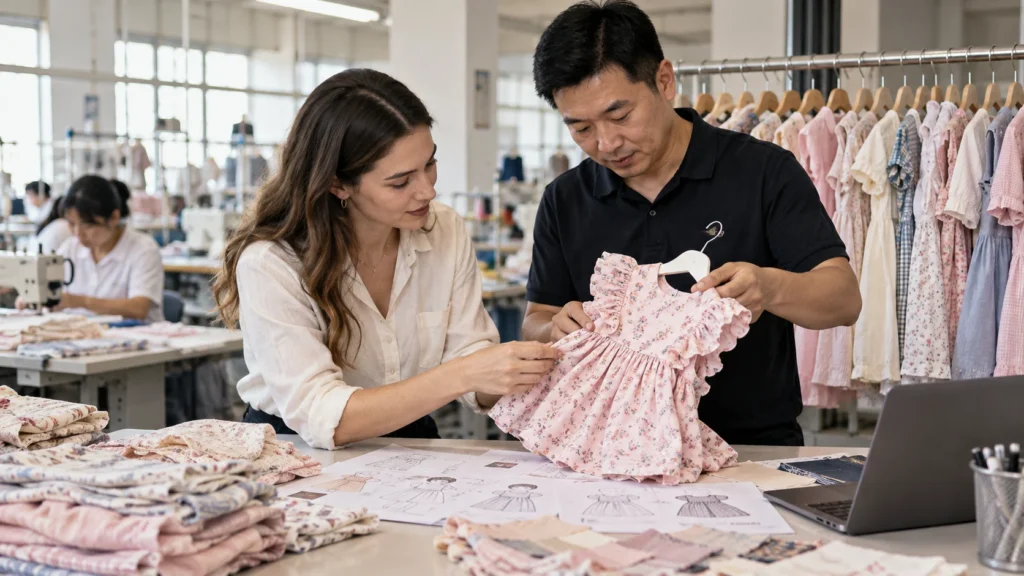
Two professionals review a repeat-order children’s garment together in a production environment.
A good supplier relationship becomes more valuable over time. The factory learns your fit, quality expectations, packaging, fabrics, and communication style. Repeat sampling becomes faster, and production problems are easier to anticipate.
You should still manage supplier risk sensibly, but a stable manufacturing relationship is a real operational asset. Constantly switching factories to chase the lowest quote can create hidden costs in sampling, quality variation, and lost production knowledge.
A Simple Supplier Scorecard for Boutique Buyers
When several suppliers look promising, I like a simple scorecard because it stops one attractive factor—usually price—from dominating the decision.
| Supplier Criteria | Example Weight |
| Product quality | 25% |
| Price competitiveness | 15% |
| MOQ flexibility | 10% |
| Communication | 10% |
| Lead time | 10% |
| QC process | 10% |
| Compliance capability | 10% |
| Sampling ability | 5% |
| Reorder capability | 5% |
Your weighting can change. A premium boutique may care more about fabric and finishing. A trend-led store may prioritize speed and newness. The point is to rank suppliers according to your business model rather than whichever catalog looks most exciting.
Questions I Would Ask Before Approving a Supplier
- What children’s clothing categories do you specialize in?
- What is the MOQ per style and per color?
- Can sizes be mixed within the MOQ?
- Can I place a smaller trial order?
- Do you manufacture directly, and which processes are outsourced?
- How long do sampling and bulk production normally take?
- How do you control fabric shrinkage, shade, and repeat availability?
- What inspections take place during production?
- How are measurements controlled?
- Can you support private labels and custom packaging?
- What testing and compliance documents can you support for my destination market?
- How are repeat orders documented and reproduced?
- How are defective products handled?
- Can I arrange a third-party inspection?
- How does lead time change during peak season?
You do not need a perfect answer to every question on the first call. What you are looking for is a supplier that answers clearly, asks relevant questions in return, and has a process behind the promises.
How We Think About Boutique Orders at HAPA
From the manufacturing side, boutique orders require balance. You need enough variety to keep your assortment interesting, while the factory needs enough volume per style, color, or material to produce efficiently.
That is why the best solution is often not simply ‘lower MOQ’ or ‘lower price.’ Sometimes the smarter structure is to reduce the number of colors, keep the size range broad, and use one proven fabric. Sometimes it is better to test a style at a modest quantity and scale the reorder only after you have real sales data.
We also look at where a buyer is in the business. A new boutique testing its first collection needs flexibility and controlled inventory exposure. An established retailer with proven styles may benefit more from repeatability, production planning, and stronger quantity economics.
That context is what turns a vendor into a reliable wholesale supplier for a children’s boutique. The relationship works best when the production plan supports how you actually sell, replenish, and grow. Studying how other boutiques present a distinctive assortment can also inform your supplier brief; start with these online children's boutique examples.
Final Checklist: Choosing a Reliable Wholesale Supplier for a Children’s Boutique
- The supplier has genuine children’s clothing experience.
- Samples meet your quality expectations before bulk production.
- Fabric, trims, measurements, and packaging are documented.
- MOQ fits your inventory and cash-flow plan.
- The color and size breakdown is understood.
- The quotation clearly states what is included.
- Sampling and approval procedures are organized.
- The bulk lead time is realistic.
- Quality control happens during production, not only at the end.
- Measurement tolerances are documented.
- Product-safety and labeling requirements are discussed for your market.
- Private-label options are available if you need them.
- Communication is clear and complete.
- Repeat-order records can be maintained.
- Third-party inspection can be arranged if required.
- The supplier has enough capacity for your likely growth.
If several of those points remain unclear, keep investigating before you place a large order. A few extra questions before production are usually much cheaper than fixing a shipment after it arrives.
Final Thoughts
Choosing a reliable wholesale supplier for a children’s boutique is ultimately a supply-chain decision, not just a shopping decision. You are choosing the business that will help you turn a product idea into something your customers can trust.
For a new boutique, flexibility may matter most. For a growing boutique, consistent reorders and lead times become more important. For an established retailer, production capacity, documentation, compliance support, and cost control may move to the top of the list.
Your priorities will change, so choose a supplier that can adapt with you. If I were comparing two factories and one was slightly cheaper while the other had stronger quality control, clearer communication, better records, and more reliable repeat production, I would usually choose the second one.
Your customers never see the factory quotation. They see the garment. They feel the fabric, notice the fit, wash the product, and decide whether they trust your boutique enough to order again.
That is why a reliable wholesale supplier for a children’s boutique becomes more than a source of inventory. Done well, the supplier relationship becomes part of the customer experience you deliver.