Launching a children’s clothing line is exciting, but the first practical question is rarely about design — it’s about production. For most founders, working with a private label kidswear manufacturer is the fastest, lowest-risk way to turn a brand idea into shelf-ready products without building a factory of your own. The challenge is that the term “private label” gets used loosely online, minimum orders and costs are hard to pin down, and children’s clothing carries safety responsibilities that adult apparel does not.
This guide walks through the four decisions that shape every new kidswear brand: understanding how the private-label model actually works, choosing the right production model, evaluating and selecting a manufacturer, planning your first order, and getting safety and compliance right. The aim is to help you make confident, informed choices before you ever send a deposit. For the wider business side of launching — naming, positioning, and marketing — see our companion guide on how to start a kids’ clothing brand.
What Is a Private Label Kidswear Manufacturer, and How Does the Process Work?
A clear definition saves a lot of confusion later, so it’s worth getting this right before you compare suppliers or request quotes.
What “private label” means in children’s clothing
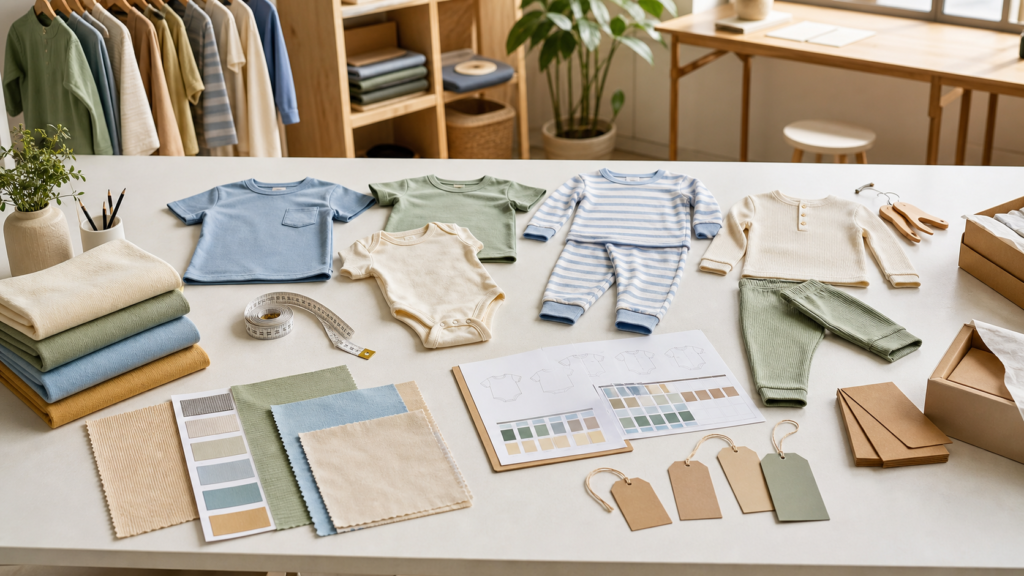
A private label kidswear manufacturer produces garments that you sell under your own brand. Instead of buying finished products from a wholesaler and reselling them as-is, you work with a factory to put your labels, tags, and packaging on garments — and, in most private-label arrangements, to customize those garments to some degree, whether that’s fabric, color, print, fit details, or trims.
The key difference from plain wholesale is ownership of the brand experience. With wholesale blanks, the product is generic and so is everyone else’s. With private label, the customer sees your brand from the woven neck label to the hang tag, which is what allows you to build recognition, loyalty, and healthier margins over time.
The typical private-label workflow, step by step
From a manufacturing standpoint, a first private-label order usually moves through a predictable sequence:
- Brief and specifications. You share what you want to make — ideally a tech pack with sketches, measurements, fabric and trim details, and label placement, or at minimum a clear reference and spec list.
- Quotation. The manufacturer reviews feasibility and returns pricing, minimums, and an estimated timeline.
- Sampling. The factory produces a sample so you can assess fabric hand-feel, construction, and fit before committing to volume.
- Approval and revisions. You review, request adjustments, and approve a pre-production sample that represents bulk quality.
- Bulk production. Once the sample (and any required testing) is approved, the main run begins.
- Quality control and delivery. Goods are inspected, finished, packed, and shipped.
What’s usually included versus what you supply
Most full-service manufacturers can support design refinement, fabric and trim sourcing, pattern-making, labeling, and packaging. What you typically supply is the creative direction (designs or specs), your brand assets (logos, label and tag artwork), and the business decisions — including which markets you’ll sell into, which determines your compliance obligations. Knowing where the handoffs sit helps you scope your first project realistically and avoid surprises mid-production.
Private Label vs. White Label, OEM, ODM, and Cut-and-Sew: Which Model Fits a New Kids’ Brand?
These five terms are used almost interchangeably across supplier websites, but they describe meaningfully different levels of control, cost, and lead time. Choosing the right one upfront is one of the highest-impact decisions a new brand makes.
Private label vs. white label
White label sits at the simplest end: you take an existing, ready-made product and add your brand label, with little or no customization. Private label is a step further — you still start from an existing base or the factory’s capabilities, but you customize meaningful elements (fabric, color, prints, trims, sometimes fit) and brand the result. For a new kidswear line, white label is the quickest way to test the water; private label gives you a more distinctive product without the time and budget of building styles from scratch.
OEM vs. ODM
OEM (original equipment manufacturer) means the factory builds your designs from your specifications — you provide the tech pack, and they produce to it. ODM (original design manufacturer) means you brand and adapt designs the factory already offers, which is faster and needs less technical input from you. As a rough guide: choose OEM if you have your own designs and detailed specs, and ODM if you want speed and are happy to start from the manufacturer’s existing styles. Many kidswear suppliers, including HAPA, offer both OEM kidswear manufacturing and ODM services so you can mix approaches across a collection.
Cut-and-sew and full-package production
Cut-and-sew (often part of full-package production) builds a garment from the ground up — your fabric, your patterns, your construction details — giving you maximum control and a genuinely unique product. It also carries the highest cost and the longest lead time, because everything is developed rather than adapted. As HAPA’s own cut-and-sew manufacturing resource notes, this route differs from private label precisely because nothing starts from an existing blank; it’s the right choice when a signature silhouette or construction is central to your brand.
Which model fits a brand-new brand
A simple decision rule: if you have limited budget and want to validate demand quickly, start with white label or private label. If you already have designs and want them produced faithfully, you need OEM. If you want design help and speed, ODM works well. If a one-of-a-kind product is the whole point of your brand and you have the capital and runway, cut-and-sew is worth the investment. Most new brands begin with private label or ODM and graduate to OEM or full cut-and-sew as they grow.
| Model | What you provide | Control & uniqueness | Relative cost & MOQ | Best suited to |
|---|---|---|---|---|
| White label | Brand label only | Lowest | Lowest | Testing the market with minimal design input |
| Private label | Brand assets + chosen specs | Moderate | Moderate | New brands wanting a branded line without full development |
| ODM | Brand assets; factory designs | Moderate | Moderate | Brands wanting speed and design support |
| OEM | Full designs + tech pack | High | Higher | Brands with their own designs and specifications |
| Cut-and-sew / full-package | Concept, designs, specs | Highest | Highest | Well-funded brands seeking a truly unique product |
What New Brands Should Prepare Before Contacting a Kidswear Manufacturer
A good inquiry makes sourcing faster. A vague message such as “I want to make kids clothes, please send price” forces the manufacturer to guess. A clear brief helps the supplier understand the product, estimate cost drivers, and identify sampling needs.
For a children’s clothing manufacturer for startups, the goal is not to make the first email perfect. The goal is to provide enough information for a practical discussion.
Product brief and tech pack basics
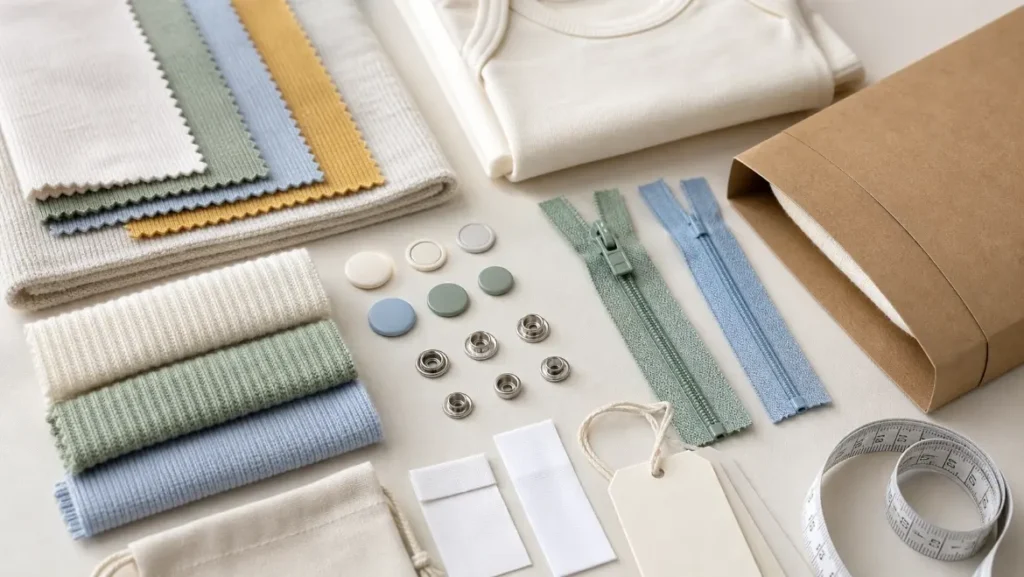
Start with a simple product brief. Include the product category, target age range, gender or unisex positioning, season, reference images, expected order quantity, destination market, and brand style. If you have a tech pack, include it. If you do not, prepare the essentials:
- Front and back reference images or sketches
- Fabric preference, such as cotton jersey, rib, fleece, woven cotton, denim, or bamboo viscose blend
- Colorways and print or embroidery artwork
- Size range, such as 0-24 months, 2-6 years, or 7-12 years
- Label, hang tag, and packaging requirements
- Sales channel, such as online store, boutique retail, wholesale, or marketplace
- Target price range, if you have one
Do not hide budget constraints. A realistic target price helps the supplier recommend feasible fabric, trims, construction, and packaging choices.
Size chart, grading, and fit expectations
Fit is one of the most common risk points in kidswear. Children grow quickly, age labels vary by market, and parents often compare fit across brands. A “4Y” size in one brand may not match another.
Prepare a size chart if you have one. If you do not, ask whether the manufacturer can work from a reference sample or help develop measurements. For a first collection, keep size ranges focused. Too many sizes can increase production complexity, inventory risk, and inspection time.
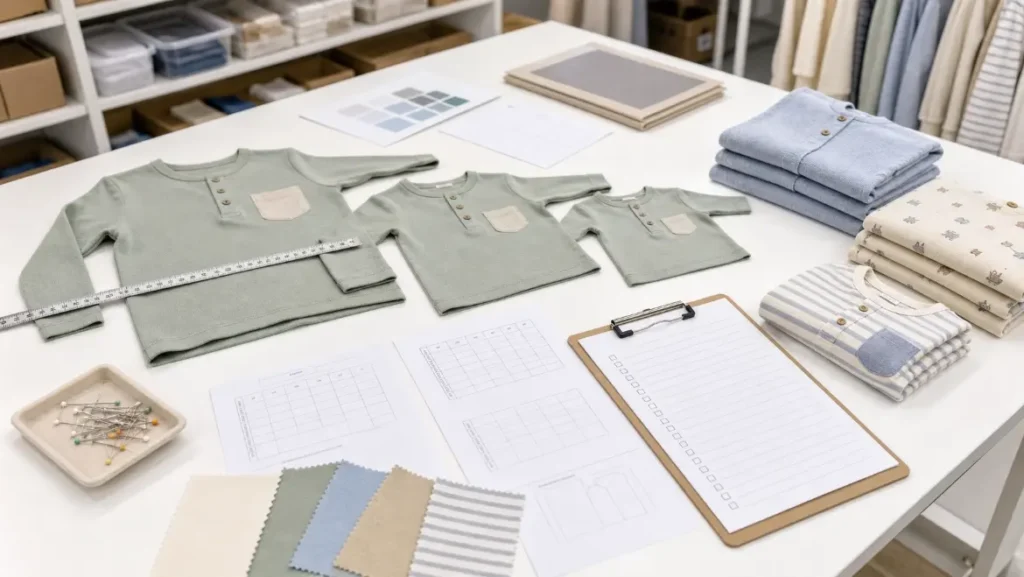
Size-set approval is especially useful before bulk production. A sample in one size can look good while smaller or larger sizes have sleeve, rise, waist, or shoulder issues. Reviewing a size set helps catch grading problems before they become full-order problems.
Label, packaging, and market requirements
Private label buyers often focus on the logo first, but care labels, fiber content, country-of-origin marking, warning statements, packaging labels, and retailer requirements may matter just as much. Requirements can vary by product category and destination market, so brands should confirm applicable labeling and compliance needs before final production.
How to Evaluate and Choose a Private Label Kidswear Manufacturer
There is no shortage of factories that can make children’s clothing. The skill is telling a reliable, kidswear-ready partner apart from a risky one — and a structured process beats scrolling through “best supplier” lists.
Start by defining your needs
Before you contact anyone, write down four things: your product category (for example, baby bodysuits, toddler sets, or older-kids hoodies), your target market (which sets your compliance requirements), your realistic first-order volume, and how much customization you need. A clear brief instantly narrows your shortlist and lets suppliers quote accurately. A factory that excels at organic babywear may not be the right fit for sequined party dresses, and vice versa.
Run a structured vetting process
Once you have candidates, evaluate each against consistent criteria rather than first impressions:
- Kidswear specialization. Children’s products have specific safety and construction considerations; experience in this category matters more than general apparel volume.
- Sample quality. Always order a physical sample before bulk. Photos can flatter; a sample tells you about fabric, stitching, and fit.
- Certifications and current test reports. Ask for relevant quality and social-compliance certificates and recent third-party test results — and confirm they’re current.
- MOQ flexibility. Can the minimum work for a first order, especially per color?
- Communication. Responsiveness and clarity during quoting usually predict how a supplier behaves mid-production.
- Capacity and scalability. Can they grow with you if the line succeeds?
- References or track record. Evidence of working with brands at your stage is reassuring.
Watch for red flags that should pause a deal:
- Cannot or will not provide current certificates or test reports on request.
- Vague, shifting pricing, or no clear MOQ per color.
- No demonstrable children’s-wear experience.
- Pressure to skip sampling and move straight to bulk.
- Slow or unclear communication before you’ve even placed an order.
Send a clear RFQ to get accurate quotes
The quality of your quotes depends on the quality of your request. Avoid a generic “how much is this?” — it invites vague answers. Instead, send a specific request for quotation: a tech pack or detailed specs (fabric, GSM, sizes, quantities, customization), and ask explicitly for MOQ per color, unit price at your target quantity, sampling cost and timeline, and estimated bulk lead time. Specific questions get specific, comparable answers — and they signal that you’re a serious buyer.
MOQ, Costs, Sampling, and Lead Times: Planning Your First Private-Label Order
“Low MOQ!” is on almost every supplier’s homepage, but it doesn’t tell you what your first order will actually require. Here’s how to plan realistically.
Understanding MOQ (stock versus custom)
Minimum order quantity is driven mostly by how custom your order is. Using in-stock fabrics and existing bases keeps minimums lower; fully custom fabric or ground-up cut-and-sew pushes them higher, because the factory has to commit materials and setup. Across the industry, minimums commonly fall somewhere in the range of roughly 50 to 300 pieces per style, depending on these factors — but this varies by manufacturer, so always confirm the minimum per color, not just per style, since color splits affect feasibility and price.
Cost components and budgeting your first run
Rather than chasing a single startup figure (which varies enormously by model and scale), budget by component:
- Sampling — initial samples and revisions; often charged, and sometimes credited against your bulk order.
- Fabric and trims — the base material cost, varying by fabric, weight, and quantity.
- Make (labor) — cutting, sewing, and finishing.
- Branding — woven or printed labels, hang tags, and custom packaging.
- Compliance testing — third-party lab testing for your destination market.
- Logistics — freight, insurance, and any duties or customs charges in your country.
Mapping these out prevents the common mistake of budgeting only for the garments and being caught off guard by testing, branding, and shipping.
Sampling and approval (pre-production sample and size set)
Sampling is your insurance against an expensive mistake, so never skip it. Expect an initial sample, one or more rounds of revisions, and then a pre-production sample that represents true bulk quality. For children’s wear, also confirm fit across your size range — a size set or graded samples help catch fit issues early. When you review a sample, don’t just look at it: check fabric softness, seam strength, closures, and, where possible, fit on a real child. Give precise feedback (“shorten the hem by one inch”) rather than vague notes. Accurate sizing is especially important in kidswear; sharing your own measurements or a reference children’s clothing size chart helps avoid undersized or oversized production.
Lead-time planning
Sampling and bulk production are separate phases, and approvals gate the clock — bulk doesn’t start until the sample (and any testing) is signed off. Sampling can take anywhere from a few days to a few weeks, and bulk production commonly runs from a few weeks to a couple of months depending on quantity and complexity. Build a buffer into your launch calendar, confirm current timelines with your manufacturer before committing to a launch date, and remember to add shipping and customs time on top.
Safety, Compliance, and Labeling for Private-Label Kids’ Clothing
This is the section new brands most often underestimate — and the one with the highest cost if it goes wrong. The guidance below is general information, not legal advice; requirements vary by market and change over time, so confirm what applies to each country you sell into with the relevant official authority.
Who’s responsible for compliance (usually your brand)
A common and risky assumption is that the factory is responsible for safety and compliance. In practice, the business placing the product on the market — your brand — typically carries the legal responsibility. That’s exactly why your manufacturer’s compliance capability is a core selection criterion: you need a partner who can produce to the right standards and provide the documentation you’ll rely on, even though the ultimate obligation sits with you.
What’s commonly required, by market
Requirements differ significantly between regions. Treat the points below as commonly referenced starting points, and verify the specifics for your destination market.
United States
For the US market, children’s products are commonly subject to testing under the Consumer Product Safety Improvement Act (CPSIA), supported by a Children’s Product Certificate (CPC) based on third-party testing, along with tracking-label requirements, and category-specific rules such as flammability standards for children’s sleepwear. For authoritative, current requirements, consult the U.S. Consumer Product Safety Commission (CPSC) rather than relying on summaries.
European Union and UK
For the EU and UK, chemical-content rules under REACH commonly apply to textiles, and there are recognized safety standards for design features — for example, the long-standing European standard governing cords and drawstrings on children’s clothing. Fiber-content and care labeling expectations also apply. The official source for chemical-compliance details is REACH, administered by the European Chemicals Agency (ECHA).
Other markets and general best practice
For any market, the safe approach is the same: request current third-party test reports, keep a compliance file for each product, and confirm requirements separately for every country you sell into. Independent textile-testing certifications such as OEKO-TEX STANDARD 100 can provide useful evidence that materials have been tested for harmful substances — but a material certification is not a substitute for meeting a specific market’s legal requirements.
Labeling and documentation basics
Beyond testing, plan your labeling early: care and fiber-content labels, country-of-origin information, and any market-specific tracking or safety labels. Keep test reports and certificates organized — they support retail onboarding and can be requested at customs. Ask your manufacturer up front which documents they will provide and in what format, so you’re not scrambling after production.
Conclusion
Choosing and working with a private label kidswear manufacturer comes down to four connected decisions: pick the production model that matches your budget and design readiness, vet manufacturers against consistent criteria instead of marketing claims, plan your first order around realistic minimums, costs, sampling, and lead times, and confirm the safety and compliance requirements for every market you sell into. Get those right and the rest of building a brand becomes far more manageable.
When you’re ready to move from planning to production, HAPA is a children’s-wear specialist offering OEM, ODM, private-label, and cut-and-sew services, with an in-house design team and support for lower minimums (a standard starting point around 100 pieces per style, with mixed sizes). HAPA also holds quality and social-compliance certifications such as ISO and BSCI and can provide product test documentation for your market — and, as always, you should request current certificates to confirm. A good next step is simple: send your specs, request a sample, and get a clear quote. Explore HAPA’s private label clothing services to start the conversation.
Frequently Asked Questions
What is a private label kidswear manufacturer?
It’s a factory that produces children’s garments you sell under your own brand — your labels, tags, and packaging — usually by customizing existing bases or producing to your specifications. It lets you launch a branded kids’ line without owning or operating a factory yourself.
What’s the difference between private label, white label, OEM, and ODM?
White label is an existing product with your label added. Private label is an existing base customized and branded for you. OEM means the factory builds your designs from your tech pack. ODM means you brand the factory’s existing designs. Control and cost generally rise from white label toward OEM and cut-and-sew.
What is the typical MOQ for private label kids’ clothing?
It depends on the manufacturer and on whether you use in-stock fabrics or fully custom production. Minimums commonly fall somewhere around 50 to 300 pieces per style, and many factories are more flexible on first orders using standard materials. Always confirm the minimum per color, in writing.
How do I choose a reliable private-label children’s clothing manufacturer?
Prioritize kidswear specialization, order a physical sample before bulk, request current certificates and third-party test reports, confirm MOQ flexibility and lead time, and test communication during quoting. Avoid suppliers who won’t share documentation or who pressure you to skip sampling.
What safety certifications or testing are required for kids’ clothing?
This varies by market. US-bound goods commonly involve CPSIA testing, a Children’s Product Certificate, and tracking labels; EU and UK markets commonly involve REACH and recognized safety standards; certifications such as OEKO-TEX STANDARD 100 evidence tested materials. This is general guidance — confirm exact requirements for each market with the official regulator.
How long does private-label kidswear production take?
Sampling and bulk are separate phases, and approvals gate the timeline. Sampling can take from a few days to a few weeks, and bulk production commonly runs from a few weeks to a couple of months depending on quantity and complexity. Build in buffer time and confirm current lead times with your manufacturer before setting a launch date.