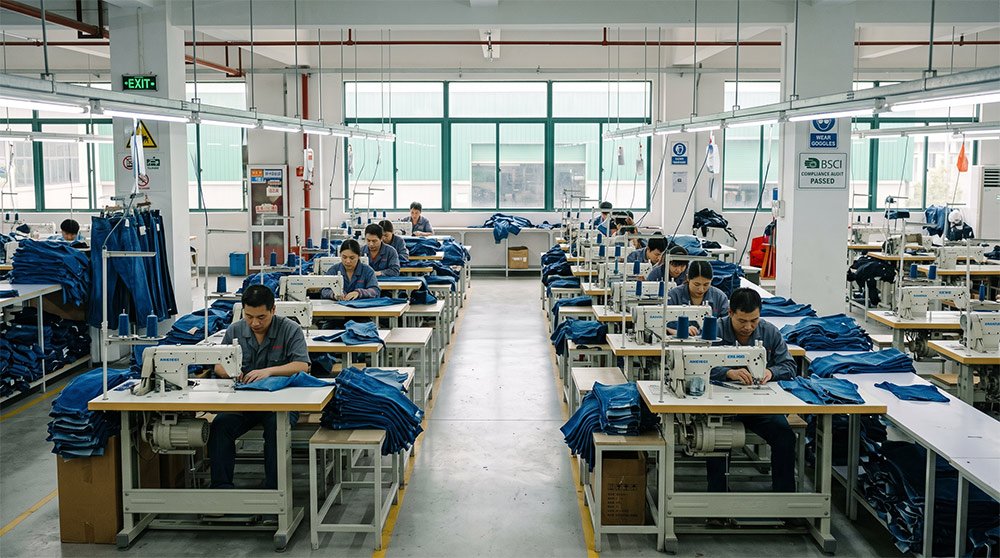
BSCI compliance is usually what decides the stability of a kids denim supply chain years before anyone notices — and I learned that lesson in a single week, early in my sourcing career, touring two denim factories back to back. On paper they were nearly identical: similar machinery, similar capacity, quotes within a few percent of each other. The first had a current BSCI audit and walked me through their improvement plan unprompted. The second waved off my questions about BSCI compliance with “we can get whatever certificate you need.” I chose the first, and my colleague at another brand chose the second. Within eighteen months, factory two had been shut down for three weeks over safety violations, mid-production, during back-to-school season. My colleague spent that autumn air-freighting replacement stock at a loss.
That week taught me what this article is really about: social compliance isn’t paperwork sitting next to your kids denim supply chain — it’s a window into whether that supply chain will still be standing in five years. And in the apparel world, BSCI is the framework you’ll encounter most often.
What BSCI Actually Is (and What It Isn’t)
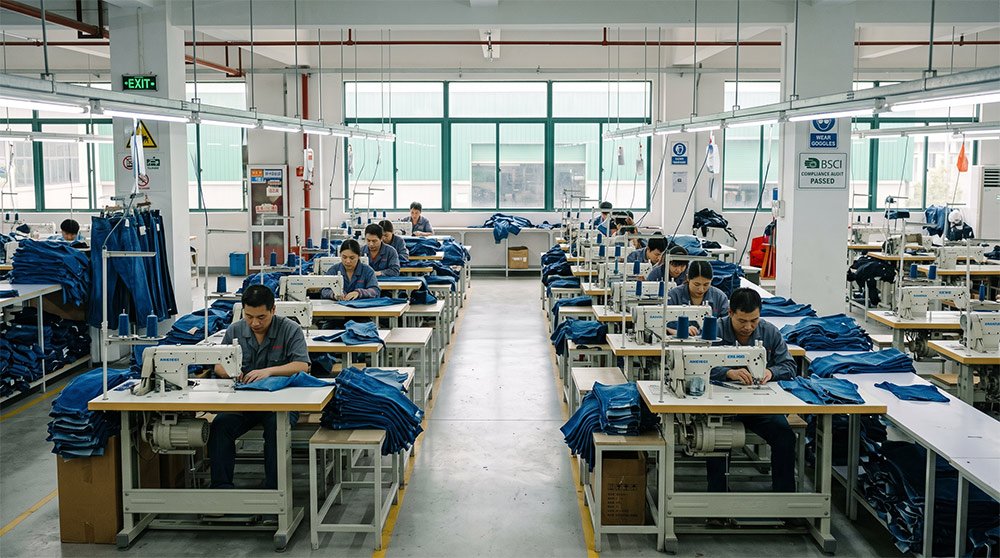
BSCI — the Business Social Compliance Initiative, operated by amfori — is the most widely adopted framework for auditing and improving social conditions in global supply chains. A BSCI audit assesses a factory against principles covering fair pay, working hours, occupational health and safety, no child labor, no forced labor, freedom of association, ethical business behavior, and environmental protection. Factories receive graded results and a continuous-improvement pathway rather than a simple pass/fail stamp.
Two clarifications I find myself making constantly:
BSCI is not product safety certification. It doesn’t test your jeans for lead, phthalates, or nickel release — that’s the territory of CPSIA and EN 71 lab testing. BSCI is about the conditions under which your products are made. A stable kids denim supply chain needs both, and they answer different questions.
BSCI is not a one-time credential. Audits recur, improvement plans get tracked, and grades move in both directions. That ongoing nature is exactly what makes it meaningful as a stability signal rather than a wall decoration.
The Core Connection: Well-Run Factories Are Stable Factories
Here’s the insight that took me years of factory visits to fully appreciate: the management discipline that produces good audit results is the same discipline that produces reliable production.
Think about what a factory needs to sustain a strong BSCI grade: documented working hours and payroll, functioning safety systems, trained supervisors, grievance mechanisms, and records that survive third-party scrutiny. A factory that maintains all of that has, almost by definition, organized management — and organized management is what delivers consistent quality, honest schedules, and early warnings when something slips.
The reverse is just as telling. Factories that fail social audits usually fail for reasons — chaotic record-keeping, excessive unplanned overtime, high worker turnover — that are also the leading indicators of missed ship dates. Excessive overtime in particular isn’t only a labor issue; it’s a symptom of poor production planning, and poor production planning eventually becomes your delayed container. In a kids denim supply chain, where wet processing already adds schedule complexity, that risk compounds.
Benefit 1: Workforce Continuity Becomes Quality Continuity
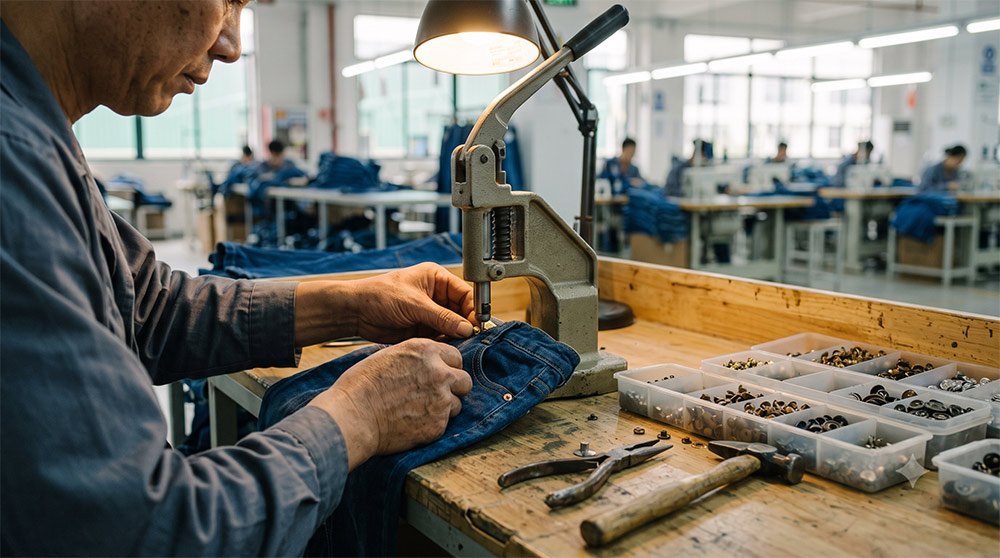
Kids denim rewards experienced hands more than almost any category I’ve worked in. Reinforced knees, adjustable waistbands, secure rivet attachment, small-size construction on heavyweight fabric — every one of these improves with worker experience, and worker experience only accumulates where workers stay.
Factories with fair pay, reasonable hours, and safe conditions — the substance behind BSCI’s principles — retain skilled sewers and denim technicians at dramatically higher rates. Lower turnover means the team that made your last order makes your next one, and you see it directly in consistency between production runs. High-turnover factories are perpetually training new hands on your garments, and you pay for that training in your defect rate. I’ve compared QC reports across both kinds of factories for years; the pattern is not subtle.
Benefit 2: Fewer Sudden Disruptions
Instability in a kids denim supply chain rarely announces itself in advance. It arrives as a factory shut down by regulators over safety violations, production halted by a labor dispute, or a supplier financially destabilized after other customers drop it — exactly what happened to my colleague’s factory.
BSCI-audited factories are meaningfully less exposed to these shocks. The audit process surfaces safety and legal gaps before regulators or accidents do. Grievance mechanisms give workers a channel other than walkouts. The continuous-improvement structure means problems get managed early and gradually instead of exploding mid-season. None of this makes disruption impossible — but it shifts the odds substantially in your favor, and supply chain stability is ultimately a game of odds played over years.
Benefit 3: Retail Doors That Stay Open as You Grow
If your brand aspires to wholesale, marketplaces, or international retail, social compliance is steadily shifting from advantage to requirement. Major retailers across Europe and North America increasingly require BSCI (or equivalents like Sedex/SMETA or WRAP) from the factories behind their suppliers — and legislation is moving the same direction, with the EU’s corporate sustainability due diligence rules making brands legally accountable for conditions in their chains.
Building your kids denim supply chain on audited factories from day one means those doors stay open as you scale. The expensive version of this lesson is discovering a compliance gap after a major retailer requests documentation — because switching denim factories under time pressure, with wet-processing relationships and approved washes at stake, is one of the most destabilizing events a young brand can go through.
Benefit 4: Reputation Insurance in the Most Trust-Sensitive Category
Every apparel category carries reputational risk. Children’s clothing carries more. Parents respond with particular intensity to stories about child labor or unsafe conditions — the dissonance of children’s products made in ways that harm other people’s children spreads fast and sticks permanently.
A documented, audited social compliance program is the strongest protection available: it demonstrates diligence, sharply reduces the probability of a genuine incident inside your chain, and gives you a credible, evidence-based answer if questions ever arise. For a children’s brand, that isn’t just ethics. It’s continuity planning for the trust your entire business runs on. This is exactly why we publish our own audit standing on our certifications page — in this category, verifiable beats claimed, every time.
Benefit 5: A Vetting Filter That Predicts Good Partnership
Here’s the most practical takeaway I can offer: how a factory engages with BSCI tells you almost everything about how it will engage with you.
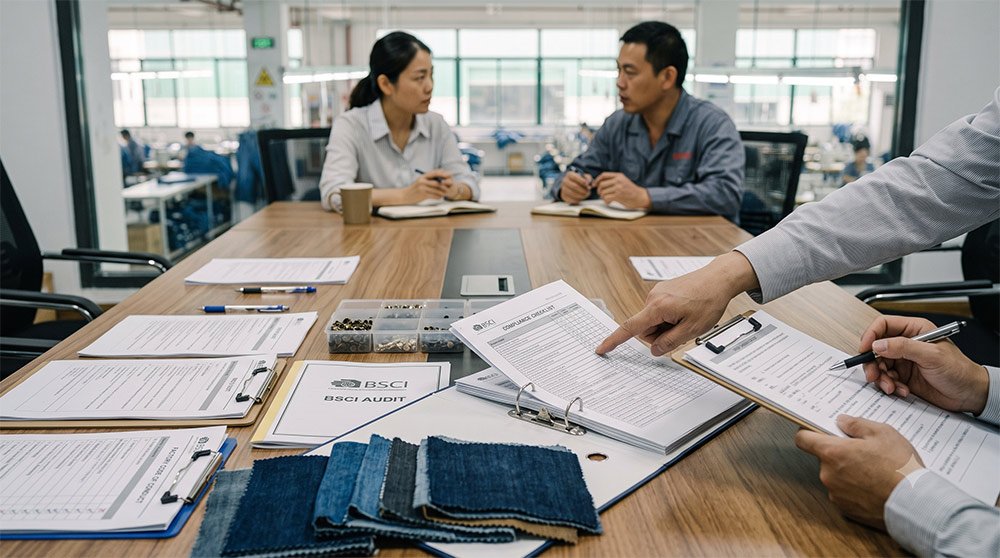
A factory that shares recent audit reports promptly, discusses its improvement plan openly, and can explain its grade is showing you exactly the transparency you want in a long-term partner. A factory that produces an expired report, dodges the question, or offers a suspiciously perfect result from an auditor you’ve never heard of is showing you its relationship with inconvenient truths — and inconvenient truths are precisely what you need surfaced early in manufacturing.
After years on both sides of these conversations, I can tell you the correlation is strong: the factories genuinely engaged with social compliance are the same ones that flag a fabric delay honestly at week two instead of apologizing at week ten.
How to Put This into Practice in Your Kids Denim Supply Chain
For founders and sourcing managers doing the actual work:
- Ask every prospective factory for current BSCI (or Sedex/WRAP) results — recent, from a recognized audit body, matching the factory’s actual name and address
- Read the report, not just the grade — findings and improvement areas tell you where the operational risks in your kids denim supply chain actually live
- Treat engagement as the signal — a factory working openly through a B-grade improvement plan is often a better long-term partner than one waving an unverifiable A
- Recheck periodically — audits expire, and stable partnerships refresh documentation as routine, not as a scramble
- Pair social compliance with product compliance — BSCI for how your jeans are made, CPSIA/EN 71 testing for the jeans themselves. A genuinely stable kids denim supply chain stands on both legs
The Bottom Line
BSCI compliance strengthens a kids denim supply chain through mechanisms that compound quietly over years: well-managed factories that ship reliably, experienced denim hands that sew consistently, fewer sudden shutdowns, retail doors that stay open as regulation tightens, protected reputation in the most trust-sensitive category in apparel, and a vetting filter that reliably identifies transparent partners. Ethics and risk management arrive in the same package — which is exactly why experienced sourcing teams treat social compliance as foundational rather than optional.
At Hapa Garments, BSCI-audited social compliance is part of how we operate every day, alongside the product testing and construction standards that children’s clothing demands — you can review our current standing on our certifications page. If you’re building a kids denim supply chain designed to still be standing — and still be trusted — five years from now, we’d be glad to show you the documentation and talk about your project.
Start the conversation at Hapa Garments — and build your children’s clothing brand on a foundation that lasts.