Finding a dependable domestic partner can feel overwhelming, especially when you are managing a children’s apparel brand from overseas. You need a factory that not only meets strict safety standards but also communicates clearly across time zones.
To make your sourcing process easier, we’ve researched 15 US-based manufacturers, looked at their compliance certifications, production capabilities, and minimum order requirements, and grouped them by manufacturing type. Whether you’re a boutique owner placing your first small order or a private label brand scaling up children’s apparel, you’ll find options matched to where your business actually is.
Before reaching out to anyone, take a few minutes with our vetting checklist further down. It’s a small step that can save you a far costlier mistake later.
Why Source From Clothing Manufacturers Based in the USA
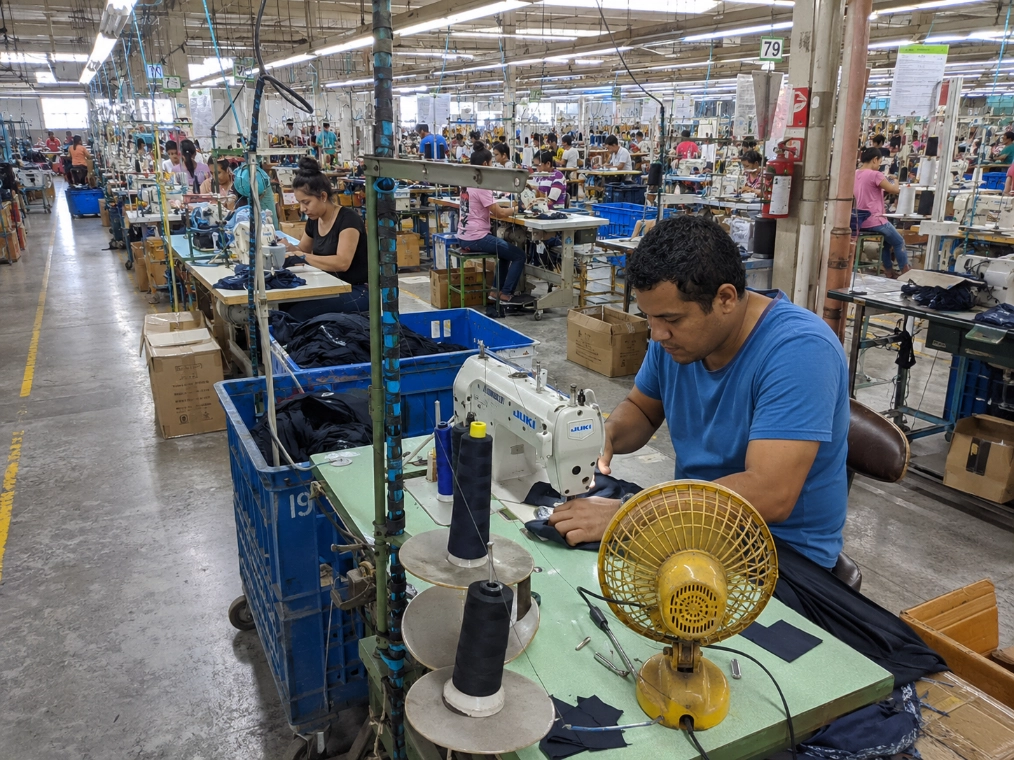
Producing stateside is a supply-chain decision before it is a marketing one. For brands selling into the American market, leaning entirely on overseas factories can lock up cash and expose you to long shipping delays. American clothing manufacturers cost more per unit, but they bring operational advantages that often close the gap. Here is where domestic production earns its premium.
The “Made in USA” Premium
A “Made in USA” label does more than signal origin. It builds buyer confidence, supports higher pricing, and carries legal requirements you have to meet before you can use it.
Consumer Trust and Pricing Power
Across most apparel categories, shoppers weigh safety, fabric quality, and ethical production when they decide what to buy. A domestic label reads as an instant trust cue, since buyers tend to associate US-made goods with tighter quality control and safer materials. That confidence translates into real pricing room: retailers can often charge 20 to 40 percent more for domestically produced apparel, which helps absorb the higher production cost and protect margins.
FTC Rules for “Made in USA” Labels
Charging that premium comes with obligations. The FTC regulates origin claims closely, and a “Made in USA” tag legally requires a garment to be “all or virtually all” made domestically, meaning the significant parts and processing happen in the US. Working with a vetted domestic factory gives you the paper trail to support the claim without risking fines or marketplace listing removals.
Faster Speed to Market
Apparel trends move quickly, pushed along by social media and rapid seasonal shifts. Standard overseas production typically runs 12 to 16 weeks once you account for manufacturing, customs, and ocean transit. Domestic factories usually turn orders in 4 to 8 weeks. That shorter cycle lets you test small batches, read customer response, and restock your bestsellers mid-season, before demand cools.
Inventory Flexibility and Lower Freight Risk
Cash flow is often the hardest part of running a cross-border apparel brand. Large overseas minimums and unpredictable ocean freight rates drain working capital fast. Shifting part of your production stateside gives you room to order what the coming quarter actually needs instead of betting on a full container months out. It also sidesteps container shortages, port delays, and freight spikes, which makes your landed costs far easier to forecast.
Types of Clothing Manufacturers in the USA
Not every factory works the same way, and the model matters as much as the location. Before you shortlist, it helps to know the main types of clothing manufacturers in the USA and which one matches your stage.
Custom and cut-and-sew manufacturers build garments from your patterns and tech packs, which suits brands that already have their own designs. OEM and ODM manufacturers go a step further: an OEM clothing manufacturer produces to your exact specification, while an ODM partner offers ready designs you can rebrand. Private label clothing manufacturers in the USA apply your label to their existing base garments, the fastest route to market. Wholesale clothing manufacturers and blanks suppliers sell undecorated stock for print-on-demand and merch programs. Full-package production, or FPP, covers the whole chain from fabric sourcing to finishing, while CMT (cut, make, trim) expects you to supply the materials yourself.
A quick way to match type to need:
- Your own designs, first small run: custom / cut-and-sew or full-package
- Fastest launch, minimal setup: private label
- Print and merch at volume: wholesale blanks
- Hands-off, end to end: full-package (FPP)
- You already source your fabric: CMT
The Core List: Top 15 Clothing Manufacturers in USA
- 1. Lefty Production Co.
- 2. Indie Source
- 3. Argus Apparel
- 4. The Evans Group (TEG)
- 5. Royal Apparel
- 6. Ferrara Manufacturing
- 7. Cord Apparel
- 8. Stylus Apparel
- 9. Steve Apparel
- 10. Good Clothing Company
- 11. Argyle Haus of Apparel
- 12. Apparel Production Inc. (API)
- 13. Tack Apparel
- 14. Portland Garment Factory
- 15. BOMME STUDIO
1. Lefty Production Co.
Website: https://www.leftyproductionco.com
Location: Los Angeles, California, USA
Founded: 2012
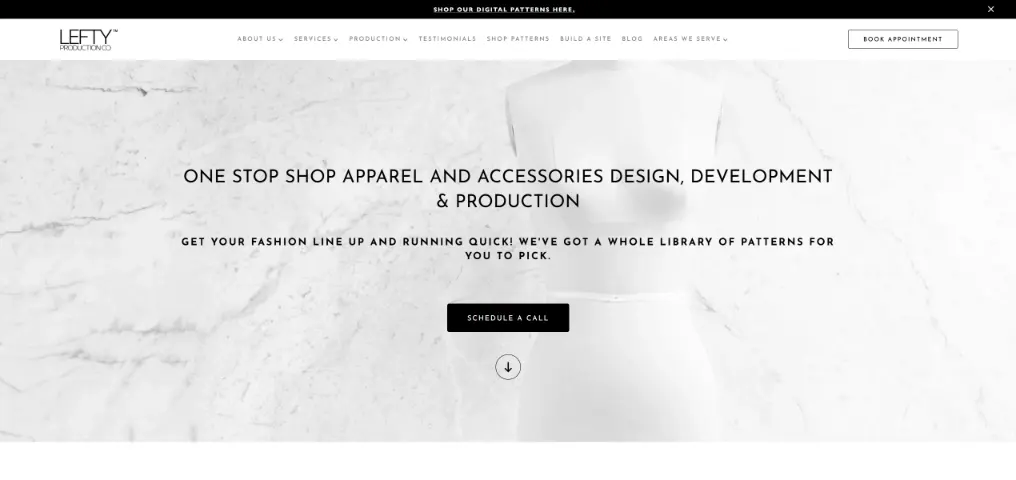
Lefty Production Co. is a one-stop garment and accessories factory in downtown LA, guiding brands from sketching and fabric sourcing through pattern-making, grading, and full production. The team has produced for Nordstrom, Neiman Marcus, and independent designers alike.
They specialize in womenswear, menswear, and childrenswear, with particular depth in swimwear, activewear, and athleisure — plus accessories, handbags, and home textiles for brands wanting a single production partner.
Services:
- Custom clothing manufacturing
- OEM / ODM production
- Sampling & prototyping
- Small-batch and bulk production
Specialties:
– Swimwear / Activewear / Childrenswear
– Small batch production
Best For: Brands needing a scalable partner with experience across diverse categories, including menswear, womenswear, childrenswear, and highly technical swimwear.
—

2. Indie Source
Website: https://indiesource.com
Location: Los Angeles, California, USA
Founded: 2012
Indie Source is an apparel manufacturer and fashion consultancy built to solve the gap emerging brands face navigating supply chains. They pair clients with a dedicated project manager, sourcing specialists, and patternmakers for full-package production from 200 to 20,000+ units.
In 2020 they acquired a 21-year-old children’s clothing factory across the street from their main facility, doubling production capacity and adding dedicated kidswear expertise to their core offering.
Services:
- Custom clothing manufacturing OEM / ODM production
- Sampling & prototyping
- Full-package development
Specialties:
- Childrenswear (via dedicated factory)
- Small batch production (200-unit minimums)
Best For: Brands needing a scalable partner with extensive experience across diverse categories, including menswear, womenswear, and childrenswear.
—
3. Argus Apparel
Website: https://argusapparel.com
Location: Los Angeles, California, USA
Founded: Operating for over a decade
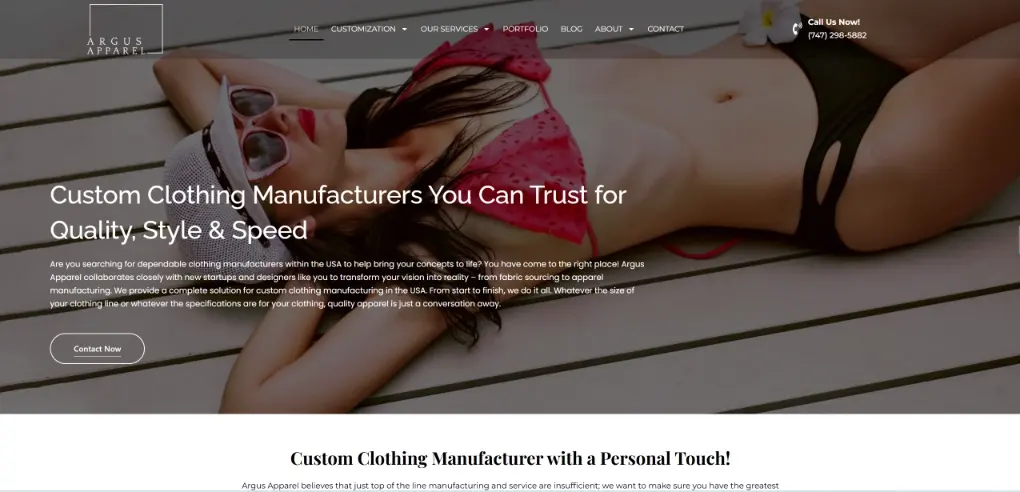
Argus Apparel is a custom clothing manufacturer offering cut-and-sew, private labeling, and screen printing for startups and established brands. Their baby and kids’ division follows CPSIA compliance standards, including flammability and lead-content requirements, with tracking and care labels on every order.
For sustainability-focused buyers, they offer GOTS-certified organic cotton, OEKO-TEX-certified fabrics, and bamboo blends, alongside flexible low-MOQ production for newer brands.
Services:
- Custom clothing manufacturing
- Private label services
- Sampling & prototyping
- Cut & sew manufacturing
Specialties:
- Kidswear / Babywear (CPSIA-compliant)
- Sustainable fabrics
- Small batch production
Best For: Brands needing a CPSIA-compliant babywear and kidswear partner with flexible MOQs and sustainable fabric options.
—
4. The Evans Group (TEG)
Website: https://tegmade.com
Location: Los Angeles, California, USA
Founded: 2005
TEG is a full-service development and production house that has worked with nearly 4,000 brands since 2005. Their Studio Level Production handles no-minimum cuts of 1–50 pieces in-house, while Factory Level Production scales to 300+ pieces through a vetted network of California factories.
Beyond manufacturing, TEG runs a designer mentorship program, pairing each client with a project manager, sourcing expert, master patternmaker, and seamstress for hands-on guidance.
Services:
- Custom clothing manufacturing
- OEM / ODM production
- Sampling & prototyping
- Design & mentorship services
Specialties:
- Small batch / no-minimum production
- Luxury and high-end construction
Best For: Brands needing a scalable partner with extensive experience across diverse categories, including menswear, womenswear, childrenswear, and highly technical swimwear.
—
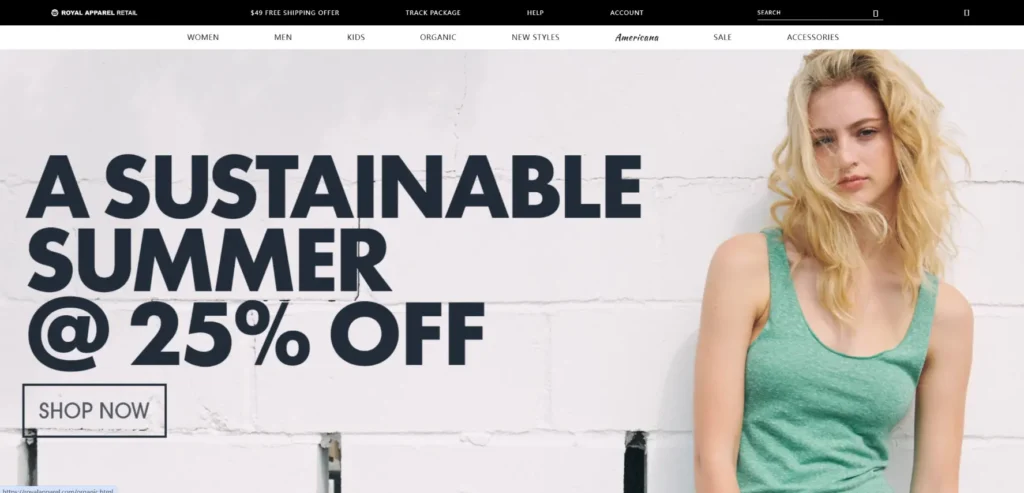
5. Royal Apparel
Website: https://www.royalapparel.net
Location: Hauppauge, New York, USA
Founded: Early 1990s
Royal Apparel is a union-shop manufacturer producing sustainable fashion across infant, toddler, youth, and adult sizing. They operate multiple manufacturing facilities across New York, New Jersey, and Pennsylvania, with fabric operations in Allentown, PA, keeping the full process domestic.
Their fabric library includes certified organic cotton, organic bamboo blends, organic hemp, and recycled RPET polyester — all dyed using low-impact, fiber-reactive processes free of heavy metals.
Services:
- Custom clothing manufacturing
- Private label services
- Wholesale blanks production
Specialties:
- Sustainable / organic fabrics
- Infant & toddler apparel
- Union-made production
Best For: Brands prioritizing certified organic and sustainable fabrics, with the assurance of unionized USA labor across the full supply chain.
—
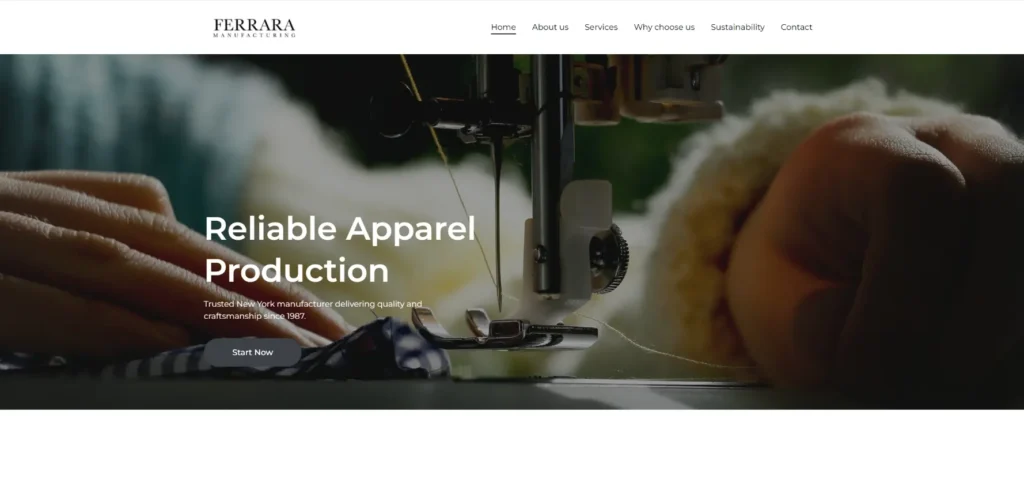
6. Ferrara Manufacturing
Website: https://www.ferraramfg.com
Location: Long Island City, New York, USA
Founded: 1987
Ferrara Manufacturing is a family-owned, union-represented factory specializing in luxury tailored garments — suits, trousers, jackets, and coats. Their work has appeared on runways in New York and Paris, and the company has produced for Ralph Lauren, Calvin Klein, Donna Karan, and Team USA Olympic uniforms.
The 50,000-square-foot facility blends traditional tailoring with 3D printing, CAD-based pattern engineering, and automated cutting, sourcing fabric, thread, and trim exclusively from US suppliers.
Services:
- Custom clothing manufacturing
- OEM / ODM production
- Sampling & prototyping
Specialties:
- Luxury tailoring / technical garments
- Highly detailed construction
Best For: Brands needing highly technical, precision-tailored garments at a luxury quality level, backed by union craftsmanship.
—

7. Cord Apparel
Website: https://cordapparel.com
Location: Missouri City, Texas, USA
Founded: Recently established
Cord Apparel offers custom and private label manufacturing for startups and growing brands, with categories spanning t-shirts, hoodies, activewear, and baby clothing. They describe their model as hybrid: USA-based project management and quality oversight, paired with the option of global production for brands chasing lower per-unit costs at scale.
Smaller and sample runs are handled domestically with closer quality control, while larger reorders can route through their international manufacturing network — a structure worth confirming directly for any order where country of origin matters to your buyers.
Services:
- Custom clothing manufacturing
- Private label services
- Sampling & prototyping
Specialties:
- Hybrid USA + global production
- Low MOQ for startups
Best For: Brands wanting flexibility to start with domestic small-batch runs and shift to lower-cost overseas production as order volume grows — not a fit for buyers who need guaranteed 100% domestic sourcing.
—
8. Stylus Apparel
Website: https://stylusapparel.com
Location: Linden, New Jersey, USA
Founded: 2003
Stylus Apparel is a family-owned, factory-direct manufacturer just outside New York City, producing screen-printed, embroidered, and cut-and-sew apparel for corporate clients and emerging clothing brands alike. All production happens in their own Linden facility — no subcontracting.
Their services span private labeling, woven labels, pattern making and grading, and same-day quoting, making them a practical fit for buyers who need decorated merchandise alongside core garment production.
Services:
- Custom clothing manufacturing
- Private label services
- Sampling & prototyping
- Screen printing & embroidery
Specialties:
- Corporate apparel / uniforms
- Decorated apparel (print & embroidery)
Best For: Brands and organizations needing decorated apparel — screen printing, embroidery — combined with corporate uniform and workwear programs.
—

9. Steve Apparel
Website: https://steveapparel.com
Location: Hilliard, Ohio, USA
Founded: 2015
Steve Apparel operates as an accessible custom clothing manufacturer catering to brands globally with a significant presence in Ohio. They focus heavily on providing a seamless, end-to-end production experience, from digital tech pack creation to the final woven label.
They are well-regarded for handling a vast array of garment styles, including specialized kids’ activewear and streetwear. With highly competitive minimums and dedicated project managers, Steve Apparel helps overseas buyers easily navigate the complexities of domestic custom clothing production.
Services:
- Custom clothing manufacturing
- Cut, make, and trim (CMT)
- Digital tech pack creation
- Custom labels & packaging
Specialties:
- Kidswear & streetwear
- Activewear & fitness apparel
- Low MOQ production
Best For: Growing Amazon and Shopify sellers requiring end-to-end guidance and flexible cut and sew capabilities for kids’ activewear.
—
10. Good Clothing Company
Website: https://www.goodclothingcompany.com
Location: Fall River, Massachusetts, USA
Founded: Operating for over a decade
Good Clothing Company is a small-batch manufacturer offering minimums as low as 10 pieces per size, style, and color — a deliberate structure designed to prevent the overproduction common in larger-minimum factories. All design, pattern-making, sample development, and sewing happen at their Fall River facility.
They also run their own in-house label, Good Apparel, as a working demonstration of the production model they sell to clients, and use eco-friendly textiles throughout.
Services:
- Custom clothing manufacturing
- Sampling & prototyping
- Small batch production
Specialties:
- Small batch production (minimums as low as 10 units)
- Sustainable / ethical manufacturing
Best For: Small brands and independent designers needing very low minimums without sacrificing US-based quality control.
—

11. Argyle Haus of Apparel
Website: https://www.argylehaus.com
Location: Los Angeles, California, USA
Founded: 2014
ARGYLE Haus owns its own factory in the San Fernando Valley, conducting 100% of cutting, sewing, and finishing under one roof — no offshore or onshore subcontracting. They’ve helped launch more than 150 startup brands since founding, alongside enterprise-level production for established names.
Their “Bespoke Matrix” lets clients select their level of engagement based on budget and readiness, with low-MOQ small-batch runs starting at 25 pieces scaling up to 1,000+ piece enterprise orders.
Services:
- Custom clothing manufacturing
- OEM / ODM production
- Sampling & prototyping
- Technical design development
Specialties:
- Small batch to large-scale production
- Fully in-house (“original apparel”) manufacturing
Best For: Startups through enterprise brands wanting full in-house control and visibility, with no outsourced production at any stage.
—
12. Apparel Production Inc. (API)
Website: apparelproductionny.com
Location: New York, New York, USA
Founded: 1949
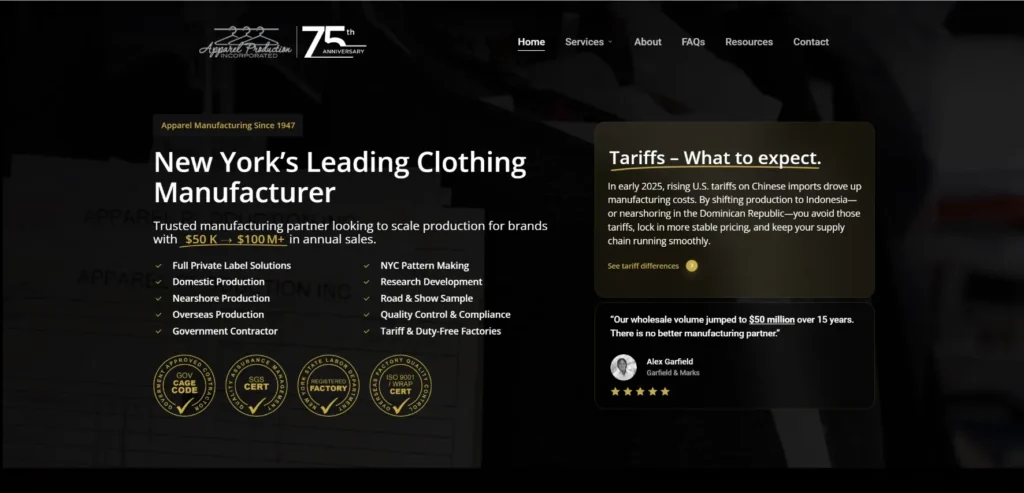
Apparel Production Inc. is a long-established New York garment manufacturer known for offering high-quality fabrics at competitive rates. Over more than seven decades, the company has built both domestic and international manufacturing networks, giving clients flexibility across production scale and price point.
API has worked with high-end fashion labels throughout its history, combining old-school garment district craftsmanship with the logistics needed to serve modern wholesale and private label buyers.
Services:
- Custom clothing manufacturing
- OEM / ODM production
- Sampling & prototyping
Specialties:
- Full-service production
- Long-standing NYC garment district experience
Best For: Brands wanting an established, multi-decade NYC manufacturing partner with flexible domestic and international production options.
—
13. Tack Apparel
Website: https://tackapparel.com
Location: Long Beach, California, USA
Founded: 2018
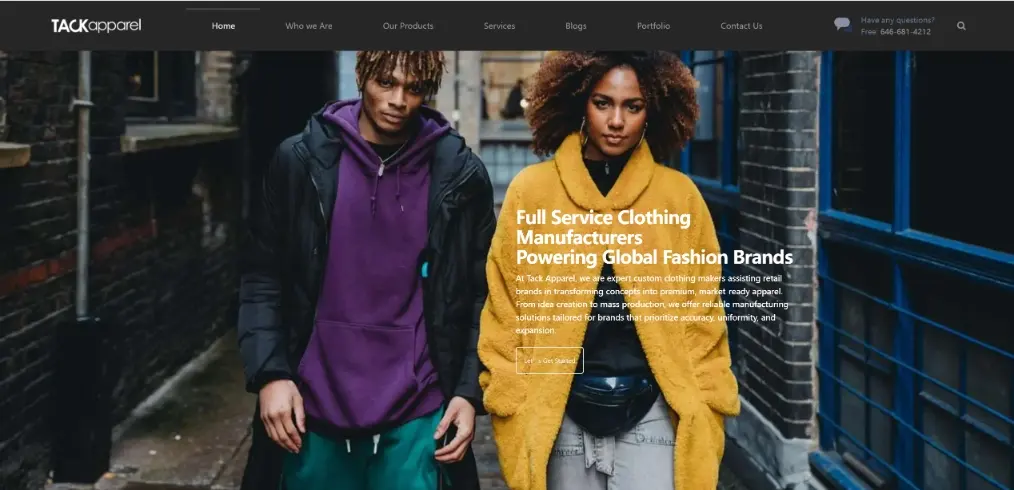
Located in Long Beach, California, Tack Apparel serves as a full-service custom clothing manufacturing partner for both startups and established retail brands. They handle the entire garment creation lifecycle, taking early concepts through rigorous sampling to final bulk production.
Tack Apparel excels in producing a wide variety of clothing categories, including trendy streetwear and comfortable children’s apparel. Their commitment to clear communication and flexible order sizes helps international businesses secure reliable, high-quality private label manufacturing stateside.
Services:
- Full-service apparel production
- Cut and sew manufacturing
- Custom embroidery & printing
- Tech pack development
Specialties:
- Kidswear & streetwear
- Activewear & athleisure
- Startups & mid-size brands
Best For: Established retail brands and growing e-commerce stores looking for reliable, scalable private label manufacturing stateside.
—
14. Portland Garment Factory
Website: https://www.portlandgarmentfactory.com
Location: Portland, Oregon, USA
Founded: 2008
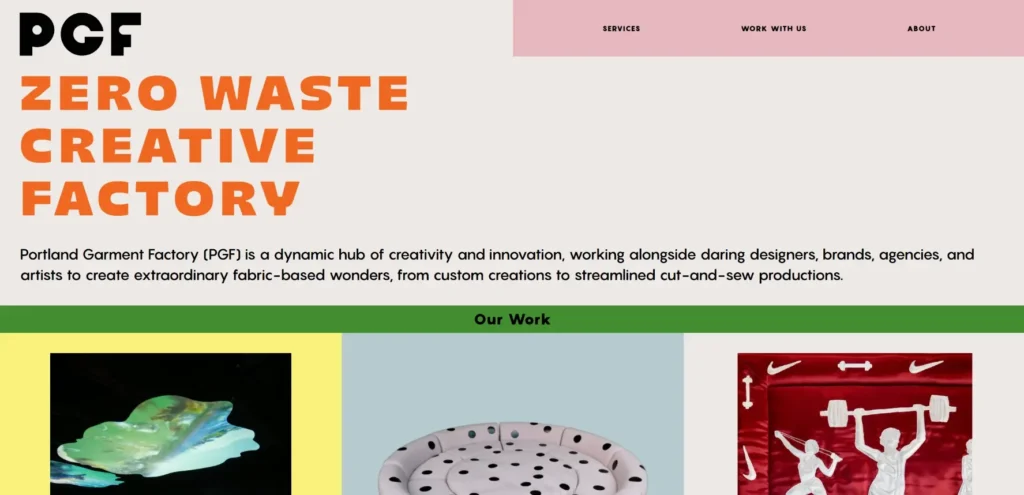
Portland Garment Factory is a women-owned, certified B Corp operating as a zero-waste design and fabrication studio. Their client base ranges from independent designers to major brands like Nike, with a production model built specifically to minimize textile waste at every stage.
Beyond garments, PGF produces soft goods, installations, and a blanks program made from upcycled fabric scraps left over from client production runs.
Services:
- Custom clothing manufacturing
- Sampling & prototyping
- Zero-waste production
Specialties:
- Zero-waste / sustainable manufacturing
- Small batch production
Best For: Brands prioritizing zero-waste, B Corp-certified production with strong creative and fabrication support.
—
15. BOMME STUDIO
Website: https://www.bommestudio.com
Location: Los Angeles, California, USA
Founded: 2014
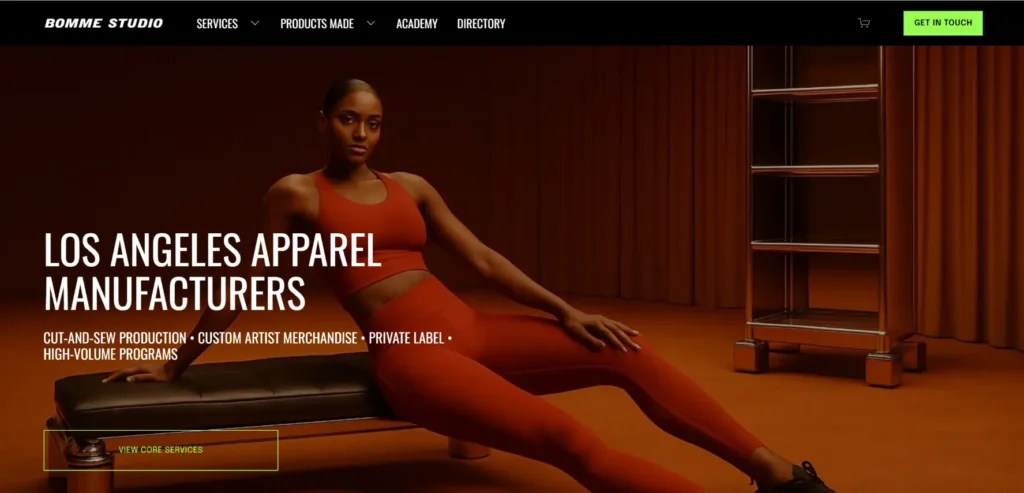
BOMME STUDIO is a full-package development house based in downtown LA, offering Cut, Make, Trim (CMT) and small-batch production domestically, starting around 150 units per style. For full-package programs above 600 units per style, they route production through vetted global factory partners in Mexico, South Korea, and Vietnam — a model they disclose openly rather than blur.
This gives brands a choice: faster, hands-on LA production for pilot runs and replenishment, or globally scaled manufacturing with the same BOMME quality oversight once volume justifies it.
Services:
- Custom clothing manufacturing
- OEM / ODM production
- Private label services
- Sampling & prototyping
Specialties:
- Hybrid USA + global production
- Activewear / streetwear / merch
Best For: Brands wanting LA-based small-batch development with a clear, transparent path to scale into global full-package production — not a fit for buyers requiring guaranteed 100% domestic origin at every volume tier.
How to Choose the Right US Clothing Manufacturer
Picking the right domestic partner takes a systematic approach rather than a gut call. Use the framework below to evaluate factories from overseas and land a reliable manufacturing relationship.
Match Product Expertise to Your Category
Confirm the factory genuinely works in your category before you trust it with your designs. Ask about its machinery, the construction methods your product needs, and its track record with the specific fabrics you plan to use, whether that is technical knits, delicate silks, or organic cotton. A factory that excels at tailoring may not be the right home for stretch activewear.
Check Minimum Order Quantity and Flexibility
Make sure the factory’s minimums fit your budget and inventory strategy. Look for partners that allow small initial test batches of 50 to 100 units but can still scale for a Q4 push. If you are unsure what is realistic for your product, our guide to apparel MOQs walks through typical ranges by production type.
Assess Quality Control and Compliance
Compliance is not optional, and the requirements depend on what you make. Verify that the factory understands the standards that apply to your product, whether that is CPSIA for children’s products, flammability rules for sleepwear, or fiber-content and care labeling for general apparel. Ask for documentation, tracking labels, and valid certificates up front to avoid customs holds or marketplace listing suspensions.
Review Communication and Responsiveness
Cross-border work lives or dies on clear communication. Test response times, fluency with technical garment terms, and willingness to accommodate your time zone through scheduled calls or a dedicated account manager. A factory that answers quickly during the quoting stage usually stays responsive once production starts.
Compare Pricing, Lead Times, and Sampling
Request a golden sample to judge physical quality in hand, calculate your true landed cost, and measure how closely the factory holds to promised lead times. A low quote means little if delivery slips by weeks or the sample misses your spec. Treat the sampling round as the real test of the relationship.
Verify OEM, ODM, and Private Label Experience
Match the factory’s business model to what you need. Decide whether you want white-label or private label blanks for quick turnarounds, or a partner with the technical skill to execute a complex custom cut-and-sew tech pack accurately. The right answer depends on how much design work you bring to the table.
Made in USA vs. Overseas Manufacturing
Domestic versus overseas is a set of trade-offs across cost, speed, and control, not a question of which is better in the abstract. The table below lays out what actually changes when you move production, so you can weigh it against your own priorities.
| Factor | Made in USA | Overseas Manufacturing |
|---|---|---|
| Lead time | Typically 2–6 weeks for sampling and production, no ocean freight delay | Often 6–12+ weeks including production and ocean transit |
| Cost structure | Higher labor cost; competitive for small and mid batches with no freight or duties | Lower labor cost; more competitive at high volume despite shipping and duties |
| MOQ flexibility | Often lower, with 25–200 units common | Often higher, with 500–1,000+ units common |
| Communication | Same or near time zone, easier real-time coordination | Time-zone gaps and spec-interpretation risk |
| On-site visits | Feasible for most US-based brands | Costly and time-consuming, harder to verify in person |
| Compliance oversight | Easier to audit for CPSIA, labor, and safety standards directly | Requires third-party verification, less direct oversight |
| Best fit for | Small batches, fast reorders, brands wanting direct oversight | Large-volume orders, lower per-unit cost, established supply chains |
When Domestic Production Isn’t the Right Fit
Domestic production is not the right answer for every brand or every order. Overseas manufacturing can be the stronger call if you:
- run tight margins on basic, high-volume styles
- need a deep fabric library that US mills do not stock
- are scaling past the volumes where local minimums make economic sense
The case for mature Asian manufacturing rests on more than cost, and most of it has little to do with tariffs.
Vertical Integration and Fabric Access
Under a full production package model, spinning, knitting, dyeing, and assembly often sit inside one regional cluster. That removes the multi-leg shipping a US factory needs just to gather imported fabric and trims. The advantage shows up most on technical fabrics and specialty sustainable textiles that domestic mills rarely stock, where a US cut-and-sew shop is usually importing the raw material from Asia anyway.
Speed, Compliance, and Automation
Three further advantages tend to travel together at well-run overseas factories:
- Faster sampling: with fabric and trims already on hand, a tech pack can move from concept to approved sample in a couple of rounds instead of waiting weeks on imported components.
- Built-in compliance: established facilities often fold SGS testing and certification, including CPSIA and Children’s Product Certificate paperwork, into their daily workflow, which clears customs without costly post-production testing.
- Automation: investment in machine-vision inspection and quick style changeovers makes lower minimums viable, where a US factory might need a high minimum just to cover overhead.
A Note on Cost and Tariffs
The cost picture is moving fast, so treat any snapshot as dated. As of mid-2026:
- Vietnam and Bangladesh sit near 10 percent under the flat Section 122 tariff, while China’s effective apparel rate is meaningfully higher.
- The Section 122 rate is temporary and set to lapse in late July 2026 unless Congress extends it.
- New trade investigations covering most major sourcing countries opened in March 2026.
The takeaway is simple: do not pick a country on a tariff headline that may change next quarter. Build your landed-cost model on current, verified rates for your specific product and fabric, then weigh fabric access, lead time, and compliance alongside duty.
Where HAPA Fits
For brands sourcing children’s apparel specifically, this is the gap we fill. HAPA is a children’s wear manufacturer with 16+ years in OEM and ODM production, running the integrated, compliance-built workflow described above. Our guide to sourcing apparel from China walks through how that process works in practice. When a US private label factory is not the right fit for your kids’ line, we are glad to be one of the options you compare.
Conclusion
The US has a deep bench of clothing manufacturers, from no-minimum studios to union shops and B Corp factories, and the right one depends on your category, your volume, and how much oversight you want. Use the checklist above, order a sample before you commit, and get certifications confirmed in writing.
If you are sourcing children’s apparel and decide a partner outside the US fits your margins and volumes, HAPA offers OEM and ODM production backed by 16+ years in kids’ wear, flexible customization, and the capacity to scale. Either way, the goal is the same: a factory you can trust to ship consistent quality on time.
Frequently Asked Questions
How do I find a reliable clothing manufacturer in the USA?
Start with industry directories such as Maker’s Row and domestic sourcing trade shows, then vet each candidate carefully. Request relevant client references, verify the factory’s physical US address to rule out offshore middlemen, and order a golden sample before you sign any bulk contract.
What is a typical Minimum Order Quantity for US production?
Most US factories accept far smaller orders than overseas plants, usually 50 to 300 units per style and color. While overseas factories often require 1,000 units or more, that domestic flexibility is a major advantage for testing new products and managing inventory risk.
Are clothing manufacturers in the USA always more expensive?
The per-unit labor cost is higher domestically, but the total picture is often more favorable for cash flow. Domestic production removes volatile ocean freight, import duties, and the risk of over-ordering inventory to meet large overseas minimums, which can offset much of the unit-cost gap.
Do US garment manufacturers offer full-package production?
Yes. Many domestic factories offer full-package production, handling the entire chain from pattern making and fabric sourcing through final cut-and-sew, which is the easier route for overseas buyers. The alternative, CMT (cut, make, trim), requires you to source and deliver your own fabric.
What should I prepare before contacting US factories?
Prepare a complete tech pack so factories can quote accurately. A solid tech pack includes technical flat sketches, precise sizing and grading charts, a bill of materials, and your target production quantity.