Knitwear Comparison Guide
Sweatshirt Vs Sweater At A Glance
A sweatshirt and a sweater may look similar, but the biggest difference is how they are made. A sweatshirt is usually cut and sewn from knitted fabric such as French terry or fleece, while a sweater is typically knitted from yarn. That difference affects texture, warmth, styling, care, and how each garment is used. The best choice depends on the fabric, weather, occasion, and the look you want.
Construction
Sweatshirts are usually cut and sewn from finished knit fabric. Sweaters are generally knitted from yarn.
Materials
Sweatshirts commonly use cotton, French terry, fleece, or blends. Sweaters often use wool, cotton, cashmere, acrylic, or blended yarns.
Warmth
Neither is always warmer. Thickness, fiber type, knit structure, fleece, and layering determine actual warmth.
Best Choice
Choose a sweatshirt for relaxed casual wear. Choose a sweater when you want knit texture and a more polished look.
If you’ve ever wondered about the difference between sweatshirt and sweater, you’re not alone. They can look similar and are both popular for cooler weather, but they are not quite the same garment.
The biggest difference is how they are made. A sweater is typically knitted from yarn, while a sweatshirt is usually cut and sewn from knitted fabric such as French terry or fleece. This difference affects everything from texture and warmth to styling, care, and everyday use. In this guide, we’ll break it down clearly so you can easily decide which one is right for you.
What Is a Sweatshirt?
A sweatshirt is a casual, long-sleeved top typically made from soft, relatively thick knitted fabric. Traditional styles are usually collarless and often feature a crew neck, ribbed cuffs, and a ribbed hem. Cotton, French terry, fleece, and cotton-polyester blends are among the most common materials. Merriam-Webster and Cambridge both describe sweatshirts as informal upper-body garments commonly made from heavier cotton fabrics.
Sweatshirts are mainly designed for comfort and easy layering, which is why they are widely used for everyday wear, travel, sports-inspired outfits, and casual cold-weather dressing. In children’s wear, the same priorities also matter in custom kids sweatshirt manufacturing, where fabric weight, softness, fit, and washability can have a noticeable impact on everyday comfort and durability.
What Is a Sweater?
A sweater is a knitted garment made from yarn rather than cut from finished sweatshirt fabric. Common materials include wool, cotton, cashmere, acrylic, and blended yarns.
Sweaters come in many forms, from lightweight crew necks and V-necks to cardigans, turtlenecks, and chunky winter knits. Compared with sweatshirts, they generally offer more variation in texture and can work across both casual and smart-casual outfits.
What Is the Difference Between a Sweatshirt and a Sweater?

A sweatshirt is normally a cut-and-sew garment made from finished knit fabric, while a sweater is made through a sweater-knitting process or from sweater-knit panels. This is more accurate than saying that a sweater is knitted and a sweatshirt is not. French terry, sweatshirt fleece, and jersey are usually knitted fabrics too. The distinction is found in the type of material and the way the garment is produced.
Feature | Sweatshirt | Sweater |
Typical production route | Finished fabric is cut into panels and sewn | Yarn is knitted into panels or fabric, then linked or sewn |
Common material form | French terry, sweatshirt fleece, or heavy jersey | Sweater yarn or sweater-knit fabric |
Common fibers | Cotton, polyester, or blends | Wool, cotton, cashmere, acrylic, polyester, or blends |
Surface | Often smooth outside with loops or brushing inside | Usually shows a more visible knit structure or texture |
Typical fit | Relaxed, sporty, or casual | Ranges from fitted and refined to relaxed and chunky |
Decoration | Well suited to prints, embroidery, patches, and appliqué | Often relies more on knit texture, stitch pattern, or subtle embroidery |
Care tendency | Frequently designed for machine washing | May require gentler washing, reshaping, or flat drying |
Common uses | Sportswear, streetwear, travel, schoolwear, and loungewear | Casual layering, office wear, seasonal fashion, and smart-casual outfits |
These are common patterns, not rigid rules. A cotton sweater may be lighter than a heavy fleece sweatshirt, and similar fibers can appear in either category. When the name is unclear, check the material structure, inside surface, seams, and care label.
For kidswear in particular, fabric selection should go beyond fiber content alone. When comparing the best fabrics for children’s clothing, comfort, durability, stretch, breathability, care requirements, and intended season all need to be considered alongside composition.
How Are Sweatshirts and Sweaters Constructed?
The production route explains many of the practical differences between these garments. It affects the information a factory needs, the risks that appear during sampling, and the details a buyer should inspect before bulk production. This also forms part of the broader garment factory process, where material approval, sampling, cutting, assembly, finishing, and inspection need to work together before a style is ready for bulk production.
Cut-and-Sew Sweatshirt Production
A sweatshirt normally starts with finished fabric. The factory does not knit each body panel directly from yarn as part of the garment-making step. Instead, it prepares a fabric roll and follows a cut-and-sew workflow:
- Confirm the fabric specification.The buyer and supplier agree on composition, structure, weight, color, finishing, shrinkage expectations, and intended use.
- Relax and inspect the fabric.Knit fabric may need time to relax before cutting, and the factory checks width, shade, defects, and usable quantity.
- Cut the pattern pieces.Body, sleeves, pockets, hood panels, and other components are cut according to the approved pattern and marker.
- Assemble the garment.Operators sew the panels and attach components such as rib cuffs, neckbands, waistbands, pockets, or hoods.
- Apply decoration.Printing, embroidery, appliqué, patches, or other treatments are added at the stage suitable for the design.
- Finish and inspect.The garment may be washed, pressed, trimmed, measured, and checked for workmanship and appearance.
- Verify packing requirements.Labels, folding, tags, bags, and cartons are checked against the approved order instructions.
This route is familiar to factories handling T-shirts, hoodies, joggers, and other knit cut-and-sew products. Even so, fabric relaxation, shrinkage, skew, rib recovery, seams, decoration, and measurements can change the result. Brands exploring custom cut-and-sew production should specify these details instead of relying on a photo.
Fully Fashioned Sweater Production
In fully fashioned production, sweater panels are shaped during knitting by changing the number or position of working needles. The front, back, and sleeves are produced closer to their required shapes, then joined through linking or another suitable assembly method. Fashion marks may be visible near armholes or other shaped areas, depending on the design and technique.
This method creates controlled shaping and can reduce material cut away, but it places greater importance on yarn behavior, machine setup, tension, panel dimensions, and linking. A measurement change may require a knitting-program adjustment rather than a paper-pattern alteration. Fully fashioned also does not mean seamless, since shaped panels can still be joined.
Cut-and-Sew Sweater Construction
Sweaters can also be made from knitted yardage. Fabric is produced across the width of a flat-bed or circular machine, and pattern pieces are cut from that material before sewing. CottonWorks explains both shaped and cut-and-sew routes in its sweater manufacturing overview.
At a high level, this resembles sweatshirt production because both use cut panels. The material is still different. Sweater fabric is specified through yarn, gauge, stitch construction, tension, and finishing, while sweatshirt fabric is usually specified as French terry, fleece, jersey, or another finished knit fabric with a target weight and surface.
During quality review, cut sweater-knit edges, pattern matching, seam bulk, stretch, and recovery need attention. Buyers should ask the supplier to name the construction route instead of assuming that every sweater is fully fashioned.
Which Is Warmer: A Sweatshirt or a Sweater?
Neither category is automatically warmer. A dense wool sweater can be warmer than a light French-terry sweatshirt, while a heavyweight brushed-fleece sweatshirt can feel warmer than a thin cotton sweater. The fair comparison is between two actual garments in the conditions where they will be worn.
What Determines Garment Warmth?
Several connected variables influence thermal comfort:
- Fiber and moisture behavior:Different fibers handle moisture and heat differently, but fiber content does not work independently from construction.
- Thickness and loft:A brushed or bulky structure can trap more still air than a compact, thin material.
- Knit density:A dense structure may reduce air movement, while an open knit can allow more airflow.
- Fabric or garment weight:Weight can indicate substance, but two materials of similar weight may have different thickness and air permeability.
- Fit and coverage:A closer fit, long cuffs, a high neckline, or an attached hood can change how the garment retains warmth.
- Wind and layers:A sweater or sweatshirt that feels warm indoors may need a wind-resistant outer layer outside.
This is why broad statements such as “sweaters are warmer” are unreliable. The name does not tell you enough about the material, thickness, density, or wearing system.
Compare Real-World Layering
For a cool office, a fine-gauge sweater may provide a polished layer without the bulk of heavy fleece. For travel or relaxed outdoor use, a brushed sweatshirt may feel comfortable and work easily under a jacket. In dry cold conditions, a dense wool sweater can be effective as a mid-layer. In windy conditions, either garment may need a shell because knitted structures do not automatically block moving air.
If warmth is a product requirement, brands should write the use case into the brief. “Winter sweatshirt” is vague. “Mid-layer for cool outdoor use under a shell” gives the supplier a clearer performance context. The sample should then be assessed for thickness, coverage, mobility, moisture comfort, and compatibility with the intended outer layer.
Sweatshirt vs Sweater Fit and Style
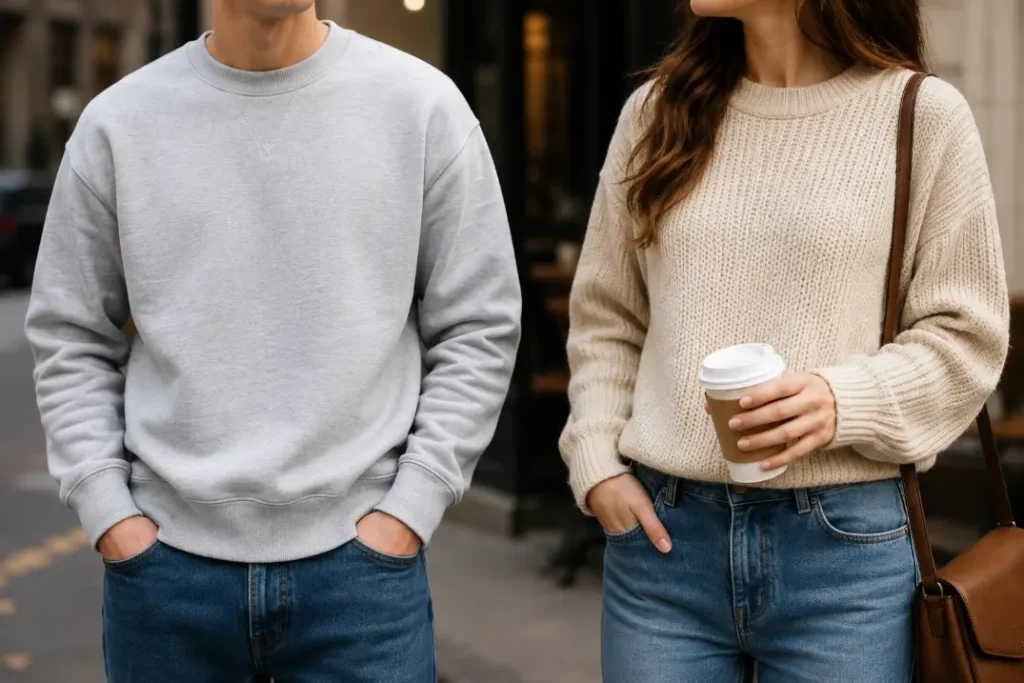
Sweatshirts often read as sporty, relaxed, or streetwear-oriented, while sweaters can move from casual to refined. Those associations are useful for styling, but they are not definitions. Designers regularly borrow proportions, necklines, and details across categories.
Fit and Silhouette
A classic sweatshirt often has a relaxed body, set-in or raglan sleeves, rib cuffs, and a rib waistband. Dropped shoulders and oversized proportions are common in streetwear. The fabric is cut from a roll, so the pattern maker controls the silhouette through panel shape, seam placement, and grading.
Sweaters range from fitted fine-gauge pullovers to boxy cardigans and chunky oversized knits. Their fit is influenced by the knitted structure as well as the measurements. A loose stitch may grow or relax differently from a compact knit, and heavy yarn can change how the garment hangs. Brands need to evaluate fit after the intended finishing and care process, not only when the first sample comes off the machine.
Texture and Drape
Sweatshirt fabric often has a smoother face and a more uniform surface. Its body and drape depend on weight, fiber blend, loop structure, brushing, and finishing. A compact heavyweight fleece can create a structured silhouette, while a lighter French terry can fall more softly.
Sweaters provide a wider visible range of stitch textures. Rib, jersey, cable, jacquard, pointelle, and other structures can become central design elements. The same silhouette can look refined in a fine compact knit or casual in a bulky textured yarn. This makes texture part of the product identity rather than just a background fabric choice.
Style and Formality
Sweatshirts are natural choices for sportswear, schoolwear, loungewear, graphic collections, and casual sets. A clean crewneck in a compact fabric can still look polished, but it usually retains a casual character. A hoodie belongs to the sweatshirt family in common apparel usage because the hood is added to a sweatshirt-style body. For a product example, HAPA’s custom girls’ hoodies page shows how silhouette and decoration can vary within that category.
Sweaters can work in casual, smart-casual, office, or occasion-focused wardrobes. Cardigans, fine-gauge crewnecks, and turtlenecks are easy to layer with shirts, trousers, skirts, or dresses. Still, a distressed oversized sweater can be more casual than a minimal sweatshirt. Formality comes from the full design, not the category label alone.
Which Is Easier to Care For: Sweater or Sweatshirt?

Sweatshirts are often designed for regular machine washing, while many sweaters need gentler handling. That is a useful starting point, not a rule. Fiber, dye, fabric or knit structure, trims, decoration, finishing, and garment construction all affect safe care.
Use the label and product evidence as your guide. In the United States, the FTC Care Labeling Rule requires manufacturers and importers of covered textile apparel to provide care instructions and have a reasonable basis for them. A brand should not copy a standard care label from a similar-looking garment without confirming that the instruction is suitable for the actual product.
A practical care review should cover the following points:
- Washing method and temperature:Confirm whether the garment is suitable for machine or hand washing and which temperature protects color, dimensions, and surface.
- Drying method:Tumble drying can affect shrinkage, surface appearance, and shape. Some sweaters are better dried flat and reshaped.
- Dimensional stability:Measure body length, width, sleeves, openings, and other critical points before and after the agreed wash cycles.
- Pilling and fuzzing:Review high-friction areas and the overall surface after wear simulation or an agreed test method.
- Twist and recovery:Check side seams, hems, ribs, neck openings, and cuffs for distortion or poor recovery.
- Decoration and trims:Confirm that prints, embroidery, patches, zippers, labels, and other components remain suitable after care.
AATCC lists recognized methods for evaluating properties such as dimensional change and appearance after laundering on its textile standards page. The appropriate method, number of cycles, acceptance criteria, and testing laboratory should be agreed for the product and target market.
For a clothing brand, the safest approach is to evaluate a garment sample before bulk production. Review the sample as received, after the intended care process, and against the approved measurements. A soft first impression is not enough if the garment shrinks, twists, pills, or loses shape after washing.
When Should You Wear a Sweatshirt or Sweater?
Choose according to the setting, weather, expected care, and the rest of the outfit. Neither garment is better everywhere.
Situation or priority | Sweatshirt is often the better fit | Sweater is often the better fit |
Relaxed everyday wear | Easy match for jeans, joggers, or casual sets | Works when you want casual texture with a more styled appearance |
Travel and lounging | Soft, familiar, and easy to layer | Suitable when temperature control and a lighter knit layer matter |
Sportswear-inspired styling | Strong category fit, especially with rib trims or graphics | Less typical unless the collection uses performance knitwear |
Office or smart-casual setting | Possible with a clean, minimal design and suitable dress code | Fine-gauge pullovers and cardigans usually integrate more easily |
Graphic branding | Smooth surfaces often support prints and bold embroidery | Better for subtle embroidery, knit-in graphics, or stitch texture |
Cold-weather layering | Brushed fleece can provide comfortable mid-layer warmth | Dense wool or other substantial knits can work well under outerwear |
Easy-care priority | Often easier, subject to the actual label | Depends strongly on fiber, knit structure, and finishing |
Think in terms of the complete garment. If you need a relaxed graphic top for frequent washing, a sweatshirt is usually the clearer starting point. If you want visible knit texture, refined layering, or a cardigan shape, a sweater is more suitable. If warmth is the main concern, compare the actual materials and layering plan rather than choosing by name.
Sweatshirt or Sweater: Which One Should You Choose?
Choosing between a sweatshirt and a sweater comes down to your lifestyle, the occasion, and the kind of look you want. Neither is universally better—the right choice depends on whether you prioritize relaxed comfort or a more polished, versatile style.
Choose a Sweatshirt
A sweatshirt is the better choice when comfort and easy styling come first. Its relaxed shape works naturally with jeans, joggers, sneakers, and casual outerwear, making it especially practical for weekends, travel, lounging, and everyday wear.
Best for: Casual outfits · Travel · Streetwear · Layering
Choose a Sweater
A sweater offers more flexibility when you want something slightly more refined. Fine-knit crew necks, V-necks, cardigans, and turtlenecks can move easily between casual, smart-casual, and work settings while offering a wider variety of knitted textures.
Best for: Smart casual · Workwear · Layering · Fall & winter
Warmth should not be the deciding factor by itself. A heavyweight fleece sweatshirt may be warmer than a thin cotton sweater, while a thick wool sweater can outperform a lightweight sweatshirt. Look at the actual material, thickness, construction, and weather conditions before making your choice.
Conclusion
Choose by the actual garment. Compare material structure, warmth conditions, fit, texture, care, and intended setting. If you are developing a collection, define the production route before requesting quotations and approve performance through a documented sample process.
For brands moving into children’s clothing OEM manufacturing, a clear development brief is especially important. Fabric or yarn specifications, fit, trims, size range, target market, quantity, care requirements, and testing expectations should be confirmed early so that sampling and bulk production start from the same standard.
FAQs About the Difference Between Sweatshirts and Sweaters
What is the difference between a sweatshirt and a sweater?
The main difference is usually the material form and production route. A sweatshirt is typically cut and sewn from finished knit fabric such as French terry or fleece, while a sweater is made from sweater yarn or sweater-knit material using methods such as fully fashioned knitting, panel knitting, or cut-and-sew construction.
Is a sweatshirt a type of sweater?
Not technically, though the words are used loosely in speech. Both are pullover tops worn for warmth, but “sweater” describes a knitted construction and “sweatshirt” describes a sewn fleece garment. On a purchase order or tech pack, they are separate categories.
Is a hoodie a sweatshirt or a sweater?
Usually a sweatshirt. A hoodie is a sweatshirt with a hood, cut and sewn from fleece or French terry. Knitted hooded garments exist and are correctly called hooded sweaters or hooded cardigans, but they are the exception.
Which is warmer, a sweatshirt or a sweater?
Neither category wins automatically — fibre, thickness and construction decide it. A heavyweight brushed fleece sweatshirt beats a fine-gauge cotton sweater, while a chunky wool sweater beats a lightweight French terry crewneck. Compare fabric weight and fibre, not the label.
Are children’s sweatshirts subject to safety rules that sweaters are not?
In some markets the risk profile differs. In the US, children’s upper outerwear — a category the rule defines using sweatshirts as an example — is treated as a substantial product hazard when it carries certain neck, hood, waist or bottom drawstrings. Europe applies a standard on cords and drawstrings. Knitted sweaters raise different issues, such as buttons as small parts. Confirm current requirements for your market with the regulator or a recognised testing laboratory.
Does a sweater cost more to produce than a sweatshirt?
Often, though it depends on yarn and gauge. Knitting a garment panel by panel and linking it takes more machine and hand time than cutting and sewing fleece, and yarn is bought to its own minimums. Sweatshirts also scale more predictably across sizes and colours.