Jeans are the ultimate wardrobe staple, a versatile garment worn for nearly every occasion imaginable. For fashion brands and retailers, denim unlocks immense commercial potential, driving consistent high-volume sales and fostering long-term customer loyalty.
However, denim is also a high-stakes category. The jeans manufacturing process is among the most complex and craftsmanship-intensive in the entire fashion industry. Even the slightest misstep can compromise the finish, fit, and overall quality of the final garment.
Every stage of premium denim production is make-or-break. As a professional jeans manufacturer with over a decade of experience, we break down the full process in depth — from the cutting floor to the final quality inspection. Our goal is to help you source higher-quality, more sustainable denim for your brand.
Understanding Denim Fabric
The primary raw material for How Are Jeans Manufactured begins with denim: a rugged cotton twill fabric constructed with weft yarns passing under two or more warp yarns.Up close, you will see a distinct diagonal weave pattern (most commonly right-hand twill) across the fabric surface, which gives denim its signature thickness and superior durability compared to standard plain-weave cotton.
Before a single pattern piece is ever cut, the success or failure of a pair of jeans is determined by its fabric. In jeans manufacturing, fabric costs account for approximately 40–50% of total production expenses. For brand owners, selecting the right fabric is the very first step in the jeans production process, as it defines the garment’s cost structure, fit retention, and final wash outcome. Below are the most widely used denim types in the industry today:
| Denim Type | Key Characteristics |
| Raw Denim (Dry Denim) | Unwashed, stiff, deep indigo color. Will shrink significantly (up to 10%) if not sanforized. Fades uniquely to the wearer. |
| Sanforized Denim | Pre-shrunk at the mill using steam and pressure. Ensures the final garment size is stable (less than 1% shrinkage). |
| Selvedge Denim | Woven on traditional shuttle looms. Features a self-finished edge (often with a red ID line). Narrow width (approx. 30″). |
| Stretch Denim | Incorporates elastic fibers for comfort and flexibility. Good “recovery” is key to prevent bagging at knees. |
| Poly-Blend Denim | Detailed with polyester for durability and wrinkle resistance. Lighter and cheaper but less breathable. |
Pre-Production: The Blueprint Before Sewing
Before jeans production ever begins, a rigorous planning phase and thorough preparation are non-negotiable. Any error made at this stage — whether in the size chart or fabric consumption calculations — can result in thousands of dollars in wasted materials and costly production delays.
Tech Pack & Bill of Materials (BOM)
The tech pack (technical package) is the single most critical document in apparel manufacturing, serving as the binding contract between the designer and the jeans manufacturer. For a pair of jeans, a standard tech pack must include:
- Technical Flat Drawings: Precise 2D flat sketches that showcase every single design detail, from the placement of the coin pocket to the exact stitch type (e.g., contrast gold topstitching vs. tone-on-tone matching thread).
- Size Specifications: A detailed measurement chart for the base size (typically a size 32 for denim).
- Bill of Materials (BOM): A comprehensive raw material checklist that itemizes every component required to produce a single pair of jeans: 1.5 yards of denim fabric, 1 YKK #5 zipper, 1 main waist button, 6 rivets, required thread consumption, and pocket lining fabric.
- Wash Standard: Since denim finishing relies heavily on wet processing, the tech pack must include a clear wash standard (usually a physical fabric swatch or reference photo) to guide the laundry facility through the exact washing process.
Pro Tip: Inaccuracies in the Bill of Materials are the number one cause of production delays. If you fail to specify rivet finish (for example, antique brass vs. bright silver), the factory will have to halt the production line to clarify, resulting in weeks of costly setbacks.
Pattern Making & Grading
Once the tech pack is fully approved, expert pattern makers translate the 2D technical drawings into a 3D pattern, available in both physical paper and digital formats.
- Shrinkage Allowance: This is a unique, non-negotiable factor for denim. Because jeans undergo heavy wash processes (including stone wash and enzyme wash), the fabric will shrink significantly. Pattern makers must calculate the shrinkage rate (typically 10–15% for denim) and oversize the pattern accordingly. If the pattern is cut to the final finished size without adding shrinkage allowance, the final jeans will come out up to two full sizes too small.
- Grading: Once the base size pattern is perfected, it undergoes grading to create the full size range (24–36 waist, or XS–XL for unisex fits). Modern manufacturing facilities use industry-leading CAD software (such as Gerber or Lectra) to ensure consistent fit and proportional integrity across every size.
Sample Approval (Quality Gatekeeping)
Bulk production should never begin without fully signed-off samples. The sample development process typically includes three critical stages:
- Prototype Sample: The first physical iteration of the design. It is used to validate the design intent and overall silhouette, and may not use the final production fabric or target wash finish.
- Fit Sample: Focused exclusively on size accuracy and wearability. Is the crotch depth correct? Is the thigh fit too tight? This sample ensures the garment fits and performs as intended for the end wearer.
- Pre-Production (PP) Sample: This is the gold standard sample. It must be constructed with the final production fabric, all specified trims and hardware, and finished with the exact final wash process. Bulk production cannot commence until the PP sample is fully approved and signed off by the client.
The Step-by-Step Jeans Manufacturing Process
Unlike a basic T-shirt that can be sewn in minutes, the creation of a pair of denim jeans is nothing short of an engineering marvel. It requires rigorous physical and chemical processing. From a roll of raw fabric to a finished retail-ready garment, the process demands the seamless integration of heavy-duty industrial machinery and the masterful craftsmanship of skilled artisans.
Below is the complete 8-step manufacturing process:
Step 1: Precision Cutting & Component Preparation
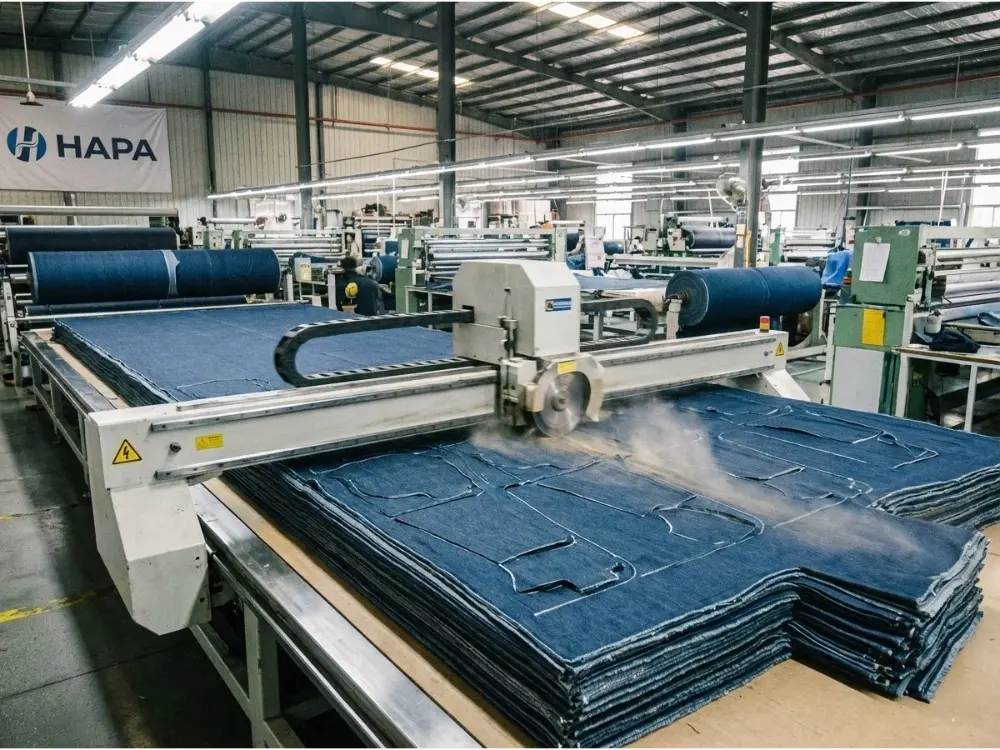
Everything begins in the cutting room, where precision is non-negotiable.
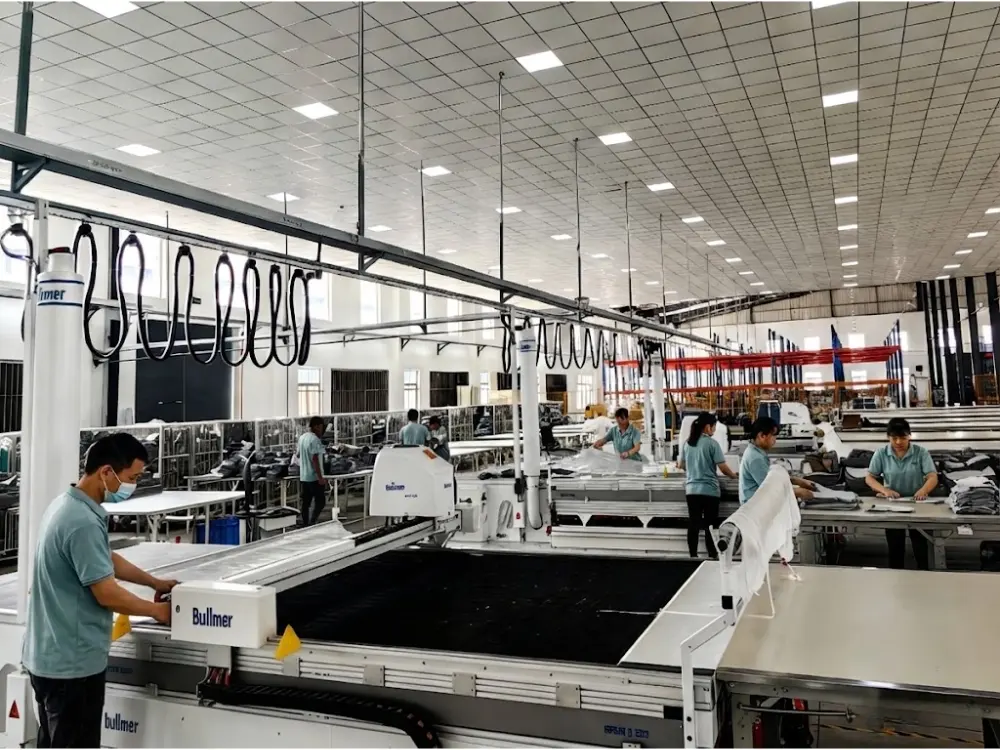
Tension-Free Spreading: Large rolls of denim fabric are unrolled and laid across long cutting tables. Critically, the spreading process must be 100% tension-free. If the fabric is stretched during spreading, the finished jeans will shrink and twist after washing, ruining the intended fit.
CNC Cutting: Once the fabric is fully laid, a digital marker guides a CNC automatic cutting machine to slice through up to 100 layers of denim at once with laser-like accuracy.
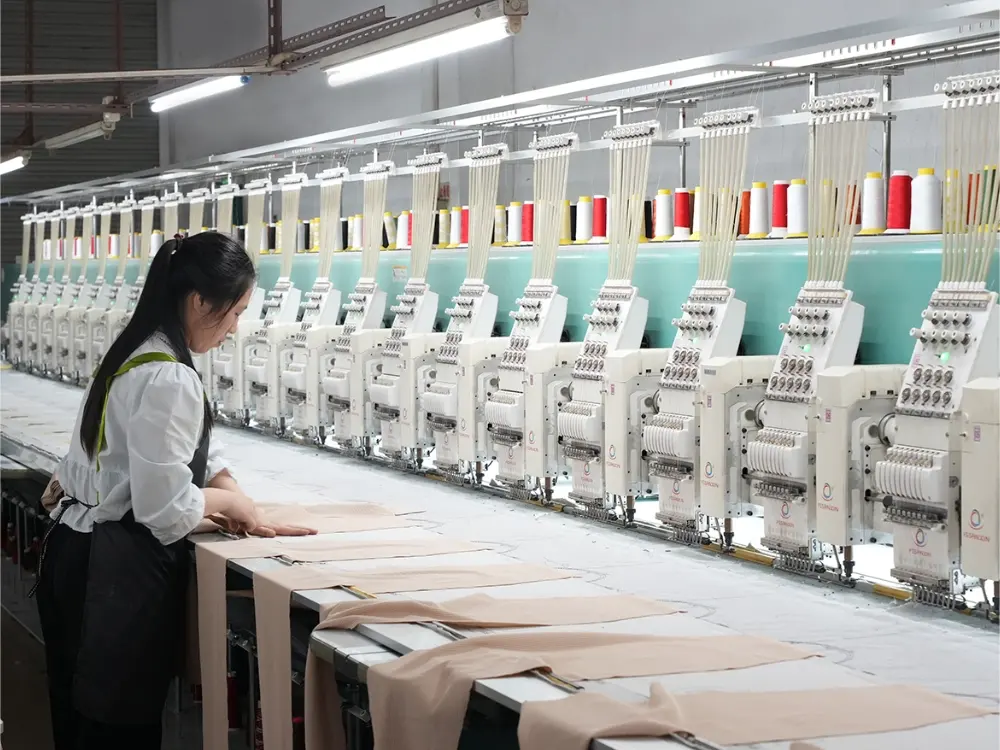
Component Prep: In parallel, a secondary production line prepares smaller components. Pocket linings are overlocked, coin pockets are constructed, and long strips of denim are fed through a specialized folder machine to form belt loops. This parallel processing ensures no operator on the main sewing line is ever left waiting.
Step 2: Assembly & Sewing (Construction)
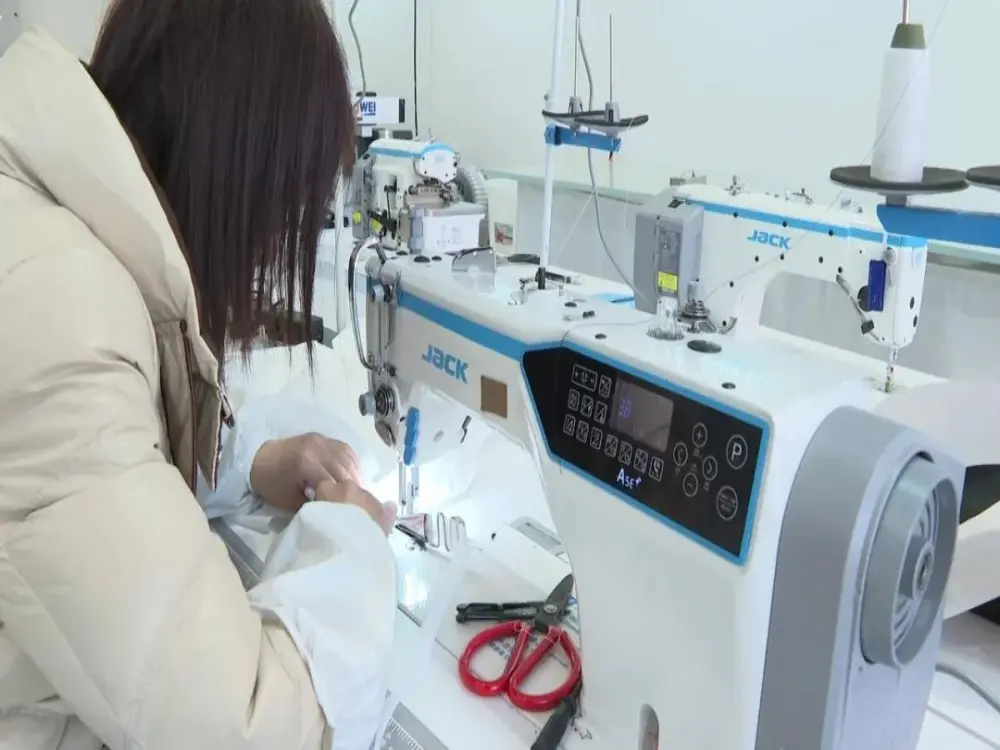
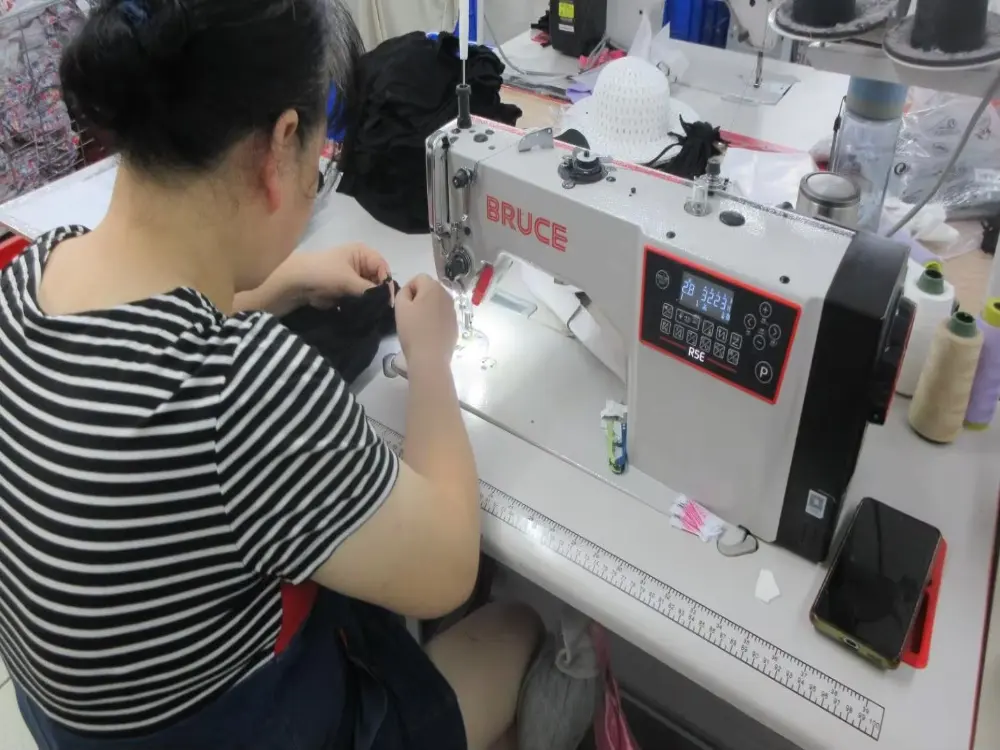
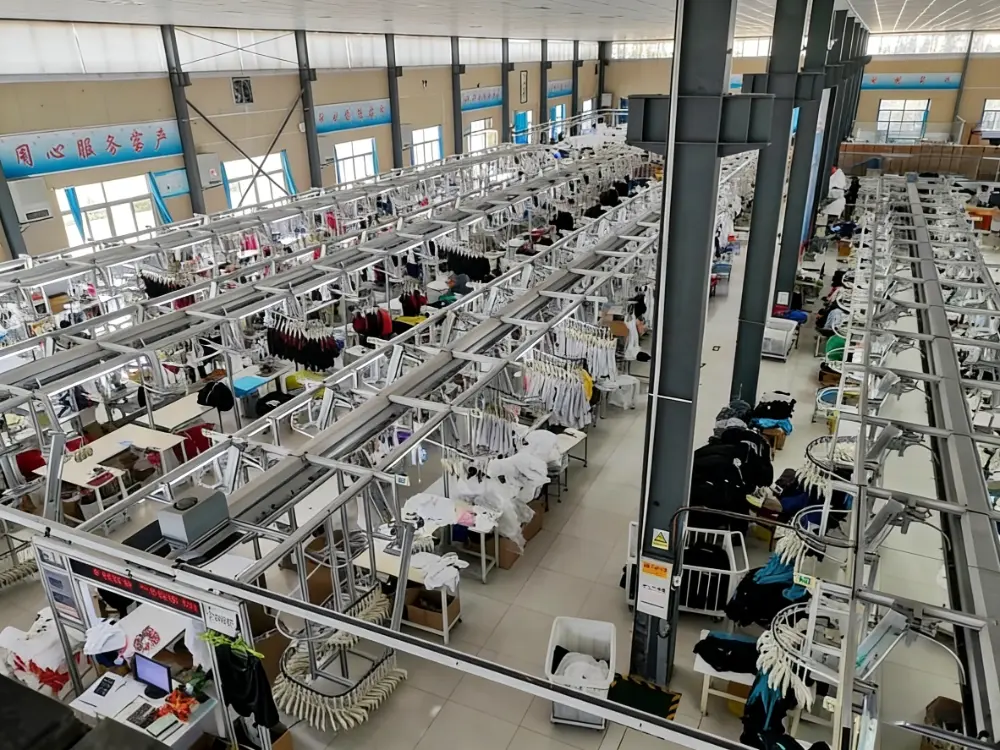
Sewing denim jeans is fundamentally different from constructing other garments, owing to denim’s thick, heavyweight build and the extreme durability requirements of the final product. Standard single-needle sewing machines are simply not equipped for the task.
Instead, factories utilize a full suite of specialized equipment purpose-engineered for each specific operation. Below is a detailed breakdown of the machinery used in this stage:
| Anatomy of a Jean | Machine Used | Purpose & Technical Detail |
| Inseam | Feed-off-the-arm Machine | Creates a high-strength, interlocked chain stitch that stretches with the wearer’s movement without breaking. |
| Back Yoke | Double Needle Chain Stitch | Attaches the V-shaped yoke to the back legs. This seam bears the most tension when you sit down. |
| Pockets & Fly | Bartack Machine | Reinforces stress points (pocket corners, belt loops) with a dense zig-zag stitch to prevent tearing. |
| Waistband | Waistband Folder | Automatically folds and stitches the waistband in one continuous motion for a clean, uniform finish. |
Step 3: Dry Processing (Distressing & Hand Finishing)
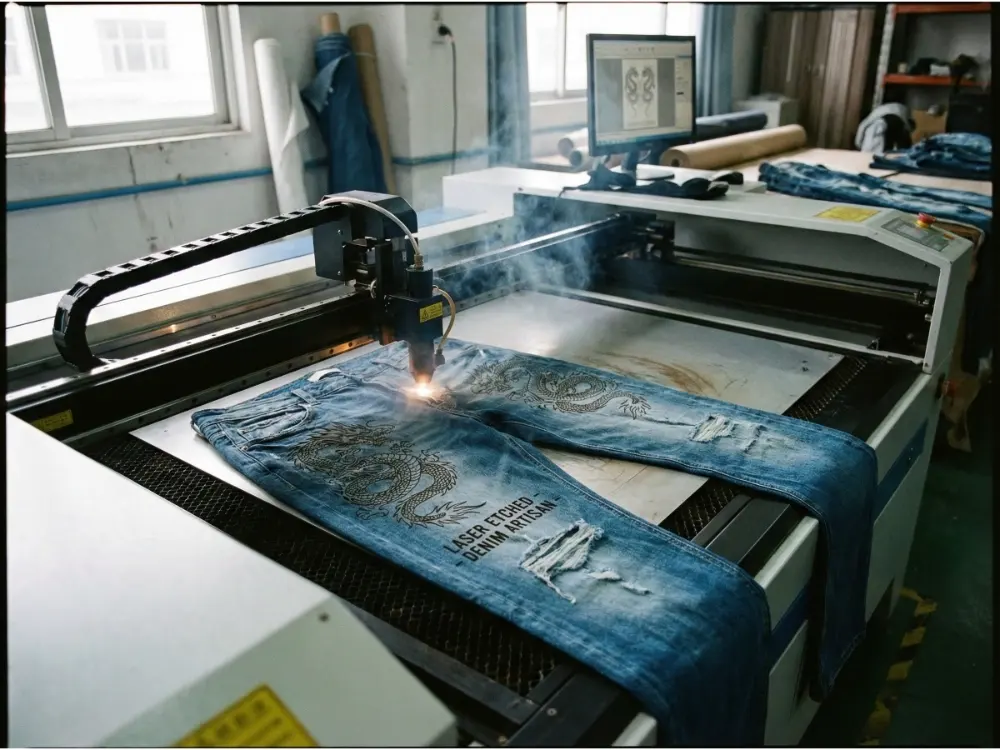
Prior to ever being exposed to water, jeans undergo what is known as dry processing. This is the stage that gives each pair its unique character. Highly skilled artisans handcraft distressing effects using tools including sandpaper, industrial grinders, and Dremel tools. This includes whiskering (the faded crease lines around the crotch and hip area) and honeycombing (the diagonal faded lines along the inner thigh).
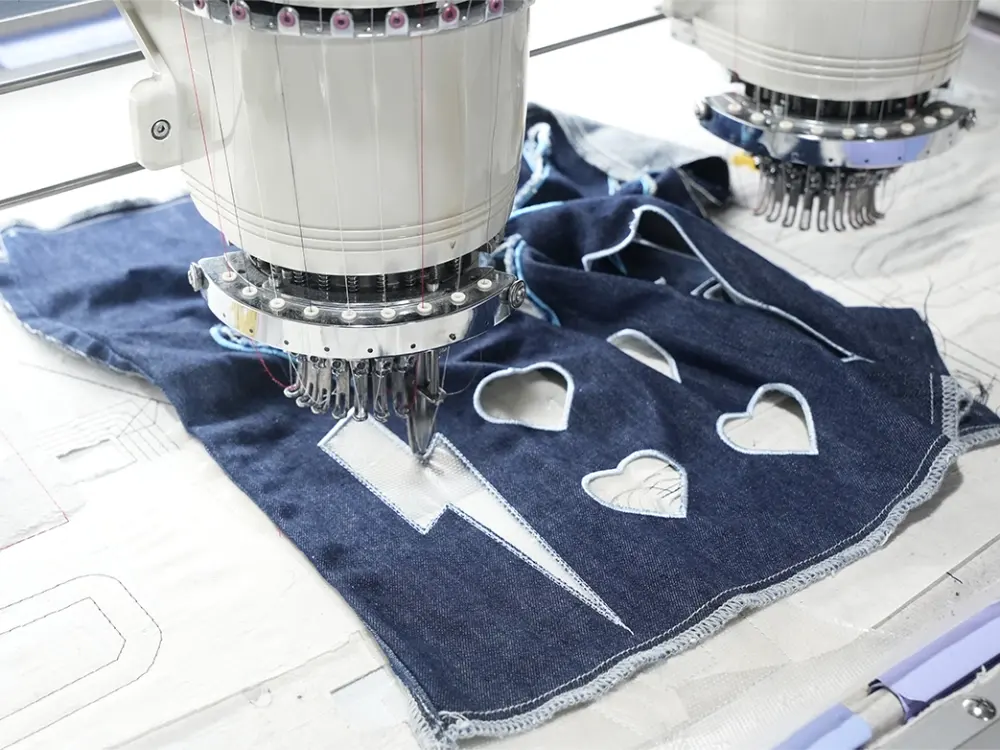
In more advanced jeans manufacturing process facilities, laser technology is rapidly replacing this manual handwork. A laser can etch patterns directly onto the fabric surface in seconds, delivering consistent vintage effects across every single pair while eliminating the serious health risks (such as silicosis) associated with manual sanding.
Step 4: Wet Processing (Wash & Finishing)
This is the very soul of denim manufacturing. The fully sewn garments (now referred to as raw denim) are loaded into large-scale industrial washing machines. The core goals of this stage are to remove the fabric’s starch coating (desizing), soften the hand feel, and achieve the exact desired blue shade.
The entire process relies on complex chemical formulations: First, enzymes are added to break down the cellulose fibers, gradually fading the color. To create the iconic stone wash effect, pumice stones are tumbled alongside the jeans to physically abrade the fabric surface. Finally, bleaching agents or ozone gas are used to lighten the fabric to its final target shade, ranging from a deep dark rinse to full ’90s-style bleach wash effects.
Step 5: Post-Wash Finishing & Hardware Attachment
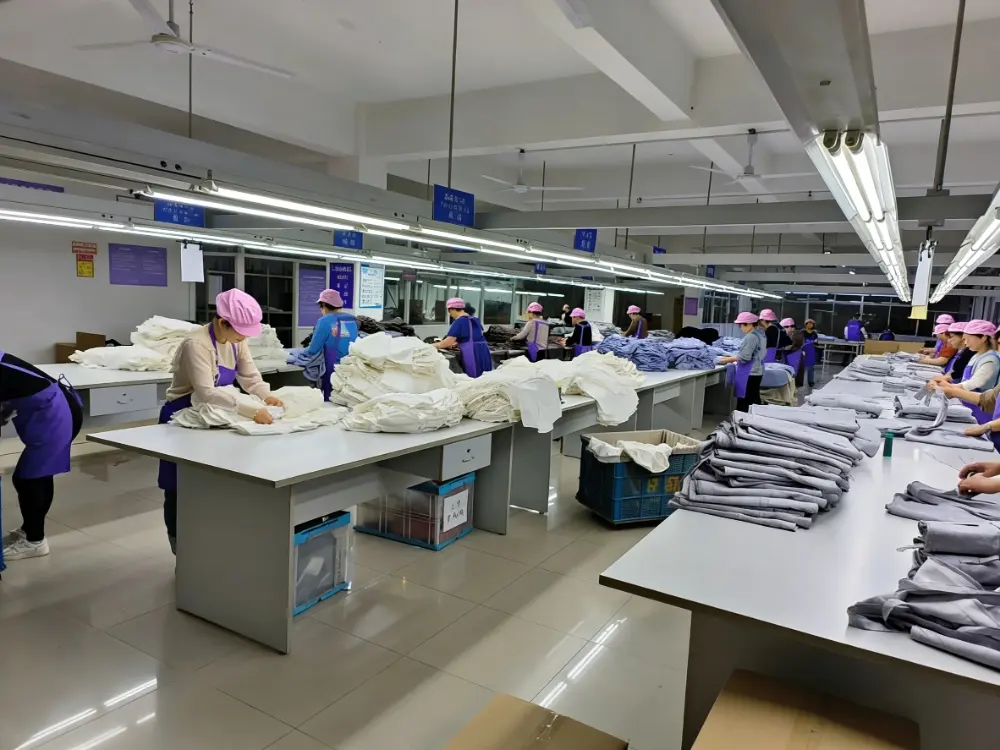
After the jeans are washed and dried, they are sent back to the post-finishing workshop where the final structural components are added. Heavy-duty pneumatic press machines crimp the main button into the waistband and set rivets into the high-stress pocket corners. A leather patch (or Jacron paper patch for vegan brands) is sewn onto the back right waistband. Finally, a dedicated trimming team removes any loose threads left behind during the washing process.
Step 6: Quality Control (QC) Process
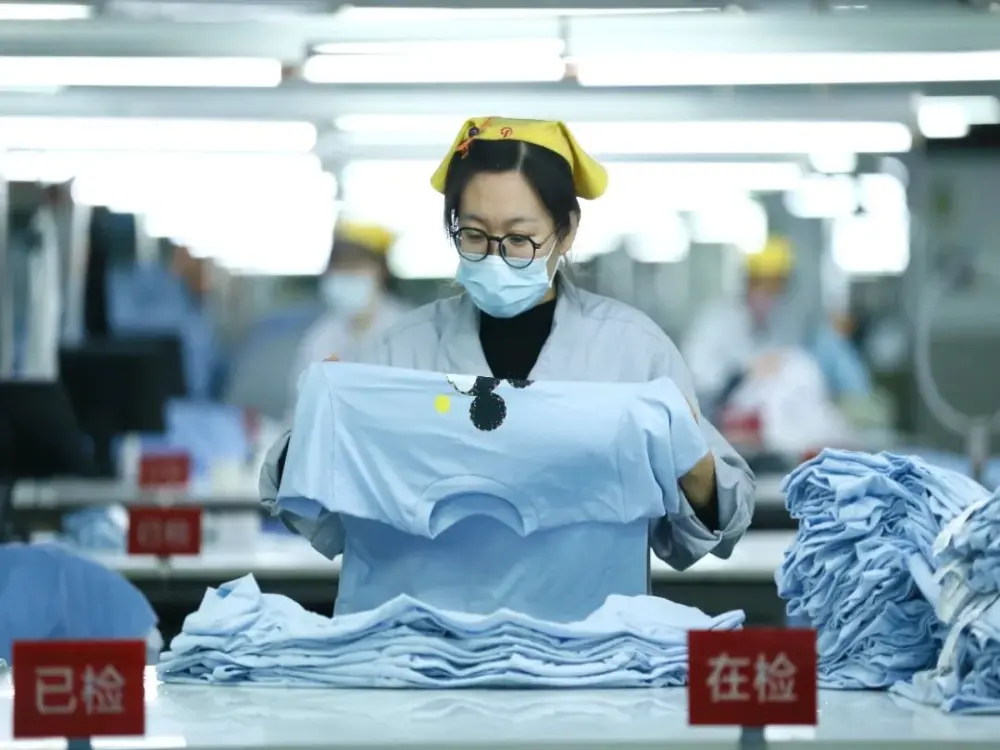
Quality control requirements for denim are far more stringent than those for other apparel categories due to the high number of unpredictable variables introduced during the wash process. As a top-tier jeans manufacturer, inspectors don’t just check for loose threads — they conduct a full audit for wash defects and construction flaws.
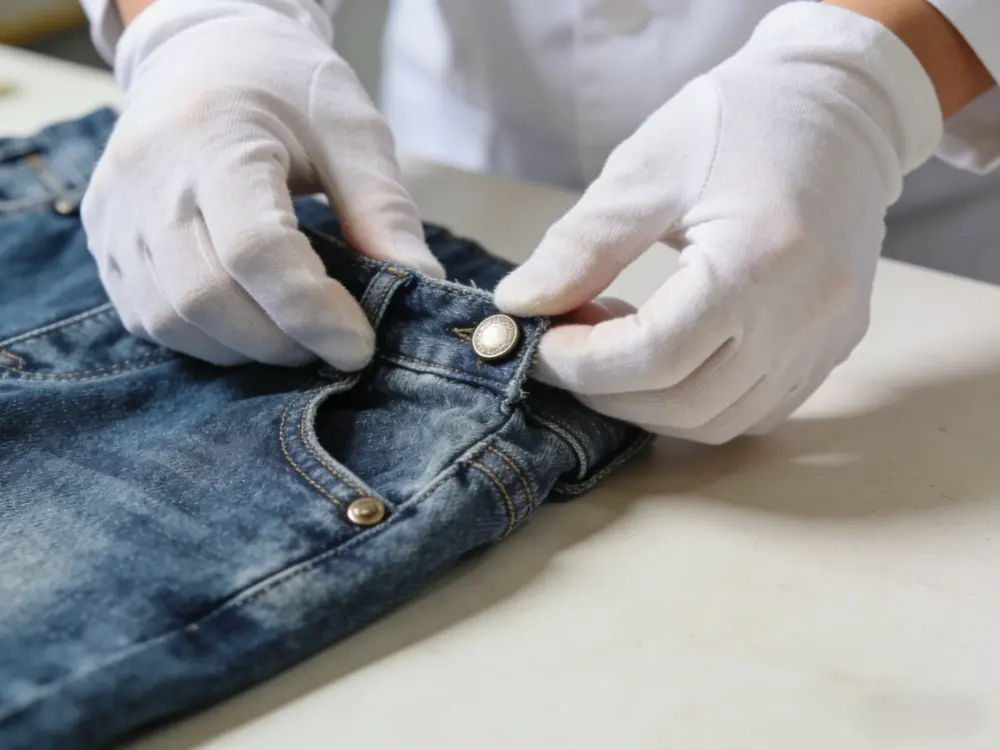
Common Denim Defect QC Inspection Checklist:
| Defect Type | What to Look For |
| Shade Banding | Do the left and right legs match in color? Are there unblended streaks from the bleaching process? |
| Leg Twist | When the jeans are laid flat, does the side seam twist to the front? (Tolerance is usually <5%). |
| Measurement Tolerance | Since jeans shrink during washing, do they still match the spec sheet? Critical areas: Waist, Hip, and Inseam. |
| Hardware Safety | Are the buttons secure? Are there any sharp edges on the rivets? |
Step 8: Final Audit & Packaging
This final step ensures every pair of jeans meets mandatory safety standards and is fully retail-ready. Every single garment must pass through a conveyor-belt needle detector — a non-negotiable safety requirement for exported goods, designed to eliminate any risk of broken needle fragments harming the end consumer.
Once cleared through the safety inspection, jeans are finished with industrial steam pressing to remove any residual wrinkles and set the final silhouette. They are then fitted with branded price tags, size labels, and care tags, before being neatly folded and sealed in protective polybags. At this stage, the jeans are fully finished, and ready to be shipped to your warehouse and stocked on your retail shelves.
The Art of Denim Washing: Techniques & Finishes
If the sewing floor is the body of a pair of jeans, the laundry house is its soul. While raw denim carries a rugged, rigid charm, it lacks everyday comfort and wearability. It is the washing process (known industry-wide as wet processing) that transforms this stiff, unyielding fabric into soft, textured garments with distinct, one-of-a-kind character.
Washing is a delicate balance of chemical and mechanical action; even the smallest tweak to temperature, timing, or chemical mix can completely alter a garment’s final finish. Below, we break down the industry’s most widely used techniques:
Stone Wash & Acid Wash: Timeless Classics
Stone wash is the most iconic denim finishing method. Jeans are tumbled with pumice stones, which abrade the fabric to strip away indigo dye, delivering that beloved vintage, broken-in look and buttery-soft hand feel. The tradeoff? It takes a heavy toll on industrial machinery, and generates large volumes of stone sludge and waste.
Acid wash (also called moon wash) takes this effect to the extreme.Dry jeans are tumbled with pumice stones soaked in chlorine bleach, creating the high-contrast, marbled patterns that defined 1980s denim fashion. Today, true acid washing is rarely used—its highly corrosive nature has seen it largely replaced by potassium permanganate spraying or laser distressing technology.
Enzyme Wash: The Gentle “Bio-Stone Wash”
Now the industry standard, enzyme washing uses natural organic enzymes to break down cellulose in cotton fibers, smoothing and polishing the fabric surface. Far gentler than traditional stone washing, it preserves the fabric’s tensile strength, cuts down on machinery wear, and has a much smaller environmental footprint. It can also be paired with stone washing to strike the ideal balance between vintage texture and a luxuriously smooth, supple hand feel.
Bleaching & Overdyeing: Mastering Color
Once the perfect texture and distressing are locked in, bleaching and overdyeing step in to refine the garment’s final hue:
- Bleaching: Strong oxidizing agents strip indigo dye from the fabric to create light blue, ice blue, or stark white finishes. After bleaching, the fabric must be carefully neutralized to avoid fiber damage and breakdown.
- Overdyeing: To lend denim an authentic, well-loved vintage patina, garments are overdyed with small doses of pigment—warm yellow tones for a tea-stained effect, rich browns for a mud wash—mimicking the natural color fade of denim worn and aged over decades.
Sustainable Practices in Modern Denim Jeans Manufacturing
For decades, the denim industry has carried a heavy environmental burden: it is one of the most polluting sectors in the entire fashion industry. Producing a single pair of conventional jeans can consume up to 1800 gallons of water, and relies on harmful chemicals including potassium permanganate.
Today, however, denim manufacturing is undergoing a full-scale green revolution. Driven by shifting consumer demands and increasingly stringent environmental regulations, leading manufacturing facilities are adopting eco-denim technologies to slash water consumption, chemical waste, and energy use.
Leading private label jeans manufacturers are adopting eco-denim technologies:
Laser Technology
Laser technology uses computer programming to precisely etch the fabric surface, fully replacing traditional manual sanding and harmful chemical sprays. It delivers consistent, repeatable distressing effects while drastically boosting production efficiency, all while eliminating the health risks to workers and toxic chemical runoff associated with conventional dry processing.
Ozone Washing
Ozone washing leverages the strong oxidizing properties of ozone gas to achieve controlled fabric fading, eliminating the need for large volumes of chemical bleaching agents and lengthy wash cycles. This industry-leading technology can reduce production water consumption by a dramatic 50% to 80%, while also cutting energy use by shortening drying times.
Water Recycling Systems
Factories implement advanced wastewater treatment and water reclamation systems to purify production effluent, removing chemical contaminants and sediment before recirculating the treated water back into the production line. This creates a closed-loop water cycle, achieving ultra-low discharge targets and reducing a facility’s overall freshwater consumption by up to 90% in some cases.
How Much Does It Cost to Manufacture Jeans?
“How much does it cost to manufacture a pair of jeans?” This is the question we are asked most frequently. The answer is not a single fixed number, but a formula. The FOB (Free On Board) cost of a basic 5-pocket pair of jeans can range from $6 to over $20, depending entirely on your garment specifications.
To help you budget for your next denim collection, below we break down the five core cost drivers in the jeans manufacturing process:
- Fabric Cost
Accounting for 40%–60% of total production costs, fabric is the single largest expense. The unit price is heavily influenced by fluctuations in global cotton prices and fabric weight (oz), making it the defining factor in your base production quote. - Washing Complexity
The more intricate the wash process (such as heavy whiskering, hand spray detailing, or extended stone washing), the higher the labor hours and energy consumption required. Complex washes directly drive up the unit cost of the finished garment. - Order Volume (MOQ)
Economies of scale play a huge role here. Larger orders allow us to spread the fixed costs of product development, marker making, and machine setup across a larger production run. Bulk production orders almost always command a far more competitive unit price than small-batch custom runs. - Trims & Hardware Quality
The details define the premium feel of your garment. Opting for YKK zippers, custom branded buttons, or genuine leather waist patches will increase costs significantly—but will also drastically reduce post-sales return rates due to hardware failure. - Origin & Labor Cost
Labor costs vary dramatically across manufacturing regions worldwide. Brands typically need to strike a balance between cost advantages and a factory’s technical expertise, production efficiency, and quality consistency.
Global Sourcing: Where Should You Manufacture Your Jeans?
Selecting a manufacturing location for your denim line requires a careful balance between cost, quality, and lead time. While many countries offer apparel production services, denim manufacturing demands highly specialized supporting infrastructure and technical expertise.
China (Advanced Technology & End-to-End Supply Chain)
As a premier China denim manufacturer, this region remains the undisputed leader in the mid-to-premium denim segment. With the most complete end-to-end supply chain and state-of-the-art machinery (including laser distressing and ozone washing technology), China is the ideal choice for complex wash processes and fashion-forward designs that demand extreme precision — and this is exactly where HAPA’s competitive advantage lies.
Bangladesh (High-Volume Production & Lowest Cost)
This region is the go-to destination for ultra-high-volume orders of basic 5-pocket jeans. While Bangladesh offers the lowest unit pricing, it often lacks the technical flexibility required to handle intricate design details or small-batch hand wash processes.
Turkey (Proximity to Europe & Strong R&D Capabilities)
Turkey is renowned for its premium fabric mills and innovative R&D, making it the top choice for European brands seeking nearshoring solutions. However, its production costs are typically significantly higher than comparable offerings from Asia.
How to Choose the Right Jeans Manufacturer
Finding a factory is easy — finding the right long-term manufacturing partner is not. Due to the high risks inherent in the washing and finishing stages of jeans production, the relationship between a brand and its manufacturer is far more intimate and collaborative than for any other apparel category.
To avoid costly losses from quality failures or delayed shipments, evaluate potential partners against these four non-negotiable key criteria:
- Flexible Minimum Order Quantity (MOQ)
For startup brands or test launches, it is critical to partner with a factory that offers flexible MOQs (typically 100–300 pieces per style). This allows you to test market demand with low risk, without being stuck with excess, unsold inventory. - OEM vs. Private Label Capabilities
Be clear on your core needs: fully custom-designed production (OEM) or white-label private labeling on existing, proven styles. OEM is ideal for designer brands seeking unique, one-of-a-kind silhouettes and finishes, while private label drastically reduces your time-to-market. - Sample Turnaround Speed & Quality
Samples are the ultimate litmus test for a factory’s craftsmanship. A high-quality, reliable partner will typically deliver high-fidelity samples within 7–10 days, that accurately replicate the dimensions, fit, and wash finish specified in your Tech Pack. - Certifications & Compliance
Prioritize factories with internationally recognized certifications, such as BSCI (Business Social Compliance Initiative) for ethical labor practices, or OEKO-TEX for non-toxic, eco-friendly production. These certifications not only mitigate ethical and regulatory risks in your supply chain, but also serve as powerful validation for your brand’s sustainability commitments.
Stricter Standards for Children’s Jeans Production
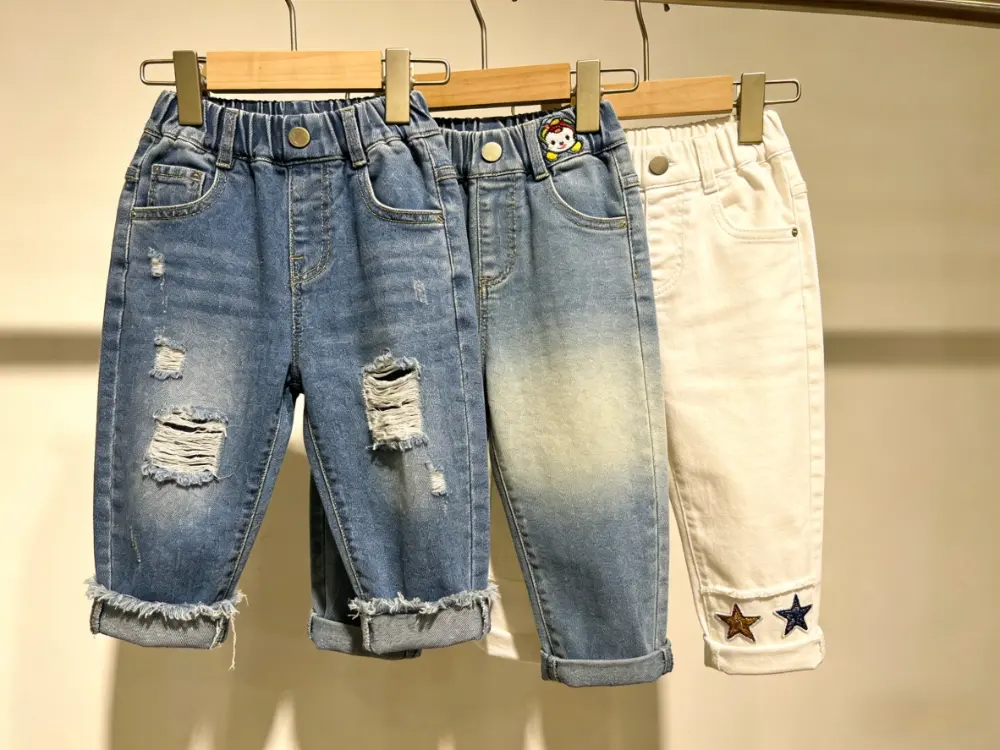
Safety is the non-negotiable core of our production standards for children’s jeans.
All buttons and rivets must pass a rigorous tensile pull test to prevent detachment and potential choking hazards. Furthermore, zippers and seams must be free of any sharp edges that could scratch or irritate a child’s delicate skin.
We place extreme emphasis on kids jeans manufacturing safety:
- Fabrics and hardware must be certified lead-free and non-toxic.
- The washing process is calibrated to a neutral pH to prevent skin irritation.
- 100% of finished products must pass through an industrial conveyor-belt needle detector.
HAPA’s uncompromising approach to safety is what sets us apart. With over 16 years of specialized experience, we know that producing kids’ jeans is not simply a matter of scaling down adult silhouettes — it requires an exceptional, dedicated focus on regulatory compliance and wearer comfort.
Conclusion
The journey of a single pair of jeans—from a raw cotton boll to a laser-finished fashion staple—is where human ingenuity meets industrial precision. How are jeans manufactured? It’s a blend of art, science, and rigorous safety standards.
At HAPA, we have mastered every inch of this process over the last 16 years. We aren’t just a children’s wear manufacturers; we are a full-service jeans manufacturer for brands that demand quality.
Ready to take your denim concepts from sketch to shelf? Let’s partner up and build a market-leading collection together.
FAQ
What is the typical lead time for manufacturing a bulk order of jeans?
The standard production timeline for jeans is typically 45 to 60 days after the Pre-Production (PP) sample is approved.
Why do Minimum Order Quantities (MOQs) matter in denim production?
MOQs are crucial in denim because of the fabric dyeing process. Denim mills usually require a minimum length to dye a specific shade of indigo efficiently.
What is the difference between “Sanforized” and “Unsanforized” denim?
Sanforized denim has been pre-shrunk at the textile mill using steam and pressure, ensuring the final jeans will shrink less than 1% after washing.
How much does a “Tech Pack” cost, and do I really need one?
Yes, a Tech Pack is non-negotiable. It is the architectural blueprint for your jeans manufacturing process.
Is sustainable jeans manufacturing really possible?
Absolutely. Modern sustainable manufacturing utilizes Laser Technology and Ozone Washing to reduce water usage by up to 80%.