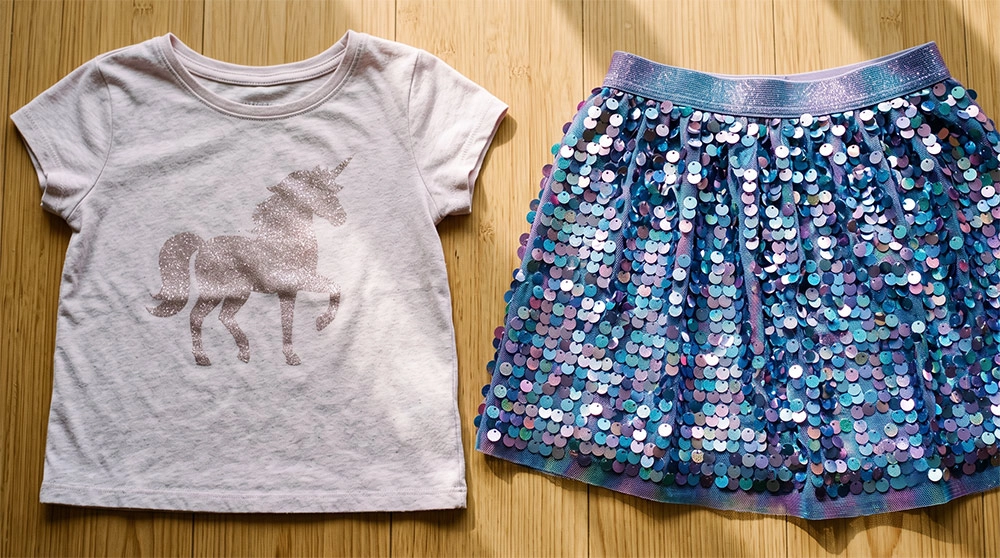
The glitter vs sequins question landed on my desk for real the year my daughter needed a holiday concert outfit. We came home with two contenders: a shimmer-print tee that looked identical to her everyday shirts but sparkled under light, and a fully sequined skirt that turned her into a walking disco ball. Six months later, the tee still sparkled like day one. The skirt — a cheaper glued construction, as I later diagnosed — had shed a small galaxy of silver discs into my washing machine, my car, and at least one relative’s couch.
That’s when I started paying professional attention to what separates these two materials, and after years working on the production side of children’s clothing, I can tell you the glitter vs sequins difference runs much deeper than “both sparkly.” They differ in what they physically are, how they’re applied, how they survive washing, how they feel on a child’s skin, and — critically for kids — how safe they are at different ages. Whether you’re a parent trying to shop smarter or a brand developing your own children’s line, understanding this difference will save you money, frustration, and a few couch-cleaning sessions.
Let’s take it from the top.
The Quick Answer
Glitter is thousands of tiny reflective particles — usually under a millimeter across — bonded to fabric through inks, films, or coatings. It’s an applied finish: the sparkle is locked into a layer on the garment.
Sequins are individual discs, typically 3 to 10 millimeters across, attached to fabric one by one or in rows — ideally by stitching, sometimes (regrettably) by glue. They’re an attached embellishment: each sequin is a small object in its own right.
Finish versus embellishment. Bonded particles versus attached objects. Every practical difference in the glitter vs sequins comparison — durability, washability, texture, safety, cost, even how they catch light — flows from that single distinction.
What Exactly Is Glitter?
Glitter is so familiar that almost nobody asks what it actually is. Commercially, it’s precision-cut particles from multilayer film — usually a PET plastic core coated with a thin metallic layer, often topped with color or iridescence — cut into hexagons and squares between 50 and 1,000 microns.
Here’s the good news for parents: in children’s clothing, glitter almost never arrives as loose particles. It comes applied through a handful of established methods, and knowing which one you’re looking at predicts almost everything about how the garment will behave.
Glitter Print (Glitter Ink Screen Printing)
Glitter suspended in a clear ink base, screen-printed as part of a design — the method behind every shimmer-filled unicorn tee in existence. The glitter is locked inside the cured ink, and curing quality is destiny: a properly cured print survives years of washing, while a rushed cure cracks and sheds within a month. I’ve seen both come off the same style of press; the difference was thirty seconds of dwell time someone decided to save.
Glitter Heat Transfer Vinyl (Glitter HTV)
Glitter pre-embedded in a vinyl film, cut to shape and heat-pressed onto the garment. Because the particles physically live inside the vinyl, this is the most shed-resistant glitter method there is — the workhorse behind personalized name shirts and birthday-number tees.
Glitter-Coated and Glitter-Dot Fabrics
Fabrics that arrive pre-glittered, like tulle scattered with glitter dots. Quality here spans the entire spectrum. The best coated fabrics lock their sparkle admirably; the cheapest shed on contact — and if you’ve ever hugged a child in a bargain glitter-tulle dress and then attended a meeting wearing half of it, you already knew that.
Glitter Yarns and Metallic Threads
Technically a cousin: metallic or lurex threads knitted directly into the fabric, so the sparkle is the textile and cannot shed at all. Many premium “glitter” sweaters use this approach precisely because it eliminates the shedding problem — and as I’ll come back to later, it’s the safest sparkle option for the very youngest children.
What Exactly Are Sequins?
A sequin is a discrete disc — usually PVC or PET plastic — with a thread hole, attached to fabric as an individual object. What defines a sequin garment isn’t the sequin; it’s the attachment. We work with sequin materials daily, and you can see the range of constructions on our sequin fabric page — but here’s the field guide.
Hand-Sewn or Machine-Sewn Sequins
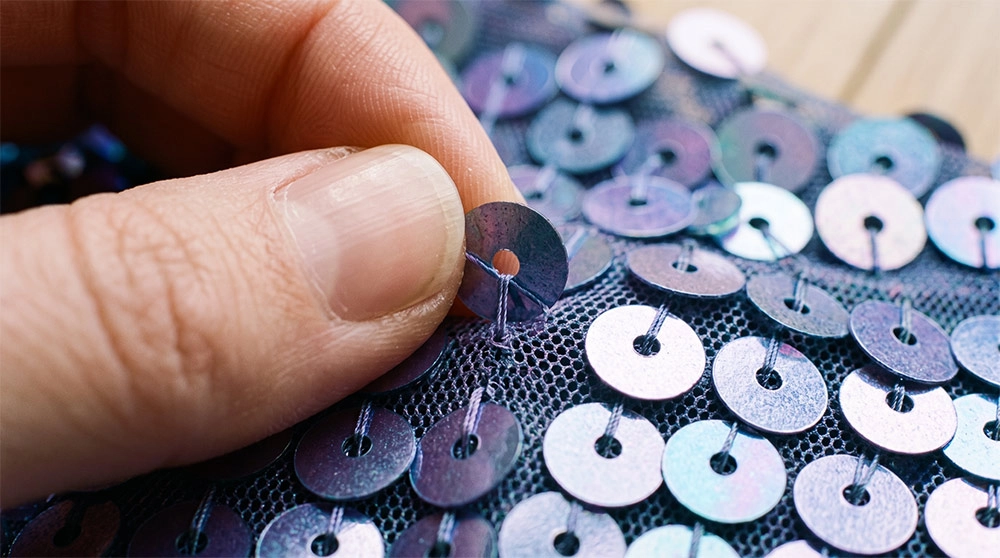
Each sequin anchored by thread — ideally individually knotted, so one failure loses one sequin. The riskier alternative is chain stitching, where a single continuous thread runs through a whole row: faster to produce, but one broken stitch releases the entire line. I’ve watched a chain unravel mid-recital. It’s memorable for the wrong reasons.
Sequin-Embroidered Mesh Fabric
The dominant construction in modern kids’ sequin clothing: sequins machine-embroidered onto mesh under industrial tension before the garment is cut, then used as the outer layer over a soft lining. Done well, this delivers remarkably durable, evenly covered sequin garments at accessible prices — it’s the reason quality sequin party dresses stopped being a luxury item.
Glued Sequins
Adhesive instead of thread. Cheap, fast, and the least durable construction in this entire article — washing machines defeat glue with depressing reliability, which is exactly what happened to my daughter’s concert skirt. In children’s clothing, glued sequins are also the primary safety concern, because a detached sequin is a small part within reach of small hands and mouths.
Reversible (“Flip” or “Mermaid”) Sequins
Two-sided sequins attached loosely enough to flip color when brushed. Kids are obsessed with them, and I understand why. From a construction standpoint, they’re deliberately loose sewn sequins — which means attachment quality matters more, not less, because the whole design invites constant touching and picking.
Glitter vs Sequins: The Full Head-to-Head
With definitions in place, here’s how the glitter vs sequins comparison plays out across every dimension that matters in kids’ clothing.
Appearance and Light
Glitter gives you diffuse, continuous shimmer — thousands of micro-reflections reading as even twinkle. Sequins give you discrete, bold flashes — each disc is a tiny mirror, and a twirling child in sequins is a light show. Subtle shimmer: glitter. Dazzle and movement: sequins. Neither is better; they’re different instruments.
Texture and Feel
Quality glitter applications add almost no texture — a glitter-print tee feels like a regular tee with a slightly grittier design area. Sequins add real weight and stiffness, and their undersides can scratch, which is why proper children’s sequin garments are always lined. For sensory-sensitive kids this is often the deciding factor: many children who happily wear glitter prints simply cannot tolerate sequins, and that’s worth respecting rather than fighting.
Durability and Washing
This is the dimension where the glitter vs sequins question gets asked most — usually right after a laundry disaster. Construction quality matters more than category, but the patterns are consistent:
- Glitter HTV and well-cured prints — very durable, wash after wash
- Glitter-coated fabrics — wildly variable; the cheapest shed from day one
- Individually sewn or embroidered sequins — the garments that last years and get handed down
- Chain-stitched sequins — fine until the first thread breaks
- Glued anything — the shortest-lived sparkle money can buy
Universal care rules for both: inside out, cold water, gentle cycle, mesh bag, never tumble dry. Heat is the enemy of adhesives and sequin plastics alike.
Comfort and Occasion
Glitter effects integrate into everyday clothing effortlessly; sequins are occasion wear by nature — the weight and texture sort them into that role regardless of styling intentions. There’s a reason the school-clothes rack has glitter graphics and the party rack has sequin bodices.
Cost
Glitter application adds modest cost over standard decoration. Sequins cost more at every level — material, specialized embroidery or hand labor, mandatory lining, extra quality control. The price difference you see in boutiques is real and mostly justified.
The Safety Question: What Matters for Kids Specifically
Here’s where glitter vs sequins stops being aesthetic and starts being consequential — because children’s clothing carries safety expectations and legal requirements that adult clothing doesn’t.
Small Parts and the Mouthing Age
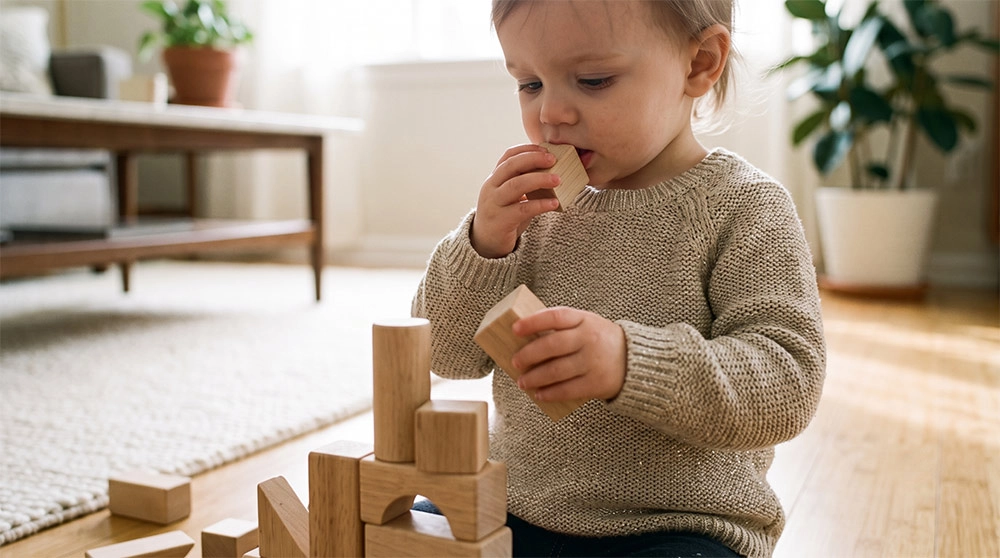
Sequins are exactly the size of thing toddlers put in their mouths. A securely attached sequin is not a hazard; a detaching one is — which makes attachment method the single most important safety variable in kids’ sequin clothing. Quality manufacturers pull-test embellishments as routine QC, and glued sequins have no legitimate place in clothing for the youngest ages. For babies and children still in the mouthing stage, the honest recommendation is to skip sequins entirely and get the sparkle from glitter prints or metallic yarns instead — a principle we cover in the bigger picture of how to choose safe clothing for children.
Glitter particles are too small to choke on, but shedding glitter reaches hands, mouths, and occasionally eyes, where it genuinely irritates. Well-bonded glitter eliminates the issue; bargain coatings don’t.
Skin Contact
Sequin undersides and anchor threads can abrade delicate skin — lining isn’t a luxury in kids’ sequin clothing, it’s a design requirement. Properly cured glitter presents a smooth surface and rarely causes trouble.
Chemical Compliance
Both materials fall under children’s chemical safety regulation: in the US, CPSIA limits on lead and phthalates apply to embellishments as component parts, and a Children’s Product Certificate must stand behind the finished garment — we’ve written a plain-English breakdown in our guide to understanding CPC certification. In the EU, EN 71-3 and REACH restrictions cover similar territory. None of this is visible at the rack, but it’s fundamental for anyone manufacturing or importing: your sparkle needs test reports.
Flammability and Sleepwear
Fluffy glitter tulle and certain coatings raise flammability considerations, particularly for sleepwear — one of several reasons neither glitter coatings nor sequins belong on children’s pajamas. Sleepwear standards are deliberately boring, and that’s a feature.
Caring for Each: Glitter vs Sequins Laundry Routines That Actually Work
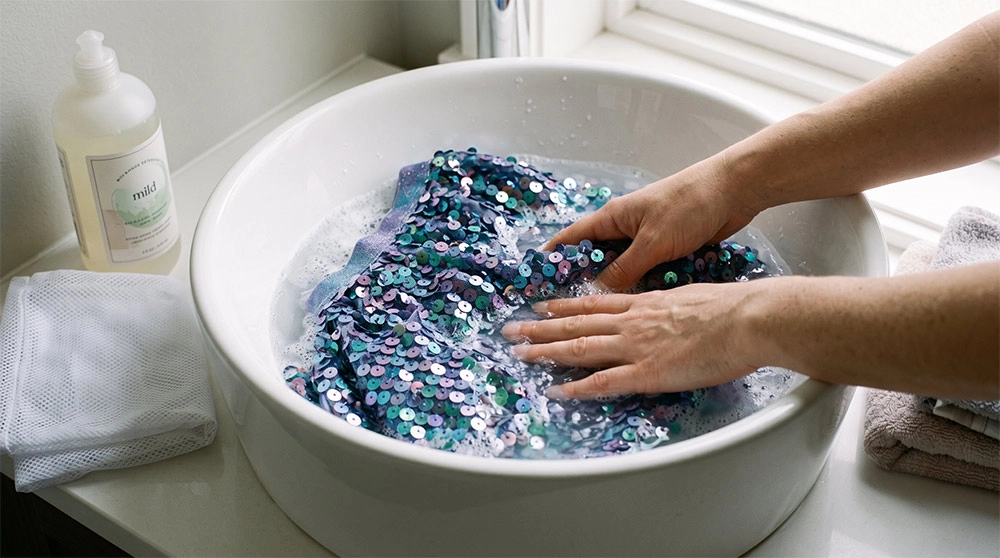
Glitter garments: inside out, cold, gentle, mild detergent, no fabric softener (it degrades print adhesion over time), air dry, and never iron directly over a design. Hand wash glitter tulle if you can.
Sequin garments: fastenings closed, inside out, mesh bag, cold delicate cycle or a basin hand wash. Press water out — never wring. Dry flat away from sunlight, never tumble dry, never touch an iron to a sequin (plastic deforms permanently). Store flat; heavy sequin pieces stretch on hangers over time.
And a shared rule from hard experience: wash any new sparkle garment separately the first few times. Even good pieces release a stray particle or disc early on, and you don’t want them migrating onto school uniforms.
When to Choose Which: The Glitter vs Sequins Decision Guide
Choose glitter effects when: the garment is for everyday wear; the child is under three or still mouths objects; sensory comfort matters; you want wash-and-go simplicity; the design calls for subtle shimmer; budget is tight.
Choose sequins when: the occasion calls for maximum impact; the child is past the mouthing stage; the garment is lined and the sequins pass a gentle tug test; movement is part of the magic — dance costumes and twirl dresses exist for sequins; flip sequins fit the child’s age and personality.
Choose metallic yarns when: you want real sparkle with zero shedding and zero small parts — the safest sparkle there is, appropriate even for babywear when the yarn meets skin-contact standards.
What Quality Looks Like from the Production Side
Since I spend my days where these garments are actually made, let me share what separates sparkle that lasts from sparkle that generates one-star reviews — the details factories see and shoppers can’t.
For glitter, quality lives in curing and substrate matching. Correct temperature and dwell time bond a print permanently; rushing the cure to save line time produces the prints that crack in a month. For sequins, quality lives in attachment and lining: individually locked stitches instead of vulnerable chains, pull-testing as standard QC rather than afterthought, soft full linings separating every thread from skin, and compliance testing on the actual production materials — not a sample from a different batch. And one kids-specific detail we apply at Hapa Garments: no sequins on high-abrasion zones like inner sleeves, where even excellent attachment eventually loses to friction.
None of this shows in a product photo. All of it shows at wash twenty — which is when children’s clothing reveals what it’s really made of.
A Note on Sustainability
Conventional glitter and sequins are both plastics — metallized PET and PVC/PET respectively — so shed particles contribute to microplastic pollution. The industry is genuinely moving: cellulose-based biodegradable glitters — pioneered in university materials labs — have matured into real production options, and recycled-PET sequins are increasingly available. The practical takeaway I give every brand we work with: durable application is the sustainability feature. Sparkle that stays on the garment stays out of the environment, and a sequin dress that survives to be handed down beats any single-season alternative.
Frequently Asked Questions
In the glitter vs sequins debate, which is safer for toddlers?
Well-bonded glitter — HTV or properly cured prints — is the safer choice for toddlers, since nothing can detach. Sequins become appropriate once children reliably stop mouthing objects, and only with secure stitching and full lining. For babies, metallic yarns win outright.
Why does my child’s sequin dress shed after washing?
Almost always glued rather than sewn sequins, or a broken chain-stitch thread. Check the survivors: if sequins lift away with no thread attached, the dress was glued and will keep shedding no matter how gently you wash it.
Can glitter clothing go in the dryer?
No. Heat degrades the adhesives and films holding glitter in place. Air drying multiplies the life of every glitter garment.
Are flip sequins safe for young children?
They’re built for touching, so attachment quality matters even more than usual. Best for ages three and up, and worth the same tug test as any sequin garment before buying.
Do glitter and sequins meet children’s safety regulations?
They can and must. CPSIA chemical limits and CPC certification in the US, EN 71-3 and REACH in the EU. Reputable manufacturers test embellished garments and hold the reports — and if you’re sourcing production, ask to see them.
The Bottom Line
The glitter vs sequins difference comes down to this: glitter is a bonded finish — subtle, lightweight, everyday-friendly, and safest for the youngest kids when properly applied. Sequins are attached objects — bold, dramatic, occasion-defining, and wonderful for children old enough to enjoy them, provided attachment and lining are done right. The complaints attached to each (“glitter gets everywhere,” “sequins fall off”) aren’t inherent to the materials. They’re symptoms of cheap application that good manufacturing simply doesn’t use — my daughter’s shedding concert skirt included.
At Hapa Garments, we produce children’s clothing across the full sparkle spectrum — glitter prints, embroidered sequin fabrics, flip-sequin designs, and metallic knits — with the secure attachment, full linings, and compliance documentation that embellished kids’ clothing genuinely requires. If you’re developing sparkly pieces for your own children’s line and want them to survive both the dance floor and the washing machine, we’d love to talk about your project.
Start the conversation at Hapa Garments — and give your customers sparkle that lasts.