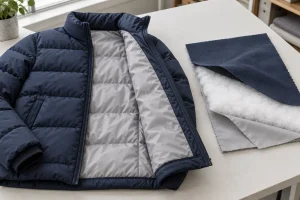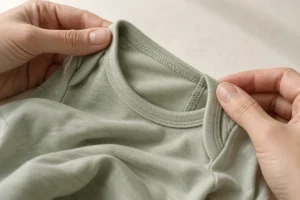
Modal vs cotton is one of the most common fabric questions in product development, and it rarely has a clean answer. Modal is usually the stronger starting point when you want a smooth hand, fluid drape, and soft next-to-skin comfort. Cotton is usually the more versatile starting point when a garment needs structure, a wide choice of knit and woven constructions, familiar care behavior, or easier sourcing. Neither fiber wins automatically. The right choice depends on the finished fabric specification, the garment’s use, your supplier route, and your test results — and for some products, a modal-cotton blend beats both.
What Are Modal and Cotton Fabrics?
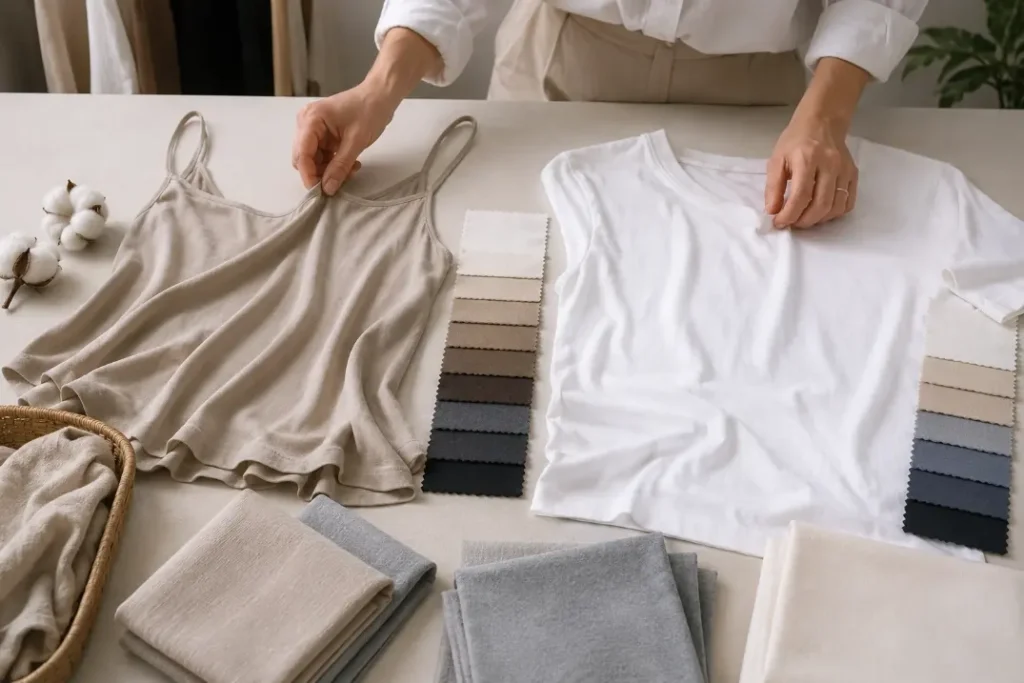
Cotton is a natural seed fiber. Modal is a manufactured regenerated cellulosic fiber. Both are cellulose at the molecular level, which is why they dye similarly, absorb water, and blend well — but they are formed in completely different ways, and that changes what evidence you can get about them.
How Cotton Becomes Fabric
Cotton grows on the plant as a staple fiber of finite length. After ginning it is graded on properties including staple length, fineness, strength, and uniformity, then spun into yarn — and the spinning system already sets much of the final hand. Ring-spun yarn from longer, combed fiber gives a smoother, stronger, less fuzzy surface than open-end yarn from shorter fiber, before anyone picks a knit or weave.
That yarn then becomes jersey, rib, interlock, fleece, poplin, twill, gauze, canvas, or denim, and goes through dyeing and finishing. Every stage moves the result, which is why “is cotton soft?” has no useful answer. Cotton is a category, not a specification. For the range of constructions available, see HAPA’s guide to the types of cotton fabric.
How Modal Becomes Fabric
Modal starts with cellulose obtained from wood pulp. During the modal fabric production process, the cellulose is dissolved, regenerated into fiber, cut to the required staple length when appropriate, and spun into yarn. The resulting yarn can be knitted or woven alone or blended with cotton, elastane, and other fibers.
Modal is therefore neither a raw plant fiber like cotton nor a petroleum-based synthetic such as polyester. Describing it as a regenerated cellulosic fiber is more accurate than forcing it into a simple natural-versus-synthetic label.
Generic Modal and TENCEL™ Modal
TENCEL™ Modal is Lenzing’s branded modal, and the distinction is commercial rather than merely semantic.
Lenzing publishes specific, footnoted claims for its own fiber: TENCEL™ Modal is made with at least 50% less carbon emissions and water consumption compared to generic modal, from wood sourced from certified or controlled sources, and carries the EU Ecolabel.
Read that first claim carefully, because it is routinely misquoted. The comparison is against generic modal — not against cotton. Any page recycling it as a modal-versus-cotton environmental fact has changed its meaning.
Three terms worth keeping straight in specifications and marketing copy:
- Modal — a generic fiber name with a technical definition. Any qualifying mill can produce it.
- TENCEL™ Modal — a Lenzing trademark. Using the mark requires authorization from Lenzing, and the published claims attach to that fiber, not to modal in general.
- Rayon, viscose, lyocell — related regenerated cellulosics. ISO 2076 lists “rayon (US)” as the other denomination for both modal and lyocell, so US label wording needs checking rather than assuming.
Modal vs Cotton: What Are the Differences?
Modal typically leads toward smoother, more fluid fabrics, while cotton provides a broader route to both soft and structured clothing. The table below describes useful starting tendencies, not guaranteed results. Construction, weight, finish, dyeing, and garment design can change the outcome.
| Decision factor | Modal starting tendency | Cotton starting tendency | What the brand must verify |
|---|---|---|---|
| Fiber category | Regenerated cellulosic fiber made from wood-pulp cellulose | Natural seed fiber | Correct generic fiber name and supplier documents |
| Surface feel | Often smooth, fine, and silky | Can range from soft and brushed to dry or crisp | Approved hand standard on the actual fabric |
| Drape | Often fluid and body-following | Varies widely from fluid jersey to firm woven fabric | Silhouette on a sewn sample |
| Structure | Usually less crisp in common lightweight knits | Broad structural range across knits and wovens | Construction, GSM, yarn, and finish |
| Moisture behavior | Can absorb moisture well, but absorption does not prove wicking or fast drying | Absorbent, with airflow and drying affected strongly by construction | Air permeability, moisture transport, and dry-time tests when relevant |
| Shrinkage | Cannot be predicted from the fiber name alone | Some constructions, especially knits, need careful shrinkage control | Dimensional change after the intended care cycles |
| Pilling | Possible in lightweight, fuzzy, or poorly engineered fabrics | Possible depending on fiber, yarn, construction, finish, and use | Pilling resistance on the chosen fabric |
| Color and appearance | Branded modal suppliers may support specific color-retention claims | Dye response varies with cotton quality and processing | Colorfastness and appearance after laundering |
| Sourcing | Supplier and grade evidence can vary; branded programs require verification | Widely available in many qualities and constructions | Traceability, consistency, minimums, and replenishment plan |
| Environmental evidence | Depends on wood source, fiber process, energy, chemistry, and supplier evidence | Depends on farming, geography, irrigation, processing, and certification | Product-specific evidence for any marketing claim |
The main lesson is that a fiber comparison is only the first screening step. A dense cotton jersey can feel warmer than an open modal knit, but a light cotton gauze may allow more airflow than a compact modal jersey. Stabilization and construction can also reverse an expected shrinkage or surface result.
The correct unit of comparison is therefore not “modal versus cotton” in the abstract. It is one documented fabric against another, under the same intended use and care conditions. Readers who want to explore one part of the comparison in more detail can review HAPA’s explanation of modal fabric breathability, while keeping in mind that airflow, absorbency, moisture transport, and drying speed are separate properties.
How Do Modal and Cotton Feel in Clothing?
Wearer experience is where fiber tendencies become commercially real — and where the most confident claims tend to be the least reliable.
Softness and Surface Feel
Modal’s advantage here is consistency. Because the fiber is engineered rather than harvested, staple length and fineness vary far less than in cotton, producing a uniformly smooth surface with a cool initial touch. Lenzing attributes softness in its own fiber to the cross-section and tenacity of TENCEL™ Modal, which it says lets fabrics withstand repeated washing and drying.
Cotton’s range is wider in both directions. A combed, ring-spun, enzyme-washed cotton jersey can feel softer than a mediocre modal; a coarse carded cotton at the same weight will not come close. If softness is a headline claim, fiber choice narrows your risk but does not settle the outcome.
Drape and Silhouette
Drape is a fabric property, not a fiber property, but modal biases toward the fluid end. Its smooth surface and typically fine yarn counts produce fabrics that fall close to the body — good for a slip dress or a drapey lounge pant, a problem if you want a tee to stand away from the torso.
Cotton spans the full range: the same fiber gives you a gauze that moves like air and a canvas that holds shape on its own. If your sketch depends on a silhouette surviving a day of wear, that range is cotton’s strongest argument.
Airflow and Moisture Behavior
This is the section where most comparison articles go wrong, so it is worth separating the concepts:
- Absorption — how much moisture the fiber takes up. Both cellulosics absorb well.
- Moisture transport (wicking) — how moisture moves laterally through the fabric structure. Largely driven by construction and finish, not fiber identity.
- Evaporation and dry time — how fast the fabric releases moisture to the air. Affected by surface area, weight, and finish.
- Perceived clamminess — what the wearer actually notices. A function of all of the above plus fit, layering, and climate.
A fabric can absorb a great deal and still feel damp, because absorption and drying pull in opposite directions. This is why claims like “absorbs more moisture, so it keeps you drier” collapse under inspection — the premise does not lead to the conclusion. If moisture behavior is central to your product, specify comparative testing on matched fabrics for air permeability, moisture management, and dry time, and treat fiber-level claims as a hypothesis.
One boundary worth stating plainly: neither fiber is inherently hypoallergenic or suited to sensitive skin. Skin response depends on the finished product — dyes, finishes, residues, trims, seams, and fit — not on the fiber name.
Which Fabric Performs Better After Washing?
Neither fiber has an automatic durability advantage. Shrinkage, twisting, pilling, fading, stretching, and recovery are outcomes of the fiber, yarn, fabric, finishing, sewing, and care system working together.
Dimensional Change
Cotton fabrics can shrink when tension introduced during spinning, knitting, weaving, or finishing is released by laundering. Knits often need particular attention because their looped structure can relax and change length or width. Controlled finishing, garment washing, pattern allowance, and an appropriate care instruction can improve the result.
Modal fabrics also need dimensional-stability checks. A lightweight knit can grow, distort, or lose shape if its construction and finishing do not support the intended garment. Hanging a wet, fluid garment can add another source of deformation. Test length and width change on fabric, then confirm fit and seam position on a sewn sample.
Pilling and Surface Wear
Pilling is not a simple modal problem or cotton problem. Pills form when loose fibers work to the surface, entangle, and remain attached. CottonWorks durability guidance identifies fiber or blend, fiber dimensions, yarn and fabric construction, finishing, and end use as contributing factors.
A soft, fuzzy hand can sometimes increase surface-fiber movement. A tightly controlled yarn and suitable finish may improve resistance. Because the shopper sees the finished surface rather than the fiber specification, pilling tests and wear trials are more useful than a supplier’s broad promise.
Color and Shape Retention
Color performance depends on the dye system, shade, process control, after-treatment, and care conditions. Dark shades, prints, contrast panels, and products worn against light upholstery or underwear may require different colorfastness checks. Shape retention also depends on recovery, pattern balance, seam construction, and whether the garment is dried flat, hung, or tumble dried.
Care Instructions
Before fabric approval, run a consistent care review rather than relying on a single unwashed swatch:
- Wash the modal, cotton, and blend samples with the same water temperature, detergent, load, and drying method.
- Measure length and width at agreed reference points before washing and after the selected number of cycles.
- Check twisting, side-seam movement, neckline shape, surface fuzz, pilling, shade, print, and hand feel.
- Wear or fit the sample after laundering, because a small dimensional change can affect comfort and grading.
- Set measurable tolerances and a realistic care label before bulk production, then make sure production matches the approved fabric code.
Is Modal or Cotton More Sustainable?
There is no defensible universal environmental winner. A useful comparison needs product-specific information about raw material sourcing, fiber production, energy, water, chemistry, dyeing, durability, consumer care, and the likely end of life.
Raw Material and Traceability
Cotton impact varies with location, climate, irrigation, yield, farm practices, and the chain of custody through ginning and spinning. Terms such as organic, recycled, or preferred cotton require evidence from the relevant program and transaction chain. A generic “natural” label is not enough to describe the whole impact.
Modal starts with wood-derived cellulose, but the origin and management of that wood must be documented. Branded programs can provide a clearer evidence route. For example, Lenzing publishes sourcing, production, identification, and certification information for TENCEL™ Modal. Those program-specific claims do not automatically apply to generic modal from another producer.
Fiber and Fabric Processing
Fiber production is only one stage. Spinning efficiency, knitting or weaving, pretreatment, dyeing, washing, finishing, wastewater treatment, energy source, rejects, and transport all contribute to the fabric’s footprint. A lower-impact fiber route can be undermined by an intensive color or finish, just as a conventional starting fiber can be part of a durable, efficiently processed garment.
Use Phase and Durability
Care frequency, washing temperature, drying, ironing, repairability, and useful life affect the garment after sale. A fabric that retains acceptable fit and appearance for its expected use may avoid premature replacement.
Claims and Certification Evidence
Ask for evidence that matches the exact statement your brand wants to make:
- Fiber producer, country of origin, and chain-of-custody documents for the purchased lot.
- Scope and validity of any certification, including whether it covers the fiber, mill, finished fabric, or garment.
- Product-specific environmental data with its comparison basis, system boundary, method, and date.
- Dye, finish, restricted-substance, and wastewater information relevant to the destination market and buyer policy.
- Approval for any fiber-brand trademark, hangtag, or marketing language before artwork is finalized.
For childrenswear, material selection is only one part of a broader product decision. HAPA’s guide to fabric for children’s clothing can help you consider garment use, construction, and care alongside fiber choice. Any safety or environmental claim should still be supported by finished-product evidence rather than inferred from the fiber name.
When Should Brands Choose Modal or Cotton?
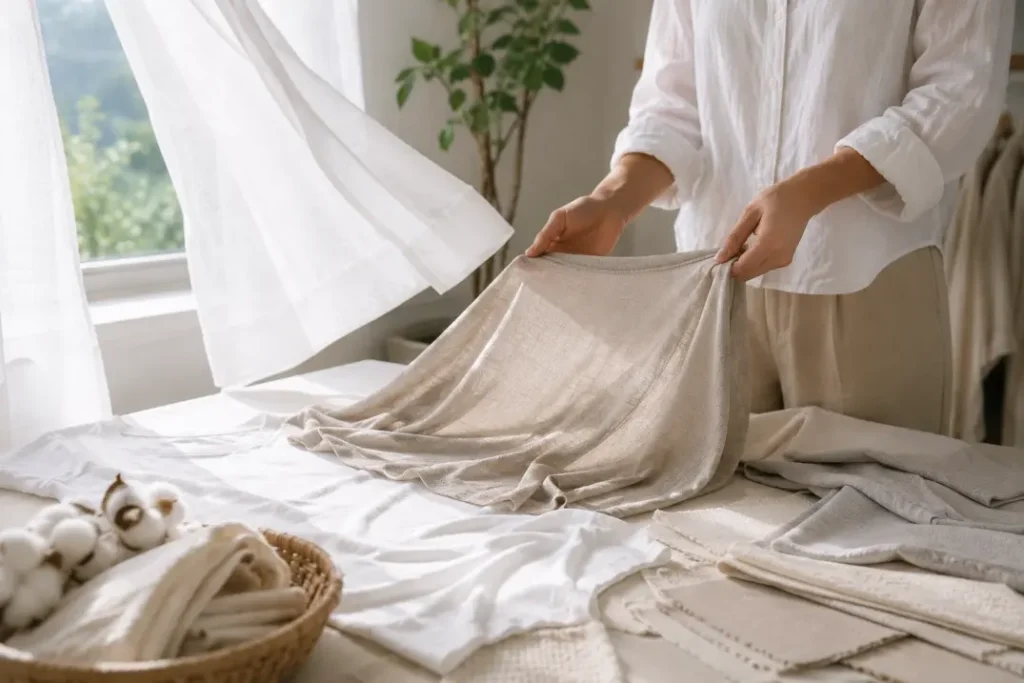
Brands should choose from the product brief, not a general fiber ranking. Modal is a strong sampling candidate for fluid, soft, next-to-skin products. Cotton is a strong candidate when the line needs construction variety, familiar casual texture, or more body.
| Garment type | Main product priority | Modal starting case | Cotton starting case | Blend option | Critical sample check |
|---|---|---|---|---|---|
| Underwear and base layers | Smooth hand, low bulk, recovery | Strong candidate for soft, body-following knits | Suitable where a familiar cotton hand is preferred | Add cotton for body and elastane if stretch is required | Recovery, seam comfort, pilling, and laundering |
| Pajamas and loungewear | Softness, drape, easy care | Strong candidate for fluid jersey or rib | Strong candidate for jersey, interlock, flannel, or woven sets | Useful when softness and structure must balance | Dimensional change, twisting, and hand after washing |
| Everyday T-shirts | Hand, opacity, shape, price | Useful for a smoother premium position | Broad choice across weights and visual textures | Often practical for a softer cotton-led hand | Neckline recovery, spirality, pilling, and opacity |
| Draped dresses and tops | Movement and silhouette | Strong candidate where fluid fall is central | Suitable in soft jersey, voile, or lightweight woven options | Can moderate drape and add body | Drape after washing, seam growth, and shade consistency |
| Sweatwear | Body, warmth, surface durability | Usually needs careful construction or blending | Strong range in terry and fleece structures | Modal may soften selected lightweight styles | Pilling, growth, abrasion, and dimensional stability |
| Woven shirts and structured styles | Crispness and shape | Less common when firm structure is the priority | Strong candidate in poplin, Oxford, twill, and canvas | Consider only after a clear structure trial | Collar, placket, seam, and wrinkle appearance |
| Children’s basics | Comfort, fit, repeated care, age suitability | Candidate for soft pajamas, tees, and base layers | Candidate across knits, wovens, and casual basics | Useful when comfort and shape targets compete | Finished-product safety, fit, trims, wash response, and labeling |
Next-to-Skin Clothing
Modal deserves a place in the first sample round when the commercial brief calls for a smooth surface, gentle drape, and premium hand. Cotton remains relevant when consumers expect a familiar natural-fiber story or when the design benefits from a less fluid touch. For either route, review seams, elastics, labels, and fit because those elements can outweigh small differences in fabric softness.
Everyday Basics
Cotton’s construction range suits broad basics programs. Modal can differentiate a premium T-shirt, lounge set, or soft dress. A blend may provide a smoother hand while retaining useful body.
Structured Garments
Cotton usually offers the clearer route for crisp shirts, boxy dresses, jackets, denim, and utility pieces. Modal can appear in woven or blended options, but the sample must prove that collars, plackets, pockets, pleats, and hems retain the intended shape.
Children’s Clothing
Fiber choice alone does not establish that a product is safe or suitable for children. Age group, fit, drawstrings, attachments, trims, chemical requirements, flammability rules, labeling, and repeated washing all matter. HAPA’s children’s clothing OEM workflow includes fabric and trim selection and sample development, which can help a brand turn a preferred material direction into a physical garment for review before bulk production.
Should You Use a Modal Cotton Blend?
A modal-cotton blend can balance softness, drape, body, sourcing, and price, but the percentage on the label does not predict the complete result. Yarn design, blending method, construction, GSM, finish, and any elastane content still shape performance.
When a Blend Makes Sense
Blending is useful when one fabric direction meets only part of the product brief. Consider testing several development routes:
- For a cotton T-shirt that feels too dry or firm, compare the current cotton with a modal-cotton construction designed for a smoother hand.
- For a fluid modal style that lacks body or appears too clingy, test a cotton-containing option at a similar weight and finish.
- For a close-fitting garment, compare modal, cotton, and blended fabrics with the same elastane target so that stretch and recovery are evaluated fairly.
These are sample scenarios, not standard formulas. The best ratio depends on the problem and the trade-offs consumers will notice.
What the Blend Ratio Cannot Tell You
A label such as 50% modal and 50% cotton does not reveal yarn count, twist, blend uniformity, knit density, weight, finish, shrinkage control, or recovery. Two fabrics with the same composition can feel and perform very differently. It also does not prove that a particular branded modal fiber was used.
How to Compare Blend Options
Ask the mill or supplier to identify the exact fabric code and provide composition, construction, GSM, width, finish, color route, and available test data. Then compare at least two realistic options under the same garment pattern and care procedure. Approve the fabric that meets the product’s priorities rather than the one with the most attractive fiber percentage.
How Should Brands Test Modal and Cotton?
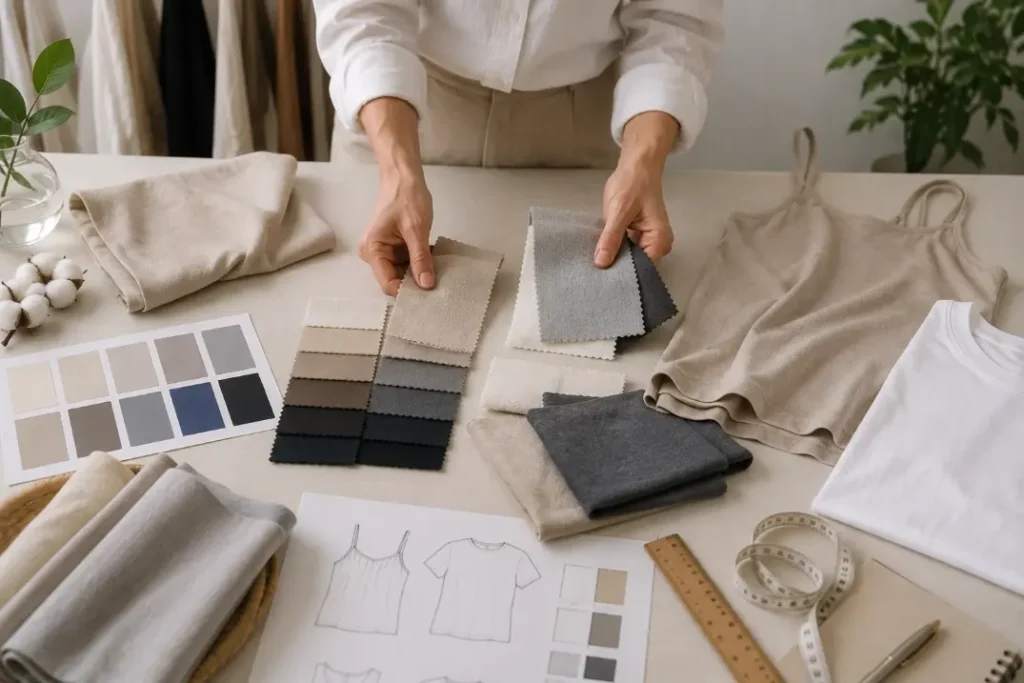
Brands should test comparable fabrics and sewn garments under the intended care conditions, then lock measurable tolerances into the approved specification. An unwashed hand-feel decision is not enough for bulk approval.
A Five-Step Fabric Approval Workflow
- Define the product brief. Record the garment category, target wearer, fit, silhouette, season, price position, target market, expected care, quantity range, and the few performance priorities that matter most. Separate essential requirements from preferences.
- Request comparable swatches. Ask for modal, cotton, and blend candidates that are reasonably close in construction, GSM, color, and finish. Collect the fabric code, composition, yarn information, usable width, finish, source, minimum order conditions, and available reports.
- Test the fabric. Select tests with a qualified laboratory according to the garment and market. Relevant areas can include composition, dimensional stability, pilling, strength, colorfastness, spirality, stretch and recovery, air permeability, moisture behavior, and appearance after laundering.
- Wash and review sample garments. Sew the most promising options in the same pattern. Measure them before and after the agreed care cycles, then review fit, drape, seams, surface, shade, print, trims, and wearer experience.
- Lock the approved specification. Record the supplier, fabric code, composition, construction, GSM tolerance, width, finish, shade reference, performance tolerances, care method, approved sample, and substitution rules. Require written approval before any material change.
Build a Practical Approval Scorecard
A scorecard turns subjective comments into a repeatable decision. Give each candidate a status such as pass, revise, or reject across these groups:
- Identity and supply: supplier, mill, fabric code, fiber composition, branded-fiber proof when applicable, width, minimums, continuity, and traceability.
- Construction: yarn details, knit or weave, GSM and tolerance, finish, usable width, stretch direction, and shade reference.
- Aesthetic result: dry and washed hand, drape, opacity, luster, surface uniformity, print or embroidery compatibility, and silhouette.
- Performance: dimensional change, spirality, pilling, strength, stretch and recovery, colorfastness, abrasion where relevant, and appearance after laundering.
- Garment result: fit, seam behavior, neckline or waistband recovery, trim interaction, wearer comfort, care compatibility, and final measurements.
- Commercial decision: landed material input, sample revisions, production risk, claim evidence, approval owner, and final status.
The laboratory and buyer should agree on current test methods and acceptance levels for the actual end use. A generic supplier report can inform the review, but it does not replace testing of your color, finish, construction, and finished garment.
Use the Sample as a Controlled Reference
A sample lets you see and feel the differences that a specification cannot fully communicate. HAPA’s process for brands that want to review a clothing sample before bulk production covers the brief, material sourcing, sample production, and buyer feedback. The approved sample can become a physical reference for hand, drape, fit, construction, and branding, while written tolerances and laboratory evidence control measurable requirements.
For an efficient request, send the product category, wearer and size range, market, tech pack or reference, construction, GSM, composition options, color, finish, care target, quantity range, required tests, and launch timing. This makes the comparison more useful than asking for a supplier’s “best fabric.”
Check Fiber and Care Labeling
Labeling rules depend on where the garment will be sold. In the United States, the FTC requires covered textile products to disclose fiber content using recognized generic names and percentages by weight, along with other required information. The FTC permits ISO names including modal, but a trademark does not replace the generic fiber identification. The FTC textile labeling guide is a useful US-specific starting point.
Confirm destination-market rules before artwork approval. Fiber composition, country of origin, responsible business identification, care instructions, language, placement, and children’s product requirements may be governed by different laws or standards.
Conclusion
The modal vs cotton decision should end with a tested fabric specification, not a universal winner. Modal is often the better starting candidate for smooth, fluid, next-to-skin clothing. Cotton is often the better starting candidate when you need a wider choice of knit and woven structures, a familiar casual hand, or a firmer silhouette. A modal-cotton blend can help when those requirements compete.
Whichever route you choose, compare like-for-like swatches, sew representative garments, wash them under the intended care conditions, and approve measurable tolerances. Keep generic modal separate from TENCEL™ Modal, treat absorption and wicking as different properties, and support sustainability or safety claims with evidence for the actual product. The best fabric is the one that still meets the brief after sourcing, sewing, testing, care, and real use.
Frequently Asked Questions About Modal and Cotton
Is modal the same as rayon, viscose, or TENCEL™?
Not exactly. Modal, viscose, and lyocell are names used for different regenerated cellulosic fiber routes or categories, although they are closely related and may be grouped within the broader rayon family in some contexts. TENCEL™ is Lenzing’s brand, and its portfolio includes TENCEL™ Modal and TENCEL™ Lyocell. If branded fiber is specified, confirm its identity and use both trademark and generic fiber terminology correctly for the destination market.
Does modal always shrink less than cotton?
No. Fiber behavior can influence shrinkage, but it does not guarantee the dimensional stability of a finished fabric. Yarn, knit or weave, relaxation, wet processing, finishing, garment construction, and washing all matter. Compare actual modal and cotton samples under the same care cycles, measure length and width change, and check fit and seam movement before approving bulk material.
Is modal safe for baby and children’s clothing?
The word “modal” alone cannot prove safety. Evaluate the finished garment for the applicable chemical and physical requirements, colorfastness, trims, attachment security, construction, labeling, age group, and intended use. Avoid unsupported claims such as hypoallergenic, eczema-safe, or child-safe. The same evidence-based approach applies to cotton and blended fabrics.
What modal-to-cotton blend ratio is best?
There is no universal best ratio. Start with the product problem: more softness, more body, better recovery, a different drape, or a particular commercial target. Ask for two or more practical fabric options and compare them at similar weights and constructions. If elastane is included, account for it separately because it can materially change stretch, recovery, fit, and care.
What tests should brands request before bulk production?
Choose tests according to the garment, target market, material, color, and risk. Common evaluation areas include fiber composition, dimensional stability, spirality, pilling, colorfastness, strength, stretch and recovery, appearance after laundering, and care compatibility. Breathability or moisture tests are useful only when those properties matter to the product claim. Agree on current methods and pass criteria with the laboratory, supplier, and brand before testing.