Pick the wrong factory and you’ll feel it in every shipment — seams that fail after three washes, dye that irritates a toddler’s skin, an order that misses your season. Pick the right one, and production stops being something you worry about.
With children’s clothing, the bar sits higher than it does for adult apparel. A garment has to look good, but it also has to be safe against the skin, comfortable for a kid who never sits still, and durable enough to survive the wash, all while matching the price and positioning your brand stands for.
That tension is why knowing how to choose a kids’ clothing manufacturer matters. This guide walks you through where to find candidates, how to vet them, and how to validate quality before you commit to bulk.
Why Choosing the Right Kids’ Clothing Manufacturer Matters
Adult apparel forgives a lot. A loose thread or a half-size-off fit annoys a grown customer; it rarely puts anyone at risk. Children’s clothing doesn’t get that grace. After enough time around kidswear production, the pattern is hard to miss: the factory you pick sets the ceiling on everything downstream — your safety record, your quality, and how fast you can grow.
That is why it pays to understand how to find a reliable kids’ clothing manufacturer before you compare prices or place your first order.
Kids’ Clothing Demands Higher Safety and Comfort Standards
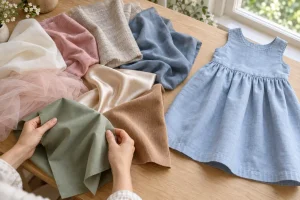
Young children have thinner, more reactive skin than adults, so fabric choice isn’t a comfort preference; it’s a safety decision. Soft, breathable, non-irritating materials and low-impact dyes lower the risk of rashes and overheating in kids who can’t always tell you something feels wrong. A manufacturer who lives in children’s wear treats this as the starting point, not an upgrade.
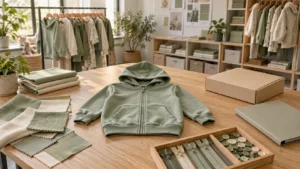
The physical hazards are where the rules get specific. Snaps and buttons have to hold under a determined pull, small detachable parts are a choking risk for anyone under three, and drawstrings are tightly controlled. In the U.S., the CPSC treats hood and neck drawstrings on children’s upper outerwear in sizes 2T to 12 as a substantial product hazard, and limits waist and bottom drawstrings on sizes 2T to 16 to three inches outside the channel, with no toggles or knots. A factory that builds children’s clothing every day designs around these constraints by default. One that doesn’t will hand you a liability you won’t catch until it’s on a shelf.
Manufacturing Quality Directly Impacts Your Brand Reputation
Parents are a tough audience. They notice when a tee pills after two washes, when a 4T shrinks to a 3T, when color fades or a seam gives up — and they rarely complain. They just quietly stop buying. In children’s wear, where the same parent might reorder every few months as their kid grows, that lost repeat purchase is expensive. Consistent construction is what turns a first order into a loyal customer, and your manufacturer is the one holding that consistency batch after batch.
A Reliable Manufacturer Helps You Scale
Quality keeps customers; reliability lets you grow. A partner you can scale with shows up in a few concrete ways:
- Delivery you can plan around. Hitting agreed ship dates so you can commit to a drop calendar and retail buyers without hedging.
- MOQs that match your stage. Minimums low enough to launch and test styles, with room to move into bigger runs as demand proves out.
- Real development support. Help with prototyping, sampling, and customization so you’re not carrying every technical detail alone.
- Reorders done right. Repeating a bestseller without quality or color drifting between batches.
Get these right and the relationship compounds. The factory learns your standards, your sizing, and your expectations, and each season runs smoother than the last. That’s the case for a long-term partner over chasing the lowest quote every time.
How Quality Problems Become Returns and Bad Reviews
Every defect eventually lands on a balance sheet or a product page. A bad batch means returns and refunds, and in children’s wear a safety complaint can escalate to a recall, both costing far more than the production saving that caused them. The damage is also public and permanent: a one-star review describing a rash or a broken snap sits there for the next shopper to read, and it’s hard to outrun. Solid manufacturing is the cheapest insurance you can buy against all of it.
Where to Find Kids’ Clothing Manufacturers
There’s no shortage of places to find a factory. The channels differ mostly on one axis: how much vetting they leave on your plate. The easiest to access tend to be the noisiest; the highest-signal ones cost more time or money up front. Most founders end up working a few of these in parallel.
Start Online: Directories, Search, and Social
The fastest place to begin is a B2B sourcing platform. Alibaba, Global Sources, and Made-in-China.com list thousands of suppliers with filters for product type, certifications, and order size, while Western-focused directories like Maker’s Row and ThomasNet cover domestic options. The reach is huge, and so is the noise. Plenty of listings are trading companies reselling other factories’ output, so treat these as a starting pool, not a shortlist.
Google search and manufacturer websites work better than people expect, with one catch: the best production factories are often terrible at SEO. They optimize for output, not search ranking, so your strongest candidate might sit on page three behind a dated website. Go past the first page, and read a factory’s own site for the details that matter — capabilities, certifications, and the markets they already serve.
Social media and LinkedIn earn their place in vetting more than in cold discovery. LinkedIn lets you find and message the actual decision-makers at a factory instead of a generic sales inbox, and an Instagram feed showing real production lines and finished garments tells you more about true capability than any directory listing.
Meet Them in Person: Trade Shows and Sourcing Trips
Seeing fabric, handling samples, and meeting the people behind a factory cuts months off the process. Two formats are worth the travel.
Trade shows and apparel expos put dozens of vetted suppliers in one room. For kidswear, CBME in Shanghai is Asia’s largest baby and maternity expo and Kind + Jugend in Cologne is Europe’s leading children’s products fair, alongside Pitti Bimbo, Playtime, CIFF Kids, and Bubble London, with MAGIC Las Vegas covering broader U.S. apparel sourcing.
Manufacturing hubs let you compare many factories in a few days: Guangzhou and the Pearl River Delta for broad kids’ wear, Tiruppur (India) for knits, Dhaka (Bangladesh) for volume, and Istanbul for fast turnaround into Europe.
Work the Network: Referrals, Agents, and Associations
The most trustworthy leads come through people who’ve already taken the risk.
Referrals from other brand owners are the highest-trust option — just confirm the factory fits your category and volume, not only someone else’s.
Sourcing agents can shortlist and manage factories when you lack overseas experience; understand how yours is paid and whether they’re truly independent.
Associations and trade networks — apparel bodies, chambers of commerce, export councils — keep member directories with a baseline of legitimacy an open marketplace lacks.
Search the Certification Databases — the Underused Move
Almost nobody uses certification databases to find suppliers, only to check them. But you can search them directly, and for a category this compliance-sensitive that makes them one of the strongest starting filters you have:
- The GOTS Public Database lists certified entities across the supply chain by location, field of operation, and product category.
- The OEKO-TEX Buying Guide is a searchable directory of certified manufacturers and brands you can source partners from.
The payoff is two jobs in one: you discover and pre-screen factories at the same time, since every name already holds a certificate you can verify by its license number. It works in reverse, too. A supplier claiming certification but missing from these databases is a red flag, and because certificates lapse annually, current status is what counts.
How to Vet a Manufacturer: The Criteria That Matter
Once you have a shortlist, the real work starts. The goal isn’t the lowest quote; it’s the factory that can make your product safely, consistently, and at a true cost that protects your margin. Run each candidate through these criteria, roughly in order, since the early ones are pass/fail.
Start With Safety and Compliance — It’s Pass/Fail
If a factory can’t meet the safety rules for your market, nothing else matters. For the U.S., the baseline is specific and non-negotiable:
- Third-party testing and a CPC. Children’s products have to be tested by a CPSC-accepted third-party lab, and the manufacturer or importer must issue a written Children’s Product Certificate confirming compliance.
- Lead limits. Accessible parts of a children’s product can’t exceed 100 ppm of total lead content.
- Tracking labels. Every children’s product and its packaging must carry permanent markings identifying the manufacturer or importer, the batch or lot, and the date and place of production.
- Sleepwear flammability. If you make pajamas, children’s sleepwear answers to its own flammability standards under 16 CFR Parts 1615 and 1616, far more demanding than the rules for everyday garments — on top of the drawstring limits above.
The nuance most guides miss: plain natural or man-made fabric is generally exempt from third-party lead testing, but adding a screen print, transfer, or decal voids that exemption, and the component has to be tested. Non-textile parts like snaps and zippers were never covered either. A factory that lives in kidswear sources its trims and prints accordingly; one that doesn’t hands you a testing bill — or a failure — you didn’t see coming.
Above the legal floor, OEKO-TEX STANDARD 100 and GOTS (for organic claims) aren’t required but are increasingly expected by buyers and parents. And starting July 8, 2026, importers must file CPC data electronically through U.S. Customs’ ACE system at the time of entry, not on request — so a factory’s paperwork discipline now affects whether your shipment clears. Ask to see real certificates and recent test reports, not just claims they exist.
Match Production Capability to Your Product
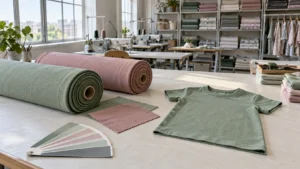
A factory that’s great at knit basics can be wrong for structured outerwear or woven dresses. What matters isn’t whether they’re “good” but whether their core competency matches your product, so ask what they make most, which fabric weights (GSM) they handle well, and to see samples close to your category. Quality control lives here too: a serious factory runs in-line checks and a final inspection against an agreed AQL before shipping. If they can’t describe their QC process, you’ve just been volunteered as their inspector.
Look Past Unit Price to True Landed Cost
The price per piece is the smallest part of what you’ll pay. A low FOB number can land more expensive than a higher one once you add sampling and development fees, recurring lab testing, duties, freight, customs brokerage, and labeling. Two wrinkles right now: duties vary by fabric and classification and tariff rates have been moving, so today’s number may not hold next quarter; and quotes come on different terms — FOB, CIF, DDP — that include different things. Build a landed-cost-per-unit figure for each factory on the same basis before comparing. The cheapest quote and the cheapest garment are rarely the same one.
Understand the Real MOQ — Garment vs. Fabric
Everyone asks the garment MOQ; the number that actually constrains you is the fabric minimum. A factory may run 100 pieces, but the mill won’t dye less than a set quantity per color, so your real minimum per colorway sits well above the garment minimum — that’s how “100 pieces” becomes 300 per color once you pick your shades. Ask both: the per-style minimum and the dyeing minimum per color. Then ask whether they hold stock fabrics, since that’s often the only route to a genuinely low launch quantity.
Check Sizing, Grading, and Reorder Continuity
Kids’ sizing runs newborn to about 14 years, and grading a pattern cleanly across that span is harder than it looks. Ask how a factory grades and whether they can localize to your markets’ size systems — US, UK, EU, and Australian sizing don’t align, and a fit that’s right in one is off in another. Continuity matters over time, too: when a style sells, can they reproduce it without color drifting between dye lots, and will they hold fabric so reorders match? That repeatability is what keeps a hit a hit.
Weigh Communication, Lead Times, and Ethics
How a factory communicates before you’ve paid is the clearest preview of the relationship: quick, specific answers and a single point of contact are good signs; vague, slow replies don’t improve after the deposit. Match their lead times and spare capacity to your seasonal drops and growth. Finally, ethical and social compliance: audits like BSCI, WRAP, and Sedex/SMETA verify safe conditions and fair labor, and for a brand selling to parents — and to retail buyers who now require it — that’s not optional. It protects the kids wearing your clothes, the people making them, and your brand.
Validate Quality Before You Commit to Bulk Production
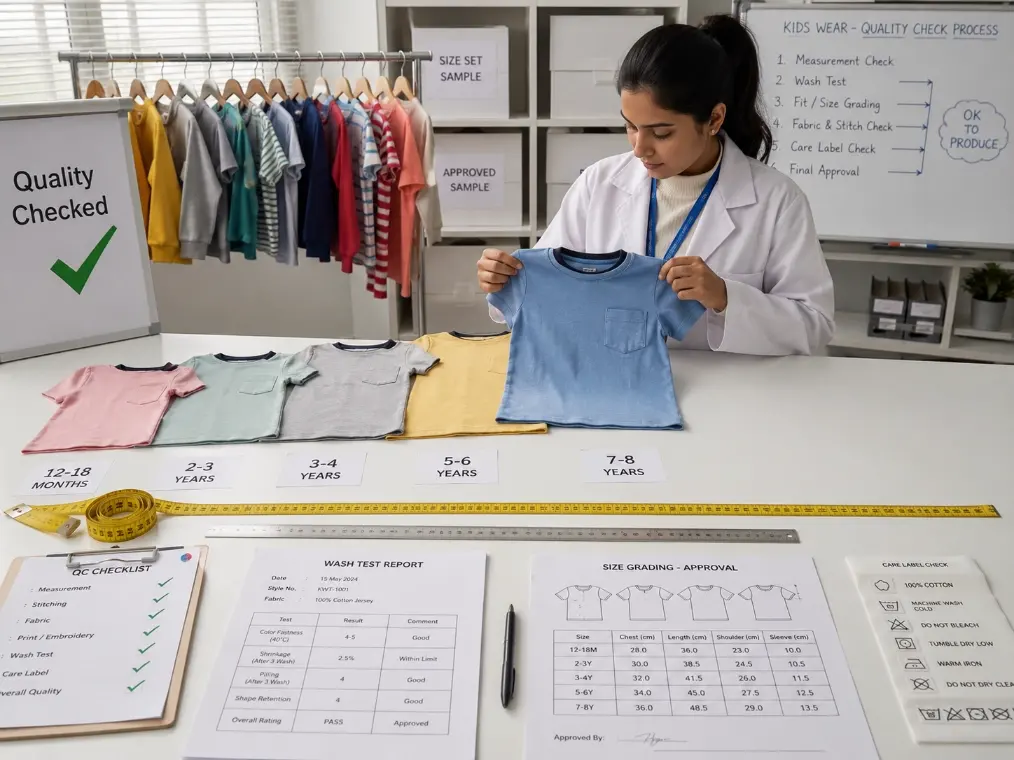
A sample can look perfect on your desk and still fail in a washing machine or fall apart across a size run. Two checks before you approve bulk catch most of what goes wrong: a real wash-and-wear test on the production sample, and a full size-set approval. Build both into your contract so the factory knows the standard up front.
Wash- and Wear-Test the Production Sample
Test the finished pre-production sample, not just a fabric swatch, using the same care instructions you’ll print on the label. Agree the test plan before anything goes in the wash: water temperature, drying method, cycle count, and the pass/fail limits. “It passed” means nothing without those numbers.
Ask for a written report with the style number and materials, the wash conditions and cycle count, before-and-after measurements at key points (body length, chest, sleeve, inseam, waistbands, necklines, cuffs), photos, and clear pass/fail results. Set your tolerances in advance — maximum shrinkage, acceptable color change or transfer, no seam twisting or puckering, no print cracking or peeling, and trims that still work after washing.
Knitwear, leggings, babywear, ribbed styles, and elastic waistbands need the closest look, since that’s where shrinkage, twisted seams, and poor elastic recovery show up. Then run a short wear test on the high-stress areas — knees, elbows, seat, crotch seams, pockets, cuffs — checking for pilling, abrasion, seam breakage, and shape loss. For playwear, uniforms, and activewear, a brief wearer trial tells you what the wash alone can’t. Don’t release bulk until the results meet your approved sample.
Approve a Full Size Set Before Bulk Cutting
A base-size sample that fits beautifully tells you nothing about how the style grades up and down the range. In kidswear, grading errors turn into returns, complaints, and rework, so validate the full range before anyone cuts bulk.
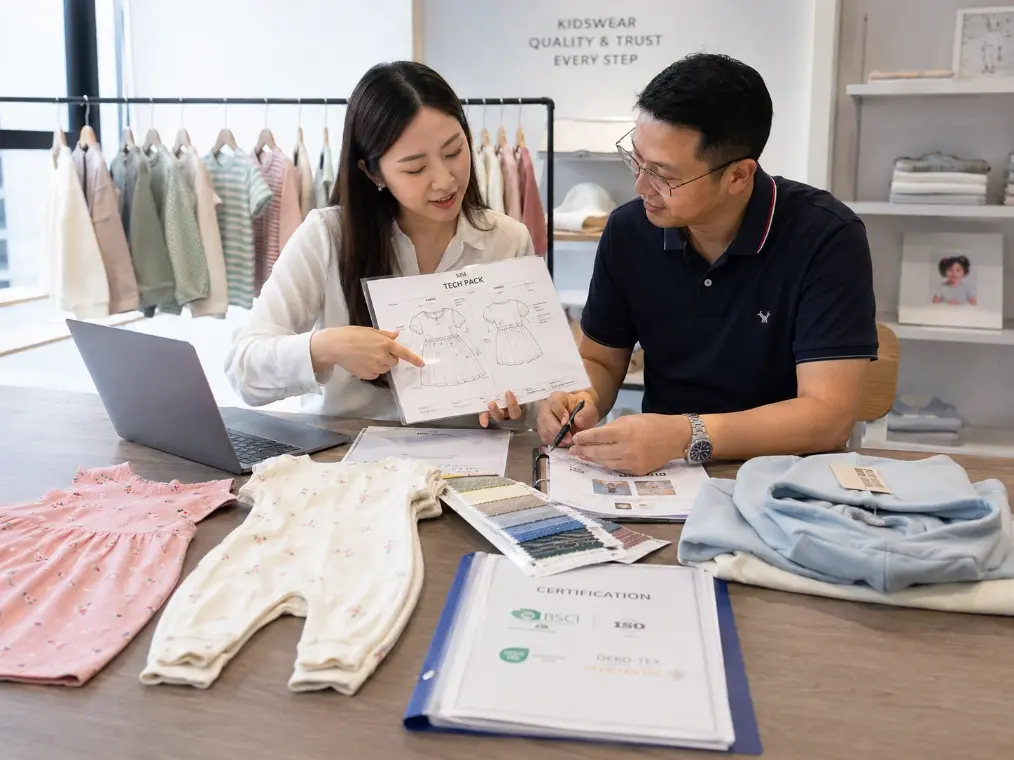
Start from a measurement spec, not age labels. Your tech pack should define every point of measurement, the base size, grade increments between sizes, finished-garment tolerances, and shrinkage allowance. Use a recognized children’s body-measurement standard as a starting point, then adjust for your customer, fabric stretch, and intended fit.
Then have the factory make a full size set — or at least the smallest, base, largest, and one middle size — and review them side by side. Check that proportions stay balanced, that armholes, necklines, and pocket positions scale correctly, that grade increments don’t create sudden jumps, and that the smallest and largest sizes still read as the same design. Measure each size before and after washing, and check fit and freedom of movement when a kid sits, bends, and plays. This matters most for babywear, leggings, dresses, hoodies, school uniforms, and fitted sleepwear.
Once approved, seal and label that size set as the production reference and require the factory to measure first-off pieces in every size before running bulk. A signed size-set record also makes any post-shipment sizing problem far easier to trace.
Why Brands Work With HAPA
For a kidswear brand, the right partner does more than sew. HAPA works with brands from early development through finished production: tech pack review, fabric sourcing, sampling, bulk manufacturing, private labeling, and quality control.
Where HAPA goes deeper than basics is decorated kidswear: sequins, hand-applied beadwork, embroidery, tie-dye, and other detailed finishes for girls’ dresses, partywear, coordinated sets, and statement pieces. These techniques are easy to do badly — a misplaced sequin, a weak bead attachment, or an uneven finish shows immediately and can fail a wash test — so they reward a factory that inspects this work closely.
Working with HAPA gives a brand:
- OEM and ODM support for custom or private-label collections
- Guidance on fabric, fit, trims, and production feasibility
- Sample development before any bulk commitment
- Sequin and beadwork craftsmanship for premium designs
- QC covering stitching, measurements, fabric, and finishing
- Custom labels, packaging, and branding
Whether you’re building a boutique occasionwear line or adding standout styles to an established range, HAPA can help turn a detailed concept into garments that hold up on the shelf and in the wash.
Where to Start
If you do only two things, do these: gate every candidate on safety and compliance first — it’s pass/fail, and everything else is wasted effort without it — then never approve bulk until you’ve signed off a wash-tested sample and a full size set. Price comes after both.
When you’re ready to compare partners on real capability rather than the lowest quote, [request samples and a quote from HAPA] and put them through exactly the checks above.
FAQ
What is the typical MOQ for kids’ clothing manufacturers?
MOQ varies by factory, fabric, and customization. Ready-to-ship children’s apparel may start around 50–100 pieces, while custom OEM/ODM styles commonly require 300–500 pieces per style or color. Ask whether colors and sizes can be mixed, and confirm whether fabric, print, or trim minimums raise the final requirement.
What certifications should a children’s clothing manufacturer have?
There’s no single universal certificate. For U.S.-bound kidswear, confirm compliance with applicable CPSC rules, required third-party testing, a Children’s Product Certificate, and tracking labels. For textiles, request OEKO-TEX STANDARD 100 — especially Product Class I for infants — or GOTS certification when claiming organic content, and review social-compliance audit evidence.
Is it better to manufacture kids’ clothing domestically or overseas?
Neither is automatically better. Domestic manufacturing can make factory visits, communication, and replenishment easier, while overseas sourcing may offer broader fabric networks and more competitive costs at higher volumes. Choose based on MOQ, speed, customization, landed cost, and oversight capacity. Wherever you produce, the brand or importer stays responsible for product compliance.
What’s the difference between OEM and ODM for kids’ apparel?
OEM means you supply the design direction — a tech pack, measurements, materials, and artwork — and the factory produces it. ODM means the manufacturer provides an existing or in-house design that you adapt with colors, labels, or packaging. OEM offers more differentiation; ODM is usually faster to launch.
How long does kids’ clothing production usually take?
Custom kidswear usually takes about 8–12 weeks from development to finished production: roughly 2–4 weeks for sampling and approvals, then 6–8 weeks for bulk manufacturing and quality control. Simple repeat orders can move faster; custom fabrics, embroidery, sequins, multiple revisions, and peak-season capacity can extend the schedule.