When you’re shopping for clothing, flip to the care label and find it’s made from 100% polyester — you shouldn’t be surprised. Today, polyester is the most widely used fabric across the global fashion industry. From the athletic T-shirt on your back, to soft bed linens, to outdoor hardshell jackets, polyester is nearly everywhere.
Yet, many people hold lingering misconceptions about this material: it is not a natural fabrics, and it is often thought to underperform cotton in many key areas. The critical question many people ask is: is wearing polyester harmful to your health?
In this guide, we’ll answer everything you need to know about polyester fabric: from its chemical composition and manufacturing process, to its core advantages and disadvantages, sustainability profile, care tips, and much more. This guide is for you whether you’re shopping for everyday apparel, developing your own clothing line, or simply curious about the fabrics that make up your daily wardrobe.
What Is Polyester Fabric?
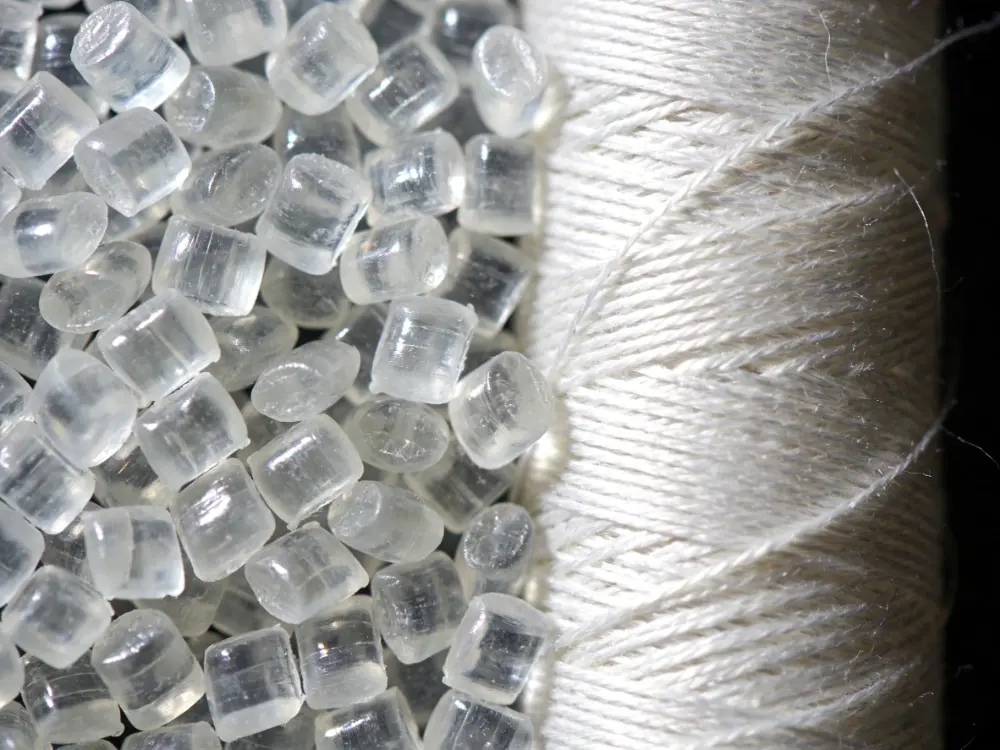
Polyester is a synthetic, man-made textile derived from petroleum. It is the undisputed giant of the textile world, holding the dominant global market share (over 50%) and universally prized for its exceptional durability, wrinkle resistance, and reliable shape retention.
From a chemical perspective, polyester is a polymer primarily composed of Polyethylene Terephthalate (PET) — the exact same raw material used to make standard plastic water bottles.
The Reality: In essence, your performance activewear and your disposable water bottle are close chemical cousins.
Is Polyester a Synthetic or Natural Fiber?
Polyester is a 100% synthetic fiber. Unlike natural fibers (such as cotton, wool, or silk) which are harvested from plants or animals, polyester is artificially synthesized in a controlled laboratory setting. Classified as a form of plastic, it is produced from petroleum, coal, air, and water via a chemical process called polymerization.
The Origin: From Lab to Wardrobe
Polyester was first developed in a British laboratory in 1941, before being scaled to mass industrial production in the 1950s by the American chemical giant DuPont. This innovation forever changed how humans dress.
Thanks to decades of technological refinement, modern polyester delivers a soft, breathable hand feel that rivals natural fibers. It is no longer the “stuffy, plastic-like fabric” of the 1970s, but an indispensable high-performance material woven into nearly every corner of modern life.
A Brief History of Polyester’s Rise
While commercialized in the 1950s, polyester has evolved through three distinct waves of popularity:
- The 1970s (The Disco Era): Polyester became the defining fabric of the decade, celebrated for its ability to hold vibrant, saturated colors and its hassle-free, “wash-and-wear” convenience.
- The 1990s & 2000s (The Athleisure Boom): Fueled by the explosive growth of athleisure and the development of high-performance microfibers, polyester became the gold standard for sportswear and functional apparel.
- The 2010s & Beyond (The Sustainable Turn): The maturation of Recycled Polyester (rPET) technology allowed the material to reinvent itself. Today, it remains the most widely used textile in the apparel industry, accounting for over 60% of all garment fibers produced worldwide.
How is Polyester Fabric Made?
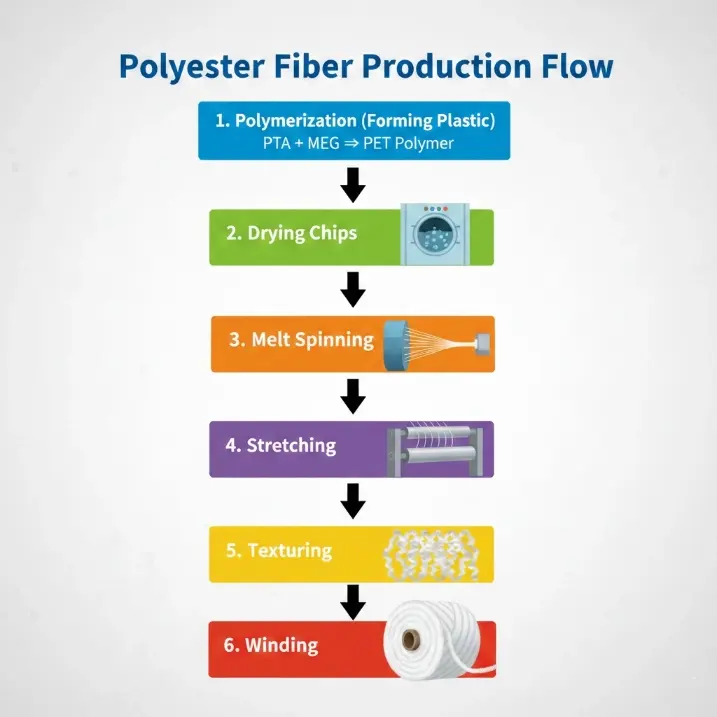
The production process of polyester fabric consists of five core stages: polymerization, drying, melt spinning, drawing, and winding. In simple terms, manufacturers melt solid plastic pellets, force the liquid polymer through microscopic holes to form continuous filaments, then stretch these filaments to create strong, durable yarns.
Step 1: Polymerization (Creating the Plastic)
Purified Terephthalic Acid (PTA) and Ethylene Glycol (EG) undergo a chemical reaction in a reactor to form Polyethylene Terephthalate (PET). The resulting polymer melt is cast into continuous strips, cooled, and cut into small polyester chips — the solid raw material for the subsequent spinning process.
Step 2: Drying the Chips
The polyester chips are fed into drying equipment, where residual moisture is removed via high-temperature hot air. This step is critical: it prevents hydrolysis of the chips during the subsequent melting process, ensuring stable and consistent spinning performance.
Step 3: Melt Spinning
The dried chips are heated and melted into a viscous flow state in a screw extruder. After precision filtration, the melt is metered and fed into a spinneret by a spinning metering pump. The melt is extruded through the microscopic holes on the spinneret to form fine streams, which rapidly solidify into as-spun fibers in cooling air.
Step 4: Drawing
The as-spun fibers are drawn through multiple sets of drawing rollers running at different speeds, aligning the randomly arranged internal molecular chains along the fiber’s axial direction. This process significantly increases the fiber’s breaking strength, giving it the physical and mechanical properties required for practical textile applications.
Step 5: Texturing and Winding
The drawn fibers undergo an oiling treatment to enhance smoothness and antistatic properties, then are precisely wound onto bobbins under constant tension. The final formed yarn cakes are the finished polyester filament yarns, which can be directly used for subsequent textile processing.
Pros and Cons of Polyester Fabric
Is polyester right for your collection? Every fabric has its unique advantages and drawbacks. Understanding these strengths and limitations is the key to choosing garments that match your needs — whether you’re sourcing for durable school uniforms or high-performance athletic tops.
The Advantages
There is a clear reason for polyester’s decades-long dominance. Its chemical structure delivers performance that natural fibers simply cannot match.
- Exceptional Durability & Abrasion Resistance:
Polyester fibers are incredibly tough. They are resistant to tearing, pilling, and abrasion, boasting a lifespan far longer than cotton or linen. This makes it the ideal choice for high-wear garments like workwear and outdoor gear. - Easy Care & Shape Retention:
Polyester is the ultimate “wash-and-wear” fabric. It resists wrinkling effortlessly and requires no ironing. Critically, it holds its shape reliably, snapping back quickly after stretching without sagging (known as elastic recovery), ensuring garments look new for longer. - Superior Colorfastness & UV Resistance:
Unlike cotton, which fades over time, polyester locks in color. It is highly resistant to sunlight and UV degradation, meaning it won’t yellow or fade easily, even with long-term outdoor exposure. - Cost-Effectiveness:
With a mature global supply chain, polyester offers an unbeatable balance of performance and price. It allows brands to produce durable, high-quality garments at an affordable price point.
The Disadvantages
For all its strengths, polyester is not perfect. Its plastic-based nature brings specific challenges.
- Hydrophobic Nature (Poor Moisture Absorption):
As a plastic-based fiber, polyester does not naturally absorb water. Without specialized wicking treatments, it can feel “stuffy” or hot in summer, as sweat gets trapped between the fabric and the skin rather than evaporating. - Breathability Issues:
Standard polyester has a dense fiber structure that limits air circulation. It is generally not suitable for garments requiring high breathability (like everyday underwear) unless it is a specially engineered performance mesh. - Static Build-Up:
In dry environments, polyester generates static electricity. This can cause the fabric to cling to the body, attract dust and pet hair, or create small sparks when removed. - Heat Sensitivity (Thermoplasticity):
While durable, polyester melts under high heat. Extreme exposure (such as high-temperature ironing) can cause the fabric to soften, shine, or deform permanently. - Environmental Concerns:
Since it is derived from petroleum, virgin polyester is non-biodegradable. However, the industry is increasingly mitigating this through the use of Recycled Polyester (rPET), which repurposes plastic waste into new textiles.
Common Types of Polyester You Should Know
Not all polyester is created equal. Depending on the production process and chemical structure, polyester can feel as silky smooth as silk, as sturdy as canvas, or as soft as cotton. Below are the main types of polyester commonly used in today’s fashion industry:
1.Polyethylene Terephthalate (PET)
This is the most prevalent type of polyester used in apparel. Its core component is polyethylene terephthalate, the standard polyester fiber we commonly refer to, widely used in everything from T-shirts to full dresses.
PET polyester is renowned for its exceptional durability, light weight, and wrinkle resistance. If your garment’s care label simply reads “100% polyester”, it is almost certainly made of PET. This makes it the perfect choice for everyday fashion pieces, children’s wear, and all kinds of casual apparel.
2.PCDT Polyester
Compared to PET, PCDT polyester is far less common, but it stands out for its superior elasticity and resilience. Thanks to its unique chemical structure, PCDT fibers are heavier and more durable than standard PET, making it ideal for heavy-duty applications. For example, it is frequently used in interior upholstery, curtains, heavy outerwear that requires extra strength, and industrial garments.
3.Microfiber
As a modern, upgraded iteration of polyester fiber, microfiber is made of ultra-fine polyester filaments even thinner than silk. This extremely fine fiber completely eliminates the “rough” hand feel often associated with traditional polyester, delivering an incredibly soft, luxurious touch.
For this reason, microfiber is the ideal choice for high-end sportswear, moisture-wicking athletic jerseys, and premium cleaning cloths. In addition, when tightly woven, it achieves excellent water resistance, making it a staple material for raincoats and outerwear.
4.Recycled Polyester (rPET)
Recycled polyester is the fashion industry’s leading sustainable solution to the global plastic crisis. It is produced by melting down existing plastic products — most commonly discarded water bottles — and re-spinning them into brand-new polyester fibers.
Compared to virgin polyester, its production process cuts energy consumption by 59% and reduces carbon dioxide emissions by up to 32%. It is undoubtedly an excellent choice for eco-conscious fashion brands, as well as consumers looking to reduce their carbon footprint without sacrificing the fabric’s signature durability.
5.Polyester Blends
When blended with other fibers, polyester often delivers even more balanced, high-performance properties. For example, a cotton-polyester blend cleverly combines the breathability of cotton with the strength and wrinkle resistance of polyester, making it a staple fabric for high-wear items like school uniforms.
Meanwhile, a polyester-spandex blend, enhanced by the stretch of spandex, gives the fabric exceptional elasticity and shape retention, making it perfect for leggings, swimwear, children’s sportswear, and other garments that require flexible, reliable stretch.
Polyester vs. Cotton: Which Fabric Should You Choose?
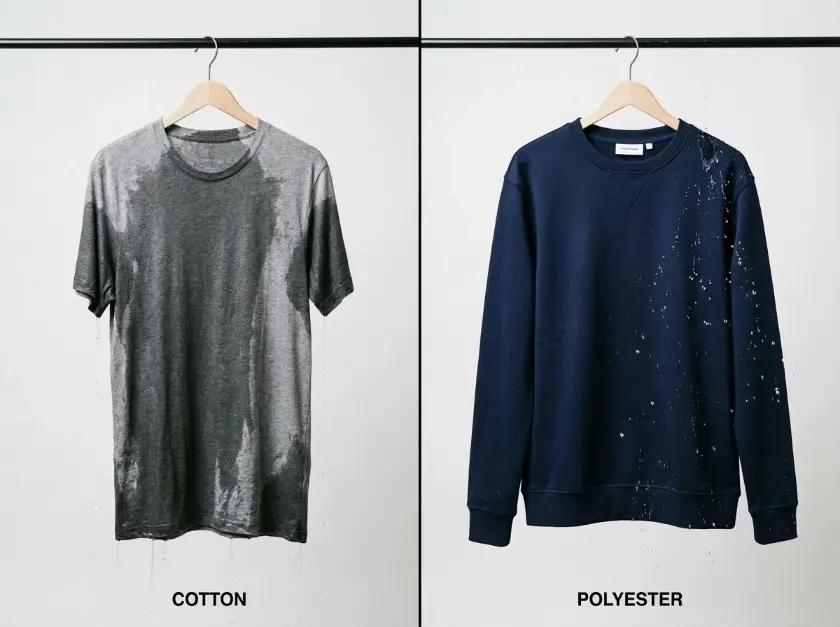
This is the timeless rivalry in the textile industry: natural fiber versus synthetic fiber. For centuries, cotton reigned as the undisputed “King of Fabrics”, but polyester has rapidly claimed the top spot with its unmatched versatility and durability. The truth? Neither fabric is inherently superior or inferior — the right choice comes down entirely to how and where you plan to use it.
| Feature | Cotton (Natural) | Polyester (Synthetic) |
| Source | Natural (Cotton Plant) | Synthetic (Petroleum/Plastic) |
| Breathability | High (Very breathable) | Low (Traps heat) |
| Moisture Wicking | Low (Absorbs sweat like a sponge) | High (Wicks sweat away) |
| Durability | Moderate (Prone to tearing/shrinking) | Excellent (Resists tearing/stretching) |
| Wrinkle Resistance | Low (Needs ironing) | High (Wrinkle-free) |
| Feel on Skin | Soft, natural texture | Smooth, slick, or silky |
| Best For | T-shirts, underwear, summer lounging | Activewear, outerwear, childrenswear |
Quick Summary
- Choose cotton if you prioritize skin-friendly softness for close-fitting, everyday wear.
- Choose polyester if you need exceptional durability, hassle-free care, and reliable performance for high-frequency use or specialized scenarios.
- For the perfect balance of both fabrics’ strengths, a cotton-polyester blend is your ideal solution.
Common Polyester Blend Fabrics
Why choose between comfort and durability? Polyester blends are created by spinning polyester fibers together with natural or other synthetic fibers. This process creates a “hybrid super-fabric” that balances the strengths and mitigates the weaknesses of each individual material.
Below are the 5 industry-standard blends you need to know:
1.Polyester-Cotton (Poly-Cotton / TC)
The Golden Ratio: Typically 65% Polyester + 35% Cotton.
Why choose it: This is the workhorse of the apparel industry. It combines the abrasion resistance and “wash-and-wear” ease of polyester with the skin-friendly softness and breathability of cotton.
Best Application: Ideal for workwear, school uniforms, and casual shirts where you need the fabric to last long and resist wrinkling without sacrificing daily comfort.
2.Polyester-Spandex (The Performance Blend)
The Ratio: Typically 90%-95% Polyester + 5%-10% Spandex.
Why choose it: This blend unlocks 4-way stretch. It leverages the exceptional elasticity and recovery of spandex (elastane) while maintaining the durability of polyester. It ensures garments snap back to their original shape without sagging.
Best Application: The standard for activewear, leggings, swimwear, and yoga pants that require a body-hugging, non-restrictive fit.
3.Polyester-Viscose (Poly-Rayon / TR)
The Ratio: Commonly 65% Polyester + 35% Viscose.
Why choose it: Viscose (Rayon) adds a silky, semi-synthetic softness and excellent moisture absorption, offsetting polyester’s wicking limitations. The result is a fabric that drapes beautifully and feels cool against the skin.
Best Application: Perfect for fashion dresses, blouses, and slacks that require a fluid drape and a more premium hand feel than pure polyester.
4.Polyester-Wool (Poly-Wool)
The Ratio: Typically 50-60% Polyester + 40-50% Wool.
Why choose it: This is the “affordable luxury” alternative. It captures the warmth, breathability, and classic texture of wool but adds the shrink resistance and machine-washability of polyester. It significantly extends the garment’s service life compared to pure wool.
Best Application: A staple for corporate suits, trousers, and coats, offering a professional look with lower maintenance costs.
5.Polyester-Linen (The Summer Blend)
The Ratio: Often 50% Polyester + 50% Linen.
Why choose it: Linen is cool but famously wrinkles the moment you look at it. Blending it with polyester helps retain that breezy, natural “linen look” while drastically improving wrinkle resistance and softening the scratchy texture of raw linen.
Best Application: Ideal for summer resort wear, casual shirts, and curtains, combining natural aesthetics with modern practicality.
Where is Polyester Fabric Produced?
While polyester fabric is used across every corner of the globe, its production is heavily concentrated in Asia. China stands as the undisputed global powerhouse of polyester manufacturing, with industry research showing its production capacity accounts for over 70% to 80% of the world’s total output. Other major producing regions and countries include India, China’s Taiwan region, Southeast Asia (Vietnam and Thailand), and the United States.
Understanding the origin of your fabric is critical to gaining clear insight into its quality and cost structure. Partnering with Chinese apparel manufacturers results in a significantly lower carbon footprint for raw material transportation, as fabric mills are typically located just a few hours’ drive from garment production facilities.
Is Polyester Sustainable?
In general, virgin polyester is not environmentally friendly. Throughout its entire lifecycle — from production and daily use to end-of-life disposal — the fabric poses adverse environmental impacts at every stage.
First, it is derived from fossil fuels. Unlike natural fibers, which are grown from agricultural sources, polyester requires petroleum extraction and a series of complex refining processes, which carry a significant risk of contaminating local ecosystems.
In addition, polyester has an extremely stable chemical structure and is highly resistant to biodegradation. When polyester garments are sent to landfill, they can take between hundreds of years to fully break down.
Peer-reviewed research shows that every wash of synthetic fiber garments (including polyester, nylon, and acrylic) releases tiny plastic fibers known as microplastics. This is catastrophic for marine life, and also contaminates drinking water supplies across the globe.
That said, the global textile industry is actively working to mitigate these environmental harms. Through recycling and reuse, technological upgrades, and raw material substitution, the sustainability profile of polyester can be drastically improved. Many manufacturers are rapidly shifting to recycled polyester (rPET), a material that reduces energy consumption by up to 50% and cuts the volume of plastic waste sent to landfills.
Is Polyester Fabric Cheap?
In general, polyester is indeed more affordable than natural fibers including cotton, wool, and silk, ranking among the lowest-cost textiles manufactured globally. Today, standard polyester fabric typically retails between $2 and $10 per yard, with prices subject to daily market fluctuations.
As a petroleum-derived synthetic fiber produced on an enormous global scale, polyester enables manufacturers to tightly manage and reduce production costs. As a foundational textile raw material, it is an exceptionally cost-effective choice for production teams, which has cemented its position as the workhorse of the mass-market apparel industry.
However, “low-cost” does not always equate to “low quality”. In fact, the production costs of high-performance polyester microfibers and recycled polyester (rPET) are often higher than those of conventional cotton.
Key Applications of Polyester Fabric in the Fashion Industry
From high-performance sportswear for professional athletes to durable school uniforms for first graders, polyester is truly the “chameleon of the textile world”. It can be engineered into a vast range of textures and weights, making it the go-to fabric for nearly every apparel category.
Sportswear: Why Polyester is the Gold Standard
If you check the care label of your favorite workout gear from brands like Nike, Adidas, and Lululemon, you will almost certainly find it reads “100% polyester” or a polyester blend.
Polyester is the undisputed fabric of choice for athletic apparel. Its core advantage lies in superior moisture-wicking performance: through profiled cross-section technology, it rapidly draws sweat away from the skin’s surface and accelerates evaporation, keeping the body consistently dry.
At the same time, it boasts high tensile strength, exceptional elastic recovery, and a lightweight, quick-drying nature. It withstands intense stretching and friction without losing its shape, making it perfectly suited for every athletic scenario, from yoga wear to basketball uniforms.
Casual Apparel: Shirts, Pants, Dresses, and Denim Blends
Polyester meets diverse everyday wear needs through blending with different fibers.
Silk-like polyester filament is widely used for shirts and dresses, combining the luxurious luster of real silk with the practicality of wrinkle resistance and easy care.
Polyester-viscose (T/R) fabric is a classic choice for suit pants and casual trousers, delivering reliable structure and shape retention. Polyester-cotton blends create lighter, drier, stretchier denim, eliminating the restrictive tightness of traditional 100% cotton jeans.
Outerwear: Warmth, Windproofing, and Water Resistance
Polyester is the ideal material for outdoor protective apparel, balancing both protective and thermal functions.
Thermal Performance: Fleece jackets are actually made entirely from polyester! Through a brushing process, polyester fibers form tiny air pockets that trap body heat, keeping you warm without the heavy bulk of wool.
Wind & Water Resistance: As a plastic-based fiber, polyester can be tightly woven to block out wind. When treated with a Durable Water Repellent (DWR) coating, it becomes the perfect core fabric for raincoats, down jackets, and parkas.
Swimwear, Underwear, and Shapewear
In close-fitting wear and water-based environments, polyester’s durability and stability stand out. Swimwear made with chlorine-resistant polyester holds up far better than standard fabrics against pool chlorine and UV sun exposure, staying snug and shape-retentive even after repeated use in water.
In underwear, it is commonly used in side panels and structural areas to ensure no deformation after repeated washing. Shapewear relies on the combination of high-stretch polyester and spandex to deliver consistent, even compression and recovery, remaining tight and supportive even with long-term wear.
Kids’ and Infant Apparel: A Parent’s Best Friend
For active children, polyester’s stain resistance and durability are incredibly practical. Its smooth surface is non-absorbent to most common stains, making spill and mess cleanup effortless.
Its exceptional abrasion and wrinkle resistance make kids’ clothing hard-wearing and shape-stable—qualities that the best kids clothes brands rely on to drastically reduce the daily care burden for parents.
It is commonly used in kids’ outerwear, pants, and cotton blends, balancing reliable comfort with the resilience to keep up with a child’s daily adventures and growth.
Is Polyester Good for Children’s Skin?
Currently, the majority of clothing on the market contains polyester. To be honest, pure polyester is generally not the best choice for children’s base layers.
When selecting next-to-skin garments for your child — such as undershirts, underwear, or pajamas — I strongly advise against polyester. Instead, opt for natural, moisture-wicking, and highly breathable materials like 100% cotton, bamboo, or modal.
How to Wash Polyester
One of polyester’s biggest selling points is its incredibly easy care routine. However, “easy care” does not mean “no care required”. As a synthetic, plastic-based fiber, polyester reacts differently to heat and chemicals than natural fibers like cotton. Follow these simple steps to keep your polyester garments looking brand new for years to come.
Washing Instructions
Soak garments in cold or lukewarm water, with the temperature strictly controlled below 30-45℃. Use a standard synthetic laundry detergent, and avoid bleach entirely. For heavily soiled areas like collars and cuffs, gently scrub with a soft-bristled brush. Both machine washing and hand washing are suitable for polyester fabrics.
Drying Guidelines
After washing, gently squeeze out excess water and air dry in a cool, shaded area. Avoid direct harsh sunlight, as UV rays can damage polyester fibers and cause fading. Minimize the use of tumble dryers, as high heat can lead to shrinkage and permanent wrinkling.
Special Care Tips
- For polyester-wool blends: Use a mild, neutral detergent, or opt for professional dry cleaning to preserve the fabric’s texture and shape retention.
- For spandex-blend athletic wear: Ensure wash water temperature does not exceed 40℃ to protect the fabric’s elasticity and stretch recovery.
- When ironing: Always use a damp pressing cloth between the iron and the garment, iron on a medium-low heat setting, and never let the iron come into direct contact with polyester fabric to avoid melting or scorching.
Conclusion
The advent of polyester sparked a revolution in the global textile industry. Today, it is ubiquitous in apparel manufacturing—powering everything from simple everyday T-shirts to the exquisitely crafted sequined party dresses that define HAPA’s expertise.
While its environmental impact cannot be ignored, the industry is in a state of continuous evolution. Manufacturers are working relentlessly to minimize this footprint through recycled innovations (rPET) while preserving the fabric’s signature high-performance benefits.
Why HAPA Chooses Performance Polyester
As an experienced children’s apparel manufacturer, HAPA understand that children play with boundless energy. That is why we select premium, high-performance polyester blends for our collections. We are committed to creating children’s apparel that is:
- Stain-Resistant: Ready for messy play and easy to clean.
- Shape-Retentive: Snaps back to fit perfectly, wear after wear.
- Vibrant & Durable: Remains lustrous and like-new even after repeated machine washing.
Whether you are sourcing hard-wearing school uniforms or eye-catching party wear, understanding your fabric is the first step to making smarter, more durable, and more responsible fashion decisions.
FAQ
Is polyester fabric plastic?
Yes, polyester is essentially plastic; it is made from polyethylene terephthalate (PET), the exact same polymer used to make clear water bottles.
Because it is derived from petroleum, it shares many properties with plastic, such as being water-resistant, durable, and melting rather than burning when exposed to high heat.
Is polyester fabric a good fabric?
It is excellent for durability and performance, as it resists wrinkles, shrinking, and fading better than most natural fibers. However, it is generally considered “bad” for breathability and comfort in hot weather because it traps heat and moisture against the skin unless chemically treated.
Is polyester fiber a natural or synthetic fiber?
Polyester is a 100% synthetic (man-made) fiber, created through a chemical reaction involving coal, petroleum, air, and water. Unlike cotton or wool, which are grown or harvested from animals, polyester is extruded from a machine into long, continuous filaments.
Is polyester fiber biodegradable?
No, traditional polyester is not biodegradable and can take anywhere from 20 to 200 years to decompose in a landfill.
Furthermore, as it breaks down, it does not return to nature but instead fragments into millions of tiny microplastics, which can pollute oceans and waterways.
What is the difference between polyamide and polyester?
Polyamide (commonly known as Nylon) is softer, stretchier, and more durable than polyester, making it the preferred choice for lingerie, swimwear, and hosiery.
Polyester is generally rougher, less expensive, and more heat-resistant, making it ideal for outerwear, t-shirts, and everyday clothing that requires frequent washing.