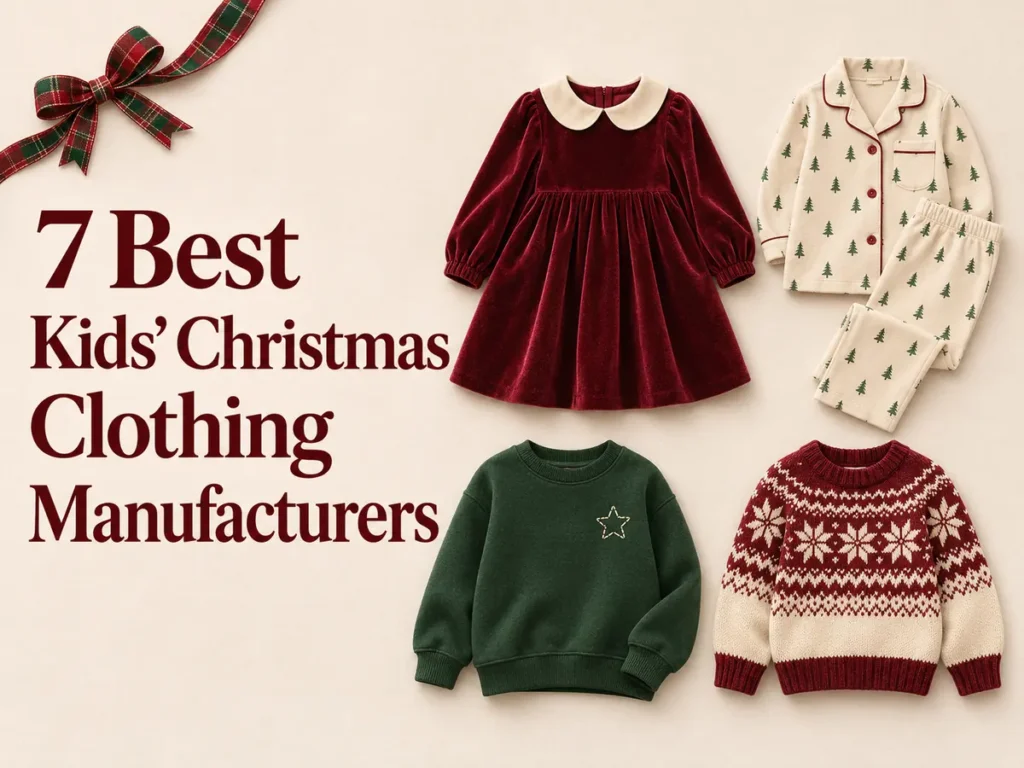
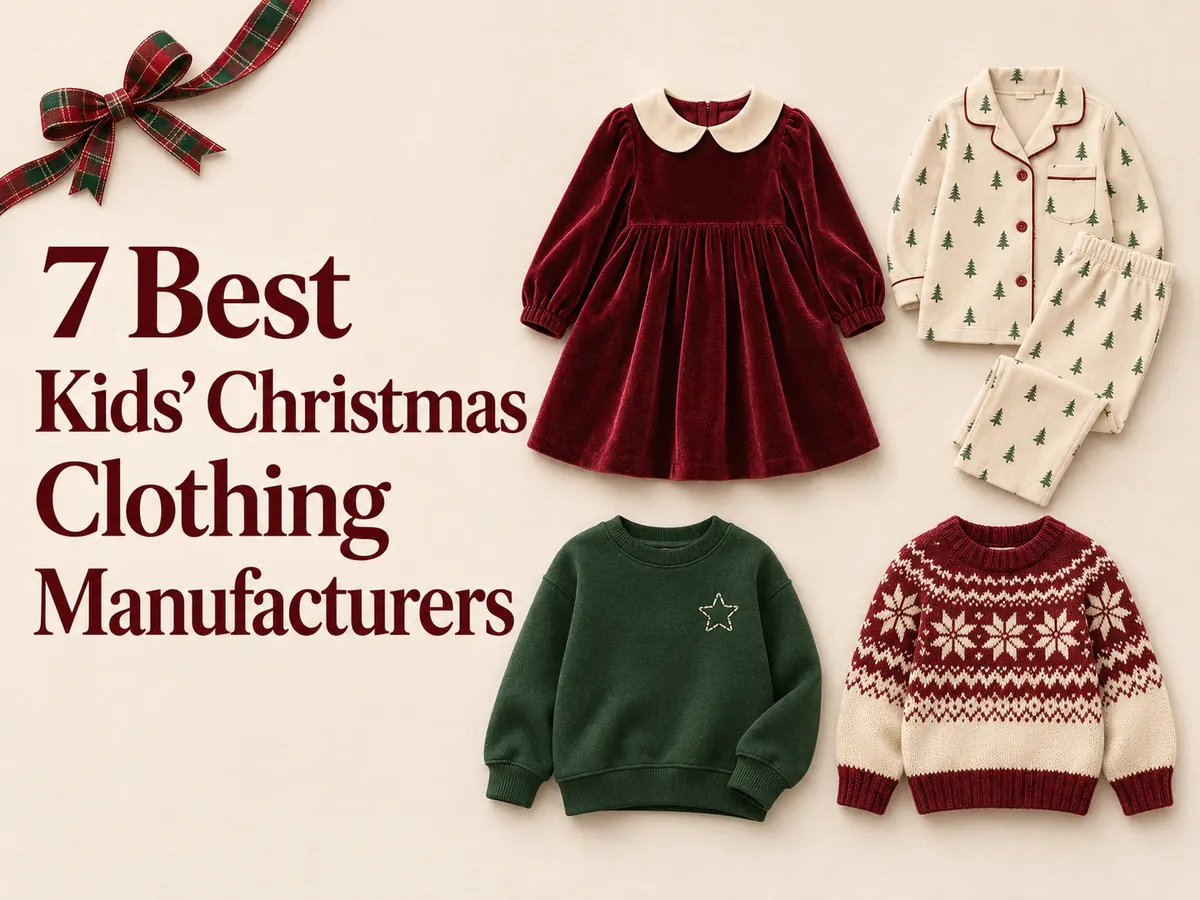
Christmas collections may share the same festive colors, but they do not share the same manufacturing requirements. A hand-smocked holiday dress, a printed children’s pajama set, and a jacquard Christmas sweater each need different fabrics, equipment, and sample approvals.
This guide compares seven kids’ Christmas clothing manufacturers by their product strengths, customization services, and published order requirements. It also covers wholesale versus custom production, fabric choices, seasonal deadlines, and the details clothing brands should settle before placing a holiday order.
How We Selected These Kids’ Christmas Clothing Manufacturers
We focused on five factors that help clothing brands find a supplier suited to their Christmas collection:
- Relevant Christmas products: A published offering for holiday dresses, Christmas pajamas, festive sweatshirts, Christmas sweaters, or coordinated kidswear.
- Manufacturing specialization: Experience with the actual garment construction, such as smocking, garment sewing, all-over printing, or knitted jacquard motifs.
- Customization options: The availability of OEM/ODM, private labels, samples, embroidery, prints, labels, or made-to-order designs.
- Order flexibility: Published minimum order quantities (MOQs) and whether the supplier offers ready-made stock, custom production, or both.
- Seasonal delivery planning: The sample, material, production, and shipping arrangements that matter when a collection has a short selling window.
The resulting shortlist covers different product and purchasing needs, from boutique Christmas dresses to family-matching knitwear.
Compare 7 Kids’ Christmas Clothing Manufacturers
| Manufacturer | Country | Main Christmas Products | MOQ / Purchasing Model | Best For |
|---|---|---|---|---|
| HAPA Garments | China | Girls’ holiday dresses and custom kids’ pajamas | Standard MOQ: 150 pieces; custom OEM/ODM and private label | Brands developing original festive kidswear with decorative details |
| SIUKID | China | Christmas-themed dresses, tops, sets, and other holiday clothing | Holiday OEM/ODM page: 200 pieces per style; separate retailer section mentions 150 pieces | Brands planning coordinated festive collections |
| Babeeni | Vietnam | Smocked Christmas dresses, embroidered outfits, tartan sets | Wholesale: 200 pieces/sets per order, with 50 per design/color and 10 per size stated in its policy | Boutiques seeking classic smocked or embroidered holiday styles |
| Billoomi Fashion | India | Custom Christmas pajamas and children’s sleepwear | Pajamas: 25 pieces/style for simple solid colors; 100 pieces/style when printing or embroidery is required | Private-label brands developing original holiday pajamas |
| Nuohua Garment | China | Kids’ Christmas French terry sweatshirts | Published stock route: 50 pieces; custom route: 100–200 pieces | Buyers comparing fast stock sourcing with customized festive sweatshirts |
| Lin Sweater Factory | China | Kids’ Christmas sweaters and family-matching knitwear | 300 pieces per style and color combination | Brands seeking custom knitted motifs and private-label Christmas jumpers |
| Mr Balaclava | Pakistan | Children’s jacquard Christmas sweaters and matching family styles | 50 pieces per design | Retailers developing lower-volume festive knitwear |
These figures come from the companies’ published product or service information, except HAPA’s 150-piece standard, which follows its current company order policy. Minimums apply in different ways: a 50-piece stock order is not the same offer as 50 pieces of an original custom design. Compare the relevant product, style, color, and size rules before selecting a supplier.
7 Kids’ Christmas Clothing Manufacturers to Consider
1. HAPA Garments
HAPA Garments is a Guangzhou-based children’s clothing manufacturer offering OEM, ODM, and private-label production. Its product range includes girls’ holiday dresses and children’s pajama collections. Brands can discuss custom prints, color combinations, sequins, beadwork, linings, labels, and packaging as part of their festive assortment.
HAPA has 16 years of kidswear manufacturing experience and a reported 6,000 m² factory. Its design and production services cover fabric sourcing, sampling, cutting, sewing, and bulk manufacturing.
- Location: Guangzhou, China.
- Main Products: Girls’ Christmas dresses, partywear, and custom children’s pajamas.
- Services: Custom design development, fabric sourcing, samples, decorative craftsmanship, OEM/ODM, and private label.
- Standard MOQ: 150 pieces; the style and color allocation is determined for the order.
- Best For: Brands that want an original holiday collection rather than a ready-made garment with an added logo.
For festive dresses, the manufacturing brief should specify where decorative elements sit, how the bodice is lined, and how children will put the dress on and take it off. Those details affect the finished garment as much as the front-view design. The same supplier may also make holiday pajamas, but sleepwear needs its own fit and market-safety review.
Related HAPA services: girls’ dress manufacturing and custom kids’ pajama manufacturing.
2. SIUKID
SIUKID offers custom holiday-themed children’s clothing, including Christmas collections. Its services cover design development, fabric sourcing, sampling, branding, and bulk production for brands seeking coordinated festive styles.
- Location: Guangzhou, China.
- Main Products: Christmas-themed dresses, tops, sets, and other holiday kidswear.
- Services: OEM/ODM development, customization, labeling, and packaging.
- Published MOQ: 200 pieces per style on its holiday manufacturing page; a separate retailer section states 150 pieces.
- Best For: Brands creating a coordinated seasonal assortment across more than one garment type.
A collection built around the same red, green, or festive print may use different fabrics for each garment. The samples should be viewed together before approval because the same color reference can look different on jersey, woven cotton, and brushed fabrics. The applicable MOQ should be confirmed for the exact styles being ordered.
3. Babeeni
Babeeni is a Vietnamese children’s clothing manufacturer known for hand-smocking, embroidery, and boutique-style garments. Its Christmas range includes tartan dresses, velvet-collar styles, traditional embroidery, coordinated pant sets, and holiday pajamas.
- Location: Hanoi, Vietnam, with production facilities listed in Vietnam.
- Main Products: Smocked Christmas dresses, embroidered outfits, tartan styles, and festive sets.
- Services: Wholesale collections and custom-design inquiries.
- Published MOQ: 200 pieces or sets for children’s wholesale orders, including 50 pieces per design/color and 10 pieces per size under its published policy.
- Best For: Boutiques seeking traditional Christmas styles and decorative needlework.
Babeeni is particularly relevant when the design depends on the finished look of hand-smocking or embroidery. Buyers should review stitch placement, the inside finish, and how decorative panels scale between sizes. Its published wholesale policy also provides quantity and production information that can help boutiques prepare an initial brief.
4. Billoomi Fashion
Billoomi Fashion is a made-to-order clothing manufacturer in India. Its pajama manufacturing service lists children’s pajamas and Christmas pajamas, making it a possible partner for brands developing their own festive sleepwear prints and garment details.
- Location: New Delhi, India.
- Main Products: Custom pajama sets, including children’s and Christmas sleepwear categories.
- Services: Made-to-order manufacturing, pattern and sample development, fabric sourcing, and private label production.
- Published MOQ: As low as 25 pieces per style for a simple solid-color pajama; 100 pieces per style when printing or embroidery is involved.
- Best For: Brands with original holiday sleepwear designs rather than buyers looking for immediate stock.
The difference between solid-color and printed MOQs is commercially important. A Christmas print may require more material preparation and approvals than a plain pajama. Artwork scale also needs reviewing on the smallest children’s sizes, not only on a full-width fabric swatch.
5. Nuohua Garment

Nuohua Garment, based in Guangdong, China, markets a Christmas-themed children’s French terry sweatshirt with both advertised stock and customization options. Its purchasing routes allow buyers to consider a ready-made festive garment or request changes to the style, print, trim, or packaging.
- Location: Guangdong, China.
- Main Products: Kids’ Christmas sweatshirts and casual festive clothing.
- Services: Stock purchasing, custom printing, trims, labels, and OEM/ODM production.
- Published MOQ: 50 pieces for its ready-stock route; 100–200 pieces for customization.
- Best For: Retailers that want festive casualwear and need to compare stock availability against custom production.
The order model matters more than the label “wholesale.” A hangtag on an available sweatshirt may require less development than a new fabric, all-over print, or fit. Nuohua’s Christmas sweatshirt product page separates those routes; stock quantities by color and size should be checked for the planned order.
6. Lin Sweater Factory
Lin Sweater Factory is a knitwear manufacturer in Dalang, Dongguan, China. Its Christmas program covers children’s sweaters, family-matching knitwear, and private-label jacquard or intarsia patterns. Unlike printing a holiday motif onto a sweatshirt, the design can be knitted into the sweater itself.
- Location: Dongguan, China.
- Main Products: Kids’ Christmas sweaters, reindeer and snowflake designs, and family-matching knitwear.
- Services: Custom knit patterns, yarn and color selection, samples, and private labels.
- Published MOQ: 300 pieces per style and color combination.
- Best For: Brands creating knitted Christmas jumpers or matched adult-and-child ranges.
The proportion of a motif matters across the children’s size range. A reindeer design that works on an adult sweater may fill too much of a toddler front panel. A physical sample in the proposed yarn helps confirm gauge, hand feel, neckline stretch, and artwork placement before bulk knitting.
7. Mr Balaclava

Mr Balaclava advertises children’s Christmas jacquard sweaters from Sialkot, Pakistan, including reindeer and snowman motifs that can coordinate with adult versions. Its listing describes a made-to-order product with brand-label and color options, produced through its own facilities or partners according to the project.
- Location: Sialkot, Pakistan.
- Main Products: Kids’ Christmas jacquard sweaters and matching family styles.
- Services: Made-to-order knitwear, branding, label customization, and packaging.
- Published MOQ: 50 pieces per design.
- Best For: Brands testing a smaller custom Christmas sweater collection.
The company’s children’s product listing shows a starting price of $12.80 per piece at 50–99 units, before shipping and extra customization. This is a published example for one acrylic sweater, not a general price for Christmas knitwear. For children’s orders, the approved size chart and sample should be attached to the production specification.
Ready-Made or Custom Christmas Clothing: Which Should You Choose?
Ready-made stock is useful when the holiday selling window is close. Custom manufacturing is more suitable when a brand has time to approve its own fabrics, fit, artwork, labels, and production samples.
| Purchasing Route | What the Buyer Gets | Main Planning Consideration |
|---|---|---|
| Ready-made stock | Existing styles in available sizes and colors | Confirm the actual inventory and a warehouse arrival date |
| Stock with added branding | An existing garment with agreed labels, packaging, or decoration | Confirm that the chosen stock and decoration can be finished in time |
| Fully custom OEM/ODM | A garment developed to the brand’s specifications | Allow time for sourcing, sampling, revisions, production, inspection, and shipping |
For buyers sourcing late in a Christmas season, a confirmed in-stock option may be more useful than starting a new custom garment. For original products intended for the next holiday season, early development gives brands more room to review samples and resolve material changes.
The key commercial distinction is that adding branding to a finished garment does not create an exclusive design. Brands seeking original silhouettes, unique prints, custom sizing, or knit-in artwork should discuss full custom development.
Best Fabrics and Finishes for Kids’ Christmas Clothing
Christmas styling should never override the practical requirements of the garment. A velvet holiday dress, brushed sweatshirt, knitted jumper, and printed pajama set have different comfort and construction needs.
| Christmas Product | Fabrics or Construction to Consider | What Matters in Sampling |
|---|---|---|
| Girls’ party dresses | Woven cotton, velvet, tulle or decorative outer layers with appropriate lining | Inside comfort, lining coverage, movement, and trim attachment |
| Christmas pajamas | Cotton jersey, interlock, or a suitable stretch blend | Fit, stretch, wash behavior, and destination-market sleepwear rules |
| Festive sweatshirts | French terry or brushed fleece | Weight, warmth, cuff recovery, and print durability |
| Christmas sweaters | Acrylic, cotton blends, wool blends, or other yarns suited to the range | Gauge, neckline stretch, skin feel, and motif scale |
| Coordinated holiday sets | Matching woven or knit fabrics | Color consistency across materials and balanced sizing |
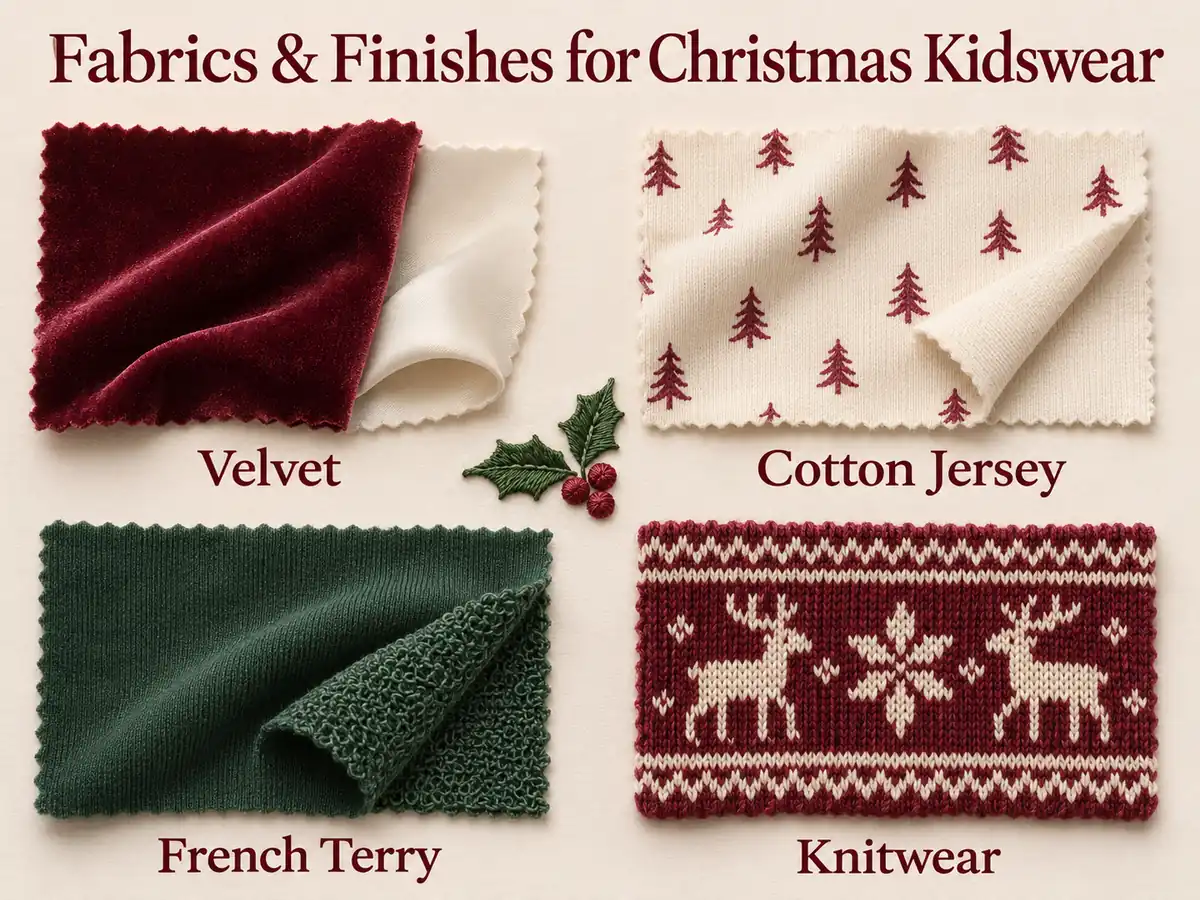
For Christmas clothing, decoration should be approved on the actual production material, not only as a digital image. Sequins, embroidery backing, knitted-in motifs, and printed artwork behave differently on different fabrics. The reverse side and finished garment deserve as much attention as the front view.
What Affects the Cost of Christmas Kidswear Manufacturing?
The cost of a Christmas collection depends on the garment type, fabric, decoration, order quantity, and development work. A small order using a stock fabric may have a very different cost structure from a custom-dyed, embroidered, or jacquard-knit product.
For useful quotations, compare these items on the same basis:
- Garment and material costs: Fabric or yarn, lining, trims, cutting, sewing or knitting, decoration, and finishing.
- Development: Artwork preparation, patterns, samples, revisions, and approvals.
- MOQ calculation: Minimums by style, color, design, or material; the planned size breakdown.
- Branding and packaging: Woven labels, care labels, hangtags, retail packs, and gift boxes.
- Checks and delivery: Relevant testing, inspections, packing, freight, and the agreed delivery destination.
A published price should be read with its product specification. For example, Mr Balaclava’s children’s acrylic Christmas sweater is listed at $12.80 for a 50–99-piece order, before freight and additional customization. That figure cannot be used to price a velvet party dress or a hand-smocked cotton outfit. Similarly, the 25-piece MOQ published by Billoomi for plain pajamas should not be applied to a printed Christmas design, for which it publishes a different minimum.
A lower MOQ does not always create a lower-cost collection. Custom fabrics, printing, and special trims can have separate material minimums. Brands should plan their styles, colors, and sizes together so the assortment remains commercially manageable.
When Should Clothing Brands Order Christmas Collections?
Work backward from the date customers need to buy the collection—not December 25 itself. Wholesale appointments, product photography, retail receiving, and online launches often happen weeks before the holiday.
For a Northern Hemisphere autumn retail launch, this planning sequence provides a starting point:
| Stage | Recommended Planning Focus |
|---|---|
| Spring | Decide the product range, target ages, silhouettes, and initial artwork |
| Early summer | Develop samples, approve fabrics, prints or knitted motifs, and settle product requirements |
| Mid-to-late summer | Confirm order quantities, material purchases, production slots, and label artwork |
| Before the autumn launch | Complete production checks, ship, clear imports, receive stock, and prepare listings |
| During the selling season | Review available stock and consider replenishment only if the arrival date remains commercially useful |
Actual lead times depend on supplier, order size, design complexity, material availability, and destination. For example, Lin Sweater Factory’s Christmas page describes a 300-piece minimum and a first-sample stage, while Mr Balaclava advertises a shorter standard production time for a specific sweater after approval. Those offers are not interchangeable, and neither production estimate alone represents a confirmed warehouse arrival date.
A practical seasonal decision is to set a latest useful arrival date. Once a shipment would arrive after the main sales window, the brand should reconsider the order size or product route rather than assume faster freight will solve unfinished sampling or material delays.
How to Check Christmas Kidswear Samples and Safety
Holiday products deserve the same fit and durability checks as year-round clothing, with additional attention to decorative parts, knitted motifs, and intended use.
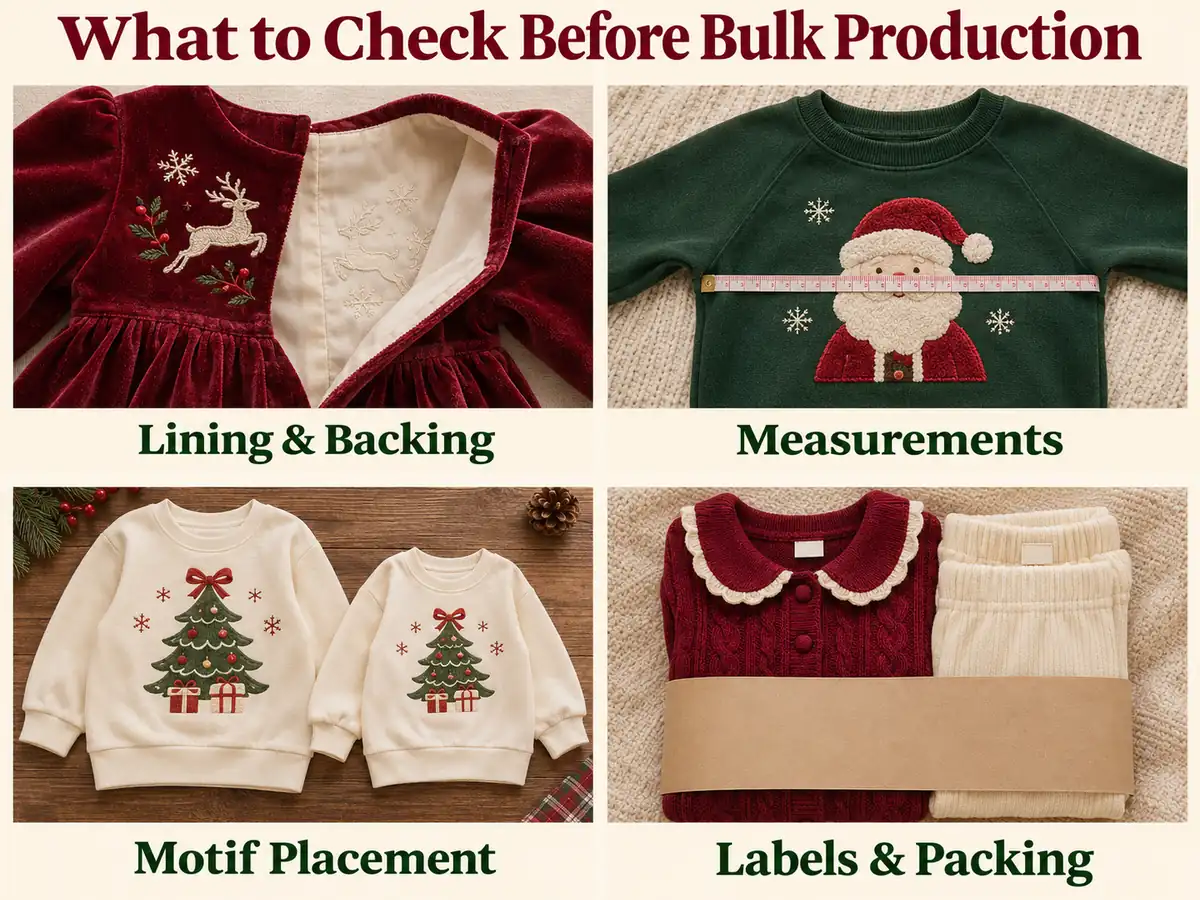
Review the following on the production sample:
- Fit and movement: Check garment measurements and how children move, sit, and put on or remove the clothing.
- Inside finish: Check seam allowances, lining, embroidery backing, and any material that may rub the skin.
- Trim attachment: Evaluate buttons, bows, beads, sequins, snaps, and other details for the intended ages.
- Wash and color behavior: Review changes to measurements, surface appearance, decoration, and coordinated colors after appropriate care checks.
- Size consistency: Confirm that prints and knitted motifs remain balanced on the smallest and largest planned sizes.
- Packing and pairing: Check matching set components, labels, size identification, and gift packaging against the approved brief.
For children’s sleepwear sold in the United States, the Consumer Product Safety Commission identifies flammability requirements under 16 CFR Part 1615 (sizes 0–6X) and 16 CFR Part 1616 (sizes 7–14). Certain infant garments and qualifying tight-fitting sleepwear follow different provisions. The proper product classification, fabric, sizing, labeling, and testing requirements should be considered before the pajama design is approved. See the CPSC children’s sleepwear guidance.
A sample approved in one fabric is not automatic approval for a different production fabric. If the material, print, trims, or construction changes, review the difference against the approved design before the bulk order proceeds.
What to Send a Christmas Clothing Manufacturer
A clear inquiry helps a supplier assess the project without guessing about the style, quantities, or timing. The first brief should include:
- Products: Holiday dresses, pajamas, sweatshirts, knitwear, or matching sets, with reference images or sketches.
- Sizes: Intended age group and size chart, plus adult sizes if family outfits are required.
- Quantities: Planned units by style, color, design, and size—not only the overall order total.
- Materials and decoration: Fabric or yarn preferences, festive color references, artwork, embroidery, sequins, or jacquard motifs.
- Brand details: Woven labels, care labels, hangtags, packaging, and gift boxes if needed.
- Market and timing: Destination country, warehouse arrival date, retail launch target, and relevant testing requirements.
- Development stage: Whether the supplier is receiving a completed tech pack, an approved sample, or an initial concept.
For brands considering custom festive dresses or pajamas, HAPA’s private-label manufacturing service provides a route to discuss development, samples, labels, and bulk production. The supplier should be given enough detail to quote the actual proposed collection.
Conclusion
The right kids’ Christmas clothing manufacturer depends on what the brand wants to sell. HAPA and SIUKID offer broader custom kidswear development, Babeeni specializes in smocked and embroidered boutique styles, Billoomi focuses on made-to-order pajamas, Nuohua offers a stock-versus-custom sweatshirt route, and Lin Sweater Factory and Mr Balaclava focus on festive knitwear.
Use the published MOQs and product strengths to create a shortlist, then compare samples and quotations against the same brief. Because Christmas clothing has a narrow sales window, the most useful production partner is one whose products, order model, and warehouse arrival schedule fit the brand’s plan.
Source Notes
Supplier product categories, order information, and sourcing routes were checked against the company websites on November 11, 2026. The supplier domains are listed here as plain text for reference: hapagarments.com, siukid.com, babeeni.com, billoomifashion.com, nuohuagarment.com, en.linsweater.com, and mrbalaclava.com. Children’s sleepwear requirements are sourced from cpsc.gov.
Frequently Asked Questions
What Is the MOQ for Custom Kids’ Christmas Clothing?
It depends on the product and supplier. HAPA’s standard MOQ is 150 pieces; Billoomi publishes 100 pieces per style for printed or embroidered pajamas; Lin Sweater Factory lists 300 pieces per Christmas sweater style and color combination; and Mr Balaclava lists 50 pieces per design for its children’s sweater. Check the exact size and color rules for the proposed order.
Can I Buy Wholesale Christmas Kidswear Without Developing a New Design?
Yes. Some suppliers offer existing collections or advertised stock, while others focus on made-to-order production. Nuohua publishes a ready-stock route for its Christmas sweatshirt, and Babeeni offers a seasonal wholesale collection. Confirm the actual available styles and sizes before planning a retail launch.
When Should I Start Developing a Custom Christmas Clothing Collection?
For a Northern Hemisphere autumn launch, it is sensible to begin concept work and supplier discussions in spring, followed by sampling and bulk planning in summer. The exact start date depends on decoration complexity, material sourcing, factory capacity, and the destination market. Work backward from the required warehouse arrival date.
Can One Manufacturer Make Matching Christmas Outfits for Children and Adults?
Some can. Lin Sweater Factory and Mr Balaclava advertise family-matching knitwear. Confirm separate children’s and adult patterns, size charts, minimums, and sample approvals. Do not assume an adult garment can simply be scaled down for a child.
Can I Use My Own Christmas Prints, Characters, and Brand Labels?
Manufacturers commonly accept original artwork and private-label details, but the brand should provide files it owns or is licensed to use. Confirm print size, motif placement, woven labels, care labels, and artwork approval before production. Copyrighted characters require appropriate permissions.
Do Christmas Pajamas Need Special Safety Testing?
Depending on their intended use and sales market, yes. Children’s sleepwear sold in the US may be subject to specific flammability, sizing, labeling, and testing requirements. Agree on the intended product category and age range early, and obtain the appropriate documentation for the finished garment.
Can I Reorder a Christmas Style During the Selling Season?
A reorder may be possible when materials or finished stock are available and the remaining delivery window is long enough. Keep the approved sample, patterns, color references, artwork, and trim details so a new batch can be compared with the original. Confirm the new warehouse arrival date before committing to extra stock.