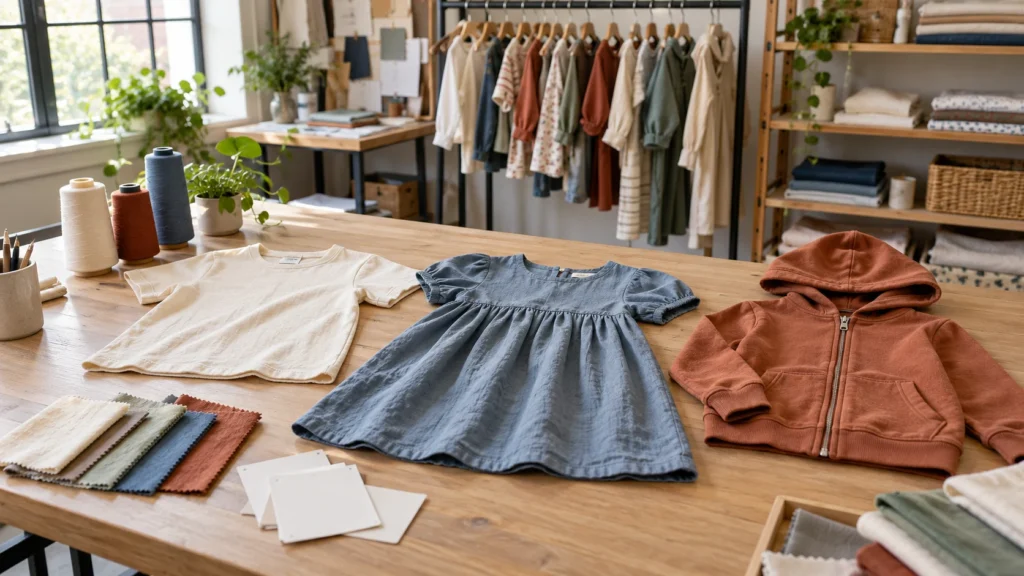
Different styles call for different sample and approval decisions.
There is no dependable universal number of children’s clothing samples for a new collection. Order enough physical garments to answer the decisions that could change your product or stop your launch, and no more than those decisions justify. For most brands, that means a starting sample for each genuinely different style, selected sizes that test the fit range, extra versions for material or construction risks, and a final production reference. It does not mean automatically ordering every style in every size and color before you know whether the base design works.
The useful question is not “Is five samples enough?” but “What must each sample prove?” A first sewn piece can reveal a wrong neckline or pocket position. It cannot approve an entire graded size range, all color processes, final labels and the actual materials intended for bulk. Conversely, two colors of the same stable body may not need two complete early fit samples if a physical color approval will resolve the only difference.
I would make a plan for children’s clothing samples before requesting a quote. Give each proposed piece a style, size, color or material, revision stage, reviewer, and decision. If you cannot name what a sample will help you decide, ask whether it is needed yet. If one garment is expected to answer several questions, check that those questions can genuinely be evaluated on that same version.
What are you counting when you order children’s clothing samples?
People use “sample” to mean a garment, a round of development, a fabric swatch, or a box of showroom pieces. Those are different purchasing units. A factory may quote one development round for a style while delivering several physical garments; another may include only one base-size piece and price every added size separately. Define the unit before comparing offers.
A physical garment is one sewn item that can be measured, fitted, washed, photographed or retained. A sample round is a submission for review: it may contain one or several garments. A style is a product design with a distinct pattern and construction. A variant changes its size, color, fabric, print or other specification. Your first bulk quantity is a commercial production decision, not a sample count.
When asking HAPA or another supplier for product sample development, request a list of actual children’s clothing samples by style and stage, the work included in each price, and the cost of an additional revision or size. A one-line “sample fee” conceals whether you are buying pattern work, materials, sewing, grading, decoration or shipping.
Begin with a question, not a fixed multiple
A simple jersey T-shirt and a lined occasion dress do not need identical verification. The dress may have several layers, a closure and decorative details whose position changes across sizes. The T-shirt might share a proven fabric and body block with an earlier approved product. Both still need an adequate review, but their unresolved questions differ.
Write one sentence for each requested piece: “This sample will confirm the base fit,” or “This garment will confirm that the printed motif remains clear in the smallest size.” That purpose lets you stage spending. You can approve the basic silhouette before paying to make a full range of sizes, and you can reject an unsuitable style before commissioning photography garments.
Keep sample uses separate
The same garment can sometimes be examined for fit, workmanship and visual presentation. It may not be available afterward if you send it for destructive testing or cut it apart to inspect construction. A washed sample is useful for observing change after care, but it is no longer an untouched color or finishing reference. A sales sample that travels between showrooms may not be the controlled reference the factory needs beside a production line.
Decide which pieces may be reused and which must be additional physical units. Write that distinction on the sample request, especially if your team, laboratory, photographer and factory are in different places.
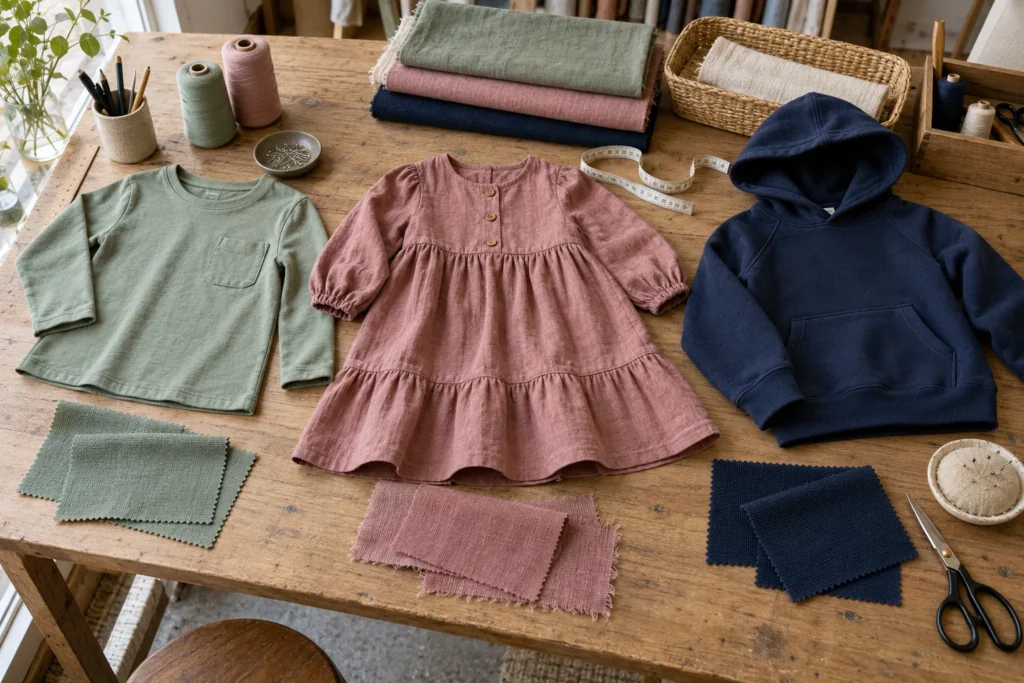
Count the construction questions for each style before expanding the size and color range.
Build the count by style before multiplying by size or color
List every proposed style and group only designs that genuinely share a pattern and production method. A T-shirt with a different screen print can often begin from the same fit body; a T-shirt with a new neckline, different knit structure or changed sleeve is not necessarily the same technical problem. A two-piece set also contains two garments whose fit and construction may need separate review, even though the customer buys them as one SKU.
Start your children’s clothing samples with one base-size development garment for each distinct construction route. That is a planning starting point, not an approval rule. If your range has three independent styles, three starting garments may reveal whether those designs are ready for further work. If the first version fails, you will need a revised physical sample for the affected style. Do not buy an entire size set from an unapproved base pattern merely because all sizes appear on the future product page.
For a supplier that supports children’s clothing OEM development, ask whether it is adapting an existing block or making a new pattern, what the base size represents, and which measurements will be updated after fitting. An existing block can save development effort, but it is not evidence that the new fabric, wearer or silhouette fits your customer.
Treat each independent construction as its own risk
Review how a garment is put on, adjusted and worn. A pull-on knit top, zip hoodie, woven dress and padded coat can expose different problems even when they carry the same label size. Pockets, fasteners, linings, prints and embellishments can also create their own approval questions. Grouping samples by merchandising name alone can hide those differences.
If your collection contains five graphic variations on one approved T-shirt body, you may need one body fit path and separate artwork approvals, rather than five duplicate first-fit garments. If those graphics use different application methods, fabrics or placements, ask what extra sewn proof is needed. The decision follows the physical product, not a shortcut based on how the catalog is arranged.
Stage the work so a failed sample does not multiply
Give the supplier a provisional plan, with release points. For example, request the base fit samples first. Once the fit, construction and material direction are acceptable, release selected graded sizes and the most consequential appearance variants. Authorize the final pre-production samples only when the necessary choices are stable.
This is also a fairer way to quote the work. Ask for the price of the initial pieces and an itemized schedule of possible additions. You cannot know in advance exactly how many revisions a novel style will need, but you can budget a contingency and agree what triggers a new charge. Keep design changes separate from corrections to an agreed specification.
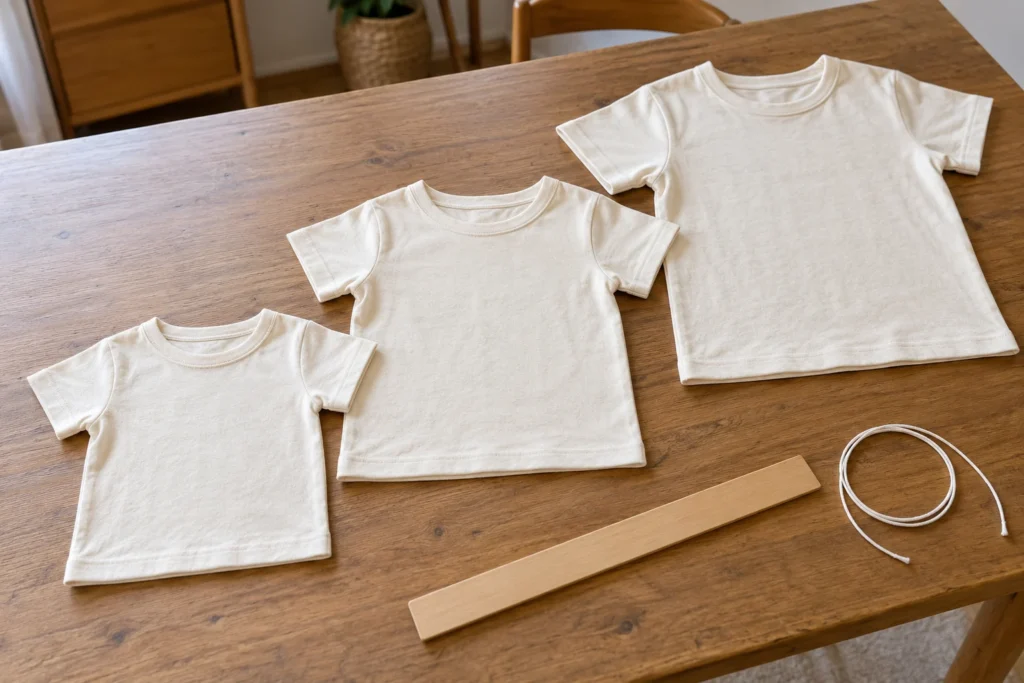
Selected physical sizes can reveal fit and grading differences across the range.
Which sizes need physical samples before a children’s clothing launch?
One middle size is rarely enough evidence for a wide children’s range. Proportions, opening sizes, movement and decoration placement may change in ways a measurement chart alone does not reveal. Yet ordering every size in every color at the first round can waste money while the base fit is still moving.
Choose children’s clothing samples for the size range around fit risk. Begin with a base size that represents the intended wearer and fit concept. After the base is stable, consider the smallest and largest planned sizes, and any size where the body block or age group changes. A range spanning infants, toddlers and older children may need more than one fit block; do not assume one proportional grade can handle all of them.
If you sell only a narrow range, the relevant edge sizes may be close to the base. If you sell a very broad range, more physical fit evidence may be necessary. Agree with the patternmaker how to inspect the complete measurement specification and which sizes merit sewn garments. A size set is a selected group of physical sizes for review, not automatically a garment in every size or a guarantee that the grading is right.
Inspect the garment in the intended use
Measure each selected size against agreed points of measure, but also assess dressing, movement and comfort in the intended context. For a toddler top, an attractive flat photograph does not show whether the head opening works. For a coat, the relevant question includes room over the intended layers. For a dress, consider sitting and movement as well as the standing silhouette.
Use an appropriate fit reference and document how the review was performed. Body measurements, finished-garment measurements and a label such as “4 years” are not interchangeable. Record size, wearer or form reference, fabric, sample version, measurements, photographs and comments together. A fit note without a version can be applied to the wrong piece.
The kids clothing manufacturing process explains where pattern making, grading and fit approval sit in the wider production route. This article’s narrower task is to choose the physical evidence your particular range needs before that route moves forward.
Use size extremes deliberately
Small and large sizes are often useful because they reveal whether openings, trim proportions and artwork placement continue to work. But “always sample the smallest and largest” is not a substitute for judgment. A mid-range size might be the critical transition if a separate block begins there. A new size added after fitting may deserve review even if it is not an extreme.
Ask the supplier to show the grade rules and finished measurements for every offered size, including sizes you do not sew in the sample set. A physical sample checks a selected point; a controlled size specification guards the spaces between those points. If a sampled edge size fails, correct and recheck the affected range before approving the whole grade.
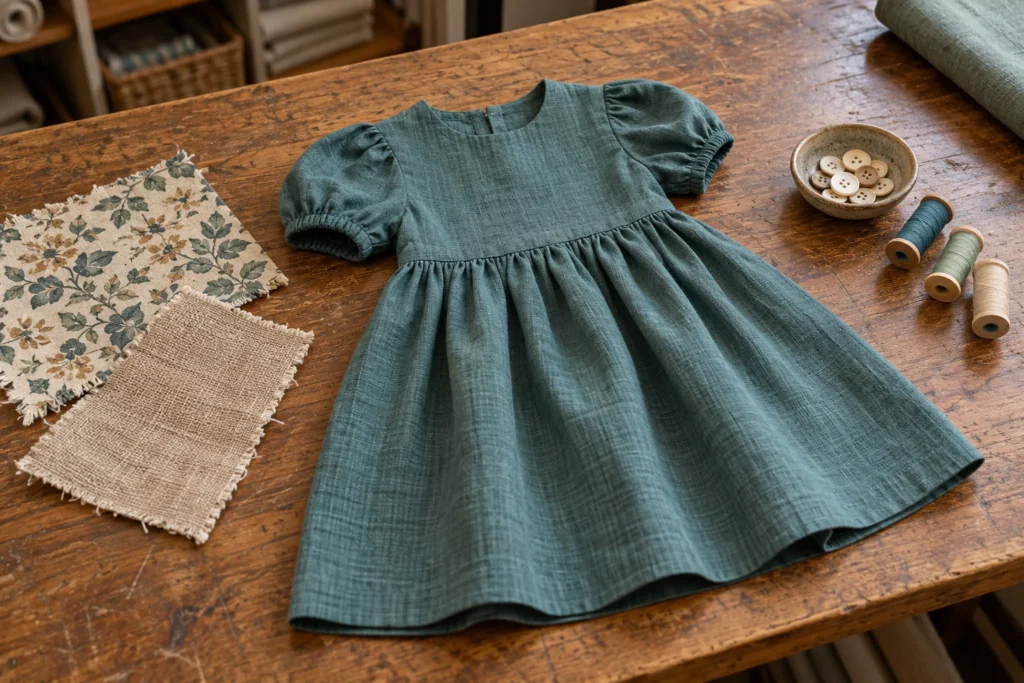
A material change may need a sewn garment review when it affects drape or construction.
When do color, fabric and trim changes require another garment?
A separate color is not always a separate fit problem. A small fabric swatch, lab dip or print strike-off may answer a color question more efficiently than a full garment. However, a changed material can affect drape, stretch, shrinkage, sewing behavior or feel against the skin. A changed print placement can look acceptable on a large size and crowd a seam on a small one.
Before ordering more children’s clothing samples, make a variant list and state what changes: only dye color, fabric composition or structure, weight, decoration, lining, fastener, label, or packaging. Then identify the approval object. You may request a swatch for a shade, a printed panel for scale, a trim sample for feel, and a sewn garment where the combined construction or fit must be seen. Do not turn a color approval into an implied approval of a different fabric.
If you need children’s clothing samples in more than one material, start with the variant most likely to challenge the pattern or production method. Confirm with the supplier whether other variants are sufficiently represented or need their own sewn piece. Put every approved material and color reference in the specification so a single photographed garment does not silently stand for several different products.
Decoration and closures can change the count
An embroidery design may add stiffness and a backing against the skin. A large print can change hand feel or crack when stretched. A zipper may affect the front balance and opening. A decorative trim can alter wash behavior or create a product-specific safety question. These are reasons to inspect an actual combination when a loose trim or flat artwork cannot show its behavior on the garment.
Place the proof on the size where the issue is most likely to appear. For example, the smallest planned chest width may be more informative for a large graphic than another middle-size print. If the same decoration will be resized across the range, specify which scale belongs to each size group and what the additional approval pieces must demonstrate.
Do not mistake a swatch for a finished-product test
A material certificate or component test can be useful evidence, but its meaning depends on the applicable rule. The CPSC’s component-part testing guidance explains that some requirements can be supported by component testing while functional or mechanical requirements may need the finished product. A change in a component can also affect what must be retested. For a U.S. launch, ask the responsible importer and qualified laboratory to determine applicable test scope and sample quantity; a brand’s visual fit sample plan is not a substitute.
This matters when buying sample pieces. Laboratory work may consume or alter a garment, and the lab may need a specified construction, age range or variant. Obtain the test plan before reserving your final approval piece for a different use. For other destination markets, confirm the relevant rules and responsible party there rather than copying a U.S. checklist.
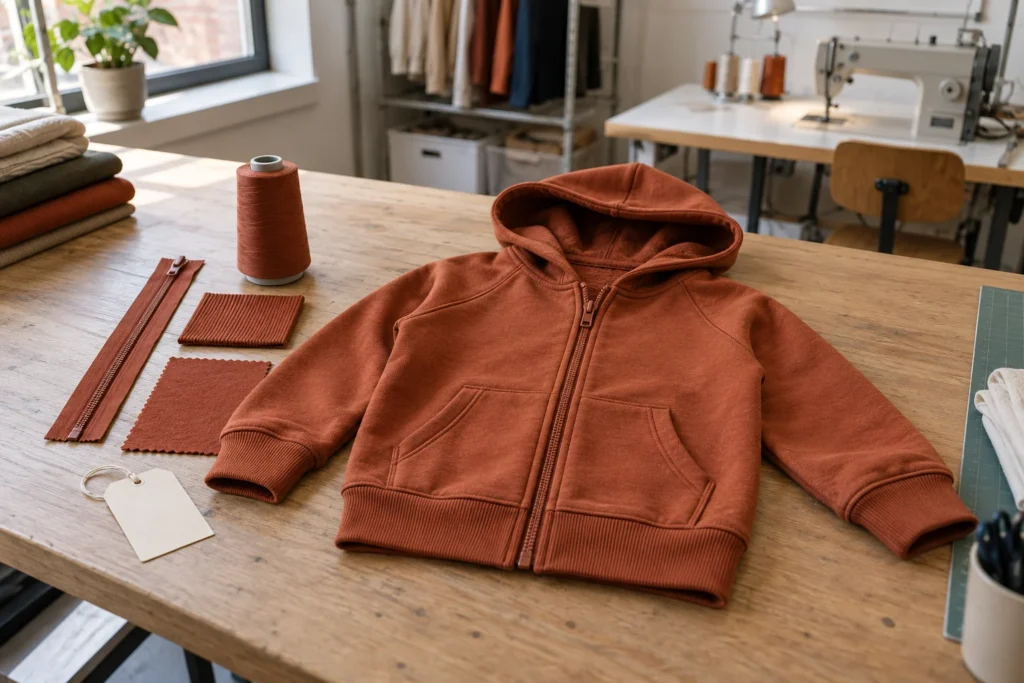
The final garment reference should match the materials and details approved for production.
Budget revisions and final pre-production samples separately
The first sewn version is often a learning tool. A revision is not a failure of the project; it is a controlled answer to an identified problem. What matters is whether each round closes decisions and updates the same current specification. An open-ended stream of “slightly better” samples consumes calendar and money without creating an approvable product.
For every style, keep a dated record of children’s clothing samples with the sample ID, size, materials actually used, observations, measurements, requested corrections and the person who approves them. Send one consolidated decision to the supplier. If a neckline changes, ask whether that affects the graded pattern, binding, artwork position or any other detail. The next sample should show the implemented change, not merely arrive with a new version number.
Agree the commercial terms before work starts: what counts as a correction within the quoted scope, what counts as a new design, how many submitted pieces are included, who pays for courier shipments, and whether materials or special techniques are billed separately. Do not assume a sample fee is refundable or that a quoted week includes every review cycle; request current terms in writing for your project.
A final PP sample answers a different question
A fit sample may use substitute material or temporary trims. A pre-production or PP sample should represent the approved production combination closely enough to be a meaningful reference for the agreed product. Check its fabric, color, construction, size specification, artwork, labels and packing against the latest file. List any approved exceptions rather than calling a visibly different piece “final.”
One PP sample per style may be a sensible starting line for a stable, single-material construction. Multiple critical variants may need separate production references. Ask which physical sample the factory will retain and which you will hold. If the only approved item leaves for photography or testing, the production team may lack the same reference that you signed off.
The U.S. CPSC’s Children’s Product Certificate guidance places certification duties on the responsible domestic manufacturer or importer for covered children’s products, using applicable third-party test results. An approved PP garment helps control manufacture, but it is not itself a certificate. Resolve the product-specific test plan, documentation and responsible party before the bulk commitment.
Treat labels and packing as product decisions
Inspect placement, content, attachment and readability of the labels that will be used on the final garment. For U.S. sales, the FTC’s apparel-labeling overview describes fiber, origin, responsible-business and care-information requirements that can apply to the product. Other markets may differ. A blank sample label is not proof that the final artwork has been reviewed.
If your launch requires retail folds, individual bags, barcodes or display packaging, obtain an appropriate packed reference as well. It might use an existing approved garment if that piece can still serve the production team; otherwise budget a separate unit. The goal is to know what your warehouse or retail partner will receive, not to accumulate attractive presentation samples with no approval record.
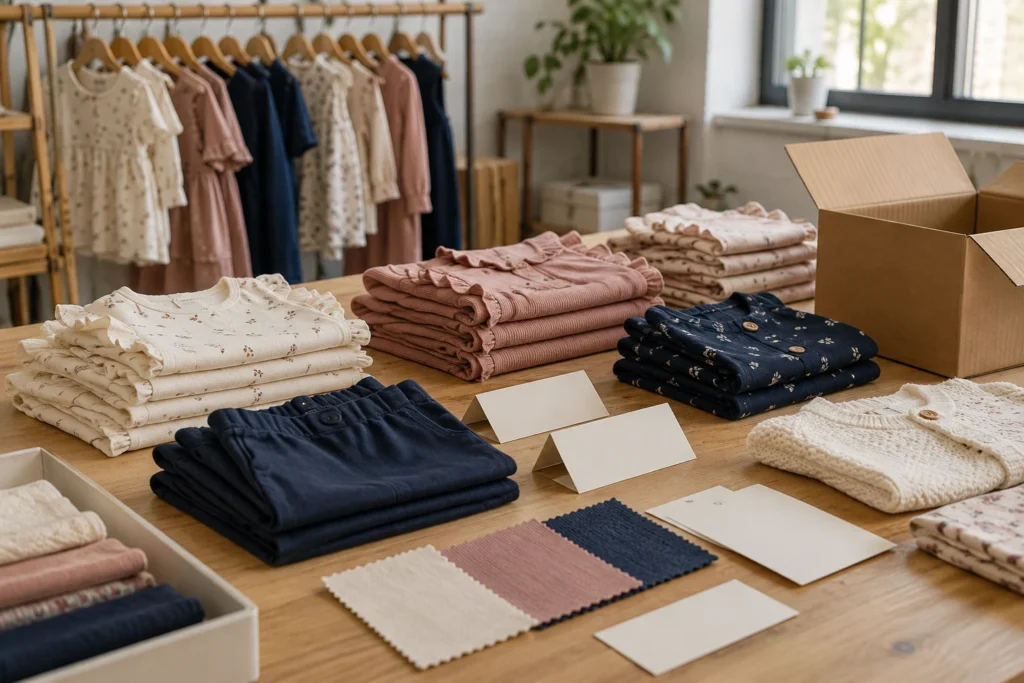
An itemized sample plan makes each physical piece and its purpose visible.
A worked example: sixteen physical garments for one hypothetical collection
Consider a brand planning three independent styles: a jersey T-shirt, a woven dress and a zip hoodie. Each will eventually sell in five sizes and two colors. That is thirty style-color-size selling combinations, but thirty is not the automatic sample order. The following plan is illustrative arithmetic, not a recommended HAPA quantity, quotation or compliance sample size.
First, request one base-size development garment for each style: three pieces. Suppose the T-shirt fits well while the dress and hoodie require one corrected fit submission each: two more pieces. Once the base patterns are acceptable, request a small and a large size for each style to check grading alongside the already reviewed base size: six pieces. Assume the dress’s second color also uses a materially different fabric, and the hoodie’s second color changes a prominent trim combination; approve one sewn variant of each: two pieces. Finally, request one current production-reference sample for each style after specifications and materials are agreed: three pieces.
The development order in this example is 3 + 2 + 6 + 2 + 3 = 16 physical garments across several stages. This illustrates how children’s clothing samples can be counted without multiplying every retail variant. It is not sixteen garments in one parcel, and it is not sixteen pieces for every collection. If the dress’s fabric change affects the small size, a further garment could be justified. If a graded piece is also the fully representative final PP sample and both parties can retain equivalent references, some work may be combined by agreement. If a lab requires separate specimens, those pieces add to the plan.
Notice what the example deliberately does not do. It does not sample all thirty retail combinations, assume two revisions for every style, or claim that a pair of edge sizes validates all children’s grading. It makes each addition explainable. Replace the hypothetical assumptions with your own style list, materials, age range, schedule and risk review.
Make the arithmetic editable
Use one row per proposed physical piece, with columns for style, purpose, stage, size, color/material, reference number, due date, cost, recipient and approval decision. Then total the rows by stage and by recipient. A garment sent to a laboratory and another kept at the factory are two units even if they have the same specification.
Set a provisional allowance for revisions and mark it “contingency,” not an already ordered sample. If a style passes its first fit check, do not spend that allowance merely because it was budgeted. If an unresolved safety or functional issue appears, increase the evidence plan rather than protecting an arbitrary target count.
What should you send the manufacturer when asking for a sample quote?
Send the style list, sketches or current tech packs, target wearer and market, size range, intended materials, colorways, decorations, branding, expected bulk quantity range and desired launch date. Separate what is confirmed from what needs development. A quote based on one plain color cannot be compared fairly with a proposal that includes complex printing, several materials and packed retail samples.
Ask the supplier to reply with a stage-by-stage schedule for the children’s clothing samples. For each stage, require the number of physical pieces, sizes and variants, materials used, what is provisional, included review and revision work, decision deadline, and cost of additions. Ask who will keep the approved reference and what happens to earlier versions. This turns a vague “sample package” into a plan you can approve or revise.
If you are still comparing factories, the guide to finding a kids clothing manufacturer can help you frame the supplier decision. Send comparable briefs, but judge the sample response by clarity as well as price. A careful supplier should be able to explain why a certain piece is useful and where a swatch or file approval can avoid unnecessary sewing.
Set approval gates before the parcel arrives
Define what the base sample must pass before size grading begins. Define what the graded samples must show before a PP sample is made. Confirm who has authority to approve fit, material, color, artwork, labels and packing. A photograph, chat emoji or invoice payment is a poor substitute for an identified approved version and written exceptions.
Review each arrival against the current brief. Note what changed, what did not, and whether the sample answers its assigned question. If a supplier substitutes fabric for speed, record that fact on the sample and limit your approval to what the substitute can demonstrate. Approving shape in substitute fabric is not automatically approving fit, color or hand feel in the proposed bulk material.
When all relevant product decisions are closed, freeze the approved specification, material references, grading, artwork and sample identifiers. The bulk purchase order should point to that controlled package. Keep the sample plan and actual outcomes; they will help you plan revisions or reorders without replaying the first launch from memory.
Frequently asked questions
Is one sample per style enough?
It may be enough to begin evaluating a distinct style. It is rarely enough to approve a multi-size, multi-material collection for production on its own. After the first review, decide which fit sizes, material variants and final reference pieces are needed to close the remaining questions. Do not order later pieces before the base direction is sound.
Should I order every size and color?
Not by default. Use physical sizes where fit or grade risk needs inspection, and separate colors or materials where a swatch, print proof or existing garment cannot demonstrate the result. A broad age span, new block, difficult decoration or changed fabric may justify more sewn evidence. Record why each variant is or is not represented.
Can a washed or photographed sample become the factory reference?
Sometimes, but only if its condition and location still support the intended approval. A washed garment may not represent the original surface or dimensions; a traveling sales sample may not be available to the production team. Decide in advance which piece is retained by whom and whether another identical reference is needed.
How many rounds should I budget?
Budget time and money for correction, but do not treat a fixed number of rounds as a quality guarantee. The need depends on design readiness, material behavior, fit risk and the clarity of feedback. Ask the supplier what is included, document the decision at each round and stop when agreed criteria are met. A new design request should be quoted separately from correction of the agreed design.
Are samples for compliance testing included in the development count?
Count them as physical units if they must be supplied separately, but let the responsible party and qualified laboratory set the type and quantity for the applicable rules. A visual sample count, an approved PP reference and a regulatory test plan serve different purposes. Never infer a testing exemption or certificate from an attractive sample.
Decide the count from the questions still open
The right number of children’s clothing samples is the number that gives you trustworthy evidence for the styles you intend to sell, the sizes and materials that could behave differently, and the final product you will ask the factory to reproduce. Begin narrowly, release later pieces at clear gates, and keep a written reason for every addition.
That approach gives you a practical buying conversation. Instead of asking a factory for “some samples,” send an itemized plan and ask it to challenge your assumptions. If the supplier can show where a single piece answers several questions, where another piece is essential, and how the approved version will reach bulk production, you can spend your sampling budget on decisions that protect the collection.